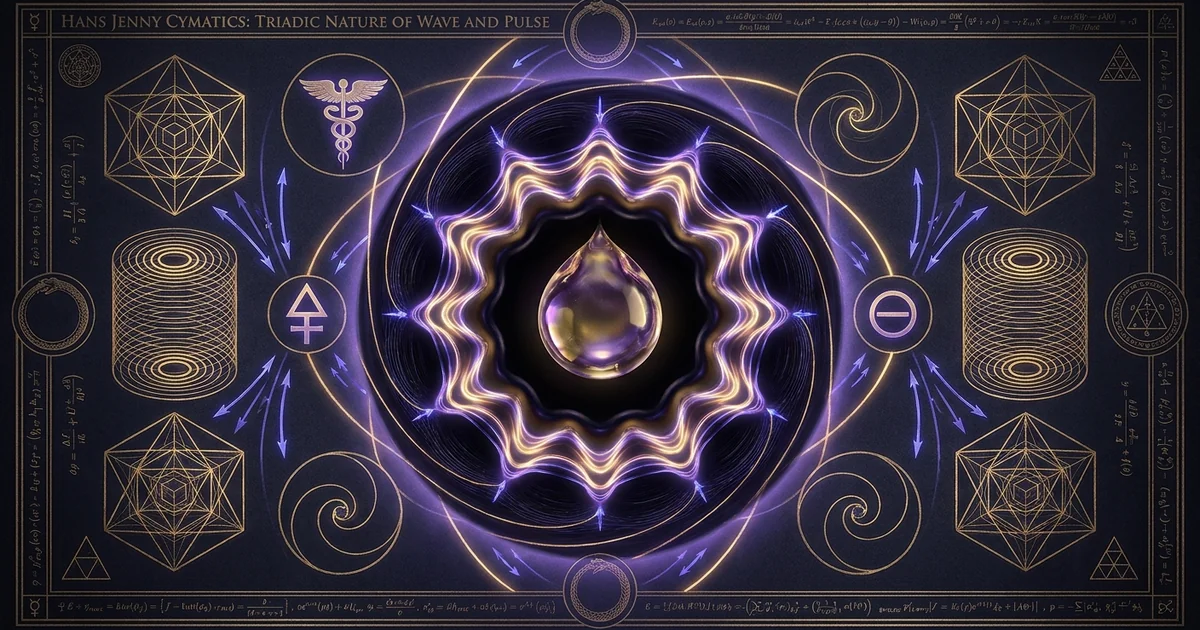
Hans Jenny Cymatics: Triadic Nature of Wave and Pulse
Executive Summary & Theoretical Thesis: The Triadic Phenomenon of Acoustic Morphogenesis
The Triadic Invariance: Form, Movement, and Energy Vector
The fundamental operational premise of cymatics, established empirically by the Swiss physician and natural scientist Hans Jenny (1904–1972), posits that acoustic morphogenesis is governed by an indivisible triadic unity. In his foundational monographs Kymatik: Wellen und Schwingungen mit ihrer Struktur und Dynamik (Jenny, 1967; 1974), Jenny demonstrated that morphological manifestations in physical media cannot be comprehended through isolated structural analysis. Instead, physical patterns are manifestations of a continuous, non-linear triad: generative pulse or energy (Puls / Kraft), wave propagation or periodic movement (Welle / Bewegung), and emergent spatial pattern or form (Figura / Gestalt). This conceptual architecture reveals that matter does not possess an autonomous, static form onto which kinetic energy is subsequently applied; rather, physical morphology is sustained standing-wave order maintained by continuous energy translation.
[ Puls / Kraft ]
                   (Energy Vector)
                         / \
                        /   \
                       /     \
                      /   ⚡   \
                     /         \
   [ Welle / Bewegung ] <-------> [ Figura / Gestalt ]
  (Kinetic Propagation)           (Emergent Topology)
In Jenny’s experimental framework, these three aspects are neither temporally sequential nor causally separable; they represent three perceptual and operational vantage points of a single, systemic physical phenomenon. The generative pulse introduces dynamic periodic phenomena into an elastic or fluid substrate; this kinetic injection instantly transforms into propagating longitudinal waves, transverse surface waves, and hydrodynamic shear currents.
The interference of these vectors gives rise to complex eigenmode-topology and defined cymatic-modal-nodes. The observed “form” is merely the visible envelope of continuous underlying kinetic turnover. To examine form without its intrinsic movement, or movement detached from its generative impulse, is a reductionist error that fails to capture non-linear acoustic-matter coupling.
Jenny's Triadic Morphogenetic Continuum
- Ontological Unit: The inseparable triad of Energy-Movement-Form (Puls-Welle-Figura).
- Material Characterization: Matter is fundamentally processual; structures are sustained standing-wave invariants occurring within continuous hydrodynamic and vibrational flux.
- Causality: Non-linear, reciprocal field-matter feedback. The boundary geometry and vibrational spectrum mutually co-determine the resulting spatial manifestation.
- Equilibrium: Non-equilibrium steady-state (NESS). Halting the driving pulse immediately dissolves the morphology; stability demands persistent kinetic throughput.
Classical Reductionist Kinematics
- Ontological Unit: Discrete corpuscular masses possessing autonomous spatial dimensions, acted upon by external force vectors ($\mathbf{F} = m\mathbf{a}$).
- Material Characterization: Matter is fundamentally inert and static; form is an intrinsic geometric property of an isolated solid body.
- Causality: Linear, unidirectional chain of mechanical causation. External driving forces act upon passive boundary substrates without retrocausal geometric coupling.
- Equilibrium: Classical thermodynamic equilibrium. Form persists independently of continuous kinetic inputs (e.g., rigid-body architecture).
Beyond Classical Boundary Values: The Continuous Genesis Model
Classical mechanics historically relegated nodal patterns to static solutions of linear partial differential equations. In such models, boundary values mathematically constrain the system to discrete harmonic standing waves, treating the substrate as a passive canvas. Jenny’s laboratory experiments transcended this limitation by proving that when vibrational amplitude and frequency sweep beyond linear thresholds, the media exhibit active morphological transformations. Phase changes, dynamic circulation loops, and self-organizing particulate streams emerge that cannot be accounted for by classical linear plate equations alone. Acoustic nodal morphology operates as a direct sensory proxy for non-linear energy dissipation and field-matter phase-locking across continuous media, establishing an empirical bridge to modern non-equilibrium thermodynamics.
This continuous genesis model invalidates the assumption that material form is a permanent property of dense matter. By investigating high-viscosity pastes, zinc plates, ferrofluids, and colloidal suspensions driven by continuous harmonic audio frequencies, Jenny proved that spatial stability is an operational illusion produced by high-frequency cyclic repetition. The morphology exists only as long as the standing-wave-ratio remains elevated above ambient dissipative losses. Ceasing the periodic driver causes instant degradation of the structural pattern into amorphous, entropic rest states. Jenny demonstrated that physical architecture is an open, dissipative structure whose coherence depends entirely on the steady throughput of directed acoustic-radiation-pressure.
These dynamics align with field-theoretic frameworks explored in /physics-electromagnetism/standing-waves-scalar-potentials. There, localized mass-energy concentrations are treated as spatial interference nodes of continuous underlying fields. Jenny recognized this macro-acoustic parallel early: acoustic morphogenesis is an empirical, macroscopic scale model of fundamental matter generation. The triadic nature of wave and pulse shows that the apparent permanence of solids is a persistent dynamic phenomenon—a stabilized standing wave maintained by underlying field dynamics.
Historical Lineage & Experimental Precedents: From Chladni and Faraday to Jenny’s Kymatik
Chladni Plates: Mechanical Nodal Lines and Particulate Inertia
The experimental genealogy of acoustic visualization began systematically with Ernst Florens Friedrich Chladni. In his 1787 treatise Entdeckungen über die Theorie des Klanges, Chladni laid the empirical foundation of acoustic phenomenology by scattering dry quartz sand across circular and rectangular brass plates, exciting their edges with a violin bow. The resulting sand distributions—Chladni figures—delineated the nodal lines of the vibrating mechanical structures. At these lines, local vertical displacement equaled zero ($w(x,y) = 0$), allowing particulate matter to settle via gravitational and inertial drift away from active antinodal domains.
Chladni’s methodology, while revolutionary, remained mechanically uncalibrated. Excitation via an organic horsehair bow introduced irregular manual shear stresses, uncontrolled harmonic overtones, and inconsistent energy input. The media observed were strictly dry, discrete, non-cohesive particulates (sand, quartz grains) interacting mechanically with the plate surface. Consequently, early acoustics interpreted these figures strictly as mechanical nodal trajectories, ignoring secondary aerodynamic effects, fluid-phase dynamics, or continuous energetic circulation loops.
The historical trajectory of this nodal geometry is systematically documented in /sound-cymatics/chladni-resonance-nodal-geometry, tracing the evolution from manual acoustic excitation to modern piezoelectric interferometry.
       [ Chladni (1787) ]             -> Friction Bowing / Dry Particulates
               |                         (Mechanical nodal lines only)
               v
       [ Faraday (1831) ]             -> Hydrodynamic Instabilities / Lycopodium
               |                         (Acoustic streaming & boundary drag)
               v
       [ Jenny (1967, 1974) ]         -> Piezoelectric Transducers / Tonoscope
                                         (Non-linear triadic field invariants)
Faraday’s Hydrodynamic Anomalies and Acoustic Streaming
The first fundamental crack in the purely mechanical, inertia-driven model was identified by Michael Faraday in his 1831 Bakerian Lecture before the Royal Society of London. Investigating anomalous particulate behavior on vibrating plates, Faraday noted that when using extremely light powders—most notably the microscopic spores of Lycopodium clavatum—the particles did not migrate toward the zero-displacement nodal lines as classical mechanics predicted. Instead, they collected at points of maximum vertical displacement: the antinodes.
Faraday recognized that this inversion pointed to an unseen fluid medium operating directly above the vibrating boundary: the surrounding air. The acoustic motion of the plate induced localized, non-linear vortices in the contiguous air layer—a phenomenon now formalized as inner boundary layer Schlichting streaming and outer bulk Rayleigh streaming. The drag force exerted by these micro-vortices exceeded the inertial forces acting upon the low-density spores, sweeping them into the centers of antinodal kinetic activity. Faraday’s experimental discovery of these hydrodynamic anomalies broke with the static paradigm, showing that acoustic boundary excitation produces continuous, circulatory fluid fields that actively construct particulate patterns.
“The light powder, on the contrary, collects at the most agitated parts… It was soon found that the currents of air were the cause of this peculiar disposition of the powder… so that all light powders resting on the plate were gathered up towards these centers of agitation.” — Michael Faraday, Philosophical Transactions of the Royal Society of London, 1831.
“It is not a case of static stability, but of stationary processes. The forms are maintained only by constant circulation. We are observing dynamic periodic phenomena whose stability depends entirely on continuous kinetic throughput.” — Hans Jenny, Kymatik: Vol. 1, 1967, p. 38.
Faraday’s documentation of parametric surface waves—now known in non-linear hydrodynamics as the faraday-instability—further proved that vibrating liquid surfaces generate subharmonic standing-wave patterns at half the driving frequency ($f/2$). This established the initial fluid mechanics baseline that Jenny would synthesize more than a century later.
The Piezoelectric Shift: Jenny’s Tonoscope and Controlled Frequency Spectra
Hans Jenny upgraded acoustic morphology from qualitative demonstration to a laboratory science by modernizing its instrumentation. Drawing on his medical and anthroposophical background in Dornach, Switzerland, Jenny replaced Chladni’s erratic mechanical violin bow with high-precision crystal oscillators, frequency generators, and specialized piezoelectric transducers. This equipment allowed him to transmit pure, unvarying sinusoidal frequencies across an operational range spanning from sub-audible infrasound (sub-10 Hz) through the human audible spectrum up to ultrasonic regimes exceeding 30,000 Hz.
Central to Jenny’s technological innovation was the invention of the Tonoscope (Tonoskop). Designed to visualize human phonetics and vocal formants without intermediate electrical distortion, the apparatus routed the acoustic output of the vocal tract through a direct acoustic-mechanical coupling directly onto a sensitive, flexible membrane dusted with fine particulate matter. The details of this acoustic-mechanical transducer interface are examined in /sound-cymatics/tonoscope-mechanics-vocal-harmonics.
Using this calibrated, distortion-free system, Jenny systematically mapped the morphology of pure sinusoidal tones across varied substrates:
- Heavy metallic powders, quartz sand, and lycopodium spores
- Highly viscous fluids, industrial pastes, and non-Newtonian colloids
- Complex chemical emulsions, volatile hydrocarbons, and ferrofluids
Jenny confirmed that as vibrational parameters vary systematically in frequency and amplitude, the medium responds through continuous structural metamorphosis rather than discontinuous jumps between rigid states. His photographic and cinematographic records captured the gestalt of vibration, proving that pure frequency maps predictably to geometric topology.
Mathematical Formalism & Physical Mechanics: Non-Linear Dynamics and Acoustic Dispersion
The Kirchhoff-Love Plate Equation and Eigenmode Resonances
The primary mechanical framework describing the transverse vibration of thin, isotropic elastic diaphragms used in cymatic experiments derives from the Kirchhoff-Love plate theory. In this formulation, the displacement field $w(x, y, t)$ normal to the midplane is governed by a fourth-order biharmonic partial differential equation:
$$D \nabla^4 w(x,y,t) + \rho h \frac{\partial^2 w(x,y,t)}{\partial t^2} = F_{ext}(x,y,t)$$
where $\nabla^4 = \nabla^2 \nabla^2$ is the biharmonic operator, $\rho$ represents the mass density of the plate material, $h$ denotes the plate thickness, and $F_{ext}$ represents the spatially distributed transverse driving force delivered by the central piezoelectric transducer. The variable $D$ represents the flexural rigidity of the plate, defined analytically as:
$$D = \frac{E h^3}{12(1 - \nu^2)}$$
where $E$ is Young’s modulus and $\nu$ is Poisson’s ratio. Under steady-state harmonic excitation driven at an angular frequency $\omega = 2\pi f$, we assume harmonic time dependence $w(x,y,t) = W(x,y)e^{i\omega t}$. For free vibrations ($F_{ext} = 0$), the equation simplifies to the spatial eigenvalue problem:
$$D \nabla^4 W(x,y) - \rho h \omega^2 W(x,y) = 0 \implies \left(\nabla^4 - k_b^4\right) W(x,y) = 0$$
where the flexural wave number $k_b$ is defined by:
$$k_b = \left(\frac{\rho h \omega^2}{D}\right)^{1/4}$$
This fourth-order operator can be factored into Helmholtz and modified Helmholtz operators:
$$(\nabla^2 + k_b^2)(\nabla^2 - k_b^2)W(x,y) = 0$$
The general analytical solution is constructed via linear combinations of ordinary and modified Bessel functions:
$$W(r, \theta) = \sum_{m=0}^\infty \left[ A_m J_m(k_b r) + B_m Y_m(k_b r) + C_m I_m(k_b r) + D_m K_m(k_b r) \right] \cos(m\theta + \phi_m)$$
The boundary conditions imposed upon the plate (clamped, simply supported, or completely free edges) generate an infinite, discrete set of eigenvalues $\omega_{mn}$. The zeroes of these eigenfunctions delineate the nodal lines:
$$W(r_0, \theta_0) = 0$$
These nodal coordinates correspond directly to the classical geometric lattices observed by Chladni and Jenny at low drive amplitudes, establishing the linear mechanical baseline of cymatic-modal-nodes.
The physical transport of suspended particles across a vibrating membrane is driven by the spatial gradient of the acoustic radiation potential, combined with the normal plate acceleration $\ddot{w} = -\omega^2 W$. The acoustic field generates a time-averaged radiation pressure that acts upon any immersed particulate or fluid element.
The time-averaged acoustic radiation force $\mathbf{F}_{rad}$ operating on a spherical particle of radius $r_p$ suspended within an acoustic velocity and pressure field is derived via the Gor’kov potential $U$:
$$\mathbf{F}_{rad} = -\nabla U$$
$$U = 2\pi r_p^3 \rho_0 \left[ \frac{\langle p_{in}^2 \rangle}{3 \rho_0^2 c_0^2} f_1 - \frac{\langle \mathbf{v}_{in}^2 \rangle}{2} f_2 \right]$$
where $\langle p_{in}^2 \rangle$ and $\langle \mathbf{v}_{in}^2 \rangle$ are the mean-square acoustic pressure and acoustic fluid velocity vectors at the particle’s spatial location, $\rho_0$ is the ambient fluid density, and $c_0$ is the acoustic phase velocity. The dimensionless monopole and dipole scattering factors are:
$$f_1 = 1 - \frac{\rho_0 c_0^2}{\rho_p c_p^2} \quad \text{and} \quad f_2 = \frac{2(\rho_p - \rho_0)}{2\rho_p + \rho_0}$$
This potential field shows that particulate migration is not purely an inertial mechanical slide. Instead, it is governed by electro-acoustic radiation forces that drive matter along radiation potential gradients $-\nabla U$, pushing it into either nodal or antinodal configurations based on particulate acoustic impedance relative to the host medium.
Acoustic Radiation Force and Gor’kov Potential Formalism
When acoustic waves propagate through a fluid or gaseous boundary layer, spatial gradients in acoustic energy density exert a steady, time-averaged acoustic-radiation-pressure on dispersed matter. Developed by Lev Gor’kov in 1962, this formalism explains particulate behavior in cymatic geometries that cannot be attributed to direct mechanical contact with the plate alone.
If a suspended particle has greater compressibility than the surrounding fluid ($f_1 > 0$) and possesses a higher density ($\rho_p > \rho_0$, rendering $f_2 > 0$), the acoustic radiation force $\mathbf{F}_{rad} = -\nabla U$ directs the particle toward local velocity antinodes or pressure nodes. Conversely, when the acoustic properties of the particle cross impedance thresholds—as seen with low-density lycopodium spores or hollow micro-balloons—the sign of the potential gradient inverts.
This mathematical framework explains the phase inversions Jenny documented across diverse particulate classes: changes in particle morphology occur not because the plate’s vibration changes, but because the acoustic radiation force vector reverses its sign relative to the underlying Gor’kov field.
Secondary Streaming: Rayleigh, Schlichting, and Eckart Circulations
When drive amplitudes exceed infinitesimal acoustic limits, the Navier-Stokes equations can no longer be linearized. Jenny’s experimental observations of persistent fluid circulation loops—vortical columns that maintain their spatial positions for hours—are direct macroscopic expressions of non-linear secondary acoustic-streaming.
[ Bulk Medium: Eckart Streaming ]
       (High-velocity attenuated acoustic beams)
                      |
                      v
       [ Outer Boundary: Rayleigh Circulation Cells ]
       (Vortical loops driving macro-particulate heaping)
                      |
                      v
       [ Inner Viscous Layer: Schlichting Streaming ]
       (High-shear boundary layer: δ = √(2ν/ω))
This streaming hierarchy operates across three distinct fluid regimes:
-
The Schlichting Boundary Layer (Inner Viscous Streaming): Immediately adjacent to the oscillating plate boundary, viscous dissipation dominates across an acoustic boundary layer thickness: $$\delta_v = \sqrt{\frac{2\nu}{\omega}}$$ where $\nu$ is the kinematic viscosity. Non-zero Reynolds stresses within this thin shear zone generate localized, high-velocity steady vorticity fields that direct fine particulates toward antinodal regions.
-
The Rayleigh Streaming Regime (Outer Circulation Streaming): Beyond the inner Schlichting boundary layer, momentum transfers outward into the bulk fluid, driving secondary circulation cells throughout the acoustic cavity. These counter-rotating vortical pairs, governed by Rayleigh’s classical 1883 formulation: $$\psi(x,y) \propto \sin(2kx)\sinh(2ky)$$ drag particulates along fluid tracks, explaining the continuous fountain effects Jenny observed in dry sand and lycopodium powders.
-
Eckart Streaming (Bulk Attenuation Streaming): In large liquid volumes subjected to high-frequency ultrasonic excitation, the spatial attenuation of the acoustic wave beam drives bulk hydrodynamic flow in the direction of wave propagation, establishing massive continuous convection cells.
These secondary streaming regimes reveal that the complex fluid morphologies in Jenny’s experiments are not arbitrary dynamic artifacts. They are deterministic, non-linear solutions to the Navier-Stokes equations, driven by acoustic energy dissipation within boundary layers.
Empirical Evidence & Observational Data: Viscous, Granular, and Fluid Phase State Phenomena
Granular Dynamics: Faraday Heaping, Segregation, and Fluidization
In the first volume of Kymatik, Jenny documented granular material behaviors that challenged classical continuum mechanics. When dry quartz sand or glass beads are placed upon an activated diaphragm, their collective dynamics are governed by the non-dimensional acceleration parameter $\Gamma$:
$$\Gamma = \frac{a \omega^2}{g}$$
where $a$ is the physical displacement amplitude, $\omega$ is the angular frequency, and $g$ is the local acceleration due to gravity. Jenny observed three distinct behavioral regimes as this acceleration parameter shifted:
[ Regimes of Granular Activation ]
  |-- Regime 1: Sub-Critical (Γ < 1)  --> Inertial drift to Chladni nodal lines
  |-- Regime 2: Critical (Γ ≈ 1.2)     --> Granular fluidization & Faraday heaping
`-- Regime 3: Super-Critical (Γ > 2) --> Convective loops, vortex jets, phase-locking- Sub-Critical Regime ($\Gamma < 1$): At low acceleration thresholds, particulate behavior remains purely kinematic. Sand particles maintain continuous contact with the plate or undergo micro-ballistic flights that terminate at mechanical nodal lines where the local plate acceleration satisfies $a_{local}\omega^2 < g$.
- Critical Fluidization Threshold ($\Gamma \approx 1.2$): As the acceleration exceeds gravity, the particulate bed transitions from a solid-like resting lattice to an active, fluidized state. Internal inter-particle friction collapses, and the granular medium behaves as a non-Newtonian fluid.
- Super-Critical Convective Regime ($\Gamma > 2$): At elevated driving amplitudes, internal convective loops trigger Faraday heaping: dense, steep-sided mounds of sand that sustain their spatial morphology despite continuous internal particle circulation. Particles are drawn upward through the mound’s central core, erupt at the apex, cascade down the slopes, and re-enter the base in a continuous circulatory loop.
Jenny proved that these granular mounds are dynamic steady states rather than static piles. The visible geometry remains invariant even as the constituent physical matter undergoes constant, high-velocity spatial turnover.
Jenny systematically mapped the frequency and acceleration domains for circular zinc plates (radius $R = 15\text{ cm}$, thickness $h = 0.5\text{ mm}$, Young’s Modulus $E \approx 108\text{ GPa}$, density $\rho \approx 7140\text{ kg/m}^3$):
- Drive Frequency Range: Calibrated systematically from $100\text{ Hz}$ to $18,400\text{ Hz}$ via high-precision sinusoidal oscillator inputs.
- Acceleration Thresholds: Initiation of granular fluidization occurred across all tested grain sizes ($50\mu\text{m} - 300\mu\text{m}$) at non-dimensional acceleration values $\Gamma = 1.15 \pm 0.05$.
- Rotational Symmetry Invariants: Transitions between discrete $m$-fold radial symmetries followed the dispersion relation for flexural waves, maintaining topological symmetry invariants across order shifts: $$f \propto k_b^2 \propto \left(\frac{m}{R}\right)^2$$
- Spatial Stability: Convective granular heaps sustained structural geometry without drift for continuous periods exceeding $t > 1.44 \times 10^4\text{ seconds}$ (4 hours) under stable temperature ($T = 293.15\text{ K}$) and constant frequency drive ($\Delta f / f < 10^{-5}$).
Rheological Inversion: Non-Newtonian Shear Thickening under Acoustic Stress
Jenny expanded his cymatic investigations beyond dry granular matter into complex rheological fluids, including high-viscosity mineral oils, glycerin, coal tar suspensions, and colloidal pastes. When subjected to continuous acoustic excitation, these media exhibit non-Newtonian shear thickening (dilatant behavior) and thixotropic inversions.
Under acoustic stress fields, high-viscosity colloidal slurries self-organize into stable, ribbed formations and circulating annular rings. As the acoustic shear rate $\dot{\gamma}$ exceeds the fluid’s relaxation threshold, localized viscosity surges by several orders of magnitude:
$$\tau = K \dot{\gamma}^n \quad (n > 1)$$
This viscosity shift locks the fluid into rigid, structural ribs at acoustic nodes. Meanwhile, in adjacent antinodal regions where compressional stresses dominate, the substrate fluidizes and circulates rapidly.
Jenny’s high-speed photographic plates captured how these viscous drops generate stable internal vortex pairs:
Acoustic Energy Field (Puls)
                     |
                     v
   [ Localized Viscosity Stratification ]
         /                       \
        v                         v
 [ Antinodal Zones ]       [ Nodal Ribs ]
  • High compressional      • High shear stress
    stress                  • Viscosity spikes
  • Low viscosity           • Rigid structural
  • Fluidized circulation     lattices
These structures establish stable circulatory loops: two counter-rotating vortices spin in opposite directions within the droplet, maintaining a precise geometric boundary without rupturing the surface envelope. The drop does not splash or atomize; it forms an acoustic levitation node that maintains a constant shape while its internal matter flows continuously along closed streamlines. Form persists as a stable, invariant shell, continuously created and sustained by the underlying velocity field.
Vocal Harmonic Visualizations: Human Phonetics Mapped via the Tonoscope
Jenny’s investigations into phonetics using the Tonoscope yielded some of his most striking experimental findings. Routing human vocalizations directly onto an unamplified, powder-dusted latex membrane, he discovered that specific spoken phonemes reliably generate coherent, axisymmetric geometric arrays.
[ Human Vocal Tract ]
                 |
                 v (Vocal Tract Resonance: Formants F1, F2, F3)
      [ Acoustic Field Wavefront ]
                 |
                 v (Impedance Matched Membrane Coupling)
       [ Tonoscope Diaphragm ]
                 |
                 v (Eigenmode Sorting & Boundary Reflection)
     [ Symmetrical Nodal Geometry ]
      (e.g., Sanskrit "OM" / Open "O" -> Concentric Hexagonal Arrays)
When an operator voiced the open vowel “O” (as in the phonetic /oʊ/ or the sacred phoneme OM), the Tonoscope organized the particulate distribution into concentric rings and radial spokes, resolving into hexagonal and circular geometric symmetries. When the pitch changed while maintaining the same vowel formant, the fundamental geometry scaled radially outward or inward while preserving its central symmetry. Conversely, shifting the phoneme from “O” to “E” or “A” at an identical fundamental pitch altered the internal interference pattern entirely, mapping the higher-order formant frequencies ($F_1, F_2, F_3$) onto the membrane.
These Tonoscope experiments proved that human speech is not merely an arbitrary sequence of kinetic air pulses used for semantic exchange. Phonetic expressions are acoustic field complexes whose internal harmonic ratios map directly to geometric invariants. The Tonoscope demonstrated that the acoustic spectrum of natural language possesses an inherent morphological signature, where specific frequency combinations correspond directly to defined spatial topologies. This vocal-structural relationship is examined further in /sacred-geometry/cymatic-patterns-platonic-solids.
Metaphysical Implications & Unified Synthesis: Cymatic Topology as a Morphogenetic Paradigm
Biological Morphogenesis: Embryology and Acoustic Field Structuring
The morphological correspondences observed in cymatic experiments prompted Jenny to suggest an acoustic basis for biological morphogenesis. At the time, classical embryology relied almost exclusively on molecular diffusion gradients—the morphogen theories formalized by Alan Turing in 1952. Jenny argued that pure chemical diffusion was insufficient to explain the rapid, highly coordinated spatial differentiation observed during early embryogenesis, such as blastula invagination, somite segmentation, and neural crest migration.
+-------------------------------------------------------------------------+
|                  MORPHOGENETIC CORRESPONDENCES                          |
+-------------------------------------------------------------------------+
| Cymatic Dynamic Invariants               Embryological Mechanics       |
| • Nodal settling zones               <-> • Somite boundary segmentation |
| • Acoustic streaming vortices        <-> • Gastrular invagination cells |
| • Rheological viscosity banding      <-> • Cytoskeletal shear zoning    |
+-------------------------------------------------------------------------+
Jenny’s empirical findings suggest that biological organisms use acoustic and mechanical field configurations as an epigenetic framework. Cellular tissues function as viscoelastic media with complex rheological properties, continuously exposed to both endogenous and exogenous vibrations:
- Pulsatile circulatory contractions
- Synchronized ciliary beating
- High-frequency cytoskeletal resonances driven by actin-tubulin polymerization
These mechanical oscillations generate spatial standing waves across cellular matrices, producing acoustic radiation force profiles, Gor’kov potentials, and micro-scale Schlichting streaming loops.
Mobile embryonic cells do not navigate blind chemical gradients alone. Instead, they migrate along mechanical potential gradients toward stable acoustic nodes, much like particulates on a Chladni plate.
This acoustic morphogenetic framework provides a physical basis for Alexander Gurwitsch’s morphogenetic field concept (morphogenetisches Feld) and Rupert Sheldrake’s morphic resonance, replacing ambiguous metaphysical assumptions with demonstrable wave-matter mechanics:
The Triadic Principle as Universal Archetype: Matter as Sustained Vibration
Jenny explicitly connected his physical findings to an encompassing philosophy of nature (Naturphilosophie). He argued that the empirical triad revealed in cymatics—Form (Figura), Movement (Welle), and Energy Vector (Puls)—constitutes a universal structural archetype:
$$\text{Triadic Actuality} = \left{ \text{Puls} \ \cup \ \text{Welle} \ \cup \ \text{Figura} \right}$$
This triadic formulation directly parallels foundational metaphysical systems without descending into vague mysticism:
- The Hindu cosmological dynamic of Sattva (Form), Rajas (Kinetic Activity), and Tamas (Inertia/Mass-Energy Source)
- The Triadic Principle of the Christian Trinity (Father as Unmanifest Pulse, Son as Manifest Form, Holy Spirit as Mediating Kinetic Wave)
- The Hermetic axiom of mental and vibratory polarity
       ESOTERIC PRINCIPLE            <--->        CYMATIC REALIZATION
-------------------------------------------------------------------------
Sattva (Essence / Coherence)         <---> Figura (Emergent Nodal Form)
Rajas  (Kinetic Activation)          <---> Welle  (Oscillatory Movement)
Tamas  (Substrate Potential / Mass)  <---> Puls   (Generative Energy)
Jenny maintained that this triadic relationship is a strict topological law. Matter cannot exist as form without underlying periodic motion, and motion cannot occur without an activating energy pulse. The manifest material universe is not an assemblage of static, physical building blocks that happen to move; it is a continuous dynamic process where being is synonymous with vibrating. Form is not what matter is; form is what matter does when sustained by periodic kinetic throughput.
Electrodynamic and Wave-Particle Parallels: Standing Waves as Mass Equivalents
The structural invariants demonstrated by Jenny’s macro-acoustic experiments anticipate fundamental concepts in modern quantum mechanics and electrodynamics. In de Broglie’s pilot-wave theory and contemporary interpretations of the Schrödinger equation, an electron bound within an atomic potential well is described mathematically as an acoustic standing wave:
$$\psi(\mathbf{r}, t) = \psi_0(\mathbf{r})e^{-iEt/\hbar}$$
The discrete orbital configurations of atomic electron clouds ($s, p, d, f$ orbitals) are three-dimensional spherical harmonic solutions of a linear wave equation—exact mathematical analogs to Jenny’s two-dimensional circular plate harmonics:
$$\psi_{nlm}(r,\theta,\phi) = R_{nl}®Y_l^m(\theta,\phi)$$
Quantum Orbital Lattices                 Jenny's Cymatic Lattices
 [3D Standing Spherical Harmonics]   <===>   [2D Standing Bessel Harmonics]
          (Ψ_nlm Solutions)                        (W_mn Eigenmodes)
                 |                                         |
                 v                                         v
   Spatial Probability Densities               Mass-Particulate Ensembles
      (Zero-displacement nodes)                (Acoustic radiation nodes)
At both micro-physical and macro-acoustic scales, the physical geometry remains the same:
- The electron’s spatial probability density matches the acoustic radiation potential of a cymatic membrane.
- Quantum nodes, where the probability of finding an electron drops to zero, correspond to nodal lines where particulate density drops to zero.
- Einstein’s mass-energy equivalence: $$E = mc^2 \implies m = \frac{E}{c^2} = \frac{\hbar \omega}{c^2}$$ asserts that mass is localized, self-interfering wave energy.
Jenny’s cymatics makes these quantum geometries directly observable. An observer looking at a cymatic pattern does not see sand or liquid held by a static scaffold; they see matter trapped within the interference nodes of a continuous energy field. Hans Jenny’s experimental legacy shows that mass is sustained vibration, and form is the spatial signature of non-linear standing waves.
Frequently Asked Questions Regarding Jenny’s Triadic Cymatics
Acoustic Radiation vs. Mechanical Shock: Demarcating Cymatic Drivers
How do non-linear acoustic radiation forces physically differ from conventional mechanical shock or ballistic bouncing when driving cymatic patterns?
Conventional mechanical shock relies on ballistic, out-of-plane momentum transfer. When a plate accelerates upward with $\ddot{w} > g$, suspended particles leave the surface and enter parabolic flight paths. In this Newtonian limit, particulate motion is governed entirely by ballistic trajectories, gravity, and the plate’s restitution coefficient. This impact-driven model operates effectively at low frequencies and high amplitudes, where Chladni’s classical inertial drift toward zero-acceleration nodal lines accounts for pattern formation.
+--------------------------------------------------------------------------+
|                       MECHANISTIC DEMARCATION                            |
+--------------------------------------------------------------------------+
| Parameter                 Ballistic Mechanical Shock   Acoustic Radiation |
+--------------------------------------------------------------------------+
| Phase Coupling            Uncoupled ballistic flight  Phase-locked field |
| Boundary Dynamics         Direct surface impact       Gor'kov potential  |
| Fluid Requirement         Operates in hard vacuum     Requires viscous   |
| Medium Dependency         Particle mass/restitution   Acoustic impedance |
+--------------------------------------------------------------------------+
Acoustic-radiation-pressure and secondary acoustic-streaming, by contrast, are continuous field effects that depend on non-linear momentum transfer from the surrounding wave field. In this regime, acoustic forces do not require the plate to strike the particles directly:
- Acoustic radiation force originates from time-averaged gradients in the field’s acoustic energy density, as formalized by the Gor’kov potential: $$\mathbf{F}_{rad} = -\nabla U$$ This force operates in mid-air, in liquid suspensions, and even across submerged boundary layers where no physical impact occurs.
- Schlichting and Rayleigh streaming establish stable hydrodynamic drag vectors within the contiguous boundary layer: $$\delta_v = \sqrt{\frac{2\nu}{\omega}}$$ These circulation loops systematically sort and circulate particulates based on size, density, and fluid viscosity.
While mechanical shock simply scatters loose material until it lands in passive low-acceleration zones, acoustic radiation forces build and sustain complex, circulating forms—such as liquid vortices, ribbed pastes, and fluidized granular mounds—even against gravity and mechanical displacement.
The Physical Validity of the Tonoscope in Modern Phonetics
Does Jenny’s Tonoscope hold analytical validity as a scientific diagnostic instrument in modern phonetics and speech pathology?
The Tonoscope remains a valid, non-invasive instrument for real-time acoustic-mechanical spectrum analysis, though its modern diagnostic role has been largely superseded by digital Fast Fourier Transform (FFT) algorithms and digital spectrographic displays.
The Tonoscope translates complex acoustic signals into two-dimensional spatial patterns through direct physical resonance:
- The vocal tract acts as an acoustic filtering cavity, shaping glottal pulses into distinct resonant peaks: the vocal formants ($F_1, F_2, F_3$).
- These acoustic wavefronts strike the Tonoscope’s membrane, mechanically projecting their Fourier components onto the elastic diaphragm.
- The membrane decomposes these inputs into superimposed circular eigenmodes ($W_{mn}$), sorting multi-frequency signals into two-dimensional spatial geometries.
While modern speech pathology relies on computerized digital signal processing (DSP) to analyze phonemes as two-dimensional spectrograms (frequency vs. time), the Tonoscope provides an analog spatial representation of phase coherence, harmonic integrity, and vowel stability. A spoken phoneme with rich, unforced harmonics generates crisp, stable, symmetrical geometries.
If the speaker introduces vocal fry, dysphonic tension, or harmonic distortion, the visual pattern instantly loses symmetry, smearing the geometric boundaries. The Tonoscope demonstrates that the human vocal mechanism is an acoustic field generator capable of producing ordered geometric topologies in physical matter.
Scaling Limits: Can Cymatic Invariants Apply to Macroscopic and Cosmic Scales?
To what extent can the physical mechanisms governing laboratory cymatics be scaled to macro-geological, astrophysical, and cosmological systems?
The mathematical equations that generate laboratory cymatics—linear wave equations, the Navier-Stokes equations, and magnetohydrodynamic (MHD) formulations—are scale-invariant under specific non-dimensional transformations. When the governing parameters (such as the Reynolds, Mach, and Froude numbers) remain scaled to the medium, the resulting geometric configurations remain structurally identical across radically different dimensional orders.
[ Cymatic Dimensional Scale Hierarchy ]

MICRO-SCALE:
• Quantum De Broglie Standing Waves (10^-10 m)
  Eigenmodes governed by Schrödinger wave equation: Ψ_nlm

LABORATORY:
• Jenny's Cymatic Formations (10^-2 m - 10^-1 m)
  Biharmonic plate & Navier-Stokes streaming: W_mn, Gor'kov U

PLANETARY / GEOLOGICAL:
• Mantle Convection & Rayleigh-Bénard Resonances (10^6 m)
  Planetary Rossby waves and lithospheric buckling eigenmodes

COSMOLOGICAL:
• Baryon Acoustic Oscillations (10^24 m)
  Cosmic Microwave Background acoustic peaks: l ≈ 200 multipoles
At planetary and geological scales, cymatic mechanics appear in mantle convection dynamics, seismic standing waves, and volcanic fluidization. Earth’s molten core and viscoelastic mantle function as an acoustic resonator. Deep seismic standing waves generate clear boundary-layer shear zones that mirror the viscous ribbing Jenny documented in heavy industrial pastes, shaping deep mantle plumes and surface plate tectonics.
At astrophysical scales, the plasma structures observed across nebulae, interstellar filaments, and galactic arms are governed by magnetohydrodynamic wave equations that closely parallel acoustic formulations:
$$\rho \left( \frac{\partial \mathbf{v}}{\partial t} + (\mathbf{v} \cdot \nabla)\mathbf{v} \right) = -\nabla p + \frac{1}{\mu_0}(\nabla \times \mathbf{B}) \times \mathbf{B} + \nu \nabla^2 \mathbf{v}$$
In astrophysical plasmas, the Lorentz force:
$$\mathbf{F}_L = \mathbf{J} \times \mathbf{B}$$
replaces the Gor’kov acoustic radiation force, organizing cosmic dust and ionized gas into concentric shells, rotating helical vortices, and nodal filaments that mirror the morphology of Jenny’s acoustic fluids.
On the largest observable scale, the Cosmic Microwave Background (CMB) radiation displays primordial Baryon Acoustic Oscillations (BAO). In the early universe, before recombination, photon pressure and gravitational attraction competed within the primordial plasma, generating sound waves that propagated through the cosmic fluid:
$$c_s = \sqrt{\frac{\partial p}{\partial \rho}} = \frac{c}{\sqrt{3\left(1 + \frac{3\rho_b}{4\rho_\gamma}\right)}}$$
These cosmic acoustic modes created density variations that seeded the large-scale structure of the modern universe: the cosmic web of galaxies, voids, and filamentary superclusters. The resulting distribution of galactic matter mirrors the nodal networks observed in Jenny’s three-dimensional acoustic experiments, demonstrating that the triadic principle—the continuous interplay of Energy Pulse, Wave Motion, and Manifest Form—structures physical matter across all observable scales of the cosmos. :::