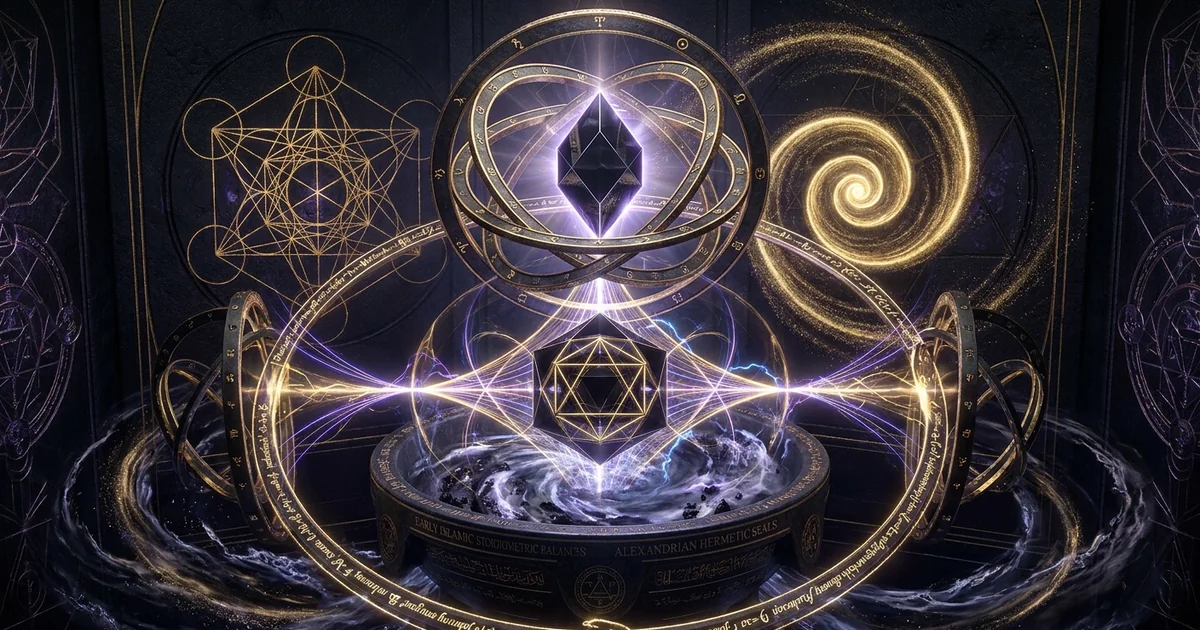
Alchemical Magnum Opus: Seven Stages Transformation
Metaphysical Thesis & Epistemological Opening: The Ontological Reality of Hermetic Transmutation
Trans-Materiality and the Rejection of Cartesian Dualism
Operative alchemy has suffered systematic mischaracterization across the post-Enlightenment continuum. Positivist historiography demotes the discipline to an embryonic, pre-scientific proto-chemistry, while modern psychological reductionism—frequently misapplying Carl Jung’s phenomenological insights—evaporates its physical reality into a disembodied theater of internal archetypes. Both positions emerge from the Cartesian settlement: an epistemological fracture that cleaved reality into res extensa (inert, unthinking, mechanically quantifiable extension) and res cogitans (unextended, subjective, isolated intellect).
Hermetic philosophy refuses this bifurcation. In the classical and Renaissance alchemical worldview, matter is not dead, passive clay waiting for external mathematical laws; it is condensed, slow-vibrational spirit. Conversely, spirit is volatile, highly refined, non-localized substance. The physical laboratory was never merely an allegorical stage for psychic projection, nor was it an early chemical engineering bay devoid of transcendent orientation. Instead, laboratory operations operated under an ontology of trans-materiality, wherein the transmutational operator and the transmuted substrate occupied a continuous, non-dual spectrum of being.
Hermetic Continuum:
Volatile Spirit  <=====================================>  Condensed Matter
(Subtle, Active Information)               (Coagulated, Crystalline Structure)
The alchemical process is an intervention within the anima mundi (world soul), predicated on the realization that physical substance harbors an active, living teleology. To engage in chrysopoeia (the generation of gold) without simultaneously executing an interior transmutation of the noetic apparatus was regarded by historical masters as an operative impossibility, an absurdity dubbed souffleur (“puffer”) ignorance.
                                 [ M E N S ]
                           (Purified Intelligence)
                                      │
                                      ▼
                        [ NOETIC INTENTIONALITY ]
                                      │
                                      ▼
[ PRIMA MATERIA ] ─────────► [ VAS HERMETICUM ] ─────────► [ LAPIS PHILOSOPHORUM ]
 (Chaotic Substance)             (Microcosm)                    (Living Stone)
                                      ▲
                                      │
                        [ ENERGETIC TRANSFORMATION ]
                         (Ignis Gehennae / Vulcan)
The transformation of base metal into solar perfection reflects the systematic acceleration of a cosmic evolutionary impulse inherent to nature itself, an informational transduction bridging the physical vessel and the operator’s consciousness.
Cartesian Mechanistic Reductionism
- Ontological Division: Reality split permanently into passive, unthinking spatial extension (res extensa) and unextended immaterial thinking mind (res cogitans).
- Status of Matter: Dead, inert, strictly deterministic; responsive solely to external mechanical vectors, kinetic collisions, and quantifiable forces.
- Role of the Observer: Radical detachment; an epistemic ghost inhabiting a physical machine, viewing the universe through an impassive, non-participatory lens.
- Entropy & Process: Systems drift inexorably toward thermal death and structural dissipation; material transformation is merely chemical rearrangement governed by blind physical laws.
Hermetic Hylomorphic Panpsychism
- Ontological Continuity: Reality structured as a dynamic, unbroken continuum between volatile spiritual frequencies and condensed material crystallizations (unus mundus).
- Status of Matter: Living, auto-poetic substance (prima materia) pregnant with divine intentionality, governed by systemic interiority and qualitative signatures.
- Role of the Observer: Intrinsic participatory feedback; the operator’s noetic clarity acts as an active qualitative operator upon the reaction dynamics within the vessel.
- Entropy & Process: Systemic negentropy achievable through the Great Work; systematic purification and coagulation reverse biological and mineral decay.
The Tripartite Ontology: Salt, Sulfur, and Mercury as Cosmic Operators
When Paracelsus (Theophrastus von Hohenheim) revolutionized Western Hermetism in the sixteenth century by formulating the tria-prima, he was not classifying chemical compounds in the modern sense. The triad—Sulfur, Mercury, and Salt—constituted a universal ontological grammar, an energetic architecture governing every manifest phenomenon within the sublunary sphere.
                   ▲ [ SULFUR ]
                  ╱   (The Active Informational Principle: Soul, Fire, Consciousness)
                 ╱           ╲
                ╱             ╲
               ╱               ╲
[ MERCURY ] ◄─────────────────► [ SALT ]
(The Mediating Fluid:            (The Receptive Ground:
 Prana, Anima, Spiritus)          Body, Earth, Fixed Mass)
Within this tripartite framework, Sulfur represents the combustible, active informational principle: the anima, the celestial fire, the unquenchable conscious identity within matter that carries its qualitative essence and morphological archetype. It is radiant, dry, masculine, and catalytic. Mercury (spiritus) serves as the dynamic, mediating, oceanic principle. It is the volatilized liquid energy, the psychic fluid, the prana of Eastern metaphysics, and the transformative vapor that enables communication between the higher ideal forms and lower structural matrices. It is simultaneously wet, cold, and radically convertible—the universal solvent and reconciler of dialectical opposites. Salt (corpus) embodies the principle of somatic structural crystallization, fixed mass, and tangible sedimentation. It provides the necessary earthly vessel, the architectural matrix within which Sulfur’s intentionality can be anchored and preserved from premature dissipation.
       Cosmic / Universal Expression       Somatic / Laboratory Correlate
Sulfur   = Solar Ignition / Noesis      ───► Fixed Radical Oil / Volatile Ash
Mercury  = Pranic Solvent / Anima Mundi ───► Volatilized Vapor / Heavy Spirit
Salt     = Structural Form / Crystalline Base ──► Insoluble Matrix / Calx
Disease, spiritual bondage, and metallurgical corruption occur when these three cosmic operators fall into dysrhythmia—when Salt solidifies into brittle, entropic stagnation without the lubrication of Mercury, or when Sulfur flares uncontrolled, consuming its material substrate in unguided fever. The alchemical magnum opus seven stages operate as a precise systematic protocol to extract, rectify, wash, and re-integrate this triad. By stripping each principle of its accidental impurities through thermal discipline, the alchemist liberates the tria prima from earthly dross, allowing them to recombine not into a fragile temporal compound, but into an indissoluble, incorruptible unity.
Alchemy as Informational Transduction in the Microcosm
Seen through the contemporary lens of informational physics, Hermetic transmutation can be understood as an operant intervention within open, non-equilibrium systems. Entropic decay—the dissipation of organization, vitality, and morphological coherence codified in classical thermodynamics—governs the fallen state of matter within the post-primordial matrix. The alchemist diagnoses this planetary condition as a state of cosmic sickness: an interruption of the downward cascade of the nous into the lower worlds, leaving physical forms trapped in recursive degradation.
The Great Work intervenes against this thermodynamic slope. Through deliberate, localized applications of structural resonance, cyclical distillation, and intentional consciousness, the alchemist establishes within the sealed crucible an artificial micro-reality. Here, natural entropy is reversed through systematic informational feedback loops. By continually liberating volatile substances and driving them back down upon their own fixed foundations (an operational sequence known as circulatio), the adept purifies the informational signal of the matter.
        ┌──────────────────────────────────────────────────┐
        ▼                                                  │
Volatilization (Ascent) ──► Separation ──► Precipitation (Descent)
        │                                                  ▲
        └──────────────────────────────────────────────────┘
                 Systemic Information Feedback Cycle
                     (Negentropic Distillation)
The operator functions as an ontological transducer, projecting concentrated, coherent noetic intention into the laboratory apparatus, thereby synchronizing the microscopic chemical reactions with macroscopic astrological rhythms and celestial forces. Matter, far from resisting this rectification, possesses an intrinsic yearning (ephesis) to return to its uncorrupted solar ground. Transmutation is the active negentropic redemption of the physical continuum, restoring fallen mass to the primordial perfection of the divine economy.
Primary Codices & Historical Transmission: From Greco-Egyptian Metallography to Western Adepts
The Alexandrian Crucible: Leyden and Stockholm Papyri and Gnostic Metallurgy
The operational lineage of the Western Magnum Opus crystallized within the dense cultural and spiritual matrix of Hellenistic Egypt, specifically in the syncretic urban crucible of late-antique Alexandria. Here, three radically distinct streams of ancient human praxis converged: the closely guarded metallurgical secrets of Egyptian temple craftsmen charged with gilding divine statuary and mummifying the sacred dead; the theoretical speculations of Greek natural philosophy regarding prime substance (hyle); and the trans-mundane soteriology of Alexandrian Gnosticism and the Hermetic mystery cults.
The earliest documentary witnesses of this synthesis survive in the Leyden and Stockholm Papyri (dating to roughly 300 CE), transcribed in Greek. While appearing upon superficial reading to be practical recipe books for fraudulent artisanal work—such as the artificial tinting of base alloys to imitate silver and gold—these technical texts must be read alongside the visionary treatises of Zosimos of Panopolis (c. 300 CE). In his Visions (Peri tes arches tes poieseos), preserved within the Byzantine compilation Codex Marcianus Graecus 299, Zosimos reinterprets these metallurgical craft techniques through an intensely experiential, theurgic framework.
[ ALEXANDRIAN CRUCIBLE ]
                                (Hellenistic Syncretism)
                                           │
         ┌─────────────────────────────────┼─────────────────────────────────┐
         ▼                                 ▼                                 ▼
[ Egyptian Temple Crafts ]      [ Greek Natural Philosophy ]        [ Gnostic / Hermetic Cults ]
- Mummification Techniques      - Aristotelian Hyle                 - Theurgic Soteriology
- Divine Metallurgical Guilds   - Four Elements & Qualities         - Cosmological Emancipation
         │                                 │                                 │
         └─────────────────────────────────┼─────────────────────────────────┘
                                           ▼
                    [ INITIATIC PROTO-METALLURGY: ZOSIMOS ]
                    - Sublimation as Spiritual Liberation
                    - Transmutation of the Operant Observer
To Zosimos, the melting, tinting, and alloying of metals were liturgical acts. The physical apparatus—the kerotakis (a reflux extraction device) and the alembic—served as mechanical vessels wherein metals underwent somatic crucifixion, death, and resurrection. Zosimos recounts visions of an altar shaped like a bowl of boiling water, upon which the priest Ion is pierced with swords, dismembered, burned by fire, and reassembled as a creature of pure spirit. The physical alteration of metals was inseparable from the Gnostic mythos of liberating the divine pneumatic spark from the dense, suffocating machinery of the planetary rulers. Read through this context, the historical origins of the tradition reveal that early metallurgical procedures were never solely utilitarian; they were liturgical and initiatic, structured around sacrificial models of death and rebirth. For deeper analysis of how these metallurgical operations intertwined with Mediterranean esoteric philosophy, see /ancient-prehistory/alexandrian-syncretism-and-gnostic-metallurgy.
The Islamic Synthesis: The Jabirian Balance ('Ilm al-Mizan) and the Emerald Tablet
Following the decline of the classical Mediterranean world, the operational continuity of Hermetism was rescued, preserved, and dramatically elevated within the Islamic Golden Age. Between the eighth and eleventh centuries, Islamic scholars did not merely transcribe Greek and Syriac codices; they introduced unprecedented mathematical rigor, empirical instrumentation, and a systematic metaphysics of qualitative equilibrium.
Central to this Islamic Hermetic renaissance stands the vast corpus attributed to Jabir ibn Hayyan (latinized as Geber), whose cornerstone achievement was the ‘Ilm al-Mizan—the Science of the Balance, expounded exhaustively in his Kitab al-Mizan (The Book of the Balance). Jabir posited that every metal and substance in the sublunary sphere consists of varying combinations of Aristotle’s four fundamental qualities: Heat, Cold, Dryness, and Moisture. Critically, Jabir distinguished between the manifest (external, observable) qualities and the occult (latent, interior) qualities of a metal.
Substance: BASE LEAD
  Manifest (External): Cold, Dry   ──► Sensed by physical instruments
  Occult   (Internal): Hot, Moist  ──► Hidden energetic core

TRANSFORMATION VIA 'ILM AL-MIZAN:
Expose interior Heat/Moisture ──► Invert manifest structure ──► SOLAR EQUILIBRIUM (Gold)
In lead, for example, Cold and Dryness dominate the surface, while Heat and Moisture remain locked within its internal core. Transmutation was the systematic operational inversion of this balance: drawing out the latent internal qualities to the surface, and forcing the outward manifest qualities inward, until perfect mathematical and elemental harmony was established—the immutable ratio of Gold.
Concurrently, it was within this Islamic context that the ultimate philosophical charter of the Great Work first appeared in written form: the Tabula Smaragdina (The Emerald Tablet). Embedded within the Kitab Sirr al-Khaliqa (The Book of the Secret of Creation), attributed to Balinas (Pseudo-Apollonius of Tyana, c. 8th century), this brief, profoundly dense text established the universal metaphysical axiom that sustains all subsequent operative alchemical logic.
"Quod est inferius est sicut quod est superius, et quod est superius est sicut quod est inferius, ad perpetranda miracula rei unius. Sicut omnes res fuerunt ab uno, meditatione unius, sic omnes res natae fuerunt ab hac una re, adaptatione.
Pater eius est Sol, mater eius Luna; portavit illud ventus in ventre suo; nutrix eius terra est. Pater omnis telesmi totius mundi est hic. Virtus eius integra est, si versa fuerit in terram. Separabis terram ab igne, subtile a spisso, suaviter, magno cum ingenio. Ascendit a terra in caelum, iterumque descendit in terram, et recipit vim superiorum et inferiorum. Sic habebis gloriam totius mundi. Ideo fugiet a te omnis obscuritas."
Exegesis: The axiom “That which is below is like that which is above” is frequently degraded into a poetic metaphor for passive correspondence. Within operative Hermetism, this statement forms a topological transformation rule. The lower realm (the somatic, physical substrate in the crucible) and the upper realm (the subtle planetary informational vectors) mirror each other non-locally. The operation described is a technological protocol: matter is systematically aerated, volatilized, and made to ascend through cyclic reflux (ascendit a terra in caelum), absorbing the celestial energetic field, before being mechanically and intentionally driven back down into a fixed, terrestrial crystalline matrix (iterumque descendit in terram). Transmutation is not an escape from physical reality, but the deliberate, highly technical consolidation of cosmic power within an earthly chassis.
Late Medieval and Renaissance Transmutation: From Geber to Khunrath
As these Arabic Hermetic treasures migrated into Christendom via the translation epicenters of Toledo and Salerno in the twelfth and thirteenth centuries, European thinkers absorbed them with urgent intensity. Early figures such as Albertus Magnus, Roger Bacon, and the anonymous fourteenth-century Latin author writing under the pseudonym Geber (Summa Perfectionis Magisterii) consolidated the technical procedures of mineral acids, cupellation, and high-temperature furnace designs, attempting to square Hermetic operation with Christian theology and Aristotelian physics.
By the late sixteenth century, the operational laboratory had entered an era of profound iconographical and mystical sophistication. No text embodies this synthesis more vividly than Heinrich Khunrath’s monumental Amphitheatrum Sapientiae Aeternae (Amphitheatre of Eternal Wisdom), published in Hanau in 1595. Khunrath, an adept belonging to the emerging Rosicrucian currents, bridged laboratory pyrotechnics with Paracelsian theosophy and Christian Kabbalah.
[ KHUNRATH'S AMPHITHEATRUM ]
                                     (1595 Synthesis)
                                            │
                       ┌────────────────────┴────────────────────┐
                       ▼                                         ▼
                 [ ORATORIUM ]                             [ LABORATORIUM ]
           - Sustained Noetic Prayer                 - Physical Furnaces & Coals
           - Theurgic Invocation                     - Heavy Reflux Glassware
           - Internal Rectification                 - Thermal Manipulation
                       │                                         │
                       └────────────────────┬────────────────────┘
                                            ▼
                             [ ORA ET LABORA CONTINUUM ]
                             - Indivisibility of Mind and Substance
                             - Transmutation of the Operator
In the iconic main engraving of the Amphitheatrum, the space is divided equally between the oratorium—where the adept kneels in continuous theurgic prayer, invoking the divine name within an illuminated tent—and the laboratorium, packed with heavy glassware, bellows, scales, and roaring furnaces. Khunrath’s central operational axiom, ora et labora (“pray and work”), asserts the indivisibility of mind and matter. The laboratory became a sanctum sanctorum where the adept re-enacted the cosmogonic genesis, guiding fallen metals through their archetypal phases toward that living, physical singularity known as the Philosopher’s Stone. Detailed explorations of these conceptual systems can be studied via /spirituality/hermeticism-corpus-hermeticum-initiatic-tradition.
Ontological Architecture & Cosmological Models: The Chromatic Progression and the Closed Vessel
The Vas Hermeticum as an Isolated Dimensional System
The physical theater of transmutation is the vas hermeticum (the Hermetic Vessel), also designated in the texts as the egg of the philosophers (ovum philosophorum) or the circulatory pelikan. The material composition of this vessel—uniformly blown from thick, unblemished, tempered glass—is structurally integral to the physics of the Great Work. The vessel must be completely, hermetically sealed (sigillum Hermetis), often using a lute formed of calcined clay, egg white, and iron filings, or fused directly by melting the glass neck shut with a jeweler’s torch.
[ THE VAS HERMETICUM (THE HERMETIC EGG) ]
             /=================\  <-- Sealed Glass Neck (Hermetic Seal)
            /                   \
           |    AETHER / VAPOR   | <-- Ascending Volatile Soul (Spiritus)
           |                     |
           |  ~~~~~~~~~~~~~~~~~  | <-- Phase Boundary / Dynamic Reflux
           |                     |
           |   CONDENSED MASS    | <-- Fixed Calx / Earthy Body (Corpus)
            \                   /
             \=================/
                     ▲
                     │
             [ EXTERNAL HEAT ] (Athanor / Controlled Fire)</code></pre>
The functional necessity of the absolute seal transcends the chemical imperative of preventing the physical escape of precious vapors, volatile mercury, or noxious acids. Within the metaphysical architecture of the Opus, the closed vessel functions as an isolated thermodynamic and noetic micro-universe. Under ordinary terrestrial conditions, matter exists in entropic communication with the degraded ambient environment; it degrades, oxidizes, and conforms to the chaotic macrocosmic baseline.
By severing the internal material substrate from the ambient spacetime continuum, the alchemist establishes an alternate physical envelope. Within this artificial micro-womb, the prima-materia can be subjected to intensifying thermal and psychic pressure without leaking its volatilized, energetic vitality into the entropic sink of the surrounding room. The vas hermeticum operates as an ontological particle accelerator: an isolated phase-space where spiritual intentionality and material substance undergo forced, cyclical collisions until their baseline dimensional frequency shifts irrevocably.
The Chromatic Continuum: Nigredo, Albedo, Citrinitas, and Rubedo
The unfolding of the Magnum Opus is demarcated by an invariable, non-linear sequence of color transformations visible within the glass. While minor sub-phases are observed by different schools—such as the shimmering iridescent display known as the Peacock’s Tail (cauda pavonis)—the classical chromatic architecture rests upon four profound, cosmological milestones.
The initial movement is the Nigredo (the Blackening), catalyzed by the gentle, moist thermal dissolution of the initial ingredients. Here, the vessel blackens until it attains the absolute darkness of pitch, coal, or rot. This is the stage of radical mortification, the loss of all structural form, and the return of differentiated substance to the formless abyss of the prima-materia. The material decays; its physical coherence is utterly annihilated.
Following the prolonged preservation of this black state, the first dawning of the new dawn appears: the Albedo (the Whitening). The vessel gradually clarifies through continuous washing (ablutio) and distillation. The substance crystallizes into an intensely brilliant, shimmering white earth, often called the White Swan, the Queen, or the White Stone. The Albedo represents the purification of matter, the expulsion of dark somatic sediment, and the stabilization of the lunar, receptive, non-decaying principle. It possesses the operative capacity to transmute base metals into physical Silver.
Historically placed between the white and red states was the Citrinitas (the Yellowing), an elusive transition phase increasingly folded into the Rubedo during late medieval restructuring. The Citrinitas represents the emergence of the solar principle from the pure lunar ground, comparable to the golden dawning of dawn. It indicates that the intellectual and conscious aspects of the stone have become luminous, moving from reflective lunar clarity to active solar radiation.
The final structural realization is the Rubedo (the Reddening). Under sudden, heightened furnace heat, the white stone absorbs the radiant, unquenchable fire of the Sulfur, shifting in phase density from dazzling gold-yellow to deep, volcanic carmine, royal purple, and blood-red. This is the crown of the work: the fixation of the active solar principle within the indestructible body of the transformed Salt. The Rubedo signifies the resurrection of the physical substrate into an incorruptible, crystalline state—the Lapis Philosophorum—capable of resisting all entropic decay.
PHASE           DOMINANT ELEMENT     METALLIC VALUE         METAPHYSICAL STATE
Nigredo         Earth (Chaos)        Base Lead / Corrupted  Ontological Death / Mortification
Albedo          Water / Air          Lunar Silver           Purified Structure / Innocence
Citrinitas      Air / Fire (Dawn)    Nascent Gold           Solar Dawn / Intellectual Illumination
Rubedo          Fire (Fixed)         Pure Solar Gold        Indestructible Divine Singularity
Astral Resonances: Planetary Metalleity and the Macrocosmic Mirror
The classical Hermetic universe is an unbroken continuum mediated by the seven traditional planetary spheres. Alchemical cosmology posits that metals are not random geological deposits scattered through the earth by chance; they are embryonic planetary energies planted in terrestrial soil, gestating over geological millennia toward solar completion. Every sublunary metal is the physical anchor point, the material signature, of a celestial intelligence.
ASTRONOMICAL MATRIX:
Saturn   (Lead)   ──► Densest inertia, crystallization, entropic boundary
Jupiter  (Tin)    ──► Expansion, mediate order, philosophical porosity
Mars     (Iron)   ──► Combustible dynamic force, dynamic outward severance
Sol      (Gold)   ──► The Archetypal Center: Radiant Equilibrium, Incorruption
Venus    (Copper) ──► Cohesion, generative attraction, moist affinity
Mercury  (Quicksilver) ──► Radical fluidity, boundary-crossing volatility
Luna     (Silver) ──► Receptive purity, luminous reflective mirroring
The progression through the stages of the Great Work traces a precise, ascending and descending circuit through these planetary spheres. The work begins in the dark, heavy, cold constraints of Saturn (Lead)—the planetary archetype of calcified boundaries, time, and entropic mortality. To liberate the seed of gold hidden within Saturnian matter, the alchemist must systematically strip away its dense shell, moving through the expansive, optimistic porosities of Jupiter (Tin), surviving the violent energetic ignitions of Mars (Iron), cooling and harmonizing the matter through the balance and affective unity of Venus (Copper), unlocking its dynamic, fluid informational core through Mercury (Quicksilver), and cleansing it in the cool, luminescent reflective mirror of Luna (Silver).
[ SATURN ] ──► [ JUPITER ] ──► [ MARS ] ──► [ SOL ] ◄── [ VENUS ] ◄── [ MERCURY ] ◄── [ LUNA ]
 (Lead)          (Tin)          (Iron)     (Gold: Apex)  (Copper)      (Mercury)      (Silver)
Only when this total planetary octave has been experienced, integrated, and cleared of its asymmetrical imbalances can the substrate ascend to the radiant throne of the Sun (Gold). This sevenfold planetary ascent directly recapitulates the ancient Gnostic soteriology: the liberation of the pneumatic seed through the concentric astral rings (sphairomata) dominated by the planetary Archons. The transmutational vessel becomes a celestial engine wherein the metals cast off their fallen, fragmented planetary condition to be reborn into the unitive splendor of the primordial solar monarch.
Phenomenological Mechanics: The Sevenfold Operations of the Magnum Opus
Phase I: Dissolution and Mortification (Calcination, Dissolution, Separation)
The sevenfold operational grammar of the Magnum Opus executes an unwavering systemic dialectic: solve et coagula (dissolve and coagulate). The initial movement of the work is mercilessly deconstructive, designed to shatter the false, acquired identity of the prima-materia.
================================================================================
                                PHASE I: SOLVE
================================================================================
[ PRIMA MATERIA ]
        │
        ▼ (Violent Thermal Ignition)
 1. CALCINATION  ──► Strips acquired somatic form; reduces substrate to ash (calx).
        │
        ▼ (Immersion in Radical Moisture)
 2. DISSOLUTION  ──► Melts rigid structural matrices; opens energetic interior.
        │
        ▼ (Subtle Sorting & Filtration)
 3. SEPARATION   ──► Divides the refined from the gross, light spirit from dead dross.
Calcination initiates the sequence through the application of fierce, dry, external heat (ignis gehennae). In the physical alembic, the raw mineral base is subjected to sustained open flame until its moisture is evaporated, its combustible sulfurous components are burnt out, and its rigid structural form collapses into a fine, gray, powdery ash (calx). Phenomenologically, Calcination represents the absolute destruction of egoic calcifications, dogmatic mental architectures, and the somatic illusions of self-sufficiency. The fire does not annihilate the true essence of the substance; it burns away the historical, accidental impurities that hold the material hostage in a lower state of structural organization.
Dissolution immediately follows the dry destruction of the fire with the radical immersion of the ash in water. The calx is plunged into its own internal, unctuous moisture or dissolved by a corrosive, secret philosophical acid (frequently an early form of nitric or sulfuric acid, or a dynamic organic menstruum). The solid form melts; the rigid structures dissolve into a dark, swirling liquid broth. Ontologically, the boundaries between discrete forms blur. The firmament collapses back into the primordial waters of Genesis, forcing the matter to surrender its individual boundaries to the oceanic depths of the unconscious.
Separation is the rigorous, delicate procedure of sorting the components resulting from the previous dissolution. The alchemist does not allow the dissolved substance to remain in stagnant, chaotic confusion. Utilizing precise, gentle heating and filtration, the subtle, volatile parts of the substance (the light, aromatic spirit and unctuous soul) are carefully drawn off from the heavy, dense, opaque sediments resting at the bottom of the vessel (terra damnata or cursed earth). Separation demands severe intellectual and theurgic discernment: the capacity to untangle truth from projection, the spiritual impulse from somatic compulsion, and the living metallic seed from dead, entropic debris.
The historical alchemists issued relentless warnings regarding the lethality of the initial stages of the Opus. The transition from Calcination through Dissolution into the heart of the Nigredo induces a catastrophic ontological shock in both the physical substrate and the operator’s noetic field.
When the structural ego is subjected to the unrestrained solvents of the deep unconscious without adequate theurgic grounding, the psyche risks acute fragmentation, radical melancholia, clinical dissociation, and somatic despair (traditionally codified as the melancholia alchemica or the “poisonous breath of the dragon”).
Premature exposure to the unrefined prima materia—the unintegrated primordial chaos of the objective unconscious—inundates the human cognitive apparatus with unmodulated archetypal material. If the vas hermeticum of the psychic chassis possesses micro-fractures, the volatile contents will catastrophically rupture the vehicle, resulting in total psychological inflation, paranoid megalomania, or absolute catatonic collapse. No adept was permitted to light the furnace without having erected absolute internal energetic wards and purified the intentionality of the will.
Phase II: Mediate Reconstitution (Conjunction and Putrefaction/Fermentation)
Once the subtle and gross elements have been extracted, purified, and categorized, the Opus pivots from analytical deconstruction toward dynamic, mediate synthesis.
================================================================================
                                PHASE II: RE-CONSTITUTIO
================================================================================
 4. CONJUNCTION  ──► The Sacred Marriage (Hieros Gamos); union of Sol & Luna.
        │
        ▼ (Organic Sinking into Rottenness)
 5. FERMENTATION ──► Infection of the inert paste with the living spiritual germ.
Conjunction (coniunctio) constitutes the pivot of the entire Hermetic enterprise, universally mythologized as the Hieros Gamos—the Sacred Marriage of opposites. Within the vessel, the purified feminine, lunar, volatile principle (Mercury, Luna, the White Queen) is reunited with the purified masculine, solar, fixed principle (Sulfur, Sol, the Red King).
          [ THE SACRED MARRIAGE (HIEROS GAMOS) ]

           THE RED KING                    THE WHITE QUEEN
           (Solar Sulfur)                  (Lunar Mercury)
           Active Form                     Passive Receptacle
           Radiant Heat                    Volatile Moisture
                  \                               /
                   \                             /
                    ▼                           ▼
                     [ HERMAPHRODITIC EMBRYO ]
                     (Rebis: The Reconciled Core)
This union reconciles fundamental metaphysical polarities: fire and water, sky and earth, conscious and unconscious, active form and receptive substrate. The two become an indissoluble hermaphroditic embryo (Rebis). Yet, in the paradox of the Hermetic dialectic, this initial union is fragile and immediate; the lovers do not instantly give birth to the immortal Stone. Instead, their ecstatic union produces an immediate, suffocating collapse back into darkness.
Fermentation (often integrated with the deep operational state of Putrefaction) is the consequence of this initial marriage. The unified substance must die to its previous life. It is buried in the dark, warm belly of the furnace, sustained by a gentle, brooding heat compared to the temperature of a nesting hen or a decomposing dung heap (balneum Mariae). The combined mass rots.
Bacteria, mold, and pitch-black putrefactive decay devour the dead forms of King and Queen. Yet, precisely as a seed of wheat must fall into the earth and rot to germinate into new life, this putrefactive rotting introduces the living spiritual ferment. A drop of spiritual light, like yeast in dough, infects the dead, decomposing paste, vivifying it from within. The substance transitions from an inorganic, mechanical compound of minerals into an organic, living, self-replicating metaphysical organism.
Phase III: Fixation and Exaltation (Distillation, Coagulation, and Projection)
The final movement resolves the dialectical tension between volatile spirit and fixed mass, culminating in the permanent stabilization of the transmutational engine.
================================================================================
                                PHASE III: COAGULA
================================================================================
 6. DISTILLATION  ──► Cyclical reflux; washing the fermented mass with volatile vapor.
        │
        ▼ (The Living Stone is Born)
 7. COAGULATION   ──► Permanent crystallization of the volatile into an immortal body.
        │
        ▼ (Application to the Lower Worlds)
[ PROJECTION ]   ──► Ontological contagion; instant chrysopoeia upon base metals.
Distillation is the relentless, rhythmic purification of the vivified substance. The fermented matter is subjected to continuous, cyclic cycles of evaporation and condensation within the pelikan or circulating alembic. The volatile vapors rise into the cooler neck of the vessel, condense into pristine water droplets, and cascade down upon the dark, fixed earth resting at the base.
This process, repeated hundreds of times (circulatio), steadily washes, bleaches, and spiritualizes the dark sediment, while simultaneously fixing the celestial power of the descending dew into the body of the earth. Distillation executes the instruction of the Emerald Tablet: it systematically ascends from earth to heaven, and descends anew to earth, unifying the dynamic capacities of both realms into a singular, highly energized fluid.
Coagulation marks the triumphant, terminal fixation of the work. The volatile vapors no longer escape the earth; the earth no longer holds the vapors in passive, unilluminated prison. The liquid and dry components fuse into a solid, unshakeable crystalline mass that does not melt at heat, does not rot in moisture, and cannot be cut by any blade. This is the generation of the Lapis Philosophorum—the Philosopher’s Stone.
The Stone is not a mere stone; it is physical matter transformed into condensed divine spirit, an ontological singularity possessing absolute coherence, incorruptibility, and radiant solar vitality. It is blood-red, heavy as gold, translucent as diamond, and completely resilient against the thermodynamic decay governing the surrounding universe.
            [ THE IMMORTAL BODY: LAPIS PHILOSOPHORUM ]
            - Total Incorruptibility
            - Complete Non-Melting Stability
            - Self-Luminous Translucent Density
            - Infinitely Multiplicative Negentropy
From this terminal realization springs the operant application: Projection (multiplicatio and projectio). When a single grain of this perfected Lapis is cast into a swirling crucible containing thousands of times its weight in molten, corrupt lead or mercury, the base metal does not merely undergo a chemical reaction. It suffers a sudden, instantaneous informational contagion.
The radical, concentrated solar coherence of the Stone shatters the fragile, corrupt informational matrix of the base metal, pulling its atomic and energetic structure into immediate alignment with the Stone’s own solar perfection. The lead flashes into pure, physical, non-decaying Gold. The work of the macrocosmic redemption of fallen substance has achieved total, tangible, historical reality.
Initiatic Synthesis & Philosophical Implications: Reality Architecture and Human Sovereignty
The Lapis as an Antidote to Demiurgic Entropy
The ultimate realization of the lapis-philosophorum operates as far more than a triumph of speculative metallurgy; it represents a radical metaphysical rupture within the prevailing architecture of physical reality. Within the Hermetic, Gnostic, and Kabbalistic cosmologies, the sublunary realm is caught in the tightening grip of a structural tragedy: the entropic dispersion engineered by the Demiurgic architecture. This cosmic framework, sustained through planetary mechanisms of cyclical decay, ensures that all biological and material organizations are condemned to fragmentation, oxidation, suffering, and death.
DEMIURGIC REALITY (Fallen Metric)   ──► Recursive Entropy, Fragmentation, Decay
                      │
                      ▼
[ LAPIS PHILOSOPHORUM INTERVENTION ]
                      │
                      ▼
HERMETIC REDEMPTION (Solar Reality) ──► Re-Enchanted Matter, Negentropy, Incorruption
The Philosopher’s Stone serves as an intentional antidote to this cosmic inertia. By manifesting a physical substance that embodies pure, unalterable solar equilibrium, the adept breaks the deterministic laws of lower material causality. The Lapis is not an escape from matter into an ethereal, disembodied transcendence; it is the anchoring of transcendent, incorruptible life within matter itself. The existence of the Stone proves that entropy is not an absolute, immutable cosmic law, but an operational condition of fallen nature—one that can be systematically overcome when human intentionality is purified and harmonized with the primordial logos.
"Hermetic alchemy and the traditions of operative esotericism are characterized by what must be defined as a ‘participatory epistemology.’ Unlike modern scientific methodologies, which require an absolute rupture between the impassive observer and the objective physical substrate, the Hermetic adept operates within a fundamentally living, enchanted cosmos (anima mundi).
Here, knowing is not an act of detached cognitive representation, but of direct ontological resonance. The transmutation occurring in the crucible is intrinsically linked to the transfiguration of the operator’s inner noetic structure. Transmutation is the deliberate realization of the divine will within the fabric of nature through the cooperative agency of humanity as the cosmic mediator." — Wouter J. Hanegraaff, “Esotericism and the Academy: Rejected Knowledge in Western Culture”, Cambridge University Press, 2012.
The Re-Enchantment of Matter: Alchemical Panpsychism
The operational philosophy underlying the Magnum Opus demands a radical re-enchantment of the cosmos. In contrast to modern industrial paradigms that reduce nature to an inert repository of natural resources awaiting exploitation, Hermetic philosophy recognizes every stone, mineral, plant, and drop of dew as an active participant in universal consciousness. This perspective is a rigorous, panpsychist vitalism: matter possesses interiority, memory, and a latent yearning to realize its divine telos.
       [ MODERN INDUSTRIAL MECHANISM ]
       Human (Exploitative Consumer)
         ──► Imposes raw force
         ──► Treats matter as dead, inert commodity
         ──► Amplifies systemic entropy and structural exhaustion

       [ HERMETIC PARTICIPATORY HYLOMORPHISM ]
       Adept (Participatory Midwife / Co-Creator)
         ──► Attunes noetic intention
         ──► Treats matter as living, embryonic spirit
         ──► Accelerates nature's innate desire for solar completion
By entering into an initiatic relationship with the mineral realm, the alchemist functions not as an arrogant technician imposing artificial forms upon passive substances, but as a holy midwife to nature. The adept listens to the internal voice of the metal, diagnoses its structural imbalances, and creates the ideal, safe micro-environment (the vas hermeticum) where the substance can shed its historical trauma and achieve in a few months what would otherwise require millions of years of subterranean planetary pressure. This participatory hylomorphism dissolves the violent alienation between humanity and the natural environment, positioning human consciousness as the conscious organ through which the universe reflects upon, purifies, and completes itself.
The Adept as Conscious Demiurge: Theurgy and Sovereign Agency
The consummation of the Magnum Opus radically reconfigures the ontological status of the human being within the cosmic hierarchy. The adept who successfully navigates the seven operations escapes the passive submission to the astrological constraints and psychic control matrices of the planetary archons.
   [ THE LOWER SOVEREIGNTY MATRIX ]
   Demiurge & Planetary Archons
   ──► Impose cyclical, astrological programming
   ──► Trap the fragmented soul in biological / mineral loops
   ──► Human as automated prisoner of fate (Heimarmene)

                  │
                  ▼ [ INITIATIC MAGNUM OPUS ]
                  │

   [ THE HIGHER THEURGIC APEX ]
   Transfigured Adept (Theurgic Operator)
   ──► Transmutes the internal and external Tria Prima
   ──► Integrates the macrocosmic planetary forces into the solar Lapis
   ──► Human as Sovereign Co-Creator / Redeemed Demiurge
Through theurgy—the art of divine action and the activation of the divine names within matter—the alchemist ceases to be a puppet of cosmic fate (heimarmene) and steps into the office of a conscious, sovereign co-creator. The transmutation of lead into gold is the ultimate demonstration of spiritual sovereignty: it proves that the divine spark residing within human consciousness possesses direct, operational authority over physical substance.
The transfigured adept stands fully emancipated from the manipulations of lower reality systems. Having dissolved the illusory boundary between spirit and matter, mind and vessel, the worker of the Great Work fulfills the deepest initiatic promise of the Hermetic tradition: homo est deus in terris—humanity is a mortal god, and god is an immortal human. For a wider investigation into how these theurgic technologies intersect with non-human intelligences and historical control paradigms, explore /nhi-phenomena/theurgic-contact-and-archontic-control-systems.
Frequently Asked Questions: Metaphysical and Historical Inquiries into the Opus
Did Historical Alchemists Achieve Physical Chrysopoeia?
The historical question of chrysopoeia—the actual, laboratory transmutation of base metals into physical silver and gold—remains one of the most contentious points of intersection between historical scholarship and esoteric tradition. Rigorous archival historiography demonstrates that numerous European sovereigns (including Rudolf II in Prague, Emperor Ferdinand III, and King Charles II of England) maintained private, heavily funded alchemical laboratories staffed by court adepts. Moreover, there exists a persistent, highly detailed catalog of documented transmutations witnessed by skeptical, external observers of unimpeachable intellectual standing.
Among the most famous historical accounts is that of Johann Friedrich Schweitzer (Helvetius), physician to the Prince of Orange, who in 1666 was visited by an anonymous adept who provided him with a minute scrap of the Philosopher’s Stone. Helvetius, an outspoken critic of operational alchemy, performed the transmutation in his own laboratory in the presence of his wife and the city goldsmith. The resulting gold, thoroughly assayed by the silversmith Brechtel using aqua fortis and borax, was certified to be of the absolute highest purity.
               [ HISTORICAL WITNESSES TO CHRYSOPOEIA ]
Helvetius (1666)        Jan Baptist van Helmont   Robert Boyle (1676)
- Skeptical royal MD    - Founder of pneumatic     - Father of modern chemistry
- Independent assay       chemistry                - Witnessed projection
- Proven solar purity   - Multiplicative evidence  - Prompted Anti-Multiplication Act
Similar rigorous accounts were recorded by Jan Baptist van Helmont (the founder of pneumatic chemistry, who coined the word “gas”) and Robert Boyle, whose direct, repeatable observations of metallic projection led him to urge the English Parliament to repeal the Henry IV Statute Against Multipliers in 1689, fearing the economic collapse of the realm should the technique spread unchecked.
From within the Hermetic epistemology, physical chrysopoeia was not an impossibility, but neither was it the primary objective of the work. It was understood as a secondary diagnostic symptom—a physical confirmation that the operator had successfully stabilized the Lapis Philosophorum. The production of mineral gold was merely an empirical proof that the spiritual, subtle fire had achieved absolute structural fixation within terrestrial matter. If an adept sought the Stone purely for financial avarice, the work uniformly failed; the internal disharmony of the operator’s intent instantly ruptured the informational coherence of the vas hermeticum.
How Does Jungian Alchemical Psychology Differ from Traditional Operative Hermetism?
Carl Gustav Jung’s rediscovery of alchemical literature, systematically expounded in works such as Psychologie und Alchemie (1944) and Mysterium Coniunctionis (1955), rescued the Western Hermetic canon from Enlightenment ridicule and introduced it into modern intellectual discourse. Jung recognized that the astonishingly vivid, bizarre, and uniform imagery found across medieval and Renaissance alchemical manuscripts (dragons devouring their tails, crowned hermaphrodites, chemical weddings, dismembered kings) mirrored the spontaneous dream imagery and active imaginations of his clinical patients.
Jung formulated the thesis that the historical alchemists were unknowingly projecting the archetypal contents of the collective unconscious into the dark, obscure chemical reactions taking place within their alembics. The Great Work, in the Jungian framework, is the historical predecessor to the psychological process of individuation—the psychic journey through which the ego encounters the Shadow (Nigredo), integrates the Anima/Animus (Conjunction/Albedo), and finally achieves the realization of the integrated, sovereign Self (the Lapis or Rubedo). For deeper philosophical analysis of how these archetypal fields condition human perception, consult /consciousness/jungian-archetypes-and-the-unconscious-field.
   [ JUNGIAN INDIVIDUATION ]                 [ OPERATIVE HERMETISM ]
   Psychological Phenomenon Only             Psycho-Somatic Unified Field
   Inner psychic projection                  Simultaneous inner AND outer reality
   Alembic as metaphorical screen            Alembic as real, sealed physical crucible
   Integration of the Self                   Fixation of the Stone across Matter and Mind
While Jung’s psychological interpretation is brilliant and structurally coherent, it exhibits a distinct modern limitation: it amputates the physical and metaphysical reality maintained by the historical adepts. Operative Hermetism does not view the alchemical vessel as a blank screen for psychological projection. Rather, it operates from the stance of a unified, psycho-somatic field (unus mundus).
The historical adept insisted that the transmutation must take place in the external glassware as well as in the internal soul. Matter is not an inert mirror for the psyche; it is an active participant in an ontological dialogue. By reducing the physical operations entirely to internal psychic dynamics, modern Jungian reductionism risks stripping the Magnum Opus of its revolutionary ontological core: the real, physical redemption and structural transmutation of material entropy.
The historical etymology of the word alchemy preserves the dual cosmological identity of the Opus. The linguistic root bifurcates into two distinct ancient designations:
-
The Egyptian Origin (Khem or Khemia): The ancient Egyptian word Km.t (Kemet), meaning “the Black Land,” designates the rich, dark, fertile alluvial silt deposited annually by the flooding Nile River, contrasted with the barren red sand of the surrounding desert (Deshret). Under this derivation, al-kimiya is “the art of the Black Earth.” The transformation is conceptually bound to the primordial, fertile darkness of Egypt’s riverbed—the moist, decaying, infinitely pregnant soil out of which new agricultural and spiritual life emerges. This roots the work directly in the regenerative mechanics of the Nigredo.
-
The Greek Origin (Chemeia or Chumeia): Derived from the Greek verb chein (“to pour”) or chuma (“that which is poured out, an alloy or liquid metal”). Under this derivation, the art concerns the pyrotechnical and metallurgical mastery of liquifying, alloying, and tinting molten minerals within the temple foundries.
The synthesis of these two etymological currents within the Arabic al-kīmiyā’ reveals that the Opus is simultaneously the mastery of liquid, metallurgical fire (chemeia) and the spiritual cultivation of the fertile, regenerative cosmic soil (khemia). It is an art born of dark earth, quickened by liquid fire.
What Distinguishes the Seven Stages from the Twelve Alchemical Gates of George Ripley?
Students of historical alchemy frequently encounter structural variance between treatises that map the Magnum Opus onto a sevenfold stage progression (such as the classical planetary schema explored throughout this monograph) and those that delineate an operational progression through twelve technical stages, most famously codified in the fifteenth-century English adept Sir George Ripley’s Compound of Alchymy; or the Ancient Hidden Art of Archemie: Conteining the Right & Perfectest Mean to Make the Philosophers Stone (1471), commonly known as The Twelve Gates.
================================================================================
                    STRUCTURAL SYSTEM COMPARISON
================================================================================
CLASSICAL SEVEN STAGES               RIPLEY'S TWELVE GATES
(Cosmological / Phenomenological)     (Operational / Technical Laboratory Protocol)
─────────────────────────────────     ─────────────────────────────────────────────
1. Calcination                        1. Calcination
2. Dissolution                        2. Solution
3. Separation                         3. Separation
4. Conjunction                        4. Conjunction
5. Fermentation (Putrefaction)        5. Putrefaction
                                      6. Congelation
                                      7. Cibation
6. Distillation                       8. Sublimation
                                      9. Fermentation
7. Coagulation                        10. Exaltation
                                      11. Multiplication
[ Integrated in Stone ]               12. Projection
This structural divergence represents not a doctrinal contradiction, but a difference in pedagogical and technical resolution. The Seven Stages represent the essential, phenomenological macro-cycle of the Opus. This sequence maps directly to the seven classical planetary spheres, tracing the archetypal soul-journey through descent, radical death, energetic purgation, and solar crystallization. It is a cosmological map intended to guide both the psychic alignment of the adept and the broad phase-shifts occurring within the closed vessel.
Conversely, Ripley’s Twelve Gates represent a hyper-detailed, technical expansion designed for the daily liturgical procedures of the operational laboratory. Ripley maps his twelve operations not to the planets, but to the twelve signs of the Zodiac, establishing a total astro-chemical calendar:
- Calcination (Aries) - The initial ignition of the crude matter.
- Solution (Taurus) - Dissolution of the calcined calx in philosophical water.
- Separation (Gemini) - Discerning and filtering the subtle from the dense.
- Conjunction (Cancer) - The initial, mediate union of the divided components.
- Putrefaction (Leo) - Sustained burial and rot of the conjoined mass.
- Congelation (Virgo) - Stabilization and moist hardening of the fluid.
- Cibation (Libra) - “Feeding” the dried matter with unctuous, distilled moisture.
- Sublimation (Scorpio) - Driving the subtle vapors upward by intense fire.
- Fermentation (Sagittarius) - Vivifying the mass with the living spiritual seed.
- Exaltation (Capricorn) - Elevating the internal qualitative dignity of the Stone.
- Multiplication (Aquarius) - Augmenting the power, virtue, and quantity of the Lapis.
- Projection (Pisces) - Casting the perfected Stone into base metals to consummate chrysopoeia.
Ripley’s Twelve Gates do not alter the fundamental metaphysical trajectory of the sevenfold path (solve et coagula). Rather, they break down intermediate laboratory requirements—such as cibation (the technical nourishment of the dry matter with drops of refined volatile water) and exaltation (the deliberate stepping-up of thermal frequency)—so that the practicing adept does not prematurely overheat, starve, or suffocate the delicate living embryonic entity forming within the depths of the Hermetic egg. The sevenfold path remains the foundational ontological spine of the Great Work; the twelve gates are the detailed mechanical steps by which that spine is carefully and historically realized in matter. :::