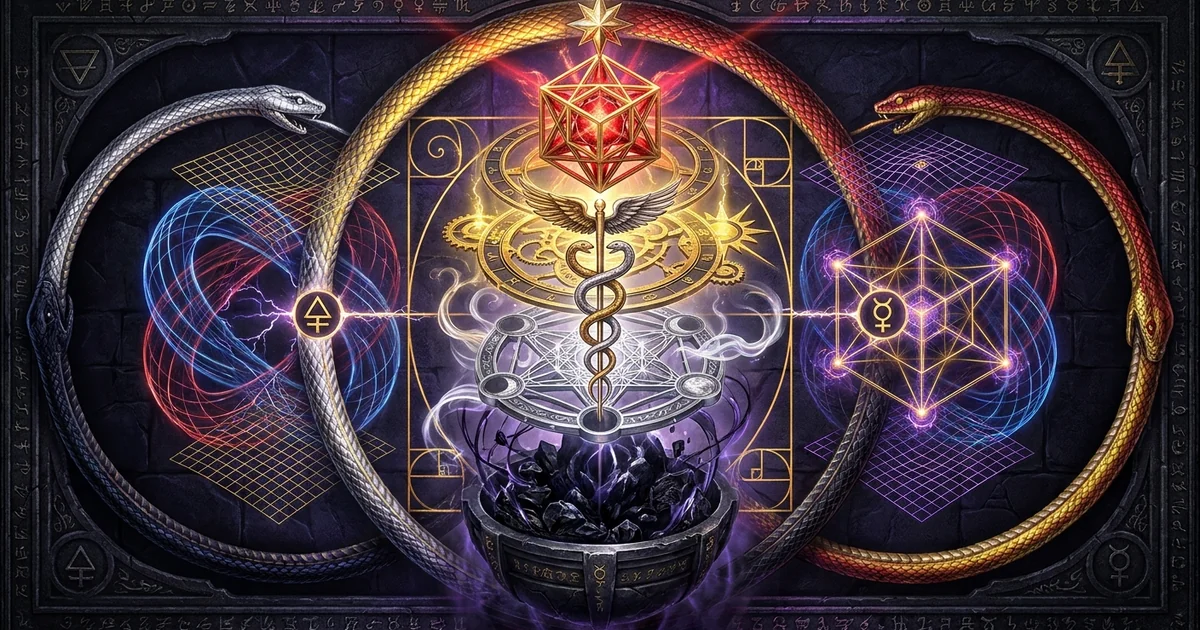
The Magnum Opus: Four Stages of Alchemical Soul Growth
Metaphysical Thesis & Epistemological Opening: The Alchemical Laboratory of Spirit
Beyond Vulgar Metallography: Alchemy as Hyper-Physics
The systematic degradation of the Hermetic art into a primitive precursor of modern chemistry represents one of the most profound epistemological truncations in the history of science. Where Cartesian-Baconian positivism retroactively casts historical spagyrists as proto-chemists fumbling in empirical darkness toward the periodic table, primary textual hermeneutics reveals a radically disparate reality. The operational core of the Hermetic craft was never the mere physical transubstantiation of base metals into bullion, an ambition relegated to the souffleurs (“puffers”) whose exoteric greed blinded them to the ontological bedrock of the tradition. Rather, authentic Western alchemy functions as a rigorous hyper-physics: an integrated, triune cosmology wherein the material, the psychoid, and the metaphysical operate along an unbroken ontological continuum.
To parse the mechanics of the Great Work—the Magnum Opus—is to engage with an operative paradigm that rejects the bifurcated cosmos of modern metaphysics. In the classical alchemical worldview, matter is not an inert, dead substrate governed purely by mechanical billiard-ball collisions. Instead, matter is the crystallized, terminal expression of divine emanation, carrying within its dense molecular prisons the trapped light of the divine pneuma. The transmutation of lead into gold (aurum non vulgi) constitutes a simultaneous ontological redemption: an acceleration of cosmic evolution wherein the artisan cooperates with nature to liberate the latent divinity held captive within entropy.
The Epistemology of the Alchemical Laboratory of Spirit
Within the operational sanctum of the adept, the alchemical laboratory of spirit serves as an externalized, active mandala. The physical instruments—the alembic, the athanor, the pelican, and the cucurbit—do not function merely as heat-resistant glassware for chemical operations, but as somatic and psychic interfaces. The furnace reflects the internal visceral heat of the practitioner; the sealed vessel mimics the hermetically contained boundary of the individuation vessel, or vas Hermetis. There exists within this space a direct, bidirectional informational feedback loop between the intentional consciousness of the operator and the material substratum under heating, dissolution, and coagulation.
+-------------------------------------------------------------------------+
|                  THE TRIUNE CONTINUUM OF ALCHEMICAL TRANSMUTATION       |
+-------------------------------------------------------------------------+
|  METAPHYSICAL   | Pleromic Influx    | Divine Idea     | Unus Mundus    |
|  PSYCHOID       | Intentionality     | Active Imaginal | Subtle Body    |
|  CORPOREAL      | Athanor & Flask    | Matter / Salt   | Cellular Base  |
+-------------------------------------------------------------------------+
This interaction is governed by the principles articulated in foundational texts such as the Hermetic principles of mental transmutation, wherein the observer and the observed participate in a unified field of consciousness. The laboratory is an epistemic nexus where the bifurcation between subject and object, res cogitans and res extensa, collapses entirely. The operative’s ascetic purification, noetic lucidity, and concentrated prayer (oratorio) act as structural boundary conditions that physically bias the stochastic behavior of the material within the crucible.
The etymological provenance of the term al-kimiya bridges linguistic, geographic, and cosmological realities. Deriving from the ancient Egyptian khem or khēmia—denoting the fertile, jet-black alluvial silt deposited by the inundation of the Nile—the word simultaneously encodes the black prima materia of metaphysical genesis and the geographic womb of the craft. When assimilated into Hellenistic Greek as chumeia (the art of pouring or alloying metals) and subsequently preservation-amplified through Arabic Islamic philosophy as al-kīmiyā, the term retained its radical ontological synthesis: an alchemical laboratory of spirit where noetic intention directly reconfigures physical entropy.
Challenging Jungian Reductionism: Somatic and Ontological Realism
While twentieth-century psychological hermeneutics, driven largely by the monumental scholarship of Carl Gustav Jung, successfully salvaged alchemy from the intellectual dustbin of rationalist historiography, it instituted its own severe distortion. Jung posited that alchemical literature represents an unmediated, spontaneous projection of the unconscious onto unknown chemical matter. In Psychology and Alchemy and Mysterium Coniunctionis, Jung relegated the operations of calcination, dissolution, and coagulation almost entirely to the interior psychic topography, framing the lapis philosophorum as a symbol of the integrated Self achieved through psychological individuation.
This psychologized hermeneutic, while diagnostically brilliant, strips the Magnum Opus of its visceral, ontological realism. The ancient and Renaissance masters—from Zosimos of Panopolis to Gerhard Dorn—did not view the Great Work as an internal metaphoric exercise. They maintained that the transubstantiation occurred simultaneously in the psyche and the somatic matrix of the physical body. To reduce the Magnum Opus to an internal psychological drama is to impose a secular, post-Enlightenment dualism onto a radically non-dual tradition.
The transformative arc from the chaotic, undifferentiated substrate of the prima materia to the hyper-coherent diamond architecture of the philosopher’s stone represents a literal transfiguration of the practitioner’s biological and subtle-body architecture. It is an empirical soteriology wherein the cellular baseline is elevated to sustain the voltage of non-dual gnosis, permanently altering the human organism’s metabolic, bioelectrical, and spiritual resonance.
Primary Codices & Historical Transmission: Lineage of the Great Work
Graeco-Egyptian Hermeticism: Zosimos and the Extraction of the Pneuma
The theoretical codification of the magnum opus great work four stages alchemy soul transmutation crystallizes in the crucible of Graeco-Egyptian Alexandria during the first through third centuries of the Common Era. It is here that indigenous Egyptian metallurgy, temple embalming technologies, and sacred dye synthesis fused with Hellenistic natural philosophy, Platonic-Aristotelian physics, and Gnostic cosmology.
The preeminent surviving authority of this inaugural epoch is Zosimos of Panopolis (c. 300 CE), whose treatises—preserved across Byzantine compilations and later curated in Marcellin Berthelot’s Collection des Anciens Alchimistes Grecs—establish the fundamental architecture of transmutational mysticism. For Zosimos, metallurgy is fundamentally a theurgical enterprise of pneumatic extraction. The metal is not a compound of mechanical elements, but a living body (soma) imprisoning a divine spark or volatile breath (pneuma).
The Great Work necessitates the liberation of this spirit from the prison of corruptible form through a process of systemic, ritualized dismemberment. This dynamic is grounded in the operational cosmology of the Emerald Tablet, which declares the co-identity of celestial and terrestrial realms under the governance of the One Mind.
“I saw a priest standing before me upon an altar shaped like a bowl. And there were fifteen steps leading up to the altar. And the priest stood there, and I heard a voice from above saying to me: ‘I have accomplished the descent of the fifteen steps into darkness, and the ascent of the steps into light. It is the sacrificer who transforms and renews me; he casts off the heaviness of the body, and having been consecrated priest by necessity, he becomes a spirit (pneuma).’ And looking closely, I saw that his eyes were like blood. And he vomited his own flesh, and cut himself into pieces with his own sword, and burned his limbs upon the wood of the altar, until his body was transubstantiated, becoming pneuma.” — Zosimos of Panopolis, The Visions (c. 300 CE, preserved in Marcellin Berthelot, Collection des Anciens Alchimistes Grecs, 1888)
This horrifying vision of the brazen altar codifies the initiatic necessity of ontological fragmentation: the soul cannot achieve structural divinization without undergoing a total, violent rupture of its initial conditioned ego-structure, an operational requirement that later traditions formally categorized under the rubric of the nigredo.
The Islamic Translation Movement: Jabir ibn Hayyan and the Science of Scales
Following the intellectual collapse of late antiquity, the transmission vector shifted to the golden age of Islamic polymathy. The corpus attributed to Jābir ibn Ḥayyān (Latinized as Geber, fl. 8th century), systematically compiled and augmented by the Ikhwān al-Ṣafāʾ (Brethren of Purity) and later codified in medieval texts like the Summa Perfectionis Magisterii, introduced an unprecedented degree of quantitative precision to Hermetic metaphysics.
Jābir established the Mīzān—the Science of the Balance—which posited that every terrestrial substance exists as an asymmetric combination of four primary qualitative states: Heat, Cold, Dryness, and Moisture. These elemental qualities manifest in dual configurations: two exist externally (zāhir) and are empirically measurable, while two remain internal (bātin) and occulted.
TERRESTRIAL COMPOUND (METALLIC MATRIX)
       ┌───────────────────────────────┐
       │   EXTERIOR QUALITIES (Zāhir)  │  <-- Readily accessible,
       │      [Heat]  &  [Dryness]     │      empirically unstable
       └──────────────┬────────────────┘
                      │ Inverted via Alchemical Heat
       ┌──────────────▼────────────────┐
       │   INTERIOR QUALITIES (Bātin)  │  <-- Occulted Divine Seed,
       │     [Coldness] & [Moisture]   │      harmonically rectified
       └───────────────────────────────┘
Transmutation, according to Jabirian methodology, is not the magic-bullet insertion of foreign properties into an alien substance, but an ontological inversion. By systematically altering the elemental proportions through recursive distillation, sublimation, and coagulation, the hidden interior perfection of a base metal is brought to the surface, while its exterior, corruptible imbalance is driven into occultation.
In the Latin West’s interpretation of this tradition, specifically in the Summa Perfectionis Magisterii, this principle was adapted to metallic sulfur and mercury: the sulfurous masculine seed and the mercurial feminine menstruum must be purified until their structural bond is incorruptible, yielding the medicine of the third order, the ultimate catalytic agent that transfigures everything it touches from prima materia to philosophers stone.
Renaissance Theosophy: Paracelsian Paragranum and the Dornian Speculativa
The synthesis of alchemical mechanics reached its philosophical zenith during the European Renaissance, catalyzed by the rediscovery of the Corpus Hermeticum and the medical revolution initiated by Theophrastus Paracelsus von Hohenheim (1493–1541). Paracelsus ruptured the Aristotelian four-element dogma by introducing the Tria Prima—the three transcendent principles of Sulfur (the volatile, animating soul; the flammable principle), Mercury (the subtle, circulating spirit; the fluid, transmutative medium), and Salt (the dense, somatic body; the unyielding physical matrix).
Paracelsus insisted that pathology in the human organism directly mirrors imbalances within these cosmic principles. Disease, like metallic corruption, is a degradation of the spiritual archeus—the internal alchemical forge of the body.
This Paracelsian paradigm was elevated into a metaphysical architecture of cosmic redemption by the Belgian physician and alchemist Gerhard Dorn (fl. late 16th century). In his masterwork Speculativa Philosophia (published in the monumental compendium Theatrum Chemicum, Vol. I, 1581), Dorn outlined the tripartite initiatic stages of metaphysical union required to consummate the Great Work:
- Unio Mentalis: The preliminary liberation of the rational soul from the clutches of bodily identification and instinctual conditioning. This is the stage of psychological purification and severe detachment, achieved through deep contemplative meditation.
- Unio Corporalis: The catastrophic reunion of this freshly purified intellect with the somatic, physical vehicle. Dorn warned that spiritual enlightenment that merely escapes or negates the somatic structure remains impotent. The physical body must be illuminated, resurrected, and transmuted by the purified spirit.
- Unus Mundus: The supreme consummation wherein the newly integrated psychophysical monad unites directly with the primordial unity of cosmic reality—the transcendent ground of all being.
Concurrently, Heinrich Khunrath crystallized this hyper-dimensional theosophy in his Amphitheatrum Sapientiae Aeternae (1595/1609), visually documenting the alchemical workspace as a split sanctum: on the left, an elaborate, fire-fed laboratory for precise physical distillation; on the right, an oratorium draped in sacred geometry, dominated by a praying adept kneeling before the divine tetragrammaton. For Khunrath and Dorn, the transmutation of matter without noetic deification was demonic vanity; somatic and metaphysical transubstantiation were one and the same operation.
Ontological Architecture: The Quaternary Procession from Chaos to Stone
                    THE QUATERNARY ENGINE

              [ NIGREDO ] ───────> [ ALBEDO ]
                   │                    │
          (Putrefaction)        (Purification)
          Dissolution of         Lunar Dawn of
           Ego-Matrix             Noetic Mirror
                   │                    │
                   v                    v
              [ CITRINITAS ] ────> [ RUBEDO ]
                   │                    │
             (Solar Dawn)         (Incarnation)
             Golden Light          The Lapis /
            Pneumatic Will        Cosmic Red King
Nigredo: Putrefactio, Radical Deconstruction, and Prima Materia
The foundational phase of the Magnum Opus initiates under the sign of the raven’s head (caput corvi): the nigredo, or blackening. This stage demands the absolute, terrifying reduction of the calcified subject to its primordial, undifferentiated, and formless state: the prima materia. In the operational canon, this phase proceeds under the mechanical operations of calcination (the destruction of bodily cohesion through intense heat) and putrefaction (the slow, wet decay of the dead substrate within the sealed vessel).
From the perspective of psychological and esoteric phenomenology, the nigredo signifies the radical, involuntary shattering of the consensual ego-matrix. All conditioned identities, somatic armor, social conditioning, and theological certainties are cast into the athanor to be systematically scorched. This is not the passive melancholy of modern clinical depression, but an active, terrifying encounter with the personal and collective shadow, the abyssal vacuum that underpins manifested reality.
The adept experiences the total withdrawal of psychic projections: the outer world ceases to provide meaning, and the vessel becomes an opaque, suffocating tomb. The prima materia encountered here is simultaneously repulsive and invaluable; as the alchemical aphorism states, in stercore invenitur (“it is found in filth”). The divine spark cannot be extracted while it remains comfortable within its illusory container. The vessel must turn completely black before the slightest ray of divine illumination can register upon the broken substrate.
Albedo: Ablutio, Lunar Rectification, and the White Stone
From the depths of necrotic disintegration emerges the second phase: the albedo, or whitening. Known operationally as the ablutio (washing) or dealbatio (purification), this stage represents the baptismal resurrection of the dissolved substance. The dense, sulfurous impurities and calcined soot that darkened the vessel during the nigredo are repeatedly washed through circular distillation (sublimatio), returning as a crystalline, shimmering precipitation upon the walls of the flask.
The albedo is fundamentally a lunar, reflective phase. The consciousness of the adept, having survived the ontological evisceration of the blackening, achieves a state of cool, detached, and uncorruptible lucidity. The turbulent passions and instinctual drives of the lower biological vehicle are harmonized and integrated into the subtle body.
Here manifests the White Stone (lapis albus), or the White Tincture, which possesses the operational power to transmute base metals into silver. This corresponds to the opening of the astral eyes and the stabilization of the pure, witness consciousness: the adept becomes a flawless mirror capable of receiving the divine light without distortion.
However, Hermetic masters issued stark warnings regarding the seductive danger of remaining arrested within the lunar bliss of the albedo. To halt the work here is to embrace a disembodied, escapist spirituality that divorces itself from material existence, mistaking cold, reflective illumination for complete divine realization.
Citrinitas & Rubedo: The Solar Dawn, Chymical Wedding, and Lapis Philosophorum
The bridge between the reflective silence of the albedo and the incarnate fire of the final realization is the citrinitas, or yellowing. Historically excised from many later, debased tripartite schemas, the citrinitas signifies the dawn of solar gnosis: the transition from the reflective, lunar light of the intellect to the radiant, uncreated gold of the pneumatic Self. It is the solar awakening, the xanthosis of the Alexandrian masters, wherein the divine masculine energy awakens to marry the purified lunar feminine vessel. The cold silver of the mind is irradiated by divine light, turning the interior landscape golden.
This solar awakening drives directly into the ultimate consummation: the rubedo, or reddening. Known also as the iosis, the rubedo is characterized by an escalating, volcanic intensification of heat within the athanor. The solar King and the lunar Queen unite in the catastrophic ecstasy of the coniunctio oppositorum—the Chymical Wedding. This is the radical reconciliation of all primordial polarities: Spirit and Matter, Volatile and Fixed, Heaven and Earth, Above and Below.
The crowning achievement of this terminal coagulation (coagula) is the manifestation of the lapis philosophorum—the Philosopher’s Stone. The Stone is not merely an external red powder or an ethereal metaphysical concept; it is an ontological technology of supreme coherence. It is divine light physically anchored within somatic density. The Stone possesses the power of multiplicatio and projectio: a single grain can transfigure infinite oceans of base, entropic chaos into pristine, radiant gold.
The quaternary cycle of blackening whitening yellowing reddening is thereby completed. The divine pleroma has descended into, conquered, and resurrected the fallen material kingdom.
Phenomenological Mechanics & Subtle Body Transubstantiation
The Circulation of the Mercurial Spirit: Archeus and Anima Mundi
The operational dynamic underpinning the entirety of the Great Work rests upon the manipulation of a single, polymorphous agency: the Mercurial Spirit (Spiritus Mercurialis). In the Hermetic treatises, Mercurius is celebrated as the Ouroboros—the serpent devouring its own tail, symbolizing the self-generating, closed informational circuit of the cosmos. Mercurius is the divine prima materia in active motion, simultaneously acting as the corruptible matter, the agent of purification, and the crowning Stone itself.
+--------------------------------------------------------------------------+
|                     THE MERCURIAL FEEDBACK ENGINE                        |
+--------------------------------------------------------------------------+
| Macrocosm  : Anima Mundi (World Soul) <====> Universal Information Field |
|                                ||                     ||                 |
| Dynamic    : Circulatio (Sublimatio <=======> Condensatio)               |
|                                ||                     ||                 |
| Microcosm : Archeus (Visceral Core)  <====> Human Neuro-Endocrine Axis   |
+--------------------------------------------------------------------------+
Within the human micro-cosmology, this Mercurial agency corresponds directly to the subtle-body dynamics detailed in high-level esoteric traditions. It is the living bridge that links somatic human physiology with the macro-cosmic World Soul (anima mundi).
During the operational process of circulatio—the endless vaporization and condensation of the substance within the hermetic vessel—the adept circulates this living current between the visceral base of the biological container and the celestial centers of noetic consciousness.
The Archeus, the internal alchemical forge centered around the biological heart and neuro-endocrine axes, is systematically cleansed of its biological dross. The Mercurial serpent, once an erratic force of chaotic drives, is rectified into a coherent current of spiritual vitality, realigning the individual life-force with the overarching computational architecture of the cosmos.
Somatic Mutation: The Diamond Body and the Corpus Glorificationis
The Great Work explicitly rejects the Cartesian heresy that reduces the physical body to an accidental organic machine. Rather, consistent with advanced tantric and theurgic systems, alchemy asserts that the somatic vehicle is the necessary, sacred anchor for divine embodiment. The culmination of the Magnum Opus triggers an irreversible ontological restructuring of the practitioner’s biological substratum, precipitating the birth of what Christian Hermeticism terms the Corpus Glorificationis (the Resurrection Body) and Eastern esotericism identifies as the Diamond Body (Vajradeha).
This somatic transubstantiation alters the biophysical and bioelectrical properties of the human organism. As the dense, mineral Salt of the physical vehicle is repeatedly purified and saturated by the radiant Sulfur of the soul and the subtle fluid of the spiritual Mercury, the gross matter of the body approaches the condition of light.
The cellular structure is harmonized so thoroughly that physical entropy ceases to exert its degenerative imperative. The alchemical masters who recorded histories of radical longevity were not seeking physical immortality out of an egoic terror of death, but recognized that the stabilization of high-voltage divine consciousness requires an indestructible, biologically coherent energetic chassis.
Daoist Neidan (Internal Alchemy)
- Jing (Essence): The raw, somatic vital energy rooted in the lower Dan Tian, kidneys, and reproductive system; the foundational baseline.
- Qi (Breath/Vital Energy): The refined, dynamic vibrational current circulating through the meridian networks, harmonized in the middle Dan Tian.
- Shen (Spirit): The illuminated solar awareness cultivated within the upper Dan Tian (Muddy Pellet), transcending physical decay.
- Wuji (The Ultimate Void): Return to primordial, unconditioned Tao; dissolution of the immortal embryonic self into the Source.
Western Hermeticism (The Magnum Opus)
- Prima Materia / Salt: The gross, mineral bodily architecture containing the unrectified Divine Spark in physical captivity.
- Spiritus Mercurialis: The volatile, circulating fluid medium transmuting and linking somatic structures to celestial templates.
- Sulfur / Anima: The luminous, non-dual divine soul radiating solar gnosis, crowned through the Citrinitas into the Red King.
- Lapis Philosophorum: The total coagulation of Spirit and Matter; divine immanence physically anchored within cellular reality.
Non-Local Resonance and High Strangeness within the Crucible
A critical, often systematically suppressed dimension of advanced alchemical laboratory practice is the precipitation of profound macro-scale anomalies within the local environment. When the adept successfully brings the substance to the brink of the Rubedo, the boundary separating subjective intentionality from objective space-time dissolves. The athanor becomes a regional reality breach, inducing localized field perturbations that parallel what modern ufologist and informational theorist Jacques Vallée characterizes as the phenomenon of high-strangeness.
Historical codices routinely describe non-ordinary energetic manifestations accompanying the appearance of the Stone: inexplicable luminescence emanating from the sealed vessel in absolute darkness, drastic localized temperature gradients, spontaneous acoustic phenomena resembling the sound of breaking crystal or human choirs, and deep macro-synchronicities that defy all probability distributions.
These occurrences demonstrate that physical reality behaves not as a rigid container of mechanical objects, but as a hyper-dimensional, holographic projection. When human consciousness couples directly with the material substratum through radical alchemical coherence, the informational architecture of the local consensus reality is fundamentally hacked, exposing the permeable software of space and time to the primary hardware of the divine will.
Initiatic Synthesis & Philosophical Implications: Reality Architecture and Sovereignty
Shattering the Archontic Demiurgy through Internalized Theurgy
The metaphysical context of the Great Work cannot be comprehensively grasped outside its fundamental dialogue with Gnosticism. In classical Gnostic cosmologies, the material universe is not the direct creation of the transcendent Source, but an entropic prison constructed by a blind, parasitic artisan: the Gnostic Demiurge and the Archons. This lower architect imprisons the divine shards of the uncreated pleroma within carbon-based meat-machines, subjecting them to continuous cycles of reincarnation, energetic harvesting, and existential dread.
The Magnum Opus functions as an applied counter-technology against this structural tyranny. Through the methodology of internalized theurgy and divine ascent, the Hermetic adept does not merely plead for external salvation from an anthropomorphic deity, but actively undertakes the surgical extraction of the divine spark from the demiurgic prison.
By taking the raw, fallen, and chaotic material world—the very domain claimed by the Archontic authorities—and transmuting it into the incorruptible architecture of the Philosopher’s Stone, the adept shatters the determinism of the planetary spheres (the heimarmene). The adept transmutes the heavy, leaden constraints of fate into the radiant, golden freedom of unconditioned being.
+--------------------------------------------------------------------------+
|            THE DEMIURGIC INVERSION: PASSIVITY VS. THEURGY                |
+--------------------------------------------------------------------------+
|  ARCHONTIC MATRIX (Fate / Heimarmene)                                    |
|  [ Ingestion of Chaos ] ===> [ Entropic Decay ] ===> [ Energetic Enslavement ]
|                                                                          |
|  OPERATIONAL ALCHEMY (The Great Work)                                    |
|  [ Extraction of Pneuma ] ===> [ Solve et Coagula ] ===> [ The Living Stone ]
+--------------------------------------------------------------------------+
The Adept as Conscious Demiurge: The Coagula Phase
The historical split between ascetic, world-denying mysticism and operative Hermeticism hinges upon the crucial alchemical operation: solve et coagula (dissolve and coagulate). The conventional mystic is intoxicated exclusively with the solve phase: the radical dissolution of form, the escape from the material body, the flight of the alone to the Alone. This ascetic path ultimately confirms the Demiurge’s sovereignty over matter by abandoning the earth as an irredeemable cesspool of suffering.
The alchemist, however, recognizes that dissolution without subsequent coagulation is a catastrophic failure of divine duty. The true test of sovereignty is the coagula: the conscious condensation of transcendent gnosis back into somatic and terrestrial reality.
In executing the coagula, the adept does not abandon the world; they become an alternative, conscious, and redeemed demiurge. The adept takes up the mantle of reality architect, consciously programming the holographic codes of the local environment according to the geometric perfection of the Pleroma. The Magnum Opus is not an escapist ticket out of manifestation, but the absolute sanctification and divinization of physical form.
The transition between the Citrinitas and the initial phases of the Rubedo constitutes the most perilous threshold within the transmutational continuum. When the adept is irradiated by the nascent solar fire of divine consciousness, the lower ego-complex—if not totally pulverized and purified during the Nigredo—will seize upon this divine voltage, manufacturing a catastrophic psychic inflation known within initiatic circles as ‘alchemical hubris’.
The unrectified personality identifies directly with the uncreated Light, birthing monstrous messianic delusions, energetic vampirism, and severe psychological fragmentation. If the vessel is not structurally immaculate, the descent of the solar fire does not yield the Philosopher’s Stone; it cracks the crucible, inducing permanent psychosis or total somatic collapse.
Sovereign Transmutation: The Ethos of the Living Stone
The operational completion of the Great Work births an entity that the Hermetic lineage characterizes as the “Living Stone.” The adept who has transmuted the base lead of conditioned reactivity into the unyielding gold of autonomous consciousness has ceased to function as a passive node within the cosmic ecosystem. They are no longer an entropic consumer of energy, drifting at the mercy of societal indoctrination, biological programming, and hyper-dimensional manipulation.
Instead, the adept operates as a negentropic engine: a living fountain of divine emanation continuously broadcasting coherence, order, and healing into an entropic and dying world.
This state constitutes the restoration of true, pristine human sovereignty. The realization of the Lapis Philosophorum represents the fulfillment of what Christian Kabbalists and Gnostics termed Apokatastasis—the universal restoration of the primordial divine order. The living Stone acts as a localized catalyst: by their very physical presence within an environment, base structures of corruption, cognitive dissonance, and spiritual lethargy begin to break down, accelerating the latent gold within all surrounding beings. The Great Work is thus revealed in its ultimate, breathtaking scope: it is not the selfish elevation of an individual soul, but the initiation of the collective transfiguration of the entire cosmos from within the crucible of the earth.
Frequently Asked Questions: Technical and Ontological Dimensions
Why Was Citrinitas Historically Dropped from Later Alchemical Tracts?
During the late medieval and early modern periods, particularly from the fifteenth century onward, numerous European alchemical manuals began consolidating the classical quaternary schema (nigredo, albedo, citrinitas, rubedo) into a tripartite progression (nigredo, albedo, rubedo). This structural excision was largely driven by theological pressure to align Hermetic operations with orthodox Christian trinitarianism (Father, Son, and Holy Spirit), as well as a practical misunderstanding of the subtle distinction between the solar yellowing and the solar reddening.
However, within the authentic operational transmission, the removal of the citrinitas creates a dangerous operational blind spot. The citrinitas represents the crucial phenomenological shift from the reflective, cool, and passive lunar clarity of the albedo to the active, radiant, and radiating solar will.
Without this intermediate phase of solar awakening (xanthosis), the violent, volcanic heat of the rubedo descends upon a vessel that possesses lucidity but lacks the requisite energetic fire to anchor the realization. Excising the citrinitas obscures the delicate mechanics of the chymical dawn, turning the conjunction of the King and Queen into an unstable, volatile collision rather than an integrated, organic synthesis.
How Does the Prima Materia Relate to Modern Quantum Information Field Concepts?
The classical alchemical prima materia—characterized by Aristotle as prote hyle and described by Paracelsus as the undifferentiated, virgin cosmic womb—bears an astonishing structural correspondence to the quantum vacuum state and non-local zero-point information fields in contemporary fundamental physics. In Hermetic metaphysics, the prima materia is not “nothingness” in the sense of absolute void, but pure, uncollapsed potentiality. It contains all forms, qualities, and structures in a state of superposition, yet possesses no single, localized, or definite form of its own.
In quantum mechanics, the vacuum state is precisely such an ocean of infinite, zero-point energetic fluctuations from which virtual particle pairs continuously bubble into manifestation before collapsing back into unmanifest potential. Modern information-theoretic frameworks, such as Wheeler’s “it from bit,” posit that physical reality emerges only when an observer imposes a binary measurement, collapsing the wave function from infinite possibility into a discrete, physical state.
The alchemist operates precisely as this hyper-coherent observer: by entering the laboratory of spirit, the adept interacts directly with the uncollapsed quantum information matrix of the prima materia, utilizing concentrated noetic intentionality to collapse the infinite possibilities of the field into the pristine, hyper-coherent crystalline architecture of the Philosopher’s Stone.
+--------------------------------------------------------------------------+
|                 ANALOGUE OF PRIMORDIAL POTENTIALITY                      |
+--------------------------------------------------------------------------+
|  HERMETIC OPERATIVE METAPHYSICS   |   MODERN QUANTUM INFORMATION FIELD   |
+-----------------------------------+--------------------------------------+
|  Prima Materia                    |   Quantum Vacuum / Zero-Point Field  |
|  Unformed Chaos                   |   Superposition of States            |
|  The Great Work / Transmutation   |   Wave Function Collapse via Mind    |
|  The Lapis Philosophorum          |   Hyper-Coherent Macroscopic State   |
+--------------------------------------------------------------------------+
Can the Great Work Be Realized Exclusively Within the Psyche Without Somatic Realignment?
The proposition that the Magnum Opus can be realized entirely within the mental or psychic sphere without a corresponding somatic, neurochemical, and energetic transfiguration is an erroneous modern psychological conceit. While interior psychological integration—as brilliantly articulated by C.G. Jung—is an indispensable prerequisite of the work, it constitutes merely the first phase of the Gerhard Dornian paradigm: the Unio Mentalis.
To arrest the process within the intellect or the psyche is to remain trapped in an ungrounded, disembodied Cartesian gnosis that leaves the biological vehicle subject to the predatory entropy of the material sphere.
“To reduce Western esotericism to a purely psychological phenomenon is to perform an anachronistic secularization upon an epistemic tradition that was explicitly grounded in a pan-en-theistic continuum. As historically evidenced in both the Alexandrian physical papyri and the early modern Theatrum Chemicum, authentic alchemy requires the simultaneous transmutation of the macrocosmic, microcosmic, mental, and somatic matrices. To eliminate the material crucible from the Great Work is to construct a modern revisionist narrative that robs the tradition of its radical ontological realism.” — Wouter J. Hanegraaff, Esotericism and the Academy: Rejected Knowledge in Western Culture (Cambridge University Press, 2012; alongside Antoine Faivre, Access to Western Esotericism, SUNY Press, 1994)
The true realization of the Philosopher’s Stone requires the Unio Corporalis: the descent of the illuminated spirit back into the somatic flesh. The physical cellular matrix, the endocrine glandular system, the visceral organs, and the nervous system must be biologically upgraded to sustain the immense informational voltage of the uncreated light.
If the Great Work does not alter the somatic, cellular, and energetic reality of the practitioner, it remains a philosophical daydream—an unconsummated wedding wherein the King and Queen never meet within the sanctum of the flesh.
What Distinguishes the Lapis Philosophorum from Purely Escapist Mystical Absorption?
The critical differentiator between the attainment of the Philosopher’s Stone and the non-dual absorption sought in escapist mystical traditions (nirvikalpa samadhi, world-negating asceticism, or Gnostic cosmic abandonment) lies within the Hermetic doctrine of projectio (projection) and multiplicatio (multiplication). In traditional world-denying mysticism, the ultimate goal is the total dissolution of personal identity into the unmanifest Absolute, effectively fleeing the messy, corrupt, and painful landscape of material manifestation.
The possessor of the Lapis Philosophorum, by contrast, rejects this escapist trajectory entirely. The Stone is not a vehicle to leave the world; it is an instrument to heal and transfigure the world. The defining quality of the Stone is its outward-facing, catalytic potency. When cast into a sea of molten base metal, the Stone does not absorb the lead into its own red perfection; it transfixes the lead, causing the base metal to spontaneously reorganize its molecular and spiritual architecture into gold.
The alchemical adept who has achieved the Lapis becomes an active, non-local node of universal transfiguration, committed to the sanctification of matter, the dismantling of entropic tyranny, and the systematic resurrection of the entire cosmos into its native divine architecture.