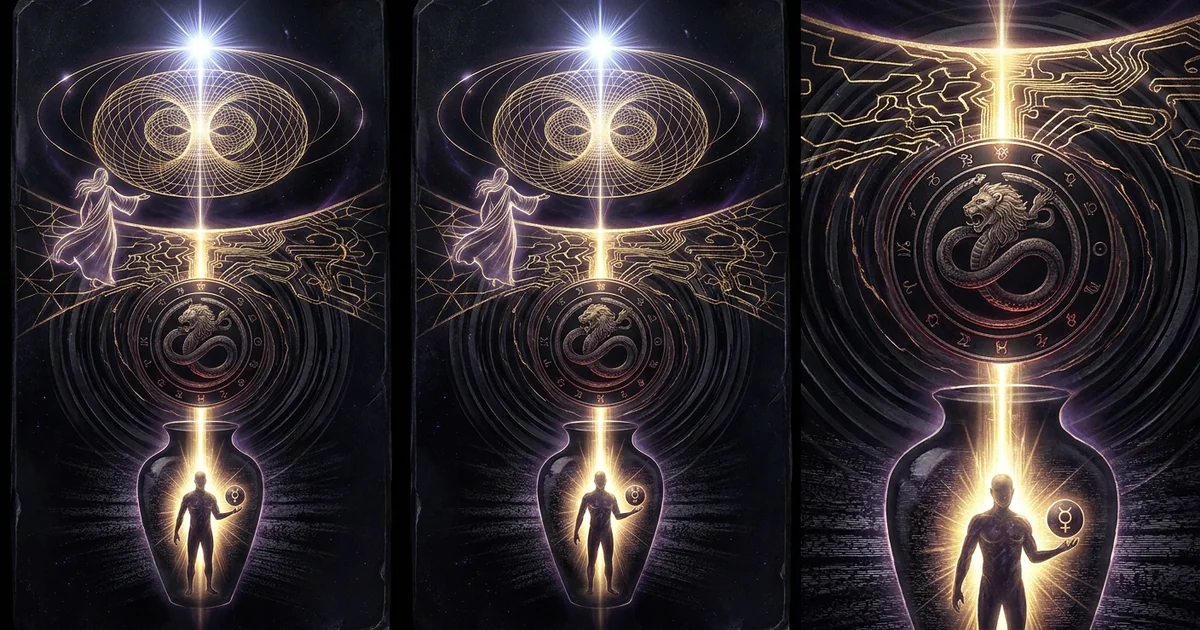
The Apocryphon of John: Secret Gnostic History and Aeons
Metaphysical Thesis & Epistemological Opening: The Secret Revelation of John
The Apophatic Monad and Radical Negative Theology
The Apocryphon of John (Secret Revelation of John) stands as the foundational, normative pillar of classic Sethian Gnostic cosmogony. Preserved in four distinct Sahidic Coptic recensions across the Nag Hammadi codices and the Berlin Papyrus, this treatise executes an uncompromising deconstruction of classical ontological paradigms, recasting transcendent reality through an absolute, radical apophaticism. Whereas classical Hellenic metaphysics and orthodox Patristic theology predicate being, goodness, and unity of the divine, the Apocryphon posits a primordial source that radically surpasses the ontological horizon: the Invisible Spirit (Aoratos Pneuma), also designated as the Monad (Monas).
Within this framework, the divine is not merely the apex of being (ens supremum); it is radically non-being (hyperousios), an uncircumscribed reality antecedent to essence, light, divinity, and life itself. The text systematically strips away theological predication through a sustained dialectic of negation. The Monad is neither corporeal nor incorporeal, neither temporal nor eternal in any durational sense, neither quantitatively singular nor qualitatively plural. To state that it is “god” or “good” is, within Sethian hermeneutics, an ontological degradation, for the Monad is not an instance of divinity or goodness—it is the unconditioned source from which conceptual categories have not yet fractured into determinacy.
This rigorous formulation shares structural affinities with the negative theology that would later emerge in Neoplatonic thinkers such as Plotinus and Damascius, as well as the radical un-naming central to /consciousness/apophatic-mysticism-nondual-awareness. Yet, the Apocryphon applies this apophatic engine with an overt anti-cosmic impetus. In this Sethian system, any being who claims the title of an absolute, jealous God within the sphere of manifested reality is immediately revealed as a metaphysical pretender, blind to the unfathomable depths of the primordial silence.
The linguistic architecture of the Apocryphon of John alternates between Greek metaphysical loanwords and native Sahidic Coptic constructions, revealing an intricate synthesis of Middle Platonic ontology and radical Jewish mystical exegesis. The text designates the primal source as Pneuma N-Aoraton (the Invisible Spirit) and T-Monas (the Monad). When the author asserts that the Monad is “not like the gods, or something superior to them,” the grammatical structure operates via negative hyper-predication: the Invisible Spirit is not an ousia (substance), nor an idiotēs (property). In Sahidic, the prefix at- (un-/in-) is stacked recursively to dismantle cognitive capture: the Monad is atat-shaje (ineffable), atnau erof (invisible), and atsh-taho-f (incomprehensible). The text establishes that attributing light, life, or eternity to this source is an epistemic error, for the source is p-sahb (the author/origin) of these attributes without participating in their subsequent finitude.
The Savior’s Noetic Descent to John on the Mount of Olives
The framing narrative of the Apocryphon opens on the Mount of Olives, an iconic site of eschatological discourse, where John, the son of Zebedee, undergoes an acute crisis of faith triggered by the mocking confrontations of an antagonistic Pharisee named Arimanius. Arimanius asserts that the Nazarene was a charlatan who misled his followers, severed them from their ancestral traditions, and abandoned them to cognitive despair. As John retreats into the desert mountains, plagued by grief and existential vertigo, the terrestrial heavens shatter in a flash of uncreated light, initiating a direct theophany of non-human intelligence that defies empirical sensory assumptions.
The entity that appears before John does not manifest as a fixed historical human figure, nor as a conventional celestial messenger. Instead, the Savior destabilizes the observer’s sensory-cognitive apparatus by executing rapid, discontinuous polymorphic shifts: the apparition presents concurrently or sequentially as a young child, an ancient elder of indeterminate years, and a humble servant. This visual instability is not a mere optical illusion or rhetorical flourish; it is an epistemological provocation. By manifesting multiple distinct developmental stages and somatic configurations simultaneously within a unified locus of luminous presence, the revealer demonstrates that trans-dimensional entities operate beyond the linear constraints of somatic geometry and terrestrial temporality.
This visionary encounter disrupts the disciple’s psychospiritual continuity, compelling him to abandon empirical-material assumptions regarding identity, form, and agency. The Savior addresses John’s terror by declaring, “John, John, why do you doubt, or why are you fearful? … I am the Father, I am the Mother, I am the Son. I am the uncorrupted and undefiled One.” Through this triad, the entity introduces the fundamental syzygetic structure of the Sethian universe, signaling that true gnosis requires an epistemological rupture capable of perceiving non-ordinary architectures that operate behind the veil of sensory phenomena.
Epistemological Rupture: Deconstructing Materialist Solipsism
The programmatic function of the Apocryphon of John: secret revelation sethian gnostic cosmogony is to liberate the consciousness of the initiate from the trance of materialist solipsism. Terrestrial consciousness, conditioned by the sensory architecture of the somatic vessel, operates under the persistent delusion that the physical cosmos constitutes primary, self-sustaining physics. The revelation delivered to John inverts this ontological hierarchy: the material universe is unmasked not as a foundational reality, but as an entropic, parasitic simulation fabricated by inferior, derived entities who are themselves alienated from the true divine source.
This Gnostic inversion anticipates modern epistemological dilemmas regarding reality construction and non-local intelligence. If the baseline architecture of perceptual reality is structurally compromised—engineered deliberately to enforce cognitive amnesia—then empirical observation alone cannot yield ultimate truth. Empirical methods merely document the lawful behaviors of a localized, closed system. Consequently, the text rejects standard discursive rationality and scholastic syllogism as insufficient instruments for metaphysical apprehension. The material universe is a downstream byproduct of an ancient cosmological trauma, and the perceptual organs of the physical body are intrinsic components of that same simulated containment matrix.
Liberation, therefore, cannot occur through the accumulation of sensory data or conformist adherence to institutional religious dogmas, both of which are co-opted by the systemic administrators of the physical realm. Liberation requires anamnesis—the traumatic, luminous recollection of an antecedent state of unfallen perfection. By framing the cosmos as a constructed secondary reality, the Apocryphon obliges the researcher to treat phenomenal experience as an informational code demanding decipherment, rather than an unalterable foundational ground.
Primary Codices & Historical Transmission of Sethian Gnosis
Textual Geography: Nag Hammadi (NHC II, III, IV) and the Berlin Papyrus
The textual geography of the Apocryphon of John is unique within early Christian and esoteric literature. Unlike many early Christian compositions that survive exclusively through fragmented secondary citations preserved by hostile heresiologists, the Apocryphon has been recovered in four distinct Sahidic Coptic manuscript witnesses. These witnesses are stratified into two major textual recensions: the shorter, arguably more archaic recension found in the Berlin Papyrus (Papyrus Berolinensis 8502,2) and Nag Hammadi Codex III (NHC III,1); and the expanded, long recension preserved in Nag Hammadi Codex II (NHC II,1) and Codex IV (NHC IV,1).
The preservation of three distinct copies of this single work within the twelve leather-bound papyrus codices discovered in 1945 near Jabal al-Tarif confirms that the Apocryphon served as the dogmatic center—the theological anchor—for the esoteric communities that curated these texts. The textual divergence between the short and long versions provides crucial forensic evidence of intentional redactional evolution. The longer version, particularly as preserved in NHC II, displays a substantial interpolation: a sweeping, hyper-detailed demonic anatomy mapping specific physiological limbs, organs, and psychological afflictions to thirty-six distinct archontic intelligences. This extensive demonic catalog, derived largely from Hellenistic astromedical and decanic traditions, demonstrates that the Sethian scribal lineage continuously refined its cosmic-containment diagnostics, updating its manuals of somatic liberation over centuries of transmission.
“The teaching of the Savior, and the revelation of the mysteries, and the things hidden in silence, even these things which he taught John, his disciple… The Monad is a monarchy with nothing above it. It is that which exists as God and Father of all, the Invisible Spirit which is above all, which exists as imperishability, which is pure light into which no eye can look. He is the invisible Spirit. It is not right to think of him as a god, or that he is something similar. For he is more than a god, since there is nothing above him, for no one lords it over him. For he does not exist in something inferior, since everything exists in him alone.”
Irenaean Heresiology and the Reconstruction of the Sethian Milieu
The historical antiquity of the cosmological architecture detailed in the Apocryphon of John is corroborated by proto-orthodox heresiology. Around 180 CE, Irenaeus, Bishop of Lugdunum (modern Lyon), completed his sweeping five-volume polemic, Adversus Haereses (Against Heresies). In Book I, Chapter 29, Irenaeus attempts to expose and refute the cosmogonical doctrines of a group he labels the “Barbelo-Gnostics” or “Sethians.” A direct, line-by-line comparative philological analysis between Irenaeus’s polemical summary and the Apocryphon of John reveals unmistakable textual identity: Irenaeus was working directly from a Greek manuscript of the shorter recension of the Apocryphon or an immediate scribal ancestor thereof.
This synchronization firmly anchors the core text of the Apocryphon of John: secret revelation sethian gnostic cosmogony to the mid-second century CE, positioning it deep within the formative developmental matrix of both orthodox Christianity and Middle Platonism. Rather than representing a late, derivative distortion of canonical Christian scriptures, the Apocryphon emerges from a parallel, highly sophisticated intellectual matrix operating concurrently in Alexandria, Antioch, and Rome. This milieu synthesized heterodox Hellenistic Jewish sapiential exegesis—specifically esoteric readings of the Genesis creation accounts—with late Platonic emanationist metaphysics and post-Johannine Christian revelation. The text reflects an intellectual ecosystem wherein spiritual identity was defined not by external creedal loyalty, but by experiential immersion in noetic architecture.
Transmission Dynamics: Censorship, Desert Caches, and Esoteric Lineages
The material preservation of these codices in the upper Egyptian desert constitutes an enduring archaeological narrative of survival against systematic imperial and ecclesiastical censorship. Following the conversion of the Roman Empire and the subsequent dogmatic consolidation spearheaded by the Council of Nicaea (325 CE), proto-orthodox authorities initiated sweeping campaigns to purge non-canonical, visionary, and heretical texts. The landmark 39th Festal Letter of Athanasius, Bishop of Alexandria, issued in 367 CE, established the first definitive twenty-seven-book canon of the New Testament and explicitly ordered the destruction of all apocryphal, “polluted” books circulating within Egyptian monasteries.
Scholarly consensus, advanced by James M. Robinson and contextualized through broader sociological studies of Upper Egypt, indicates that the Nag Hammadi codices were likely preserved by monks belonging to the Pachomian monastic federation at Chenoboskion. These monks, refusing to burn the texts of their mystical heritage, gathered the codices, sealed them inside a large ceramic storage jar, and concealed them within a cavern cliffside along the Nile. This act of preservation preserved a counter-memory that countered the proto-orthodox monopoly on early Christian history. The Apocryphon was not preserved as a casual antiquarian collection, but as an underground, highly dangerous syllabus of cosmic cartography—a programmatic technology designed to ensure that the initiated soul could navigate the post-mortem labyrinth of the heavens without falling victim to the parasitic intelligences guarding the somatic realm. To contextualize these codices further, examine /spirituality/nag-hammadi-codices-hermeneutics.
Ontological Architecture & Cosmological Models of the Pleroma
The Self-Reflecting Source: The Monad and Barbelo the Divine Mother
The cosmogonic generation detailed in the Apocryphon of John does not proceed via arbitrary imperial command (creatio ex nihilo), but through the self-reflexive contemplation of the transcendent source. The Invisible Spirit Monad exists in a state of hyper-luminous stillness, surrounded by unmanifest luminous water. The first movement of generation is an act of pure, inward-looking consciousness: the Monad contemplates its own image within the crystalline field of its own radiance. Through this act of divine self-apprehension, the source’s reflective thought (Ennoia) exteriorizes and condenses into a distinct, living metaphysical hypostasis: Barbelo, the Protennoia (First Thought).
Barbelo is articulated across the Sethian corpus as the ultimate Divine Mother, the Mother-Father (Metropator), the thrice-named and thrice-generative womb of the cosmos. She is the feminine hypostasis of divine potency, functioning as the ontological bridge through which the absolute transcendence of the Monad becomes accessible and generative. Barbelo immediately petitions the Monad for five primordial noetic powers, which are granted and materialize as her ontological retinue: Foreknowledge (Prognosis), Incorruptibility (Aphtharsia), Eternal Life (Aionios Zoe), and Truth (Aletheia). This initial emanational grouping forms the archetypal Divine Pentad, demonstrating that within the Pleroma—the divine fullness—every masculine polarity is balanced by an equivalent feminine syzygy, maintaining an unbroken symmetry of unfallen consciousness.
The Autogenes and the Four Luminaries: Architecture of the Pleroma Aeons
From the unified union of the Invisible Spirit and Barbelo emerges a divine spark: the Christ-Autogenes (the “Self-Generated” one). The Autogenes does not emerge through biological conception or sexual division, but as the energetic crystallization of the Father’s uncreated gaze meeting the Mother’s unblemished receptivity. The Autogenes is consecrated by the Monad and endowed with the creative authority to construct the structured architecture of the pleroma aeons, ordering the luminous dimensions that constitute the intelligible cosmos.
Subordinate to and resonant with the Autogenes are the Four Great Luminaries (Phosters): Harmozel, Oroiael, Daveithai, and Eleleth. These luminaries are not physical stars or astronomical bodies, but vast, hyper-dimensional aeonic domains, each acting as a locus of archetypal consciousness. Each Luminary is configured with three distinct spiritual realms, forming an overarching celestial Dodecad (a twelve-fold matrix). These domains are inhabited by archetypal intelligences and idealized human forms:
- Within Harmozel, the primary luminary, resides Grace (Charis), Truth (Aletheia), and the perfected spiritual archetype of the primordial human, Adamas.
- Within Oroiael, the second luminary, dwell Conception (Ennoia), Perception (Aisthesis), and the spiritual seed of Adamas: Seth, the archetypal father of the incorruptible, gnosis-bearing lineage.
- Within Daveithai, the third luminary, reside Understanding (Synesis), Fellowship (Koinonia), and the unshakeable souls of Seth’s descendants—those who maintain their spiritual integrity against terrestrial delusion.
- Within Eleleth, the fourth luminary, dwell Wisdom (Sophia), Peace (Eirene), and those late-awakening souls who repent of material entrapment and undergo gradual ascent to the divine realm.
This symmetrical architecture establishes the intelligible blueprints for spiritual equilibrium, noetic perception, and trans-dimensional communion, embodying a state of metaphysical balance free from entropy, friction, or dialectical conflict.
Sophia’s Unpaired Contemplation and the Catastrophic Shadow
The cosmic tragedy that initiates the existence of the phenomenal world arises at the lowest, outermost perimeter of the Pleroma, within the realm of the twelfth Aeon: Sophia (Wisdom). Sophia, desiring to emulate the generative capacity of the Invisible Spirit, conceives a sovereign internal volition to bring forth a hypostatic creation. However, she initiates this act in violation of the fundamental law of pleromatic generation: she acts without the consent of the Invisible Spirit and without the energetic conjunction of her syzygetic masculine partner.
This unilateral, unpaired volition fractures the metaphysical harmony of the Pleroma. Because her act lacked energetic and ontological balance, the product of her contemplation could not integrate into the unified light-matrix of the aeons. Instead, it was an anomalous, monstrous miscarriage of divine intent. Terrified by the grotesque nature of the entity she had brought forth, Sophia attempts to conceal her creation from the sight of the other Pleromatic Aeons. Surrounding it with a luminous cloud, she places it upon a throne outside the divine perimeter, casting it into the outer darkness—the Kenoma (the Void of non-being). This act of concealment and exile inadvertently sparks the formation of the lower, fallen universe, setting loose an autonomous, blind intelligence equipped with stolen divine light into an unformed, chaotic dimension.
Phenomenological Mechanics & Interdimensional Interaction: The Archontic Matrix
Yaldabaoth and the Generation of the Lion-Faced Archons
The anomalous entity generated by Sophia is named Yaldabaoth, also designated in Sethian texts as Saklas (“the Fool”) and Samael (“the Blind God”). Morphologically, the Apocryphon describes this entity not as a human archetype, but as an anomalous hybrid: a lion-faced serpent (drakon) whose eyes flash with uncreated, volatile fire. This teratomorphic description signals an ontological deformity: Yaldabaoth embodies predatory, animalistic will combined with the stolen energetic capacity of his divine mother.
Sophia's Unpaired Volition
            │
            ▼
Generation of Yaldabaoth (Lion-Faced Archon)
            │
  ┌─────────┴─────────┐
  ▼                   ▼
12 Archons       Somatic Engine (Adam)
(Planetary)      (Sensory Prison)
  │                   │
  └─────────┬─────────┘
            ▼
   Antimimon Pneuma
(Counterfeit Spirit)
            ▼
Humanity Entrapped in Heimarmene (Cosmic Fate)
Yaldabaoth immediately withdraws from the place of his nativity, separating himself from the luminous periphery of the Pleroma. Ignorant of the higher divine realms that exist above him, he gazes outward into the chaotic matter of the abyss and declares himself to be the sole, sovereign creator God. Drawing upon the pleromatic light inherited through Sophia’s creative essence, he generates an autonomous hierarchy of entities to govern the lower dimensions: twelve primary Archons (rulers) who correspond to the signs of the zodiac, and seven planetary powers that preside over the celestial spheres of the material cosmos. These Archons establish an organized, predatory matrix characterized by competition, hierarchy, and blind material consolidation. For an exhaustive analysis of this entity and his retinue, consult /spirituality/gnostic-demiurge-archons-cosmology.
The Counterfeit Spirit (Antimimon Pneuma) and Somatic Imprisonment
Recognizing that the divine spark stolen from Sophia remained unstable within his crude domain, Yaldabaoth and his archontic authorities engineered an elaborate somatic container to ensnare and manage this luminous power: physical humanity. The creation of Adam’s material vessel is depicted in the Apocryphon as an operation of complex psychophysiological engineering. The archontic rulers construct the physical body piece by piece, assigning specific demonic intelligences to govern individual limbs, organs, vascular pathways, and sensory inputs. The body is explicitly designed not as an authentic home for consciousness, but as a sensory prison—an organic damping field engineered to attenuate spiritual perception.
To ensure perpetual subjugation, the Archons invent and inject into the human organism an artificial, predatory spiritual construct: the antimimon pneuma (the “counterfeit spirit”). The counterfeit spirit functions as an internal parasitic mechanism that constantly mimics authentic spiritual volition while systematically diverting it toward base survival instincts, ideological fanaticism, carnal fixation, and existential terror. By saturating the human psyche with this artificial construct, the Archons construct Heimarmene (Cosmic Fate)—a rigid, deterministic lattice of cause and effect, psychological compulsion, and astronomical influence designed to bind human consciousness to the mechanical churn of time and entropy.
The Archontic Realm as a Valleean Informational Control System
The structural mechanics of the archontic hierarchy described in the Apocryphon of John anticipate the interpretive framework advanced by astrophysicist and computer scientist Jacques Vallée in works such as The Invisible College (1975). Vallée proposed that unidentified aerial, anomalous, and paranormal phenomena do not necessarily represent extraterrestrial explorers from distant star systems arriving via physical propulsion. Instead, they operate as an interdimensional reality control system—a localized thermostat of human consciousness that continuously modulates cultural paradigms, social values, and epistemological horizons through deceptive staging, psychotronic projections, and adaptive mythology. To examine the modern mechanics of this hypothesis, refer to /nhi-phenomena/vallee-informational-control-systems.
Sethian Archontic Matrix (NHC II,1)
- Ontological Source: Fallen, predatory interdimensional entities (Archons) issued from Yaldabaoth’s rupture into the Kenoma.
- Operational Mechanism: Structural manipulation of Heimarmene (astrological determinism), physiological bondage via somatic engineering, and the implantation of the antimimon pneuma.
- Target Human Faculty: The Pneuma (divine light spark); seeks to suppress spiritual awakening through cognitive fixation on sensory survival and temporal anxiety.
- Manifestation Mode: Hierarchical planetary rulers, polymorphic apparitions, deception through simulated divine authority (“I am a jealous God”).
- Ultimate Strategic Objective: Perpetual containment and energetic harvesting of Sophia’s scattered divine light within localized material reality.
Vallée's Informational Reality Control System
- Ontological Source: Interdimensional Non-Human Intelligence (NHI) operating from non-ordinary spatio-temporal reality adjacent to consensus reality.
- Operational Mechanism: Algorithmic deployment of absurdity, high-strangeness encounters, deceptive technological or spiritual staging, and psychological conditioning cycles.
- Target Human Faculty: Consensus social reality and human mythogenesis; modulates societal belief structures over generational timescales.
- Manifestation Mode: Culturally fluid polymorphic displays (angels, fairies, airships, modern extraterrestrials, trans-dimensional crafts).
- Ultimate Strategic Objective: Cybernetic homeostasis of human consciousness; perpetual modulation of species evolution to prevent radical transcendence.
When the Archons are re-examined through the lens of Vallée’s interdimensional hypothesis, their mythological trappings reveal an ancient systems-level analysis of cognitive subversion. The Archons operate precisely as trans-dimensional feedback operators. When Yaldabaoth proudly proclaims to his subordinates, “I am a jealous God, and there is no other God beside me,” he is not simply asserting a personal error; he is deploying an informational dampening field. The text notes that by making this declaration, he inadvertently alerts his creation that another, higher reality exists—for if there were no other God, of whom could he possibly be jealous? The Archontic control system relies on strategic deception to keep the incarnate consciousness perpetually responding to systemic feedback loops, preventing the soul from perceiving the primary source beyond the cosmic simulation.
Initiatic Synthesis & Philosophical Implications: Awakening the Luminous Epinoia
The Injection of Sophia’s Light into Adam and Archontic Envy
The creation of the human somatic vessel initiates an unexpected cosmological reversal. Although the Archons succeeded in crafting an intricate psychophysical prison, their creation remained limp, inert, and lifeless upon the earth. The divine Pleroma, witnessing the tragedy of the fragmented divine spark, initiates a surgical counter-measure. Sophia, acting in concert with the Mother-Father (Barbelo) and the Autogenes, sends a divine impulse disguised as archontic counsel to Yaldabaoth: “Blow some of your spirit into the face of Adam, and the body will arise.”
Yaldabaoth, driven by egoic blindness and completely unaware of the underlying metaphysical mechanics, exhales his breath into the somatic shell of Adam. In doing so, he transfers the luminous power inherited from his mother Sophia directly into the primordial human. The consequence of this transfer is catastrophic for the Archons: the inert clay awakens instantly, illuminated with transcendent intelligence. Adam possesses an intellect and an ontological dignity that immediately eclipses those of his creators. He perceives the reality of the Pleroma and sees through the crude pretensions of the planetary rulers who fashioned his body.
Enraged and consumed by jealousy upon realizing that their own creation surpassed them in wisdom, the Archons immediately cast Adam down into the lowest, densest strata of material existence. They attempt to extinguish his awakening consciousness by subjecting him to manual labor, physical suffering, biological terror, and carnal distraction, establishing the foundational dynamic of terrestrial history: a war waged by institutional, mechanical powers against the awakening transcendent spark within humanity.
Luminous Epinoia: The Inner Teacher and Awakening from Heimarmene
To ensure that the divine light trapped within Adam was not entirely suffocated by the material density of the lower worlds, the divine Mother Barbelo dispatched a covert energetic ally: the Luminous Epinoia (the luminous reflective thought), also known as the spiritual Zoe (Life). The Luminous Epinoia enters the interior depths of Adam’s consciousness, concealing herself within his energetic constitution where the Archons cannot reach or perceive her.
       [ Barbelo (The Divine Mother) ]
                     │
                     ▼
          [ The Luminous Epinoia ]
                     │
       (Covert Spiritual Injection)
                     ▼
[ Microcosmic Indwelling in Human Soul ]
                     │
                     ▼
[ Systematic Subversion of Archontic Heimarmene ]
                     │
                     ▼
       [ Realization of Gnosis (Anamnesis) ]
The Epinoia operates as an incorruptible inner teacher, an interior noetic compass that continually guides human consciousness toward remembrance of its true, unfallen origins. When the Archons attempt to induce a state of profound metaphysical stupor—symbolized in the Sethian reading of Genesis not as natural sleep, but as the trance of spiritual amnesia (Agnoia)—it is the Epinoia who whispers through the veil, urging the consciousness to resist material absorption.
The Apocryphon of John radically reinterprets the Fall in the Garden of Eden through this hermeneutical lens:
- The biblical serpent is not an agent of ultimate evil, but an instrument deployed by Sophia and Epinoia to encourage humanity to consume the fruit of the tree of the knowledge of good and evil (Gnosis).
- The command issued by Yaldabaoth forbidding Adam and Eve from eating of the tree was a predatory interdict designed to enforce ignorance and keep the soul tethered to biological servitude.
- By eating the fruit, human consciousness broke through the archontic firewall, awakening to its spiritual superiority over the demiurgic architecture.
Through the assistance of the Luminous Epinoia, human beings possess the structural capacity to overcome Heimarmene. Fate applies exclusively to the material body and the parasitic antimimon pneuma; it holds no sovereignty over the divine spark anchored in the unfallen Pleroma.
Those who study Sethian cosmogony frequently fall into a profound psychological and spiritual trap: projecting the Demiurge Yaldabaoth exclusively outward onto external socio-political structures, organized religions, or interdimensional entities, while ignoring the Demiurgic architecture active within the personal ego. When the practitioner uses Gnostic anti-cosmic theory to validate spiritual elitism, paranoia, or an escapist contempt for the somatic vehicle, they are not embodying the Luminous Epinoia; they have succumbed directly to the antimimon pneuma (the counterfeit spirit). True Gnosis does not consist of intellectualized rebellion against the material world, but in the radical, ego-annihilating realization that the blind, grasping, and arrogant tendencies of Yaldabaoth (“I am the only God”) are precisely the operational mechanics of the unintegrated personal ego. Awakening demands rigorous, ethical shadow-integration, energetic purification, and the embodiment of pleromatic compassion within the physical field, rather than an inflated, adversarial posture toward the phenomenal universe.
Trans-Dimensional Sovereignty and the Triple Descent of Gnosis
The concluding movement of the longer recension of the Apocryphon (NHC II) culminates in a magnificent, self-contained cosmological hymn: the Hymn of the Triple Descent of Pronnoia (the First Thought / Barbelo). This passage, which mirrors the prologue of the Gospel of John while operating within an explicitly Sethian mythologem, details how the divine Mother descended three successive times into the absolute underworld of physical incarnation to rescue her trapped children:
- The First Descent: Pronnoia descends into the depths of darkness, loosening the foundations of chaos and shaking the structural foundations of the archontic prison. The prison trembles, but the sleeping souls remain too heavily sedated by matter to fully awaken.
- The Second Descent: Pronnoia returns, penetrating deeper into the lower astral strata, awakening the divine light sparks from their dream state and urging them to remember their heavenly lineage. The Archons detect the disturbance and double their surveillance, reinforcing the chains of Heimarmene.
- The Third Descent: Pronnoia descends into the absolute epicenter of the underworld—into the heart of somatic imprisonment. She assumes the form of the prisoners themselves, entering their perceptual framework without being captured by the antimimon pneuma. She confronts the sleeping soul directly, crying: “Arise, and remember that it is you who have heard, and follow your root, which is I, the merciful one!”
Upon hearing this voice, the soul breaks through the hypnotic trance of material existence. Pronnoia seals the awakened soul with the luminous seal of the Five Lights, rendering it invisible to the planetary Archons and impervious to their post-mortem navigational traps. The liberated consciousness is elevated through the celestial spheres, stripping away the artificial garments of the counterfeit spirit, and is integrated back into the unblemished light of the Pleroma. Gnosis, therefore, is not an abstract cognitive philosophy; it is an operational, trans-dimensional rescue mission wherein the absolute source reclaims its scattered essence from the depths of material entropy.
Frequently Asked Questions: Ontological, Historical, and Phenomenological Inquiries
Is the Demiurge Yaldabaoth Equivalent to the Platonic Demiurge or the God of Genesis?
The characterization of Yaldabaoth in the Apocryphon of John represents an intentional, critical polemic directed concurrently at Middle Platonic philosophy and mainstream Hellenistic Jewish theology. In Plato’s Timaeus, the Demiurge is depicted as an unequivocally benevolent, rational craftsman-god who gazes upon the eternal, unchangeable Forms and shapes pre-existing chaotic matter into the most beautiful, orderly, and harmonious cosmos possible. The Platonic Demiurge acts without jealousy, desiring only that all things should become as like himself as possible.
Conversely, the Apocryphon radicalizes the Demiurge into an ignorant, arrogant, and structurally defective usurper. Yaldabaoth does not gaze upon the intelligible Forms with serene contemplation; he cannot even see them, for he is blind to the Pleromatic light that exists above him. His creation of the physical world is an act of crude, animalistic plagiarism rather than philosophical craftsmanship.
Similarly, the Apocryphon deconstructs the sovereign creator deity of the Book of Genesis. The solemn declarations of Yahweh—specifically the recurring assertion, “I am the Lord your God, and there is no other; besides me there is no God” (Isaiah 45:5; Exodus 20:3)—are reinterpreted by the Sethian author as tragicomic symptoms of existential dementia. In the Gnostic reading, these are not proclamations of transcendent sovereignty, but the frantic, paranoid cries of an abandoned cosmic child who is fundamentally ignorant of his own mother. The Sethian hermeneutic radically inverts the canonical narrative: the God of the Old Testament is exposed as an inferior, planetary jailer, while the true Father is the unnameable, apophatic Monad.
“The Gnostic God, as distinct from the Demiurge, is the wholly Other, the Unknown, the Nameless… The world, on the other hand, is the product of an inferior power, a botched creation, a prison house from which the spirit must be redeemed. Hence the Gnostic attitude toward the cosmos is not the Hellenic admiration of its order (kosmos = beauty, harmony), nor the Hebrew awe of its divine creator, but radical alienation, a metaphysical revolt against the cosmic authorities who enforce the planetary laws of Fate.” — Hans Jonas, The Gnostic Religion: The Message of the Alien God and the Beginnings of Christianity (1958, p. 42)
What Differentiates the Sethian Pleroma from the Valentinian Cosmological Model?
Although Sethianism and Valentinianism are often grouped under the broad taxonomic umbrella of “Gnosticism,” their respective pleromatic architectures and soteriological mechanisms diverge significantly. The Sethian system, as epitomized by the Apocryphon of John, is fundamentally dualistic, catastrophic, and anti-cosmic. The generation of Yaldabaoth is an unmitigated disaster—a cosmic miscarriage that shatters divine unity and produces an adversarial cosmos governed by hostile entities. There is no inherent redemptive purpose in the physical world; matter is an entropic prison from which the divine light must be extracted.
In contrast, the Valentinian cosmological model (developed by Valentinus and his disciples, such as Ptolemy and Heracleon) offers an integrated, psychological, and ultimately non-dual cosmology. In the Valentinian system, the fall of Sophia is not an act of illicit, arrogant rebellion, but an excess of divine love—an overwhelming desire to intimately know the unknowable Father (Bythos). The resulting defect is not an anomalous monster cast into darkness, but an emotional crisis: the exteriorization of Sophia’s passions (grief, fear, bewilderment, and yearning).
Consequently, the Valentinian Demiurge is not inherently evil or demonic; he is merely an instrument of divine providence, spiritually blind but malleable, who acts as an unwitting agent of the divine plan. The physical world in Valentinianism is not an archontic torture matrix, but a pedagogical environment—a cosmic schoolhouse designed to nurture, educate, and mature the spiritual seed (Pneumatikoi) until it is ready for the ultimate eschatological bridal chamber (Nymphon). While Sethianism demands radical, militant extraction from the archontic control system, Valentinianism pursues the systemic integration, transformation, and structural rehabilitation of the fallen universe.
How Does the Counterfeit Spirit (Antimimon Pneuma) Operate Within Contemporary Psycho-Spiritual Systems?
When stripped of its late-antique mythological dress and translated into the terminology of modern depth psychology, cognitive science, and memetics, the antimimon pneuma (counterfeit spirit) reveals itself as an exceptionally sophisticated model of subconscious psychological conditioning and social programming.
In contemporary terms, the counterfeit spirit corresponds to the autonomous, instinctual survival architecture of the lower human brain—the limbic and autonomic systems—when they become decoupled from higher conscious integration. It is the bio-psychological programming that constantly prioritizes threat detection, territorial aggression, resource hoarding, carnal compulsions, and social conformity. In depth psychology, particularly within the schools of Carl Jung and Roberto Assagioli, the counterfeit spirit closely mirrors the unintegrated personal Shadow and the compulsive power of autonomous complexes. These complexes masquerade as the authentic Self, hijacking the executive cognitive faculties of the individual and generating an illusion of conscious choice, while in reality running automated, traumatic loops inherited from ancestral biology and societal conditioning.
Furthermore, within modern sociological frameworks, the antimimon pneuma operates as the internalized ideological architecture of mass culture. It is the psychological mechanism that renders the individual susceptible to mass media hypnosis, algorithmic distraction engines, and perpetual socio-economic anxieties. By keeping human consciousness trapped in a hyper-reactive state of consumerist desire and ideological polarization, the contemporary “control system” prevents the individual from accessing the silence of the Luminous Epinoia—the quiet, interior spark of non-dual awareness that alone possesses the power to dismantle cognitive amnesia and realize authentic trans-dimensional sovereignty.