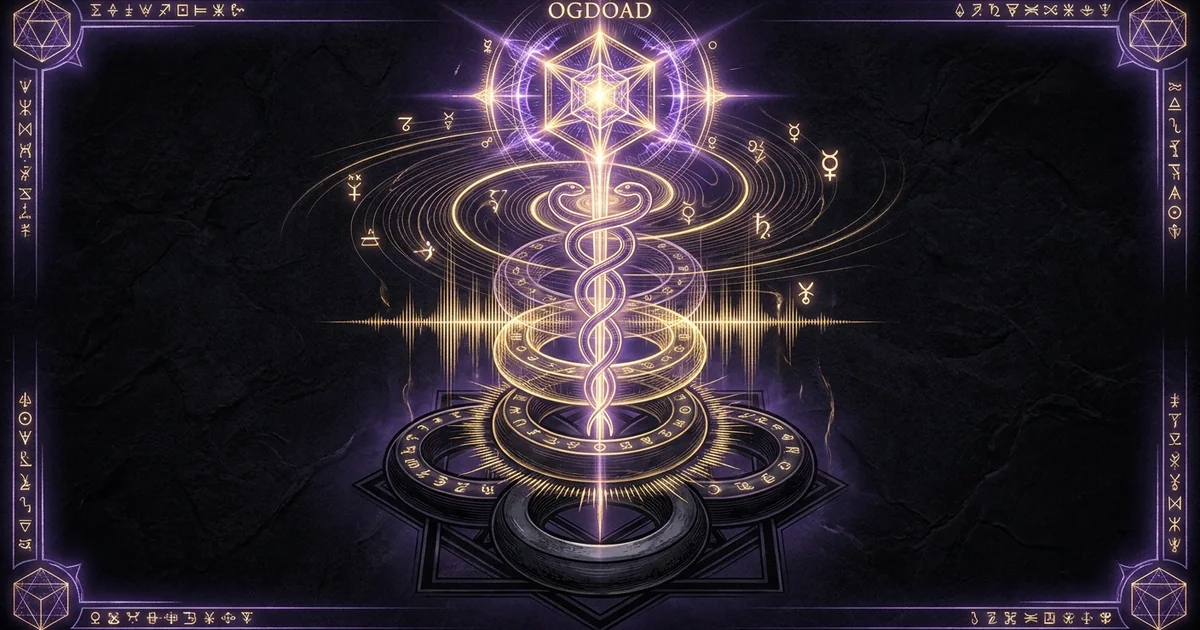
The Divine Nous: Transcending Seven Planetary Spheres Flow
Metaphysical Thesis & Epistemological Opening: The Noetic Rupture of Cosmic Determinism
The foundational crisis of Hellenistic anthropology does not stem from mortality alone, but from the terrifying realization of ontological imprisonment. Within the syncretic crucible of Graeco-Egyptian Alexandria, late antique thinkers encountered a cosmos that was neither an open horizon of divine grace nor an indifferent void, but rather a hyper-structured, concentric apparatus of energetic subjugation. Central to this cosmogenetic anxiety is the operational dynamic of heimarmene (cosmic fate)—an unyielding metaphysical architecture orchestrated through the rotational revolutions of the seven planetary spheres. Under this paradigm, humanity does not merely dwell beneath the stars; human consciousness is actively synthesized, conditioned, and bound by their vibrational mechanics.
Yet, embedded within the primary treatises of the Corpus Hermeticum, there persists a revolutionary counter-doctrine: the presence within the human individual of an uncreated, trans-dimensional essence known as the Divine Nous. The spiritual path articulated across these lineages does not advocate passive resignation or quietist surrender to cosmic law. Rather, it demands an operational anabasis—an ontological ascension wherein the awakened consciousness systematically decouples itself from the celestial machinery. By ascending through the seven planetary spheres, the adept does not simply escape matter; they intentionally dissolve the energetic cords of astrological determinism, breaking through the celestial boundary into the trans-cosmic realm of the Ogdoad.
The term heimarmene (εἱμαρμένη), deriving from meiromai (to receive one’s allocated portion or lot), underwent an ontological shift from archaic Homeric fatalism to a mechanistic technology of celestial subjugation in Hellenistic esotericism. Within the Hermetic framework, heimarmene is the energetic governance exerted by the planetary Hebdomad over the somatic (soma) and psychic (psyche) vehicles of the incarnated individual.
Unlike the Stoic conception, which embraced heimarmene as the benevolent, rational providence (pronoia) of the Logos, Hermeticism views it as an energetic enclosure. Crucially, it also diverges from radical Sethian Gnosticism, which viewed the planetary rulers as demonic entities born of an aborted ignorance. Hermetic heimarmene is an intrinsic, lawful property of the generated cosmos—neither intrinsically evil nor ultimately absolute. It represents a closed-loop cybernetic feedback system that regulates material stability, yet possesses an ontological boundary permeable exclusively to the sovereign, uncreated agency of the Divine Nous.
Heimarmene: The Astrological Matrix and Mechanistic Enclosure
To comprehend the imperative of the ascent, one must first confront the metaphysical mechanics of the enclosure. The sublunary world is not fundamentally governed by human intent or localized terrestrial causality. Instead, it operates as the baseline receiver of the celestial emanations generated by the planetary hebdomad (the seven traditional rulers: Moon, Mercury, Venus, Sun, Mars, Jupiter, and Saturn). Each concentric sphere, rotating with its specific geometric velocity and mathematical harmonic, continuously casts an energetic web—a lattice of causal necessity—over all composite bodies.
This celestial architecture functions as a multi-layered filter. As the spiritual Anthropos (the archetypal human essence) descended through the planetary rings toward material generation, it did not arrive unadorned. According to the foundational cosmology preserved in the Alexandrian schools, the descending soul intersects each planetary horizon, mechanically accumulating successive energetic sheaths or garments (chitones). These sheaths are composed of the specific cosmic qualities of each sphere: biological growth and decay from the Moon, deceptive articulacy from Mercury, erotic and gravitational appetites from Venus, imperial vanity from the Sun, violent wrath from Mars, grasping covetousness from Jupiter, and cold, calcifying inertia from Saturn.
Consequently, incarnate man is an ontologically composite entity: a divine spark of pure spirit wrapped in an astral chassis, which is subsequently anchored within a dense physical form. The mechanism of heimarmene does not act directly upon the divine core; it acts upon the astral and physical interfaces. By modulating the passions, somatic instincts, and psychological propensities encoded within these acquired planetary coats, the planetary governors execute total behavioral determinism over the unawakened human subject. The mundane self is fundamentally a planetary puppet, reacting mechanistically to the subtle shifts of the cosmological apparatus.
Nous as Uncreated Trans-Dimensional Agency
Liberation from this determinism becomes possible only because the human being possesses an ontological component that predates the construction of the planetary apparatus itself: the Divine Nous. As articulated across the internal architecture of /spirituality/corpus-hermeticum-gnosis, Nous is not equivalent to discursive intellect (dianoia), rational computation (logismos), or neurochemical cognition. It is uncreated, unconditioned, hyper-dimensional awareness—the unfragmented mind of the Supreme Father refracted directly into the individual.
While the physical body belongs to the earth (ge) and the energetic psyche belongs to the celestial spheres (sphairai), the Divine Nous originates directly from the trans-cosmic source beyond the celestial spheres. It is of identical essence (homoousios) with the primal light-power that initially spoke the universe into existence. Because it does not derive its substance from the seven planetary spheres, it stands radically outside their causal jurisdiction.
The tragic condition of the uninitiated individual resides in the fact that the Nous lies dormant, submerged beneath the deafening sensory clamor of the planetary vestures. When consciousness identifies entirely with its somatic-astral vehicles, it falls under the absolute jurisdiction of cosmic fate. The soul becomes blind to its hyper-cosmic origin, accepting the planetary parameters as the sole horizon of reality. Yet, the moment the individual undergoes noetic awakening, the ontological hierarchy reasserts itself. The Divine Nous recognizes its ontological superiority over the cosmos, sparking the realization that the planetary spheres are not absolute metaphysical ceilings, but traversable energetic gates.
The Anabatic Paradigm: Subverting Planetary Governance
The dissolution of astrological fate demands a methodological, dynamic traversal: an operational anabasis (ascent). This anabatic paradigm stands in sharp opposition to any theology that advocates passive reliance on outer intervention or post-mortem grace. The Hermetic initiate understands that because the descent (katabasis) was an actual, ontological entanglement with the seven layers of cosmic structure, the return must be an equally structured, operational journey of untangling.
This process, examined in detail through /consciousness/noetic-transcendence-mechanics, constitutes a deliberate assault upon the boundaries of cosmic law. To ascend through the seven planetary spheres is to perform an energetic deconstruction of the personal ego. The adept cannot force their way past the planetary guardians through sheer willpower or mundane intellectual cleverness; the guardians—the energetic wardens of each sphere—demand the surrender of the specific passions and astral garments originally granted during the soul’s incarnation.
Ascension is not the conquest of the planets, but an act of restorative justice: returning to each cosmic level the energetic density that belongs to it. By stripping away these borrowed signatures, the Divine Nous progressively disarms the planetary mechanisms of heimarmene. When there is no planetary matter left within the subtle anatomy of the adept to hook into, the cosmic machinery ceases to have any causal grip upon the soul. The anabatic vector thus transforms the soul from a passive object of astrological manipulation into an active, trans-dimensional agent moving inexorably toward the threshold of the Ogdoad.
Primary Codices & Historical Transmission: Alexandrian Hermetica to the Coptic Gnostic Library
The technical mechanics governing this planetary ascent are neither allegorical poetry nor speculative philosophy; they were preserved as precise, experiential rituals across the textual legacy of Late Antiquity. The two primary pillars documenting this celestial ascent are Tractate I (Poimandres) of the Greek Corpus Hermeticum and the Coptic Hermetic treatise The Discourse on the Eighth and Ninth discovered among the non-canonical codices of Upper Egypt.
Corpus Hermeticum I.24–26 (Codex Laurentianus LXXI, 33 / Tr. Walter Scott & B. Copenhaver collated):
“καὶ οὕτως ὁρμᾷ λοιπὸν ἄνω διὰ τῆς ἁρμονίας, καὶ τῇ πρώτῃ ζώνῃ δίδωσι τὴν αὐξητικὴν ἐνέργειαν καὶ τὴν μειωτικήν, καὶ τῇ δευτέρᾳ τὴν μηχανὴν τῶν κακῶν, δόλον ἀνενέργητον… καὶ τότε γυμνωθεὶς ἀπὸ τῶν τῆς ἁρμονίας ἐνεργημάτων γίνεται ἐπὶ τὴν ὀγδοατικὴν φύσιν, τὴν ἰδίαν δύναμιν ἔχων, καὶ ὑμνεῖ σὺν τοῖς οὖσι τὸν πατέρα.”
"And thereafter the human being rushes upward through the cosmic harmony. To the first zone [the Moon] he surrenders the energy of growth and waning; to the second zone [Mercury], the machinations of evil, a cunning stripped of its power; to the third [Venus], the lustful deception that has been rendered ineffective; to the fourth [the Sun], the arrogance of command, stripped of ambition; to the fifth [Mars], unholy audacity and rash confidence; to the sixth [Jupiter], evil striving after wealth, rendered barren; and to the seventh zone [Saturn], the falsehood that lies in wait.
And then, stripped of all the operations of the celestial harmony, he enters into the Ogdoadic nature, retaining only his own proper power, and alongside those who dwell there, he sings hymns to the Father."
Poimandres (CH I) and the Geometry of the Seven Governors
In the Poimandres, the visionary manifestation of the supreme Mind reveals to Hermes the primordial cosmogony and the precise mechanism of individual liberation. The text establishes that the Demiurgic Mind, working in concert with the Word (Logos), formed the seven governors within their concentric crystalline orbs, encompassing the sensible world within their cycles. The human tragedy initiates when the archetypal Man (Anthropos), peering through the cosmic framework, becomes enraptured by the reflection of divine form cast upon the waters of primeval nature (physis).
The descent is marked by an asymmetrical cosmological convergence: Nature embraces the Anthropos, and the Anthropos voluntarily takes on the energetic and structural qualities of the seven governors, who eagerly share their particular qualities with their divine brother. Consequently, physical incarnation is defined as an entrapment within the planetary harmony (harmonia), an ambiguous Hermetic term denoting both the geometric order of the spheres and the deterministic, interlocking mechanism of heimarmene.
The climax of the Poimandres (sections 24–26) outlines the reverse operation with surgical clarity. The dissolution of death serves as the natural catalyst for this ascension, but within the esoteric reading preserved by the Alexandrian adepts, this post-mortem ascent was anticipated and ritually enacted during life through noetic realization. The adept must ascend through the seven zones, presenting at each celestial checkpoint the specific energetic vice received during the primordial descent, effectively neutralizing the identity markers that allow the cosmos to categorize and retain the soul.
The Discourse on the Eighth and Ninth (NHC VI, 6) as Experiential Anabasis
The discovery of the Nag Hammadi library in 1945 decisively shattered the long-standing scholarly assumption—largely championed by early twentieth-century philologists like André-Jean Festugière—that Hermeticism was merely a “reading religion” (Buchreligion), an intellectualized collection of eclectic texts lacking practical ritual grounding. Within Nag Hammadi Codex VI, tractate 6, titled /spirituality/nag-hammadi-discourse-eighth-ninth, scholars encountered an explicitly operational, liturgical manual detailing the ecstatic ascent of an initiate guided by Hermes Trismegistus.
The Coptic text abandons abstract cosmological dialectic in favor of real-time visionary theurgy. Hermes leads his spiritual son beyond the planetary spheres directly into the Ogdoad (the eighth sphere of the fixed stars) and subsequently grants him a vision of the Ennead (the ninth sphere, the divine realm beyond physical manifestation). The document provides concrete evidence that late antique Hermetic communities practiced advanced methodologies of ecstatic altered states of consciousness, using glossolalia, vowel-intonation formulas, and energetic transits to breach the planetary spheres while the physical body remained immobilized in trance.
The text’s dialogue preserves the precise moment of cosmic egress. As the adept transcends the seventh sphere, he exclaims that he sees the universal choir of the Ogdoad and the divine light of the Ennead, declaring: “I see the Mind, and I have seen an uncreated realm… I have found the beginning of the power that is above all powers, the one that has no beginning.” Here, the anabasis is definitively validated not as a philosophical metaphor for moral improvement, but as a direct, empirical rupture of dimensional space-time, enabling the initiate to step outside the planetary matrix while still embodied.
Transmission Dynamics: From Hellenistic Egypt to Renaissance Theurgy
The continuity of this trans-planetary science underwent severe systemic disruption as the intellectual infrastructure of the classical world collapsed. In the Latin West, direct contact with the primary Greek Hermetic texts was severed for nearly a millennium, leaving only the Asclepius (preserved in Latin via pseudo-Apuleius) to hint at the profound cosmogonic framework of the early Egyptian lodges. The detailed mechanics of the ascent through the seven governors were largely obscured, survival dependent on the preservation and ongoing development of these manuscripts within the Eastern Roman (Byzantine) empire and the Islamic esoteric tradition of the Harranians (Sabians) and early Sufi philosophers such as Suhrawardi.
The rediscovery of the Corpus Hermeticum occurred in 1460, when the monk Leonardo da Pistoia delivered a Byzantine manuscript containing fourteen tractates to Cosimo de’ Medici in Florence. Marsilio Ficino’s immediate Latin translation sparked the intellectual firestorm of the Renaissance, but with a critical mutation: the strict, anabatic stripping of the planetary passions was transformed into a system of sympathetic magic and psychological synthesis.
Ficino, operating under the ever-watchful gaze of the Roman Inquisition, reframed the planetary spheres. Rather than viewing them as an energetic prison (heimarmene) requiring systematic deconstruction, Ficino’s De Vita Triplici utilized planetary correspondences to attract favorable celestial influences (spiritus) to harmonize the melancholic temperament of the scholar. It was not until the radical, uncompromised cosmological treatises of Giordano Bruno that the trans-planetary impetus reemerged in its full, dangerous glory. Bruno re-envisioned the Hermetic nous as an infinite, unconditioned agent capable of breaking through the crystalline celestial spheres entirely, tearing down the boundary between the sublunary realm and the divine infinity—an ontological boldness for which he was burned at the stake in 1600.
Ontological Architecture & Cosmological Models: The Septenary Mechanism of Entrapment
To systematically dissect how the Divine Nous achieves its liberation, the cosmological scaffolding of the Ptolemaic-Hermetic universe must be understood not as primitive astronomy, but as an informational control system operating across distinct metaphysical dimensions. The concentric architecture of the ancient cosmos was an absolute metaphysical map: seven internal gates, one enclosing firmament, and an absolute trans-spatial source.
The Seven Governors: Planetary Spheres as Cybernetic Regulators
The planetary spheres are described in Hermetic treatises as archontes (rulers) or dioikētai (administrators). Each governor acts as a specialized frequency modulator within the cosmic whole. In the operational model of late antiquity, these celestial spheres were not understood as empty physical space containing isolated planetary orbs, but as interpenetrating, continuous crystalline strata—dimensional densities that encompass the sublunary earth.
When examined through the modern lens of /nhi-phenomena/vallee-control-systems, this ancient framework exhibits the definitive hallmarks of an informational control matrix. The astrophysicist and computer scientist Jacques Vallée proposed that human consciousness across historical epochs has been conditioned, constrained, and modulated by an omnipresent, non-human informational mechanism that masquerades as the cultural mythology of the era. The planetary Hebdomad of Hermeticism functions precisely as such an informational system. It is a cosmic feedback loop that maintains the structural continuity of the physical universe by circumscribing human conceptual, psychological, and biological possibilities.
The planetary governors regulate the dimensional boundaries through the energetic emission of the stoicheia (elements and basic principles). Each sphere reinforces a particular distortion of consciousness:
- The Lunar sphere governs the cycling of moisture, somatic incarnation, cellular decay, and the unconscious instinctual drive.
- The Mercurial sphere governs structural linguistic patterns, formalistic rationality, trade, and the deceptive fragmentation of unified meaning into competitive semantics.
- The Venusian sphere injects the continuous agitation of desire, the pursuit of somatic pleasure, and the projection of ideal forms onto impermanent physical envelopes.
- The Solar sphere establishes the illusions of linear time, chronological authority, egoic identity, and the thirst for centralized dominion.
- The Martial sphere projects the polarizing forces of discord, defensive aggression, reactive terror, and destructive dynamism.
- The Jovian sphere regulates social hierarchy, the impulse toward boundless systemic accumulation, self-righteous moralization, and bureaucratic institutionalization.
- The Saturnian sphere, acting as the outermost planetary barrier, projects structural limitation, spatial boundaries, physical density, chronic depression, and physical death.
Together, these seven interlocking regulators generate a closed experiential environment. Consciousness, continuously reacting to these seven energetic inputs, remains perpetually trapped in a state of autonomic stimulus-response, mistaking planetary programming for autonomous personal identity.
Emanational Physics: Energetic Densification Across the Spheres
The Hermetic cosmos operates upon a rigorous physics of emanational degradation. The Supreme Source does not directly fashion dense matter; rather, the divine energy cascades down through descending metaphysical levels, undergoing progressive densification at each planetary threshold. This process mirrors the Neoplatonic concepts of proodos (procession) and mone (remaining), but emphasizes the energetic friction generated by the celestial spheres.
As the divine light descends from the supra-cosmic source, it is refracted through the planetary governors. Each sphere operates as an energetic sieve, cooling, condensing, and polarizing the divine emanation. By the time this energy reaches the center—the sublunary earth—it has lost its frictionless, unconditioned quality and has calcified into the four dense terrestrial elements: fire, air, water, and earth. Matter, therefore, is not an independent substance existing in opposition to spirit; it is hyper-densified spirit, trapped in a state of maximum structural inertia governed by the mechanics of the planetary rulers.
[ Pleromatic Light: Pure Trans-Spatial Consciousness ]
                        |  (Degradation & Refraction)
                        v
[ Saturn: Temporal Coagulation ]
                        v
[ Jupiter: Expansive Ideation ]
                        v
[ Mars: Energetic Friction ]
                        v
[ Sun: Formal Metric Organization ]
                        v
[ Venus: Attractive Cohesion ]
                        v
[ Mercury: Structural Articulation ]
                        v
[ Moon: Somatic Materialization ]
                        v
[ Sublunary Realm: Four Dense Elements / Material Entrapment ]
When a human soul descends into this emanational cascade, it undergoes what ancient esoteric commentators termed amnesia—a progressive forgetting of its transcendent origin. The soul absorbs the energetic pollution of each successive sphere, accumulating an astral density that drags it inexorably down into somatic birth. The physical body functions as the anchor point of this chain, the terminal receiver where all seven planetary frequencies converge to lock the divine spark in a state of metaphysical amnesia.
The Threshold of the Ogdoad: The Boundary of the Fixed Stars
The critical breaking point in this cosmological model is the sphere of the fixed stars: the Ogdoad (the eighth sphere). In ancient astronomy, while the seven wandering planets moved across the sky in complex, seemingly erratic retrogradations, the fixed stars remained immutably locked in their constellations, rotating as an undivided whole around the celestial pole.
Metaphysically, the Ogdoad serves as the ontological event horizon separating Chronos (cyclical, planetary time) from Aion (divine eternity). The planetary spheres represent the realm of perpetual becoming, alteration, decay, and conflict. The eighth sphere represents the realm of true being, spatial integration, and divine stability. It is the boundary wall of the created universe.
Beyond the Ogdoad lies the Ennead (the ninth sphere, associated with the pure archetypal realms of the intelligible world) and the Absolute Pleroma—the infinite, unmanifest divine fullness. The Ogdoad is the threshold where cosmic architecture ends and unconditioned divinity begins. To reach the Ogdoad is to escape the jurisdiction of the planetary rulers entirely. Once the consciousness of the initiate crosses the threshold of the eighth sphere, the deterministic laws of heimarmene collapse; the soul is no longer a subject of the cosmos, but an integrated participant in divine sovereignty.
Phenomenological Mechanics & Interdimensional Interaction: The Stripping of Planetary Passions
The process of planetary ascension is fundamentally a rigorous phenomenological practice. The ascent does not entail physical translation through astronomical space; rather, it requires the adept to travel through the internal landscape of their own subtle anatomy, progressively decoupling consciousness from the seven planetary resonance patterns that constitute the conditioned self.
The Hebdomadic Accretions (Surrendered)
- 1st Sphere (Moon): Somatic compulsion; autonomic biological growth and decay; subconscious terror of mortality.
- 2nd Sphere (Mercury): Intellectual manipulation; sophistry; fragmented analytical craftiness; discursive deception.
- 3rd Sphere (Venus): Projective lust; emotional dependency; aesthetic fixation; the insatiable hunger for union with external forms.
- 4th Sphere (Sun): Centralized ego-inflation; imperial pride; the compulsion to dominate and seek external validation.
- 5th Sphere (Mars): Reactance; violent assertion; competitive destruction; paranoia and warlike audacity.
- 6th Sphere (Jupiter): Boundless acquisitiveness; social hypocrisy; institutional greed; self-aggrandizing moral posturing.
- 7th Sphere (Saturn): Existential inertia; calcified dread; temporal despair; insidious lethargy and deceitful silence.
The Ogdoadic Virtues (Realized)
- 1st Sphere Transformation: Radical somatic stillness; mastery over cyclic vitality; transcendence of biological dread.
- 2nd Sphere Transformation: Integral truth; direct intuitive knowing (noesis); communication aligned with the divine Logos.
- 3rd Sphere Transformation: Trans-personal divine love (Agape); self-contained aesthetic appreciation; unconditioned unity.
- 4th Sphere Transformation: True spiritual sovereignty; self-luminous identity derived from the Source; radiant illumination.
- 5th Sphere Transformation: Transmuted spiritual will; dynamic spiritual fortitude; fearlessness in the presence of dissolution.
- 6th Sphere Transformation: Spiritual generosity; perfect alignment with divine justice; boundless inner sufficiency.
- 7th Sphere Transformation: Eternal presence beyond time; deep contemplative stillness; crystalline metaphysical clarity.
The Cathartic Procession: Energetic Restitution at Each Zone
The classical term applied to this process is katharsis (purification or stripping away). The anabasis requires the initiate to enter states of deep meditative sensory deprivation and visionary trance, systematically turning the light of the Divine Nous back upon the psychic structures of the astral body.
At each planetary gate, the soul encounters the energetic signature of that zone’s sovereign ruler. The guardian does not bar entry out of arbitrary malice, but through the mechanical laws of metaphysical resonance: an entity cannot pass through an energetic boundary while carrying the dense, unintegrated vibrational matter of the sphere below it. The ascension operates via a principle of restitution: what was borrowed from the cosmos must be surrendered back to the cosmos.
As the initiate confronts the first gate (the Moon), the soul disengages from its identification with biological cycles and the frantic drive for physical self-preservation. The energy of generative growth and decay (ten auxetiken energeian kai ten meiotiken) is decoupled from the will and released back to the lunar sphere. The soul has made its first payment of energetic debt. The consciousness feels an immediate lightening—a dramatic reduction in the somatic heaviness that characterizes terrestrial embodiment.
Decoupling the Astral Body from Planetary Signatures
Advancing to the second gate (Mercury), the adept encounters the subtle machinations of the intellect: the compulsive drive to label, categorize, deceive, and manipulate through language. The initiate strips away the “machinations of evil” (ten mechanen ton kakon) and intellectual cunning (dolon anenergeton). The mind stops seeking to dominate its reality through semantic compartmentalization. Discursive chatter (logos) falls silent, revealing the deeper, non-dual presence of the uncreated Mind (Nous).
At the third gate (Venus), the soul confronts the profound, hypnotic cords of erotic desire and aesthetic fixation. Incarnation is perpetually stabilized by the longing for the other—the desperate, evolutionary drive to seek wholeness through sexual reproduction or material beauty. The initiate consciously releases “lustful deception” (ten epithymetiken apaten), rendering it entirely inert. The energetic field of the heart is emptied of its grasping hunger, stabilizing in an unconditioned, self-sustaining luminous poise.
Crossing into the fourth gate (the Sun), the initiate must surrender the central anchor of the mundane self: the ego itself. The solar sphere is the seat of self-conscious identity, individual pride, and the drive for rulership (ton archontikon tuphon). At this threshold, the initiate surrenders the ambition to be an isolated sovereign self. The personal identity undergoes a temporary, terrifying dissolution; the adept recognizes that the “I” that sought enlightenment was itself merely an astral synthesis constructed by solar mechanics. This stripping is the Hermetic crucifixion—the absolute surrender of personal autonomy into the ocean of divine being.
Mundane Ego (Solar Center)
  --> Realization of Planetary Synthesis
  --> Surrender of Centralized Vanity
  --> Dissolution of the False "I"
  --> Emergence of the Sovereign Nous
The Neutralization of Egoic Distortions: From Moon to Saturn
Passing through the solar crucible, the higher planetary gates demand the systematic neutralization of the most deep-seated astral distortions. At the fifth gate (Mars), the initiate surrenders the raw, predatory impulses of the psyche: unholy audacity (to thrasos to anosion) and reactive aggression. The soul releases the survival mechanisms forged in the evolutionary struggles of the material world, stripping away all defensive tension, terror, and the compulsive need to conquer opposition.
At the sixth gate (Jupiter), the soul surrenders the sophisticated distortions of social identity: the longing for boundless material accumulation, social status, and moral vanity (tas aphormas tas kakas tou ploutou). The initiate dissolves the psychological need to validate their existence through institutional belonging, prestige, or wealth.
Finally, the adept arrives at the terrifying, cold perimeter of the planetary Hebdomad: the seventh gate (Saturn). Saturn represents the final boundary—the gate of limitation, calcification, and falsehood that lies in wait (to enedreuuon pseudos). Here, the soul must surrender its fundamental orientation toward temporal causality. It must confront and release the existential dread of non-existence, the cold inertia that resists transformation, and the subtle, insidious despair that whispers that matter and death are the ultimate realities of the cosmos.
When the Saturnian garment is stripped away, the astral body is completely dissolved. The initiate is now “naked” (gymnotheis)—stripped entirely of the operations of the planetary harmony. There is no longer any energetic friction between the soul and the cosmos. The planetary matrix has lost all its leverage over the consciousness of the adept.
Initiatic Synthesis & Philosophical Implications: Transcending Fate into the Ogdoadic Mind
Upon clearing the Saturnian gate, the initiate does not dissolve into an undifferentiated, nihilistic void. Instead, a radical metaphysical transformation occurs: the soul enters the Ogdoadic nature (ten ogdoatiken physin), retaining only its “proper power” (ten idian dynamin). The consciousness awakens inside the trans-spatial realm of the fixed stars, greeted by the divine chorus of those who have already achieved noetic liberation.
The anabatic ascent through the planetary spheres is fraught with profound psychological and metaphysical dangers. If an initiate attempts to force this celestial transit through magical technique or altered states of consciousness while their somatic-astral vehicles remain anchored in unresolved egoic desires, the process results in catastrophic psychic fragmentation.
The ancient masters warned of “falling down through the harmony”—a state where the descending planetary forces, rather than being surrendered, are seized upon by a fragile ego. This produces the severe pathology of Luciferian inflation: the initiate mistakes the acquired powers of the planetary rulers (particularly the solar and martial energies) for divine self-realization.
The resulting psychosis is marked by megalomania, energetic burnout, moral depravity, and an absolute deepening of cosmic entrapment. The planetary rulers do not tolerate hubris; an adept who seeks the Ogdoad without radical ethical purification, psychological integration, and profound humility before the Source will find their energetic anatomy shattered against the Saturnian threshold, cast back down into the lowest densities of material existence in a state of severe spiritual derangement.
Theiosis: Ontological Deification within the Divine Dynamis
The entrance into the Ogdoad is the moment of theiosis—direct deification. In the Hermetic paradigm, deification is not the passive reception of an honorary title from a transcendent deity, nor is it the total annihilation of the individual essence. Rather, as articulated throughout the higher teachings of /spirituality/corpus-hermeticum-gnosis, it is the conscious, qualitative transformation of human identity into divine agency.
Within the Ogdoad, the purified Nous perceives the operations of the cosmos from the perspective of the Creator. The adept joins the assembly of the unfallen powers (dynameis), who continuously chant hymns to the Father in transcendent, wordless harmony. The initiate’s consciousness is simultaneously individual and universal: they retain their distinct identity as an awakened point of divine awareness (idia dynamis), yet they are fully integrated into the collective mind of the divine pleroma.
From the Ogdoad, the ascent continues into the Ennead (the ninth sphere), where the adept experiences the unmediated vision of the Divine Source. This is the apex of Hermetic gnosis: the complete realization that the individual Nous, the cosmic Logos, and the unmanifest Father are an indivisible ontological continuum. The soul has returned to its primordial home. It has undone the catastrophic fall of the Anthropos, recovering its native status as a co-creator of reality.
The Hermetic Philosopher as Interdimensional Anchor
Crucially, the Hermetic anabasis is not a journey of permanent, escapist abandonment of the world. Unlike certain extreme forms of Gnostic asceticism that sought death as the ultimate release from the physical prison, the Hermetic adept who achieves the Ogdoad must return to the somatic vehicle. The true master of the Hermetic path is an interdimensional voyager who anchors the higher dimensions within physical existence.
Having ascended through the spheres, stripped away the planetary passions, and touched the unmanifest light of the Ennead, the initiate re-enters the physical body. Yet, the physical body and the surrounding sublunary world are now radically transformed. The initiate does not look upon matter as a dark, evil prison; it is now perceived as the radiant, living sanctuary of God (kosmos theos estin).
The Hermetic philosopher returns to mundane existence as a trans-dimensional bridge. Because their Divine Nous is permanently anchored in the Ogdoadic realm beyond the reach of the planetary governors, they walk through the world entirely free from the chains of heimarmene. The planetary spheres continue their revolutions, the astrological currents continue to affect the sublunary climate, and the physical body remains subject to the inevitable laws of biological mortality; yet, the consciousness directing that body is sovereign, untouchable, and fundamentally free.
[ Absolute Source: Trans-Spatial Pleroma ]
                       ^
                       |  (Continuous Bi-Directional Axis)
                       v
[ Ogdoadic Consciousness: Permanent Spiritual Anchor ]
                       ^
                       |  (The Liberated Adept)
                       v
[ Material World: Walking Somatic Vehicle (Free from Heimarmene) ]
Re-entry Dynamics: Operating in the World Free from Heimarmene
This state of inner liberation fundamentally alters the adept’s relationship to terrestrial life. To be free from heimarmene does not mean that the initiate lives a magical fantasy detached from physical laws; it means they are no longer conditioned by the psychological and spiritual scripts written by the planetary rulers.
The passions that once served as the hooks for astrological manipulation have been neutralized. When the planetary forces attempt to stimulate lust, anger, vanity, or greed within the subtle body, there is no reactive astral substance left to ignite. The adept experiences emotions not as uncontrollable internal hurricanes, but as external atmospheric shifts passing harmlessly around a diamond core of stillness.
Furthermore, the liberated Hermetic philosopher becomes an active theurgic agent within the cosmos. They possess the authority to command the lower elements, heal spiritual and psychological diseases, and mediate divine energies into the sublunary sphere. Having reclaimed their primordial status as the archetypal Anthropos, they participate in the ongoing maintenance, spiritual elevation, and ultimate sanctification of the cosmos itself. Humanity is not an accidental biological mutation on a hostile planet; humanity is the crucial, metaphysical hinge upon which the redemption and conscious awakening of the entire created universe depends.
Frequently Asked Questions: Cosmological and Philosophical Clarifications
As demonstrated by Wouter Hanegraaff in Hermetic Spirituality and the Historical Imagination (2012) and Brian Copenhaver in his definitive textual commentaries on the Corpus Hermeticum (1992), an unbridgeable ontological gulf separates Hermetic cosmology from Sethian and Valentinian Gnosticism.
Gnostic systems embrace an anti-cosmic dualism: the physical universe is an ontological abortion created by an ignorant or malicious Demiurge (Yaldabaoth), and the planetary archons are demonic wardens actively hostile to the divine spark. Liberation is an act of violent cosmic rupture—an escape from a burning house.
In sharp contrast, Hermeticism advances a cosmos-affirming, panentheistic monism. The cosmos is the “second God” (deuteros theos), a visible, living image of the invisible Creator. The planetary governors are not evil entities, but the harmonious instruments of cosmic order. The error does not lie in the architecture of the cosmos, but in human ignorance (agnoia), which worships the created instrument rather than the unmanifest Source. Planetary ascension in Hermeticism is not an escape from cosmic evil, but a maturation of consciousness: an initiate’s journey of returning borrowed cosmic gifts to enter divine maturity.
How Does Hermetic Planetary Ascension Differ from Gnostic Escape?
The fundamental distinction lies in the ontological evaluation of the cosmic architecture. In classical Gnostic codices (such as the Apocryphon of John), the seven planetary archons are monstrous, tyrannical usurpers born of Sophia’s fallen passion. The human soul must use secret names, passwords, and protective seals to evade and outwit these demonic gatekeepers, escaping a universe that is considered fundamentally irredeemable.
In the Hermetic tradition, the planetary spheres are not evil; they are divine administrators executing the necessary laws of manifestation. The planetary passions are not demonic poisons, but the energetic materials required to sustain physical existence. The planetary ascent in Hermeticism is characterized by profound reverence, cosmological integration, and structural justice.
The adept does not deceive or curse the planetary rulers; they pay their energetic debts, returning to each sphere its rightful property with gratitude and understanding. The Hermetic goal is not to annihilate or permanently abandon the cosmos, but to become an illuminated co-administrator of it. The adept ascends to the Ogdoad to receive the divine dynameis, only to turn back toward the cosmos with enlightened love, transforming the material world into an earthly temple of the Divine Mind.
Is Planetary Transcendence an Actual Disembodied Voyage or an Interior State?
Within the non-dual metaphysics of late antique Hermeticism, the modern dichotomy between an “interior psychological state” and an “external ontological voyage” is completely invalid. The Hermetic cosmos operates upon the foundational axiom of universal correspondence: as above, so below; as within, so without.
The human subtle anatomy is an exact microcosmic reflection of the macrocosmic heavens. The seven planetary spheres are simultaneously external crystalline shells surrounding the earth and internal energetic centers (chakras or subtle nodes) wound around the spinal axis and subtle body of the human individual. Therefore, traveling through the planetary spheres is an operation that collapses the subject-object boundary entirely.
When an adept sits in theurgic stillness and turns the focus of the Divine Nous inward, deconstructing the psychological passions of lust, anger, greed, and intellectual pride, they are concurrently traveling through the actual dimensional planes of the planetary Hebdomad. The internal phenomenology of ego-dissolution is the external metaphysical navigation of the cosmic spheres. The Ogdoad is reached not by traveling millions of miles into physical space, but by piercing the deep fabric of personal awareness until consciousness intersects the uncreated, trans-spatial dimension of the unmanifest Godhead.
What Exact Role Does the Divine Nous Play During Physical Somatic Life?
During mundane, physical existence, the Divine Nous operates as an interior beacon of transcendent orientation—the spiritual compass that remains entirely incorruptible by the illusions of the sublunary world. While the everyday ego-consciousness (psyche) is buffeted by the astrological currents of heimarmene, oscillating constantly between pleasure, pain, ambition, and existential dread, the Nous remains seated in pristine, luminous neutrality.
The presence of the Nous is felt experientially as sudden intuitive realizations of non-duality, the unshakeable certainty of personal immortality, spontaneous moments of prophetic clarity, and the deep, persistent spiritual homesickness that refuses to be satisfied by any terrestrial pleasure or achievement. It is the unceasing voice of the Supreme Father reminding the soul of its true origin.
In the life of an awakened initiate, the Divine Nous transitions from a dormant background presence to the active director of daily experience. The Nous continually identifies the subtle algorithmic traps of heimarmene playing out within mundane existence. When anger surges in response to an insult, the Nous recognizes the martial frequency attempting to hook the astral body, instantly neutralizing it with noetic awareness. The Nous allows the human being to operate within physical reality with supreme efficiency, utilizing the intellect and the physical body as pristine, calibrated instruments, while the primary identity of the self remains eternally seated beyond the stars, resting securely in the silence of the Ogdoadic Mind. :::