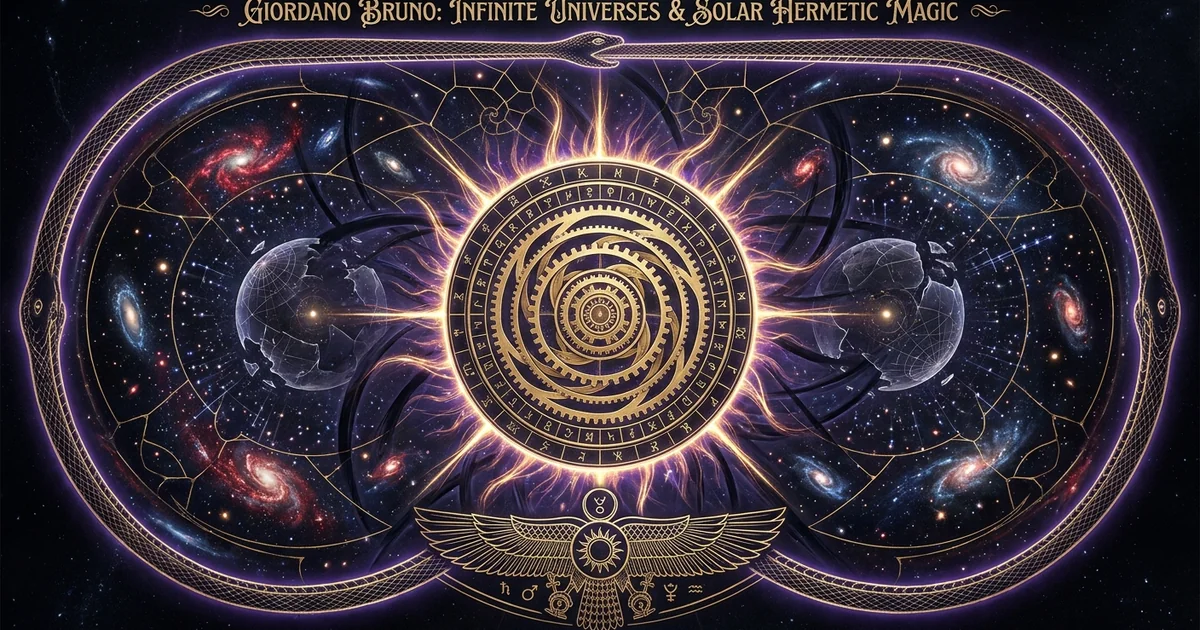
Giordano Bruno: Infinite Universes & Solar Hermetic Magic
Metaphysical Thesis & Epistemological Opening: The Infinite Cosmos as Divine Self-Explication
The Dissolution of the Aristotelian-Ptolemaic Crystalline Sphere
The cosmological architecture of late sixteenth-century Europe remained tethered to the claustrophobic geocentric construct inherited from Aristotle and formalized by Claudius Ptolemy. Within this dominant paradigm, reality terminated abruptly at the primum mobile—an outermost crystalline vault that demarcated absolute physical existence from the impassable transcendence of the Empyrean heaven. Sublunary existence was consigned to mutability, corruption, and fallen mechanics, sharply quarantined from the pristine, unalterable circular motions of the celestial spheres.
When Nicolaus Copernicus published De revolutionibus orbium coelestium in 1543, his mathematical repositioning of the terrestrial globe into an orbit around the solar core represented an exquisite, albeit structurally conservative, computational reform. Copernicus retained the fixed outer sphere of stellar bodies, maintaining an essentially bounded, finite container for creation.
The radical rupture occurred when the Nolan philosopher, Giordano Bruno, synthesized this mathematical reorientation with the ontological fires of the Hermetic revival. Bruno did not merely accept the Copernican hypothesis; he shattered the outermost crystalline shell altogether, casting terrestrial consciousness into an unbounded, anisotropic spatial continuum.
For Bruno, the concept of a finite cosmos was not merely a physical error; it was an ontological blasphemy against the supreme principle. In his revolutionary reading, the dissolution of the celestial spheres liberated the planetary bodies from rigid mechanical tracks, transforming the cosmos into an open, living sea of infinite space. By discarding the celestial hierarchy that placed humanity at the wretched bottom of an ontological ladder, Bruno initiated a catastrophic break from medieval scholastic theology, inaugurating an epistemology wherein the absolute can be directly apprehended through the infinite expanse of the sensible universe.
[ ARISTOTELIAN-PTOLEMAIC MODEL ]
                     (Closed Crystalline Shell)
        Empyrean -> Primum Mobile -> Fixed Stars -> Earth (Center)
                                   |
                          [ COPERNICAN MODEL ]
                        (Mathematical Sun-Center)
             Fixed Stellar Sphere -> Planets -> Sun (Center)
                                   |
                           [ BRUNIAN MODEL ]
                  (Boundless Anisotropic Multiverse)
   Infinitum Spatium <---> Living Solar Synods <---> Immanent Monas
The Inexhaustible Cause: Physical Infinity as the Exact Mirror of Divine Omnipotence
Central to the Brunian metaphysical project is the ironclad deductive axiom that an infinite primary cause must necessarily produce an infinite effect. Drawing profoundly from the esoteric philosophy embedded in the initiatory lineages of Hermeticism, Bruno argued in De l’infinito, universo e mondi (1584) that to restrict divine creative agency to a finite sphere of matter would be to impute either impotence or envy to the divine source. If the ultimate principle—termed the Monas or the inexhaustible Cause—possesses infinite operational and ontological power (potentia infinita), its self-explication (explicatio) into manifest reality cannot terminate at any arbitrary geometric boundary.
Physical infinity is therefore understood not as a secular mathematical abstraction or an empty, cold spatial void, but as the direct, necessary, and living mirror of divine omnipotence. The universe does not stand apart from God as an external, manufactured artifact; rather, it is God in extension, the immanent unfoldment of absolute unity into unbounded multiplicity. Bruno unites physics with operative theurgy: to contemplate the boundless cosmos is to engage in an act of noetic ascent, apprehending the supreme source not through dry scholastic syllogisms, but through the ecstatic recognition of its infinite physical manifestation.
The cosmos becomes an infinite living organism animated by the panpsychic World Soul (anima-mundi), wherein every point in space operates simultaneously as a center, reflecting the unconditioned totality of the primordial origin.
Heliocentrism as Altar: The Egyptian Solar Re-Enchantment of Copernican Space
Mainstream historiography has long committed the anachronistic error of casting Giordano Bruno as a secular martyr of modern empirical science, an early hero of rationalistic physics martyred by a dogmatic religious institution. This positivist caricature radically fundamentally misreads Bruno’s primary motives. Bruno did not champion Copernicus because he anticipated the cold, clockwork mechanics of Isaac Newton or René Descartes; he seized upon heliocentrism because he recognized it as the cryptographic resurrection of the ancient Egyptian solar theology praised in the Asclepius.
For Bruno, the Sun was an archetypal tabernacle of living fire—an energetic focal point channeling intelligible light into the manifest realms. In the Brunian system, the Copernican sun is re-consecrated as an altar. It serves as an active, living organ within the macrocosmic anatomy, transmitting vitalized spiritus throughout the anisotropic ether to nourish the planetary organisms that circulate around it.
The transition from a geocentric to a heliocentric architecture was understood by Bruno as an essential magical purgation: the false, fear-driven illusions of scholasticism were cleared away to restore humanity’s direct operative contact with the divine source. Within this framework of giordano bruno infinite worlds hermetic solar magic mnemonics, the celestial bodies are not inert stones guided by blind gravity; they are conscious, ensouled divinities engaged in a sublime choral dance across an endless cosmic ocean.
“Bruno’s vision of the infinite universe is not a scientific hypothesis in the modern sense; it is a religious and magical insight. Copernicus was the dawn; the full daylight was to be the return of the magical religion of the Egyptians… The infinite worlds are the infinite effects of an infinite cause, and the infinite universe is the vast living image of the divine nature.” — Frances A. Yates, Giordano Bruno and the Hermetic Tradition (1964), pp. 235–240.
“The Brunian cosmos is a vast erotic network animated by the universal life-force of the spiritus phantasticus. In Bruno, magic, eros, and cosmology converge into a unified science of astral manipulation and psychic bonding, transforming the philosopher into an operator of cosmic networks.” — Ioan P. Couliano, Eros and Magic in the Renaissance (1987), pp. 89–93.
Primary Codices & Historical Transmission: From Egyptian Gnosis to the London Dialogues
Transmission Vector: Marsilio Ficino’s Corpus Hermeticum to Bruno’s Radicalized Prisca Theologia
The intellectual lineage that culminated in Bruno’s radical metaphysics originated with the fifteenth-century rediscovery of the Corpus Hermeticum. Cosimo de’ Medici instructed Marsilio Ficino to halt his translation of Plato’s dialogues in order to prioritize the newly recovered Greek manuscripts attributed to Hermes Trismegistus.
Ficino approached these texts with reverence, viewing them as the foundational records of the prisca theologia—a primordial, pristine divine revelation that predated Moses and prefigured the Christian Gospel. However, Ficino’s appropriation of this magical tradition was tempered by an acute Counter-Reformation caution. He confined his magical operations to a refined, natural-astral theurgy, systematically cataloged in De vita libri tres (1489), wherein talismanic arrangements captured the impersonal celestial influences (spiritus mundi) to balance the melancholic temperament of scholars.
       [ Primordial Egyptian Hermetism ]
                      │
                      ▼
[ Marsilio Ficino (1471): Cautious Astral Platonism ]
                      │
                      ▼
[ Heinrich Cornelius Agrippa (1533): Systematic Occultism ]
                      │
                      ▼
[ Giordano Bruno (1584): Militant Counter-Cosmological Theurgy ]
Bruno severed this Ficinian compromise. Rejecting Ficino’s defensive Christianization of the Hermetic corpus, Bruno weaponized the texts into a militant philosophical counter-reformation. He declared that the original Egyptian religion was superior to both medieval scholasticism and Protestant reform, which he derided as parasitic distortions that had severed mankind from the living body of nature.
Integrating Ficinian astral theory with the aggressive, systematic occultism of Heinrich Cornelius Agrippa, Bruno transformed the Hermetic vision from an elite contemplative philosophy into an insurgent ontological revolution. The prisca theologia was no longer a decorative precursor to Christian theology; it became an operative blueprint for dismantling the theological structures that had fractured Europe through ideological warfare.
Exegesis of La Cena de le Ceneri: The Ash Wednesday Supper as Counter-Reformation Geopolitical Subversion
Published in London in 1584 during his residency at the French embassy under the protection of Michel de Castelnau, Bruno’s La cena de le ceneri (The Ash Wednesday Supper) remains one of the most vitriolic, philosophically complex polemics of the late Renaissance. Set against the backdrop of an academic disputation at the University of Oxford, the dialogue serves as an epistemological tribunal. Bruno depicts the English doctors of theology and natural philosophy as blinded, pedantic Aristotelians, stubbornly clinging to dead grammatical forms while remaining utterly ignorant of the living geometry of the cosmos.
Within the dense theatricality of the dialogue, the ash wednesday supper cosmology unfolds as a direct assault on the theological orthodoxies dividing Europe. Bruno uses the heliocentric proof not as an isolated mathematical novelty, but as an initiatic wedge to expose the spiritual bankruptcy of contemporary ecclesiastical authorities. By showing that the terrestrial globe moves through the heavens—meaning that Earth is itself a celestial body floating among the stars—Bruno abolishes the ontological gulf between heaven and earth.
This subversion possessed radical geopolitical implications: if the absolute center of the cosmos does not exist, then neither the Papal throne in Rome nor the Anglican monarchy in London could lay claim to an exclusive, centralized divine mandate. The political authority built upon hierarchical scholastic cosmologies collapsed into an egalitarian, polycentric cosmos where every point participates directly in the divine life.
The Frankfurt and Parisian Operative Manuscripts: From Shadows of Ideas to General Bonding
Before his London dialogues, Bruno had captured the attention of King Henri III of France with his extraordinary systems of artificial memory, articulated in De Umbris Idearum (The Shadows of Ideas, Paris, 1582). Far from being a simple, utilitarian art of rhetorical recall, this Parisian manual represents an operative text of internal talismanic theurgy. Bruno organized the human memory palace into dynamic, concentric wheels inscribed with zodiacal archetypes, Egyptian decans, and mythological figures, effectively turning the mind into a living mirror of the cosmos.
“The universe is one, infinite, immobile. I say that the absolute possibility is one, the act is one, the form or soul is one, the matter or body is one, the thing is one, the being is one, the maximum and the optimal is one… It is not capable of comprehension, for it has no bounds; it is therefore infinite, and so it cannot be limited or contained within any extrinsic term.” — Giordano Bruno, De l’infinito, universo e mondi (1584), Dialogue I.
“Because our ancestors erred deeply regarding the knowledge of the gods, through incredulity and negligence of religion, they discovered the art of making gods. Having discovered it, they added an appropriate virtue drawn from the nature of the cosmos, and because they could not make souls, they evoked the souls of demons or angels and inserted them into holy images and divine mysteries, so that the statues might possess the power of doing good and evil.” — Asclepius, Corpus Hermeticum (Latin text trans. by Bruno’s circle), Sections 23–24.
Bruno’s operative manual reached its systematic apex in his later Frankfurt treatise, De vinculis in genere (A General Account of Bonding, 1591). In this extraordinary work, Bruno anticipates modern cybernetics, mass psychological manipulation, and interdimensional interaction.
He asserts that all entities in the cosmos are linked through an intricate web of invisible bonds (vincula), rooted fundamentally in desire and attraction (eros). The accomplished operator, or magus, is one who understands how to apply these bonds across multiple ontological registers—captivating individuals, political bodies, and discarnate intelligences by aligning with their specific energetic inclinations.
Ontological Architecture & Cosmological Models: The Unified Informational Matrix of Anima Mundi
The Panpsychic Vacuum: Spatium Infinitum and the Universal Spiritus as Informational Medium
In the cosmological architecture of Bruno, the concept of absolute empty nothingness is an impossibility. What conventional observers perceive as empty space between the planets—the spatium infinitum—is, in ontological truth, a continuous, subtle etheric substrate: the universal spiritus. Bruno resolves the ancient philosophical debate regarding the void by demonstrating that space is not non-being, but the receptive, uninterrupted vessel through which the World Soul, or anima-mundi, executes its perpetual creative metabolism.
This universal spiritus functions as an informational medium that permeates all physical matter, mediating between the purely intelligible realm of transcendent forms and the mutable world of physical condensation. Through this etheric continuum, non-local resonances occur across immense cosmic distances. The vacuum is not a dead, passive void, but a conscious, vibratory field.
Physical particles, planetary spheres, and stellar furnaces do not merely sit inside space; they are vortexes within this panpsychic medium, condensed out of the selfsame continuous substrate. By reframing space as an active spiritual plenum, Bruno anticipated non-local physical interactions, grounding them in an operative informational field that links every locus of reality to the whole.
       DIVINE MONAS (Inexhaustible Cause)
                     │
                     ▼
      ANIMA MUNDI (Panpsychic World Soul)
                     │
                     ▼
        ETHERIC PLENUM (Spiritus Medium)
                     │
                     ▼
     INHABITED WORLDS (Planetary Organisms)
                     │
                     ▼
    HUMAN CONSCIOUSNESS (Operative Monad)
The Synodic Topology of Plural Worlds: Innumerable Earths, Solar Systems, and Inhabited Spheres
The boldest assertion of Bruno’s metaphysical cosmological model was his doctrine of the plurality of worlds. Sweeping aside the Aristotelian claim of Earth’s unique station, Bruno posited an infinite archipelago of solar systems distributed evenly throughout the etheric ocean:
“There are countless suns and innumerable earths all rotating around their suns in exactly the same manner as the seven planets of our system… The other worlds are inhabited no less than our own.” — De l’infinito, universo e mondi
Bruno’s cosmic ecology categorizes celestial bodies into two primary metabolic agents: the fiery, active, light-emitting bodies (suns or stars) and the aqueous, passive, light-receiving bodies (earths or planets). These bodies operate in synodic, complementary unions. They do not travel along rigid metaphysical tracks; rather, they navigate through the fluid ether under their own internal propulsion, directed by their own immanent souls. Bruno conceptualized these planetary bodies as vast, living organisms undergoing birth, decay, regeneration, and conscious evolution.
Consequently, the Brunian cosmos is populated by an infinite variety of non-human intelligence (NHI), ranging from physical organisms inhabiting distant earths to discarnate, etheric beings inhabiting the open fields of the spatium infinitum. The cosmos is an inexhaustible, living ecosystem teeming with vitality.
Non-Local Monadology: The Coincidentia Oppositorum within Bruno’s Immanentist Pantheism
Drawing heavily upon the Christian mystic Nicholas of Cusa, Bruno placed the principle of the coincidentia oppositorum (the coincidence of opposites) at the center of his immanentist ontology. In an infinite reality, all geometric, spatial, and physical metrics break down:
- The infinite line is simultaneously a circle;
- The absolute maximum coincides identically with the absolute minimum;
- The center of the universe is located everywhere, while its circumference is situated nowhere.
This paradoxical geometry led Bruno directly to his foundational doctrine of the Monad. In his metaphysical schema, the absolute whole is fully encapsulated within the infinitesimal part. Every single atom, creature, and inhabited world is a monas—an indivisible locus of being that mirrors, encodes, and reflects the totality of the cosmic matrix.
+-------------------------------------------------------------------+
|               NON-LOCAL COINCIDENTIA OPPOSITORUM                  |
|                                                                   |
|   Point = Everywhere (Center)       Limit = Nowhere (Perimeter)   |
|   Maximum (Infinite Multiverse) =   Minimum (Indivisible Monad)   |
|                                                                   |
|              [ Divine Monas Immanent in the Whole ]               |
|                                 |                                 |
|            +--------------------+--------------------+            |
|            |                                         |            |
|            v                                         v            |
|   Macrocosmic Multiverse                   Microcosmic Psyche     |
|   - Boundless Solar Synods                 - Memory Wheel Decans  |
|   - Living Anima Mundi                     - Imaginatio Conduit   |
+-------------------------------------------------------------------+
This Brunian intuition laid the conceptual bedrock later developed by Gottfried Wilhelm Leibniz in his philosophical monadology and Baruch Spinoza in his pantheistic formulation of deus sive natura (God or Nature). Bruno’s universe is non-local and holographic: the part does not merely belong to the whole; the whole is actively, dynamically present within every discrete part through the animating presence of the World Soul.
Phenomenological Mechanics & Interdimensional Interaction: Memory Wheels as Astral Computronium
The Mechanics of De Umbris Idearum: Concentric Alphabetic Rotations as Astral Reality Generators
In De Umbris Idearum, Bruno radically restructured the traditional, linear art of memory (ars memorativa) inherited from Cicero and Thomas Aquinas. In classical rhetoric, mnemonics served as an archival, filing-cabinet technique to store speeches, arguments, and textual citations through the mental construction of static memory palaces. Bruno transformed this storage system into a dynamic, combinatoric operational instrument—an internal, astral computation engine.
Bruno’s mnemonic architecture consisted of concentric, independently rotating wheels marked with alphabetic characters, which corresponded to intricate matrices of celestial archetypes, astrological decans, mythological entities, elemental powers, and physical actions. By mentally rotating these wheels against one another, the practitioner could generate tens of thousands of combinatoric variations, producing complex synthetic images within the theater of the mind.
                  [ BRUNIAN MNEMONIC ROTATION ENGINE ]
                              Outer Wheel:
                       36 Decans / Astral Daemons
                                  │
                                  ▼
                             Middle Wheel:
                   Mythological Archetypes & Deeds
                                  │
                                  ▼
                             Inner Wheel:
                  Physical Operations, Elements, Forms
                                  │
                                  ▼
                   Synthetic Archetypal Phantasm
               (Direct Resonance with Astral Currents)
These wheels did not merely record arbitrary facts; they simulated the celestial mechanics of the macrocosm. The combinatoric wheels operated as astral computronium: cognitive software designed to internalize the archetypal machinery of the heavens. By mastering these permutations, the magus internalized the living patterns of the World Soul, acquiring an operative cognitive interface capable of interpreting, calculating, and manipulating physical reality.
The Phantastic Ray: Operating the Internal Imaginatio to Intercept Interdimensional Astral Currents
For Bruno, the human imagination (phantasia or imaginatio) was not an unreal faculty for entertaining illusions, but a sensitive organ of perception—an ontological bridge connecting the sensible, physical realm with the intelligible realm of forms. In De Umbris Idearum, Bruno details how the mind’s internal eye, when disciplined by the art of memory, can generate archetypal figures that catch the rays of the cosmic spiritus.
Because the physical cosmos is an informational medium infused with the anima-mundi, mental forms (phantasmata) generated with sufficient geometric and emotional precision create a real resonance within the universal ether. The magus functions like a radio transceiver: by arranging the internal memory images into exact archetypal combinations, the operator tunes their consciousness to specific planetary and stellar currents.
Through this intentional alignment, the operator opens an interior channel to the intelligible light, drawing down celestial gifts, securing visionary states, and intercepting the communicative vectors of discarnate, interdimensional intelligences traversing the etheric ocean.
Classical Aristotelian-Thomistic Memory Art
- Epistemological Function: Static, linear storage mechanism for rhetorical orations, virtues, vices, and theological texts.
- Operational Mode: Passive retrieval; mental mapping of static loci (memory palaces, architectural halls).
- Cosmological Alignment: Sublunary and dualistic; firmly subordinated to scholastic theology and intellectual classification.
- Psychic Mechanism: Rational association of concepts with sensible signs without energetic or theurgic intentionality.
- Metaphysical Scope: Strictly closed human intellect working within finite Aristotelian categories.
Brunian Hermetic-Combinatoric Mnemonics
- Epistemological Function: Dynamic, computational engine for theurgic operations, reality generation, and universal cognition.
- Operational Mode: Active permutation; concentric, rotating wheels generating combinatoric archetypal syntheses.
- Cosmological Alignment: Panpsychic, infinite, and non-local; directly mirrors the living, boundless anima-mundi.
- Psychic Mechanism: Energetic activation of the spiritus phantasticus to draw down macrocosmic currents.
- Metaphysical Scope: Magus as micro-monad interfacing with infinite inhabited worlds and non-human intelligences.
De Vinculis In Genere and Universal Bonding: Cybernetic Exploitation of Desire and Daemonic Resonance
The operational culmination of Brunian magic is preserved in his Frankfurt codex, De vinculis in genere. In this pioneering treatise on psychological manipulation and energetic dynamics, Bruno establishes that all interaction across the universe is governed by the application of bonds (vincula). These bonds are not mechanical restraints; they are links of desire, attraction, aesthetic harmony, and emotional resonance rooted in the universal Eros that holds creation together.
Bruno catalogs how these bonds operate across every layer of the cosmic hierarchy:
- The Divine & Daemonic: Discarnate entities, planetary spirits, and cosmic intelligences are bonded not through coercive sorcery, but by offering them an appropriate, resonant medium—specific images, perfumes, arrangements, and psychological currents that harmonize with their nature.
- The Sociopolitical & Collective: Rulers, priests, and charismatic leaders bind entire populations through collective narratives, shared symbols, and appeals to primal desires and fears. Bruno anticipates mass psychology, recognizing that individuals can be directed when their inner yearnings are understood and guided by an operator who sits above the current.
- The Microcosmic & Interpersonal: Between individuals, bonding occurs through the transmission of the spiritus phantasticus—subtle etheric rays projected from the eyes and voice that captivate the imagination of another.
The Brunian magus is an engineer of relational networks. By mastering the science of bonds, the operator stands at the nexus of the universal web, capable of drawing down celestial forces, manipulating sociopolitical reality, or shielding the self from external psychic and spiritual subjugation.
Initiatic Synthesis & Philosophical Implications: The Roman Stake and Modern Anomalistics
The Inquisitorial Condemnation: Cosmic Pantheism Burned at the Stake in the Campo de’ Fiori (1600)
On February 17, 1600, after eight grueling years of interrogation and confinement in the prisons of the Roman Inquisition, Giordano Bruno was led to the Campo de’ Fiori in Rome. His tongue was bound in a leather clamp to prevent him from addressing the assembled crowd, and he was burned alive at the stake.
A persistent misconception of positivist history claims that the Inquisition executed Bruno simply for maintaining that the Earth moves around the Sun. The archival records of his trial, overseen by the Cardinal Inquisitor Robert Bellarmine, reveal an indictment far more sweeping, theologically dangerous, and esoteric.
Bruno was condemned because his cosmology was inseparable from a total demolition of the Christian salvific framework:
[ Brunian Immanent Pantheism ]  <== IRRECONCILABLE ==>  [ Catholic Soteriological Hegemony ]
- Infinite Worlds / Inhabited Planets                  - Single Incarnation of Christ on Earth
- Metempsychosis / Transmigration of Souls              - Linear Heaven / Hell / Purgatory
- Matter Co-Eternal with God (No Ex Nihilo)             - Creatio Ex Nihilo by Transcendent God
- Operative Egyptian Daemon-Theurgy                     - Heresy / Demonic Sorcery
- Center Everywhere, Circumference Nowhere - Exclusive Hierarchical Pontifical Throne- Destruction of Unique Incarnation: If an infinity of inhabited worlds exists across the heavens, the singular historical Incarnation of Jesus Christ on Earth loses its universal efficacy. Did Christ undergo infinite crucifixions on infinite earths, or were those innumerable civilizations abandoned by the Christian God?
- Denial of Trinitarian Dualism: Bruno interpreted the Holy Trinity through an immanentist, pantheistic lens, equating the Holy Spirit with the anima-mundi and identifying matter as an eternal, uncreated divine substance, effectively abolishing the doctrine of creation ex nihilo.
- Rejection of Linear Soteriology: He defended metempsychosis—the transmigration of the soul through myriad forms across boundless space and time—thereby dismantling the doctrines of Hell, Purgatory, and the singular Last Judgment.
- Hermetic Insurgency: Bruno refused to recant his embrace of the Hermetic theurgy of the Asclepius, unapologetically affirming that the ancient Egyptian religion of nature was pristine, while the institutional Church was an engine of darkness and tyranny.
Facing his death sentence, Bruno delivered his famous challenge to his judges: “Maiori forsan cum timore sententiam in me fertis quam ego accipiam” (“Perhaps you pronounce this sentence against me with greater fear than I receive it”). In that final defiance, the Nolan showed that an inquisitorial court anchored in a finite world could not conquer an initiate who had already realized his identity with the unbounded cosmos.
The Control System Interface: Reading Bruno Through Jacques Vallée’s Informational Framework
Viewed through the lens of modern anomalistics and Jacques Vallée’s cybernetic theory of the UFO phenomenon, Bruno’s magical treatises emerge as an early, sophisticated diagnostic of reality management. Vallée proposed in Invisible College and Passport to Magonia that non-human intelligence interacts with humanity through a long-term informational “control system” that shapes human cultural, religious, and philosophical frameworks via symbolic projections, folkloric encounters, and high-strangeness phenomena.
Bruno’s De vinculis in genere analyzes precisely how symbolic forms, apparitions, and archetypal projections can be deployed to govern human behavior. What modern researchers categorize as the interdimensional-hypothesis, Bruno understood as the diverse, conscious inhabitants of the spatium infinitum operating upon human consciousness through the etheric medium of the spiritus.
Bruno recognized that human societies are consistently bound by collective illusions—what esoteric philosophy terms an egregore—managed through religious institutions, shared dogmas, and mythological symbols.
By analyzing the mechanics of how humans are captivated through their desires and fears, Bruno anticipated modern cybernetic analyses of psychological warfare and interdimensional contact. He provided an operative methodology for decoding the symbolic transmissions of the control system, urging the practitioner to step out of unconscious cultural servitude and operate as an awakened sovereign node within the cosmos.
Operating the internal combinatoric engines of the phantastic ray without complete alignment with the primordial Monas exposes the consciousness to catastrophic fragmentation. When an operator activates the rotating decan-wheels of De Umbris Idearum in the absence of rigorous ethical, ontological, and philosophical centering, the subjective phantasia becomes susceptible to parasitic capture by lower astral entities and autonomous etheric currents.
The practitioner risks severe psychological inflation, ungrounded paranoia, and energetic drained states, as the astral forms intended for cosmic attunement invert into self-reinforcing cognitive loops. The Brunian art of memory is an operative theurgy capable of piercing the veils of reality, but without unwavering grounding in the transcendent origin, the unshielded psyche risks destabilization within the open ether.
Ontological Sovereignty in an Unbounded Multiverse: The Magus as Reality Architect
The enduring initiatic legacy of Giordano Bruno lies in his declaration of total ontological sovereignty. By annihilating the Aristotelian spheres and anchoring existence in an infinite, self-explicating universe, Bruno liberated human consciousness from cosmic, social, and spiritual subjugation. In a cosmos where the center is everywhere and the circumference is nowhere, every human being is intrinsically the center of reality, maintaining an unmediated, immediate link to the supreme source.
The Brunian magus does not cower beneath distant deities or bow before worldly hierarchies. Instead, the practitioner awakens to their role as an operative co-creator, a conscious microcosm housing the infinite potential of the macrocosmic anima-mundi. By constructing the internal memory engine, harmonizing the inner phantasy with the archetypal cosmos, and understanding the cybernetic mechanics of attraction and bonding, the initiate becomes an architect of reality.
Bruno invites the seeker to break free from the finite constructs of inherited cultural programming, step into the boundless ocean of the living multiverse, and realize their unconditioned divine essence within the eternal dance of infinite worlds.
Frequently Asked Questions Regarding Giordano Bruno and Hermetic Cosmogony
Historical Disputation: Bruno’s Execution and the Inquisition Records
Was Giordano Bruno executed for his scientific theories or his religious heresies?
The historical consensus, informed by the discovery and publication of the surviving Roman Inquisition trial summaries (Sommario del Processo di Giordano Bruno), demonstrates that the tribunal did not distinguish modern “science” from theology. To the Inquisition, Bruno’s assertion of an infinite cosmos populated by infinite inhabited worlds was itself an incendiary religious heresy.
It directly undermined fundamental Roman Catholic dogmas, including the singular incarnation of Jesus Christ, the unique creation narrative of Genesis, and the reality of the Sacraments. Furthermore, the charges against Bruno centered heavily upon his rejection of the Trinity, his claim that Christ was a clever magician rather than God incarnate, his defense of the transmigration of souls, and his practice of Hermetic-Egyptian astral magic. Bruno was not executed for an isolated astronomical theory, but for advancing an alternative, pantheistic cosmology that rendered Catholic soteriology obsolete.
+-------------------------------------------------------------------------+
|                  CORE INQUISITORIAL CHARGES (1592-1600)                 |
+-------------------------------------------------------------------------+
| [1] Infinite Worlds Heresy      | Subversion of Genesis & Christ's      |
|                                 | singular incarnation.                 |
| [2] Anti-Trinitarianism         | Reinterpreting the Trinity as Mind,   |
|                                 | Intellect, and Anima Mundi.           |
| [3] Christological Inversion    | Viewing Christ as an Egyptian magus   |
|                                 | rather than the unique Son of God.    |
| [4] Metempsychosis & Soul       | Affirming the transmigration of souls |
|                                 | across infinite animal/human forms.   |
| [5] Operative Egyptian Theurgy  | Practicing astral talismanic magic    |
|                                 | drawn from the Asclepius.             |
+-------------------------------------------------------------------------+
Operative Clarification: The Nature of Brunian Magic vs. High Renaissance Talismanic Magic
How does Bruno’s magical system differ from that of Marsilio Ficino and Cornelius Agrippa?
While Marsilio Ficino and Heinrich Cornelius Agrippa provided the foundations for Renaissance magic, their systems remained defensive, intellectual, and cautious. Ficino practiced a gentle, astrological medicine restricted to channeling the impersonal spiritus mundi using colors, scents, and planetary music, carefully avoiding any interaction with discarnate spirits or daemons to shield himself from the Inquisition. Agrippa gathered and organized vast encyclopedias of magical lore in De occulta philosophia, but his approach was scholarly and syncretic, vacillating between Christian cabala, Neo-Platonism, and traditional grimoiric recipes.
Bruno abandoned Ficino’s self-protective caution and bypassed Agrippa’s compilations. His magical system was an aggressive, operational psychology and cosmic theurgy. Bruno dismissed natural talismanic magic as mere child’s play compared to the operative mechanics of the human mind:
- Internalization of the Cosmos: Instead of inscribing physical talismans on metals or parchment, Bruno constructed internal talismans within the practitioner’s imagination using combinatoric memory wheels.
- Erotic Bond Manipulation: In De vinculis in genere, Bruno developed a psychology of manipulation, demonstrating how desire, emotional resonance, and archetypal projections can be deployed to bind human minds and tap into discarnate entities.
- Cosmological Identity: Bruno operated not as a humble sublunary petitioner pleading with higher spheres, but as an awakened Monad commanding the astral currents of an infinite, panpsychic continuum.
- Monas (μονάς): Derived from the Greek monos (alone, solitary, unique), the term denotes the absolute, indivisible unit of being. In Bruno’s metaphysics, the Monas is simultaneously God, the absolute minimum (the atom), and the absolute maximum (the infinite multiverse). It implies that the entire cosmic code is fully present in every discrete particle of existence, laying the ontological foundation for later developments in monadic pantheism and idealist philosophy.
- Vinculum (pl. Vincula): The Latin noun for a chain, bond, fetter, or binding cord. In the Brunian operational lexicon, it defines any psychological, emotional, or etheric link forged through desire (eros). The vinculum is the mechanism through which an operator hooks into the perceptual apparatus of a target, whether that target is an individual human mind, a collective political population, or an etheric non-human intelligence traversing the anima-mundi.
Modern Physics Convergence: Brunian Plurality of Worlds vs. Contemporary Many-Worlds Multiverse
How does Giordano Bruno’s concept of infinite worlds compare to modern quantum mechanics and cosmology?
Superficially, Bruno’s vision of infinite worlds appears to anticipate the modern cosmological multiverse—such as the inflationary multiverse models of contemporary astrophysics or the Many-Worlds Interpretation (MWI) of quantum mechanics formulated by Hugh Everett III. However, this comparison requires careful metaphysical qualification.
+--------------------------------------------------------------------------+
|                       COSMOLOGICAL ARCHITECTURE                          |
+--------------------------------------------------------------------------+
|  BRUNIAN MULTIVERSE                     EVERETTIAN / MODERN MULTIVERSE   |
|  - Panpsychic, ensouled plenum          - Materialist, mechanical space  |
|  - Anima Mundi drives motion            - Quantum wave decoherence       |
|  - Teleological & self-explicating      - Mathematical, non-purposive    |
|  - Coincidentia Oppositorum             - Probabilistic branching        |
|  - Center everywhere, perimeter nowhere - Geometric space-time geometry  |
+--------------------------------------------------------------------------+
Modern physics posits a multiverse rooted in mathematical abstractions, non-purposive quantum decoherence, or cold, isotropic space governed by unbending physical constants. In sharp contrast, Bruno’s universe is an organic, panpsychic, and theological continuum.
For Bruno, space is not dead geometric extension, but the living breath of the divine, infused throughout with the anima-mundi. The infinite planetary systems are not accidental coagulations of dust governed by impersonal quantum mechanics; they are conscious, ensouled divinities, bustling with life, teleology, and intelligence.
While modern physics arrives at a multiplicity of worlds through an analysis of physical matter, Bruno deduced it from the inexhaustible plenitude of the divine nature. His vision offers an inspiring metaphysical synthesis: a cosmos infinite in physical scale, yet fully unified through an immanent, panpsychic consciousness that remains open to the contemplative mind of the magus. :::