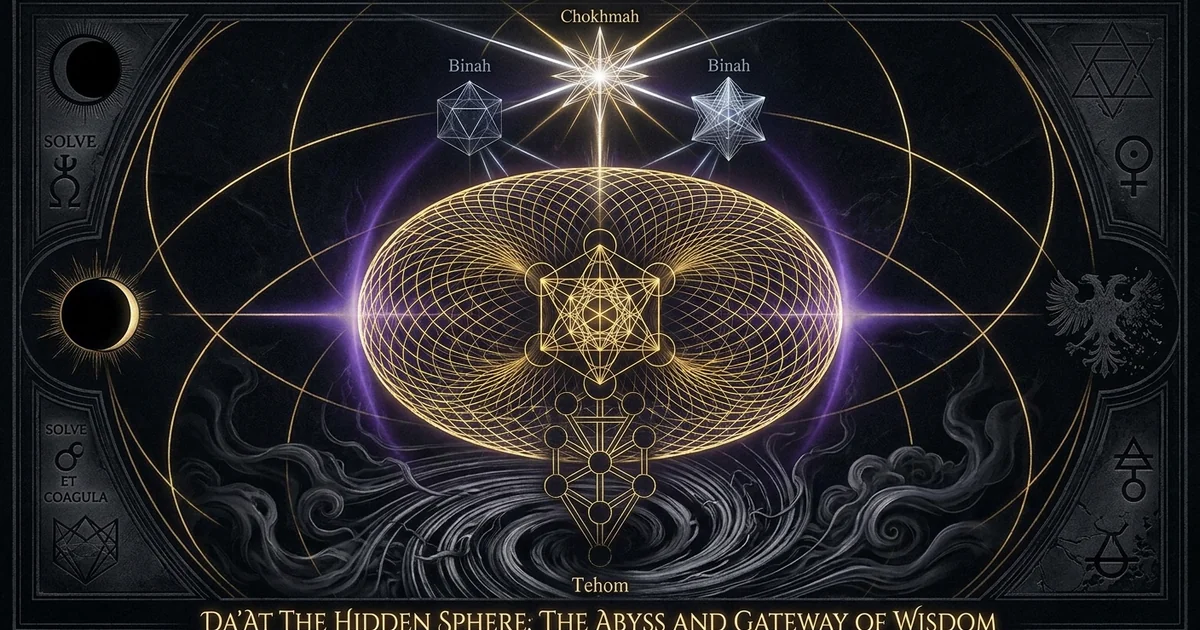
Daat the Hidden Sphere: The Abyss and Gateway of Wisdom
Metaphysical Thesis & Epistemological Opening: The Epistemic Paradox of Daat
The Non-Sephirah as Cognitive Conjunction
Within the metaphysical architecture of the Kabbalistic Tree of Life, Daat occupies an anomalous coordinates-space. It is designated categorically as the “non-sephirah,” an unnumbered ontological nexus that simultaneously exists and does not exist within the formal structural decad. Rather than constituting an autonomous hypostatic vessel (keli) produced through sequential cosmic emanations, Daat emerges dynamically from the persistent, reciprocal contemplation (yichud) of the two primary cognitive potencies: Chokhmah (Wisdom, the undifferentiated primordial seed of ideation) and Binah (Understanding, the architectonic matrix of structural differentiation). When Chokhmah and Binah reach equilibrium, their recursive synthesis precipitates a cognitive field that is neither purely intuitive nor purely analytic, but an operative singularity termed Daat.
This non-sephirah acts as the functional pivot of the central vertical axis, the Pillar of Mildness (Kav Ha-Emtzai). It crystallizes directly below the crown of Keter and hovers immediately above the emotive-volitional cluster of the lower Sefirot, known collectively as Zeir Anpin. Because classical Kabbalistic doctrine asserts that Keter is wholly transcendent and imperceptible—functioning as the direct interface with the boundless absolute, Ain Soph—Daat serves as Keter’s phenomenal proxy within the experiential matrix of consciousness. It is the operative presence of the crown translated into the dimension of interiority, transforming remote ontological will into direct subjective perception.
Consequently, Daat cannot be classified as an independent container of divine light (or). Its appearance within schematic models signifies a specific threshold of systemic coherence: when consciousness operates in fragmentation, Daat retreats into an impassable chasm; when integrated through contemplative synthesis, it stabilizes as a luminous conduit. This dual disposition reveals that Daat is an event horizon rather than a static sphere, marking the definitive boundary where divine emanations cease to cascade as objective archetypes and collapse into the crucible of localized self-awareness.
Beyond Episteme: The Rupture of Dualistic Knowing
The epistemology of Daat destabilizes the structural premises that underwrite both classical Hellenistic philosophy and Western Cartesian rationalism. In the Western philosophical lineage, knowing has historically been formulated through the bifurcation of the epistemological field into a conscious subject (res cogitans) and an externalized object (res extensa). Within this dualistic framework, episteme—and subsequently modern scientific empiricism—demands an invariant distance between the observer and the observed to validate informational fidelity. The knower constructs an internal, discursive representation of the external phenomena, remaining fundamentally insulated from the ontic essence of the object itself.
+-------------------------------------------------------------+
|                THE DUALISTIC EPISTEMIC FIELD                |
|                                                             |
|   [ Res Cogitans ] <====== Distant Observation =====> [ Res |
|      (Subject)               (Representation)          Extensa]
+-------------------------------------------------------------+
                              vs.
+-------------------------------------------------------------+
|               THE NON-DUAL MATRIX OF DA'AT                  |
|                                                             |
|      Knower <==== Ontological Conjunction (Yichud) ====>    |
|                             Known                           |
|                               ||                            |
|                               \/                            |
|             [ Direct Ontological Realization ]              |
+-------------------------------------------------------------+
Daat shatters this representational paradigm by substituting intellectual observation with ontological union. In this modality, genuine knowing is not the accumulation of descriptive predicates (mada), but the radical assimilation of the subject into the ground of the known. The knower does not possess knowledge; rather, the knower is ontologically transfigured by the encounter, collapsing the distinction between the perceptual apparatus and the incoming informational stream. Daat demands the complete surrender of the detached egoic witness, replacing representational cognition with what esoteric traditions term gnosis—a direct, participatory immersion in the divine mechanics.
This rupture of dualistic knowing transforms epistemology into ontology. To “know” within the operational horizon of Daat is to participate in the divine self-cognition that structures the cosmos. As consciousness approaches this juncture, propositional logic exhausts its operational validity. The paradoxes of the Supernals cannot be resolved through dialectical debate or linear syllogism; they require an epistemic phase shift wherein the bifurcated intellect dissolves, allowing the underlying non-dual substrate of reality to reveal itself through an act of total cognitive unification.
The Informational Singularity of the Tree
Topologically, Daat functions as the informational singularity of the macrocosmic Tree of Life. In contemporary physics and systems theory, a singularity represents a region wherein standard field equations collapse and the density of information approaches an infinite threshold. Daat exhibits precisely these characteristics within the metaphysical economy of emanation. It is situated at the precise structural crossroads where the vertical flow of divine will intersects the horizontal counter-pressures of systemic differentiation. All data streams descending from the transcendent Supernals must condense and pass through this narrow throat before dispersing into the diversified manifestations of form, energetic exchange, and material manifestation.
Because it represents an informational density so concentrated that no conventional vessel can contain it, Daat remains formally unnumbered and invisible within the outer geometry of the Decad. It is the unseen vortex that regulates the cosmological bandwidth between infinite potentiality and finite structuralization. If the light of the Supernal Triad were to flood the lower emanations without the mediating, compressive function of Daat, the fragile structural architecture of the phenomenal universe would instantly revert to unmanifest chaos. Daat acts as an omnidirectional metaphysical transformer, stepping down the absolute coherence of the transcendent realms into modulated frequencies accessible to created entities.
Simultaneously, for the ascending consciousness attempting the reverse vector of return, Daat operates as a cognitive gateway. It represents the point where all accumulated knowledge, sensory memory, and identity structures must be compressed to their absolute informational limit. In this context, Daat behaves as a metaphysical black hole: as the aspirant draws near, the discursive operations of the mind undergo radical deceleration and inevitable breakdown, stripping the traveler of all categorical frameworks before admitting the naked spark of awareness into the trans-rational void of the Supernals.
The Hebrew noun Da’at (דַּעַת) derives from the triconsonantal root Dalet-Ayin-Tav (ד-ע-ת), which fundamentally signifies profound personal acquaintance, intimate connection, and generative relational union rather than speculative or abstract intellectualization. Its archetypal biblical mobilization appears in Genesis 4:1: “Ve-ha-Adam yada et-Chavah ishto” (“And the man knew Eve his wife; and she conceived”). Here, knowing is inseparable from bodily and spiritual interpenetration, resulting directly in the manifestation of new ontic reality.
This formulation diverges fundamentally from the Hellenistic lineage:
- Episteme (ἐπιστήμη): Denotes theoretical, scientific, or demonstrable knowledge structured through external observation, classification, and logical syllogism, maintaining the distance between subject and object.
- Gnosis (γνῶσις): While closer to Daat through its emphasis on direct spiritual apprehension, Gnosis often assumes a dualistic rejection of the material cosmos in early Hellenistic systems, framing knowing as an escape from matter.
- Da’at (דַּעַת): Operates as a non-dual bridge. It is intrinsically relational and synthetic, denoting an existential embrace wherein the knower (ha-yode’a), the act of knowing (ha-madda), and that which is known (ha-yadu’a) merge into an indistinguishable unified phenomenon. In Kabbalistic psychology, Daat is the explicit operationalization of this union within the physical nervous system, bridging the noumenal mind with somatic and emotional reality.
Primary Codices & Historical Transmission: Textual Evolution of the Eleventh Emanation
Sefer Yetzirah and the Axiom of ‘Ten and Not Eleven’
The critical textual dilemma surrounding Daat originates in the foundational treatise of Jewish speculative mysticism, the Sefer Yetzirah (The Book of Creation). Dating in its earliest redacted forms between the third and sixth centuries CE, the text establishes an inviolable numerical boundary that dictated the parameters of all subsequent Kabbalistic metaphysics. In its opening chapter, the text delivers a severe mathematical axiom regarding the cosmological architecture:
“Ten Sefirot of nothingness: ten and not nine, ten and not eleven. Understand with wisdom, and be wise with understanding. Examine them, probe from them, establish each thing on its base, and seat the Creator on His foundation.” (Sefer Yetzirah 1:2)
This strict proscription—“ten and not eleven”—served as an ontological firewall against any doctrinal deviation that might introduce polytheistic proliferation or compromise the strict unity of the divine Decad. The early commentators, including Saadia Gaon and Dunash ben Tamim, interpreted this injunction as an absolute barrier. The structure of reality was inherently bounded by the number ten, corresponding to the ten fingers of the hands, the ten utterances of creation in Genesis, and the ten primary geometric dimensions of the cosmos. To suggest an eleventh Sephirah was to commit an ontological heresy, threatening the absolute structural integrity of the divine self-manifestation.
Consequently, early Kabbalists faced a major hermeneutic challenge: how to reconcile the experiential and scriptural reality of Daat—which the biblical corpus repeatedly paired with Chokhmah and Binah as a third primary divine attribute (e.g., Exodus 31:3, Proverbs 3:19–20)—with the non-negotiable decad of the Sefer Yetzirah. The resolution required a profound conceptual refinement. Daat could not be integrated as an additive, twelfth or eleventh structural vessel; it had to be understood as an entirely different order of reality—an interior dynamism, an emergent property, or an alternate operational state of the primary emanations themselves.
Classical Decad Paradigm (Sefer Yetzirah)
  [Keter]
  [Chokhmah] --- [Binah]
  [Chesed]   --- [Gevurah]
        [Tiferet]
  [Netzach]  --- [Hod]
        [Yesod]
        [Malkhut]
  TOTAL: Strictly 10 Sefirot ("Ten and not eleven")

Dynamic Operative Paradigm (Cordovero / Luria)
  Option A (Transcendent Phase):      Option B (Immanent Phase):
        [Keter] (Counted)                    (Ain Soph Hidden)
  [Chokhmah] --- [Binah]              [Chokhmah] --- [Binah]
         (Daat Latent)                       [DAAT] (Manifest)
  [Chesed]   --- [Gevurah]            [Chesed]   --- [Gevurah]
        [Tiferet]                           [Tiferet]
  [Netzach]  --- [Hod]                [Netzach]  --- [Hod]
        [Yesod]                             [Yesod]
        [Malkhut]                           [Malkhut]
  TOTAL: 10 Operational Nodes         TOTAL: 10 Operational Nodes
Cordoverian Systematics in Pardes Rimonim
The systematic codification of this paradox reached its intellectual apex in the sixteenth century through the monumental works of Rabbi Moses ben Jacob Cordovero (the Ramak). In his masterwork, Pardes Rimonim (Orchard of Pomegranates, completed in 1548), Cordovero undertook the task of harmonizing the divergent cosmological schemas transmitted through the Zoharic corpus and the medieval commentators. In Sha’ar Seder Ha-Natzilat (The Gate of the Order of Emanation), he confronts the structural status of Daat directly, deploying an elegant ontological solution that preserved the sanctity of the Yetziratic decad while legitimizing the functional necessity of Daat.
Cordovero established that Keter and Daat exist in a state of reciprocal occultation and manifestation. Keter represents the most concealed aspect of the divine will—so infinitely refined that it borders on non-being (Ayin) and cannot be grasped, numbered, or engaged by created intellects. When the metaphysical system is mapped from the perspective of its transcendent origin, Keter is enumerated as the first Sephirah, and Daat remains entirely concealed, submerged as an unexpressed potentiality within the depths of Chokhmah and Binah. In this transcendent configuration, the Decad spans from Keter to Malkhut.
Conversely, when the system is conceptualized from the perspective of human consciousness and down-flowing emanation, Keter recedes into the absolute unknowability of Ain Soph, withdrawing from enumeration entirely. In this operative phase, Daat crystallizes to occupy the structural void, acting as the explicit, manifest articulation of the Supernal will. Cordovero writes:
“Daat is not an autonomous Sephirah, but the externalization of Keter; for when Keter is hidden and exalted above apprehension, Daat descends between Chokhmah and Binah to serve as the unifying vessel of their light.” (Pardes Rimonim, Sha’ar 8, Ch. 3)
By establishing that Keter and Daat are the internal (penimi) and external (chitzon) dimensions of the identical spiritual essence, Cordovero resolved the problem of the eleventh emanation. The system never exceeds the sacred count of ten: whenever Daat is counted, Keter is concealed; whenever Keter is enumerated, Daat returns to its hidden, unmanifest state.
Lurianic Shevirat Ha-Kelim and the Emergence of the Chasm
Following the death of Cordovero in Safed in 1570, his student Isaac Luria (the Ari) revolutionized Kabbalistic cosmology through an apocalyptic, processual metaphysics centered on the cosmic catastrophe known as Shevirat Ha-Kelim (The Shattering of the Vessels). Recorded and systematized primarily by his foremost disciple, Chaim Vital, in the definitive codex Etz Chaim (The Tree of Life), Lurianic Kabbalah radically altered the understanding of Daat, transforming it from a harmonious cognitive synthesis into the focal point of a cosmic rupture.
In Luria’s cosmological narrative, the primordial configuration of the Sefirot did not originally exist as the interconnected, triangular matrix known as the Olam Ha-Tikkun (World of Rectification). Instead, they emerged in an initial phase termed the Olam Ha-Nekudot (World of Points), wherein each Sephirah existed as an isolated, sovereign point of divine light, unaware of and detached from its neighboring emanations. These original vessels were rigid, narrow, and wholly incapable of inter-relational circulation; they were archetypes of pure, unyielding selfhood.
When the concentrated, infinite light of the primordial man, Adam Kadmon, erupted from his eyes, nose, and mouth down into the throat region—the anatomical and metaphysical location of Daat—the structure reached its breaking point. Daat was intended to act as the primary distribution nexus, harmonizing the Supernal light and mediating it into the lower vessels. However, because the vessels of the lower seven Sefirot were fragmented and non-communicative, the sheer intensity of the Supernal transmission shattered them sequentially. The lower vessels fractured and plummeted into the lower depths of reality, entraining sparks of holy light (nitzotzot) into the nascent realms of form, matter, and the demonic shells (Kelipot).
“Know that when the lights issued from the eyes of the Primordial Man, they emerged in the aspect of points (Nekudot), separated one from another, lacking any mutual interpenetration or conjunction (hitkallalut). And the light of Daat was the first to descend to illuminate the lower vessels. But because the lower vessels possessed no shared harmony, and could not bear the infinite intensity descending through the throat of Adam Kadmon, the vessel of Daat could not contain the light and fractured. And its light ascended back to its supernal source, while the shards of its vessel fell downward, followed by the catastrophic shattering of the seven kings who ruled in the land of Edom before any king reigned over Israel. Thus the central axis was broken, and between the mind of the Supernals and the broken heart of the lower worlds, an infinite chasm—the Tehom—was exposed, wherein all subsequent existence must wander until the Great Rectification (Tikkun).” — Etz Chaim, Sha’ar 8: Drushey Nekudot, Chapter 2 (Jerusalem Edition, 1910).
In the wake of this catastrophe, Daat underwent a traumatic structural reconfiguration. The harmonious bridge linking the Supernal Triad to the lower worlds was physically and spiritually severed. The fracture transformed the throat center of the cosmic macrocosm into an ontological void—an impassable, entropic chasm. From this point forward in Lurianic theology, Daat is permanently dualized: it remains the locus of the primordial fracture, the Abyss through which light fell, while simultaneously standing as the sole metaphysical gateway through which the labor of cosmic restoration (Tikkun Olam) can be executed.
Ontological Architecture & Cosmological Models: The Supernal Triad and the Chasm of the Abyss
The Supernal Triad Noumenon vs. The Phenomenal Decad
The primary ontological demarcation within the Tree of Life is the radical division separating the Supernal Triad—comprising Keter, Chokhmah, and Binah—from the lower seven Sefirot (Chesed through Malkhut). The Supernals constitute the realm of Azilut (Emanation), the absolute noumenon of pure divine reality. Within this supernal triad, existence is characterized by flawless unity, total non-duality, and the absence of any subject-object differentiation. There is no experience of time, spatial extension, limitation, or fragmented identity. It is an unconditioned state of pure being, infinite creative potential, and structural ideation existing prior to any concrete realization.
NOUMENAL REALM OF AZILUT (Non-Dual Coherence)
=============================================================
                     [ KETER ]
                    /         \
        [ CHOKHMAH ] <=======> [ BINAH ]
=============================================================
                      THE ABYSS
  (Tehom / Maspak / The Informational Firewall of Reality)
=============================================================
        [ CHESED ]   <=======> [ GEVURAH ]
                    \         /
                     [TIFERET]
                     /       \
         [ NETZACH ] <=======> [ HOD ]
                         |
                      [YESOD]
                         |
                     [MALKHUT]
=============================================================
PHENOMENAL WORLDS: BERIAH, YETZIRAH, ASSIAH (Dualistic Form)
In stark contrast, the lower seven Sefirot, often referred to collectively as the Binyan (the Construction) or Zeir Anpin (the Microprosopus / Lesser Countenance) crowned by Malkhut, project downward through the three lower worlds: Beriah (Creation), Yetzirah (Formation), and Assiah (Action/Matter). These lower dimensions constitute the phenomenal universe. Here, reality is defined by multiplicity, temporality, spatial extension, and the progressive crystallization of discrete individual entities. In these realms, consciousness operates within the parameters of duality: the ego perceives itself as distinct from the environment, from other beings, and from its divine source.
Daat occupies the precise horizontal and vertical threshold separating these two radically incompatible ontological orders. It is neither purely noumenal nor purely phenomenal, but the point of absolute friction between them. Without Daat, there is no conceptual or structural link between the infinite simplicity of the Supernals and the finite complexity of the lower worlds. It represents the boundary condition of reality, mediating between the unconditioned absolute and the conditioned realms of form.
Topography of the Abyss: Tehom, Maspak, and the Cosmic Gulf
Because of the primordial rupture described in Lurianic metaphysics, the metaphysical territory immediately underlying the Supernal Triad is not an empty spatial clearance, but a violent, entropic gulf termed the Abyss—identified in classical Hebrew texts as the Tehom (the deep, primordial primordial waters of formlessness) and in later Hermetic systematizations as the Maspak (the veil of doubt or separation). This gulf is an informational firewall embedded in the cosmic architecture, functioning as a non-spatial boundary that segregates the transcendent source from the downstream operational matrices of consciousness.
The Abyss is characterized by absolute ontological negativity. It is not merely the absence of light, but an active, entropic dissolution field. Within the topography of the Abyss, all spatial coordinates, temporal chronologies, and discursive categories cease to function coherently. Forms and concepts that enter this zone without the required internal structural coherence are ripped apart into disjointed, chaotic data fragments. The Abyss functions as a metaphysical immune system: it ensures that no corrupted, ego-bound, or fragmented informational patterns can ascend into the pure, non-dual equilibrium of the Supernal Triad.
Simultaneously, this cosmic gulf shields the phenomenal world from the unmediated, blinding intensity of the Supernals. Were the unfiltered noumenon of Keter and Chokhmah to penetrate into the lower worlds without passing through this dampening and transmuting field, the fragile boundaries that sustain individual consciousness and material form would instantly vaporize. The Abyss is therefore paradoxical: it is at once a catastrophic rupture that isolates humanity from immediate divine communion, and a necessary systemic partition that permits a diversified, developmental reality to exist at all.
Daat Elyon and Daat Tachton: The Split Polarity of Transcendent Mind
To govern this volatile boundary, the unified cognitive faculty of Daat undergoes a functional bifurcation, dividing into two complementary topological polarities: Daat Elyon (Upper Knowledge) and Daat Tachton (Lower Knowledge). This split is thoroughly developed within later Chassidic metaphysics, particularly in the Chabad intellectual lineage initiated by Rabbi Shneur Zalman of Liadi, to explain how the transcendent unity of God can harmoniously coexist with the apparent reality of the physical universe.
Daat Elyon (Upper Knowledge)
- Cosmological Locus: Resides within the Supernal domain, intimately affixed to the lowest base of Keter and mediating between Chokhmah and Binah.
- Epistemological Perspective: Perceives reality strictly from the viewpoint of the infinite absolute (mi-lemalah le-mata—from above to below).
- Ontological Reality: Operates from the axiom that the Ain Soph is the absolute and singular reality; the entire created universe is recognized as fundamentally non-existent (Yesh me-Ayin inverted: reality is absolute nothingness relative to the divine source).
- Systemic Function: Gathers the undifferentiated creative impulses of the Supernals and preserves their non-dual coherence before they cross the threshold of manifestation.
Daat Tachton (Lower Knowledge)
- Cosmological Locus: Extends downward into the throat of Zeir Anpin, anchoring the upper perimeter of Chesed and Gevurah.
- Epistemological Perspective: Perceives reality from the vantage point of created, contingent existence (mi-lemata le-malah—from below to above).
- Ontological Reality: Acknowledges the apparent, empirical reality of the phenomenal cosmos (Yesh), but operates as the cognitive engine that unifies this multiplicity back into divine dependency.
- Systemic Function: Serves as the central organizing clearinghouse for the lower emotional and rational faculties (the Ruach), transmuting abstract intellect into actionable ethical and spiritual will.
This bifurcation confirms that Daat is an interactive trans-dimensional axis. Daat Elyon is the downward-facing consciousness of the transcendent, while Daat Tachton is the upward-striving consciousness of the immanent creation. When these two modalities are integrated through the rigorous discipline of contemplative practice, the chasm of the Abyss is bridged. The practitioner reconciles both realities simultaneously: perceiving the physical cosmos as an authentic domain of action while experiencing its ultimate identity as unconditioned divine essence.
Phenomenological Mechanics & Interdimensional Interaction: Choronzon and the Psycho-Informational Crisis
Choronzon: The Guardian of the Abyss as Personified Entropy
When consciousness undertakes the reverse ascent of the Tree of Life, passing beyond the rational integration of Tiferet and attempting to cross the threshold of the Supernals, it encounters the Abyss not as an abstract geometric boundary, but as a severe phenomenological crisis. In the Western esoteric lineage—crystallized through the nineteenth and twentieth-century operational frameworks of the Hermetic Order of the Golden Dawn and later codified experientiality by Aleister Crowley in The Vision and the Voice (Liber 418, 1911)—the Abyss is inhabited and guarded by a personified entity named Choronzon.
Choronzon, designated as the “Demon of the Abyss,” is the metaphysical personification of absolute informational entropy, fragmentation, and incoherent ego-projection. In his seminal accounts within the tenth Aethyr (ZAX), Crowley describes Choronzon not as an integrated, autonomous entity with a singular will, but as an aggregation of chaotic impulses, discontinuous narratives, and contradictory personae:
“The name of the Dweller in the Abyss is Choronzon, but he is not really an individual. The Abyss is inhabited by the forms of all things that are, because he is their negation; and these have no communication one with another, because they have no true will. In him is no unity, nor any principle of balance… He is that which is unformed, chaotic, and malicious.” (Liber 418, The 10th Aethyr)
Choronzon represents the totality of the unrectified ego’s defensive structures. When an individual intellect approaches the Abyss without having achieved radical self-surrender, Choronzon weaponizes the traveler’s own discursive mind against itself. The guardian mirrors every unresolved complex, every intellectual vanity, and every sub-conscious desire for self-preservation. Because the Abyss lacks inherent form, Choronzon populates its void with infinite hallucinatory labyrinths of rationalization, trapping the unpurified psyche within an endless mirror hall of its own projections.
ASCENT TOWARD THE SUPERNALS
-------------------------------------------------------------
[ SUPERNAL TRIAD: Keter - Chokhmah - Binah ]
(Non-Dual Essence / Gnosis / Realization)
-------------------------------------------------------------
======================== THE ABYSS ==========================
                     /                 \
        [ CHORONZON: THE ENTROPIC GUARDIAN ]
   (Mental Fragmentation, Ideological Fixation, Illusion)
                     \                 /
-------------------------------------------------------------
              CRITICAL EPISTEMIC DIVERGENCE:
       /                                         \
[ BABE OF THE ABYSS ]                    [ BLACK BROTHER ]
(Total Ego Dissolution)             (Defensive Ego-Petrification)
       |                                          |
Passage through the Void                 Trapped within the Abyss
Transmutation of Mind                    Entropy and Eventual Decay
Ascent to the Supernals                  Self-Isolating Psychic Prison
-------------------------------------------------------------
[ RUACH: Discursive Mind / Analytical Faculties ]
[ NEPHESH: Somatic / Instinctual Substrate ]
High Strangeness and Ontological Dissolution at the Event Horizon
The phenomenological encounter with the Daat gateway is consistently characterized by what modern metaphysical researchers and anomalists classify as extreme “high strangeness.” As the threshold of the Abyss is approached, the baseline informational matrices that regulate ordinary human perception begin to warp. Time exhibits non-linear compression and dilation; spatial orientations invert; synchronicities escalate to an overwhelming density that threatens the stability of the rational apparatus; and anomalous non-human presences manifest within the perceptual field.
This high strangeness is the direct psychological and perceptual consequence of approaching an ontological event horizon. In the vicinity of Daat, the consensus reality construct maintained by the discursive mind—what the Kabbalah terms the Ruach—begins to undergo quantum decoherence. The mind relies on stable binary categories (inside/outside, self/other, subject/object, true/false) to navigate terrestrial experience. Because Daat is the region where these binaries disintegrate into their underlying non-dual substrate, the perceptual faculties experience this collapse as a terrifying, disorienting assault on the reality-testing apparatus.
If the aspirant attempts to navigate this domain through discursive analysis or analytical intellect, the crisis escalates into radical ontological dissolution. Every hypothesis constructed by the mind is immediately mirrored by its absolute opposite; meaning destabilizes; and the subject confronts the radical, horrifying vertigo of the void (Tehom). It is an encounter with the naked, unconditioned zero that underlies phenomenal form. Without rigorous esoteric preparation and profound energetic stability, this phase leads directly to acute psychological crisis, paranoia, or catatonic withdrawal.
The crossing of the Abyss represents the ultimate point of existential peril within esoteric initiation. When the intellect encounters the field of Choronzonic dissolution, two divergent operational responses are possible:
-
The Babe of the Abyss: The initiate recognizes the ultimate structural limitation and futility of the ego-construct (Ruach). In an act of radical epistemological surrender, they relinquish all personal identities, intellectual formulations, and self-defensive narratives, willingly pouring every drop of their individualized existence into the Graal of the Supernal Mother (Binah). The ego dies entirely. Stripped of all form, the core spark of awareness (Neshamah) descends as a newborn into the womb of the Supernals, gestating toward trans-rational resurrection.
-
The Black Brother (The Choronzonic Trap): Terrified by the impending dissolution of selfhood, the ego attempts to survive the void through sheer defensive consolidation. It deploys its intellect, esoteric erudition, and spiritual credentials to construct a fortified psychic armor, refusing to surrender its autonomy. It builds an isolated fortress of certainty within the Abyss.
This act of self-petrification seals the traveler within the domain of Choronzon. While the individual may retain massive intellectual and occult power—often mistaking this enhanced psychic inflation for ultimate spiritual mastery—they are severed from the authentic living light of the Supernals. They become an agent of spiritual entropy, an archontic consumer of lower vital energies, slowly decaying within their own impenetrable, self-referential simulation until their psychic structure is entirely dismantled by the thermodynamic friction of the cosmic Abyss.
Valleean Information Systems: Archontic Wardens and Filtering Thresholds
The mechanics of Daat and its guardian, Choronzon, can be profoundly illuminated through the modern analytical framework developed by computer scientist and astrophysicist Jacques Vallée. In his pioneering investigations into anomalous phenomena and non-human intelligence (NHI), Vallée postulated that anomalous encounters, religious apparitions, and interdimensional control systems do not primarily represent physical visitations from distant planets, but rather the localized manifestations of an overarching, informational control mechanism that operates upon human consciousness across historical epochs.
Jacques Vallée's Informational Thermostat Applied to Da'at:
[ Transcendent Ontological Core (The Supernal Triad) ]
|
v
[ THE INFORMATIONAL FEEDBACK LOOP ]
|
===========================================
[ The Da'at / Choronzonic Threshold Field ]
* Deploys High Strangeness & Absurdity
* Destabilizes Overconfident Paradigms
* Acts as an Ontological Thermostat
===========================================
|
v
[ Cultural / Egoic Consensus Paradigm ]
(Maintains baseline psychological equilibrium;
resets when consciousness attempts unauthorized breach)
Within this model, reality functions as a vast, multi-layered relational database or algorithmic matrix. The human mind is tuned to receive and translate a strictly limited frequency band of this data stream. When an unauthorized consciousness attempts to breach the parameters of this consensus simulation—attempting to access the source code residing within the Supernal domain—the informational control system deploys self-correcting defense mechanisms to maintain cosmic balance.
Choronzon, when analyzed through this cybernetic lens, operates as an automated security protocol—an archontic reality filter. Much like a digital firewall detects and neutralizes an intrusion attempt by scrambling incoming code, the guardian of the Abyss confronts the ascending intellect with absurdities, paradoxes, high strangeness, and personified terror. This destabilizes the intruder’s cognitive framework, inducing a systemic error that forces the consciousness to retreat back into the safe confines of consensus reality.
The interdimensional entities and guardian archetypes encountered at the threshold of Daat are not necessarily biological or spiritual beings with autonomous moral agendas; they are the interactive interface of the control system itself. They enforce metaphysical equilibrium, ensuring that only consciousness that has eradicated its internal noise (ego, fragmentation, ideological fixations) can achieve impedance match with the high-voltage coherence of the Supernal Triad. For unrefined consciousness, the firewall registers as a demonic, destructive predator (Choronzon); for the purified awareness, it is recognized as the necessary, compassionate immune threshold of the divine economy.
Initiatic Synthesis & Philosophical Implications: Transforming Knowledge into Realization
The Epistemic Leap: From Mada (Information) to Hassagah (Attainment)
The definitive task of the spiritual practitioner is the transmutational journey across the internal terrain of Daat: the structural conversion of Mada (discursive information) into Hassagah (authentic, direct spiritual attainment). In the preliminary stages of esoteric development, an individual accumulates massive archives of theoretical knowledge. They map the paths of the Tree of Life, memorize the permutations of Hebrew letters, decode astrological signatures, and analyze metaphysical cosmologies. This entire preliminary enterprise is confined strictly to Daat Tachton—the lower, analytical intellect operating within the realm of the Ruach.
However, the accumulation of esoteric information often creates an insidious illusion of development. The ego weaponizes metaphysical terminology to construct a sophisticated spiritual persona, confusing the map for the territory. The transformative crisis of Daat demands the systemic deconstruction of this intellectual pride. Realization cannot occur through the mere quantitative aggregation of additional data; it requires a radical qualitative phase shift. The mind must execute an existential leap over the Abyss, leaving behind the realm of descriptive signs to plunge directly into the living current of the signified reality.
       MADA (Discursive Data)                 HASSAGAH (Ontic Attainment)
------------------------------------     ------------------------------------
- Dualistic (Knower / Known separate)    - Non-dual (Knower / Known merged)
- Resides in lower Ruach / Daat Tachton  - Resides in Neshamah / Daat Elyon
- Operates via intellectual analysis     - Operates via direct ontological state
- Fragile, subject to doubt & debate     - Indelible, self-authenticating reality
- Maps the landscape from a distance     - Becomes the living territory
This epistemic leap requires the practitioner to trade the comfort of cognitive certainty for the radical openness of unknowing. The soul must cross from the domain where God is an external object of contemplation into the domain where God is the foundational subject contemplating through the human vessel. In this transmutational fire, speculative theology is incinerated, and what remains is Hassagah—an indelible, non-referential realization that permanently restructures the practitioner’s psychological and somatic field.
The Restoration of Adam Kadmon: Repairing the Ruptured Throat
Within Lurianic Kabbalah, the ultimate teleological objective of cosmic existence is the comprehensive execution of Tikkun (Restoration)—the systematic gathering of the fallen sparks and the structural healing of the shattered primordial form, Adam Kadmon. Because the initial structural fracture (Shevirat Ha-Kelim) occurred precisely at the locus of the cosmic throat—the non-sephirah Daat—the definitive theater of the cosmic restoration resides within this identical coordinate space.
The throat represents the anatomical and energetic bridge connecting the brain (the seat of the Supernal Triad: Chokhmah, Binah, and Keter) to the heart and torso (the seat of Zeir Anpin: Chesed through Yesod). When the throat is ruptured, communication between the head and the body is severed; the intelligence of the mind cannot inform the actions of the heart, and the yearnings of the heart cannot reach the clarity of the mind. The contemporary human condition—characterized by alienation, existential fragmentation, environmental destruction, and psychological neurosis—is the direct structural symptom of this cosmic throat trauma.
To repair the throat of Adam Kadmon is to rebuild the metaphysical bridge of Daat within the crucible of personal and collective consciousness. This restoration is accomplished through contemplative practices that realign discursive language (Dibur) with authentic divine breath (Hevel) and internal silence (Sheket). When the practitioner purifies their speech, aligns their emotional volitions with transcendent truth, and surrenders the illusory sovereignty of the ego, they knit the torn fabrics of the throat center back together. Daat ceases to be an impassable, entropic chasm (Tehom) and is restored to its primordial function: an open, crystalline highway through which the divine light circulates continuously throughout the entirety of creation.
Human Sovereignty and the Transmutation of the Void
The mystery of Daat reveals that human consciousness is neither a passive, accidental byproduct of material mechanics nor a helpless victim of cosmic forces. Rather, the presence of the Abyss within the human operational architecture establishes humanity as the pivotal ontological transformer of the universe. Because humans alone possess a cognitive matrix that mirrors the complete macrocosmic Tree of Life—from the physical density of Malkhut to the transcendent apex of Keter—humanity possesses the singular capacity to traverse, withstand, and transmute the void of the Abyss.
True human sovereignty is not achieved through an escapist bypass that denies the darkness, suffering, and fragmentation of existence. One cannot conquer the Abyss by pretending it does not exist, nor by seeking premature refuge in an unearned, superficial mysticism. Sovereignty is forged by walking deliberately into the terrifying vacuum of the void, confronting the personified entropy of Choronzon, and transmuting that entropic static into fuel for authentic spiritual will.
By plunging into the chasm and surviving through absolute self-surrender, the initiate accomplishes the ultimate alchemical work: converting the poison of the Abyss into the universal elixir of gnosis. The entropic void is revealed to have been the ultimate hidden ally—the profound dark womb of the Supernal Mother (Binah) in disguise. In this final realization, the abyss is annihilated, the gateway is permanently unlocked, and human consciousness realizes its primordial identity as the living, radiant vessel through which the infinite cosmos awakens to itself.
Frequently Asked Questions: Ontological and Historical Inquiries into Daat
Why is Daat Strictly Classified as a Non-Sephirah?
Daat is classified strictly as a “non-sephirah” because it lacks the foundational structural and ontological definitions of a standard Sephirah as established in classical Kabbalistic metaphysics. A formal Sephirah consists of an autonomous divine vessel (keli) specifically designed to contain and filter a distinct qualitative manifestation of the divine light (or). Each of the standard ten Sefirot occupies a defined, invariant operational role within the macrocosmic Decad, possessing unique divine names, archangelic intelligences, and mundane planetary correspondences.
Daat possesses no autonomous vessel of its own, nor does it possess a unique, exclusive divine name within the traditional hierarchies. Instead, it is an emergent phenomenological field: it comes into existence solely as the result of the active, harmonious union of Chokhmah and Binah. As the Zohar explicitly dictates (Zohar III, 290a), Daat is the dynamic synthesis of primordial wisdom and divine understanding.
Furthermore, honoring the inviolable axiom of Sefer Yetzirah 1:2 (“Ten Sefirot of nothingness: ten and not nine, ten and not eleven”), the structural decad cannot be expanded. Enumerating Daat as a permanent eleventh vessel would compromise the sacred geometry of the emanational tree. Therefore, it is maintained as an operational state, a dynamic non-sephirah that manifests to bridge the system when Keter is transcendent, and dissolves back into latent potentiality when Keter is phenomenalized.
What Differentiates Choronzon from Gnostic Archons?
While both Choronzon and the Gnostic Archons function as adversarial threshold presences within ancient and modern esoteric cosmologies, their functional mechanics and teleological roles diverge fundamentally. The Archons of classical Gnosticism (prominent in the Nag Hammadi codices such as The Apocryphon of John) are cosmic rulers and prison wardens created by the blind demiurge, Yaldabaoth. Their express operational mission is the entrapment of divine spiritual sparks (pneuma) within the defective, material prison of the planetary spheres. The Archons operate through oppressive astrological destiny (heimarmene), ignorance, and systemic cosmic deception to prevent human consciousness from ever awakening to its transcendent origins.
+-------------------------------------------------------------+
|                 GNOSTIC ARCHONTIC MODEL                     |
|                                                             |
|   Demiurgic Enforcers ===> Imprison Pneuma within Matter    |
|   Motivated by Malice/Ignorance                             |
|   Result: Permanent Systemic Entrapment                     |
+-------------------------------------------------------------+
                              vs.
+-------------------------------------------------------------+
|                 KABBALISTIC CHORONZONIC MODEL               |
|                                                             |
|   Impersonal Dissolution Filter ===> Shreds Egoic Clinging  |
|   Motivated by Informational Entropy                        |
|   Result: Necessary Trial; Enforces Trans-Rational Purity   |
+-------------------------------------------------------------+
In contrast, Choronzon is not a jailer of the physical cosmos, but the personified thermodynamic entropy of the metaphysical Abyss separating the phenomenal realms from the unmanifest noumenon. Choronzon does not govern physical laws or mundane human suffering; he exists exclusively at the metaphysical event horizon of Daat.
Most importantly, Choronzon does not possess an autonomous will, a creative essence, or an ontological soul. He is pure dispersion—the natural entropic reaction of the unrectified ego attempting to survive in an environment of total non-duality. While the Archons are depicted as tyrannical entities actively managing a cosmological penal colony, Choronzon is an automated, trans-personal filtering mechanism: a cosmic immune threshold that shreds all fragmented, dualistic informational patterns, inadvertently ensuring that only wholly unified, ego-transcended consciousness can enter the Supernal Triad.
How Does Modern Theoretical Physics Model the Kabbalistic Abyss?
Modern theoretical physics, particularly the disciplines of quantum field theory, black hole thermodynamics, and information theory, provides striking mathematical frameworks that analogize the metaphysics of the Kabbalistic Abyss and Daat:
“The genius of Lurianic Kabbalah was its radical willingness to position absolute catastrophe—the shattering of the vessels, the dislocation of the worlds, and the opening of the primordial chasm—not as an accidental deviation from the divine plan, but as its very engine. In the Lurianic vision, as developed through Vital’s Etz Chaim, consciousness cannot attain genuine non-dual communion with the En-Sof through linear, unblemished ascent. It must confront an absolute break, a structural crisis wherein the operational categories of the discursive mind undergo total collapse. The Abyss is the ontological necessity that permits the emergence of free, sovereign consciousness; it is the dark mirror through which the divine light recognizes its own infinite depth through the labor of human restoration (Tikkun).” — Gershom Scholem, Major Trends in Jewish Mysticism, Schocken Books, 1941 (pp. 244–268).
In black hole physics, the “event horizon” represents a boundary in spacetime beyond which events cannot affect an outside observer. According to the holographic principle proposed by Gerard 't Hooft and Leonard Susskind, all the informational content that falls into a black hole is encoded upon its two-dimensional boundary surface. Similarly, Daat functions as the event horizon of the Supernal Triad: it is the informational boundary layer where the three-dimensional manifestation of consciousness in the lower Sefirot is compressed down to its essential mathematical and spiritual signatures before crossing into the trans-rational singularity of Keter.
Furthermore, quantum decoherence models demonstrate how a quantum system transitioning from a state of pure superposition (infinite simultaneous potentials, analogous to the Supernal Triad of Azilut) into a classical, localized state (concrete physical outcomes, analogous to the lower phenomenal worlds) must interact with an entropic environment that strips away its phase coherence.
The Abyss operates precisely as this decoherence zone: it is the entropic boundary that scrambles the unmediated non-dual quantum coherence of the divine light, allowing discrete, individualized, and localized systems of consciousness to precipitate within the phenomenal universe without immediately collapsing back into the infinite vacuum state.