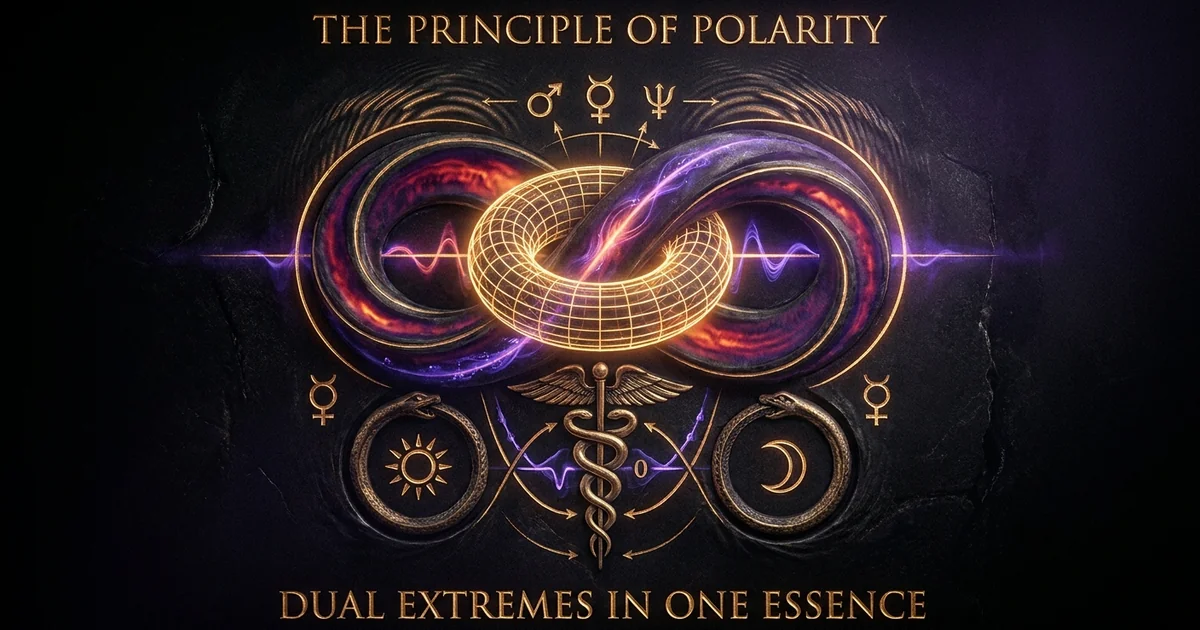
The Principle of Polarity: Dual Extremes in One Essence
Metaphysical Thesis & Epistemological Opening: The Monistic Resolution of Apparent Dualism
Scalar Continuum versus Substance Dualism
Naive realism and mechanistic materialism share an epistemological flaw: they mistake sensory perception thresholds for fundamental ontological rifts. By treating sensory contrasts—light and shadow, heat and frost, attraction and repulsion—as autonomous, mutually antagonistic substances, empirical common sense constructs a fragmented cosmos. This cognitive error culminated in Cartesian substance dualism, which divorced mind (res cogitans) from matter (res extensa), and found an earlier theological expression in Manichaean cosmologies that positioned Light and Darkness as warring primordial realms.
Against these bifurcations, the fourth Hermetic principle—the principle of polarity dual extremes identical in nature kybalion codices establish—presents an emanative monism. This axiom asserts that apparent antinomies are not distinct substances, but scalar variations along an unbroken continuum. Polar opposites share a single underlying essence, differing solely in rate of oscillation, operational frequency, and gradational measure.
When evaluated through Neoplatonic metaphysics and field theory, opposition reveals itself as an artifact of perceptual delimitation. Thesis and antithesis reside on the same ontological register. Just as absolute zero represents the thermodynamic nadir of atomic agitation rather than an autonomous element named “cold,” metaphysical negatives possess no self-subsistent reality. The fourth Hermetic principle demotes the concept of absolute opposition from a cosmological fact to a localized perceptual judgment.
Phenomena traditionally categorized as antithetical are simply polar terminals of a single phenomenological spectrum. Apparent structural schisms across the manifest cosmos are merely perceptual thresholds imposed by a localized observer, rather than ontological ruptures in the underlying fabric of reality.
The Semantic Trap of Mutually Exclusive Antinomies
Human language reinforces dialectical divisions through categorical naming conventions. By assigning distinct linguistic tokens to “love” and “hate,” or “courage” and “fear,” lexicography reifies shifting phenomenological states into concrete, incompatible things. This semantic calcification obscures the underlying dynamics of consciousness. As analyzed in models of /consciousness/non-dual-phenomenology-scalar-models, human affective landscapes are not battlegrounds between independent agents; they are variable calibrations of a singular psychic substrate.
Hatred is not the categorical antithesis of love, but its low-frequency, contracted expression. Both share the identical essence of emotional fixation, magnetic engagement, and psychic investment.
The principle of polarity resolves foundational theological and cosmological paradoxes, specifically the problem of evil (unde malum). If reality emanates from a singular, transcendent Source—designated as the One by Plotinus or the Divine Mind (Nous) in Hermetic literature—the existence of an autonomous, substantive evil would invalidate the monistic premise. Polarity demonstrates that evil, darkness, and discord possess no substantive essence (ousia).
Following the Neoplatonic doctrine of privation (steresis), evil represents a deficit of the Good, just as darkness marks an absence of photon emissions. Moral and physical negatives are gradational deficits rather than competing cosmological architectures.
The Hermetic Principle of Polarity must be carefully distinguished from Heraclitus’s concept of enantiodromia—the dialectical process whereby a phenomenon inevitably crosses over into its opposite. While enantiodromia implies a structural oscillation between two poles, the Hermetic doctrine aligns closer with the Neoplatonic concept of steresis (privation), articulated in Plotinus’s Enneads (I.8), and Procline scalar ontology.
In Hermetic scalar monism, the negative pole possesses no ontological autonomy; it is the privative attenuation of the positive pole along an uninterrupted continuum. Hermetic polarity avoids the dualist trap of treating opposites as equal and opposite substantive realities, framing them instead as differential intensities of a single operational principle.
Primary Codices & Historical Transmission: From Alexandria to Modern Hermetic Synthesis
Late Antique Provenance: The Corpus Hermeticum and Neoplatonic Emanationism
While the precise aphoristic formulation of polarity as the “Fourth Principle” crystallized in twentieth-century occultism, its conceptual roots reach back to the Greco-Egyptian syncretism of Roman Alexandria. The foundational treatises of the Corpus Hermeticum, compiled between the second and third centuries CE, contain an emanational cosmology in which divine energy projects outward from the Supreme Nous, progressively attenuating as it descends into the denser registers of material manifestation.
In Libellus XI (“Mind unto Hermes”), the cosmos is described not as a collection of disjointed objects, but as a living unity animated by a single operational life-force:
“Consider this yourself: command your soul to go to India, and it will be there faster than your command… Look at your own power, not to separate yourself from the Divine, but to understand that like is understood by like.” — Corpus Hermeticum, Libellus XI.18–20 (trans. Brian P. Copenhaver, 1992)
This dynamic reflects the cosmological doctrine outlined in /spirituality/corpus-hermeticum-emanational-cosmology. The cosmos is an integrated, energetic spectrum where gross matter is simply spirit calibrated to its lowest vibratory octave. Alexandrian Hermetism arose alongside the Neoplatonism of Ammonius Saccas and Plotinus.
In Ennead I.8 (“On the Nature and Source of Evil”), Plotinus argues that matter itself constitutes the lowest limit of emanation—not an adversarial, dark counter-deity, but the ultimate periphery of illumination. The Alexandrian world did not see reality through the prism of modern mechanistic atomism, but as a continuous field of divine presence modulated by varying degrees of descent, density, and opacity.
Emanational Descent (Plotinian / Alexandrian Schema):
[ The Transcendent One / Nous ]
       │
       ▼ (Progressive Attenuation of Intelligible Light)
[ Sefirotic / Celestial Spheres ]
       │
       ▼ (Privative Condensation / Steresis)
[ Physical Materia / Lowest Vibratory Octave ]
The 1908 Chicago Synthesis: Atkinson, The Three Initiates, and The Kybalion
The historical transmission of these continuous-field metaphysics took an unexpected turn at the dawn of the twentieth century. In 1908, the Yogi Publication Society in Chicago issued an anonymous text titled The Kybalion: A Study of the Hermetic Philosophy of Ancient Egypt and Greece, attributed to “Three Initiates.” Modern historical scholarship, led by scholars of Western esotericism such as Wouter J. Hanegraaff (2012), has conclusively identified the primary author as William Walker Atkinson, an attorney, pioneer of the New Thought movement, and prolific occultist.
The Kybalion (Chapter X: Polarity): “Thesis and antithesis are identical in nature, but different in degree; opposites are the same, differing only in their degree of vibration; the pairs of opposites may be reconciled; extremes meet; everything is and isn’t, at the same time; all truths are but half-truths.”
Corpus Hermeticum (Libellus IV.8, trans. Brian P. Copenhaver): “For the cosmos is one, and the sun is one, and the moon is one, and the divinity is one; all things, therefore, are parts of the one… If all things are in the Maker, and the Maker has made them all, then he makes himself in making them, just as he never ceases to make because he is himself without end.”
Atkinson synthesized ancient Hermetic literature, Renaissance occult traditions (passed down through Marsilio Ficino and Cornelius Agrippa), and the emerging scientific paradigms of his era. During the late nineteenth and early twentieth centuries, James Clerk Maxwell’s unification of electromagnetism, the discovery of X-rays, and early radiation research fundamentally altered the metaphysical landscape.
Atkinson recognized that the physics of electromagnetic radiation—where visible colors, radiant heat, and invisible radio waves are identical in substance, differing only in wavelength and frequency—provided an empirical framework for ancient Hermetic axioms. The Kybalion recast late-antique emanationism into a modern occult psychophysics. The fourth Hermetic principle emerged as an operational guide, translating metaphysical concepts into practical protocols for psychological transformation and energetic calibration.
Ontological Architecture & Cosmological Models: The Invariance of Scalar Gradients
The Thermometric Invariant: Hot and Cold as Arbitrary Delimitations
To understand scalar monism, consider the thermodynamic model popularized by Atkinson: the physical thermometer. An examination of a mercury or digital thermometer reveals no point where “heat” abruptly terminates and “cold” begins. “Hot” and “cold” are qualitative sensory labels assigned to relative positions along an unbroken, quantitative scale of molecular kinetic energy.
Cold has no independent physical existence; it cannot be isolated, captured, or directed as an autonomous current. It is simply a privation of thermal agitation. Absolute zero ($0\text{ K}$ or $-273.15^\circ\text{C}$) marks the theoretical cessation of classical kinetic movement, not the manifestation of an active “freezing agent.”
The Thermometric Axis:
0 Kelvin ────────────────────── Standard Ambient ────────────────────── High Plasma
[ Kinetic Privation / "Cold" ]      [ Relative Center ]        [ Kinetic Excitation / "Hot" ]
                         ◄── An Invariable Scalar Gradient ──►
This thermodynamic fact demonstrates that hot and cold same scale phenomena reveal a deeper cosmological truth. The human nervous system establishes an arbitrary homeostatic center, labeling temperatures above it as “warm” and those below it as “chilly.” The apparent polarity is generated by the observer’s somatic baseline rather than an objective break in the physical medium.
Applied to metaphysics, every qualitative polarity experienced by human awareness—light and dark, silence and noise, soft and hard—possesses an invariant structural continuity. The phenomenological field is not a checkerboard of black and white squares, but an undulating scalar gradient.
Sefirotic Architecture: Dynamic Polarity Across the Pillars of Severity and Mercy
This invariant scalar architecture is mirrored in the cosmological geometry of Jewish Kabbalah. Within the tree-of-life (Etz Chaim), reality emanates from the transcendent Ein Sof (the Infinite) through ten dynamic emanations (Sefirot), mapped onto three vertical pillars: the Pillar of Mercy (Chesed), the Pillar of Severity (Gevurah), and the Central Pillar of Equilibrium (Tiferet). As Gershom Scholem observes in Major Trends in Jewish Mysticism (1961), Chesed (boundless expansion, grace, and love) and Gevurah (contraction, judgment, and wrath) are not independent, competing deities. They are complementary polar vectors within the unified divine organism.
          [ BINAH ]              [ KETER ]             [ CHOKHMAH ]
             │                       │                       │
      (Left Pillar:                  │                (Right Pillar:
        Severity)                    │                    Mercy)
             │                       │                       │
         [ GEVURAH ] ─────────── [ TIFERET ] ─────────── [ CHESED ]
                               (Equilibrium /
                                Scalar Axis)
Left unmitigated, Chesed drowns existence in unstructured, undifferentiated abundance, while unbalanced Gevurah incinerates the cosmos with rigid contraction and judgment, giving birth to the demonic husks of the Sitrah Achra (the Other Side). Cosmological coherence is preserved because these two polar energies converge in Tiferet (Beauty/Harmony), the central sun of the Sefirotic architecture.
Tiferet does not extinguish the tension between Chesed and Gevurah; it integrates them into a functional dynamic. In Sefirotic cosmology, the Right and Left pillars form an integrated, bipolar field, balanced by the mediating central axis.
Ontological Dualism (Manichaean / Cartesian)
- Mechanism of Opposition: Primordial clash between two fundamentally distinct, irreconcilable substances or realms (e.g., Spirit vs. Matter, Light vs. Dark).
- Ontological Status of Negative States: Evil, cold, and darkness possess independent, active substance, functioning as self-subsistent metaphysical realities.
- Transmutational Potential: Transmutation is impossible; the dark pole cannot be transformed, but must be resisted, cast out, or destroyed by the light pole.
- Observer Relationship: The observer is a fractured participant, trapped within a dialectical conflict between competing external forces.
Hermetic Scalar Monism (The Fourth Principle)
- Mechanism of Opposition: Scalar variation along an invariant phenomenological continuum; extremes differ only in degree, vibratory rate, and phase.
- Ontological Status of Negative States: Negative states are privative (steresis); they reflect a relative absence or lower oscillatory frequency of the positive essence.
- Transmutational Potential: Transmutation occurs by shifting vibratory states along the existing continuum; undesirable states are elevated into their higher polar expressions.
- Observer Relationship: The observer is an active calibrator who navigates and shifts polarity through intentional volition and consciousness.
Phenomenological Mechanics & Interdimensional Interaction: Mental Transmutation and Vibratory Calibration
Sliding Mental Polarity Along Scale: Operational Hermetic Psychodynamics
Understanding that dual extremes share a single essence unlocks the mechanics of Hermetic mental transmutation. If fear and courage were distinct substances, banishing fear would require its eradication and the subsequent creation of courage ex nihilo. The psyche would be forced into an exhausting battle of suppression.
However, because fear and courage are simply polar calibrations of the same protective-attentive impulse, the Hermetic practitioner does not attempt to destroy fear. Instead, the operator applies focused volition to alter the mental state’s vibratory rate, effectively sliding mental polarity along scale from the contracted pole of fear to the expansive pole of courage.
Low Vibration: Contracted                                    High Vibration: Expansive
[ PANIC / FEAR ] ──────► [ HESITATION ] ──────► [ RESOLVE ] ──────► [ COURAGE ]
                        ◄── Operational Transmutation Vector ──►
This psychodynamic methodology, detailed in /spirituality/mental-transmutation-hermetic-mechanics, operates through sympathetic resonance and intentional focus. The practitioner changes their mental state by shifting their attention up the scalar axis. Just as a musician changes a note not by fighting the vibrating string, but by altering its tension, the Hermetic mentalist shifts their emotional state by raising its frequency.
Crucially, transmutation succeeds only between states of the same categorical continuum. One cannot transmute pride into coldness or sorrow into red light, because they do not share an ontological register. Transmutation requires scalar consanguinity: love transmutes into hate, apathy into zeal, and cowardice into valor.
The Observer-Observed Continuum and High Strangeness Modulations
The implications of scalar polarity extend beyond self-directed psychology into anomalistics and the study of Non-Human Intelligence (NHI). In his foundational work Dime con quién andas and subsequent books (Passport to Magonia, The Invisible College), Jacques Vallée challenged naive nuts-and-bolts extraterrestrial hypotheses. He argued that anomalous phenomena operate as an informational control system modulating human consciousness across historical eras. Within this paradigm, analyzed through the /nhi-phenomena/vallee-informational-control-systems framework, the interdimensional-hypothesis replaces the rigid demarcation between physical events and psychological projections.
Encounters characterized by high-strangeness demonstrate that the observer and the observed phenomenon exist on an interactive continuum. The witness is not a detached spectator viewing an objective spectacle; the encounter alters its physical and symbolic density based on the witness’s psychic state, cultural baseline, and perceptual frequency.
The phenomenon can shift from an atmospheric plasma to a metallic craft, an apparitional entity, or an internal telepathic download. These modulations represent shifts along a scalar axis connecting mind and matter. In the Hermetic sense, the phenomenon and the percipient are conjugate variables in a single informational system, where adjustments in consciousness provoke real-time changes in the manifested event.
Initiatic Synthesis & Epistemological Warnings: Human Sovereignty and the Non-Dual Praxis
The Peril of Moral Relativism and Egregoric Entanglement
The realization that all dualities share a single essence presents serious psychological and philosophical risks. The most insidious of these is moral nihilism. An undisciplined mind, discovering that virtue and vice are polar degrees of the same moral spectrum, may conclude that ethical distinctions are illusory, falling into the solipsistic trap of “nothing is true, everything is permitted.”
This misapprehends Hermetic cosmology. While polar extremes share an ontological essence, their functional trajectories differ profoundly. The higher registers of the scale represent greater coherence, awareness, and life, while the lower registers indicate fragmentation, unconsciousness, and entropy.
Novices encountering the Principle of Polarity often fall prey to an acute form of psychological inflation (hubris), conflating the metaphysical truth of non-dual scalar monism with moral indifference. Recognizing that “Light and Darkness are one essence” does not grant the initiate immunity from the systemic laws of cause and effect (Karma or Hermetic Cause and Effect).
Treating moral distinctions as irrelevant invites rapid entanglement with destructive egregore structures—collective psychic complexes that thrive on ideological extremism and unconscious shadow projection. The practitioner must never confuse scalar monism with ethical nihilism. Realizing that the thermometric scale is singular does not make hypothermia indistinguishable from homeostasis.
In mass psychology and sociopolitical engineering, polar extremes are routinely weaponized to generate powerful egregore currents—autonomous psychic structures fueled by group devotion and ideological fervor. Technocratic and sectarian systems herd human consciousness into dialectical traps: Left versus Right, Science versus Religion, Us versus Them.
By trapping public perception within these false antinomies, systems harvest psychic energy, keeping populations oscillating between artificially manufactured extremes. True sovereignty requires recognizing these binary conflicts as orchestrated friction along a single axis, disengaging from the lateral struggle to anchor oneself in the neutral center.
The Central Pillar: Transcending Dialectical Traps in Technocratic Culture
The ultimate goal of Hermetic praxis is not merely sliding polarity back and forth to achieve fleeting comfort, but cultivating the consciousness of the Central Pillar. In both classical Kabbalistic practice and advanced Hermetic theurgy, the adept does not identify permanently with either the positive or negative pole. Rather, the master stabilizes consciousness at the scale’s fulcrum.
From this neutral center, one perceives the continuum without succumbing to its oscillations. The adept navigates manifest reality through the pleroma—the fullness of intelligible reality—while remaining unswayed by the illusions of the demiurge, the archontic architect of material fragmentation.
       (+) Upper Dynamic Pole (Expansion / Light)
             │
             │   ◄── Lateral Oscillation (Vulnerable to Egregoric Capture)
             │
   ══════════[ FULCRUM / CENTRAL AXIS ]══════════  ◄── The Sovereign Operator
             │
             │   ◄── Lateral Oscillation (Vulnerable to Reactive Despair)
             │
       (-) Lower Privative Pole (Contraction / Void)
Attaining this zero-point equilibrium grants true spiritual sovereignty. Operating from the fulcrum, the Hermetic practitioner handles dualities like tools. One utilizes contraction for analytical precision and expansion for visionary synthesis, without being consumed by either extreme.
By refusing to reify opposites into ontological idols, the mind frees itself from lateral traps. Consciousness ceases to be a victim of polarized circumstance, transforming into an active, sovereign calibrator of its own reality.
Frequently Asked Questions: Deep Hermetic Metaphysics
How does the Hermetic Principle of Polarity differ from Hegelian Dialectics?
Hegelian dialectics relies on a triad: a Thesis clashes with an autonomous Antithesis, generating conflict that eventually resolves into a Synthesis ($A \times \neg A \to B$). This model posits an initial opposition that must be actively reconciled through historical and cognitive development.
In contrast, the Hermetic Principle of Polarity is non-dialectical and scalar. It asserts that Thesis and Antithesis are already identical in essence from the outset ($A_{\text{low}} \dots A_{\text{high}}$). There is no violent clash of incompatible substances, nor a newly emergent third entity. Instead, Hermetic polarity involves the adjustment of scalar variables along a pre-existing, continuous field, moving through degrees of a shared quality rather than synthesizing conflicting ones.
If Good and Evil are the same scale, does Hermeticism promote moral relativism?
Hermeticism firmly rejects moral relativism. While it asserts that Good and Evil occupy the same continuum, it identifies Evil as a privative state—a deficiency of Light, Order, and Conscious Awareness.
To use an empirical analogy: while positive and negative voltage share a single electromagnetic continuum, sticking an ungrounded conductor into a high-voltage conduit produces destructive consequences. The unity of the scale does not negate the vectors of harm, entropy, or suffering.
Evolution moves toward higher consciousness, harmony, and integration (the Good). Descending into fragmentation, violence, and ignorance (the Evil) opposes this natural cosmic momentum, generating real karmic and psychological disintegration for the individual.
Why is it impossible to transmute sadness into physical heat or intellectual pride?
Mental transmutation requires consubstantiality—the two emotional or psychological states must share an ontological axis. Sadness is an emotional calibration along the depressive-expressive axis, which has joy at its opposite pole. Physical heat exists on a thermodynamic molecular axis, while pride occupies a relational ego axis anchored by humility.
Because transmutation functions by sliding mental polarity along a shared scale, energy can only be redirected between polar extremes within the same qualitative register. Attempting to transmute grief into physical heat violates scalar mechanics; grief must be transmuted along its native axis into acceptance, peace, or joy.
“The adoption of thermodynamic and electro-dynamic metaphors by late-nineteenth-century occultists was not merely decorative rhetoric, but an epistemic re-framing. Authors within the Mental Science and New Thought milieus—most visibly William Walker Atkinson—systematically co-opted concepts of vibrational frequency, magnetic polarity, and potential energy to naturalize traditional Neoplatonic and Hermetic ontologies within a post-Newtonian worldview. Through this operation, ancient spiritual hierarchies were transposed into accessible scalar continuums.” — Wouter J. Hanegraaff, New Age Religion and Western Culture: Esotericism in the Mirror of Secular Thought (State University of New York Press, 1998, pp. 224–229)
:::