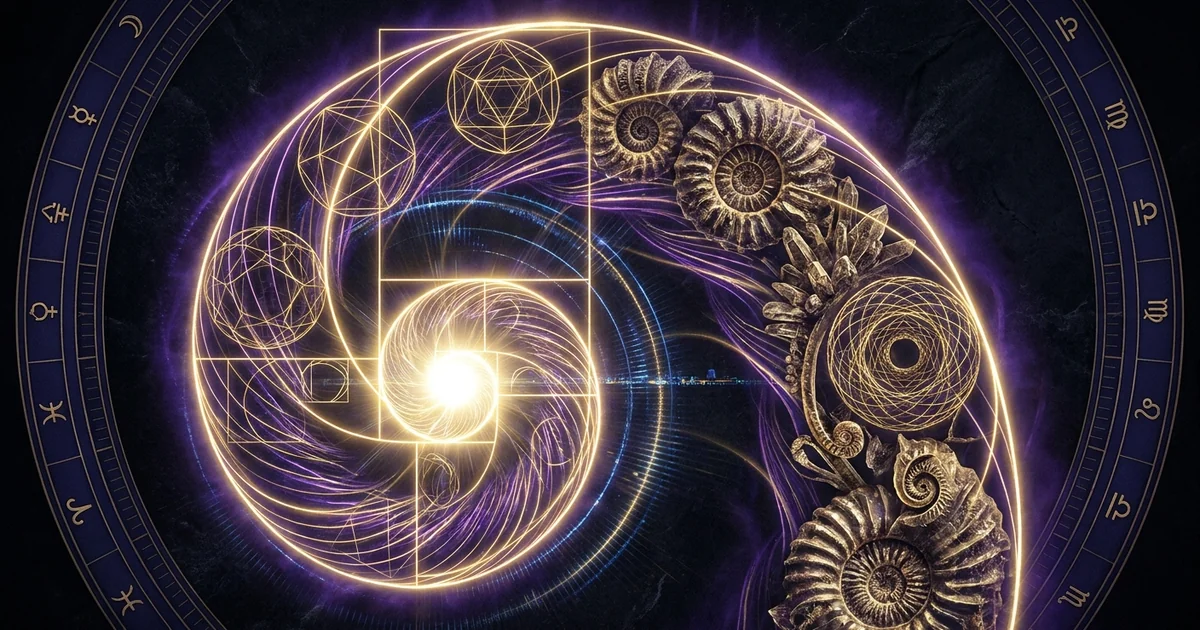
The Fibonacci Sequence: Spiral of Unfolding Growth Arts
Metaphysical Thesis & Epistemological Opening: The Recursive Ontogeny of Form
The Arithmetical Monad and the Illusion of Static Materialism
Physical materialism conceptualizes biological morphogenesis through stochastic, external biochemical pressures, failing to account for the intrinsic mathematical vectors governing biological self-assembly. In this reductionist paradigm, form is treated as an accidental byproduct of genetic transcription collisions and environmental friction.
Yet, when living matter self-organizes, it executes an invariant geometric choreography that defies purely random evolutionary drift. The structural emergence of biological systems reveals an underlying arithmology—a qualitative science of number wherein quantity acts as the spatialized garment of transcendent metaphysical principles.
Within the classical tradition, particularly as delineated in the Neoplatonic lineage descending from the Pythagorean Monad and the Tetractys, numbers are not arbitrary linguistic signifiers invented for commercial inventory. Instead, they are operative, cosmogenic forces.
The Monad, subsisting within the unmanifest stillness of the pleroma, contains all potentiality in undivided unity. For the Monad to project its internal unity into the multi-dimensional manifold of physical space, it must generate a dynamic relational grammar.
Materialism perceives only the stabilized end-state—the mineralized skeleton, the petrified shell, or the leaf blade—mistaking the fixed artifact for the living generative process. This epistemological blindness ignores the fundamental kinetic reality: form is never static. It is a frozen vector of recursive accumulation.
F(n) = F(n-1) + F(n-2)
The Fibonacci sequence ($0, 1, 1, 2, 3, 5, 8, 13, 21, 34, 55, \dots$) exposes the mechanics of this continuous procession (proodos). By examining the fibonacci sequence recursive integer series spiral natural growth, we observe that spatial extension is not an imposition of force upon inert mass. Rather, it represents the endogenous unfolding of the Monad mediating its own self-contemplation through progressive dimensionalization.
              F(5)=5
             ┌───┬───┐
             │ 2 │ 3 │
         ┌───┼───┴───┤
  F(6)=8 │ 1 │   4   │
         │ 1 │       │
         └───┴───────┘
The Operational Bridge: Mediating the Discrete and the Continuous
The central mystery of manifested existence lies in the ontological chasm separating discrete numerical units from the continuous fabric of spatial extension. How does the integer, isolated within its arithmetic boundary, give birth to the fluid, uninterrupted trajectories of organic curves? The Fibonacci series provides the functional bridge across this abyss.
Defined by the second-order linear recurrence relation:
$$F_0 = 0, \quad F_1 = 1, \quad F_n = F_{n-1} + F_{n-2} \quad \text{for } n \ge 2$$
the sequence demands that each emergent state integrate its entire operational ancestry. Physical presence is not an isolated event enacted ex nihilo; it is structurally dependent upon the summation and retention of its two immediate ontological antecedents.
This recursive summation demonstrates that matter possesses memory. In physical morphogenesis, a cell division or a leaf primordium does not simply emerge into vacant space. Its spatial coordinates, divergence angle, and volume are directly computed from the historical configuration of the adjacent tissue.
The discrete step of each integer translates into a continuous logarithmic curvature through the proportional relationship binding the successive iterations. The discrete and the continuous are revealed not as hostile dualisms, but as polar expressions of a single morphological continuum. Through this recursive accumulation, discrete arithmetical points are woven into continuous topological sheets, establishing the primary fabric upon which physical nature paints its transient morphologies.
Modern computational mathematics treats number strictly as a horizontal, quantitative syntax—an instrumental abstraction detached from ontological weight, designed solely for discrete enumeration and manipulation.
In sharp contrast, Neoplatonic and Pythagorean arithmology approaches number as a vertical hierarchy of qualitative dimensional emanations. Here, the Greek concept of Logos denotes not mere logic, but the proportional, generative rationale through which the transcendent Source organizes the cosmos.
Recursive numerical progression represents the dynamic principle of anapausis (repose within return) and proodos (procession into multiplicity). Each integer is a distinct ontic station possessing specific cosmogonic capacities: Unity ($1$) represents the indivisible absolute; the Dyad ($2$) introduces polarity, spatial extension, and alterity; the Triad ($3$) establishes the reconciliation of opposites through systemic equilibrium.
The Fibonacci operation ($F_n = F_{n-1} + F_{n-2}$) functions as a continuous arithmological bridge, demonstrating how the higher orders of manifest multiplicity perpetually preserve, synthesize, and rest upon the foundational triad of existence.
Teleological Morphogenesis: Asymptotic Drive Toward Transcendence
The terminal trajectory of this recursive integer sequence does not point toward mathematical entropy or chaotic dissolution. Instead, it is directed toward an invariant attractor: the golden ratio ($\phi$), defined as:
$$\phi = \frac{1 + \sqrt{5}}{2} \approx 1.6180339887…$$
As the integer sequence scales toward infinity, the ratio between adjacent terms exhibits an asymptotic convergence to phi ratio:
$$\lim_{n \to \infty} \frac{F_n}{F_{n-1}} = \phi$$
This convergence is alternating and perpetual; the ratios oscillate above and below the irrational limit:
$$\frac{1}{1} = 1.0, \quad \frac{2}{1} = 2.0, \quad \frac{3}{2} = 1.5, \quad \frac{5}{3} \approx 1.666, \quad \frac{8}{5} = 1.600, \quad \frac{13}{8} = 1.625, \quad \frac{21}{13} \approx 1.615$$
$$\frac{F_n}{F_{n-1}} - \phi \propto \frac{(-1)^n}{\phi^n}$$
This oscillation constitutes an arithmetical heartbeat. The finite, bounded integer strives to incarnate an ineffable, continuous proportion that cannot be expressed as a fraction of integers. The irrationality of $\phi$—uniquely characterized by its continued fraction expansion consisting entirely of ones:
$$\phi = 1 + \cfrac{1}{1 + \cfrac{1}{1 + \cfrac{1}{1 + \ddots}}}$$
makes it the “most irrational” of all real numbers. It is the number most resistant to being approximated by rational fractions.
Phi Approximation Waveform:
Value
  2.0 ┼      * (2/1)
      │                     * (8/5 = 1.60)
  1.6 ┼- - - - - - - - - - - - - - - - - - - - - - - - -  φ ≈ 1.618...
      │              * (5/3 ≈ 1.666)        * (13/8 = 1.625)
  1.0 ┼      * (1/1)
      └───┬──────────┬──────────┬──────────┬──────────┬──> Iteration (n)
         n=2        n=3        n=4        n=5        n=6
Herein lies the profound teleological drive of biophysical morphogenesis. Matter cannot embody the transcendent archetype in an instantaneous, static stroke.
Because the physical universe is bound to the temporal conditions of succession and metric division, it must approximate the divine proportion through iterative, asymptotic steps. Finite life projects itself toward infinite structural harmony, asymptotically approaching an irrational absolute that remains forever transcendent to the discrete steps that trace its path.
Primary Codices & Historical Transmission: From Vedic Prosody to the Tuscan Merchant
The Meru-Prastara and Sanskrit Poetics: Pingala to Hemachandra
The Eurocentric attribution of this sequence to medieval Italy obscures its deeper origins within the metric treatises of ancient India. Long before the Pisan merchant calculated rabbit lineages, Indian grammarians and mathematicians explored these numerical combinations to solve practical problems in Sanskrit prosody (chandas).
In the metrical system formalized by Pingala in the Chandaḥśāstra (c. 3rd–2nd century BCE), poetic meters were composed of syllables that were either light (laghu, single mora) or heavy (guru, two morae). The central combinatorial problem was determining how many distinct rhythmic patterns of long and short syllables could completely fill an arbitrary poetic meter of $n$ total morae (mātrās).
Mora Duration Calculations:
1 Mora:  [L]                           = 1 permutation  (F1)
2 Morae: [L, L], [G]                   = 2 permutations (F2)
3 Morae: [L,L,L], [L,G], [G,L]         = 3 permutations (F3)
4 Morae: [L,L,L,L], [L,L,G], [L,G,L],
         [G,L,L], [G,G]                = 5 permutations (F4)
The mathematical formalization of this problem was elucidated by subsequent scholars, notably Virahanka (c. 6th–8th century CE), Gopala (c. 1135 CE), and the Jain polymath Hemachandra (1150 CE)—who recorded the clear additive formulation over fifty years before Leonardo of Pisa.
Hemachandra demonstrated that the number of metric combinations for a duration of $n$ units is obtained by summing the combinations for a duration of $n-1$ (prefixed by a short syllable) and $n-2$ (prefixed by a long syllable).
In this Vedic context, the sequence was not born of practical agricultural accounting, but of sacred phonetics. The temporal measurement of the voice vibrating in alignment with cosmic order (Ṛta) required a precise, recursive mapping of acoustic time. The resultant staircase of numbers, known as the mātrāmeru or the pyramidal structure of rhythmic expansion, anchored linguistic incantation directly to the structural dynamics of universal unfolding.
Leonardo of Pisa’s Rabbits: Practical Algorisms Masking Universal Laws
The transmission of this mathematical relationship into the Western canon occurred through Leonardo of Pisa, posthumously known as Fibonacci. Returning to the Tuscan maritime republic from Bugia (modern Béjaïa, Algeria), where he was educated in Arabic mathematical techniques, Fibonacci completed the Liber Abaci (The Book of Calculation) in 1202.
The primary contribution of this work was pedagogical and economic: it introduced the Hindu-Arabic numeral system, positional notation, and the operative methods of modular arithmetic to an Italian commercial class still encumbered by the inefficiencies of Roman numerals.
Month  Immature Pairs  Breeding Pairs  Total Pairs
0      1               0               1
1      0               1               1
2      1               1               2
3      1               2               3
4      2               3               5
5      3               5               8
6      5               8               13
Within Chapter 12 of this massive computational treatise, nestled among prosaic problems concerning currency exchange, alloy calculations, and cargo tariffs, appears the celebrated thought experiment: “Quot paria cuniculorum in uno anno ex uno pario procreentur” (“How many pairs of rabbits can be produced from a single pair in one year”).
The problem posits an idealized, hermetically enclosed environment: an isolated breeding pair produces one new pair each month; every newly born pair matures over the course of an initial non-reproductive month; and no mortality interrupts the generational progression.
“Quidam posuit unum par cuniculorum in quodam loco, qui erat undique pariete circumdatus, ut sciret, quot ex eo paria germinarentur in uno anno: cum natura eorum sit per singulos menses aliud par procreare, et in secundo mense a natali eorum procreant.”
Translation: “A certain man put one pair of rabbits into an enclosure surrounded by a wall, in order to find out how many pairs of rabbits could be produced from that initial pair in the space of a single year: it being their inherent nature that every month they procreate another pair, and in the second month following their birth they likewise begin to generate.”
This seemingly mundane agricultural illustration served as an exoteric cloaking mechanism. Leonardo translated a recursive cosmic dynamic into a practical algorism accessible to the commercial arithmetic of medieval merchant guilds.
The rabbit pair operates as a discrete ontological token. The requirement that each pair must endure an infertile gestational interval (the maturation lag from step $n-1$ to $n$) before projecting another discrete unit into the system models the precise time-delay dynamic required for physical matter to precipitate across dimensional thresholds.
Renaissance Hermeticism: Pacioli, Kepler, and the Divine Proportion
During the Florentine Renaissance, the sequence was reclaimed from the merchant’s ledger and restored to sacred natural philosophy. The Franciscan friar Luca Pacioli, intimately collaborating with Leonardo da Vinci, authored De Divina Proportione (completed 1498, published 1509).
Pacioli formally decoupled the golden ratio from mere commercial computation, identifying five divine properties matching the attributes of God: unity, trinity (three terms required to articulate proportion: $A:B = B:C$), ineffability (irrationality), self-similarity (omnipresence), and the capacity to generate the five Sacred Geometry Platonic Solids. Da Vinci’s accompanying illustrations of stellated polyhedra visually established that this proportion provides the structural framework for Euclidean space.
       Proportion Continuum (Pacioli/Kepler)
[ Invariant Ratio (Phi) ] ── (Transcendent Archetype)
            │
            ▼
[ Fibonacci Recurrence ] ── (Immanent Spatiotemporal Vector)
            │
            ▼
[ Manifest Phyllotaxis ] ── (Material Morphic Crystallization)
A century later, Johannes Kepler recognized the golden ratio as a cosmic generative principle. In his 1611 treatise Strena Seu de Nive Sexangula (The Six-Cornered Snowflake), Kepler addressed the morphological puzzle of why snowflakes crystallize into hexagonal arrays while plant blossoms display pentagonal, Fibonacci-aligned symmetries. Kepler declared:
“Geometry has two great treasures: one is the Theorem of Pythagoras; the other, the division of a line into extreme and mean ratio. The first we may compare to a measure of gold; the second we may name a precious jewel.”
Kepler perceived that the regular dodecahedron—the Platonic signifier of the quintessence—is composed of pentagons whose diagonals intersect according to this divine cut.
He grasped that the Fibonacci series is the kinetic, living vehicle through which the static, non-reproductive geometry of mineral crystallization transitions into the reproductive, self-similar geometry of the anima mundi (world soul). Kepler saw the golden ratio not as an inert measurement, but as an active, vitalizing principle that weaves through organic creation.
Ontological Architecture & Cosmological Models: Emanation and the Logarithmic Vortex
Sefirotic Unfolding: The Triadic Addition of Manifest Reality
The mechanics of recursive summation find an analog in the emanationist cosmologies of the Western esoteric tradition, most visibly in the Kabbalistic Tree of Life. In the Lurianic and Zoharic systems, the infinite, unmanifest Source (Ein Sof) does not project reality in a single, unmediated emanational flash.
Manifestation proceeds through the structured descent of ten Sefirot—ontological vessels that successively condense the primordial divine light.
                       [ 1: Keter ]
                            │
               ┌────────────┴────────────┐
               ▼                         ▼
         [ 2: Chokhmah ]           [ 3: Binah ]
               │                         │
               └────────────┬────────────┘
                            │
                      [ F3 = F2 + F1 ]
                            ▼
                      [ 4: Chesed ]
                            │
                           ...
The progression through the upper triad illustrates the operational logic of the Fibonacci recurrence:
- Keter (the Primordial Crown) corresponds to the initial unity, $F_1 = 1$.
- Chokhmah (Wisdom), the initial active emanation, represents the second unit, $F_2 = 1$.
- Binah (Understanding), the receptive womb, synthesizes the preceding principles to establish the first manifest balance, generating $F_3 = 2$.
Every subsequent Sephira is an ontological summation. Chesed (Mercy) cannot exist without synthesizing the dynamic tension between Chokhmah and Binah; Gevurah (Severity) cannot function except as the calibrated reaction to the systemic states preceding it.
The energetic conduit descending down the central pillar to Malkuth (the physical Kingdom) mirrors the additive progression of the recursive series. The manifest realm is not an isolated material strata; it is the accumulated energetic expression of all ancestral sefirotic dimensions operating simultaneously.
Remove any prior term from the Fibonacci sequence, and the higher-order integers instantly collapse; sever the flow of the upper Sefirot, and Malkuth is drained of ontological vitality.
Spira Mirabilis: Invariance Under Dynamic Expansion
When the Fibonacci recurrence is translated into two-dimensional space through adjacent square tiling, it generates the logarithmic or equiangular spiral. First comprehensively analyzed by Jakob Bernoulli, who was so captivated by its unique geometric properties that he dubbed it the spira mirabilis (“the miraculous spiral”), this curve possesses the distinctive quality of homothety: absolute scale invariance.
Visual Mechanics: The Equiangular Spiral
                  . - ~ ~ ~ - .
              . '               ' .
            /                       \
           /     ┌─────┬───┐         \
          |      │  3  │ 2 │          |
          |      ├─────┼─┬─┤          |
          |      │  5  │1│1│          |
           \     └─────┴─┴─┘         /
            \                       /
              . '               ' .
                  ' - ~ ~ ~ - '
          (Vector expansion preserves angle θ)
In polar coordinates $(r, \theta)$, the equiangular spiral is governed by the continuous function:
$$r(\theta) = a e^{b \theta}$$
where the growth factor $b$ is linked to the golden ratio:
$$b = \frac{\ln(\phi)}{\pi/2} \approx 0.3063489$$
Unlike the Archimedean spiral—which is generated by a point moving outward along a rotating ray at a constant linear speed, creating concentric tracks separated by fixed, static intervals—the logarithmic spiral expands exponentially.
As the curve unfurls, its shape remains utterly unchanged. Every radial vector drawn from the pole intersects the spiral at precisely the same angle $\alpha$, governed by the differential identity:
$$\cot(\alpha) = b$$
Archimedean Linear Progression
- Mathematical Equation: $r = a + b\theta$
- Kinematic Profile: Uniform linear translation coupled to constant rotational velocity; generates equally spaced concentric bands.
- Scale Dynamics: Non-invariant under magnification; global geometry alters relative to origin as size increases.
- Esoteric Attribution: Demiurgic, mechanical, entropic; represents cyclical entrapment and uniform material repetition.
- Biological Manifestation: Inert mechanical winding, non-living structures (e.g., coiled rope, uniform clockwork springs).
Logarithmic Fibonacci Expansion
- Mathematical Equation: $r = a e^{b\theta}$
- Kinematic Profile: Exponential spatial expansion preserving proportional equilibrium; radial velocity scales with radius.
- Scale Dynamics: Perfect homothety (scale invariance); morphology remains completely identical across infinite scales.
- Esoteric Attribution: Hermetic principle of correspondence; represents vitalistic unfolding and spiritual evolution.
- Biological Manifestation: Dynamic living growth, phyllotaxis, nautilus shell growth, cochlear hearing channels.
This mathematical property of gnomonic growth allows an organism to expand in size without altering its operational morphology. A juvenile nautilus builds new, larger living chambers along this logarithmic curve without disturbing the hydrodynamic equilibrium of its shell.
This behavior realizes the classic Hermetic axiom of correspondence: the macrocosm reflects the microcosm precisely because the underlying geometric grammar is scale-invariant. The form preserves its integral identity while navigating indefinite dimensional growth.
Jacques Vallée’s Informational Physics and Reality Morphic Engines
To restrict the Fibonacci sequence and the logarithmic spiral to ordinary biology is to miss their broader role within non-local ontology. In the information-centric physics championed by Jacques Vallée in works such as Messengers of Deception (1979), physical reality is not composed of irreducible, hard-matter particles suspended in empty space. Instead, it is an informational control system—a multidimensional matrix of symbolic code operating beneath the perceptual threshold of human consciousness.
Within Vallée’s framework, anomalistic events, synchronicities, and Vallee’s Informational Control System are not random intrusions from outer space. They are programmatic adjustments within the informational software that underpins physical reality.
The recurrence relations that govern biological growth appear to act as reality’s morphic engines. Morphogenetic fields, as theorized by Rupert Sheldrake in his work on Morphic Resonance, suggest that forms are transmitted across space-time via non-local resonance rather than purely localized chemical signaling.
       Informational Layer (Vallée / Sheldrake)
  [ Non-Local Morphic Fields / Informational Code ]
                         │
                         ▼ (Algorithmic Projection)
  [ Fibonacci Recursive Geometry / Golden Divergence ]
                         │
                         ▼ (Biophysical Manifestation)
      [ Physical Reality / Phyllotaxis / Anatomy ]
When an organism grows, it aligns with a pre-existing geometric substrate—an energetic scaffolding that provides the path of least physical resistance and maximum informational coherence.
The Fibonacci sequence serves as the algorithmic shorthand used by this morphic matrix to generate the illusion of three-dimensional material density from an underlying informational substrate. It transforms pure code into the spatial textures of the physical realm.
Phenomenological Mechanics & Interdimensional Interaction: Morphogenesis in Living Matter
The Sun Flower Seed Head: Optimal Packing at the Golden Divergence Angle
The clearest empirical demonstration of this recursive mathematics organizing physical matter occurs in the botanical phenomenon of phyllotaxis—specifically within the disk floret arrangement of sunflower seed head packing (Helianthus annuus).
To pack the maximum number of seeds into a circular receptacle without wasting space or crushing adjacent tissue, the apical meristem must deposit successive primordia at a precise divergence angle along a continuous spiral.
Meristem Apex Primordia Deposition:
Primordium 0: [Origin]
Primordium 1: Rotates ~137.5° from Primordium 0
Primordium 2: Rotates ~137.5° from Primordium 1
...
Result: Homogeneous seed density across the entire disk area.
If the meristem deposits cells at an angle derived from an ordinary rational fraction of a complete $360^\circ$ circle (such as $360^\circ \times 1/2 = 180^\circ$, or $360^\circ \times 3/5 = 216^\circ$), the emerging seeds quickly align into straight, radiating spokes. This alignment leaves wide, unutilized gaps of empty space at the periphery.
Rational Divergence (e.g., 360° x 3/5 = 216°):
             \   |   /
              \  |  /
               \ | /
          ───────*───────  <-- Gaps grow exponentially
               / | \           toward the periphery!
              /  |  \
             /   |   \
To achieve optimal, gapless packing across a growing circular surface, the divergence angle must be an irrational fraction of $360^\circ$. Nature solves this boundary optimization problem by adopting the golden angle ($\psi$):
$$\psi = 360^\circ \times (1 - \frac{1}{\phi}) = 360^\circ \times (2 - \phi) \approx 137.5077…^\circ$$
$$\text{Fraction of Circle} = \frac{1}{\phi^2} \approx 0.381966…$$
By rotating by precisely $137.5077^\circ$ between the deposition of each successive seed primordium, the sunflower prevents any two seeds from sharing a common radial line. The seeds organize into dynamic, intersecting curved spirals whose numbers are always adjacent pairs of Fibonacci numbers: typically $34$ spirals winding clockwise against $55$ winding counter-clockwise, or $55$ against $89$ in larger specimens. This exquisite biological efficiency is driven by pure mathematical necessity.
Pinecone Parastichies: Intersecting Counter-Spirals in Ligneous Morphology
A complementary manifestation of this developmental geometry appears in the ligneous scales of the pinecone (Pinus strobus and allied species). When inspecting the base of a pinecone, the eye naturally traces continuous intersecting curves termed parastichies.
These pinecone parastichy spirals form a dual helical lattice wrapping the central woody axis: one set of spirals climbs steeply to the right, while another climbs more gently to the left.
Base Perspective of Pinecone Axis:
          . - ~ - .
      . '   / | \   ' .
     /     /  |  \     \
    ;   8 R-Spirals     ;
    ;  13 L-Spirals     ;
     \     \  |  /     /
      . '   \ | /   ' .
          ' - ~ - '
Counting these opposing parastichies consistently reveals consecutive pairs of the Fibonacci sequence: $(3, 5)$, $(5, 8)$, or $(8, 13)$.
This structural distribution is not programmed by individual genes encoding pinecone scales. Instead, it is the natural physical consequence of mechanical strain minimization operating within the growing apical bud.
As new scale primordia form around the conical apex, each successive cell is physically pushed away from the active growth zone along the line of least resistance, governed by the plastochron ratio:
$$R = \frac{r_{n}}{r_{n+1}}$$
Because the spatial divergence between successively generated primordia naturally rests at the golden angle, the physical scales settle into a dynamic packing equilibrium. The emergent spirals are structural records of the pinecone’s growth history, preserving the path of its development within a crystalline, woody lattice.
Geometric Invariants as Trans-Dimensional Boundary Interfaces
The consistent emergence of these numbers across disparate biological kingdoms—from vascular plants to shell-dwelling cephalopods—suggests that the Fibonacci series functions as a fundamental boundary interface. In theoretical biophysics, an invariant is a property of a system that remains completely unchanged under specific transformations. The golden divergence angle and the Fibonacci parastichies are geometric invariants that persist across variations in species, climate, and terrestrial chemistry.
These invariants act as structural transducers. They mediate between the higher-dimensional, purely mathematical constraints of non-Euclidean geometry and the lower-dimensional, chemical constraints of physical matter.
Living tissue does not generate the spiral through conscious design or genetic improvisation; rather, the underlying informational physics funnels physical matter through these specific geometric pathways. The logarithmic spiral acts as a dimensional valve, converting non-local geometric archetypes into biological form.
Initiatic Synthesis & Philosophical Implications: The Transmutation of Mind and Matter
Somatic Geometry: The Microcosmic Body as an Asymptotic Vehicle
In the esoteric physiology of the Hermetic and yogic traditions, the human body is understood not as an accidental collection of biological cells, but as an incarnated temple structured by sacred proportion. Classical somatic analysis demonstrates that human anatomy reflects the Fibonacci sequence throughout its skeletal architecture.
The phalanges of the human hand offer an immediate example: each finger consists of three discrete phalangeal bones whose relative lengths closely approximate the Fibonacci intervals of $2, 3, 5$, terminating in the metacarpal bone ($8$).
Human Digit Articulation Proportions:
|-- Distal (2) --|--- Middle (3) ---|----- Proximal (5) -----|------- Metacarpal (8) -------|
This structural relationship extends throughout the human body:
$$\frac{\text{Forearm}}{\text{Hand}} \approx \phi, \quad \frac{\text{Total Arm Length}}{\text{Forearm + Hand}} \approx \phi, \quad \frac{\text{Height of Navel}}{\text{Total Height}} \approx \frac{1}{\phi}$$
The anatomical framework operates as a localized antenna for informational resonance. The inner ear’s cochlea—the organ that transforms the fluid vibrations of sound into electrochemical nerve impulses—is wound in a logarithmic equiangular spiral.
Human consciousness perceives acoustic harmony precisely because the inner sensory receiver is physically formed along the same mathematical curve that structures the overtone series.
Similarly, the left ventricle of the human heart contracts along a helical muscular band that wrings blood into the aorta through an asymmetric vortex that minimizes energetic turbulence.
The physical vessel is calibrated to interface with cosmic order; somatic geometry reveals that the body is an asymptotic vehicle, mediating between the raw material world and subtle informational currents.
Escaping Demiurgic Stasis: The Spiral vs. The Circle of Eternal Recurrence
Within Gnostic cosmology, the demiurge—the subordinate, blind architect of material reality—imposes an order characterized by closed cycles, entropic repetition, and temporal imprisonment. This state of spiritual stagnation is traditionally symbolized by the Ouroboros: the serpent biting its own tail, the closed circle of eternal recurrence.
In a purely circular reality, every point returns inevitably to its origin with no increase in consciousness, generating a self-contained, closed loop of material entrapment.
Closed Demiurgic Cycle vs. Open Logarithmic Spiral
       ┌───>───┐                     . - ~ - .
      │         │                  . '         ' .
      ▲         ▼                /    . - - .     \
      │         │               /   /    ^    \    \
       └───<───┘               |   |     |     |   |
                                \   \___/      /   /
        The Circle:               \           /   /
    (Eternal Recurrence)            ' - . _ . - '
                                          \
                                    The Logarithmic Spiral:
                                (Evolutionary Transcendence)</code></pre>
The Fibonacci logarithmic spiral is the antidote to this circular trap. While the spiral continually circles around the central pole, it never returns to the same spatial coordinate. With each full turn of $360^\circ$, it expands radially by a factor of:
$$\phi^4 \approx 6.854$$
or by $\phi$ for every quadrant traversed. The spiral mirrors the cyclic rhythm of the circle, yet it systematically breaks the circular closure by expanding its dimensional scope.
This geometry models the genuine path of spiritual transformation. The initiate repeatedly revisits the same primary archetype, the same psychological shadow, or the same existential challenge; but if the inner trajectory is aligned with the spiral rather than the circle, the encounter takes place at an elevated level of awareness. The logarithmic spiral models how to transcend mechanical repetition, transmuting the closed circle of material entrapment into an open pathway toward higher integration.
Apophenia vs. Gnosis: Discriminating Morphic Invariance from Psychological Projection
Because the golden ratio and the Fibonacci series possess deep aesthetic appeal, they are frequently misapplied by popular esotericists and well-meaning mystics. Epistemological rigor demands drawing a sharp boundary between genuine structural invariance (gnosis) and psychological projection (apophenia).
The internet and pop-spirituality literature are replete with arbitrary overlays of the golden rectangle atop the Parthenon, the Great Pyramid of Giza, the Mona Lisa, and galactic spirals—often lacking any mathematical justification or historical evidence.
Diagnostic Discernment Paradigm
                       [ Phenomenon ]
                             │
            ┌────────────────┴────────────────┐
            ▼                                 ▼
   [ Strict Invariance ]             [ Cognitive Apophenia ]
  - Measured Parastichies            - Forced Grid Overlays
  - Verified Plastochron Ratios      - Arbitrary Boundary Padding
  - Explicit Textual Precedents      - Post-hoc Confirmation Bias
            │                                 │
            ▼                                 ▼
     Authentic Gnosis                Superficial Projection
The Parthenon’s facade, when measured with archaeological precision, reflects classical Greek ratios of $4:9$ derived from musical intervals rather than the golden cut. Similarly, galactic arms are dynamic, density-wave spirals governed by complex gravitational dynamics; while superficially resembling the spira mirabilis, they vary significantly in their pitch angles (ranging from $5^\circ$ to $30^\circ$) and do not universally track the invariant golden angle.
The initiate must actively resist the cognitive trap of geometric apophenia—the tendency to perceive meaningful patterns in purely random, unrelated data. Superimposing the golden spiral onto arbitrary historical artifacts or planetary photographs without rigorous measurement devalues authentic Hermetic science into superficial aesthetic romanticism.
True theurgy and mathematical gnosis demand strict empirical verification. If a biological organism, an architectural monument, or an anomalous phenomenon does not exhibit the precise divergence angle of $137.5^\circ$ or clear Fibonacci parastichies within measurable confidence intervals, the presence of the golden ratio must be rejected. Esoteric scholarship maintains its authority through mathematical precision, not imaginative wish-fulfillment.
Frequently Asked Questions: Ontological and Biophysical Inquiries
Why Does the Sequence Converge Asymptotically to Phi Rather Than Embodying It Instantly?
The recursive series converges asymptotically to $\phi$ because manifest physical reality is fundamentally discrete and temporal, whereas the golden ratio is continuous and irrational. In Euclidean space, the golden ratio is defined algebraically by the quadratic equation:
$$\phi^2 - \phi - 1 = 0 \implies \phi = \frac{1 + \sqrt{5}}{2} \approx 1.6180339887…$$
Because $\sqrt{5}$ is an irrational number, $\phi$ cannot be resolved into a clean ratio of two whole integers:
$$\phi \notin \mathbb{Q}$$
Physical creation unfolds through discrete material quanta: an atom, a single cell, an individual seed, or a single day. Matter must build reality step-by-step using whole, individual units.
Because an irrational archetype cannot be captured within an individual, static integer, nature bridges this ontological divide through time and iteration. The sequence approximates the archetypal ratio by stepping through consecutive integers:
$$\frac{1}{1}, \frac{2}{1}, \frac{3}{2}, \frac{5}{3}, \frac{8}{5}, \dots, \frac{F_n}{F_{n-1}}$$
This alternating approximation—first exceeding the target, then falling short, then narrowing the error margin with every step—mirrors the fundamental rhythm of physical reality.
Manifestation relies on perpetual oscillation around an ideal equilibrium point. Matter cannot embody absolute perfection in a single, static form; it approaches divine perfection through a dynamic, asymptotic journey.
How Do Parastichy Spirals Differ Dynamically from Archimedean Spirals?
The fundamental difference between parastichy spirals (which are logarithmic) and Archimedean spirals lies in their relationship between scale, velocity, and morphology. An Archimedean spiral, governed by the polar equation:
$$r = a + b\theta$$
maintains a constant radial distance between each successive whorl:
$$\Delta r = 2\pi b$$
It models a point moving away from an origin at a uniform linear speed while rotating at a constant angular velocity. This mechanical process is scale-variant: magnifying an Archimedean spiral reveals that its curvature tightens as it expands outward, visibly altering its geometric proportions.
Spiral Geometry Differential:
- Archimedean: r = a + b(theta)  --> [ Equal Distances Between Whorls ]
- Logarithmic: r = a * e^(b*theta) --> [ Exponentially Expanding Whorls ]“In the equiangular spiral, the ratio of any two radiivectores corresponding to a given angle is constant, and the spiral is self-similar… as the shell grows in size, it never changes its shape. Its form remains invariant throughout the entire lifecycle of the organism, allowing mechanical balance and tissue respiration to persist uninterrupted.”
Parastichy spirals, by contrast, are living, logarithmic curves governed by exponential growth:
$$r = a e^{b\theta}$$
In plant phyllotaxis, these spirals are generated by the active apical meristem, where new cell primordia are continuously produced within a confined apex and pushed outward by newer generations of cells.
Because growth is multiplicative rather than additive, the distance between whorls expands exponentially. This dynamic preserves the exact geometric proportion of the structure across varying scales (homothety).
The organism scales in size without altering its operational shape. An Archimedean spiral represents dead, mechanical tracking; a Fibonacci logarithmic parastichy represents living, self-similar morphogenesis.
Archimedean:   O===O===O===O===O===O (Linear steps)
Fibonacci:     O=O==O===O=====O========O (Exponential scale-invariance)
What Is the Epistemological Link Between Recursive Series and Interdimensional Control Systems?
In the study of anomalistic experiences and non-human intelligence (NHI), researchers such as Jacques Vallée have demonstrated that high-strangeness events frequently present themselves through mathematically precise symbolic displays.
These encounters appear explicitly calibrated to disrupt the witness’s consensus reality framework. Informational control systems use mathematical invariants—such as the golden ratio, the Fibonacci sequence, and simple Platonic geometries—because these forms operate as a universal symbolic grammar that transcends local cultural conditioning.
$$\text{Source Code} \longrightarrow \text{Informational Invariants} \longrightarrow \text{Dimensional Projection} \longrightarrow \text{Perceived Phenomenon}$$
When an anomalistic event manifests—whether as a structured geometric craft, an anomalous atmospheric light executing precise geometric maneuvers, or a physical trace exhibiting phyllotactic symmetry—it points to an underlying informational substrate operating beneath our ordinary perceptual threshold.
The recursive integer sequence reveals that physical reality is not self-contained; it is generated by an underlying algorithmic code. Non-human intelligence interacting with our spacetime manifold leverages these mathematical relationships as low-entropy, multidimensional interfaces.
By utilizing the golden ratio, an external intelligence taps into the fundamental structural code of terrestrial matter. The Fibonacci sequence is not merely a tool for organizing biological tissue; it serves as a common informational bridge connecting disparate dimensional manifolds.
The Sovereign Vector of Unfolding
The Fibonacci sequence ($F_n = F_{n-1} + F_{n-2}$) is the indispensable structural grammar bridging the transcendent absolute and the material world. From Pingala’s Sanskrit prosody to the commercial calculations of the Liber Abaci, and onward through the Renaissance geometries of Pacioli and Kepler, this recursive series reveals that physical form is fundamentally continuous, dynamic, and historical.
By constantly integrating its prior states, the sequence charts a path from discrete integers toward the transcendent, irrational ideal of the golden ratio.
Archetypal Plane:   [ Irrational Attractor: Phi (φ) ]
                               │  ▲
                               │  │  (Asymptotic Convergence)
Spatiotemporal Plane: [ Discrete Sequence: Fn = Fn-1 + Fn-2 ]
                               │  │
                               ▼  │  (Materialization)
Physical Manifestation: [ Helianthus Packing / Pinecone Parastichies ]
Whether observed in the optimal packing of sunflower florets, the protective parastichies of pinecones, the proportions of human anatomy, or the operational matrices of informational control systems, the logarithmic spiral preserves identity across dimensional expansion. It is nature’s answer to the challenge of materialization.
Rejecting both the mechanical traps of static materialism and the superficial projections of apophenia, the initiate recognizes this recursive spiral as an operative path of return: an open, living geometry through which fragmented, discrete matter continuously awakens to its infinite, transcendent origin.