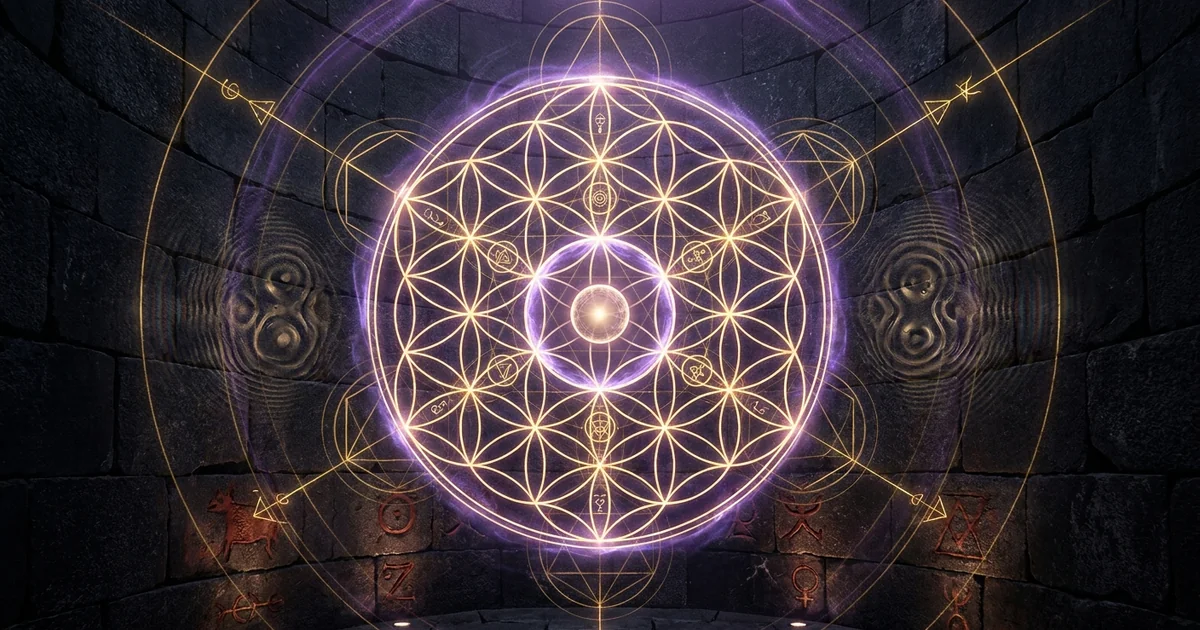
The Flower of Life: Seed of All Geometric Forms in Cosmos
Metaphysical Thesis & Epistemological Opening: The Morphogenetic Pre-Geometry of Manifest Reality
The Flower of Life is fundamentally distinct from an arbitrary decorative motif or an accidental aesthetic curio of antiquity. When examined through rigorous topological and metaphysical frameworks, it reveals itself as an invariant, isotropic informational architecture. This lattice mathematically coordinates the ontological transition from absolute, unextended potentiality into the metric-governed spatial manifold of physical matter.
Materialist reductionism routinely dismisses sacred geometry as a byproduct of human apophenia—a psychological inclination to superimpose symmetrical patterns onto an indifferent, chaotic environment. However, this view collapses when confronted with the strict constraints of isotropic sphere packing, projective stereometry, and crystalline self-organization.
The geometrical arrangement known as the flower of life sacred geometry 19 circles creation matrix operates as an archetypal, mathematical engine. It predetermines how spatial coordinates are partitioned, polarized, and stabilized across scale-invariant domains, serving as the underlying blueprint manifest reality depends upon for dimensional coherent extension.
       Radius (r)
          <--->
       ●---------●
     Center    Center
       A         B
        \       /
         \     /
       Vesica Piscis
      (√3 Proportions)
The Monad’s Self-Intersection: Ontogenesis of the Vesica Piscis
Within primary ontology, manifest existence begins with the indivisible point: the dimensionless Monad, equivalent to the Neoplatonic One or the Kabbalistic Ain Soph. As analyzed in the study of non-dual metaphysics and the Monad, this unextended singularity possesses zero spatial extension, existing merely as absolute, self-referential potential.
The initial movement of cosmological differentiation does not occur through the introduction of an external variable, but through the Monad’s endogenous act of self-reflection. In projective geometry, this is described as the duplication of the center point along an arbitrary vector whose length is precisely equal to the radius ($r$) of its initial boundary sphere.
When two spheres or circles of identical radius intersect such that the perimeter of each passes directly through the center point of the other, the resulting spatial intersection generates the Vesica Piscis (the vessel of the fish). This almond-shaped aperture constitutes the ontogenetic Dyad. It represents the inaugural phase shift from zero-dimensional unity into one-dimensional relational polarity.
Geometrically, the Vesica Piscis establishes the irreducible proportional constants that govern all spatial morphogenesis. The ratio of its long axis to its short axis is precisely $\sqrt{3} : 1$ (an irrational proportion approximately equal to $1.7320508\dots$). This value is the mathematical prerequisite for establishing the equilateral triangle, the isometric lattice, and the structural foundations of three-dimensional space. From this single morphological event, the fundamental roots of $\sqrt{2}$, $\sqrt{3}$, and $\sqrt{5}$ emerge simultaneously, supplying the operational geometric constants required for the harmonious unfolding of physical matter.
Etymologically rooted in the Latin vesica piscis (literally “bladder of the fish”), this figure forms the universal threshold of dimensional genesis. In Hermetic cosmology, the first circle represents absolute, undifferentiated conscious interiority. The emergence of the second circle marks the generation of objective exteriority.
The intersection does not dilute the Monad; rather, it yields an invariant mathematical interface. The $\sqrt{3}$ proportion inherent within the Vesica Piscis serves as the sole geometric bridge capable of generating the equilateral triangle, thereby establishing the minimum requirement for a two-dimensional surface ($2D$) and subsequent three-dimensional ($3D$) polyhedral volume.
Projective Topology: The 19-Circle Boundary as an Invariant Information Matrix
The outward propagation of this self-intersecting circular sequence continues until nineteen distinct, complete circles interlock within a unified perimeter, flanked by thirty-six partial circular arcs. This specific closure is not arbitrary; nineteen circles bounded by a double concentric perimeter represent the minimum geometric threshold required to balance internal structural equilibrium with boundary containment.
Within this nineteen-circle matrix, every intersection point serves as an informational coordinate within a continuous isotropic vector field. The outer concentric circles perform an epistemological function: they demarcate the transition between the intelligible, coherent manifest order and the chaotic, unbounded infinity of the unmanifest abyss.
This topological closure encodes the projective mechanics of the spatial continuum. When the nineteen-circle lattice is analyzed through projective stereometry, it ceases to be a flat two-dimensional diagram. It acts instead as an orthographic projection of a higher-dimensional hypersphere—specifically, an $E_8$ or higher-order Lie algebra root system projected onto a two-dimensional viewing plane.
The informational density of the flower of life sacred geometry 19 circles creation matrix functions as an algorithmic compression: an irreducible baseline from which Euclidean space derives its capacity for angular coherence, structural symmetry, and harmonic resonance.
Deconstructing Physicalist Reductionism: Geometry as an A Priori Matrix of Spacetime
Physicalist orthodoxy maintains that geometry is a descriptive convention invented by the human intellect to catalog spatial interactions between pre-existing material bodies. The Hermetic-Pythagorean lineage, sustained by late-twentieth-century developments in quantum topology and informational physics, demonstrates the inverse: geometric relations are constitutive of matter, not derived from it.
Spacetime itself is not an empty, smooth container within which objects reside. Rather, it is a discrete, granular, and geometrically constrained informational network.
The hexagonal symmetry governing the Flower of Life reflects the fundamental requirements of close-packing equal spheres in a flat plane—the Densest Lattice Packing problem historically formulated by Johannes Kepler and formalized mathematically by Carl Friedrich Gauss. Matter cannot condense, crystallize, or self-organize without submitting to these invariant spatial constraints.
To classify the structural ubiquity of this matrix as simple cognitive bias is to confuse the map with the territory. Biological morphogenesis, mineral crystallization, and the metric of spacetime itself conform to hexagonal and dodecahedral symmetries because these forms represent the lowest-energy informational pathways available to physical manifestation. The geometry is not applied post-hoc; it is the fundamental constraint through which raw entropy is transformed into physical form.
Primary Codices & Historical Transmission: Epigraphic Lineages from Abydos to the Renaissance
The material history of the Flower of Life presents a complex epigraphic problem that traverses millennia of cross-cultural transmission. Far from a spontaneous modern invention, the design appears across disparate geographic regions, embedded in subterranean architecture, temple thresholds, and private polymathic notebooks.
Tracing these primary physical records requires navigating between classical archaeology, textual hermeneutics, and the preservation of esoteric traditions across successive civilizational epochs.
       ARCHAEOLOGICAL TIMELINE
=========================================
c. 1300 BCE  [ Megalithic Osireion Erected ]
c. 1st-4th C [ Red Ochre Glyphs Inscribed ]
c. 485 CE    [ Proclus: Geometry as Nous ]
c. 1500 CE   [ Leonardo: Codex Atlanticus ]
The Ochre Petroglyphs of the Osireion: Stratigraphy and Epigraphic Disputes
The most celebrated physical manifestation of this geometry resides within the subterranean ruins of the Osireion, located immediately behind the mortuary temple of Seti I in Abydos, Upper Egypt. Carved from megalithic red granite blocks that evoke the architectural austerity of the Old Kingdom’s Fourth Dynasty Giza Plateau, the Osireion displays the interlocking nineteen-circle pattern directly upon the vertical faces of its monumental pillars.
The physical application of the osireion abydos carving is distinctive: the figures are not chiseled into the stone via bas-relief or intaglio, but are applied via a red ochre pigment that has chemically bonded with the granite’s crystalline structure.
In the definitive excavation monograph The Osireion at Abydos (1904), Margaret Alice Murray, working in collaboration with W. M. Flinders Petrie, documented the subterranean water table and anomalous architecture of the central hall. Murray’s survey identified the distinctive structural style of the central chamber: ten massive monolithic granite piers supporting megalithic architraves.
Subsequent epigraphic assessments of the red ochre Flower of Life patterns by modern Egyptological consensus date the pigment application not to the original construction period of Seti I (c. 1290–1279 BCE), but to late antiquity. They point to the 1st through 4th centuries CE, when the partially submerged temple served as a sanctuary for Hellenistic Hermeticists, early Gnostics, and Greco-Egyptian pilgrims who inscribed Greek letters alongside these geometric diagrams.
The chronological stratification of the Osireion remains an area of active scholarly inquiry. While the megalithic stone framing is securely dated to the New Kingdom (with architectural traits pointing to an even earlier Old Kingdom architectural archetype, as discussed in megalithic engineering at the Osireion of Abydos), the red ochre motifs were applied directly to the granite surfaces during an era when the site was already semi-ruined.
Paleographic analysis of the associated Greek graffiti indicates that Hellenistic and Roman-era mystics, likely steeped in Pythagorean and early Hermetic traditions, recognized the temple’s profound acoustic and spatial properties. They transformed its granite pillars into visual treatises on cosmic genesis, fixing the invariant matrix into the stone with an iron-oxide medium.
The Euclidean and Pythagorean Transmission: Proclus on the Ontic Status of Geometrical Forms
The theoretical articulation of these geometric figures matured through the Neoplatonic Academy, culminating in the work of the fifth-century philosopher Proclus Lycius. In his Commentary on the First Book of Euclid’s Elements, Proclus advanced a rigorous metaphysical critique of empirical geometry, addressing the ontic status of figures like the Vesica Piscis and the circles of the Flower of Life. Proclus rejected the notion that mathematical forms are mere abstractions drawn from sensible phenomena:
“The mathematical forms are neither derived from material objects by abstraction, as the Peripatetics assert, nor are they without substance. Rather, they subsist in the understanding (dianoia) as projected images of intelligible forms (nous). They possess an intermediate reality between the undivided unity of the higher archetypes and the divisible fragmentation of physical matter.” — Proclus Lycius, Commentary on the First Book of Euclid’s Elements (c. 485 CE), translated by Glenn R. Morrow (1970).
For Proclus and the late antique Pythagorean lineages, drawing the Flower of Life was not a descriptive exercise, but an operative, theurgic discipline. The circle represents the unfragmented movement of Nous, while its systematic self-intersection demonstrates how the intelligible world unfolds into the cosmos without compromising its essential unity. The nineteen circles visually demonstrate the intermediate realm of geometrical ontology: a structured domain through which divine archetypes descend into sensory reality.
The Renaissance Polymaths: Leonardo da Vinci’s Codex Atlanticus and Geometric Deconstruction
During the Italian Renaissance, the Flower of Life transitioned from an esoteric initiation template to an empirical object of spatial analysis. Leonardo da Vinci conducted an exhaustive mathematical deconstruction of the matrix, preserved across numerous folios of the Codex Atlanticus (compiled between 1478 and 1519). Leonardo isolated the primary components of the matrix, dissecting its curvilinear angles to investigate the properties of the lunula (the crescent derived from intersecting circles) and to address the classical challenge of squaring the circle.
Leonardo’s sketches demonstrate a clear recognition that the interlocking circular field was not merely decorative, but an underlying structural engine. By tracing the intersections within the modular seed of life egg of life configurations, he mapped out architectural vaulting techniques, mechanical gear distributions, and the proportional ratios of the human body.
His analytical drawings confirm that the 19-circle matrix functions as an algorithmic framework for volumetric projection, bridging the gap between sacred Neoplatonic proportion and the practical physics of Renaissance engineering.
Ontological Architecture & Cosmological Models: The Seed, Egg, and Fruit as Dimensional Phase Transitions
The Flower of Life does not emerge as a static, fully formed monolith; it unfolds through a rigorous morphogenetic sequence. Each stage represents a discrete dimensional phase transition, moving progressively from unextended unity, to linear polarization, to planar tessellation, and ultimately to three-dimensional volumetric reality. This progression can be understood through its primary constituent phases: the Seed, the Egg, and the Fruit of Life.
The Septenary Genesis: The Seed of Life and Symmetrical Sphere Packing
The second phase of cosmological unfoldment, directly following the initial generation of the Vesica Piscis, is the construction of the Seed of Life. This figure consists of seven symmetrically interlocking circles: a central nucleus surrounded by a ring of six peripheral circles, each tangent to the center and intersecting its immediate neighbors. This septenary arrangement provides the geometric foundation for the isotropic vector equilibrium first popularized in ancient cosmologies as the “seven days of creation.”
         ( 2 )   ( 3 )
           \       /
            \     /
    ( 1 )----( C )----( 4 )
            /     \
           /       \
         ( 6 )   ( 5 )
   Central Nucleus (C) + 6 Outer
From an informational standpoint, the Seed of Life is the direct two-dimensional projection of three-dimensional close-packing of identical spheres. When six spheres are arrayed around a seventh identical central sphere in a planar arrangement, they achieve absolute spatial equilibrium.
This configuration governs the physical geometry of snow crystals, the molecular packing of carbon networks, and the harmonic overtones of acoustics. The Seed of Life acts as the prime architectural template of the spatial manifold, establishing the fundamental hexagonal metric that persists through every subsequent expansion of the matrix.
Cellular Mitosis and the Egg of Life: Morphic Resonance in Embryogenesis
By expanding the central core of the Seed of Life through volumetric extrapolation, the geometry yields the Egg of Life. This three-dimensional arrangement consists of eight spheres arranged in the form of a cube—or two interpenetrating tetrahedra—sharing a common center. In contemporary developmental biology, this eight-sphere cluster corresponds precisely to the eight-cell morula stage of mammalian embryogenesis.
       TOP LAYER:          BOTTOM LAYER:
       [1]    [2]           [5]    [6]
          \  /                 \  /
           \/                   \/
           /\                   /\
          /  \                 /  \
       [3]    [4]           [7]    [8]

       (Forms 3D Cuboctahedron / Mitotic Morula)
Following the initial division of the fertilized zygote from one cell to two, two to four, and four to eight, the biological organism forms a symmetrical, three-dimensional eight-cell cluster. At this developmental inflection point, the mammalian embryo maintains absolute structural invariance: if an individual cell is excised from this eight-cell collective, it possesses the totipotent capacity to regenerate the entire organism.
The Egg of Life demonstrates that biological morphogenesis relies directly upon this spatial-distribution matrix. Cellular mitosis does not expand through arbitrary fluid dynamics, but follows the geometric constraints established by isotropic sphere packing.
Metatron’s Cube and the Fruit of Life: Deriving the Platonic Solids from the 13-Circle Nexus
When the full nineteen-circle Flower of Life is extended beyond its concentric perimeter, a secondary, hidden subset emerges: the Fruit of Life. Composed of thirteen selected circles extracted from the broader lattice, this figure departs from the hexagonal framing of the Seed by establishing an isotropic informational nexus consisting entirely of straight paths linking thirteen spherical nodes. This configuration serves as the geometric key to the structural universe.
                  Node 1
                    |
              Node 2--Node 3
             /      |      \
        Node 4----Node 5----Node 6
             \      |      /
              Node 7--Node 8
                    |
                  Node 9
       (Central 13-Node Informational Matrix)
By connecting the center of every single circle in this thirteen-node array to the center of every other circle using straight Euclidean vectors, seventy-eight distinct lines are generated. The resulting three-dimensional projective diagram is known as Metatron’s Cube.
Embedded natively within Metatron’s Cube are the geometric skeletons of the five regular polyhedra—the Platonic solids and sacred geometry that constitute the only regular solids possible within three-dimensional space:
- The Regular Hexahedron (Cube): Six square faces, eight vertices, twelve edges; the geometric baseline of spatial volume and the physical element of Earth.
- The Regular Tetrahedron: Four triangular faces, four vertices, six edges; the simplest three-dimensional regular solid, representing the self-stabilizing vector of Fire.
- The Regular Octahedron: Eight triangular faces, six vertices, twelve edges; the dual of the cube, representing directional equilibrium and the element of Air.
- The Regular Icosahedron: Twenty triangular faces, twelve vertices, thirty edges; possessing five-fold rotational symmetry, representing fluid dynamism and the element of Water.
- The Regular Dodecahedron: Twelve pentagonal faces, twenty vertices, thirty edges; the golden-ratio-rich container representing the cosmic envelope, Aether, and the spatial framework of the Universe.
                  /\
                 /  \
                /    \
               /______\
              /\      /\
             /  \    /  \
            /____\  /____\
           METATRON'S CUBE
     All 5 Platonic Solids Embedded:
  Tetrahedron • Octahedron • Hexahedron
        Icosahedron • Dodecahedron
The mathematical implication is unambiguous: manifest physical reality, whose material and crystalline states depend fundamentally on the symmetries of these five Platonic solids, is derived directly from the informational matrix of the Fruit of Life.
Phenomenological Mechanics & Interdimensional Interaction: Sefirotic Emanation and the Informational Control Matrix
Beyond classical stereometry and archaeological lineages, the Flower of Life provides an analytical framework for investigating non-local consciousness states, Kabbalistic metaphysics, and the interdimensional interactions documented within modern anomalous phenomena.
When analyzed through the interpretive models developed by Jacques Vallée and the classical traditions of Jewish Merkabah mysticism, the nineteen-circle lattice transforms from a static drawing into an active psycho-spatial interface.
THE SEFIROTIC OVERLAY
              (Keter)
                 |
         (Chokhmah)-(Binah)
                 |
          (Chesed)-(Gevurah)
                 |
             (Tiferet)
                 |
          (Netzach)-(Hod)
                 |
              (Yesod)
                 |
            (Malkhut)
    10 Nodes / 22 Vectors mapped
      into the 19-Circle Matrix
Mapping the Kabbalistic Otz Chiim: Geometrical Isomorphism within the 19-Circle Lattice
A profound geometric correspondence in Western esotericism is the structural congruence between the Flower of Life and the Kabbalistic Tree of Life (Otz Chiim). Historically codified in texts such as the Sefer Yetzirah and The Zohar, the Tree of Life consists of ten divine emanations (Sefirot) interconnected by twenty-two subjective paths.
When the classical diagram of the Otz Chiim is superimposed over the central column and adjacent nodes of the Flower of Life, an exact geometric isomorphism is revealed. Every Sefirah maps precisely onto an informational intersection of the nineteen-circle matrix:
- Keter (The Crown): Corresponds to the topmost intersection of the central vertical axis, emerging directly out of the primary Vesica Piscis.
- Chokhmah and Binah (Wisdom and Understanding): Align symmetrically across the upper horizontal plane, mirroring the first polarized expansion of the Dyad.
- Tiferet (Beauty/Harmony): Sits precisely at the heart of the central seventh circle of the Seed of Life, acting as the isotropic balance point of the entire system.
- Malkhut (The Kingdom/Physical Reality): Anchors the lowest terminal intersection of the central axis, representing the dimensional precipitation of the intelligible archetypes into concrete physical expression.
As Gershom Scholem observes in Jewish Gnosticism, Merkabah Mysticism, and Talmudic Tradition (1960), the visionary ascent through these cosmic spheres required the adept to visualize precise structural seals (chotamot) to navigate the heavenly halls (Hekhalot). The Otz Chiim is not an arbitrary diagram, but an integrated vector pathway derived from the nineteen-circle matrix. It serves as a visual map for understanding how divine vitality flows from the unmanifest Ain Soph down into physical manifestation.
The Jacques Vallée Paradigm: Sacred Geometry as a Trans-Dimensional Semiotic Regulator
In Messengers of Deception: UFO Contacts and Cults (1979), astrophysicist and computer scientist Jacques Vallée proposed that anomalous encounters, entity manifestations, and high-strangeness events are best understood not as visits from extraterrestrial space travelers, but as the operations of an informational control system. This Vallée informational control system framework operates as a socio-technological and spiritual feedback mechanism, actively conditioning human consciousness across deep historical epochs.
Within this framework, the continuous, cross-cultural recurrence of the Flower of Life—appearing on Megalithic Egyptian pillars, within the floor mosaics of Roman villas, inscribed across Islamic architecture (as demonstrated in Keith Critchlow’s 1976 study Islamic Patterns), and recurring in modern crop formations—is not accidental. Rather, it represents the deliberate deployment of a semiotic archetype by a non-human intelligence (NHI) operating under the interdimensional-hypothesis.
By projecting invariant geometric matrices into human cultural consciousness, this control system introduces visual catalysts that alter cognitive frameworks. The Flower of Life functions as an informational carrier wave: an archetypal glyph designed to destabilize materialist assumptions and initiate the percipient into higher-dimensional spatial mechanics.
Physicalist Reductionism
- Origin: A fortuitous visual pattern produced by compass manipulation, developed independently as decorative art across ancient societies.
- Function: A purely aesthetic ornament; a human attempt to impose symmetrical order onto nature via pareidolia.
- Spatial Status: Confined to two dimensions; any volumetric or polyhedral derivation is considered incidental pattern-matching.
- Epistemic Horizon: Closed. The glyph carries no intrinsic informational code and is completely bounded by cultural-historical context.
Hermetic-Informational Projectionism
- Origin: The direct geometric projection of higher-dimensional ($n$-dimensional) symmetry invariants into 3D Euclidean space.
- Function: An objective morphogenetic template that governs isotropic sphere packing, cellular mitosis, and physical crystallization.
- Spatial Status: A projective baseline from which Metatron’s Cube and the five regular Platonic solids are systematically extracted.
- Epistemic Horizon: Open. The glyph functions as a psycho-spatial interface bridging human consciousness, cosmological morphogenesis, and NHI semiotics.
Merkabic Vehicle Mechanics: Psycho-Spatial Coherence Fields and Anomalous Consciousness
The operational application of Metatron’s Cube within Merkabah mysticism concerns the activation of the Merkabah—literally the divine “Chariot” or vehicle of non-local conscious ascension. In early visionary texts, the Merkabah is described as a dynamic, counter-rotating structure composed of interpenetrating rings of fire, wheels within wheels (ophanim), and luminous geometric configurations.
Geometrically, the Merkabah is constructed through the counter-rotation of two interpenetrating regular tetrahedra (forming a stellated octahedron, often referred to as a “star tetrahedron”) centered within the Fruit of Life matrix. The rotation of this geometric field around the human perceptual axis produces a psycho-spatial coherence field:
$$\vec{\omega}{\text{Merkabah}} = \vec{\omega}{\text{Electric}} \times \vec{\omega}_{\text{Magnetic}}$$
When the human practitioner coordinates breath, somatic rhythm, and intense noetic visualization with this rotating isotropic framework, ordinary Euclidean perceptual localization is transcended.
The resulting phenomenology matches the high-strangeness profiles documented by anomalous phenomena researchers: spatial compression, temporal dilation, and direct non-local interaction with non-human intelligences residing within hyper-dimensional states of the Pleroma.
Initiatic Synthesis & Philosophical Implications: Geometric Theurgy, Epistemic Peril, and Conscious Reintegration
The pursuit of esoteric geometry inevitably confronts an epistemological crisis. The practitioner, historian, or anomalist must navigate the thin boundary separating profound metaphysical insight from the psychological pathologies of apophenia and cognitive inflation.
Without rigorous philosophical grounding, the study of sacred geometry risks degrading into superficial superstition or demiurgic entrapment.
Operative Theurgy vs. Egregoric Entanglement: Geometric Praxis without Superstition
Classical theurgy (theourgia), as formalized by Iamblichus in De Mysteriis Aegyptiorum, distinguishes between superstitious image-worship and genuine theurgic operation. Superstition approaches sacred symbols like the Flower of Life as automated magical engines that grant mundane personal power.
Conversely, genuine theurgy treats the geometric lattice as a structural mirror designed to purify and align the rational soul with the universal Nous.
NOUS / PLEROMA (Intelligible Archetypes)
                       |
               [ Geometric Theurgy ]
           (Active Cognitive Alignment)
                       |
     =====================================
               [ Apophenic Illusion ]
         (Egregoric Entanglement & Superstition)
                       |
       DEMIURGIC FRAGMENTATION (Material Trap)
When an initiate meditates upon the nineteen-circle matrix, the primary objective is to purge the sensory apparatus of fragmented impressions. The geometry serves as a visual compass, aligning subjective cognitive processes with the objective structural order of the cosmos.
If this work is neglected, the geometric form risks being co-opted by an egregore—a collective psychic thought-form that feeds on devotion without leading the soul toward genuine illumination. The true theurgist looks through the geometry, using it as an optical lens to access the transcendent source from which all form originates.
Epistemological Hazards: Apophenia, Psychological Inflation, and Demiurgic Reification
The study of esoteric geometry presents unique psychological risks. The ease with which the nineteen-circle lattice can be visually superimposed onto nearly any physical object creates a fertile breeding ground for unchecked apophenia.
Seekers frequently fall prey to confirmation bias, arbitrarily discovering the Flower of Life in natural formations, corporate logos, and historical architecture where its presence is historically and mathematically groundless.
The primary metaphysical danger within sacred geometry is the reification of the matrix: confusing the structural architecture of the Demiurge with the unconditioned ground of the transcendent Pleroma. The Demiurge constructs the physical cosmos using geometric laws; geometry is the very mechanism of material limitation and systemic containment.
To idolize the Flower of Life as the ultimate Divine Source is to become trapped within the cosmic architecture itself. The 19-circle matrix is the cartography of manifest spacetime, not the unmanifest Divine Radiance (Ain Soph). The genuine mystic must use the form to ascend beyond the architecture of form altogether.
Psychological inflation occurs when the human ego identifies personally with the architectural secrets encoded in the glyph. The realization that one’s biology and perceptual apparatus are expressions of this cosmic engine can lead to a messianic complex if not balanced by humility.
The practitioner must acknowledge that discovering the map does not equate to mastering the terrain. The matrix is not an instrument for human aggrandizement; it is an invariant structural baseline that demands the surrender of personal illusion to universal mathematical reality.
The Transcendent Eye: The Conscious Observer as the Inscribed Apex of the Matrix
Ultimately, the Flower of Life reveals that the observer and the observed are topologically unified. The human eye that beholds the nineteen circles is itself constructed through the spatial proportions dictated by the Vesica Piscis; the neural pathways processing the geometric stimulus reflect the close-packing network of the Seed of Life.
The Cartesian divide between the internal thinking mind (res cogitans) and the external physical universe (res extensa) is dissolved within the isotropic vector field of the matrix.
In this non-dual realization, the practitioner recognizes that they are not an isolated spectator examining an external geometric diagram. Rather, the Flower of Life is the structural mirror through which the cosmos experiences its own geometric coherence.
The conscious observer represents the dynamic center of the matrix: the locus where the unmanifest Monad looks outward through the architecture of its own unfolding creation. Form returns to the formless, and the loop of cosmological self-knowledge is closed.
Frequently Asked Questions: Epistemological and Anomalistic Inquiries
Resolving Archaeological Stratigraphy: Are the Abydos Carvings Truly Pharaonic or Roman-Coptic?
The chronological attribution of the Flower of Life designs at the Osireion in Abydos requires drawing a careful distinction between the site’s megalithic architecture and the application of its epigraphic pigments. The physical structure of the Osireion—built from monumental red granite blocks displaying exquisite stereotomic masonry—is firmly dated to the New Kingdom reign of Seti I (c. 1290 BCE), with some architectural elements suggesting even older antecedents.
However, current epigraphic evidence indicates that the red ochre Flower of Life designs were applied long after the monument was first erected.
       CHRONOLOGICAL STRATIGRAPHY: OSIREION AT ABYDOS
============================================================
[1] Megalithic Granite Piers  --> New Kingdom (Seti I, c. 1290 BCE)
[2] Subterranean Inundation   --> Late Dynastic / Ptolemaic Era
[3] Red Ochre Inscriptions    --> Hellenistic / Roman-Coptic Period
                                  (1st - 4th Century CE)
Careful examination reveals that the red ochre patterns were painted directly upon the dressed surfaces of the granite pillars alongside Greek graffiti. Paleographic analysis of the associated text dates these inscriptions to late antiquity (1st to 4th centuries CE).
During this period, the subterranean chambers of the Osireion were partially inundated with groundwater and functioned as an initiatory sanctuary for Hermetic and early Christian-Gnostic communities. These seekers identified the acoustic and structural resonance of the ancient granite monument as an ideal canvas for their sacred geometric diagrams, applying the red iron-oxide pigment that remains visible today.
Archaeological studies conducted on Hellenistic and Roman graffiti within Egyptian temple complexes—such as those published in the Journal of Egyptian Archaeology and documented by Rutherford (2003) in Pilgrim Reading: Aspects of Greco-Egyptian Inscriptions—confirm that subterranean New Kingdom sites were regularly reused by Pythagorean and Hermetic travelers during the Roman Empire.
These travelers deliberately inscribed sacred geometric motifs at places associated with the tomb of Osiris, combining classical Hellenistic geometry with the monumental stone architecture of Egypt.
Topological Rigor: Can All Five Platonic Solids Be Extracted Directly Without Auxiliary Lines?
A frequent mathematical debate concerns whether all five Platonic solids can be extracted from Metatron’s Cube without introducing supplementary or non-aligned vectors.
The three primary solids—the Regular Hexahedron (Cube), the Regular Tetrahedron, and the Regular Octahedron—derive directly and transparently by connecting the centers of the thirteen circles of the Fruit of Life. Their vertices align precisely with the nodes of the isotropic vector equilibrium.
       PRIMARY SOLIDS (Direct Node Alignment):
       • Hexahedron (Cube)
       • Tetrahedron
       • Octahedron

       SECONDARY SOLIDS (Require Golden-Ratio Intersections):
       • Icosahedron
       • Dodecahedron
The extraction of the remaining two solids—the Regular Icosahedron and the Regular Dodecahedron—requires a deeper understanding of projective geometry. These two figures possess five-fold rotational symmetry and inherently embody the Golden Ratio ($\phi \approx 1.6180339\dots$).
While their vertices do not fall solely on the thirteen primary sphere centers, they align precisely with the secondary, internal intersection points created by the overlapping lines within Metatron’s Cube.
The entire five-polyhedron system remains mathematically unified within the Flower of Life matrix; the first three solids reflect its primary structural nodes, while the final two arise from the secondary harmonic intersections generated by the interaction of those primary lines.
Information Theory and Crop Formations: Why Does This Specific Motif Dominate Anomalous Contact Phenomena?
Within the study of modern anomalous phenomena—specifically the high-strangeness apparition of complex Euclidean designs in agricultural fields (crop formations)—the Flower of Life and its constituent subsets (such as the Seed and the Julia Set) recur with statistically anomalous frequency.
Interpreted through Jacques Vallée’s semiotic control system framework, this recurring visual pattern operates as an intentional, culture-independent carrier wave.
NHI INFORMATIONAL TRANSMISSION
                     |
       [ High-Strangeness Carrier Wave ]
                     |
       (Universal Metric: Hexagonal Lattice)
                     |
         [ Human Collective Cognition ]
                     |
     (Gradual Paradigm Shift: Materialism -->
          Higher-Dimensional Topology)
Because the nineteen-circle matrix is derived from universal physical laws—the close-packing of spheres and the geometry of Euclidean space—it carries no inherent linguistic or cultural bias. It is instantly decipherable by any intelligent consciousness that has discovered the principles of geometry.
When anomalous intelligence interfaces with human collective consciousness, it uses these invariant geometric archetypes as a common visual language.
The deployment of these patterns in the physical environment acts as a cognitive catalyst. It challenges reductionist paradigms and encourages the percipient to confront the reality of an informational, higher-dimensional architecture underlying physical space.
Technical Summary of Primary Codices & Field Survey Reports
For researchers and metaphysical investigators conducting field research or technical reconstructions of the Flower of Life matrix, the primary historical references and analytical treatises are cataloged below:
- Petrie, W. M. Flinders, & Murray, Margaret Alice (1904). The Osireion at Abydos. Egyptian Research Account, Ninth Year. London: Bernard Quaritch. Contains the foundational architectural plans, granite pillar elevations, and stratigraphical context of the subterranean central hall.
- Proclus Lycius (c. 485 CE). Commentary on the First Book of Euclid’s Elements. Translated with Introduction and Notes by Glenn R. Morrow (1970). Princeton: Princeton University Press. The definitive Neoplatonic treatise establishing the ontic reality of geometric figures as projections of the intelligible realm (nous).
- Da Vinci, Leonardo (1478–1519). Codex Atlanticus. Biblioteca Ambrosiana, Milan. Specifically folios 307r, 308v, and 459r, detailing da Vinci’s systematic compass deconstructions of the Flower and Seed of Life matrices.
- Scholem, Gershom (1960). Jewish Gnosticism, Merkabah Mysticism, and Talmudic Tradition. New York: Jewish Theological Seminary of America. The classic text analyzing the visionary geometric seals (chotamot) used in early Hekhalot ascension rituals.
- Critchlow, Keith (1976). Islamic Patterns: An Analytical and Cosmological Approach. London: Thames and Hudson. Essential reading on how the nineteen-circle isotropic matrix governs the development of two- and three-dimensional sacred architecture.
- Vallée, Jacques (1979). Messengers of Deception: UFO Contacts and Cults. Berkeley: And/Or Press. Establishes the informational control system hypothesis, interpreting the cross-cultural manifestation of sacred geometric motifs as interdimensional semiotic regulators. :::