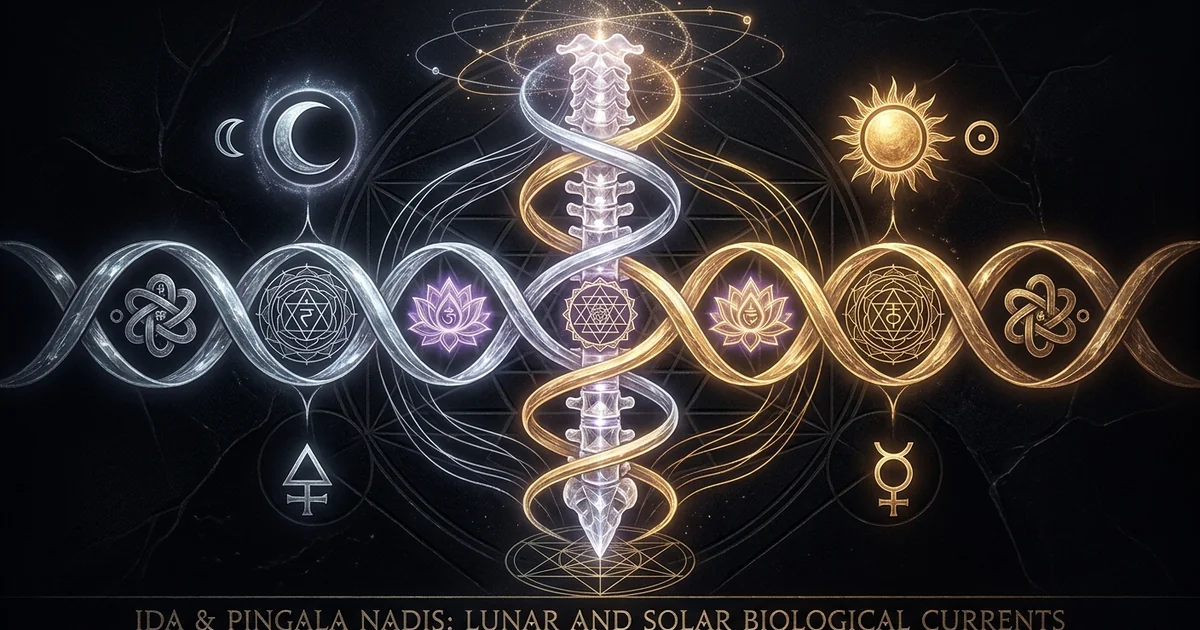
Ida & Pingala Nadis: Lunar and Solar Biological Currents
Metaphysical Thesis & Epistemological Opening: The Bipolar Subtle Architecture
Transcending Somatocentric Reductionism: The Sukshma Sharira as Informational Blueprint
Western somatic epistemologies have long suffered from an uncritical somatocentric reductionism, interpreting biological function solely through physical structures, endocrine outputs, and synaptic firings. In contrast, the classical non-dual Tantric epistemologies articulate an inverse ontology: the physical vessel (sthula-sharira) does not generate life, mind, or intentionality; rather, it is an emergent biological crystallization of a prior, highly organized subtle body (sukshma-sharira). Within this subtle architecture operates an intricate network of conduits known as nadis—dynamic energetic pathways through which primary vital currents (prana-vayu) organize consciousness into matter. The physical nervous system, with its paired cranial nerves and branching autonomic networks, represents the downstream somatic shadow of this informational template.
The foundational thesis of classical Tantric physiology asserts that manifest life is sustained by a continuous, bifurcated current. Rather than operating as an undifferentiated energetic soup, the vital life force splits upon entering manifestation into two polarized vectors: the lunar (Chandra) current traversing the left channel (Ida), and the solar (Surya) current traversing the right channel (Pingala). These ida pingala nadis lunar solar left right nostril subtle channels function as an open-loop biofield regulating thermodynamic, cognitive, and metabolic states across chronological time.
Materialist biological paradigms invariably falter when confronted with the rhythmic, alternating lateralization of human physiological efficiency. The autonomic balance oscillates rhythmically throughout a circadian cycle, directly indexed by shifting nasal resistance and asymmetric cerebral blood flow. To understand this rhythmic alternation, one must look beyond isolated neurochemical feedback loops toward the subtle energetic substrate. As explored in investigations into kundalini awakening neurobiology, physiological markers do not drive this cycle; they register the physical descent of subtle prana circulating through the primary nadis.
The Sanskrit noun nadi derives etymologically from the verbal root nad, signifying motion, flowing, sounding, or resonance. This confirms that the ancient rishis did not conceptualize these channels as rigid, passive conduits analogous to inert biological conduits, but as dynamic vibratory standing waves within the subtle body (sukshma-sharira). In the Prashna Upanishad (I.8–I.13), this bipolar topology is framed cosmogonically: the Creator (Prajapati) desirous of creation generates a fundamental ontological dyad consisting of Rayi (matter, lunar receptive form, passive potency) and Prana (energy, solar radiant fire, active consciousness). At the micro-cosmic level of human incarnation, Rayi governs Ida, while Prana governs Pingala, establishing the oscillating biological clock that anchors the incarnate subject in consensus reality.
The Dyadic Polarity of Prana: Lunar (Thamana) vs. Solar (Dahana) Radiance
The dynamic oscillation between Ida and Pingala instantiates a continuous metaphysical dialectic between two complementary principles of existence: conservation (thamana) and combustion (dahana). The lunar chandra and surya currents provide the structural counterpoint necessary for biological balance. Without the cooling, anabolic, and cohesive influence of the lunar Ida current (thamana), biological systems would undergo catastrophic metabolic hyper-oxidation under the relentless catabolic friction of Pingala. Conversely, without the thermogenic, kinetic, and transformative drive of the solar Pingala current (dahana), consciousness would collapse into vegetative inertia, cellular stagnation, and cognitive torpor.
This energetic polarity operates as an exquisite feedback loop that governs psychosomatic functioning. Ida corresponds to the soothing, maternal, introspective domain of psychological interiority—inducing deep states of parasympathetic conservation, cellular repair, and fluid homeostasis. Pingala, by contrast, operates as the energetic signature of externalization, mobilization, analytical cognition, and structural catabolism. The alternating flow between these subtle conduits is not merely a mechanism for keeping the organism alive; it is an informational control engine that dictates how consciousness processes temporal reality.
Understanding the precise mechanics of these channels requires stripping away superficial New Age abstractions and returning to primary codices. Ancient and medieval lineages recognized that human perception is held captive by this pendulum swing. The continuous oscillation between solar and lunar currents binds consciousness to binary cognition: self and other, attraction and aversion, subject and object. Only through the rigorous science of energetic balancing can these dual streams be reconciled, collapsing the tension between left and right channels to open the royal highway of the central axis.
Primary Codices & Historical Transmission: Textual Epistemology of the Nadis
Vedic Seeds to Medieval Tantras: Prashna Upanishad to Shiva Samhita
The textual genealogy of the nadis traces an evolutionary trajectory from the speculative cosmology of late Vedic literature to the operational bio-technologies of medieval Hatha Yoga and Tantra. The Chandogya Upanishad (VIII.6.6) early on establishes the subtle topological schema, declaring that “a hundred and one are the channels of the heart; of them, one goes out up to the crown of the head.” This single ascending conduit—later designated as the Sushumna—is already distinguished from the subsidiary channels that radiate outward into bodily incarnation, dispersing awareness across mortal existence.
By the medieval period, texts such as the Goraksha Shataka, the Siddha Siddhanta Paddhati, and the Shiva Samhita transitioned from theoretical ontology to clinical phenomenological mechanics. In these medieval manuals, the count of total nadis is standardized at 72,000 (or in some traditions, 350,000), of which fourteen are deemed primary, and three—Ida, Pingala, and Sushumna—are recognized as paramount. As documented by Mallinson and Singleton (2017) in Roots of Yoga, these codices synthesized somatic breath control with internal alchemical visualization, transforming the subtle body into an operational laboratory.
“In the body of man, thirty-five hundred thousand are the nadis; among them fourteen are chief… Ida, Pingala, and Sushumna are the most important. Ida is on the left side, Pingala is on the right, and Sushumna is in the middle, residing in the path of the spinal column… Ida, which is the Moon-carrier, is white and cool; Pingala, which is the Sun-carrier, is red and hot. Originating at the Muladhara, they intertwine across the centers, terminating at the nostrils.” — Shiva Samhita, Chapter II, verses 13–17 (trans. Sris Chandra Vasu)
“When the breath flows through the left nostril, it is Ida; it cools the body and calms the mind. When it flows through the right, it is Pingala; it generates internal heat and awakens the fire of digestions and thought. When prana enters the middle path, the mind becomes still, and death itself is transcended.” — Svatmarama, Hatha Yoga Pradipika, IV.16–17
The classical texts consistently locate the root origin of both Ida and Pingala at the Kanda—an egg-shaped energetic cluster positioned directly beneath the Muladhara chakra in the perineal floor. From this primordial anchor, Ida arches laterally to the left of the spinal axis, while Pingala arches laterally to the right. As they ascend through the torso, they cross one another at each energetic junction (chakra or padma), creating an alternating helical geometry that mirrors the riverine metaphors of the sacred Indian landscape: Ida as the cool, purifying Ganga; Pingala as the warm, turbulent Yamuna; and Sushumna as the invisible, underground Saraswati.
Hermetic-Kabbalistic Parallels: The Caduceus of Hermes and the Pillars of Mercy and Severity
The metaphysical recognition of a twin-serpentine polarity winding along a central axial trunk is not unique to the Indian subcontinent. A comparative hermeneutic analysis reveals striking structural isomorphisms across Western esoteric traditions, demonstrating a universal intuitive mapping of subtle human anatomy. The most transparent parallel is found in the ancient Greco-Egyptian Hermetic caduceus energetic anatomy—the wand of Hermes (Thoth) around which two serpents intertwine in opposite directions, intersecting at discrete nodes before terminating beneath a winged sphere at the apex.
The two caduceal serpents represent precisely the same ontological forces as Ida and Pingala: the opposing principles of volatility and fixation, sulfur and mercury, expansion and contraction. The central staff corresponds to the vertical pillar of the Sushumna, while the crowning winged orb mirrors the Sahasrara or the Ajna center where discursive duality is subsumed into transcendent unity. The caduceus was not an arbitrary symbol of commercial or medical diplomacy, but a precise theurgic sigil representing the mastery and harmonization of the dual currents of universal vital energy within human consciousness.
Hermetic Caduceus                 Kabbalistic Tree of Life
         ( O )  Crown / Ajna              [ Kether ]
         /   \                                |
        (  X  ) Nodes / Chakras      [Geburah]  [Chesed]
         \   /                       (Severity) (Mercy)
        (  X  )                          \   /    /
         \   /                         [Tiphareth]
         / | \                                |
      Ida  |  Pingala                 Boaz    |    Jachin
        (Sushumna)                  (Lunar)   |   (Solar)</code></pre>
Within the Kabbalistic framework of the Tree of Life, this exact triad manifests as the three vertical pillars: the Left Pillar of Severity (Boaz), the Right Pillar of Mercy (Jachin), and the Central Pillar of Mildness or Equilibrium. The Pillar of Severity represents passive containment, form-giving restriction, and cool judgment—a clear analog to the lunar, restrictive qualities of Ida. The Pillar of Mercy embodies uninhibited expansion, kinetic radiance, and projective dynamic force—the Kabbalistic reflection of Pingala.
Initiation in both Western theurgy and Eastern Tantric practice consists of escaping the pendular oscillation between these outer columns. The adept achieves sovereignty not by oscillating between Severity and Mercy, or Pingala and Ida, but by synthesizing both polarities along the middle path of equilibrium (Sushumna / Middle Pillar), thereby ascending directly to cosmic origin.
Ontological Architecture & Cosmological Models: The Dual River Systems
Chandra Nadi (Ida): Somatic Coolness, Parasympathetic Vectors, and Intuitive Matrices
Ida Nadi, historically designated as Chandra Nadi (the Moon Channel), embodies the archetypal principle of night, passivity, cooling condensation, and perceptual interiorization. Within the subtle body, it is envisioned as a current of pale white luminescence, shimmering like liquid camphor or moonlight. Originating on the left side of the pericarp of the Muladhara chakra, it governs the entirety of the left lateral field of the human somatic matrix, ultimately terminating in the left nostril.
At the physiological interface, Ida acts as the prime activator of the craniosacral parasympathetic nervous system. When Ida dominance is established—clinically identifiable through patent airflow through the left nostril—the somatic state undergoes an immediate down-regulation:
- Basal metabolic rate drops and cardiac output slows down;
- Systemic vascular resistance relaxes, lowering arterial blood pressure;
- Splanchnic circulation is enhanced, promoting gastric secretion and digestion;
- The neuro-endocrine balance tilts toward anabolic restoration, cellular synthesis, and immune replenishment.
Psychologically and epistemologically, Ida facilitates global, non-linear, intuitive, and receptive cognitive processes. It corresponds to what contemporary cognitive science identifies as right-hemispheric gestalt processing. When the Ida current runs cleanly, consciousness leans toward introspection, creative synthesis, philosophical contemplation, and empathetic resonance. However, should Ida become pathologically excessive or unmitigated by its solar twin, the psychosomatic state degrades into depressive lethargy, somatic congestion, hypothermia, emotional clinging, and cognitive dissociation.
Surya Nadi (Pingala): Metamorphic Heat, Sympathetic Mobilization, and Catabolic Velocity
Pingala Nadi, designated as Surya Nadi (the Sun Channel), manifests the archetypal principle of solar radiance, diurnal illumination, thermal combustion, and externalized action. Textually described as possessing a brilliant vermilion or coppery-red luminescence, Pingala emerges from the right side of the Muladhara and ascends along a trajectory mirrored to Ida, terminating its primary circuit in the right nasal vestibule.
Physiologically, Pingala directly stimulates the thoracolumbar sympathetic chain. When Pingala assumes dominance—indicated by preferential airflow through the right nostril—the body enters an operational mode adapted for kinetic expenditure, metabolic acceleration, and external defense:
- Heart rate and stroke volume elevate;
- Skeletal muscle tone increases via peripheral vasoconstriction;
- Epinephrine and cortisol secretion are stimulated;
- Glycogenolysis is accelerated in hepatic tissue, flooding the bloodstream with glucose to fuel immediate somatic action.
Cognitively, Pingala activates the analytical, critical, structural, and linguistic faculties traditionally associated with left-hemispheric dominance. It provides the focus required for mathematical calculation, dialectical argumentation, strategic navigation of physical environments, and linear logic. Yet, an unregulated excess of Pingala burns through bodily reserves, culminating in systemic inflammation, arterial hypertension, insomnia, aggressive behavioral volatility, and cognitive burnout. Pingala is the metabolic furnace of the organism; left uncooled by Ida, it consumes its own biological housing.
Ida Nadi (Lunar / Chandra)
- Cosmological Identity: Moon (Chandra), Night, Receptive (Rayi), Water/Nectar (Amrita)
- Anatomical Endpoint: Left nostril (Vama Nasa-Puta)
- Physiological Vector: Parasympathetic nervous system activation, craniosacral dominance
- Thermodynamic Mode: Endothermic, cooling (thamana), anabolic, tissue-preserving
- Cerebral Hemispheric Axis: Activates right cerebral hemisphere via contralateral brainstem crossing
- Cognitive Processing Style: Intuitive, holistic, visual-spatial, introspective, passive-receptive
- Chromatographic Signature: Pale white, argent, translucent lunar luminescence
Pingala Nadi (Solar / Surya)
- Cosmological Identity: Sun (Surya), Day, Radiant (Prana), Fire/Combustion (Agni)
- Anatomical Endpoint: Right nostril (Dakshina Nasa-Puta)
- Physiological Vector: Sympathetic nervous system activation, thoracolumbar chain dominance
- Thermodynamic Mode: Exothermic, heating (dahana), catabolic, tissue-metabolizing
- Cerebral Hemispheric Axis: Activates left cerebral hemisphere via contralateral brainstem crossing
- Cognitive Processing Style: Analytical, linear, mathematical, verbal-logical, projective-action
- Chromatographic Signature: Crimson, fiery vermilion, brilliant coppery solar luminescence
The Central Axis: Sushumna as the Zero-Point Transdimensional Conduit
Between these two churning currents sits the central axis: the Sushumna Nadi. Running through the core of the cerebrospinal axis, extending from the root of the perineum through the aperture of the Brahmarandhra at the crown of the calvarium, Sushumna is an energetic conduit existing outside the thermodynamic push-and-pull of manifest time (Kala). While Ida and Pingala represent temporal consciousness—the horizontal flux of past and future, rest and work—Sushumna is the timeless vertical axis of pure ontological presence.
In the ordinary uninitiated individual, the Sushumna channel remains dormant, obstructed by subtle metabolic detritus (mala) and energetic occlusions. Consequently, the individual is forced to cycle endlessly between Ida and Pingala, driven along by shifts in autonomic tone and mental distraction. Hatha Yogic praxis operates under a singular directive: to clear the obstructions in the peripheral nadis, balance the solar and lunar currents until they neutralize one another, and force the combined pranic charge into the central conduit of Sushumna.
When the opposing charges of Ida and Pingala are unified, a bio-energetic implosion occurs at the base of the spine. The prana, stripped of its polarizing bias, ceases to flow through the peripheral nostrils. This event initiates the ascent of Kundalini-Shakti through the central channel. In this zero-point state, discursive linear thinking shuts down, the autonomic nervous system enters an atypical profile marked by profound metabolic suspension, and the practitioner shifts from dualistic cognitive processing to unified, non-dual realization (samadhi).
Phenomenological Mechanics & Interdimensional Interaction: Somatic-Energetic Interfaces
The Ultradian Nasal Cycle and Lateralized Cerebral Hemispheric Dynamics
The interface between the subtle conduits and biological tissue is explicitly observable through the phenomenon known in modern chronobiology as the ultradian nasal cycle. First described in Western medicine by the German rhinologist Richard Kayser in 1895, this phenomenon involves the periodic, alternating engorgement of the nasal mucosa lining the turbinates. The erectile tissue of one nostril engorges with venous blood, restricting airflow, while the opposite nostril decongests to facilitate unobstructed respiration. This cycle alternates every 90 to 180 minutes throughout the day and night in healthy human subjects.
Long before Western instruments documented this rhythm, the esoteric science of swara yoga nasal cycle mechanics had mapped out its exact somatic and cognitive correspondences. Texts like the Shiva Swarodaya explicitly detail that when the breath flows predominantly through the left nostril, the Ida current governs the organism; conversely, when the breath flows through the right, Pingala exerts dominion.
CONTRALATERAL NEURO-RESPIRATORY FEEDBACK LOOP
     [ Right Nasal Vestibule ]        [ Left Nasal Vestibule ]
       (Pingala Termination)            (Ida Termination)
                 |                                |
     [Trigeminal Afferents]           [Trigeminal Afferents]
                 \                                /
                  \  Contralateral Projection   /
                   \                            /
                    \                          /
          [Left Cerebral Hemisphere]  [Right Cerebral Hemisphere]
          • Analytical / Linear       • Holistic / Intuitive
          • Sympathetic Drive         • Parasympathetic Drive</code></pre>
Crucially, the nasal cycle does not merely reflect local airway physics; it operates as an external indicator of alternating cerebral hemispheric dominance. The neuroanatomical linkage is mediated through the sphenopalatine ganglion, the trigeminal sensory afferents, and the autonomic centers of the hypothalamus.
Rigorous empirical investigations—such as the landmark studies by Werntz, Bickford, Bloom, and Shannahoff-Khalsa (1983)—demonstrated that forced breathing through one nostril increases electroencephalographic (EEG) amplitude and cerebral blood flow in the contralateral cerebral hemisphere. Left-nostril breathing (Ida) stimulates right-hemispheric cortical power, whereas right-nostril breathing (Pingala) selectively drives left-hemispheric processing. The nasal cycle is the somatic transducer through which the subtle body rhythmically recalibrates the two hemispheres of the brain.
Autonomic Nervous System Parallels: Vagal Tone and Sympathovagal Equilibrium
The intersection between Tantric subtle anatomy and modern neurocardiology reveals profound correspondences between the nadis and autonomic control networks. Pingala corresponds directly to the sympathetic-adrenomedullary (SAM) axis and the thoracolumbar efferent chain. When Pingala fires, the stellate and superior cervical sympathetic ganglia increase sympathetic drive to the sinoatrial node, driving down heart rate variability (HRV) and elevating low-frequency (LF) spectral power. This induces a metabolic state calibrated for rapid physical survival, mental analysis, and intense thermodynamic output.
Conversely, Ida maps onto the complex parasympathetic architecture coordinated by the tenth cranial nerve: the vagus nerve (Nervus vagus). Activation of the Ida current engages the dorsal and ventral motor complexes of the vagus, triggering the release of acetylcholine at cardiac muscarinic receptors. This down-regulates chronotropic activity, enhances high-frequency (HF) heart rate variability, and activates the “rest, digest, and socially engage” neuro-behavioral matrix described by Stephen Porges’ Polyvagal Theory.
The alternating dominance of Ida and Pingala keeps the human organism from lingering at either autonomic extreme. Pathologies—both somatic and psychiatric—emerge precisely when this regulatory oscillation becomes frozen in one state. An organism trapped in chronic Pingala dominance displays the clinical marks of sympathetic hyper-arousal: hypertension, elevated systemic cytokines, panic disorders, and metabolic exhaustion. An organism trapped in Ida stasis exhibits the signs of parasympathetic hyporeactivity: bradycardia, gastrointestinal hypomotility, chronic depression, and energetic depletion.
Crossing at Each Chakra Node: The Granthis as Transducer Gateways
The subtle architecture of the nadis does not run parallel in straight, unbending tracks. As Ida and Pingala ascend from the pelvic floor, they intersect the central spinal axis in an alternating helical formation. The crossing points of these conduits align directly with the major psycho-spiritual vortexes: the chakras. At each chakra, the opposing vectors of Ida and Pingala converge with the central Sushumna channel, establishing localized electromagnetic and subtle pranic nodes that correspond physically to the prevertebral autonomic plexuses (e.g., the hypogastric, celiac, cardiac, and pharyngeal plexuses).
At three pivotal locations along this axis, these energetic intersections crystallize into dense, structural blockages known as granthis (literally “knots”). The granthis serve as biological and interdimensional choke points. They prevent the chaotic, premature ascent of primal kundalini energy through the Sushumna by keeping prana safely bound within the pingalic and idic currents of ordinary waking consciousness:
- Brahma Granthi (located at the Muladhara/Svadhisthana region): Tied to the instinctual drive for physical survival, bodily identification, and material preservation. It anchors consciousness in the visceral reality of biological form.
- Vishnu Granthi (located at the Anahata region): Rooted in the emotional, relational, and egoic dynamics of personal identity, compassion, and sentimental clinging. It governs the attachment to psychological ego and clan survival.
- Rudra Granthi (located at the Ajna region): Anchored to the subtle intellectual ego, metaphysical dualism, and attachment to psychic powers (siddhis) or conceptual paradigms.
These knots act as safety valves within the energetic human machine. Until an individual purifies both Ida and Pingala through systematic moral, somatic, and pranic disciplines, the granthis remain locked, restricting the vital fire within ordinary biological bounds. When the dual currents are balanced through advanced pranayama, these three primary nodes unwind, permitting the prana to bore through the central axis toward trans-individual awareness.
Initiatic Synthesis & Philosophical Implications: Bio-Computational Equilibrium and Sovereignty
Nadi Shodhana as Epistemic Reprogramming: The Neutralization of the Duality Engine
Given that the alternating dominance of Ida and Pingala binds the human subject to dualistic perception and automated neurobiological reactivity, classical Hatha Yoga developed Nadi Shodhana (alternate nostril breathing) not merely as a calming respiratory exercise, but as a systematic methodology for epistemic liberation. By manually intervening in the respiratory cycle—mechanically occluding the right nostril to draw prana through Ida, suspending the breath (kumbhaka) to facilitate central equilibration, and then exhaling through Pingala—the practitioner overrides the automated autonomic programming of the brainstem.
This practice systematically neutralizes the duality engine of the mind. By deliberately balancing the volumetric intake of air and subtle prana between the two sides, the practitioner brings the sympathetic and parasympathetic divisions into an artificial state of dynamic equilibrium. Cerebral blood flow stabilizes across both hemispheres simultaneously, eliminating the asymmetric cognitive bias induced by the nasal cycle. In the words of the Gheranda Samhita, when the nadis are cleansed through this systematic cross-breathing, the physical body becomes luminous, digestion burns clean, and the subtle doorway to the central channel unlocks.
Interdimensional Information Control: Escaping Demiurgic/Biological Conditioning
When viewed through the informational reality framework pioneered by Jacques Vallée in works like Messengers of Deception (1979), biological organisms can be understood as living terminals embedded within broad informational reality control systems. Human consciousness, within this paradigm, is constrained by perceptual boundaries: sensory bandwidth is deliberately throttled, anchoring the observer in a linear, spacetime matrix optimized for biological reproduction and energetic expenditure.
From this perspective, the oscillating currents of Ida and Pingala act as the internal clock-cycle of a bio-computational control mechanism. The perpetual swinging of the pendulum between the solar current (catabolic expenditure, hunting, conceptualizing, building) and the lunar current (anabolic recovery, sleeping, digesting, desiring) locks human consciousness into a deterministic loop. The individual is perpetually reacting to physiological urges, mistaking autonomic oscillations for personal volition.
Initiatic Tantric technologies recognize that to breach this informational quarantine, one must short-circuit the alternating clock. By intentionally balancing the solar and lunar currents, the adept cancels out the carrier waves that enforce consensus reality. This neutralizes the sensory constraints that restrict perception to local spacetime, making the physical organism receptive to non-human intelligence (NHI), non-local intuitive downloads, and trans-dimensional contact. The harmonization of Ida and Pingala is nothing less than the de-compilation of the species-level control program.
The premature, aggressive application of solar-stimulating pranayamas (such as prolonged Bhastrika or Surya Bhedana) designed to blast through the granthis without systematic purification of the Ida conduit presents severe somatic and psychological dangers. Should Pingala be forcefully driven into the Sushumna channel without adequate lunar balancing, the internal circuit acts as an ungrounded high-voltage current traversing delicate neural pathways.
This condition, documented both in classical Tantric treatises and contemporary neuropsychiatry as severe “Kundalini Syndrome,” manifests clinically as:
- Severe autonomic dysregulation, intractable tachycardia, and sudden cardiac arrhythmias;
- Extreme hypothalamic-pituitary-adrenal (HPA) axis burnout and core thermoregulatory failure;
- Hallucinatory episodes, acute psychotic inflation, egoic fragmentation, and persistent depersonalization.
Techniques of energetic ascent require that the cooling lunar channel (Ida) be thoroughly stabilized before the fiery solar conduit (Pingala) is engaged. Balance must precede transcendence; to awaken the central fire while the lateral channels remain blocked is to invite internal physiological collapse.
The Merging into Non-Dual Stillness (Sandhya and Samadhi)
In the classical texts, the moments of transition between day and night—dawn (pratah-sandhya) and dusk (sayam-sandhya)—are revered as times of immense power for spiritual contemplation. The micro-cosmic analog to these macrocosmic twilight junctures is the fleeting moment when the breath naturally transitions from one nostril to the other. For a brief window of one to three minutes, air flows symmetrically through both nostrils: the point of Sandhya.
During this biological twilight, neither Ida nor Pingala holds dominance; the prana spontaneously enters the central channel of the Sushumna. Ordinary discursive thinking drops away; a deep stillness settles across the cerebral cortex, and a window opens into non-dual awareness. The yogic initiate learns to prolong this transient biological pause through the systematic practice of kumbhaka (retention), turning what is ordinarily an imperceptible somatic transition into a sustained state of contemplative illumination (samadhi).
In this unified state, the illusion of ontological bifurcation is shattered. The polar opposites of self and other, subject and object, time and eternity collapse into the unconditioned ground of pure consciousness (Chit). The serpent power ascends the spinal trunk, Piercing through the three granthis in succession, until the localized individual consciousness (Shakti) fuses with the universal transcendent witness (Shiva) in the thousand-petaled lotus of the Sahasrara. The dual rivers of the Ganga and Yamuna have emptied into the central sea; the biological machinery has fulfilled its ultimate destiny, serving as the launching pad for spiritual liberation.
Frequently Asked Questions: Technical and Ontological Clarifications
Are the Nadis Equivalent to Physical Nerves, or Purely Non-Physical Conduits?
The nadis are subtle, informational channels within the sukshma-sharira (subtle body) rather than macroscopic physical structures such as myelinated nerves or blood vessels. However, they are not purely metaphoric constructs or disembodied abstractions. In the non-dual ontology of Tantra, reality exists as a continuum of varying densities of vibrational consciousness (spanda). The nadis reside at an intermediate density of this continuum—the pranic sheath (pranamaya kosha).
The physical nervous system (the brain, the spinal cord, the sympathetic trunks, and the vagal pathways) represents the structural sedimentation or dense biological crystallization of these subtle energetic flows. When a yogic text describes the Ida Nadi ascending from the perineum to the left nostril, it describes the morphogenetic field pathway that organizes and sustains the parasympathetic autonomic pathways, the left-side peripheral nerves, and the right cerebral hemisphere. Thus, while a surgeon cannot dissect a nadi with a scalpel, the physiological activity of the autonomic nervous system is an empirical biological shadow cast by the circulation of subtle prana.
How Does the Ultradian Nasal Cycle Mechanistically Influence Cognitive Mode?
The mechanistic link between the ultradian nasal cycle and cognitive processing modes operates through a complex neuro-respiratory feedback loop involving the autonomic nervous system and the hypothalamus. The nasal passages are densely innervated by sensory fibers from the ophthalmic and maxillary branches of the trigeminal nerve (cranial nerve V), as well as by a profound network of sympathetic and parasympathetic fibers originating in the superior cervical ganglion and the sphenopalatine ganglion, respectively.
“Racial and individual variations in the nasal cycle have been demonstrated to correlate with lateralized autonomic activity… Electroencephalographic (EEG) measurements demonstrated that periods of relatively greater airflow through the left nostril (Ida) are systematically coupled with relatively greater electrical activity and functional dominance in the right cerebral hemisphere. Conversely, predominant right nostril airflow (Pingala) correlates with left-hemispheric dominance… Forced unilateral nostril breathing was found to produce a direct shift in cerebral hemispheric dominance, establishing that this peripheral respiratory gate acts as an autonomic switch for lateralized higher cortical functions.” — Werntz, D. A., Bickford, R. G., Bloom, F. E., & Shannahoff-Khalsa, D. S., Human Neurobiology, 1983.
When unilateral airflow stimulates the mechanoreceptors and temperature-sensitive afferents within a single nasal cavity, these signals travel back to the brainstem and the hypothalamus. This unilateral afferent input modulates the central autonomic tone across the neuroaxis, altering the diameter of cerebral microvessels and shifting the relative electroencephalographic (EEG) spectral power between the hemispheres. As a result, right-nostril breathing selectively activates the left hemisphere, favoring linear, analytical, and linguistic reasoning. Left-nostril breathing activates the right hemisphere, fostering holistic, intuitive, spatial, and affective mental processing.
What Distinguishes Tantric Nadi Science from Western Neurological Models?
The critical epistemological distinction between Tantric nadi science and Western neurology lies within their directional models of causality. Western neurology works upward from a materialist ontology: it posits that neurochemistry, synaptic connections, and electrical action potentials generate the subjective mind, meaning, and intentionality. In this view, the brain is a closed engine producing consciousness as an emergent epiphenomenon. Any intervention must operate directly on the somatic substrate via pharmaceuticals, electrical stimulation, or physical surgery.
Tantric science operates within a top-down, non-dual idealism. Consciousness (Chaitanya) is the primary ontological ground of reality. This primary consciousness condenses through subtle energetic frequencies (prana) that travel along organized informational vectors (nadis), which only secondarily crystallize into the physical brain, nerves, and visceral organs.
While Western neurology views the autonomic nervous system as an automated homeostatic machine regulated by subcortical structures, Tantric science demonstrates that these supposedly involuntary networks can be systematically controlled, rewired, and integrated by working directly with the subtle breath (swara). By treating the body not as a mechanical machine, but as an energetic-informational interface, the practitioner moves beyond passive biological survival, transforming the mortal human form into an intentional instrument of cosmic realization.