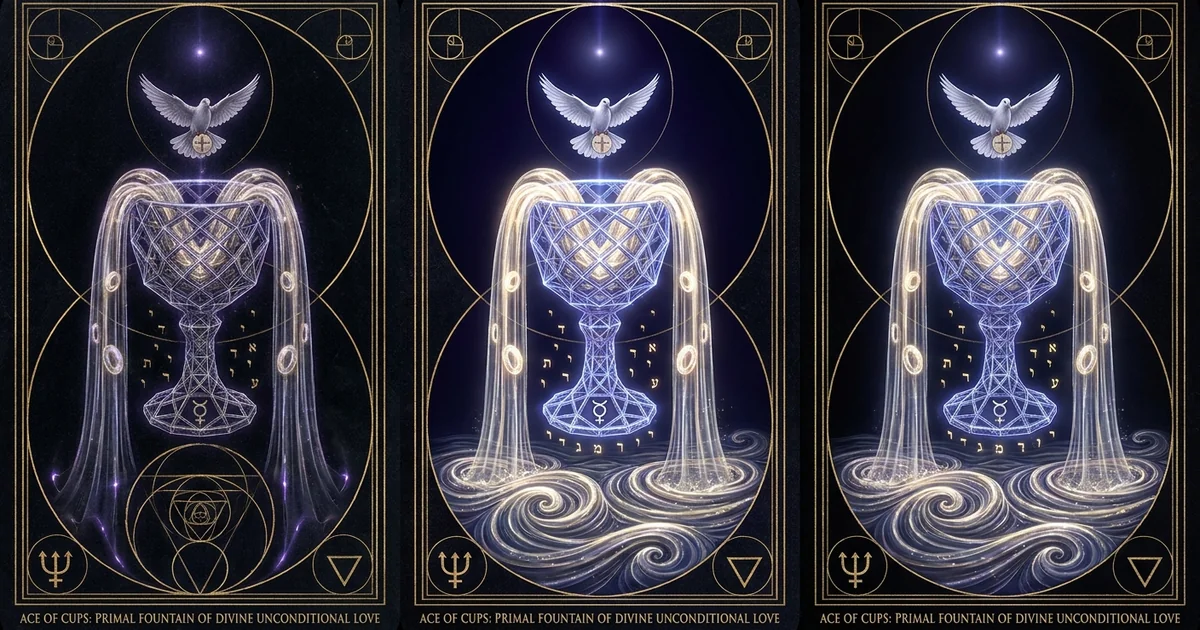
Ace of Cups: Primal Fountain of Divine Unconditional Love
Archetypal Thesis & Systemic Paradigm: The Primordial Genesis of Affect
The Kether of Briah: Undifferentiated Fluidity in the Four Worlds
Within the structural architecture of Hermetic Qabalah, the four Aces represent the unmanifest ontological seeds of the elements, occupying the supreme station of Kether (the Crown) within each of the Four Worlds of existence. The Ace of Cups resides specifically at the juncture of Kether in the World of Briah—the archangelic realm of pure Creation, affective ideation, and teleological potency. Consequently, the card does not signify an individualized emotional reaction, nor does it denote an interpersonal romantic event. Instead, it serves as the ontological fountainhead from which the entire water element emanates into the cosmic and psychological matrix. In Briah, the divine will formulated in Atziluth condenses into primordial fluidic potential; it is the non-spatial reservoir of feeling before that feeling bifurcates into subject and object.
Prior to the descent into Yetzirah (the Astral World of formative emotional structures) and Assiah (the physical world of tangible events), the water element subsists in a state of absolute, undifferentiated continuity. This state corresponds to the waters of the deep (Tehom) referenced in Genesis 1:2—a boundless energetic ocean awaiting the polarization of consciousness. As the Kether of Briah, the Ace of Cups contains the total holographic blueprint of all subsequent watery manifestations, governing every expression from the reflective intersubjectivity of the Two of Cups to the radical transmutational depths of the Scorpio decans. The ace of cups tarot meaning must therefore be understood fundamentally as an axiomatic reset of affective telemetry: a direct encounter with the uncreated, self-luminous ground of psychic life before it suffers the contractions, projections, and neuroses of individualized ego identity.
Atziluth (Archetypal Seed) -> Briah (Ace of Cups: Undifferentiated Fluidity) -> Yetzirah (Astral Formations) -> Assiah (Material Reality)
The metaphysical function of this Kether-node is to preserve the pristine purity of the affective impulse against systemic decay. Because it is unconditioned by temporal circumstances, Kether in Briah functions as an inexhaustible energetic wellspring. In the language of classical metaphysics, it is an uncaused cause of psychic movement. When this coordinate is activated within a divinatory or psycho-spiritual framework, it indicates that the individual’s consciousness is being intersected by an absolute vertical influx of divine grace, an elemental baptism that completely dissolves the rigid calcifications of the lower astral body and restores the emotional matrix to its primordial, pre-lapsarian integrity.
Eros as Psychic Binding Force: Moving Beyond Sentimentalized Romance
The colloquial conflation of the Ace of Cups with sentimentalized romance represents an acute degradation of its archetypal gravitas. In both classical Platonism and Jungian depth psychology, Eros is not merely an affinity between two domestic personalities; it is the cosmic binding force that holds the diverse fragments of the universe in dynamic coherence. As Carl Gustav Jung explicated across his investigations into the phenomenology of the Self, Eros represents the connective principle of the psyche—the function of relationship, integration, and structural synthesis—contrasted with the segregative, analytical, and discerning operations of Logos.
The Ace of Cups is the pristine instantiation of this connective principle operating at absolute saturation. When stripped of its trivialized pop-cultural accretions, the ace of cups symbolism reveals an affective substrate that does not depend on an external object for its validation. The love modeled by this card is fundamentally unconditional because it is transpersonal: it flows outward unconditionally simply because it is the intrinsic nature of the fountain to overflow. To demand that the Ace of Cups represent an immediate social contract or a reciprocal emotional partnership is to mistake the vastness of the Pacific Ocean for a domestic drinking glass.
Within the dynamics of individuation, the sudden emergence of this transpersonal Eros shatters the narcissistic containment of the ego. The ego cannot possess the fountain; it can only submerge itself within its waters. By functioning as a transpersonal archetype, the Ace establishes an internal affective baseline that renders the psyche invulnerable to external fluctuations of abandonment or validation. It is the realization that the capacity for love is an innate macrocosmic endowment rather than a scarce commodity that must be extracted from the interpersonal environment.
“Eros is a questionable fellow and will always remain so, begin how you will with him… He belongs on the one hand to the nature of the gods, on the other to the lower nature of man. He is the cement that holds the world together, and at the same time the explosive that rends it asunder. In its primal form, the water of the unconscious is the affective binder; it is the undifferentiated ocean of being in which the individual ego has not yet separated from the collective ground of the Self.” — Carl Gustav Jung, Aion: Researches into the Phenomenology of the Self (Collected Works Vol. 9, Part II), §128.
The Transpersonal Vessel: Containment and Spontaneous Overflow
The central structural paradox of the Ace of Cups lies in its simultaneous embodiment of containment and spontaneous overflow. Unlike the closed system of classical thermodynamics, which inexorably tends toward entropy and equilibrium, the psychic vessel represented by the Ace operates as an open, non-equilibrium thermodynamic structure. It maintains its form not through rigid, impermeable boundaries, but precisely through the unbroken continuity of its energetic throughput. The cup is permanently filled to absolute capacity, yet it never bursts, because its structural integrity is defined by the perpetual evacuation and replenishment of its contents.
This hydrodynamic mechanic models an advanced state of spiritual and psychological maturity. In neurotic configurations of the personality, the ego attempts to conserve emotional energy by constructing psychic dams, hoarding affect out of an ingrained fear of scarcity and depletion. This defensive hoarding inevitably leads to stagnation, psychic toxicity, and the calcification of the emotional body. The Ace of Cups demonstrates an inverse paradigm: the only mechanism by which the vessel can remain eternally full is to allow itself to perpetually overflow across its brim into the underlying waters of the collective reality.
The chalice thus represents the purified human soul acting as an immaculate conduit between supernal and infernal realms. It does not generate the living water through its own localized effort; rather, it serves as the physical and metaphysical nexus wherein the divine descending current is captured, concentrated, and diffused. The moment the vessel attempts to retain the water for itself, the current ceases, the link to the Kether-node of Briah is severed, and the living spring degenerates into an enclosed cistern.
Classical Provenance & Textual Lineage: From Eucharistic Chalice to Golden Dawn Codices
Medieval Hydromancy and the Mythos of the Holy Grail
The historical evolution of the Cups suit from early Italian trionfi decks to contemporary esoteric cartography reveals a deliberate trajectory toward theological and mythical sublimity. In the fifteenth-century Visconti-Sforza tarocchi, the suit of Coppe was represented by secular, decorative drinking vessels, reflective of courtly banquets, socio-political alliances, and the domestic celebration of wealth. However, as the Tarot was subsumed into the Western Mystery Tradition during the eighteenth and nineteenth centuries, French occultists such as Antoine Court de Gébelin and Eliphas Lévi retroactively mapped these vessels onto the mythos of the Holy Grail—the San Greal of Arthurian romance—and the instruments of classical hydromancy.
Hydromancy, the ancient practice of divining through the observation of images, ripples, and reflections on the surface of water, required a scrying vessel of absolute stillness and purity. The Grail mythos deepened this operational premise, transmuting the vessel from an instrument of passive divination into the ultimate object of spiritual quest: the cup that caught the blood of the divine Logos at the Crucifixion, which possessed the miraculous power to heal the desiccated, barren landscape of the Wounded King (the Fisher King). By synthesizing the Cups suit with the Grail, esoteric scholarship re-anchored the cards within a profound mythic grammar of renewal, wherein the psychic wasteland can only be revitalized by the discovery of an incorruptible fountain of spiritual sustenance.
“The Ace of Cups shows a hand issuing from a cloud, holding upon its palm an immense cup, from which four streams are pouring into a basin of water beneath… A dove of the Holy Spirit, bearing in its bill a cross-marked wafer, descends to place the Host in the cup; the dew of heaven falls on all sides… It is an image of the Eucharist, of the Holy Grail, and of the source from which the natural world is perpetually refreshed by the waters of grace.” — Arthur Edward Waite, The Pictorial Key to the Tarot, Part III: The Outer Method of the Oracles.
The Waite-Smith Synthesis: Visualizing Catholic Mysticism and Rosicrucian Currents
When Arthur Edward Waite collaborated with artist Pamela Colman Smith in 1909, he executed a radical iconographic revision of the Ace of Cups that broke sharply with the minimalist, floral designs of the Tarot de Marseille. Waite, deeply immersed in both Roman Catholic sacramental theology and the Rosicrucian inner order of the Golden Dawn (the Rosae Rubeae et Aureae Crucis), explicitly designed the card as an altar of Eucharistic transubstantiation. He replaced the generic chalice of the older traditions with a sacred vessel bearing the monogram of an inverted ‘M’ (often interpreted as Maria, Mundus, or the Hebrew letter Mem, the primordial Mother Water).
[ Supernal Cloud: Divine Influx ]
                |
                v
      ( Dove with Eucharistic Host )
                |
                v
       \=================/   <-- Rim: Five Sensory Streams Pouring Out
        \   ACE OF CUPS   /
         \_______________/   <-- Vessel: Transmuted Astral Receptacle
                |
                v
  ~~~~~~~~~~~~~~~~~~~~~~~~~~~~~ <-- Subconscious Lake (Water Lilies)
Smith’s rendering introduces three critical theological elements:
- The divine hand emerging from the cloud (the classical Manus Dei of medieval iconography), representing the uncaused, supernatural origin of the gift.
- The white dove of the Holy Spirit descending along a strict vertical axis, holding a consecrated Eucharistic Host marked with a cross directly over the aperture of the cup.
- The shower of precisely twenty-six droplets of divine dew suspended in the surrounding ether, flanking the vessel.
Through this imagery, the Waite-Smith deck synthesized the mystical contemplation of the Blessed Sacrament with the Rosicrucian quest for the Panacea Universalis—the universal medicine that cures all earthly diseases, psychic fractures, and moral depravities through the inundation of divine, unmerited grace.
The Golden Dawn Attributions: Root of the Powers of Water
Within the curriculum of the Hermetic Order of the Golden Dawn, formulated by S.L. MacGregor Mathers and later preserved by Israel Regardie, the Ace of Cups was stripped of purely exoteric devotional connotations and integrated into an exact mathematical-cosmological system. The card was formally titled:
“The Root of the Powers of Water”
In the Golden Dawn’s elemental schema, the four Aces do not possess astrological decan rulers. Instead, they reign over the entire quadrant of the celestial sphere associated with their respective element, acting as the elemental Yod—the primordial seed-force that feeds the subsequent nine numbered cards. The Ace of Cups governs the entire Water Triplicity, serving as the foundational root for:
- The Cardinal Water of Cancer (the emotional impulse of incubation and protection);
- The Fixed Water of Scorpio (the alchemical, transformative depths of emotional crisis and regeneration);
- The Mutable Water of Pisces (the universal dissolution of boundaries and spiritual transcendence).
Mathers established that the Ace of Cups represents the letter Heh (the primal Mother, Binah) within the first Sephira (Kether) of the elemental world of Briah. It is the womb of the cosmos, the pristine sea of the Great Mother (Marah) from which all living forms emerge. To invoke the Ace of Cups within ceremonial magic is not to petition for a romantic partnership, but to open the floodgates of Briatic energy to purify the magical circle, extinguish astral impurities, and bathe the magician’s aura in an unconditioned, restorative light.
Structural Mechanics & Symbolic Geometry: The Anatomy of the Fountain
The Five Streams and Sensory-Spiritual Transmutation
Flowing over the rim of the chalice in the Waite-Smith design are five distinct, continuous streams of living water. These streams cascade downward in graceful parabolas, striking the serene water-lily-covered surface of the lake below. In the esoteric anatomy of the card, these five streams represent the five human senses: sight, hearing, touch, taste, and smell. In the unredeemed or unawakened state, the five senses serve as instruments of material entrapment, anchoring the consciousness strictly within the illusion of separation and biological survival.
       Unredeemed Senses (Ego Bound)
                    |
           [ Spiritual Baptism ]
                    v
Transmuted Channels (Sensorium of the Soul)
  -> Visio Divina (Spiritual Sight)
  -> Auditus Coelestis (Intuitive Hearing)
  -> Tactus Sacrum (Sacramental Touch)
  -> Gustus Spiritualis (Taste of Eternity)
  -> Odor Suavitatis (Breath of Grace)
Under the influence of the Briatic influx, however, these five physical faculties undergo a complete alchemical transmutation. They cease to be passive receptors of chaotic external stimuli and become the active sensorium of the soul. The five physical senses are converted into their higher spiritual counterparts:
- Physical sight becomes visio divina (spiritual illumination);
- Physical hearing becomes the perception of the auditus coelestis (the voice of intuition);
- Touch becomes the sensitive reception of the sacramental reality of being.
The streams demonstrate that spiritual realization does not necessitate the violent mortification or denial of the sensual body; rather, it demands that the senses be plugged into the supernal current until they overflow with transcendent presence. The chalice does not contain the streams; it processes them, proving that the human sensory apparatus was designed to be a living irrigation system for the cosmos, broadcasting the beauty of divine perception directly into the physical world.
The Dove, the Host, and the Lotus: Alchemical Triangulation
The structural axis of the Ace of Cups is formed by an alchemical triangulation comprising the descending Dove, the Eucharistic Host, and the emerging Lotus (water lily) blossoms situated upon the pool below. The dove represents the active, masculine spiritual descent—the vertical vector of divine intention, traditionally associated with the Ruach Elohim (the Breath/Spirit of God) sweeping across the face of the primordial deep. By holding the Host, marked with the equal-armed cross of solar balance, the dove carries the condensed light of Kether directly into the lunar, receptive basin of the chalice.
This vertical axis intersects the horizontal plane of the chalice at an exact right angle, forming the esoteric cross of manifestation. The Chalice serves as the alchemical womb, the Vessel of Hermes, wherein the spiritual seed (the Host) is dissolved within the universal solvent (Solvent Universalis) of the Briatic waters. This intersection of spirit and soul triggers an immediate, miraculous response from the terrestrial depths below: the water lilies (Nymphaea alba) rise to the surface of the pool.
The lotus is an ancient Hermetic and Eastern symbol of the clarified unconscious. Rooted in the deep, dark, decomposing mud of the psychological underworld, its stem climbs through the chaotic currents of the astral waters to unfold its immaculate, pristine white petals in the open air, utterly unsoiled by the mud from which it drew its nourishment. The alchemical triangulation between the Dove (Spirit), the Chalice (Soul), and the Lotus (Manifest Body) illustrates the complete cycle of incarnation: the spirit descends into the soul so that the material nature can be regenerated, bearing the pristine flowers of enlightened consciousness.
The Twenty-Six Drops: Tetragrammaton and Divine Dew
Suspended in the atmosphere surrounding the central chalice are precisely twenty-six drops of water or radiant dew, shimmering in the golden ether. This number is not an arbitrary artistic flourish; it is a direct mathematical encryption of the highest divine name in the Western esoteric tradition. Through the science of Hebrew gematria, the sacred name of God—the Tetragrammaton (YHVH / יהוה)—possesses the numerical value of twenty-six:
$$Yod (10) + Heh (5) + Vav (6) + Heh (5) = 26$$
These twenty-six dew-drops embody the Tal Orit—the “Dew of Light” or divine dew referenced extensively in the Zohar and classical Kabbalistic treatises. The divine dew is the supernal secretion from the head of Arikh Anpin (the Vast Countenance / Macroprosopus), which perpetually falls upon the lower realms to revive the spiritually dead and restore the shattered equilibrium of the cosmos.
       YOD (10)
          +
       HEH (5)
          +
       VAV (6)
          +
       HEH (5)
   ==============
   26 Dew-Drops = YHVH (The Full Name of God)
By depicting these drops suspended in the air around the vessel, Pamela Colman Smith indicated that the atmosphere of the card is entirely saturated with the divine presence. The dew drops resemble the Hebrew letter Yod, which is the primeval point of flame from which all other letters of the Hebrew alphabet are constructed. Therefore, each droplet represents a miniature seed of divine consciousness, an unmanifest spark of the divine presence waiting to condense into tangible experience. This demonstrates that the grace represented by the Ace of Cups is not an exceptional, rare intervention, but the very atmospheric condition of reality when the eyes of perception are cleansed.
Psychological Dynamics & Operational Praxis: Archetypal Cathexis and Clinical Interpretation
Ego-Dissolution vs. Oceanic Narcissism: The Jungian Diagnostic Frontier
In clinical depth psychology and modern archetypal analysis, the integration of the Ace of Cups represents one of the most volatile diagnostic frontiers. The confrontation with the archetype of undifferentiated water inevitably evokes what Romain Rolland and Sigmund Freud termed the “oceanic feeling”—a sensation of boundarylessness, eternity, and indissoluble communion with the universe. However, depth psychology identifies a profound developmental bifurcation in how this oceanic state is experienced and assimilated by the psyche.
The analyst must rigorously differentiate between authentic spiritual surrender and regressive oceanic narcissism:
[ Encounter with Primordial Water ]
                                            |
                   +------------------------+------------------------+
                   |                                                 |
                   v                                                 v
    [ Authentic Spiritual Surrender ]                [ Regressive Oceanic Narcissism ]
     - Robust ego voluntarily yields                  - Fragile ego collapses backward
     - Expansion of conscious vessel                  - Dissolution into undifferentiated matrix
     - Integration of transpersonal affect            - Defense against individuation & reality
- Leads to creativity, empathy, service - Leads to borderline pathology, fantasy- Authentic Spiritual Surrender: In this state, an already robust, well-differentiated ego consciousness voluntarily yields its defensive hegemony to the transpersonal sovereignty of the Self. The vessel of the ego is expanded and flooded with numinous affect, leading to enhanced emotional resilience, profound empathy, and creative fecundity. The individual retains psychic orientation while allowing transpersonal currents to flow through them.
- Regressive Oceanic Narcissism: Here, a fragile, under-developed, or fragmented ego collapses backward into the maternal womb of the unconscious. Rather than integrating the waters of grace, the ego drowns in an idealized, infantile fantasy of effortless belonging, using spiritual bypass to evade the painful necessities of individuation, material adaptation, and structural limits.
In clinical practice, the appearance of the Ace of Cups in a client’s material requires careful assessment of ego strength. If the patient exhibits severe borderline defenses, the card may not herald a spiritual awakening, but an impending psychotic decompensation or a catastrophic dissolution of reality testing disguised as divine union. Conversely, for the neurotic patient suffering from chronic emotional constriction, rigid character armor, and pervasive depression, the Ace marks the emergence of the long-suppressed transcendent function, promising the revitalization of a barren emotional landscape.
The Open Vessel in Clinical and Contemplative Practice
As an operational methodology, the Ace of Cups establishes the discipline of the “open vessel.” In the context of active imagination, psychoanalytic listening, or contemplative prayer, this archetype demands the total suspension of intellectual critique, defensiveness, and intentional grasping. The posture required is precisely that of the upright cup: radical, non-judgmental receptivity.
The operational rule of the Ace of Cups can be stated simply:
You cannot receive that which you are attempting to seize; you can only hold that which you are willing to let overflow.
When an individual attempts to utilize the intellect (Swords) or the willpower (Wands) to solve a crisis governed by the Ace of Cups, they fail completely. Solar-Martian strategies of conquest, analysis, and boundary fortification are functionally useless in the Briatic realm of primordial Water. The psychic impasse can only be dissolved through Lunar-Neptunian soaking—allowing the affective reality of the situation to be fully felt, witnessed, and metabolized without defensive interventions.
In the relational sphere, practicing the open vessel transforms the dynamic of communication. It moves the practitioner from an anxious, transactional model of love—characterized by constant monitoring of reciprocity—to an unconditional, steady broadcast of empathy. The open vessel does not fear depletion because it understands that its emotional resources are derived from an infinite macrocosmic wellspring rather than a localized, finite reserve.
Polarity Dynamics: Upright Receptivity vs. Inverted Spillage and Stagnation
The structural mechanics of the Ace of Cups are rendered acutely visible when examining the polar tension between its upright and inverted orientations. The orientation of the vessel dictates the directionality, utility, and coherence of the elemental current.
Upright Orientation: Active Receptivity
- Structural Integrity: The vessel rests with its aperture oriented toward the supernal realm, maintaining an open vertical alignment.
- Affective State: Coherent, transpersonal love; boundless empathy; the activation of the sensory-spiritual channels.
- Psychic Vector: Negentropic throughput; simultaneous containment and spontaneous overflow without boundary fatigue.
- Relational Manifestation: The capacity to hold space for others without personal entanglement or projective identification.
- Somatic Expression: Regulated parasympathetic nervous system; open chest, fluid breathing, absence of visceral armor.
Inverted Orientation: Dissipation & Blockage
- Structural Integrity: The vessel is overturned, or its structural base is calcified, pointing its opening toward the chthonic mud.
- Affective State: Emotional incontinence, hysterical spillage, overwhelming feelings of betrayal, grief, or barren emptiness.
- Psychic Vector: Entropy; total dissipation of psychic energy or an impermeable narcissistic wall of defense.
- Relational Manifestation: Codependency, demanding love as an external entitlement, manipulative emotional vampirism.
- Somatic Expression: Somatization of repressed affect; chronic fatigue, emotional numbing, lymphatic and fluid retention issues.
When the card is inverted, the divine nectar is violently dumped onto the earth, wasted, and polluted by unconscious complexes. The inverted Ace indicates that the ego, terrified of the vulnerability required by true intimacy with the Self, has either overturned its chalice to prevent the influx, or lacks the necessary psychic structure to hold the charge. The result is emotional exhaustion, an internal sense that the well has run completely dry, and a bitter, cynical conviction that love is a destructive, predatory illusion. Re-inverting the vessel requires the slow, painful rebuilding of the emotional infrastructure through rigorous therapeutic containment and self-compassion.
Philosophical Synthesis & Macrocosmic Correspondence: Hermetic Hydrology and Cosmic Coherence
Astrological Decan Infrastructure: The Primordial Water Trine
The Ace of Cups occupies a unique astronomical and astrological station within the Hermetic canopy. As established in the Golden Dawn manuscripts, the Aces do not possess singular planetary or decanate rulers; instead, they function as the primordial engine driving an entire elemental triplicity. The Ace of Cups is the macrocosmic nexus from which the entire water triplicity of the zodiac draws its continuous vitality.
[ ACE OF CUPS: Briatic Source ]
                                  |
         +------------------------+------------------------+
         |                                                 |
         v                                                 v
  [ CARDINAL WATER ]               [ FIXED WATER ]                 [ MUTABLE WATER ]
   Cancer (The Springs)             Scorpio (The Swamps/Ice)        Pisces (The Ocean)
   - Primal gestation               - Alchemical crisis             - Universal dissolution
   - Incubation & safety            - Deep transmutational fire     - Return to the Source
- Governs 2, 3, 4 of Cups - Governs 5, 6, 7 of Cups - Governs 8, 9, 10 of Cups- Cardinal Water (Cancer): The Ace acts as the initial bubbling mountain spring, the primordial moisture that allows the physical womb of The Empress to gestate form. This current governs the Two, Three, and Four of Cups, demonstrating the early developmental dynamics of belonging, emotional safety, and stability.
- Fixed Water (Scorpio): The Ace descends into the subterranean chasms, transforming into the thermal vents, swamps, and profound alchemical ice of the emotional depths. This current governs the Five, Six, and Seven of Cups, exposing the soul to grief, emotional obsession, betrayal, and the necessity of radical inner metamorphosis.
- Mutable Water (Pisces): The Ace empties into the vast, shoreless cosmic ocean, where all individual boundaries are surrendered back to the infinite collective matrix. This current governs the Eight, Nine, and Ten of Cups, representing the spiritual pilgrimage away from transient forms, the attainment of emotional fulfillment, and final mystical absorption.
Because the Ace contains this entire tripartite continuum within its singular Briatic coordinate, it is simultaneously the mountain spring, the stagnant marsh undergoing alchemical purification, and the boundless sea. To access the Ace of Cups is to stand at the non-spatial fountain from which the entire cosmic cycle of emotional birth, death, and resurrection is perpetually generated.
The Taoist Valley Spirit (Valley of the World) Parallel
The paradoxical power of the Ace of Cups finds an extraordinary philosophical parallel in the classical Taoist metaphysics of Laozi. In Chapter 6 of the Daodejing, Laozi introduces the foundational archetype of the “Valley Spirit”:
“The Valley Spirit never dies; it is called the Mysterious Female. The gateway of the Mysterious Female is called the root of Heaven and Earth. Dimly visible, it seems to exist as a presence; draw upon it, it will never dry up.”
Furthermore, in Chapter 28, the sage advises:
“Know the masculine, maintain the feminine, and be the valley of the world. Being the valley of the world, eternal virtue will not desert you, and you will return to the state of the infant.”
The visual and functional parallels between the Valley Spirit (Gu Shen) and the Ace of Cups are geometrically precise:
  Traditional Masculine Striving (Wands/Swords)   <-->   The Valley Spirit / Ace of Cups
  - Ascending, assertive, aggressive                     - Descending, receptive, yielded
  - Seeks the peak (Solar dominance)                     - Seeks the lowest point (Oceanic baseline)
  - Subject to entropic exhaustion                       - Infinitely self-replenishing
Water triumphs over all things because it seeks the lowest place, which all men despise. It does not fight; it adapts to every container, yet it wears away the hardest granite through patient, unyielding persistence.
The chalice of the Ace of Cups is the quintessential representation of this “Valley of the World.” It possesses no jagged edges, no offensive weaponry, and no assertive trajectory. Its entire metaphysical leverage is derived from its absolute willingness to be low, open, and utterly yielded. In a culture driven by Solar-Promethean hubris, competitive accumulation, and the violent colonization of inner and outer nature, the Ace of Cups stands as an absolute radical counter-force: a monument to the invincible power of yielding, showing that the ultimate reality of the cosmos is not an unyielding stone, but a gentle, all-penetrating fluid.
- Card Title: Ace of Cups
- Esoteric Golden Dawn Title: The Root of the Powers of Water
- Qabalistic Station: Kether (Crown) in the World of Briah (Creation)
- Hebrew Letter: Primordial Heh (ה) of the Tetragrammaton; also associated with Mem (primordial water)
- Elemental Assignment: Water (Root/Pure Potential)
- Astrological Sphere: The Water Triplicity (Cancer, Scorpio, Pisces)
- Alchemical Process: Solutio (The dissolution of rigid bodies within the primary waters)
- Sacramental Symbol: The Holy Grail; The Eucharistic Chalice; The Fountain of Living Waters
The Cybernetic Feedback of Unconditional Grace
Interpreted through the modern lens of complex systems theory and cybernetics, divine unconditional love operates as a profound negative-entropy attractor. A cybernetic system—whether it is an individual human psyche, a family unit, or an entire civilization—inevitably accumulates structural entropy over time. Traumatic experiences, unresolved systemic shocks, and rigid cognitive defenses act as entropic noise, degrading the system’s capacity to process novel information and adapt to the environment.
When left to its own closed operations, the wounded psychological system enters a positive feedback loop of trauma-bonding, defensive armoring, and hyper-vigilance:
The introduction of the Ace of Cups into this closed, entropic loop represents an injection of pure, unconditioned negentropy (negative entropy). Grace is, by systemic definition, an input that was not calculated, earned, or generated by the system’s internal mechanics; it is a radically gratuitous, external perturbation:
Because unconditional love demands zero prerequisites from the system to establish connection, it instantly disables the defensive error-correcting mechanisms that perpetuate trauma. It alters the fundamental baseline attractor of the emotional landscape, establishing a new equilibrium state based on coherence, trust, and structural relaxation. The individual no longer needs to expend vast quantities of psychic energy maintaining defensive walls; the energy is liberated, flowing into creative expression, self-repair, and emotional integration.
Frequently Asked Questions: Analytical Resolutions to Divinatory Misconceptions
Does the Ace of Cups Always Guarantee a Romantic Relationship?
No. Conflating the Ace of Cups with guaranteed romantic courtship represents an elementary misinterpretation of archetypal cartography. The Ace of Cups signifies the raw, unmanifest potential of the water element—it is the Briatic wellspring of affective life, completely independent of external circumstances or interpersonal agreements. When an individual draws the Ace of Cups, the primary revelation is that their internal affective capacity has been restored to a pristine state of receptivity, allowing them to experience the reality of unconditional love as an internal baseline.
While this profound inner state of openness often makes an individual significantly more approachable, charismatic, and emotionally available—which may subsequently facilitate interpersonal attraction—the card itself does not dictate a bilateral relationship. To force this card into the narrow confines of romantic partnership is to diminish a macrocosmic metaphysical source into a localized, mundane social script. The Ace is the font, not the individuals who drink from it. The actual crystallization of an interpersonal bond requires the polar dynamic of the Two of Cups or the social celebration of the Three of Cups.
How Does the Ace of Cups Interact with Severe Trauma and Stagnation in a Spread?
When the Ace of Cups emerges alongside notoriously severe cards of dynamic crisis—such as The Tower, the Three of Swords, or the Ten of Swords—its function shifts from joyous celebration to the provision of an absolute ontological holding environment. In such configurations, the Ace represents the indestructible ground of the Self that remains wholly intact beneath the dynamic wreckage of the ego’s constructs. It signifies that while the structural elements of life, identity, or belief are suffering catastrophic dissolution, the essential capacity of the soul to experience healing, renewal, and grace cannot be extinguished.
In states of profound psychic shock, the card operates as the balm of Gilead, the miraculous emergence of an inner spring in the center of the desert. It is the guarantee that the emotional wasteland caused by the trauma will be re-irrigated. It acts as an imperative for the querent to discontinue cognitive problem-solving (Swords) or desperate, frantic action (Wands), and instead allow the nervous system to be completely held by the deep, tranquil waters of acceptance, self-compassion, and surrender to the healing process.
What Differentiates the Ace of Cups from the Three of Cups or Two of Cups?
The fundamental differentiation between these three early cards of the watery suit lies in the progression of systemic polarity and social integration:
[ ACE OF CUPS ]  -->  [ TWO OF CUPS ]  -->  [ THREE OF CUPS ]
 The Undivided Source   Polar Intersubjectivity   Collective Communion
 (Monad: Kether)        (Dyad: Chokmah)           (Triad: Binah)
Pure Potentiality The "I-Thou" Encounter Social Harmony & Harvest- The Ace of Cups (The Monad / Kether): The solitary, undifferentiated source. There is no “other” present in the Ace of Cups; there is only the fountain, the vessel, and the supernal influx. It represents the unconditioned state of divine affect within the individual’s direct communion with the cosmos.
- The Two of Cups (The Dyad / Chokmah-Binah): The emergence of polar intersubjectivity. Here, the single stream of the Ace bifurcates into two distinct vessels held by two distinct individuals. It is the classic Martin Buber “I-Thou” encounter, modeling the conscious projection, reflection, and mutual exchange of emotional energy between two separate subjects.
- The Three of Cups (The Triad / Binah Manifesting): The expansion of the dual relationship into collective communion and community. The energy is no longer held in a private, dyadic circuit; it overflows into social celebration, network cohesion, sisterhood, and the collaborative joy of shared creative or emotional harvest.
To traverse this sequence is to witness the descent of the water element from its transpersonal, supernal origin in the Ace, down into the relational mirroring of the Two, and finally out into the festive social reality of the Three. The Ace remains the indispensable engine of this entire sequence: without the unceasing overflow of its singular fountain, the cups of the lovers and the companions would swiftly run dry. :::