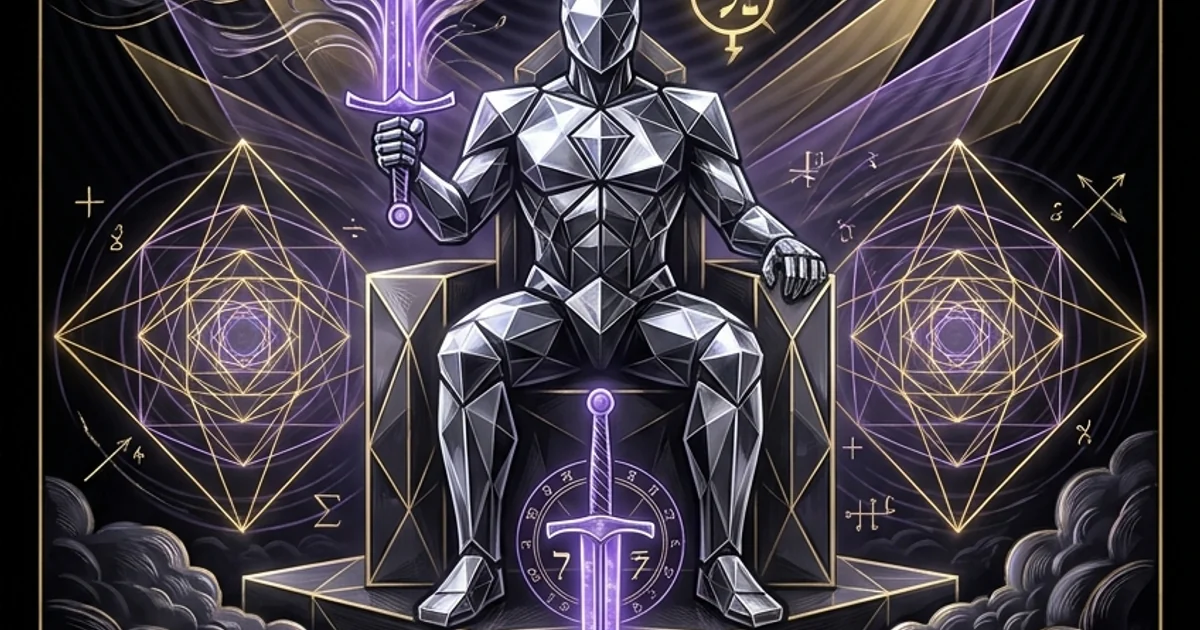
King of Swords: Sovereign Intellect and Clear Judgement
Archetypal Thesis & Systemic Paradigm: The Sovereign Logos of Yetzirah
The Epistemic Architecture of the Swords Suit
Within the architectural framework of Hermetic Qabalah, the four suits of the Minor Arcana map systematically onto the four distinct metaphysical realms of emanative cosmology. The Swords suit occupies the third cosmological plane: Olam Yetzirah, the Formative World. While the suit of Wands mediates the undifferentiated volcanic impulse of Atziluth (Archetypal Fire) and the suit of Cups gathers the oceanic emotional waters of Briah (Creative Water), the Swords suit precipitates these pre-formal potencies into the structured matrix of the mind. This matrix corresponds precisely to Ruach, the psycho-spiritual faculty of intellect, linguistic categorization, and analytical discrimination.
Understanding the king of swords tarot meaning requires recognizing that the air element is fundamentally an environment of dynamic conceptual conflict and dialectical synthesis. Air is neither inert nor static; in classical physics and Hermetic physics alike, it is the gaseous medium characterized by volatility, pressure differentials, and continuous motion. In the Yetziratic world, the intellect operates through the perpetual division, classification, and recombination of sensory and archetypal data. The suit of Swords outlines the complete teleological arc of human cognition—from the primordial spark of an absolute premise (the Ace) to the cognitive exhaustion of systemic over-identification (the Ten). Within this systemic continuum, the King of Swords sits as the teleological apex of the suit, commanding the complete operative domain of mental forms with absolute detachment and structural authority.
The sovereign intellect represented by this card is not merely subjective cleverness, academic erudition, or spontaneous wit. Rather, it represents the ontological grounding of pure noetic awareness. The King of Swords establishes an epistemic baseline where thought ceases to be an unmonitored reaction to visceral stimuli and instead becomes an intentional, cybernetic navigation of objective structural reality. Through the vehicle of this archetype, the chaotic cross-currents of cognitive noise are disciplined into systematic methodology, formal logic, and the inexorable decrees of natural and cosmological jurisprudence.
The King as the Dynamic Yod of the Formative World
To determine the structural potency of the King of Swords, one must analyze his position upon the Tree of Life. In the standard Qabalistic mapping established by the Hermetic Order of the Golden Dawn, the four court cards represent the letters of the Tetragrammaton ($YHVH$) mapped across the Four Worlds. The King (traditionally assigned to the letter Yod) embodies the archetypal masculine principle: the active, seminal, and originating drive of Chokmah (Wisdom). When the Yod of Chokmah operates within the fluid, volatile medium of Yetzirah (the realm of the letter Vav), an intense functional alchemy occurs: the King of Swords becomes the primordial Father acting upon the Formative Mind.
This establishes the specific sub-elemental formula of the card as the Fire of Air. Here, Fire is not a destructive inferno; it is the active, radiative, and directional principle that animates the expansive, ubiquitous medium of Air. Without the focusing heat of Fire, Air disperses infinitely, degenerating into intellectual paralysis, idle speculation, and fragmented verbosity. Conversely, without Air, Fire consumes its fuel and suffocates. The King of Swords harmonizes these two dynamic polarities. His intellectual faculty is propelled by an inward, unwavering will (Fire) that charges through conceptual space (Air), cutting through ideological confusion with laser-like precision.
As the dynamic Yod of Yetzirah, this figure establishes boundaries, defines legal parameters, and enforces epistemic hygiene. He does not passively observe the movement of thoughts; he governs them. He occupies the throne of mental sovereignty, executing structural mastery over the entire /tarot/suit-of-swords-archetypal-journey by anchoring the ethereal abstractions of the intellect into decisive, functional architectures.
Transcending Binary Affect: The Principle of Pure Discernment
The foundational mandate of the King of Swords is the radical sublimation of binary affect in favor of dialectical discernment. In human psychological development, the primitive ego functions primarily through binary reactions: pleasure versus pain, attraction versus repulsion, comfort versus fear. These affective currents generate a perpetual fog within the cognitive faculties, distorting reality through the lens of subjective desire and anxiety. The King of Swords represents the psychological threshold wherein the individual achieves cognitive liberation from this affective matrix.
Operating through the classical logos-archetype, the King employs the double-edged sword of discrimination to sever the observer from the observed. This is not the pathological suppression of emotion, but its radical containment. The sovereign intellect recognizes that while emotions provide diagnostic data regarding the organism’s subjective state, they cannot serve as the epistemological foundation for universal law or moral arbitration. Discernment (diakrisis) requires standing outside the immediate emotional field.
Through this conscious estrangement from affective bias, the King transforms mental turbulence into macrocosmic justice. The vertical blade held in his right hand demonstrates that the intellect is held as a sacred trust, pointed toward the transcendental sources of truth before executing terrestrial judgment. It is an instrument of unyielding moral equilibrium. The King embodies the realization that true compassion is often mediated through the surgery of truth: the willingness to excise comforting illusions to preserve structural and existential integrity.
Classical Provenance & Textual Lineage: Historical Transmission of the Air Sovereign
The Renaissance Condottiero: Visconti-Sforza to Marseilles
The iconography of the King of Swords originated within the feudal realities of early Renaissance Italy. In the 15th-century Visconti-Sforza tarocchi decks, the figure of the Re di Spade is explicitly rendered through the visual lexicon of the condottiero—the military captain, sovereign feudal magistrate, and commander of armed forces. In these early decks, the card was bound to the tangible apparatus of statecraft, territorial defense, and the secular administration of justice through the monopoly on violence. The sword was an unswerving emblem of legal authority (jurisdictio) and physical enforcement (imperium). The Italian renaissance mind viewed this figure not as a detached philosopher, but as an active ruler whose capacity for rational governance was perpetually tested by the shifting intrigues of war and politics.
As the tarot migrated across the Alps and crystallized into the classic Tarot de Marseille pattern during the 17th and 18th centuries, the iconography achieved an archetypal stability. The Roi d’Épée in the Marseille tradition is portrayed seated upon an imposing, enclosed throne, clad in full plate armor beneath his royal mantle. He holds a massive, unsheathed broadsword upright, resting heavily upon his shoulder or poised for immediate descent. His visage is stern, impassive, and bearded, symbolizing the seasoned maturity of the legal magistrate.
The Marseilles card captures the socio-political transition of Europe from fragmented feudalism to the centralized administrative state. The King no longer merely wages war; he administers the law. The armor beneath the robe demonstrates that the rational order of civil society is constantly maintained by an underlying potential for martial force. The intellect here is pragmatic, unyielding, and bound to the preservation of institutional equilibrium.
Golden Dawn Syncretism: The Lord of the Winds and Breezes
The foundational shift from feudal magistrate to esoteric cosmic intelligence occurred in the late 19th century through the Hermetic Order of the Golden Dawn. Under the leadership of Samuel Liddell MacGregor Mathers, the court cards were systematically extracted from secular, exoteric card-playing contexts and integrated into an all-encompassing system of Hermetic Qabalah, Enochian magic, and astrological decanates. Within this hermeneutic architecture, the traditional “King” of the exoteric decks was reassigned to the titular rank of the “Knight” to reflect the dynamic, active Yod force of the Tetragrammaton, while the enthroned figure was designated as the Prince.
“The Knight of Swords is ‘The Lord of the Winds and the Breezes, King of the Spirits of Air; King of the Sylphs and Sylphides.’ He is the personification of the dynamic, fiery power of Air. His attribution is the fiery part of Air, representing swiftness, intellectual activity, drive, and the violent onset of conceptual movement. He rules the heavens from the 20th degree of Taurus to the 20th degree of Gemini.”
Mathers synthesized the medieval martial archetype with late-antique Neoplatonic demonology and the elemental hierarchies of Paracelsus. The figure was no longer merely a terrestrial king; he became an elemental intelligence directing the astral currents of the yetziratic realm. The card was systematically classified under the sub-elemental algebra of the Fire of Air, uniting the combustible, dynamic impetus of Fire with the volatile, omnipresent reach of the mental plane. This synthesis established that the King’s true domain is the invisible ether of thought, where ideas clash, evolve, and assume teleological forms before crystallizing into physical manifestation.
The Waite-Smith Iconographic Canon and Its Chivalric Codes
When Arthur Edward Waite and Pamela Colman Smith published the seminal Rider-Waite-Smith (RWS) deck in 1909, they synthesized the esoteric assignments of the Golden Dawn with the exoteric readability of the Marseilles model. While Waite restored the title of “King” to the seated ruler—inverting the Golden Dawn’s specific court title taxonomy while subtly retaining its structural underpinnings—he meticulously reconstructed the king of swords symbolism to convey an elevated, philosophical reading of sovereign intellect.
In the RWS rendering, the King sits upon an architectural stone throne placed upon an elevated, open plateau. He stares directly at the viewer with an expression of unwavering, neutral scrutiny. His body is oriented forward, yet his unsheathed sword is held completely vertical in his right hand, tilted almost imperceptibly toward his right ear—a classical iconographic gesture signifying the active reception of divine inspiration and its immediate analytical processing. The sword does not rest upon his shoulder as it does in the Marseilles tradition; it is actively suspended, requiring constant, conscious muscular effort and equilibrium.
Waite eliminated the heavy plate armor of the Italian and French traditions, cloaking the King instead in flowing blue and white robes overlaid with a deep red mantle. This sartorial choice signals that the battle has shifted entirely from the physical battlefield to the theater of the mind. The King wears a crown adorned with a winged cherub, directly evoking the supernal powers of the intellect, while the back of his throne features carved reliefs of butterflies—the classical symbol of the soul (psyche) and the volatile nature of the mind—and twin crescent moons. Through this rich visual heraldry, Waite and Smith encoded a profound chivalric ideal: that supreme mental power is legitimate only when subordinated to spiritual truth, objective justice, and continuous self-governance.
Structural Mechanics & Symbolic Geometry: Astrological Decans and Elemental Algebra
The Fire of Air Sub-Elemental Synthesis
The precise operational mechanics of the King of Swords are governed by the sub-elemental formula of Fire of Air. In traditional esoteric cosmology, elements are not static substances, but qualities of motion and interaction. Air is hot and moist, characterized by connectivity, communication, intellectual expansion, and volatility. Fire is hot and dry, characterized by separation, intensity, linear projection, and transformation.
When Fire operates upon Air, the shared quality of heat generates tremendous kinetic acceleration. The Fire provides the dry, discriminating edge that counters the humid, connective, and sometimes indiscriminate nature of pure Air. Without Fire, Air connects everything to everything else, dissolving into relativism, endless semantic debate, and cognitive diffusion. Fire introduces hierarchy, judgment, and irreversible division. It transforms diffuse thought into focused intent—the broad sky into a targeted lightning strike.
       [ FIRE ]             [ AIR ]
      (Hot & Dry)         (Hot & Moist)
           \                 /
            \               /
          [ KINETIC ACCELERATION ]
          - Sharp discrimination
          - Directional focus
          - Sublimation of ambiguity
This elemental synthesis reveals why the King of Swords can appear ruthless or emotionally sterile to observers governed by the water or earth elements. His function is fundamentally surgical. He employs the dry, heating power of the will to clear away the humid fogs of sentimental illusion, revealing the structural bones of objective truth.
Zodiacal Coordinates: The Dual Spheres of Taurus and Gemini
Under the Golden Dawn astromancy system, the King of Swords presides over a specific 30-degree segment of the tropical zodiac: the final decan of Taurus and the first two decans of Gemini (specifically, from 20° Taurus to 20° Gemini). This placement bridges the transition from the Fixed Earth of Taurus to the Mutable Air of Gemini, producing a profound psychological and operational synthesis.
- Tetragrammatonic Attribution: Yod ($Y$) of Yetzirah (The primordial Father within the Formative Realm)
- Sub-Elemental Formula: Fire of Air (The energetic, directed projection of intellect)
- Astrological Coordinates: 20° Taurus to 20° Gemini (Decan III of Taurus to Decan II of Gemini)
- Planetary Rulers of Decans: Saturn (Taurus III), Jupiter (Gemini I), Mars (Gemini II)
- Color Scale Attributions: Deep blue, pure yellow-white, pale blue, gold-tinted silver
- Enochian Attribution: The Great Western Quadrangle (Elemental Air)
The inclusion of the third decan of Taurus (ruled by Saturn according to the Chaldean order) roots this archetype in unyielding structural tenacity. It provides the earthen bedrock, mental endurance, and constitutional grounding required to formulate durable legal and intellectual frameworks. The King does not entertain fleeting fads; he comprehends the weight of precedent and material consequence.
Following this earthen anchor, the archetype plunges into the first two /astrology/gemini-decans-and-tarot. The first decan of Gemini (ruled by Jupiter) introduces vast conceptual syntheses, high philosophy, linguistic elegance, and the capacity to perceive the meta-patterns uniting disparate fields of knowledge. The second decan of Gemini (ruled by Mars) injects the card with dialectical vigor, rapid-fire critical analysis, surgical precision, and the capacity to wage war in the realm of ideas. The King of Swords thus unites the steadfastness of Saturnian Earth with the brilliant, combative velocity of Jovian-Martian Air.
Iconographic Heraldry: The Straight Sword, Cherubs, and Clear Skies
The symbolic geometry of the visual motifs in the RWS iconographic canon further articulates this structural tension. The straight, double-edged sword held by the King represents the vertical axis of the mind, pointing toward the transcendent absolute while maintaining the capacity to divide terrestrial issues along the dual axes of truth and falsehood, justice and injustice. Unlike the curving scimitar or the passive shield, the straight sword requires conscious, muscular, symmetrical tension to remain upright. It mirrors the human spinal column, embodying the upright posture of conscious awakeness versus the recumbent posture of sleep and unconsciousness.
Upon the headrest of his stone throne are carved two stylized butterflies and a winged cherub. In classical Greek hermeneutics, the butterfly (psyche) is the emblem of the soul liberated from the gross caterpillar-state of physical instinct, navigating the higher atmosphere of purely mental forms. Yet butterflies are also notoriously erratic and delicate; their presence behind the King’s head serves as a reminder that the thoughts of the human mind are inherently fragile and volatile, requiring the disciplined guardianship of the sovereign will. The winged cherub, sitting above the butterflies, signifies the direct connection between human reason and the celestial hierarchies of cosmic intelligence.
The atmospheric background of the card reinforces this rigorous mental discipline. The sky is a pale, washed-out blue, indicating an absence of emotional storms and humid passions. In the distance, two solitary trees stand perfectly straight, their leaves minimally agitated, signifying that the violent winds of panic or hysteria have been stilled. A low layer of clouds sits horizontally across the lower horizon, well beneath the elevation of the King’s throne. The King sits resolutely above the cloud line. He occupies the psychological stratosphere, a realm of perpetual clarity where the horizon is unbroken and the illumination of the sun is unscattered by the condensation of emotional ambivalence.
Psychological Dynamics & Operational Praxis: The Archetype of the Detached Judge
The Senex and the Logos: A Jungian Analytical Topology
From the perspective of Jungian analytical psychology, the King of Swords represents the advanced differentiation of the Thinking function (cogitatio), operating in seamless alliance with the archetypal Senex (the Wise Old Man) and the macrocosmic Logos. Carl Gustav Jung, in The Archetypes and the Collective Unconscious, established that the psychological development of consciousness depends on the individual’s capacity to extract ego-awareness from the undifferentiated, oceanic matriarch of the unconscious. The primary instrument of this psychic liberation is the Logos—the discriminating principle of order, articulation, and cognitive distance.
[ THE UNCONSCIOUS ] (Affective Matrix / Primordial Nature)
              |
              |  <-- Severed by the Sword of Discernment (Logos)
              v
       [ THE EGO-SENEX ] (Differentiated Mind / Sovereign Judge)
The King of Swords embodies the sovereign integration of this Logos. As a psychological topology, this archetype manifests when the individual’s cognitive apparatus is no longer hijacked by the anima (the affective, relational soul-image) or the shadow (repressed, instinctual drives). The King has internalized the reality that thoughts are not personal possessions, but objective phenomena passing through the field of awareness.
This analytical posture corresponds to the highest functioning of the executive ego: the capacity for meta-cognition. The King watches the process of thought itself. He evaluates concepts through their structural integrity, internal consistency, and empirical validity, standing outside the emotional field with absolute neutrality. In this space, the King of Swords becomes the psychological archetype of the Impartial Judge—the internal arbiter who can cross-examine his own motives, dissect cognitive distortions, and dismantle self-serving rationalizations with unswerving honesty.
Operational Praxis in Diagnostic Consultation: Epistemic Rigor vs. Tyranny
In diagnostic esoteric consultation and practical divination, the emergence of the King of Swords acts as an imperative command for epistemic hygiene. It signifies that the consultant is situated within a psychological or environmental matrix where subjective narratives, emotional appeals, and intuitive impressions are wholly insufficient to resolve the crisis. The card mandates a shift toward rigorous empirical analysis, the consulting of objective expertise, the formalization of legal boundaries, and the total excision of sentimentality.
When evaluating a complex systemic dilemma, the King of Swords instructs the practitioner to ask: What are the raw, unadorned facts of this situation when stripped of hope, fear, and subjective narrative? It demands the adoption of the scientific method within the internal theater of the mind. The consultant must formulate clear hypotheses, test their assumptions against reality, and accept the truth of the diagnosis regardless of how unpalatable or emotionally challenging the conclusion may be.
This operational praxis forms a profound complementary dialectic with the /tarot/queen-of-swords-meaning. While the Queen of Swords represents the defensive, inward mastery of grief transformed into sharp, perceptual boundaries—the individual who has suffered and emerged with razor-sharp insight—the King of Swords represents the externalized, legislative execution of structural law. He does not merely set boundaries to protect his psychic sovereignty; he formulates the universal laws that govern the entire social, psychological, or operational ecosystem.
Shadow Manifestations: The Sadistic Autocrat and Hyper-Cerebral Paralysis
When the energy of the King of Swords falls into structural disequilibrium or becomes “ill-dignified” through psychic inflation, it generates a profoundly destructive pathological shadow. The shadow of the King of Swords is the Sadistic Autocrat, the Machiavellian Cynic, and the Hyper-Cerebral Invalidator. In this unintegrated state, the severance of the intellect from the affective heart (Tiphereth) is totalized, resulting in a monstrous caricature of rationality.
The shadow King utilizes the weapon of the intellect not to illuminate truth, but to inflict dominance, humiliation, and control. This manifests behaviorally as weaponized pedantry, malicious litigiousness, systemic gaslighting, and emotional refrigeration. The shadow King recognizes the vulnerabilities of others with terrifying precision, yet uses that diagnostic insight as a scalpel to dissect, manipulate, and destroy. He experiences an icy, sadistic pleasure in proving others wrong, operating from a deep-seated unconscious fear of vulnerability, warmth, and the chaotic unpredictability of love.
Integrated King of Swords (Objective Logos)
- Epistemic Modality: Radical pursuit of empirical truth and systemic coherence.
- Justice Dynamic: Impartial, equitable, protective of universal law.
- Affective Posture: Consciously detached; emotions contained to ensure objective clarity.
- Communication: Direct, transparent, surgically precise, constructive.
- Functional Telos: Excision of illusion to cultivate long-term psychic integrity.
Shadow King of Swords (Sadistic Autocrat)
- Epistemic Modality: Sophistry, weaponized semantics, dogmatic hyper-rationalism.
- Justice Dynamic: Punitive, vindictive, using the letter of the law to murder its spirit.
- Affective Posture: Emotionally frozen, contemptuous, actively hostile to vulnerability.
- Communication: Hyper-critical, sarcastic, dismissive, rhetorically abusive.
- Functional Telos: Defense of an insecure ego through absolute intellectual domination.
At its most debilitating, this shadow manifests internally within the individual as hyper-cerebral paralysis. The mind, turning inward upon its own creative impulses, subjects every nascent emotion, creative idea, and spontaneous desire to such intense, hyper-critical scrutiny that all action is suffocated at birth. The individual becomes an internal police state, where no spontaneous life is permitted to flourish because it cannot satisfy the impossible, sterile criteria of the internal tyrant.
Philosophical Synthesis & Macrocosmic Correspondence: Hermetic Axioms of Universal Law
The Principle of Mentalism: The Universe as Immaterial Concept
The metaphysical superstructure of the King of Swords finds its purest philosophical articulation within the seven Hermetic axioms preserved in the Alexandrian lineage and codified in the modern era. Foremost among these is the First Principle: /hermeticism/principle-of-mentalism—THE ALL is MIND; The Universe is Mental.
This axiom posits that the foundational substrate of reality is not dense, mechanistic matter, but an infinite, living, immaterial consciousness. The physical universe, with all its biological, thermodynamic, and gravitational dynamics, is an emanative thought-form operating within the cosmic mind. The King of Swords stands as the direct terrestrial and psychological representative of this cosmic truth. He recognizes that every physical institution, legal code, architectural monument, and scientific revolution was preceded by a mental form.
By mastering the mechanics of the mind, the King of Swords exercises macrocosmic resonance. He does not manipulate the material world through brute, direct physical force (the domain of Earth and the biological instincts). Instead, he acts upon the informational code, the structural blueprints, and the linguistic definitions that condition material manifestation. He embodies the hermetic understanding that whoever controls the conceptual frameworks of a society or a psyche governs the physical realities that inevitably precipitate from them.
The Double-Edged Blade: Polarity and Dialectical Synthesis
The double-edged sword held vertically by the King constitutes a profound glyph of the Hermetic Principle of Polarity: Everything is dual; everything has poles; everything has its pair of opposites; opposites are identical in nature, but different in degree.
The two edges of the blade signify the inescapable dualities of Yetziratic manifestation: light and darkness, truth and falsehood, creation and destruction, life and death. The straight, central spine of the sword constitutes the third term: the transcendent axis of equilibrium that unites the opposing edges into a single instrument of judgment. The King does not attempt to abolish polarity; he commands it.
“The differentiating function of the Logos is essentially discriminating; it cuts, separates, analyzes, and establishes boundaries. In this capacity, it performs the indispensable work of rescuing the nascent ego from the engulfing, undifferentiated unconscious matrix. Without the cold light of this discriminative intellect, consciousness remains hopelessly enmeshed in primitive participation mystique.”
The blade cuts both ways simultaneously. In legal jurisprudence, a just law must bind the magistrate with the identical rigor that it binds the subject. In psychological self-governance, the standard of truth that an individual applies to dissect the deceit of others must be ruthlessly applied to dismantle their own internal rationalizations. If the sword cuts outward only, it ceases to be an instrument of the Logos and degenerates into an implement of narcissistic violence. The true King of Swords maintains his sovereignty precisely because he has already survived the vertical descent of the blade upon his own illusions.
Macrocosmic State-Space Navigation: Cybernetic Feedback in Divinatory Practice
When divination is approached not through the degraded lens of superstition, but through contemporary systems theory and information dynamics, the King of Swords serves as a pristine cybernetic feedback mechanism. A cybernetic system relies on continuous error-detection, state evaluation, and negative feedback loops to maintain homeostatic equilibrium amid chaotic environmental fluctuations.
In this context, a tarot spread represents a probabilistic state-space map of consciousness. When the King of Swords manifests within this state-space, it operates as an error-correcting algorithm. It indicates that the system is currently drifting toward systemic entropy due to unexamined emotional biases, cognitive dissonance, or semantic ambiguity. The King re-establishes the system’s set-point by injecting negative feedback: he cuts through ideological noise, demands empirical re-calibration, and forces the collapsing of indeterminate wave-functions into decisive, structured intentionality.
The King of Swords does not speculate on what might feel reassuring; he dictates what must be done based on the systemic laws governing the macrocosm. He is the master navigator of complex systems, calculating vectors of cause and effect with cool, unsentimental foresight, steering the fragile vessel of human awareness through the ideological storms of the collective unconscious toward the stable shores of structural clarity.
Frequently Asked Questions: Advanced Inquiries on the King of Swords
How does the King of Swords differ from the Emperor in executive function?
While both the King of Swords and the Emperor (Major Arcanum IV) represent sovereign patriarchal authority, their operational domains, elemental foundations, and epistemic mechanisms are fundamentally distinct. The Emperor is the embodiment of Archetypal Aries, ruled by Mars and grounded in the element of Fire. His power is temporal, structural, and territorial; he rules through the establishment of physical borders, material empires, state institutions, and direct executive decree. The Emperor is concerned with dominion, stability, and the consolidation of raw power over the physical world.
In contrast, the King of Swords is an elemental entity of Air (specifically Fire of Air), operating within the formative realm of Yetzirah. His authority is purely epistemic, intellectual, and judicial. The King does not need to own the territory; he authors the legal, scientific, and philosophical principles that determine how the territory is understood, evaluated, and governed. The Emperor commands armies and enforces order through physical might; the King of Swords drafts the constitutional framework, interprets the law, acts as supreme magistrate, and exposes systemic logical errors. The Emperor is the Sovereign of the State; the King of Swords is the Sovereign of the Mind.
Why do Golden Dawn and Thoth attributions assign the King titles differently from the Rider-Waite-Smith system?
This divergence stems from an intentional structural reform introduced by Samuel Liddell MacGregor Mathers within the Hermetic Order of the Golden Dawn, which was later radicalized by Aleister Crowley in The Book of Thoth. In classical esoteric Qabalah, the four letters of the Tetragrammaton ($YHVH$) map onto the familial hierarchy: Father ($Yod$), Mother ($Heh$), Son ($Vav$), and Daughter ($Heh$ final).
Mathers recognized that the dynamic, mounted knight was a superior symbol for the fiery, active, seminal energy of the Father ($Yod$), while the enthroned king was more suited to the static, balanced, and mediating energy of the Son ($Vav$), which corresponds to the central Sephirah of Tiphereth. Consequently, in Golden Dawn documents:
- The mounted figure was named the Knight and assigned to $Yod$ (Father).
- The seated figure was named the Prince (or King in exoteric translation) and assigned to $Vav$ (Son).
When Arthur Edward Waite created the Rider-Waite-Smith deck, he was bound by Golden Dawn oaths of secrecy not to reveal this internal nomenclature to the uninitiated public. Waite deliberately chose to retain the traditional, exoteric labels: King, Queen, Knight, Page. However, he quietly aligned the visual iconography of his enthroned “King” with the dynamic, authoritative qualities of the Father principle, while Crowley in his Thoth deck abolished the title of “King” entirely, using Knight (Father/Yod), Queen (Mother/Heh), Prince (Son/Vav), and Princess (Daughter/Heh final). Therefore, Waite’s King of Swords functionally synthesizes the authoritative, mature stature of the Prince with the primordial, active sovereign power of the Golden Dawn’s Knight.
What does the King of Swords indicate when appearing reversed or ill-dignified?
When the King of Swords appears inverted, ill-dignified by surrounding adverse cards (such as the Three or Ten of Swords), or operating in a severe psychological shadow, it signals that the faculty of the intellect has broken free from moral, ethical, and macrocosmic constraints, degenerating into destructive, weaponized rationalism.
Operationally, an ill-dignified King of Swords manifests across three primary vectors:
- Malicious Jurisprudence and Systemic Gaslighting: The deliberate use of legalism, bureaucratic technicalities, or sophistry to deceive, disenfranchise, or terrorize an opponent. It indicates bad-faith arguments, perjured testimony, breach of contract defended by clever rhetoric, and the manipulation of language to distort empirical truth.
- Emotional Sadism and Tyranny: Interpersonal dynamics characterized by ruthless condescension, hyper-criticism, sarcasm, and profound emotional neglect. The reversed King uses his razor-sharp perception to locate the psychic vulnerabilities of others and systematically exploit them to maintain an illusion of absolute control.
- Intellectual Hubris and Paralysis: The total divorce of the mind from visceral, empirical reality, leading to delusional ivory-tower dogmatism. The individual constructs complex, logically airtight theoretical models that are entirely detached from observable reality, dismissing practical evidence because it conflicts with their intellectual vanity. The card inverted serves as an urgent diagnostic warning: the sword of reason has ceased to be an instrument of surgery and has become an instrument of execution. :::