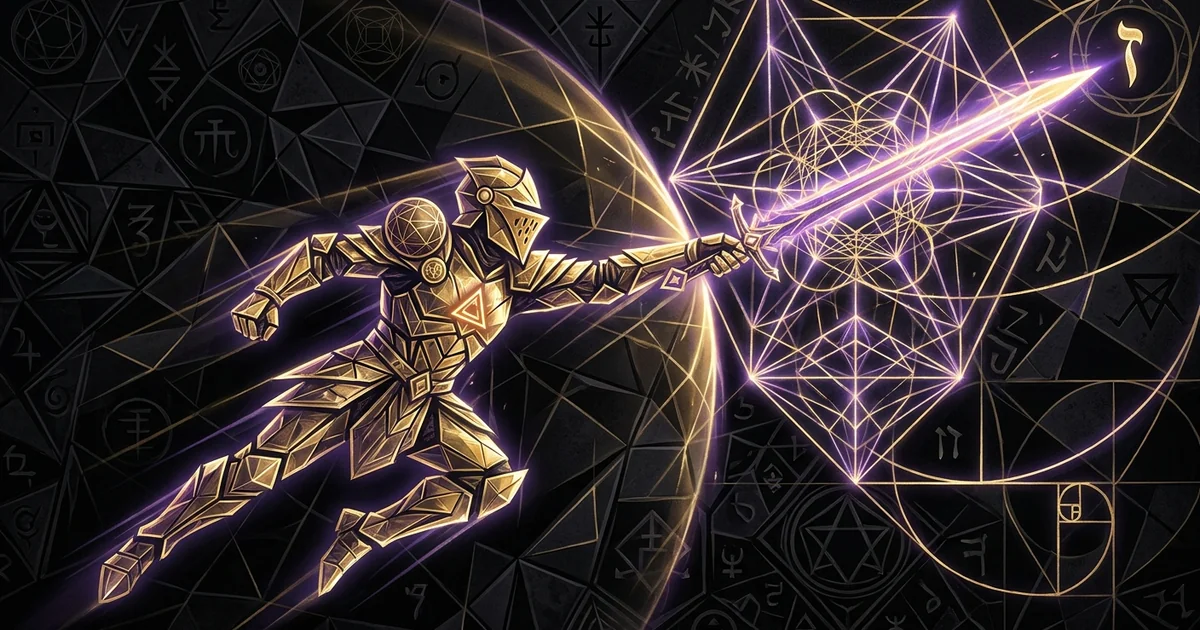
Knight of Swords: Fierce Mental Drive and Swift Reason
Archetypal Thesis & Systemic Paradigm: The Fire of Air and the Vector of Pure Mind
Elemental Algebra: The Volatilization of Volatility
Within the structural taxonomy of Hermetic Qabalah and esoteric cartography, the court cards do not depict static personalities, but rather dynamic intersections of elemental energy acting across distinct cosmological densities. The Knight of Swords operates as the kinetic teleology of the mind. Assigned the sub-elemental formula of the “Fire of Air” (the Yod sub-element of the suit of Vav), this archetype delineates the precise point where gaseous, ambient intellect undergoes sudden thermonuclear ignition. As detailed in the mechanics of court card elemental permutations, Air (Vav) represents discursive reason, communication, mediation, and the mental matrix of Yetzirah (the Formative World). When the primordial, masculine, catalytic principle of Fire (Yod / Chokmah) is introduced into this fluid, atmospheric medium, the systemic result is not gentle aeration, but a violent, pressurized thermal draft.
This elemental algebra manifests as the volatilization of volatility. Air naturally expands to occupy all available space, diffusing itself across dialectical landscapes without fixed orientation. Fire, by contrast, is unidirectionally teleological; it consumes, ascends, and polarizes. The insertion of Fire into Air transforms open-ended contemplation into a concentrated, hyper-accelerated intellectual vector. The Knight of Swords tarot meaning is rooted precisely in this thermodynamic state: thought stripped of speculative inertia and weaponized into focused, penetrating intent. In the broader system of suit of swords symbolism, this archetype represents the intellect moving at escape velocity, refusing the contemplative equilibrium of the Queen or the institutional architecture of the King.
The Teleology of Ruach: Cognitive Directionality and Focused Intent
In the tripartite psychology of the Qabalistic soul—composed of Nefesh (animal/instinctual drive), Ruach (intellectual/moral consciousness), and Neshamah (intuitive/supernal awareness)—the Knight of Swords signifies the supreme kinetic expression of Ruach. Here, discursive reason is emancipated from the heavy gravitational pull of somatic sentimentality and the vegetative instincts of Nefesh. This mobilization of Ruach represents the mind recognizing its own structural power to dictate conditions rather than merely interpret sensory data. The sword itself, forged of refined iron and tempered in the dual fires of logic and formal discipline, becomes the epistemological apparatus through which subjective illusion is bifurcated from structural reality.
This cognitive directionality converts passive observation into active intervention. Within this framework, thought ceases to be an epiphenomenon of the environment; it acts instead as a deliberate intervention upon the phenomenal field. The Knight does not merely possess ideas; he is possessed by an incisive ideational vector. The mental drive characteristic of this card manifests as an intense cognitive hunger to dismantle obfuscation, dissect complex semantic ambiguities, and arrive at axiomatic clarity with surgical efficiency. Discursive consciousness is mobilized toward a singular, uncompromising objective: the swift identification, deconstruction, and overcoming of intellectual resistance.
The Double-Edged Blade: Discriminating Intellect versus Dissociative Velocity
The inherent hazard of this archetypal configuration lies in its systemic imbalance. Because the elemental formula consists of Fire and Air, it lacks both the dampening, empathetic viscosity of Water and the grounding, friction-generating ballast of Earth. Consequently, the discriminating intellect easily mutates into dissociative velocity. When the cognitive apparatus accelerates beyond the speed of somatic and emotional integration, consciousness severs its tether to reality. The very faculty of viveka—the Sanskrit philosophical concept of spiritual discrimination, which distinguishes the real from the unreal—devolves into hyper-rational fanaticism, pedantry, and ideological cruelty.
This severance exposes the double-edged nature of the blade. One edge cuts through dogma, self-deception, and sentimental cognitive distortions; the opposing edge cuts the thinker off from the living biosphere of feeling and moral context. When velocity replaces systemic reflection, the Knight of Swords degenerates into a blind intellectual projectile. In this corrupted mode, reason becomes self-referential and masturbatory: an ungrounded cognitive loop characterized by ideological purism that views human complexity as an inconvenient impediment to the clean execution of abstract theory.
Classical Provenance & Textual Lineage: From Renaissance Chivalry to Esoteric Hermeticism
The Visconti-Sforza and Early Italian Tarocchi: The Militant Cavalier
The historical emergence of the Knight of Swords (Cavallo di Spade) within fifteenth-century northern Italian courts, such as the Visconti-Sforza deck, carried overt socio-political and martial weight. In these early Renaissance Tarocchi, the Knight was not merely a romanticized mythic wanderer, but a vivid emblem of condottiere culture—mercenary captains whose survival and sovereign utility rested entirely upon tactical decisiveness, dynamic maneuvers, and unyielding martial resolve. The physical iconography of the Renaissance Cavalier reflected the realpolitik of Northern Italy: an armored equestrian warrior executing the will of the state through kinetic violence and cold calculation.
Iconographically, these early representations emphasized physical sovereignty and institutional enforcement. Mounted on a heavy warhorse, the Cavalier held his blade in an upright or striking position, signaling total operational readiness. While these early cards lacked the explicit Qabalistic and astrological framework later introduced by nineteenth-century occult revivals, the core motif was firmly established: the Cavalier represented the active, dynamic enforcement of the law, cutting through the stagnation of social inertia through direct, assertive application of power and tactical will.
Golden Dawn Codices and Book T: The Lord of the Winds and Breezes
The systematic codification of the Tarot into an integrated Hermetic-Qabalistic engine occurred under the auspices of the Hermetic Order of the Golden Dawn, formulated primarily by Samuel Liddell MacGregor Mathers and Moina Mathers in the foundational text known as Book T. Within this rubric, the traditional court hierarchy was recalibrated along the four letters of the Tetragrammaton (YHVH). The figure commonly identified in exoteric decks as the “King” was designated the “Knight” (representing the initial Yod and elemental Fire), while the mounted warrior was renamed the “Prince” (representing Vav and elemental Air).
“The Lord of the Winds and the Breezes; the King of the Sylphs and Sylphides; Prince and Emperor of the Order of the Baalim. A winged youth with his hair floating in the wind, mounted on a galloping charger, clad in feather-patterned plate armor… He is the active and focused motion of Air, driving the clouds before him; his power is swift, destructive, penetrating, and unstable. He rules the zodiac from 20° Taurus to 20° Gemini.” — S.L. MacGregor Mathers & Moina Mathers, The Secret Heritage of the Golden Dawn: Book T (1888–1904)
In Book T, this entity is designated “The Lord of the Winds and the Breezes; King of the Sylphs and Sylphides.” The Golden Dawn assigned him precisely to the decanates bridging the fixed earth of Taurus and the mutable air of Gemini. This synthesis gave the archetype a complex dynamic: the stubborn, unyielding momentum of Taurus accelerated by the mercurial, dialectical versatility of Gemini. In this technical framework, the card represents neither an individual man nor a generic event, but a cosmic sub-elemental vector: the dynamic, volatile power of Air driven into relentless kinetic thrust by the primordial spark of Fire.
Crowley’s Thoth Transition: The Aerodynamic Striker of Chokmah-in-Yetzirah
When Aleister Crowley and Lady Frieda Harris reimagined the Tarot in The Book of Thoth (1944), they restored the Golden Dawn’s pure Qabalistic titles, officially designating the fiery father-aspect as the “Knight” and the airy son-aspect as the “Prince.” However, within Crowley’s Knight of Swords, the visual and metaphysical synthesis of the “Fire of Air” reached its definitive esoteric crystallization. Crowley stripped the figure of the conventional feudal aesthetic, portraying the Knight as an aerodynamic, mechanized projectile slicing through a hyper-dimensional tempest.
In the Thoth deck, the Knight of Swords is not merely riding a horse; he is structurally integrated into his steed, transforming into a singular biocentric cruise missile. Crowley describes this figure as representing the fiery part of Air, the wind blowing from the Mountain of God, and the supreme capacity of the mind to shatter stagnation. He portrays him as an avatar of Chokmah operating within the world of Yetzirah—an incarnation of swift, direct creative force exploding into the realm of mental forms. Crowley noted that this archetype possesses vast intellectual capacity, but its energy is so fierce and volatile that its ideas often exhaust themselves in their very articulation, leaving the surrounding environment shattered by the sheer sonic boom of their transit.
Structural Mechanics & Symbolic Geometry: Astrological Decans, Qabalah, and Iconography
Astrological Matrix: 20° Taurus to 20° Gemini and the Shift from Earth to Air
The structural mechanics of the Knight of Swords rely upon an intricate astrological matrix that governs its spatial and temporal assignment in the tropical zodiac. Unlike the pip cards, which correspond to individual ten-degree decans, the court cards (specifically the Golden Dawn Prince, which corresponds to the Waite-Smith Knight) span thirty degrees across decanic boundaries, purposefully bridging disparate elemental domains. The Knight of Swords governs from the 20th degree of Taurus through the 20th degree of Gemini.
- Spatial Arc: 51° to 80° of the Tropical Zodiac (20° Taurus to 20° Gemini)
- Decan Breakdown:
- Taurus Decan III (20°–30° Taurus): Governed by Saturn (Fixed Earth). The apex of physical resistance, inertia, and dense structural crystallization.
- Gemini Decan I (0°–10° Gemini): Governed by Jupiter (Mutable Air). The initial expansive ignition of discursive intellect, language, and conceptual categorization.
- Gemini Decan II (10°–20° Gemini): Governed by Mars (Mutable Air). The operationalization of mind as a tactical, aggressive instrument; logic applied as a precision cutting tool.
- Sub-Elemental Formula: Fire of Air (Yod of Vav), mediating the dynamic jump from Saturnian gravitational density into Jovian-Martian atmospheric turbulence.
This astrological configuration is critical for deciphering the knight of swords symbolism. The card begins in the final decan of Taurus—an astrological sector ruled by Saturn, representing the terminal crystallization of earth, physical matter, and dogmatic tradition. The trajectory of the Knight of Swords demands an explosive, violent breakout from this Saturnian soil. As the vector crosses the cusp into Gemini (ruled by Mercury), it encounters the expansive, theoretical optimism of Jupiter (Gemini I) followed immediately by the aggressive, combative intellectualism of Mars (Gemini II). This produces an astrological engine that does not merely think; it wages war against material stagnation, using reason as a sledgehammer to shatter fixed materialist complacency, as explored in the esoteric meaning of the Taurus-Gemini cusp.
Qabalistic Topography: Chokmah of Yetzirah on the Tree of Life
On the Qabalistic Tree of Life, the Knight of Swords occupies a unique metaphysical coordinate: the Sephirah Chokmah (Wisdom) projected downward into the realm of Yetzirah (the Astral/Formative World). Chokmah is the supernal Yod, the primordial, unformed dynamic will-to-create; it is pure kinetic energy prior to the stabilizing, delimiting containment of Binah (Understanding). Yetzirah, on the other hand, is the third of the four kabbalistic worlds, corresponding directly to the suit of Swords and the airy element of discursive thought. To examine this space fully, one must consult the landscape of the Tree of Life’s Yetziratic formative world.
When the fiery, unstructured flash of Chokmah intersects the astral architecture of Yetzirah, the consequence is an overwhelming surge of primary creative will channeled entirely through intellectual forms. This explains why the Knight of Swords cannot tolerate nuance, hesitation, or bureaucratic delay. It is the unadulterated divine spark attempting to write itself into the air of human conceptualization. The archetype embodies an epistemological contradiction: it possesses the absolute certainty of supernal intuition (Chokmah), yet it must operate within the dualistic, fragmented, and dialectical medium of linguistic symbols and human logic (Yetzirah).
Visual Deconstruction: The Charging Steed, Shifting Clouds, and Cleaving Wind
In the visual canon designed by Pamela Colman Smith under the direction of Arthur Edward Waite (1910), the Knight of Swords is transformed into an optical diagram of intense physical and atmospheric friction. The composition is executed entirely along dynamic, diagonal vectors, completely abandoning the static frontal symmetry seen in the seated court figures.
[ Upraised Broadsword / Vector of Viveka ]
                          ^
                         /
                        /  [ Charging Steed / Somatic Drive ]
                       /  /
[ Gale-Force Tailwinds ] ====> [ Piercing the Horizon / Objective Target ]
The steed—white, signifying the purified somatic drive and instinctual force of the nervous system—gallops forward at an unhinged, fully extended stride, its nostrils flared and eyes wide with adrenaline. Smith depicts the bridle and trappings of the horse decorated with turquoise crescents and predatory avian motifs, linking the beast to both the lunar fluctuations of the lower astral plane and the hawk-like precision of high-altitude predatory vision.
The background features jagged, windswept cirrus and altocumulus clouds stretching across the sky like torn canvas, signaling severe barometric disruption and atmospheric turbulence. The cypress trees on the horizon bend violently beneath the invisible weight of the storm. Most importantly, the Knight does not hold his sword in a resting or defensive posture; it is raised vertically at a steep diagonal angle, perfectly parallel to the charging neck of his steed. His visor is flung wide open, exposing his facial profile to the lacerating wind. He is not shielding himself from the conflict; he seeks absolute, unmediated exposure to the dynamic reality he intends to master. Every line of Smith’s composition serves as an electrical circuit diagram of the air element accelerated to its critical velocity:
- The Charging Horse: Represents instinctual, somatic momentum completely commandeered by an uncompromising cognitive objective.
- The Raised Broadsword: Signifies the active operation of discursive logic cutting through atmospheric (emotional/mental) turbulence.
- The Wind-Whipped Mantle: Depicts the dynamic interaction between internal subjective will and external environmental resistance.
- The Jagged Clouds: Illustrate the psychological fragmentation and atmospheric ionization caused by high-velocity intellectual penetration.
Psychological Dynamics & Operational Praxis: The Archetype in Analytical Psychology and Divination
The Extraverted Thinking Function: Uncompromising Objective Logic
Through the diagnostic prism of Carl Gustav Jung’s Psychological Types (1921), the Knight of Swords is the canonical symbolic personification of dominant Extraverted Thinking (Te) operating at its most radical, catalytic expression. In analytical psychology, Extraverted Thinking is an executive cognitive function that orients itself wholly toward external facts, objective data, conceptual frameworks, and universal laws. It elevates intellectual judgment into the primary guiding principle of psychological orientation, as detailed in the exploration of Jungian cognitive functions and Tarot.
Jung noted that the individual dominated by Extraverted Thinking aims to bring their entire life-activity into relation with intellectual formulas. In the Knight of Swords, this mechanism is intensified. The archetype does not evaluate the world through subjective feeling (Fi) or visceral sensory aesthetics; it measures reality against systemic coherence, efficiency, and demonstrable empirical validity. When a problem presents itself, the Knight does not deliberate—he calculates the vector of highest utility, formulates an incisive intellectual strategy, and moves instantly to eliminate systemic resistance. His psychological signature is marked by extraordinary intellectual stamina, forensic rhetorical precision, and an instinctive intolerance for cognitive dissonance, bureaucratic inertia, and irrational self-delusion.
Shadow Manifestations: Fanaticism, Cruelty, and Cerebral Dissociation
The fundamental vulnerability of this psychological profile is its profound repression of the feeling function. In Jungian topography, when Extraverted Thinking is elevated to an extreme, Extraverted Feeling (Fe) and Introverted Feeling (Fi) are violently submerged into the unconscious personal shadow. The individual under the unintegrated grip of the Knight of Swords becomes utterly blind to the human costs of their logical formulations.
Integrated Knight of Swords
- Epistemological Integrity: Ruthless pursuit of objective truth decoupled from subjective ego-preservation.
- Incisive Clarification: Swift cutting away of emotional manipulation, semantic rot, and institutional cowardice.
- Strategic Disruption: Surgical application of truth to dismantle corrupt, outmoded, or homeostatic paradigms.
- Intellectual Humility: Direct exposure of theories to harsh empirical headwinds; total willingness to be corrected by reality.
Shadow Knight of Swords
- Ideological Fanaticism: Subordination of biological life and human empathy to the tyranny of a rigid abstract schema.
- Verbal Sadism: Weaponized rhetoric used deliberately to eviscerate the emotional defenses of others without therapeutic aim.
- Cerebral Dissociation: Radical alienation from the somatic body, treating the physical form as an exhausted machine.
- Hubristic Blindness: Incapacity to perceive personal unconscious projection, mistaking personal malice for “objective logic.”
In this shadow state, the archetype devolves into the ideologue, the doctrinal fundamentalist, or the intellectual sadist. Here we observe the phenomenon of cerebral dissociation: the individual lives entirely “above the neck,” treating their biological organism as nothing more than a mechanical carriage for their brain. Because feeling values are denied legitimacy, the Shadow Knight perceives emotional vulnerability in others as weakness worthy of contempt. The sword, which was forged to liberate consciousness through intellectual clarity, is turned into an instrument of systemic cruelty, reducing interpersonal relationships to zero-sum forensic debates.
Consultation Dynamics: Navigating Sudden Breakthroughs versus Destructive Impetuosity
In practical divinatory hermeneutics, encountering the Knight of Swords indicates a sudden barometric drop in the psychic field of the querent. It signals that the era of passive contemplation, diplomatic compromise, and slow structural evolution has ended. A dynamic force has entered the operational space, requiring instant cognitive adaptation, rapid decision-making, and fearless executive clarity.
When interpreting the knight of swords tarot meaning, the cartographer must assess whether the card acts as a prescription or a diagnostic warning. As a prescription, it commands the querent to strip sentimentality from their current dilemma, drop passive-aggressive pleasantries, and speak an uncomfortable, surgical truth. It demands the swift decapitation of an ongoing illusion. As a warning, however, the card indicates that the querent—or an antagonist in their immediate sphere—is on a self-destructive warpath driven by cognitive arrogance. It cautions against charging blind into a situation without understanding the terrain, reminding the consultant that tactical velocity without systemic vision is indistinguishable from suicide.
Philosophical Synthesis & Macrocosmic Correspondence: Hermetic Dialectics and Information Theory
The Hermetic Axiom of Mentalism: Mind as the Prime Mover
The deep metaphysical architecture of the Knight of Swords grounds itself upon the primary canon of Western occultism: the Hermetic Axiom of Mentalism. Enunciated classically within the Alexandrian Corpus Hermeticum and reaffirmed in Renaissance natural magic by figures such as Heinrich Cornelius Agrippa, this principle asserts that “The All is Mind; the Universe is Mental.” In De Occulta Philosophia Libri Tres (1533), Agrippa establishes that ideas are not inert mental shadows, but active celestial forms capable of transmitting direct metaphysical force into lower material matrices:
[ Supernal Ideas / Chokmah ] ===> ( Transmitted via Yetziratic Ruach ) ===> [ Material Alteration / Assiah ]
The Knight of Swords is this axiom in dynamic motion. He embodies the moment mind steps forward as an autonomous physical force. When consciousness completely comprehends the mental infrastructure of reality, discursive reason can be deployed not merely to passively analyze phenomena, but to actively reorganize matter. The card illustrates the terrifying realization that human thoughts are not harmless private simulations; they are formative, acoustic disruptions capable of destabilizing the physical and psychic environments through which they travel.
Cybernetic Feedback and Entropic Disruption: The Mind as a Dissipative System
Viewed through modern cybernetics and Ilya Prigogine’s physics of non-equilibrium thermodynamics, the Knight of Swords can be conceptualized as an entropic disruptor—a sudden influx of high-velocity information into a calcified, entropy-accumulating complex system. Every closed homeostatic system naturally tends toward physical and informational equilibrium, decaying over time into terminal stagnation.
The Knight acts as an open thermodynamic vector: a dissipative system that injects sudden, concentrated cognitive energy into the stagnant circuit. This shock destabilizes homeostatic balance, breaking the system’s defensive feedback loops and forcing it into a critical bifurcation point. The system must either reorganize its internal cognitive pathways at a radically higher level of complexity or suffer immediate systemic collapse under the sheer informational load. In this context, the card does not signify “chaos” in the sense of random noise; it signifies a massive signal-to-noise ratio that violently purges obsolete system scripts.
The Sword as Instrument of Transmutation: Severing the Gordian Knot of Maya
In transpersonal philosophy and cross-cultural metaphysics, the central instrument of the Knight—the broadsword—shares profound structural homologies with the concept of viveka in Advaita Vedanta and the Sword of Manjushri in Tibetan Buddhist tantric iconography. In these Eastern traditions, the blade is not an instrument of mundane slaughter, but an epistemological scalpel: the luminous flame of pure awareness that cuts through Maya (the pervasive cosmic illusion of separateness and phenomenal permanence).
“The sword is an ancient and universal symbol of the discriminating intellect, the animus, and the divine logos. It separates the conscious from the unconscious, the valid from the specious, light from darkness. When the animus takes up the sword without the balancing influence of the soul’s eros, it cleaves asunder what nature joined together, leaving behind only the cold fragments of an abstract victory.” — Carl Gustav Jung, Collected Works, Vol. 9, Part II: Aion: Researches into the Phenomenology of the Self
The ultimate esoteric mission of the Knight of Swords is the systematic cleaving of the Gordian Knot. The knot represents the tangled, neurotic, endlessly self-referential complexities of the ego-mind—the paralyzed state of human consciousness caught in the labyrinth of its own defensive narratives. The ordinary mortal attempts to untie the knot thread by thread, losing a lifetime to obsessive semantic negotiations. The Knight of Swords rejects the terms of the puzzle altogether: he draws the blade of awakened Ruach and severs the knot with a single, uncompromising strike.
Frequently Asked Questions: Technical and Hermetic Clarifications
Deciphering Court Card Hierarchy: King versus Knight in Golden Dawn and Thoth Lineages
One of the most persistent technical confusions in modern cartomancy stems from the nomenclature shifts between the Arthur Edward Waite / Pamela Colman Smith deck and the systems preserved by the Golden Dawn and Aleister Crowley’s Thoth deck. To reconcile these lineages, one must map them directly to the fourfold name of God, the Tetragrammaton (Y-H-V-H), and their corresponding elemental assignments:
Tetragrammaton Axis:
  Yod   (Fire)  : Golden Dawn KNIGHT   = Crowley KNIGHT  = Waite-Smith KING
  Heh   (Water) : Golden Dawn QUEEN    = Crowley QUEEN   = Waite-Smith QUEEN
  Vav   (Air)   : Golden Dawn PRINCE   = Crowley PRINCE  = Waite-Smith KNIGHT
  Heh-f (Earth) : Golden Dawn PRINCESS = Crowley PRINCESS= Waite-Smith PAGE
In the Golden Dawn and Thoth traditions, the mounted, charging figure is termed the Prince, corresponding to Vav (the Son) and the pure elemental sphere of Air. Waite, intending to produce an accessible, exoterically conventional deck for the general public, altered this hierarchy, applying the title of “Knight” to the Vav figure (the Prince) and designating the Yod figure (the original dynamic Knight) as the “King.” Therefore, when analyzing the Waite-Smith Knight of Swords, one is mechanically and esoterically analyzing the Prince of Swords of the Golden Dawn and Crowley lineages: the dynamic, volatile expression of Vav (Air) operating within the formative mental world of Yetzirah.
Distinguishing the Knight of Swords from the Chariot and Eight of Wands
The novice analyst frequently conflates the Knight of Swords with Major Arcana VII (The Chariot) and the minor pip Eight of Wands, as all three compositions share prominent visual motifs of speed, forward propulsion, and unyielding momentum. However, their structural, elemental, and psychological mechanics are fundamentally distinct:
- The Knight of Swords (Fire of Air): Governs the kinetic vector of discursive logic, dialectical conflict, and intellectual intervention. Its motion is characterized by sharp friction, critique, and direct engagement with an ideological or systemic obstacle. The Knight fights his way forward through a lacerating intellectual storm.
- The Chariot (Cancer / Primordial Water): Represents the containment and directional mastery of opposed instinctual polarities under the supreme command of the spiritualized Ego. It is an armored vehicle moving over passive terrain; its momentum is defensive, protective, and focused on maintaining sovereign containment rather than engaging in ideological combat.
- The Eight of Wands (Fire / Mercury in Sagittarius): Embodies the pure, frictionless vector of creative will and communication traveling through unresisting space. It represents non-material acceleration—ideas, epiphanies, and dynamic shifts moving at the speed of light—completely divorced from the physical combat, atmospheric resistance, and analytical friction native to the Knight of Swords.
Remediating the Shadow: Practical Steps for Intellectual Burnout and Hyper-Agitation
When the Knight of Swords becomes an overactive, autonomous complex within the psyche, the result is extreme neurological exhaustion, chronic autonomic nervous system hyper-arousal, hyper-rational anxiety loops, and the systematic destruction of interpersonal bonds. Remediating this unintegrated archetypal state requires the conscious, deliberate cultivation of the two elements completely missing from the Knight’s constitutional formula: Water and Earth.
To remediate this state through the principle of esoteric counter-weighting, the analyst must implement specific somatic and affective interventions:
- Earth Element Grounding (The Ballast of Assiah): The hyper-accelerated nervous system must be anchored into physical density. This requires disengaging completely from abstract screen interfaces, intellectual debates, and verbal sparring. The individual must engage in heavy somatic labor, prolonged physical movement, direct contact with soil, and deliberate sensory immersion to pull the psychic energy down from the Ruach (head) back into the somatic substrate of Nefesh (body).
- Water Element Immersion (The Viscosity of Briah): The individual must cultivate the feeling function (Eros) to soften the lacerating sharpness of Logos. This involves validating non-linear, intuitive, non-verbal emotional realities that cannot be quantified or resolved through debate. The practitioner must consciously inhabit grief, empathy, and somatic feeling-states without attempting to diagnose, categorize, or solve them.
- Ceasefire on Conceptualization: The unintegrated Knight must observe a strict period of cognitive silence. He must lay down the mental broadsword and practice observing phenomenal reality without analyzing, judging, or correcting it. Only when the mind learns to reflect reality like a still pool of water (Water of Air) rather than severing it like a blade (Fire of Air) can the Knight of Swords regain his true Hermetic dignity: an instrument of immaculate insight rather than a weapon of intellectual ruin. :::