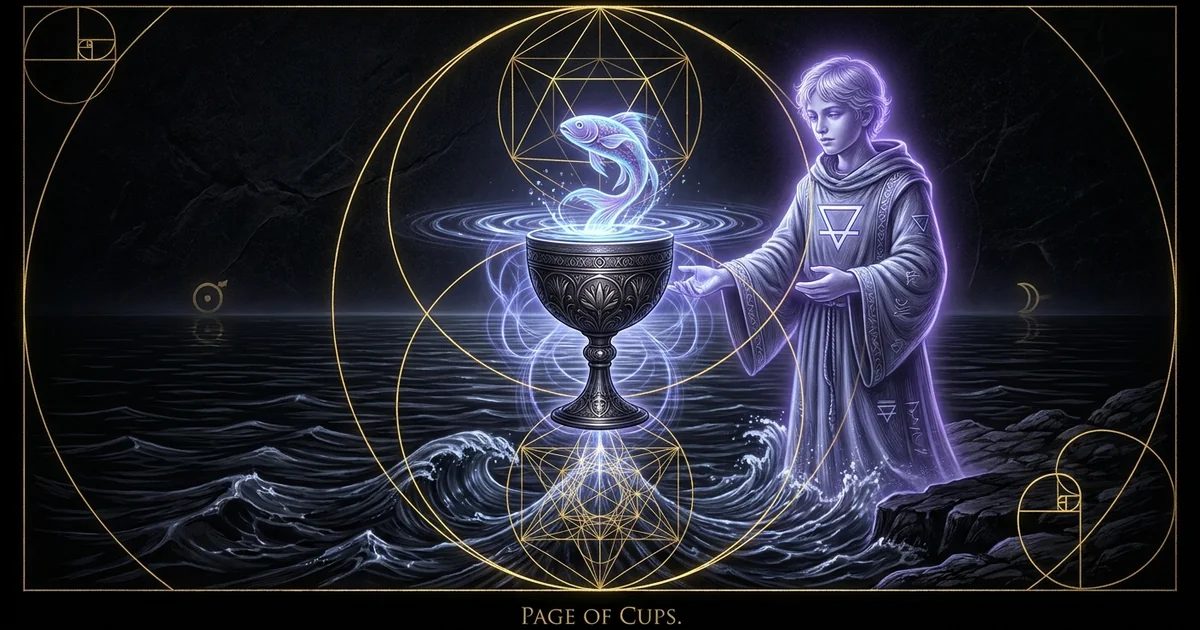
Page of Cups: Gentle Inward Voice and Emotional Wonder
Archetypal Thesis & Systemic Paradigm: The Earth of Water as Psychic Matrix
Within the hierarchical cartography of the Hermetic Order of the Golden Dawn, the Page of Cups—traditionally designated as the Princess of the Waters and the Lotus of the Palace of the Floods—occupies an indispensable psycho-cosmological coordinate. Far from representing an immature or merely ornamental emotional state, this card manifests the systemic intersection between the concrete material plane and the unconditioned psychic depths. In the classical kabbalistic schema, this figure functions as the Earth of Water, formalizing the structural descent of archetypal affect into empirical awareness. Through this specific elemental compounding, the card delineates the precise threshold where primordial feelings crystallize into articulate consciousness.
::: diagram [Tetragrammatonic Court Hierarchy: Elemental Matrix of the Cups Suit]
<div class="diagram-flow flex flex-col items-center gap-3 my-4 w-full">
  <div class="diagram-row flex flex-wrap items-center justify-center gap-3">
    <div class="diagram-node px-4 py-2 rounded-xl bg-elevated border border-gold/30 text-primary font-mono shadow-md transition-all">Atziluth / King of Cups: Fire of Water</div>
  </div>
</div>
       │
       ▼
<div class="diagram-flow flex flex-col items-center gap-3 my-4 w-full">
  <div class="diagram-row flex flex-wrap items-center justify-center gap-3">
    <div class="diagram-node px-4 py-2 rounded-xl bg-elevated border border-gold/30 text-primary font-mono shadow-md transition-all">Briah / Queen of Cups: Water of Water</div>
  </div>
</div>
       │
       ▼
<div class="diagram-flow flex flex-col items-center gap-3 my-4 w-full">
  <div class="diagram-row flex flex-wrap items-center justify-center gap-3">
    <div class="diagram-node px-4 py-2 rounded-xl bg-elevated border border-gold/30 text-primary font-mono shadow-md transition-all">Yetzirah / Knight of Cups: Air of Water</div>
  </div>
</div>
       │
       ▼
<div class="diagram-flow flex flex-col items-center gap-3 my-4 w-full">
  <div class="diagram-row flex flex-wrap items-center justify-center gap-3">
    <div class="diagram-node px-4 py-2 rounded-xl bg-elevated border border-gold/30 text-primary font-mono shadow-md transition-all">Assiah-Malkuth / Page of Cups: Earth of Water / Grounded Receptivity</div>
  </div>
</div>
:::
Elemental Sub-Distribution: The Malkuth of Briah Formula
The operational dynamic of the Page of Cups relies on the elemental sub-distribution established in Western esoteric qabalah. As detailed within the structural framework of the /tarot/court-cards-elemental-hierarchy, the Page corresponds to the Sephira Malkuth (The Kingdom) projected into the macrocosmic realm of Briah (the Creative World). While the /tarot/ace-of-cups-meaning embodies the undifferentiated, unconditioned fountainhead of the Briatic water element, the Page represents its ultimate structural grounding. In the Tetragrammatonic formula of YHVH (Yod-Heh-Vau-Heh), the Page embodies the Heh final—the receptive daughter who serves as the vessel, container, and physical anchor for the ancestral lineage of the suit.
Because Malkuth is inherently elemental Earth, the Page of Cups must be conceptualized not as fluid momentum, but as the terrestrial basin that captures, measures, and solidifies fluid momentum. It is the sedimentary bed of the river, the clay vessel that renders potable the surging torrents of the unconscious. When the water element—signifying intuition, affect, psychic fluidity, and the non-linear currents of the imagination—intersects with Earth, the systemic result is neither static inertia nor volatile dissipation. Rather, it produces a nutrient-dense silt: an ultra-receptive psychophysical medium capable of nurturing nascent psychological complexes until they cross the threshold into cognitive legibility.
The Puer Aeternus and the Epistemology of Receptive Wonder
Psychologically, this card embodies an essential, uncorrupted modality of the puer aeternus archetype. As formulated by James Hillman in his foundational treatise Senex and Puer, the puer dynamic is fundamentally concerned with the primordial dawn of vision, the pneumatic spark of renewal, and the preservation of psychic mobility against the calcifying, bureaucratic tendencies of the senex. In the Page of Cups, this eternal youthfulness is stripped of mercurial volatility and anchored instead in receptive contemplation. The epistemological stance demonstrated here is not an ignorant naivety, but an intentional suspension of rational skepticism, facilitating an attunement to what analytical psychology describes as the subtle affect-tone of the psyche.
This posture of receptive wonder challenges the hyper-rationalist paradigm of modern cognitive functioning. Whereas the senex demands verification, codification, and strategic utility, the Page operates through an open-ended, non-coercive listening. The figure does not seek to master, commodify, or redirect the emotional current; rather, it relates to the subconscious with unhurried attentiveness. The epistemological instrument of this archetype is the heart as an organ of perception—a concept articulated extensively by Heinrich Cornelius Agrippa in De Occulta Philosophia, wherein intuitive knowing arises through sympathetical resonance rather than scholastic dialectic. The Page of Cups models how the ego must bow before the unbidden promptings of its own inner waters.
The Ichthys/Fish in the Chalice: Autochthonous Symbologenesis
The defining visual anomaly of the Arthur Edward Waite and Pamela Colman Smith rendering is the emergence of a living fish from the interior curve of the golden chalice. In classical iconography, a vessel containing a living, autonomous creature signifies autochthonous symbologenesis: the spontaneous generation of archetypal forms within the contained boundaries of the human mind. The fish does not appear as dead quarry captured for nutritional consumption, nor is it a monstrosity emerging from the abyss to threaten the stability of the shore. Instead, it surfaces in an attitude of communicative reciprocity, gazing directly into the eyes of the youth.
+-------------------------------------------------------------------------+
|                  AUTOCHTHONOUS SYMBOLOGENESIS FORMULA                   |
|                                                                         |
|  [ Undifferentiated Unconscious ]                                       |
|             │                                                           |
|             ▼ (Alchemical Solutio & Incubation)                         |
|  [ Malkuth-Vessel / Stable Ego Attention ]                              |
|             │                                                           |
|             ▼ (Spontaneous Archetypal Crystallization)                  |
|  [ Ichthys Manifestation / Living Intuitive Epiphany ]                  |
|             │                                                           |
|             ▼ (Hermeneutic Mirroring & Dialogue)                        |
|  [ Grounded Consciousness: The Page's Gaze ]                            |
+-------------------------------------------------------------------------+
This interaction demonstrates the operational baseline of Carl Jung’s method of active imagination. The ego, represented by the grounded figure of the youth, holds the chalice of sustained, non-judgmental attention steady, thereby establishing a psychic sanctuary wherein the unconscious can exteriorize its contents. The fish is an ancient, living symbol of the oceanic Self—the silent, cold-blooded dweller of the unlit depths whose sudden appearance registers as an intuitive epiphany, a poetic line, or a sudden, unaccountable pang of affective clarity. The Page does not recoil in horror, nor does the figure attempt to swallow the fish; they engage in mutual, contemplative reconnaissance.
Classical Provenance & Textual Lineage: From Continental Knave to Hermetic Princess
The genealogical evolution of the Page of Cups across historic tarot morphology reveals a profound philosophical pivot. In late medieval and early modern Continental tarot patterns—exemplified by the Tarot de Marseille lineages codified by Nicolas Conver and François Chosson—the card is designated as the Valet de Coupes. In this early secular and ludic context, the Valet was depicted as a court attendant, cup-bearer, or young squire holding an open or covered chalice. The Marseille iconography emphasized terrestrial service, courtly hierarchy, and mundane domestic duty rather than transcendent psycho-spiritual initiation. The knave served as a functional emissary whose primary task was the careful transport of physical sustenance across social realms.
[ Marseille: Valet de Coupes ] ──> [ Golden Dawn: Princess of Waters ] ──> [ Waite-Smith: Page of Cups ]
  (Feudal Attendant/Domestic)       (Elemental Matrix/Heh Final)          (Theatrical/Contemplative Ego)
Devolution and Reconstruction: From Marseille Sotte to Golden Dawn Princess
The operational status of the figure was comprehensively transformed at the close of the nineteenth century through the esoteric revisions implemented by the Hermetic Order of the Golden Dawn under the guidance of S. L. MacGregor Mathers. In the Order’s inner curriculum, documented in the secret teachings of Book T, the pedestrian French Valet was stripped of its feudal connotations and elevated into the Princess of the Waters. This alteration was structural rather than aesthetic. In the Golden Dawn’s qabalistic architecture, the four court card denominations were calibrated to mirror the four letters of the Tetragrammaton: the Kings/Knights to Yod (Fire), the Queens to Heh (Water), the Princes/Knights to Vau (Air), and the Princesses/Pages to Heh final (Earth).
“The Princess of the Waters; the Lotus of the Palace of the Floods. She is the Earth of Water, the bringing into matter of the watery life. She represents sweetness, poetry, gentleness, and kindness, imaginative and dreaming much, yet slow to bring her plans to fruition. Her arms are folded on her breast, and her robes are flowing, embroidered with lotuses. In her right hand she holds a cup from which a tortoise issues, the symbol of water grounded in the shell of earth.” — S. L. MacGregor Mathers, Liber Theta: The Tarot of the Golden Dawn
By re-establishing the Page as the Earthly bride of the macrocosm and the physical receiver of the Briatic currents, Mathers repositioned the card as the foundational gateway to the entire watery suite. The Princess of the Waters was no longer an external cup-bearer serving an aristocratic sovereign; she became the living tabernacle of the suit itself, the psychophysical nexus wherein the fluid emanations of the watery triplicity (Cancer, Scorpio, and Pisces, analyzed thoroughly in the /astrology/water-triplicity-cancer-scorpio-pisces matrix) could finally achieve stable, incarnate form within the terrestrial plane of Assiah.
Pamela Colman Smith’s Theatrical Scenography and the Flowered Surcoat
When Pamela Colman Smith executed the visual redesign of the deck under the direction of Arthur Edward Waite in 1909, she synthesized her extensive experience in the Lyceum Theatre with the occult directives of the Golden Dawn. Rather than executing an austere, geometric diagram of Kabbalistic forces, Smith humanized the Princess, transforming the figure into the androgynous Page of Cups familiar to modern practitioners. Smith clothed the youth in a striking, deep blue tunic covered by a floral surcoat patterned with stylized, crimson-rose water lilies and lotus motifs. The garment’s undulating hems and dramatic folds simulate the fluid motion of water, visually reinforcing the concept that the figure’s outer persona is woven directly from the fabric of affective life.
+-------------------------------------------------------------------------+
|                  PAMELA COLMAN SMITH'S SCENOGRAPHIC AXIS                |
|                                                                         |
|        [ Unstable Tidal Edge ]       <--- Primordial Dynamic Affect     |
|                   │                                                     |
|                   ▼                                                     |
|        [ Sandy Terrestrial Shelf ]   <--- Conscious Structural Ego      |
|                   │                                                     |
|                   ▼                                                     |
|        [ Flowered Rose Surcoat ]     <--- Alchemical Sublimation        |
|                   │                                                     |
|                   ▼                                                     |
|        [ The Golden Chalice ]        <--- The Receptive Psychophysical  |
|                   │                       Apparatus                     |
|                   ▼                                                     |
|        [ Communicative Ichthys ]     <--- Emergence of Unconscious      |
|                                           Signal                        |
+-------------------------------------------------------------------------+
Theatrical scenography is evident in the dynamic tension established between the youth’s posture and the surrounding environment. The Page stands directly upon the shifting sands of an ocean shore, an unstable liminal zone characterized by rhythmic, curled tidal crests that swell in the immediate background. These waves are not rendered with naturalistic realism, but rather as stylized theatrical flats—crests of pure emotional momentum suspended in mid-surge. By positioning the Page’s weight squarely on the sand while their gaze remains fixated on the chalice, Smith depicts the precise psychological equilibrium required to prevent the fragile human consciousness from being overwhelmed by the macrocosmic sea behind it.
Crowley’s Princess of the Waters: Libidinal Purity and the Swan of Ecstasy
In The Book of Thoth, Aleister Crowley, working alongside Lady Frieda Harris, departed from Smith’s contemplative theatricality to reclaim the Golden Dawn’s raw, elemental Princess. Crowley portrayed the Princess of the Cups as an ecstatic, dancing maenad emerging from a foaming spray of oceanic energy. Her robes are translucent, crystalline, and billowy, conveying an exquisite, untouched purity. In her left hand, she holds a chalice from which a sea turtle issues, while behind her head hovers an imperial white swan—the avian signifier of Aphanisis, spiritual transfiguration, and the highest ecstasy of the water element.
Crowley’s textual analysis emphasizes that this figure represents the ultimate receptive node of the psyche, yet warns that her purity is intrinsically volatile. Because she represents the Earth of Water, she is capable of housing both the sublime intuitive whisper of the goddess and the destructive, narcissistic delusions of an ego intoxicated by its own unanchored imagery. Crowley noted that when this energy is detached from the stabilizing will of the King and the discerning intellect of the Knight, the Princess slides into unbridled affective decadence. Her virtue resides in her absolute, translucent receptivity; her vice is the helpless vulnerability to every passing affective wave that traverses the psychic atmosphere.
Structural Mechanics & Symbolic Geometry: Decoding the Iconographical Field
The iconographical architecture of the Page of Cups operates through geometric and chromatic configurations that govern its divinatory meaning. Every visual marker—from the angle of the shoreline to the exact placement of the chalice relative to the human cardiovascular center—is a deliberate psycho-spiritual coordinate.
::: note [Hermetic Coordinates of the Page of Cups]
• Sephira: Malkuth (The Kingdom, the Physical Body, Concrete Form)
• Macrocosmic World: Briah (The World of Pure Creation, Intuition, and Waters)
• Tetragrammaton Station: Heh final (The Receptive Daughter, the Preserving Vessel)
• Elemental Compounding: Earth of Water (The Physical Grounding of Intuitive Currents)
• Directional Alignment: North-East sector of the heavens
• Spatial Authority: Pages lack 30-degree zodiacal decan rulership; they hold sovereign custody over polar and quadrant domains, specifically the terrestrial manifesting-ground of the Water Triplicity (Assiah of Briah).
:::
The Ocean-Shore Threshold: Geometrical Boundary of Conscious and Unconscious
The topography of the card is fundamentally defined by the littoral boundary: the precise line of demarcation where the terrestrial shelf meets the ocean waters. In spatial semiotics, the ocean represents the primordial, unconditioned matrix of the collective unconscious—vast, undifferentiated, and lethal to the conscious individual who enters without a vessel. Conversely, the dry land embodies the waking ego, grounded in the realities of temporal existence, material constraint, and linear logic.
The Page does not swim in the deep water, nor do they retreat inland to avoid the salt spray. Instead, the figure’s soft leather boots rest directly upon the intertidal sand—a landscape that is periodically submerged, purified, and re-exposed by the tides. This shore constitutes the liminal space of psychological transitions. The Page stands within earshot of the breaking waves, utilizing the stability of the land to sustain a reflective stance. The conscious mind, anchored in somatic reality, permits the turbulent currents of the unconscious to approach close enough that its communicative emissaries (the fish) can be perceived without dragging the observer down into a state of psychological drowning.
The Chromatic Spectrum: Violet-Blue, Rose-Pink, and Watery Iridescence
The chromatic balance utilized in the Waite-Smith composition manifests an intentional esoteric harmony between lunar receptivity and nascent solar vitality. The Page’s undergarment is dyed a muted, watery blue, bordering on violet. In the Hermetic color scales of the Golden Dawn, this hue reflects the highest vibration of Yesod (the Moon and the unconscious dream-matrix) descending into Malkuth. Blue is the color of interiority, calm contemplation, and the cool passivity required to reflect images upon the mirror of the mind without introducing cognitive distortion.
LUNAR BLUE UNDERGARMENT             ROSE-PINK LOTUS SURCOAT
(Yesodic Passivity, Quiet Waters)   (Nascent Solar Fire, Living Feeling)
              │                                      │
              └───────────────┬──────────────────────┘
                              │
                              ▼
           [ THE ALCHEMICAL CONJUNCTIO OF EARLY EGO ]
         (Spiritualized Receptivity Anchored in Matter)
In sharp contrast to this cool substrate, the surcoat is adorned with stylized rose-pink blossoms and botanical tendrils. Rose is the tint of refined, spiritualized desire—the alchemical red tincture softened by the white light of innocence. This pink-red embroidery injects a current of living warmth into what would otherwise be a cold, melancholic card. It indicates that the Page’s interiority is not an escapist void, but a fertile greenhouse of the creative spirit. The iridescent sheen extending across the horizon and reflected upon the rim of the cup underscores this conjunction: the wedding of terrestrial earth and celestial water, producing a soft, luminous veil through which subtle truths are discerned.
Decanate and Spatial Sovereignty: The Page’s Planetary and Compass Attributions
Within the astrological methodology of the Hermetic Order of the Golden Dawn, Court Cards are categorized into two structural paradigms: the decanate rulers and the quadrant rulers. While Kings, Queens, and Knights rule over specific thirty-degree sectors of the zodiac, governing sequences of three decans each, the Pages are structurally distinct. Lacking decanate assignments, the Pages govern the entire quadrant surrounding the poles of the celestial sphere. The Page of Cups is assigned spatial custody over the North-Eastern sector of the elemental realm of Water.
This structural assignment endows the card with an encompassing, atmospheric quality. The Page does not represent a specific, transient astrological transit—such as Mars in Scorpio or Venus in Pisces—but instead embodies the pervasive, embryonic condition of the entire water triplicity. The North-East quadrant is traditionally associated with the transition from the absolute darkness of midnight (North) to the initial cracking of dawn (East). It is the twilight of earliest manifestation, the exact zone where invisible, occult potencies begin their pilgrimage toward physical dawn. Consequently, the Page of Cups operates as an elemental scout, registering tectonic shifts in the collective unconscious long before they materialize within ordinary daily reality.
Psychological Dynamics & Operational Praxis: The Receptive Ego in Consultation
When the Page of Cups surfaces in divinatory consultations, it signals a systemic psychological mandate: theQuerent must deliberately lower their cognitive defenses and dismantle intellectual rigidity. The card warns against the modern impulse to immediately categorize, optimize, or weaponize emergent emotions. In practical psycho-spiritual terms, this archetype demands that the individual cultivate a state of unhurried curiosity toward the eccentric, unbidden, and fragile stirrings of their inner landscape.
:::: comparison [Operational Diagnostics: Upright vs. Reversed Page of Cups]
::: column [Upright: Grounded Receptivity]
• Phenomenological State: Non-coercive, contemplative listening; acute awareness of somatic affect-tones.
• Epistemological Mode: Treating nascent dreams, creative flashes, and synchronistic occurrences as empirical data.
• Ego-Archetype Axis: The ego serves as a stable chalice; consciousness engages in open dialogue with the unconscious without fear.
• Behavioral Signature: Poetic sensitivity, artistic sincerity, emotional vulnerability without boundary collapse, genuine innocence.
:::
::: column [Reversed: Borderline Affective Flooding]
• Phenomenological State: Passive-aggressive fragility, aestheticized escapism, emotional narcissism, and infantile petulance.
• Epistemological Mode: Projective identification; mistaking personal neurotic anxieties for prophetic intuitions.
• Ego-Archetype Axis: The ego-vessel fractures or spills; unconscious waters swamp the terrestrial shore of the ego.
• Behavioral Signature: Somatization of repressed affect, inability to sustain relational boundaries, hypersensitive defensive withdrawal.
:::
::::
Carl Jung’s Affect-Intuition Nexus: Registering the Subtle Inner Voice
In his analytical model of psychological typology, Carl Gustav Jung differentiated the rational functions (Thinking and Feeling) from the irrational, perceptive functions (Sensation and Intuition). The Page of Cups represents a rare, delicate operational nexus between Introverted Feeling and Introverted Intuition. In The Archetypes and the Collective Unconscious, Jung elucidated how nascent contents of the collective unconscious rarely break into consciousness as fully articulated, logical syllogisms. Instead, they announce their presence via micro-affects: subtle shifts in somatic tension, fleeting poetic associations, or sudden synchronicities that rational analysis routinely dismisses as meaningless background noise.
The Page of Cups is the operational agent capable of isolating these faint psychic frequencies. The youth looking at the fish personifies the ego-complex when it ceases to monologue and begins to listen. The voice of this card is quiet; it does not shout commands like the Emperor, nor does it gallop toward ideological conquest like the /tarot/knight-of-cups-meaning. It speaks through what early Quaker mystics termed the “still small voice within”—a subtle interior resonance that requires an interior silence to be decoded. If the querent remains trapped in cognitive frenzy or intellectual rationalization, the signal cannot be received, and the fish slips back unrecorded into the oceanic depths.
The Shadow Polarities: Emotional Narcissism, Fragility, and Infantilism
When the structural integrity of the Page of Cups is compromised through inversion or severe psychological imbalance, its luminous innocence curdles into profound developmental pathologies. The shadow of this card is rooted in the structural failure of its Earth component: the ego-vessel becomes too thin, cracked, or porous to contain the emotional waters. The result is not creative contemplation, but psychological flooding. In this state, the querent becomes an emotional hemophiliac, incapacitated by the slightest relational friction, perceiving ordinary boundary-setting as intolerable cruelty, and retreating into an infantilized cocoon of wounded exceptionalism.
[ UNINTEGRATED PUER AETERNUS ]
                     │
     ┌───────────────┴───────────────┐
     ▼                               ▼
[ Passive Escapism ]    [ Borderline Flooding ]
  • Fantasy addiction     • Affective volatility
  • Creative paralysis    • Projective neurosis
  • Hermetic isolation    • Boundary collapse
In the reversed orientation, the communicative fish within the cup is no longer an autonomous symbol of wisdom; it becomes a projection of the querent’s own self-indulgent neuroses. The individual mistakes volatile moods, paranoias, and transient sentimental impulses for profound spiritual insights. They may weaponize their self-diagnosed “empathy” to manipulate others, demanding total atmospheric adaptation from their environment while refusing to assume adult ethical responsibility. This is the ungrounded puer at its most toxic: a creature locked in perpetual emotional adolescence, substituting the hard work of creative production with the endless, masturbatory adoration of its own unmanifested potential.
Operational Praxis: Dream Incubation and Symbolic Active Imagination
In clinical and esoteric applications, the Page of Cups provides an operational blueprint for dream incubation and creative active imagination. To enact the energy of this card, the querent must reconstruct the physical and mental posture of the youth:
- Establish the Terrestrial Vessel: Allocate a dedicated, physical space and temporal interval shielded entirely from technological distraction, logistical anxieties, and analytical debate. This serves as the terrestrial shoreline.
- Evoke the Briatic Water: Enter a state of light trance or meditative reverie through rhythmic, somatic breathing, acknowledging the presence of emotional turbulence without attempting to calm the waves or escape the shore.
- Hold the Attention Steady: Formulate a direct, gentle question or hold an obscure dream-image within the mind’s eye, lifting it up within the chalice of intentional attention.
- Await the Autochthonous Symbol: Do not manufacture responses through cognitive problem-solving. Wait patiently for the unconscious to present an autochthonous image—a symbolic “fish” that surfaces unexpectedly from the void.
- Engage in Mutual Recognition: Acknowledge the emergent image on its own terms. Transcribe, paint, or dialogue with the symbol before applying rational or critical interpretation.
Philosophical Synthesis & Macrocosmic Correspondence: Solutio and Alchemical Maturation
Viewed through the lens of esoteric philosophy, the Page of Cups marks an early phase of the magnum opus: the alchemical solutio. In the classical hermetic tradition, spiritual maturation cannot proceed while the psychic materials remain hardened in their habitual, unexamined structures. The ego, hardened by social indoctrination, defensive armoring, and intellectual pride, must undergo a systematic liquefaction. The Page represents the moment this liquefaction begins—not as a violent, apocalyptic cataclysm, but as a gentle, pervasive thawing of the heart’s calcified defenses.
+-------------------------------------------------------------------------+
|                  THE ALCHEMICAL SOLUTIO FEEDBACK CYCLE                  |
|                                                                         |
|  [ Calcified Intellectual Ego ]                                          |
|                │                                                        |
|                ▼ (Introduction of Gentle Inward Affect)                 |
|  [ Solutio / Dissolution of Rigid Dogma ]                               |
|                │                                                        |
|                ▼ (Incubation of Psychic Material)                       |
|  [ Emergence of the Ichthys / Unconscious Wisdom ]                      |
|                │                                                        |
|                ▼ (Integration into Assiah / Physical Reality)           |
|  [ The Coagula / Re-formed, Compassionate Ego-State ]                   |
+-------------------------------------------------------------------------+
The Alchemical Solutio: Liquefying the Rigid Ego-Structures
The Latin alchemical maxim Solve et Coagula (dissolve and coagulate) establishes dissolution as the mandatory precondition for spiritual transfiguration. The Page of Cups is the presiding genius of the initial solutio. The presence of water throughout the background of the card indicates that the querent’s rigid certainties are being gently undermined by the rising tides of affect. In psychological alchemy, the ego often experiences the initial stages of solutio as a frightening loss of control: linear thinking falters, emotional sensitivity spikes, and tears arise without apparent external provocation.
Yet this liquefaction is entirely redemptive. Without the softening influence of the Page, the psychological apparatus becomes brittle, vulnerable to catastrophic psychic shattering under external pressure. By permitting the tears of the soul to soften the parched earth of the ego-personality, the Page enables the psychological material to become malleable once more. The youth does not fear the dissolution of their intellectual superiority; they lean into it, recognizing that it is precisely through this tender, vulnerable un-knowing that higher spiritual knowledge can take root.
The Ichthys Archetype: From Early Christian Esotericism to Analytical Psychology
The historical-archetypal resonance of the fish (Greek: Ichthys) running through this card links the Page of Cups directly to the deep currents of Western religious esotericism. In the dawn of the Christian aeon, the fish served as the secret, subversive sigil of the transcendent mystery incarnate within the historical matrix. In his definitive work Aion: Researches into the Phenomenology of the Self, Carl Jung traced the comprehensive symbolic evolution of the fish, demonstrating that it represents the living, autonomous presence of the divine hidden within the waters of the unconscious.
“The fish is an archetypal symbol of the unconscious contents that suddenly rise up from the depths into the illuminated realm of the ego… It is a living being that lives in an element unsuited to man, an inhabitant of the nocturnal, unplumbed waters of the collective unconscious. When it rises to the surface and presents itself to the conscious mind, it brings with it the healing yet dangerous wisdom of the primordial abyss.” — Carl Gustav Jung, Aion: Researches into the Phenomenology of the Self (CW 9, Part 2, ¶128–130)
Within the Page of Cups, this immense archetypal force is domesticated without being rendered toothless. The cosmic fish of the aeon is contained within the personal chalice of the youth. This reveals a sublime esoteric paradox: while the ocean of the collective unconscious is terrifyingly infinite, its wisdom can nevertheless communicate with individual human consciousness through intimate, personal epiphanies. The transcendent God-image does not require an imperial temple or a dogmatic apparatus to reveal itself; it requires only the quiet, unobstructed attention of an open heart.
Cybernetic Signal Detection: Discerning Intuitive Noise from Archetypal Signal
Viewed through modern cybernetic systems theory, the Page of Cups can be accurately modeled as an operational system for low-threshold signal detection. Any self-regulating informational network must manage the fundamental ratio between signal and noise. In human cognitive systems, the conscious ego typically sets a high filtering threshold to prevent sensory and affective overload. While this sensory gating is necessary for survival and task-oriented execution, it inadvertently filters out micro-signals from the autonomic nervous system, somatic intuition, and unconscious processing.
LOW THRESHOLD (Page of Cups Mode):
[ Ambient Psychic Noise ] ──> [ Micro-Signal Detection ] ──> [ Intuitive Epiphany ]
                              (Chalice Filter:
                               Suspension of Skepticism)

HIGH THRESHOLD (Senex Mode):
[ Ambient Psychic Noise ] ──> [ Cognitive Gating ]       ──> [ Signal Suppressed ]
                              (Intellectual Wall:
                               Hyper-Rationalism)
The Page of Cups represents an intentional, temporary recalibration of this cognitive gate. By lowering the sensory and emotional detection threshold, the Page becomes sensitive to low-amplitude psychic data before it crosses into macroscopic emotional disturbance. It detects the subtle ripple on the water before the tsunami strikes; it hears the faint harmonic dissonance within an interpersonal dynamic long before it erupts into explicit conflict. The golden cup serves as an acoustic resonator, amplifying these weak, high-value signals so that the conscious mind can process and integrate them without falling into cognitive panic.
Frequently Asked Questions: Advanced Symbolic and Interpretive Enquiries
Distinguishing the Page of Cups from the Knight of Cups in Real-World Interpretation
A common interpretive confusion arises when differentiating the Page of Cups from the Knight of Cups, as both figures share a tender, imaginative, and emotionally sensitive aesthetic. The distinction, however, is structural and operational, rooted directly within their elemental compounding:
+-------------------------------------------------------------------------+
|                  PAGE OF CUPS vs. KNIGHT OF CUPS                        |
|                                                                         |
|  Feature:         Page of Cups             Knight of Cups               |
|  Element:         Earth of Water           Air of Water                 |
|  Operational:     Nascent Receptivity      Active Questing              |
|  Direction:       Interior / Inward        Exterior / Outward           |
|  Ego Stance:      Contemplative Basin      Chivalric Emissary           |
|  Tetragrammaton:  Heh Final (Daughter)     Vau (Son)                    |
+-------------------------------------------------------------------------+
The Page of Cups is Earth of Water, representing passive, stationary containment. The Page stands firmly upon the shore, waiting for the inner mystery to manifest within the stillness of the chalice. They do not travel; they incubate. Conversely, the Knight of Cups is Air of Water, representing the movement, projection, and communicative dispersion of the emotional life. The Knight rides an armored steed, traversing geography to deliver the chalice, to woo a beloved, to champion an artistic crusade, or to pursue an externalized romantic ideal. While the Page listens quietly to the fish, the Knight charges forward to offer the grail to the external world.
Interpreting the Page of Cups for Mature Querents: State-Space vs. Chronological Age
One of the most persistent errors in modern tarot reading is the literal, reductionist assumption that Court Cards must correspond to the biological age or physical gender of the querent. In sophisticated psycho-cosmological cartography, court cards represent dimensional states of consciousness, operational modes, and functional ego-orientations within the psyche. When the Page of Cups appears in a consultation for a mature, elderly, or strategically powerful individual, it does not point toward a child in their external environment, nor does it denote biological regression.
Instead, the card identifies the urgent requirement for an internal puer reclamation. As James Hillman emphasized in Senex and Puer, when an aging or highly structured individual becomes wholly divorced from their puer pole, their life calcifies into cynicism, bureaucratic bitterness, and spiritual stagnation. For such a querent, the Page of Cups demands that they shed their executive armor, temporarily abandon their institutional authority, and approach their life with the fresh, unarmored wonder of a beginner’s mind (shoshin in Zen philosophy). It invites the mature ego to admit that it does not possess all the answers, urging it to consult the silent, emotional truths of the heart that it has spent decades ignoring in the pursuit of material accomplishment.
Addressing the Card’s Appearance in High-Cognitive or Analytical Spreads
When the Page of Cups lands in consultations explicitly centered upon corporate strategy, algorithmic problem-solving, legal disputes, or rigorous academic research, it often causes immediate cognitive dissonance. The consultant may be inclined to view the card as an unwanted intrusion of irrational sentimentality or an irrelevant distraction from hard metrics and strategic imperatives.
This reading misjudges the epistemological utility of the archetype. In high-cognitive spreads, the Page of Cups acts as an indispensable, non-linear corrective to algorithmic tunnel vision. Hyper-rational systems inevitably suffer from systemic blindness caused by their own rigid assumptions. The Page appears in these environments to signal that the logical framework has reached its interpretive limit, and that the missing variable cannot be calculated through existing metrics. It advises the querent to pay close attention to anomalous hunches, non-linear artistic lateralities, and aesthetic impressions that defy analytical codification. In the high-stakes theater of strategy, the Page of Cups is the quiet intuition that correctly warns the executive that an apparently flawless intellectual plan “feels” misaligned—a micro-signal from the collective field that, if honored, prevents macroscopic structural catastrophe.