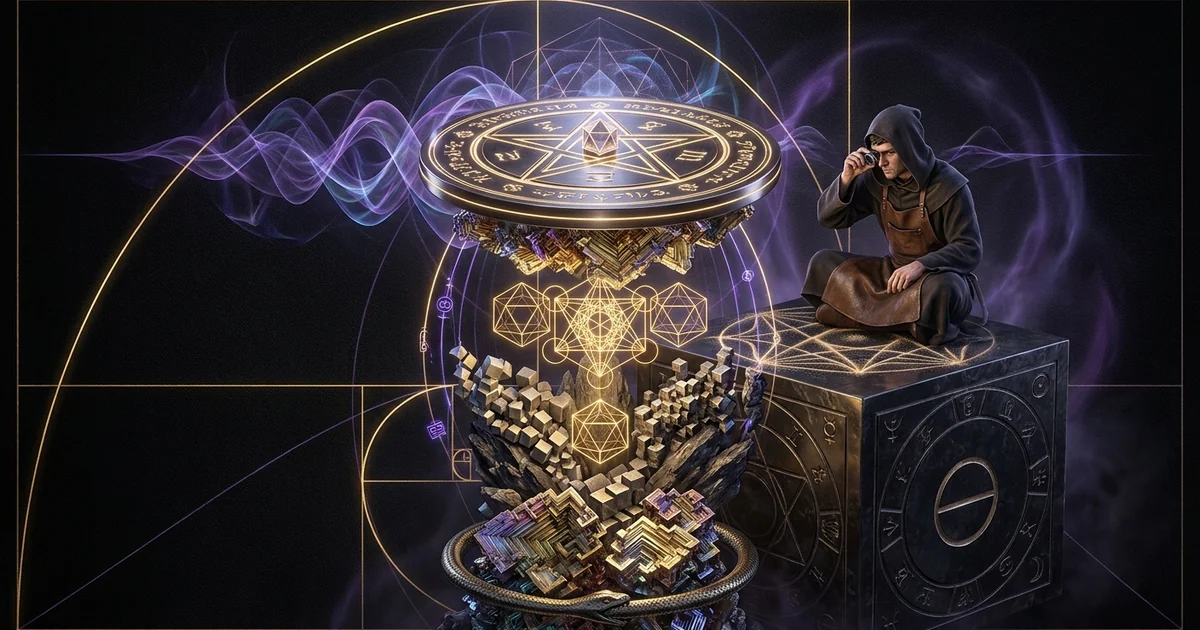
Page of Pentacles: Diligent Study and Grounded Ambition
Archetypal Thesis & Systemic Paradigm: The Somatic Crystallization of Mind
The Page of Pentacles embodies the lowest metaphysical involution point within the Western esoteric tradition: the terminal threshold where unformed spiritual intent must calibrate against thermodynamic constraints, material resistance, and temporal lag. Far from serving as an incidental marker of elementary scholasticism or mundane juvenile enterprise, the card functions as an indispensable cosmological coordinate. Within the architecture of Hermetic Qabalah, this court card operates as the Earth of Earth—the Heh-final ($ה$) of the formula of the Tetragrammaton expressed through the densest sub-elemental matrix of Assiah. Here, the energetic currents that cascade downward from the archetypal world of Atziluth through the fluid geometries of Briah and Yetzirah achieve complete physical precipitation. The card marks the moment consciousness encounters friction and realizes that without physical embodiment, will remains impotent abstraction.
TETRAGRAMMATONIC INVOLUTION
Atziluth  (Fire / Yod)       --> Primal Volition
Briah     (Water / Heh)      --> Creative Conception
Yetzirah  (Air / Vau)        --> Formative Articulation
Assiah    (Earth / Heh-final)--> Somatic Crystallization [Page of Pentacles]
The Earth of Earth: Malkuth in the World of Assiah
To decipher the primary mechanics of the pentacles suit, one must analyze its structural foundation in Malkuth, the tenth Sephirah of the Tree of Life. Malkuth does not generate radiant emanations of its own; rather, it receives, absorbs, stabilizes, and consolidates the emanations of the superior nine Sephiroth. When the earthy principle is folded recursively upon itself—yielding the Earth of Earth—the resulting metaphysical state is characterized by absolute kinetic deceleration. In this state, spiritual momentum crystallizes into dense form.
This terminal grounding is neither passive inertness nor cosmic deadweight. Within the world of Assiah (the material plane of action and chemical composition), the Earth of Earth represents the irreducible mineral base, the somatic tissue, and the objective reality of physical laws. The Page of Pentacles establishes the metaphysical baseline that every spiritual impulse, visionary inspiration, or intellectual formula must eventually confront. To build an enduring temple, the architect must first humble their consciousness before the physical properties of stone, soil, and gravitational force. The Page of Pentacles governs this precise phase of somatic calibration, anchoring ethereal desire within empirical constraints.
- Sub-Elemental Formula: Earth of Earth ($ה$ of $ה$).
- Qabalistic Locus: Malkuth of Assiah (The physical Kingdom within the World of Material Action).
- Elemental Attribution: Earth / Fixed, fertile, mineralized substrate.
- Hermetic Title: The Princess of the Echoing Hills; the Rose of the Palace of Earth.
- Attentional Mode: Focused introversion; somatic inscription; sensory calibration against physical inertia.
The Archetype of the Apprentice: Telos and Material Resistance
At an operational level, the Page of Pentacles models the psychology of the apprentice. In the traditional guild systems of medieval and early modern Europe, an apprentice was not merely an underling performing menial labor, but an ego intentionally undergoing the discipline of material resistance. The apprentice surrenders grand conceptual fantasies to learn how wood yields to the chisel, how metal tempers within the forge, or how pigments bind to the canvas.
This developmental stage demands complete submission to objective parameters that cannot be bypassed through sheer charisma or intellectual rhetoric. The telos (the inherent purpose or ultimate end) of the Page is the perfection of technique through structured repetition. This dynamic serves as an existential counterweight to the volatile inflation of the puer aeternus—the eternal youth who dreams of flight but refuses the terrestrial anchor of dedicated practice. By embracing the friction of the material plane, the Page transforms what appears to be tedious limitation into the very vessel through which mastery is achieved.
Cybernetic Feedback: The Pentacle as a Bio-Informational Disk
The iconic disk or coin held aloft by the Page of Pentacles is rarely understood in its full cybernetic dimension. In classical fortune-telling, this token is frequently degraded to signify cold currency, unexpected financial gain, or commercial exchange. Within esoteric cartography, however, the pentacle functions as an informational mandala—a discrete bio-feedback mechanism. The pentagram inscribed upon the metallic surface delineates the five elements (Fire, Water, Air, Earth, and Quintessence/Spirit) balanced harmoniously within an unbroken geometric boundary.
When the Page gazes into this disk, a closed sensory loop is formed. The observer acts upon the material, the material offers mechanical resistance, and the observer adjusts their neuromuscular output accordingly. The disk represents the externalized object of study: a living ledger of cause, effect, error, and refinement. Through this cybernetic exchange, the student’s inner cognitive models are continuously corrected against outer physical consequences. Diligent study is thus revealed not as passive absorption of dry dogma, but as active empirical observation coupled with grounded ambition.
Classical Provenance & Textual Lineage: From Court Page to Esoteric Princess
The historical evolution of the Page of Pentacles reveals a persistent hermeneutic tension between mundane social status and deep metaphysical function. In fifteenth-century Italian tarocchi decks (such as the Visconti-Sforza), the Fante di Denari was depicted as a young male servant, foot soldier, or court messenger whose function was fundamentally domestic and utilitarian. These early depictions reflected contemporary social hierarchies, situating the Page as an errand-bearer executing the administrative will of the nobility. When the Tarot crossed into the French occult revival through Antoine Court de Gébelin and Éliphas Lévi, the court figures underwent an allegorical transformation. They were elevated from class-bound societal portraits into structural components of an integrated cosmology.
“The Princesses are the Upright Columns of the Universe, and their seats are below the Thrones of the Queens, upon the crystalline sea that is the base of the Four Worlds… The Princess of the Echoing Hills, the Rose of the Palace of Earth, represents the earthy part of Earth. She is the priestess of the chthonic mysteries, bringing the fire of heaven down into the deep subterranean caverns where the gold of the philosophers is slowly ripened.” — S. L. MacGregor Mathers, The Golden Dawn: Book T (Curriculum Papers, circa 1889)
The Golden Dawn Attribution: The Princess of the Echoing Hills
The definitive revolution in court card mechanics occurred within the Hermetic Order of the Golden Dawn during the late nineteenth century. S. L. MacGregor Mathers eliminated the patriarchal, chivalric hierarchy of the court cards (King, Queen, Knight, Page), restructuring them into a precise Tetragrammatonic schema: Knight (Fire/Chokmah), Queen (Water/Binah), Prince/King (Air/Tiphareth), and Princess (Earth/Malkuth). Under this formulation, detailed in Mathers’ 1888 treatise The Tarot: Its Occult Signification, the Page of Pentacles became the “Princess of the Echoing Hills; the Rose of the Palace of Earth.”
This retitling stripped the card of its superficial connotations of servitude, establishing it instead as an earthy matrix. The Princess is the divine daughter who receives the seeds of the Father (Chokmah) through the mediation of the Mother (Binah) and Son (Tiphareth). She represents the terminal point of the lightning flash, yet she holds the latent potential to awaken and regenerate the entire cosmic tree. The Golden Dawn recognized that the lowest station of the court is cosmologically continuous with the highest; Malkuth is Kether in its most crystallized, resting state.
Waite-Smith Iconography: Pamela Colman Smith’s Verdant Horizon
When Arthur Edward Waite and Pamela Colman Smith published the Rider-Waite-Smith (RWS) deck in 1910 through the publisher William Rider & Son, they synthesized Golden Dawn esotericism with accessible pictorial narratives. Waite’s textual commentary in The Pictorial Key to the Tarot downplayed the complex Qabalistic designations to cater to public audiences, yet Colman Smith’s visual staging maintained profound esoteric integrity.
+-----------------------------------------------+
|         SMITH'S ICONOGRAPHIC STAGING          |
|                                               |
|      [ Solitary Student / Green Tunic ]       |
|                       |                       |
|        Gaze Vector: Suspended Pentacle        |
|                       |                       |
|    Furrowed Loam  <---*--->  Distant Copse    |
|   (Direct Labor)             (Latent Yield)   |
|                       |                       |
|           Distant Mountain Ramparts           |
|            (Transcendental Barrier)           |
+-----------------------------------------------+
Smith rendered the figure not as an indoor scribe or an aristocratic courier, but as a solitary student standing in an open, pastoral field. The youth’s feet rest squarely upon dark, tilled soil—the rich, friable loam of practical engagement. In the middle ground, orderly agricultural furrows stretch toward a grove of flowering trees, signifying that human labor has deliberately shaped the raw wildness of nature into productive order. On the distant horizon rises a line of mountains, tinted in soft violet-blue, signaling the enduring presence of transcendent elemental forces that anchor and enclose this agrarian sanctuary. Every iconographic element emphasizes that true understanding is rooted in rhythmic, seasonal, and non-linear cultivation.
Crowley’s Chthonic Reconstruction: The Bearer of the Secret Fire
In his seminal 1944 text The Book of Thoth, Aleister Crowley, collaborating with the artist Lady Frieda Harris, took the Golden Dawn’s Princess attribution to its radical esoteric conclusion. Crowley recast the figure as the “Princess of the Disks,” depicting an Amazonian, chthonic priestess standing beside an altar of carved stone. He described her as the living crest of generative nature, pregnant with the secret fire of Kether:
“She is the Earth in its ultimate form, yet within her heart slumbers the secret Sun… She brings about the regeneration of the fallen universe through the ecstasy of complete somatic embodiment.” (Crowley, The Book of Thoth, 1944)
Crowley’s reformulation highlights the hidden alchemical truth of the card: dense, physical matter is not a prison for the spirit, but its ultimate sanctuary. The Page/Princess of Disks does not look away from physical reality to seek transcendental illumination; instead, she concentrates her gaze entirely upon the dense disk of matter. She does this knowing that by penetrating the mechanics of the atom and the laws of the physical world, the secret luminescence of the divine will is directly uncovered.
Structural Mechanics & Symbolic Geometry: The Anatomy of Focus
The structural geometry of the Page of Pentacles reveals an architecture of sustained attention, physical equilibrium, and kinetic restraint. When the human visual apparatus engages this image, the composition immediately arrests the dynamic, sweeping diagonals typically found across the tarot’s active court figures (such as the lunging Knight of Swords or the rearing Knight of Wands). In their place, the card substitutes a stable, stabilizing verticality.
GEOMETRIC EQUILIBRIUM OF ATTENTION
            [ Pentacle / Coin ]  <-- Optical Center of Gravity
                   / \
                  /   \
                 /     \
Left Hand (Support)   Right Hand (Elevation)
                 \     /
                  \   /
               [ Upper Torso ]
                     |
               [ Base of Spine ]
                    / \
                   /   \
                  /     \
         Left Foot       Right Foot
  (Rooted in Loam)       (Slight Forward Pivot)</code></pre>
Spatial Semiotics: Gaze Vector and Upright Posture
The Page’s physical posture reflects an isometric suspension of motion. The feet are planted upon the soil: the left foot is planted flat to ensure foundational balance, while the right foot is pivoted slightly outward, ready to take a slow, deliberate step forward. This is not the posture of static catatonia, but of disciplined kinetic containment. The body is aligned along a central plumb line, rising like a biological column from the earth.
Crucially, the optical axis of the Page is fixed upon the pentacle, which hovers lightly between the palms of the hands without being tightly gripped. The fingers do not grasp or clutch the disk in a posture of avarice; they gently balance it, cradling its weight with sensitive tactile feedback. This light touch indicates that empirical mastery requires sensitivity rather than brute force. The gaze vector does not wander toward the distant horizon, nor does it look down in depressive fatigue; it remains entirely locked onto the object of study. This illustrates what modern cognitive neuroscience designates as selective attentional focus—the inhibition of extraneous peripheral stimuli in service of sustained cognitive processing.
Chromatics of the Soil: Ochre, Verdant Green, and Russet Red
The chromatic spectrum utilized in the Rider-Waite-Smith depiction is rooted in alchemical and vegetative symbology. The Page wears a flowing green tunic, edged with a pale trim, worn over a russet-brown undergarment.
- Verdant Green: Green is the color of Venus, vegetative generation, and the seasonal quickening of chlorophyll. In the realm of the mind, green denotes cognitive freshness—the beginner’s mind (shoshin in Zen epistemology), which approaches the material without the cynical preconceptions of the jaded master.
- Russet Red / Ochre: The russet and ochre tones of the Page’s hat, scarf, and lower garments anchor this youthful vitality within the chthonic base of the iron-rich soil. The heavy red headdress falls over the shoulders like a protective mantle, symbolically sheltering the neck and spine (the nervous system) from cognitive distraction.
- Golden Yellow Sky: The luminous, pale-yellow sky that bathes the background indicates the pervasive presence of solar consciousness (Tiphareth). The work of the Page is not conducted in the nocturnal darkness of the unconscious, but under the clear light of waking, critical discernment.
The Quadrate Realm: Fixed Earth and the Microcosmic Center
Geometrically, the Page of Pentacles mediates between the circle and the square. The pentacle itself is a circular disk containing a five-pointed star, but the environment it inhabits is fundamentally quadrate. The four quarters of the earth, the four seasons, and the four letters of the Tetragrammaton underpin the stability of the scene.
The pentagram inscribed within the disk operates as a diagram of the microcosm: it is man the measure of all things, the five senses through which objective reality is mediated. By lifting this five-fold symbol into the field of vision, the Page asserts that human sensory faculties, when systematically trained, are entirely capable of comprehending the geometric order of the physical cosmos. The Page stands at the center of this quadrate space, serving as an axis around which raw matter is observed, categorized, and methodically transformed into cultural and spiritual wealth.
Psychological Dynamics & Operational Praxis: The Cure for Puer Inflation
When observed through the lens of analytical psychology, the Page of Pentacles emerges as a potent clinical corrective to one of the most pervasive neuroses of both modern and ancient times: the psychological inflation of the puer aeternus. The archetype of the divine child, while carrying the visionary spark of genius and the promise of renewal, inevitably becomes toxic when it refuses to accept the constraints of time, limitation, and physical embodiment.
“The puer aeternus suffers from an inability to adapt to ordinary reality… He is filled with grand fantasies of who he could be, but he remains incapable of doing the small, boring, repetitive work necessary to become anything at all. The only cure for this state is work: sustained, regular, daily labor applied to an objective material task outside oneself. Through work, the puer is forced out of the infinite potentiality of the sky and must submit to the finite, bounded, and often painful friction of the earth.” — Marie-Louise von Franz, The Problem of the Puer Aeternus (1970)
+-------------------------------------------------------------------------+
|                  THE PUER-SENEX POLARIZATION SPECTRUM                   |
|                                                                         |
|   PUER AETERNUS                           PAGE OF PENTACLES             |
|   (Air / Inflation)                       (Earth / Somatic Integration) |
|   - Infinite potentiality                 - Voluntary limitation        |
|   - Disdain for material friction         - Devotion to craft           |
|   - Grandiose intellectual schemas        - Empirical apprenticeship    |
|   - Terror of temporal commitment         - Rhythmic, seasonal pacing   |
+-------------------------------------------------------------------------+
Jungian Typology: Sensation as the Differentiating Matrix
In Carl Gustav Jung’s structural model of psychological types, the psyche adapts to reality through four foundational cognitive functions: Thinking, Feeling, Intuition, and Sensation. Jung defines Sensation as the psychological function that mediates the perception of physical stimuli:
“Sensation is an irrational function, because it is directed essentially by the reality of what is given… It establishes what is actually present, not what is imagined or inferred.” (Jung, Psychological Types, CW 6, §792)
The Page of Pentacles represents the conscious cultivation of introverted sensation ($Si$). While extraverted sensation sweeps across the external landscape to catalog shifting sensory impressions, introverted sensation withdraws kinetic energy from the peripheral environment to register how physical stimuli resonate within internal somatic memory. The Page does not chase external novelty; rather, the Page compares the sensory feedback of the current moment against an internalized template of structural precision.
Under the reign of this function, the individual develops an appreciation for nuance: the slight differential grain of wood, the delicate viscosity of an alchemical reagent, or the structural tension of a weight-bearing wall. It is the psychology of the artisan who knows that real knowledge cannot be downloaded instantaneously, but must be built into biological muscle memory through repeated physical interaction.
Sublimating the Puer Aeternus: Practical Labor as Shadow Work
The puer aeternus lives in a state of eternal provisionality. To the puer, committing to a single career, a single relationship, or a single craft feels like an unbearable psychological death. The puer prefers the realm of abstract possibilities, drifting from one half-realized project to another, mistaking the aesthetic appreciation of art for the grueling discipline of the artist.
THE PUER RESCUE MECHANISM
[ Inflated Visionary Ideation ]  (Ungrounded Puer Flight)
|
v
[ Encounter with Physical Resistance ] (The Wall of Matter)
|
v
[ Psychological Crisis / Humiliation ] (Ego Dissolution)
|
v
[ Page of Pentacles Intervention ]     (Voluntary Apprenticeship)
|
v
[ Rhythmic, Daily Somatic Labor ]      (Introverted Sensation)
|
v
[ Integrated Craft Mastery ]           (Sublimated Groundedness)
The Page of Pentacles operates as the archetypal antidote to this neurosis. The figure demands voluntary limitation. To hold the single pentacle aloft means setting down all the other suits: the intellectual debates of the Swords, the emotional currents of the Cups, and the visionary fires of the Wands. The apprentice must willingly accept temporary ignorance, awkwardness, and the repetitive drudgery of elementary practice. As Marie-Louise von Franz demonstrates, it is precisely this humble labor that tethers the volatile ego to the bedrock of reality. The Page of Pentacles does not destroy the puer’s creative spark; rather, it provides the clay vessel that prevents that spark from burning itself out in empty space.
Operational Hermeneutics: Discerning Manifesting Intent in Divinatory Practice
Within the diagnostic framework of tarot hermeneutics, the appearance of the Page of Pentacles signals that a querent’s cognitive or spiritual ambitions have reached an empirical crossroads. The card indicates that the phase of pure ideation is over; the universe now demands proof of concept.
When this card arises, the practitioner must not interpret it as a guarantee of effortless wealth or instant material success. Instead, the card issues an operational mandate:
- Commit to an apprenticeship in the desired domain.
- Undertake systematic study, formal training, or practical research.
- Focus on tactile, verifiable actions rather than speculative theorizing.
- Accept the friction of slow, unglamorous beginnings.
The Page of Pentacles asks: What are the material conditions of your ambition? Have you mastered the elementary grammar of the language you wish to speak? Are you willing to work in the soil before expecting the harvest? The presence of this card indicates that success depends entirely on the querent’s willingness to submit their ego to the slow, non-negotiable rhythms of physical craft.
Comparative Architectures: The Earthy Vector Across Divinatory Systems
The archetypal current localized within the Page of Pentacles is universal. Because the fundamental laws of matter, limitation, and physical manifestation are consistent across human cultures, parallel systems of psycho-cosmological cartography have created identical symbolic structures to map this energy.
Page of Pentacles (Hermetic Tarot)
- Cosmological Station: Earth of Earth; Malkuth in Assiah.
- Biomechanical Dynamic: Isometric suspension of motion; optical focus locked onto a metallic disk.
- Core Praxis: Deliberate physical study; humble submission to material resistance.
- Psychological Function: Introverted sensation ($Si$); sublimation of puer inflation through grounded labor.
- Macrocosmic Echo: The fertile loam awaiting seasonal germination; the student holding the seed of manifestation.
Hexagram 52 (Ken / Keeping Still)
- Cosmological Station: Double Trigram of Mountain ($艮$ over $艮$).
- Biomechanical Dynamic: “Keeping his back still so that he no longer feels his body.”
- Core Praxis: Conscious cessation of kinetic dispersal; resting in one’s proper physical place.
- Psychological Function: Cognitive stabilization; detachment from erratic desire; somatic grounding.
- Macrocosmic Echo: The immovable mountain that halts forward momentum, forcing consciousness to cultivate interior depth.
The I Ching Parallel: Hexagram 52 (Ken / Keeping Still, Mountain)
In the I Ching (Book of Changes), the archetypal dynamics of the Page of Pentacles are reflected in Hexagram 52, Ken (Keeping Still, Mountain). Composed of the Mountain trigram doubled, Ken signifies the conscious, deliberate cessation of forward kinetic motion. The judgment of the hexagram states:
“Keeping still his back, so that he no longer feels his body. He goes into his courtyard and does not see his people. No blame.” (Wilhelm/Baynes translation)
The commentary explains that true stillness does not mean rigid immobility; rather, it means resting when it is time to rest, and acting when it is time to act. Ken halts the restless scattering of the ego’s desires. By keeping the spine erect and still, the practitioner stops reacting to every passing whim.
This mirrors the physical posture and attentional vector of the Page of Pentacles. The Page stands quietly in the field, ignoring social distractions, to focus on the circular pentacle. Both systems assert that genuine spiritual depth and material mastery can only be cultivated when the kinetic restlessness of the nervous system is stabilized within a posture of immovable concentration.
HEXAGRAM 52 (KEN)               PAGE OF PENTACLES
      === (Yang)                      [ Pentacle Focus ]
      --- (Yin)                              |
      --- (Yin)                   [ Kinetic Restraint ]
      ---------                              |
      === (Yang)                  [ Upright Spine / Posture ]
      --- (Yin)                              |
      --- (Yin)                   [ Deep Somatic Grounding ]
  (Double Mountain)                    (Earth of Earth)</code></pre>
Astrological Mapping: The First Decan of Taurus and the Earth Trine
Within Golden Dawn astrological mechanics, the court cards do not correspond directly to individual zodiacal decans; instead, they govern entire quadrant sectors of the heavens. The Princess of Disks presides over the north-polar quadrant of Earth, governing the celestial sector that influences the earthy triplicity: Taurus, Virgo, and Capricorn.
However, when examining the qualitative, phenomenological signature of the Page, the card shares a profound resonance with the foundational dynamics of Taurus and early Virgo. Taurus provides the unwavering physical patience, sensory presence, and instinctual bond with material wealth. Virgo supplies the analytical discernment, humility, and willingness to catalog, dissect, and refine the details of a craft. The Page of Pentacles synthesizes these fixed and mutable earthy currents: it unites the stubborn, somatic rootedness of the Bull with the methodical, scholarly precision of the Virgin.
Human Design Synthesis: Gate 52 (Mountain) and the Root Center Pressure
In the modern synthesis of Human Design, this archetypal current operates through Gate 52, located within the Root Center. Known structurally as “The Gate of Inaction” or “Keeping Still,” this gate is derived directly from Hexagram 52 of the I Ching.
Gate 52 provides the kinetic pressure of the root-center—not to rush outward into frantic activity, but to hold the body still to channel intense mental and physical focus. It provides the somatic stability required to sit at a desk, work at an anvil, or look through a microscope for hours on end. Without the stabilizing pressure of Gate 52, the collective would lack the biological stamina required to master complex systems. The Page of Pentacles visually encapsulates this precise energetic dynamic: the biological engine of the root center held under voluntary discipline, allowing consciousness to channel its energy into the microscopic examination of the material world.
Philosophical Synthesis & Macrocosmic Correspondence: As Above, So in Concrete Detail
The ultimate teaching of the Page of Pentacles extends far beyond career guidance or practical study habits; it represents an alchemical and philosophical reconciliation of spirit and matter. Western esotericism has frequently suffered from a dualistic pathology, viewing physical incarnation as a fallen, degraded state from which the soul must escape. The Page of Pentacles offers a complete correction to this error.
THE REVERSED HERMETIC CADENCE
  [ As Above ]  <--- Divine Architectural Blueprint
       |
       |  (Descent through Fire, Water, Air)
       v
  [ So Below ]  <--- Physical Friction & Resistance
       |
       |  (Empirical Verification / Craftsmanship)
       v

[ So Within Detail ] <– Page of Pentacles / Somatic Sanctification
The Hermetic Axiom Reversed: Grounding the Heavenly Disk
The foundational axiom of Hermeticism, recorded in the Emerald Tablet of Hermes Trismegistus, famously proclaims: “That which is Below corresponds to that which is Above, and that which is Above corresponds to that which is Below, to accomplish the miracles of the One Thing.”
Most practitioners intuitively emphasize the first half of the axiom: looking at the lower world to infer the structures of heaven. The Page of Pentacles reverses this current. The Page declares that heaven remains a mere phantom until it is fully embodied in the earth. The celestial disk is pulled down from the stars and held firmly in physical hands. The divine blueprint must prove its structural integrity within the laboratory of the physical universe. If an occult, philosophical, or spiritual system cannot be grounded in somatic health, economic sanity, ethical praxis, and material stability, it remains an unverified delusion. The Page of Pentacles is the guardian of this empirical threshold: it tests the celestial gold in the furnace of material reality.
Praxis as Alchemical Coagulation: The Solve et Coagula Dynamic
Alchemical transmutation operates under a dual rhythm: solve et coagula (dissolve and coagulate). The spiritual pilgrim must first dissolve the rigid, calcified dogmas of the ego (solve) in order to reconnect with the universal, fluid current of the cosmos. Yet many seekers become stranded within this dissolved, formless state, mistaking boundaryless dissolution for ultimate enlightenment.
THE DUAL RHYTHM OF TRANSMUTATION
      SOLVE                COAGULA
(Dissolution)           (Crystallization)
      |                         |

Breaking down form        Building stable form
Volatilization of matter  Fixation of the spirit
Cups / Swords dynamic     Pentacles dynamic
|                         |
±----> [ PAGE OF PENTACLES ] <-----+
The Alchemical Seal
The Page of Pentacles represents the necessary alchemical counter-movement: coagula. It takes volatile insights and condenses them into enduring forms. The Page gathers the scattered embers of inspiration, binds them with the moisture of feeling, cools them with the air of intellect, and locks them into the stone of physical manifestation. This is the stabilization of spiritual realization. Without this grounding, spiritual progress simply evaporates like water spilled upon dry sand.
Pedagogy of the Absolute: The Apprentice as Co-Creator
Ultimately, grounded ambition transforms the mortal practitioner into an active artisan of cosmic evolution. Within the framework of Lurianic Kabbalah, the universe was left intentionally incomplete by the divine; it contains fractures, empty vessels, and unfinished surfaces. The process of Tikkun Olam (the restoration of the cosmic architecture) demands practical human labor.
The Page of Pentacles is the archetype of the human being who accepts this sacred, terrestrial assignment. The apprentice does not curse the weight of the stone or the rough texture of the wood; the apprentice understands that this very resistance is the canvas upon which divine intelligence achieves self-realization. By approaching every small, mundane, and practical task with focused attention, the apprentice participates in the ongoing creation of the cosmos. In the quiet, diligent gaze of the Page of Pentacles, the sacred and the mundane become one: the student honors the universe simply by studying its foundational mechanics.
Frequently Asked Questions
Phenomenological Distinctions: Page of Pentacles vs. Knight of Pentacles
A common point of confusion within court card hermeneutics is the diagnostic boundary separating the Page of Pentacles from the Knight of Pentacles. While both operate within the earthy matrix of Assiah, their mechanical velocities and structural duties diverge entirely:
- Page of Pentacles (Earth of Earth): Marks the initial conceptual-empirical ignition of a material discipline. Its posture is static, reflective, and non-linear. The Page is the student, the apprentice, the investigator, and the architect drafting plans. The Page’s primary focus is comprehension, alignment, and informational acquisition.
- Knight of Pentacles (Fire of Earth): Represents the relentless, operationalized execution of a system across linear time. Mounted upon a heavy draft horse, the Knight does not stop to examine the coin; the Knight already knows the method and is busy plowing the fields from dawn until dusk. The Knight is the builder, the soldier, the project manager, and the industrialist. The Knight’s primary focus is momentum, repetition, endurance, and logistical throughput.
The Page discovers how to hold the seed; the Knight plows a hundred acres to plant the entire forest.
+-----------------------------------------------------------------------+
|                 MECHANICAL DIVERGENCE OF COURT ROLES                  |
|                                                                       |
|   FEATURE           PAGE OF PENTACLES         KNIGHT OF PENTACLES     |
|   Sub-Element       Earth of Earth            Fire of Earth           |
|   Dynamic State     Static / Contemplative    Dynamic / Unstoppable   |
|   Attentional Axis  Focused on Single Unit    Focused on Wide Horizon |
|   Primary Role      Apprentice / Researcher   Operator / Executor     |
|   Core Challenge    Overcoming Inertia        Avoiding Mechanical Ruts|
+-----------------------------------------------------------------------+
Diagnostic Interpretation of Reversed or Obstructed Pentacle Geometry
When the Page of Pentacles appears reversed, obscured, or afflicted within an operational spread, it indicates a breakdown in the connection between consciousness and physical reality. The flow of manifestation has backed up, producing distinct psychological and material blockages:
- Cognitive Dissipation and Dilettantism: The querent flits from one study to another, accumulating books, courses, and certifications without ever applying this knowledge to an objective, real-world project.
- Terror of Failure (The Paralyzed Puer): The individual refuses to submit their work to the market, to an instructor, or to physical testing, harboring a covert, narcissistic fantasy that their unexpressed potential is superior to any flawed, real-world execution.
- Material Inertia and Procrastination: The weight of the earth element collapses into its pathological, shadow state: sloth, heaviness, cognitive fog, and an inability to begin the basic physical steps required to launch an endeavor.
- Pedantic Hyper-Fixation: The querent loses the forest for the trees, obsessing endlessly over micro-technicalities, formatting, or trivial administrative details while the structural integrity of the macrocosmic project decays.
- Upright Operation: Epistemic humility, disciplined focus, somatic anchoring, respect for physical friction, structured apprenticeship, empirical verification.
- Reversed Operation: Chronic dilettantism, intellectual arrogance masking a fear of material testing, bodily dissociation, paralysis through perfectionism, administrative inertia.
Differentiating Academic Intellect from Empirical Earth Apprenticeship
It is vital to distinguish between the intellectual activities of the Suit of Swords and the grounded study of the Page of Pentacles.
The Suit of Swords governs discursive, rational, and dialectical thought. The Swords dissect, categorize, debate, and argue. A scholar operating within the Swords domain can construct elaborate theoretical models regarding how a musical instrument works, calculating the harmonic frequencies of strings through pure mathematical physics. However, that same scholar may be completely incapable of playing a single note on that instrument.
The Page of Pentacles governs somatic, tactile comprehension. It is the knowledge that enters the hands, the eyes, and the nervous system through prolonged physical interaction with materials. The Page does not merely study the theory of agriculture; the Page sticks their hands into the soil, smells the rot of the compost, feels the moisture of the earth, and notes which insects populate the roots.
The Page of Pentacles seeks direct sensory verification. It demands manual literacy and muscle memory over abstract intellectual theories. In this space, an ounce of real-world practice outweighs a ton of unverified speculation. The ambition of the Page is grounded because it measures its success not by the brilliance of its ideas, but by the tangible, lasting reality of what it actually manifests. :::