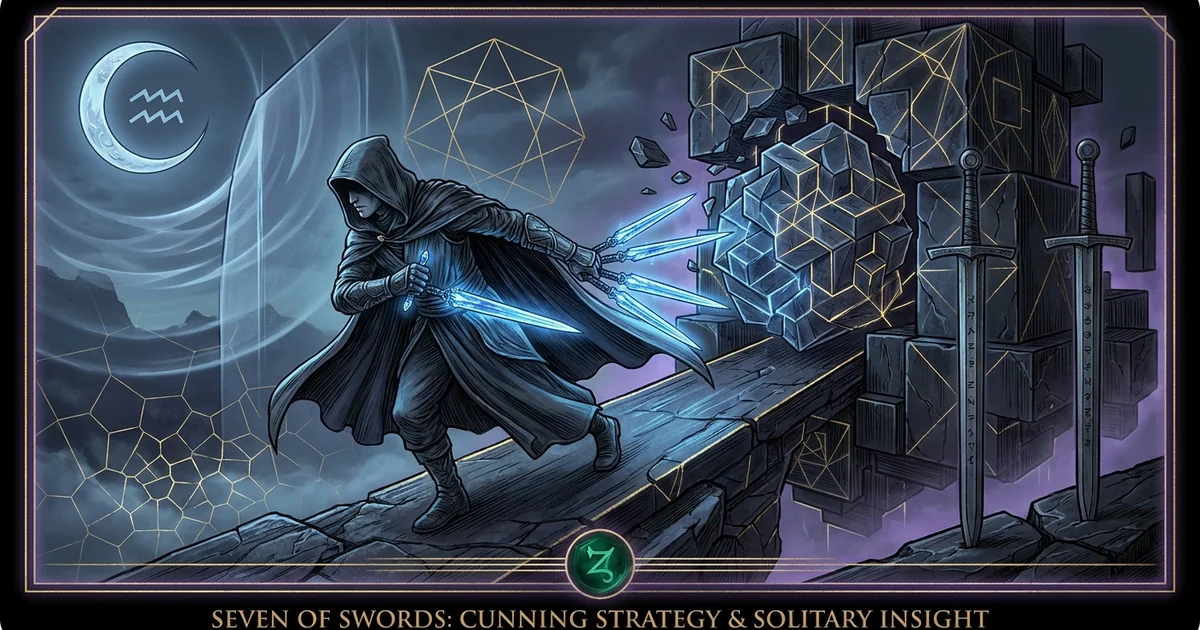
Seven of Swords: Cunning Strategy and Solitary Insight
Archetypal Thesis & Systemic Paradigm: The Epistemological Rupture of Netzach in Yetzirah
Dynamic Vector Mechanics of Seven within the Swords Suit
Within the cosmological architecture of the Hermetic Qabalah, the Seven of Swords represents an acute epistemological crisis within the mental realm of Yetzirah, the Formative World of the air element. The numeric value of Seven corresponds structurally to the Sephira Netzach (Victory), seated at the base of the Pillar of Mercy on the Tree of Life. When the dynamic, affective, and desire-driven energetic signatures of sephira netzach intersect with the discursive, analytical, and categorizing currents of the mental plane, an immediate structural incoherence is induced. The suit of Swords operates according to linear trajectory, separation, and dialectical synthesis; Netzach, conversely, operates under the jurisdiction of Venus—governed by instinctual attraction, emotional volatility, and fluctuating affective pressure.
The convergence of Netzach within Yetzirah produces a radical departure from the pristine formal geometry that precedes it. In this state-space, the mind is no longer operating as a dispassionate instrument of absolute truth. Instead, it is subordinated to the imperatives of desire, survival, and tactical circumvention. The seven of swords tarot meaning cannot be reduced to exoteric tropes of common thievery or petty deception; rather, it delineates an evolutionary tipping point wherein the intellectual apparatus discovers that linear force and orthodox dialectics are insufficient to achieve its teleological aim. The vector mechanics of the Seven within this suit demonstrate an asymmetrical distribution of force: where prior cards established binary dialectics (Two), acute trauma (Three), stable stasis (Four), ruthless domination (Five), and regulated transit (Six), the Seven introduces systemic unpredictability, asymmetric leverage, and lateral cognitive maneuvers into an otherwise rigid systemic environment.
Tree of Life: Descent through Yetzirah
[ Kether / Chokmah / Binah: Supernal Ideation ]
                     │
         [ Chesed / Geburah: Moral Matrix ]
                     │
          [ Tiphareth: 6 of Swords ]
           (Equilibrium, Consensus)
                     │
           [ Netzach: 7 of Swords ]
        (Asymmetry, Tactical Bypass)
                     │
           [ Hod: 8 of Swords ]
          (Mental Calcification)
The Fall of Pure Rationality: From Tiphareth’s Equilibrium to Netzach’s Volatility
To comprehend the structural rupture demarcated by the Seven of Swords, one must analyze its immediate genealogical antecedent: the Six of Swords. In the Six, consciousness achieves an operative equilibrium under the auspices of Tiphareth (Beauty/Harmony) in Yetzirah. The Six of Swords depicts a measured, cohesive transit across the conceptual waters—a collective, structural passage wherein intellectual consensus and ethical order facilitate safe extraction from an unviable theater of conflict. Tiphareth provides the Swords suit with an idealized, centralizing balance, harmonizing solar intelligibility with systemic utility.
The step downward from Tiphareth to Netzach represents an ontological descent from centralized coherence into decentralized, instinctual multiplicity. As the psychic vector falls into Netzach, the cohesive consensus of the Six fractures. Netzach is inherently polar to Hod (the seat of disciplined, communicative logic); divorced from the immediate regulatory discipline of Hod, the intellectual faculty within Netzach experiences a systemic destabilization. Rationality ceases to be universal; it becomes subjective, strategic, and hyper-individualized. The collective boat of the Six of Swords is abandoned; the individual agent realizes that the shared paradigm can no longer navigate the emergent terrain. Consequently, the mind abandons symmetrical governance in favor of volatile opportunism. The discursive intellect is commandeered by the desire-nature, transforming abstract philosophy into covert operational methodologies aimed at maximizing individual survival against entrenched systemic odds.
The Solitary Strategist as an Evolutionary Cognitive Emergence
The emergence of the solitary strategist signals a pivotal phase in cognitive evolutionary development. When an environmental architecture or social apparatus becomes over-coded, dogmatic, or tyrannical, symmetrical engagement guarantees the total destruction of the vulnerable agent. In such environments, the open confrontation seen in the five of swords yields only systemic ruin or pyrrhic dominance. The Seven of Swords codifies the structural transition from brute force to cognitive finesse, marking the exact moment the human psyche develops operational cunning (metis) as an adaptive mechanism.
This card models the necessary extraction of personal intellectual agency from the monolithic collective unconscious. The solitary actor recognizes that survival depends on an asymmetrical redistribution of power. By decoupling from the collective moral matrix, the strategist operates beyond the predictive algorithms of the reigning paradigm. This rupture is not merely a moral transgression; it is a vital evolutionary adaptation. Through solitary insight, the strategist identifies vulnerabilities within the systemic perimeter, exploiting gaps in institutional surveillance to secure the informational and psychological capital necessary for autonomous existence.
“The trickster is a collective shadow figure, a summation of all the inferior traits of character in individuals. And since the individual is frequently compelled by social pressure into an artificial morality, the trickster operates as an indispensable compensatory factor. He breaks the stasis of collective dogmatism not through high moral proclamation, but through subversive indirection, demonstrating that the path to individuation frequently demands the assimilation of that very cunning which the collective consciousness condemns.” — C.G. Jung, The Archetypes and the Collective Unconscious, CW 9i, §465-468
Classical Provenance & Textual Lineage: The Evolution of ‘Unstable Effort’
The Golden Dawn Cipher and Book T: The Lord of Unstable Effort
The technical hermeneutics of the Seven of Swords were fundamentally codified by the Hermetic Order of the Golden Dawn in the late nineteenth century. In S. L. MacGregor Mathers’s foundational document, Book T (The Tarot), the card is designated with the formal mystical title: The Lord of Unstable Effort. This appellation immediately strips the card of vulgar cartoonish criminality, elevating it to an ontological diagnosis of the limitations of the lower mind.
Within the Golden Dawn system, the card’s nature is dictated by its attribution to the third decan of Aquarius, governed by the Moon according to the ancient Chaldean order. In Book T, this combination of Fixed Air and mutable Lunar mechanics signifies acute intellectual brilliance undermined by an incapacity for sustained, uniform application. Mathers describes its manifestation as partial success: the conceptual apparatus devises extraordinary stratagems, yet the energy wavers at the precipice of total completion. The effort is “unstable” precisely because Netzach’s desire-nature fluctuates, preventing the absolute, cold crystallization of the mental intent. The will possesses sufficient impetus to initiate covert extraction and disrupt the enemy’s logistics, but it lacks the sustained martial endurance (which belongs properly to Geburah) to hold the captured ground indefinitely.
“Partial success. Tending to be conquered, yet not quite conquered. Intellectual success through broad-mindedness, but failing through lack of persistence. A character easily led, yet untruthful and deceptive. Unstable effort; search after many things, but achieving nothing permanent; working through indirect ways.” — S. L. MacGregor Mathers, Book T: The Tarot (1889)
“The card is called Futility. This is the result of passive intellectual sabotage. The Moon rules the third decan of Aquarius, showing the intellectual idealism of that sign corrupted by subconscious instability. The swords are arranged in a pattern where six strike against a central blade; it is a picture of intellectual compromise, where the integrity of the mind is paralyzed by its own internal contradictions.” — Aleister Crowley, The Book of Thoth (1944)
Iconographic Transmutation: From Marseille Pip Geometries to Waite-Smith Narrative Stealth
Prior to the publication of the Rider-Waite-Smith (RWS) deck in 1909, esoteric tarot iconography adhered primarily to the abstract geometric conventions preserved in the Tarot de Marseille. In the classical Marseille lineage, the Sept d’Épée features seven curved, scimitar-like blades interwoven with stylized vegetal arabesques. Six of the blades interlock in a protective, oval mandorla, while a single, straight central sword pierces the core of the configuration. This non-scenic visual geometry emphasized structural tension: the containment of a singular intellectual vector within an undulating, organic framework, subtly alluding to the dialectic between the organic life-force (Netzach) and mental crystallization (Swords).
Pamela Colman Smith, working under the esoteric direction of Arthur Edward Waite, executed a revolutionary iconographic transmutation that fundamentally altered the reception history of the card. Drawing inspiration from the fifteenth-century Sola Busca Tarot—specifically the designs of cards depicting figures interacting dynamically with clustered weaponry—Smith transformed the geometric stasis of the Marseille into a vivid dramatic narrative of tactical espionage. A lithe, cap-wearing protagonist sneaks away from an armed military encampment, carrying five swords bundled awkwardly in his bare hands, while looking back conspiratorially at two stationary swords remaining thrust into the soil.
Iconographic Genealogies:
[ Tarot de Marseille: 6 Interlaced Curved Blades + 1 Central Piercing Spire ]
                               │
            (Sublimated by Pamela Colman Smith, 1909)
                               │
[ RWS Innovation: Military Encampment / Asymmetrical Heist (5 Seized, 2 Left) ]
Waite’s textual exegesis in The Pictorial Key to the Tarot reveals an intentional multiplicity of interpretive registers. While acknowledging vulgar readings—such as theft, deceit, and compromised plans—Waite subtly underscores an alternative operative reading: “an attempt, a plan that may fail,” but equally “confidence, vigilance, and the overcoming of obstacles through artifice rather than force.” Smith’s iconography visually encoded an esoteric truth: the warrior does not conquer the garrison; the strategist disarms it through clandestine preemption, highlighting the supremacy of cognitive agility over institutionalized military power.
Aleister Crowley’s Thoth Hermeneutic: Passive Intellectual Sabotage
In stark contrast to the narrative anthropomorphism of the RWS deck, Aleister Crowley rejected the motif of the theatrical rogue in The Book of Thoth (1944). Working with artist Lady Frieda Harris, Crowley returned to rigorous geometric abstraction, naming the Seven of Swords Futility. Crowley’s hermeneutic operates through an uncompromising structural critique of Netzach in Yetzirah. For Crowley, the descent of mental energy into the sphere of desire constitutes an intellectual disaster—the betrayal of pure logic by subjective sentimentality, vacillation, and subconscious doubt.
In the Thoth card, six swords of diverse cultural origins (representing fragmented, disparate intellectual traditions and historical dogmas) converge aggressively upon a single, massive, upright sun-hilted sword. The tips of the six peripheral blades strike, bend, and fracture against the central blade, but succeed in chipping and dulling its edge. Crowley interpreted this dynamic as the tragic self-sabotage of the human intellect. Governed by the Moon in Aquarius, the mind becomes susceptible to utopian illusions, social appeasement, and passive-aggressive compromise. The Futility of the Thoth card represents the exhaustion of the intellectual apparatus when it attempts to solve problems through evasive, indirect mental gymnastics instead of the clean, decisive will of pure spiritual insight. While Waite celebrates the tactical efficacy of the covert operator, Crowley warns of the catastrophic entropy that occurs when the mind refuses direct confrontation, resulting in systemic intellectual decay.
Structural Mechanics & Symbolic Geometry: Astrological Decans and Qabalistic Grids
The Third Decan of Aquarius (20°–30°): Chaldean Lunar Rulership
The structural architecture of the Seven of Swords is anchored in the third decan of the sign of Aquarius, spanning from 20°00’ to 29°59’59" of the tropical zodiac. Under the ancient Chaldean order, which organizes planetary spheres by their apparent geocentric velocity, this decan is ruled by the Moon (Luna). In classical astrological taxonomy, Heinrich Cornelius Agrippa, in his De Occulta Philosophia Libri Tres (1533), characterized this decanic sector through images denoting intellectual ambition fused with dissatisfaction, depicting figures seeking that which cannot be openly possessed.
The third decan of Aquarius constitutes the terminal phase of the Fixed Air triplicity. Aquarius is traditionally ruled by Saturn—denoting social architectures, collective ideation, ideological systems, and structural permanence. When the swift, reflective, and instable energy of the Moon assumes governorship over this terminal decan, an intense thermodynamic friction is generated. The Moon represents the shifting currents of the unconscious, the instinctual self, and the fluctuating rhythm of cyclical time. Placed within the hyper-rational, fixed, ideological framework of Aquarius, the Moon acts as a volatile solvent. It destabilizes the rigid dogmas of the sign, compelling the intellect to seek clandestine paths through fixed systems. This decanic marriage creates the psychological archetype of the detached eccentric, the dissident intellectual, and the cognitive guerrilla who maneuvers effortlessly through the fixed ideological architecture of the collective.
- Sephira: Netzach (Victory / Affective Impulse / Dynamic Desire)
- Qabalistic World: Olam Yetzirah (The Formative World / Realm of Elemental Air)
- Zodiacal Placement: Aquarius (Fixed Air / Ideological Systems)
- Decanic Division: Third Decan (20°00’ to 29°59’59")
- Chaldean Decan Ruler: Luna (The Moon / Subconscious Influx, Fluctuation, Stealth)
- Esoteric Title: The Lord of Unstable Effort
- Primary Hermetic Equation: Netzach + Yetzirah + (Moon in Aquarius) = Tactical Asymmetry / Strategic Decoupling
Vector Analysis of the Waite-Smith Glyphs: Five Seized, Two Left Behind
A granular visual dissection of Pamela Colman Smith’s composition reveals a masterclass in symbolic geometry and vector mechanics. The central protagonist is captured mid-motion, moving his physical body along a dynamic diagonal vector from right to left (historically associated with the past, the unconscious, or the unorthodox path), while his neck is craned backward toward the right. This somatic tension demonstrates split perceptual intentionality: his physical momentum is oriented toward extraction and liberation, but his optical surveillance remains fixed on the camp he has infiltrated. He operates under perpetual retrospective vigilance, calculating the exact lag-time between his covert operation and the collective awakening of the garrison.
Vector Field of Smith's Composition:
  [ Left: Future / Wilderness / Freedom ]
               ▲
               │ (Locomotive Vector: Feet moving stealthily)
       [ Protagonist: The Dissident Strategist ]
               │ (Optical Vector: Gaze turned backward)
               ▼
  [ Right: Past / Military Encampment / Institutional Matrix ]
The numerical distribution of the weaponry encodes profound esoteric meaning. The operative carries five swords while leaving two rooted vertically in the earth. The number five corresponds to Geburah—the sphere of Mars, conflict, severity, and operational disruption. By capturing five swords, the strategist seizes the dynamic instruments of war: he disarms the collective’s offensive capacity without engaging in a catastrophic direct assault.
The two swords left standing signify the irreducible minimum of duality—the foundational dialectic of the Pillar of Severity and the Pillar of Mercy, or the binary framework (Binah and Chokmah) that cannot be extricated from the field. The operative cannot steal the entire architecture; two blades remain planted as monuments to systemic reality. He takes only what his hands can sustain. The naked grasp of the blades illustrates another crucial dynamic: the strategist handles the naked steel of pure intellect without protective hilts, bearing the direct, razor-sharp existential risk that cognitive non-conformity demands.
The Thermodynamic Tension Between Fixed Air and Lunar Mutability
The interaction between Fixed Air and the Moon can be understood via the physics of informational thermodynamics. Fixed Air represents an ideological steady-state—a closed, institutionalized thermodynamic system characterized by high structural entropy and dogmatic immobility. In sociopolitical and psychological terms, this is the military camp depicted in the background: an orderly array of conical tents representing the uniform, predictable, and regimented architecture of consensus reality.
The Lunar rulership introduces an injection of mutability that disrupts this ideological crystal. The Moon brings high-frequency, low-amplitude informational perturbations into the low-frequency, high-amplitude structure of Aquarius. The strategist, animated by this lunar influx, identifies the micro-fractures within the collective ideology. He does not seek to smash the system through sheer caloric force; rather, he exploits informational asymmetries. By extracting the vital discursive tools (the five swords), he redistributes entropy within the system, leaving the institutional matrix functionally immobilized while he slips into the peripheral wilderness. The seven of swords symbolism thus encapsulates the evolutionary victory of informational agility over static, monumental inertia.
Psychological Dynamics & Operational Praxis: The Hermes-Trickster Complex and Tactical Autonomy
Cognitive Decoupling and the Solitary Infiltration of the Collective
From the perspective of analytical psychology, the Seven of Swords embodies the critical, high-risk process of cognitive decoupling from the collective ego-ideal. The human psyche is chronically besieged by the massified values, taboos, and systemic requirements of its cultural milieu. To exist entirely within the collective garrison is to surrender individuation in exchange for the false psychological security of the group. However, direct open rebellion often invites catastrophic psychic retaliation from the collective shadow, resulting in marginalization or total ego fragmentation.
The Seven of Swords represents the strategic activation of the Hermes-Trickster complex. Hermes is the psychopompos, the god of boundaries, thieves, transitions, and secret wisdom who slips effortlessly past the locked gates of Apollo’s solar order. In this card, the ego must cultivate an intra-psychic espionage capability: it must learn to smile and nod within the institutional matrix while secretly liberating its autonomous cognitive capital from that same system. The individual feigns conformity just enough to avoid systemic destruction, quietly reclaiming their creative and intellectual faculties from institutional servitude. This is not cowardice; it is the sophisticated preservation of psychic sovereignty in hostile territory.
Intra-Psychic Spatial Dynamic:
┌────────────────────────────────────────────────────────┐
│  COLLECTIVE INSTITUTIONAL MATRIX                       │
│  (The Encampment: Mass Culture, Super-Ego Dogmas)      │
│                                                        │
│           [ 2 Rooted Swords: Unassailable Dogmas ]     │
│                     ▲                                  │
│                     │  (Infiltration / Extraction)     │
│                     ▼                                  │
│         [ The Strategist / Trickster Ego ]             │
│                     │                                  │
│                     └───► [ 5 Swords: Reclaimed Tools] │
└────────────────────────────────────────────────────────┘
                           │
                           ▼  (Exfiltration Vector)
               [ Autonomous Individuation ]
Asymmetrical Conflict Resolution: Evading Totalizing Dogmas
Operational praxis dictated by the Seven of Swords demands an honest assessment of power dynamics. In conflict scenarios, orthodox strategic doctrine dictates symmetrical engagement: marshaling force against force, argument against argument, legal resource against legal resource. Yet, when an individual confronts an entrenched, resource-rich institution—whether an ecclesiastical authority, a corporate conglomerate, or a deeply dysfunctional familial matrix—symmetrical confrontation represents strategic suicide.
The operational doctrine of this card is that of asymmetric conflict resolution. The practitioner of the Seven of Swords does not declare an ideological war that would provoke the full mobilization of the enemy’s apparatus. Instead, they employ lateral maneuvers:
- Informational Discretion: Concealing operational objectives until the assets have been successfully transferred.
- Preemptive Sabotage: Disarming the adversary’s capacity for violence by covertly removing their ideological and logistical ammunition before hostilities manifest.
- Refusal of Direct Battle: Denying the adversary the satisfaction of an identifiable front line, forcing them to exhaust their structural energy against illusions and voids.
By refusing to fight on the terrain selected by the dominant power, the strategist redefines the terms of the engagement. Victory is achieved not through total annihilation of the oppressor, but through the successful, undetected extraction of one’s own freedom and agency.
Operative Asymmetrical Strategy
- Sovereignty Reclamation: Extracting authentic intellectual assets from oppressive structural frameworks.
- Pragmatic Realpolitik: Recognizing when systemic power imbalances make open direct confrontation fatal.
- Information Security: Maintaining tactical silence and strategic operational opacity.
- Constructive Subversion: Disarming dogmatic, destructive systems through indirect manipulation.
- Heuristic Agility: Utilizing lateral thinking to outmaneuver institutional inertia and intellectual dogma.
Neurotic Evasive Pathology
- Chronic Impostorism: Living behind a fractured persona out of acute terror of being truly seen or held accountable.
- Ethical Dissolution: Habitual deceit, pathologically lying to evade mundane relational responsibilities.
- Self-Sabotage: Halting execution at 70% completion out of a neurotic dread of ultimate evaluation.
- Paranoid Hyper-Rationality: Constructing elaborate, untestable mental conspiracies that paralyze action.
- Egoic Alienation: Inability to forge authentic alliances due to compulsive, defensive cynicism.
Diagnostic Triangulation: Discerning Shrewd Autonomy from Pathological Deceit
In the clinical and diagnostic application of tarot symbology, the Seven of Swords requires rigorous discernment. The threshold between healthy individuation via tactical autonomy and regressive, pathological duplicity is paper-thin. When this card manifests within a psychological diagnostic array, the investigator must analyze the vector direction of the cunning: is the strategy utilized to liberate legitimate human value from a necrotic structure, or is it an evasive defense mechanism engineered to protect a cowardly ego from ethical maturation?
The shadow manifestation of the Seven of Swords is characterized by an addiction to the covert. The neurotic ego becomes infatuated with its own cleverness, viewing all human relationships through the paranoiac lens of espionage and zero-sum competition. This individual defaults to half-measures, lies of omission, and intellectual infidelity, abandoning projects precisely when sustained, laborious persistence is demanded. They carry away five swords, but because they grip them by the bare edges, they bleed continuously across the terrain of their own life, eventually leaving a trail that exposes their duplicity to the very forces they sought to evade.
Philosophical Synthesis & Macrocosmic Correspondence: Game Theory, Asymmetric Information, and Cybernetic Feedback
Nash Equilibrium and Information Asymmetry in Mental Warfare
The mechanics of the Seven of Swords provide a visual and symbolic coordinate system that precisely maps onto the mathematical frameworks of modern game theory, specifically non-zero-sum games governed by asymmetric information models. In classical game theory, a Nash Equilibrium describes a state where no player has an incentive to unilaterally deviate from their chosen strategy, assuming all other players remain static. However, when an environment is defined by severe information asymmetry—where one player possesses hidden information regarding the rules, the stakes, or the payoff matrix—the dominant player can be fundamentally undermined by a minor agent who executes a non-standard strategy.
Asymmetric Information Matrix:
┌────────────────────────┬───────────────────────────────────────────┐
│ Systemic Entity        │ The Covert Strategist (7 of Swords)       │
├────────────────────────┼───────────────────────────────────────────┤
│ Open Information Field │ Hidden Information Advantage              │
│ High Caloric Footprint │ Low Energetic Signature                   │
│ Symmetrical War-Games  │ Asymmetrical Heuristic Drift              │
│ Predictable Equilibrium│ Intentional Perturbation / Disequilibrium │
└────────────────────────┴───────────────────────────────────────────┘
The protagonist of the Seven of Swords refuses to participate in the established game. He alters the payoff matrix without notifying the collective system. By surreptitiously confiscating the adversary’s offensive assets (the five swords), he induces a structural disequilibrium before the game can even transition into an active phase. He embodies the principle of information dominance: victory is decoupled from physical scale and tethered directly to the latency between an action occurring and its discovery by the wider network.
The Cybernetics of Stealth: Minimizing Entropy in Hostile Environments
In cybernetic theory, as formulated by Norbert Wiener and developed further in Claude Shannon’s information theory, a system preserves its homeostatic equilibrium by managing entropy through negative feedback loops. A system under surveillance is continuously monitored by sensors that generate regulatory signals to maintain operational order. The military camp in the Seven of Swords represents a cybernetic megastructure with high feedback capacity—it possesses the weaponry, the sentinels, and the structural density to correct any direct disturbance to its perimeter.
The operative in this card succeeds by minimizing his signature within the cybernetic channel; he operates beneath the sensitivity threshold of the systemic sensors. By tiptoeing across the visual plane, he introduces minimal informational noise into the environmental matrix. He does not trigger an alarm condition because his action is gradual, localized, and mathematically calculated to exploit blind spots in the collective surveillance grid. The deliberate decision to leave two swords standing functions as a cybernetic decoy: by leaving a portion of the structure nominally intact, he delays systemic realization of the breach, thereby maximizing his window for clean exfiltration.
The Alchemical Volatilization of the Fixed: Liberating Spirit from Static Ideology
In the laboratory of Hermetic alchemy, the Great Work progresses through the dialectical oscillation between two fundamental operations: solve et coagula—the dissolution of the rigid, and the coagulation of the volatile. A central, dangerous operation within this opus is the “volatilization of the fixed” (sublimatio / volatilatio). In this phase, that which has become overly dense, calcified, and spiritually inert must be cracked open by a mercurial fire, allowing the trapped pneumatic essence to volatilize into vapor and escape the dense sediment of the crucible.
The Seven of Swords serves as the supreme tarot emblem of this volatilization process. The military tents and the planted swords represent the coagulatum—ideology that has become dangerously fixed, rigidified into dogma, and devoid of living spirit. The strategist represents the universal alchemical solvent: the sharp, volatile Mercurius. He enters the calcified mass, seizes the energetic sparks (the five swords of active ideation), and vaporizes out of the dense physical structure into the open air. This operation is perilous; if the alchemist does not properly balance the volatilization, the vessels shatter, and the vital essence is lost to the void. Yet, without this daring, clandestine theft of the sacred fire from the temples of static thought, the spirit remains forever entombed within the dead letters of unexamined tradition.
Frequently Asked Questions: Analytical Clarifications on the Seven of Swords
Deconstructing the Moralistic Fallacy of Universal Dishonesty
A pervasive, regressive tendency within popular divination is the reduction of the Seven of Swords to a crude moral warning regarding betrayal, deceit, or criminal theft. This interpretation represents an exoteric, moralistic flattening of an intricate metaphysical archetype. The cards of the Minor Arcana are not behavioral sermons; they are state-space representations of psychic mechanics and systemic power distributions within consciousness.
To perceive the Seven of Swords solely as dishonesty is to project the value-system of the collective garrison onto the solitary dissident. History and psychological evolution demonstrate that every quantum leap in human consciousness began as an act of conceptual heresy that breached the established laws of an entrenched institution. When Prometheus stole fire from the Olympian gods, he was, within the moral logic of Zeus, a thief operating under the Seven of Swords. When Galileo synthesized his astronomical observations, he operated under the necessary discretion of this card, concealing and publishing covertly to escape the pyres of the Inquisition.
The Seven of Swords represents tactical prudence, intellectual sovereignty, and the strategic economy of speech. It asserts that absolute transparency with a hostile, tyrannical entity is not a virtue, but an act of self-destructive negligence.
Epistemological Clarification:
Collective Judgment:   [ Subversion / Treason / Theft ]
Archetypal Reality:    [ Tactical Asymmetry / Preservation of Agency ]
Navigating the Polarity: Upright Tactical Autonomy vs. Reversed Exposure
When deployed within diagnostic cartomancy, the directional polarity of the Seven of Swords illustrates the delicate equilibrium between operational discretion and catastrophic systemic exposure.
In the upright orientation, the vector forces are successfully integrated:
- The cognitive decoupling is executing according to plan.
- The individual successfully maintains operational security, disarming systemic threats through preemptive lateral thinking.
- Informational asymmetry is heavily skewed in favor of the individual agent, permitting clean extraction from a toxic paradigm without triggering open structural warfare.
When the card appears in the reversed orientation, the structural mechanics indicate a systemic collapse of the covert vector:
- The Return to the Camp: The operative loses nerve, abandons the extracted swords, and retreats back into the false safety of the collective garrison, resulting in deeper psychological subjugation.
- The Exposure of the Ruse: The lag-time collapses to zero; the alarm sounds before the perimeter is crossed. The hidden strategy is exposed to systemic scrutiny, forcing an unprepared ego into direct, disastrous confrontation with institutional power.
- The Whistleblower Paradox: In its most elevated reversed manifestation, the card indicates the deliberate surrender of stealth—the conscious, sacrificial decision to bring the stolen institutional secrets into the open light of day, converting covert extraction into a direct public revelation of systemic corruption.
Synthesizing the Sword Distribution: Why Are Two Blades Left Standing?
A critical structural inquiry into the iconography of the Seven of Swords addresses the deliberate mathematical omission: why does the protagonist liberate five swords, but leave precisely two rooted within the earth?
From a Qabalistic and structural perspective, this distribution acknowledges the irreducible limits of human agency within an incarnated world. The number two corresponds to the Sephira Chokmah—the primary duality, the cosmic binary, and the foundational pillars that frame all manifested space. The strategist cannot steal the fabric of reality itself. To attempt to take all seven swords would be an act of hubristic over-extension, ensuring his capture through sheer physical encumbrance. The five swords carried represent the exact load-bearing limit of the human operator: Geburah, the martial force of dynamic action.
The two blades left standing serve three distinct esoteric functions:
- Structural Anchors: They acknowledge the permanent existence of the dialectic—thesis and antithesis remain embedded in the material world, awaiting the next historical cycle.
- Tactical Camouflage: By leaving swords in the soil, the encampment retains the visual illusion of armed readiness, delaying the institutional realization that their operational capacity has been gutted.
- Hermetic Modesty: The operative accepts an imperfect harvest. True mastery lies not in absolute, totalitarian conquest, but in securing precisely what is required to fuel the next phase of autonomous individuation, leaving the dead remnants of the system to collapse under the weight of their own hollow architecture.