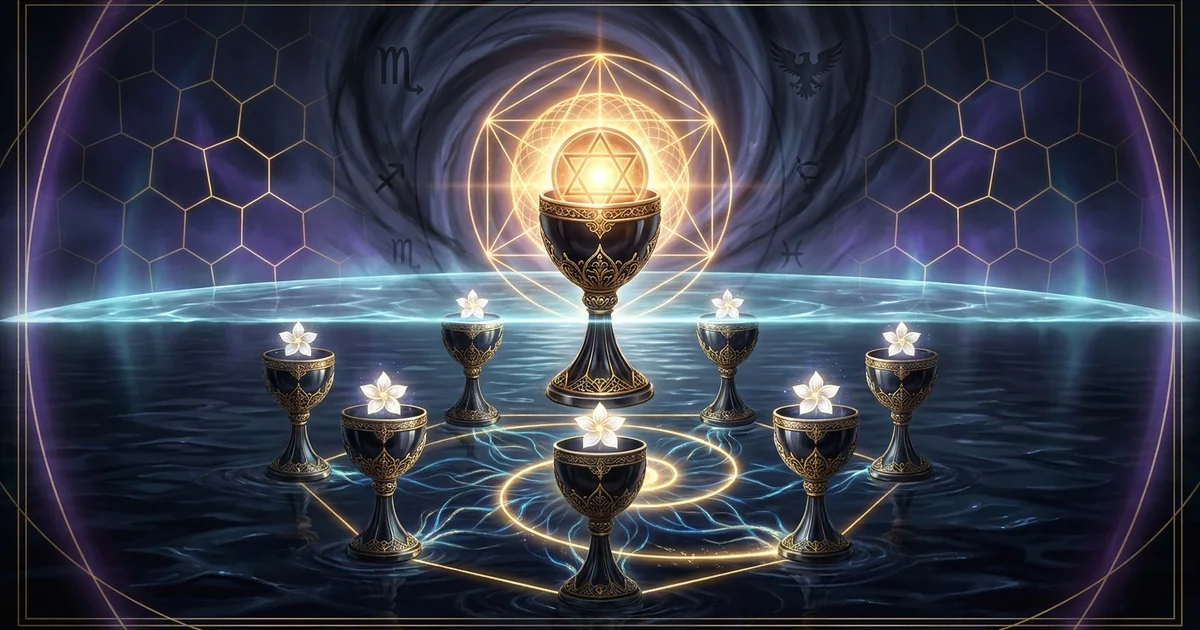
Six of Cups: Soul Nostalgia and Innocent Past Resonance
Archetypal Thesis & Systemic Paradigm: The Architecture of Anamnesis
Platonic Anamnesis versus Pathological Regression
The Six of Cups occupies a unique position in the cartography of the psyche, operating not as an invitation to escapist sentimentality, but as a dynamic engine of Platonic recollection (anamnesis). In vulgar divinatory frameworks, this card is frequently reduced to banal reminiscence or naive, regressive yearnings for an idealized past. Such interpretations fail to apprehend the structural operation of consciousness when confronted with temporal exhaustion. When the conscious ego encounters a profound developmental blockage, it does not merely retreat; it executes an unconscious retrograde movement to unearth uncorrupted archetypal material. This dynamic mirrors the Platonic doctrine wherein learning and psychic restoration are recognized not as the acquisition of foreign data, but as the active remembering of pre-temporal, primordial truths known to the soul before its descent into temporal fragmentation.
Within the Jungian paradigm, this process centers on the archetype of the puer aeternus—the eternal child representing renewal, untainted potential, and an open conduit to the numinous ground of being. The six of cups tarot meaning hinges upon this non-regressive retrieval: it summons the primordial core of the self to intervene in a present psychological crisis. By descending into the archival strata of childhood or ancestral memory, the ego does not dissolve its boundaries; rather, it drinks from a historical spring of psychological vitality. This retrieval supplies the psychic energy required to dismantle the calcified defenses constructed in the wake of the catastrophic losses mapped in the /tarot/five-of-cups-grief-transmutation.
“The child motif represents not only certain forgotten things in our childhood, but something existing here and now that is the potentiality of the future… It represents the strongest, the most ineluctable urge in every being, namely the urge towards self-realization. It is an incarnation of the inability to do otherwise, which equips it with all the power of an instinct of nature, and is essentially non-regressive, striving towards wholeness.” — Carl Gustav Jung, The Archetypes and the Collective Unconscious (Collected Works, Vol. 9, Part 1, p. 170)
The Water Element as a Dynamic Mnemonic Substrate
To comprehend this restorative mechanism, one must analyze the physical and metaphysical properties of the water element across the cups suit. In the Western esoteric tradition, water (Ap) is the universal solvent and the receptive medium of preservation. It retains astral impressions, carrying the memory of every vessel through which it has flowed. While air dissipates and fire consumes, water stores systemic imprints within its undulating, molecular continuity. In the human organism, water forms the biochemical architecture of feeling, memory, and instinctual imprinting.
Within the cups suit, emotional memory is never a static archive stored in frozen stasis. It operates as a living hydrological cycle: evaporating under the friction of trauma, condensing into the dark clouds of mourning, and precipitating downward into the deep aquifers of the unconscious. The Six of Cups signifies that precise phase of the cycle where these subterranean waters re-emerge as sweet, potable springs. The dynamic mnemonic substrate of water allows archaic affective charges to be recovered without re-traumatizing the subject. The affective charge is held in fluid suspension, cleansed of original temporal context, and presented to the conscious node as pure nourishment.
The Six of Cups Tarot Meaning: Re-anchoring the Fractured Ego
The structural transition from the Five of Cups to the Six of Cups marks the definitive re-centering of the fractured ego-structure. In the Five, consciousness is transfixed by the irreversible spill of emotional investment—three chalices overturned, their fluids draining into the black marsh of the personal shadow. The psyche is captured by entropy, fixating on irreversible loss. The Six of Cups arrests this dissipative bleed by redirecting the attention toward the preserved vessels that were neglected during the crisis.
This psychological re-anchoring functions via the restoration of a foundational temenos—a sacred, bounded space free from external violation. The fractured ego, exhausted by the combative demands of social survival and traumatic attrition, requires an insulated psychic perimeter to recover its coherence. The six of cups tarot meaning represents the deliberate reconstitution of this sanctuary. By re-establishing contact with historical experiences of unconditional acceptance, unburdened play, and pristine beauty, the psychic economy is recalibrated. The ego is no longer an isolated, wounded combatant; it is re-anchored into a historical continuity that predates its current wounds.
Classical Provenance & Textual Lineage: From ‘Pleasure’ to Golden Memories
The Golden Dawn Decanic Title: The Lord of Pleasure
The esoteric architecture of the Six of Cups was rigorously formulated by Samuel Liddell MacGregor Mathers and William Wynn Westcott within the inner order curriculum of the Hermetic Order of the Golden Dawn. Designated with the decanic title The Lord of Pleasure, the card was not conceived as a representation of hedonistic indulgence, but as the manifestation of solar harmony within the astral fluid. The title derives from the Hermetic synthesis of Tiphareth—the sixth Sephira, representing beauty, equilibrium, and the central Solar consciousness—projected into the World of Briah, the archetypal realm of pure water, emotion, and fluidic creation.
In the Golden Dawn system, “Pleasure” denotes the precise metaphysical condition that emerges when a system achieves optimal structural equilibrium. It is the deep, psycho-spiritual satisfaction of an organism operating in perfect harmony with its divine blueprint. The decanic attribution assigns this card to the second decan of the fixed water sign of Scorpio, governed by the Sun. This pairing creates a profound energetic synthesis: the absolute radiant clarity of Sol penetrating the subterranean, highly concentrated emotional depths of the Scorpion.
“The Six of Cups: Pleasure. Attribution: Sun in Scorpio. Second decan of Scorpio. Tiphareth in the World of Water (Briah). ‘Herein is the harmony of things restored; the emotional nature is purified by the central fire of Sol, producing that exquisite joy which arises when the soul remembers its pristine innocence amidst the dark waters of generation.’” — S. L. MacGregor Mathers & W. W. Westcott, The Golden Dawn Cypher Manuscripts and Tarot Attributions (1888)
Waite and Colman Smith’s Shift to Pastoral Commemoration
When Arthur Edward Waite collaborated with artist Pamela Colman Smith to generate the Rider-Waite-Smith (RWS) deck in 1909, they executed a radical semiotic translation of the Golden Dawn’s abstract geometrical and kabbalistic formula. While maintaining fidelity to the underlying occult attribution, Waite deliberately moved away from the austere, abstract glyphs favored by the continental occultists. He directed Colman Smith to ground the transcendent formula of The Lord of Pleasure in an evocative, pastoral scene of domestic and generational exchange.
In The Pictorial Key to the Tarot (1910), Waite describes the card through imagery of ancestral continuity:
“A card of the past and of that which has vanished, but at the same time an emblem of memories, of that which has been, showing two children in an old garden, with cups full of the flowers of life.”
Waite consciously shifted the focus toward human developmental stages, framing the solar-water equilibrium as the communion between historical innocence and present awareness. The card is anchored to a visual lexicon of security: a secure castle courtyard, architectural parapets, and the tender, non-coercive gesture of a boy offering a flower-filled chalice to a younger girl. Through this imagery, Waite and Colman Smith translated the metaphysical doctrine of Tiphareth in Briah into an accessible psychological landscape of comforting nostalgia, safe harbors, and the unblemished inheritance of the soul.
Crowley’s Decadence of Scorpio: Voluptuous Equilibrium in Thoth
In stark contrast to Waite’s sentimental and pastoral vision, Aleister Crowley, working with Lady Frieda Harris between 1938 and 1943, restored the uncompromising Hermetic severity of the card in The Book of Thoth. Crowley retained the title Pleasure, but heavily emphasized the precarious nature of this equilibrium when manifested within the sign of Scorpio. For Crowley, Scorpio is the sign of death, putrefaction, and generation; it represents emotional energy in its most concentrated, fixed, and potentially toxic modality.
Crowley recognized that when the solar rays of Tiphareth illuminate Scorpio, they produce a momentary, voluptuous harmony of extraordinary delicacy. However, precisely because it is situated in fixed water, this pleasure carries the latent seeds of decay if it fails to move forward. In Crowley’s vision, the six lotus blossoms do not simply represent sweet memories; they are crystalline energetic engines channeling water from a high celestial source through copper basins into a calm, yet dangerously stagnant pool. Crowley warned that this condition represents the highest refinement of feeling, bordering on the over-ripe: a voluptuousness that must either sublimate itself into spiritual will or rot into the illusions of the /tarot/seven-of-cups-astral-illusion.
Structural Mechanics & Symbolic Geometry: Astrological and Qabalistic Coordinates
Tree of Life (Briah / Water)
       [ Kether ]
           |
       [ Tiphareth ]  <--- (Six of Cups: Solar Harmony in Water)
      /    |    \
   [Net] [Yesod] [Hod]
Tiphareth in Briah: The Solar Core of the Astral Waters
The primary structural key to the Six of Cups resides in its Qabalistic coordinates: Tiphareth in the World of Briah. Tiphareth is the central axis of the Tree of Life, the seat of the Sun, the mediating force between the supernal triad and the lower physical realms. It is the locus of Beauty, harmony, and redemption—the point where the divergent paths of the Tree converge into an integrated, coherent unity. When mapped onto the Minor Arcana, all four Sixes represent the stabilization and ultimate fulfillment of their respective elements, governed by this solar equilibrium (see /tarot/tiphareth-solar-equilibrium-minor-arcana).
When Tiphareth acts within Briah—the Archangelic World of Creation, populated by the fluidic, astral matrices of form—it behaves as a radiant, organizing furnace submerged in an infinite ocean. Briah corresponds directly to the water element; it is receptive, emotional, and mythopoeic. In the Six of Cups, the absolute clarity and unconditional warmth of Tiphareth stabilize the turbulent, reactive waters of human sentiment. The card does not depict the unconscious mind running amok in emotional chaos; it captures the moment the astral light is held in pristine, symmetrical suspension by the organizing power of the Solar Logos.
- Sephira: Tiphareth (Beauty, Balance, Solar Center)
- Qabalistic World: Briah (World of Creation, Pure Astral Water)
- Astrological Decan: Sun in Scorpio (Second Decan: 10°00’ to 19°59’ Scorpio)
- Essential Dignity: The Sun possesses neutral triplicity in water, but Scorpio is traditionally ruled by Mars; the Solar presence brings vital light and purification into the fixed, martial-water sign.
- Archangelic Hierarchy: Archangel Raphael (Healing and Solar Harmony) operating through the Briatic waters.
The Sun in Scorpio: Illumination within the Underworld Caverns
The decanic governance of the card—the /astrology/sun-in-scorpio-second-decan—provides the astrological engine of the Six of Cups. The second decan of Scorpio (10° to 20°) is traditionally associated with the concentrated preservation of primal emotional bonds, deep ancestral ties, and the occult undercurrents of instinct. Scorpio is the sign of the underworld, the domain of Thanatos and eros, ruled traditionally by Mars and modernly by Pluto. It is the realm where emotional investments are forged through intense vulnerability and catastrophic loss.
When the Sun enters this decan, an astonishing alchemical transformation takes place: Sol brings absolute light into the darkest caverns of the psychological underworld. This astrological configuration pierces through the sediment of ancestral shame, trauma, and unresolved sexual-emotional conflicts, exposing the original, uncorrupted seed of desire that existed before it was twisted by earthly experience. The martial turbulence of Scorpio is pacified by the solar presence. The resulting state is an exquisite, penetrating honesty: the individual perceives the root origins of their current emotional complexes, viewing them not with the agony of the Five of Cups, but with the radiant, detached compassion of the Sun.
The Hexagrammatic Distribution of the Chalices and White Flowers
The spatial geometry of the chalice-symbolism within the card mirrors the sacred geometry of the hexagram, the universal glyph of the macrocosm and Tiphareth. The six cups are not scattered at random; they are arrayed in a stable, structural polarity—often structured as a triad above and a triad below, or four anchoring the foreground and two elevating the central plane. This hexagrammatic distribution indicates the interlocking of fire and water, heaven and earth, the past and the future converging in the focal point of the eternal present.
       /\
      /  \
     /    \
    /  ()  \      [ Chalice ]
   /________\
   \  ()  ()\     [ Chalice ]   [ Chalice ]
    \      /
     \ () /       [ Chalice ]
      \  /
       \/
Crucially, emerging from each of the chalices in the RWS iconography is a pristine, white, five-petaled flower, frequently identified as a white rose or a five-petaled lily. The number five represents the pentagram: the quintessence, the human microcosm, and the purified soul perfected through the trials of the senses. By embedding this five-petaled glyph inside the six chalices of solar beauty, the card conveys a profound esoteric equation: macrocosmic harmony (the six) provides the fertile soil from which the purified individual consciousness (the five) blossoms. The white coloration signifies total purification—the albedo stage of alchemy, where the blackened sulfur of the Five of Cups has been washed clean of toxic sediment, leaving only the pristine scent of spiritualized desire.
Iconographic Hermeneutics: Deconstructing the Visual Glyphs
The Dwarf, the Maiden, and the Guard: Spatial Archetypes of Defense
The central dramatis personae depicted in the Rider-Waite-Smith rendition require meticulous deconstruction. Traditional readings hastily label these figures as two innocent children engaged in pastoral play. However, close iconographic inspection reveals deliberate anomalies. The taller figure, who leans forward to present the chalice, possesses the physical proportions, posture, and facial maturity of an adult dwarf or a stylized elder attired in the red-hooded cowl of an artisan or jester. The recipient is a smaller, slender young maiden adorned in simple, archaic garb.
Rider-Waite-Smith (RWS)
- Visual Modality: Pastoral, historical human figures in domestic, architectural space.
- Psychological Archetype: The mature self/elder ministering to the inner child/anima; active retrieval of pristine childhood templates.
- Structural Context: Village fortress, stone masonry, defensive parapets, guarded perimeter.
- Elemental State: Sweet, localized water stored in chalices filled with white five-petaled blossoms.
Crowley-Harris (Thoth)
- Visual Modality: Abstract, crystalline geometrical and organic balance; void of personal figures.
- Psychological Archetype: Impersonal alchemical equilibrium; the precarious, voluptuous perfection of Tiphareth in fixed water.
- Structural Context: Celestial stems emerging from the Abyss, feeding copper basins above a dark pool.
- Elemental State: Fixed, concentrated water under the Solar ray, bordering on the decadence of Scorpio.
This deliberate anatomical tension highlights the card’s operational psychology: it represents the mature, experienced ego-consciousness leaning down to minister to the vulnerable, receptive anima—the historical child-self. The adult figure bears the burden of time and experience (symbolized by the heavy garments and the mantle), yet its sole purpose is to serve the sovereign innocence of the receptive inner child.
In the middle distance, walking away with a weapon held over his shoulder, is an armed city guard. This martial figure is often overlooked, yet his functional presence is essential to the mechanics of the card. The sentinel represents the ego’s external defensive apparatus—the protective boundaries, the social persona, and the cognitive skepticism developed through worldly conflict. Because this martial sentry is actively walking the perimeter, securing the village walls, the tender exchange in the foreground can occur without anxiety. The psychological sanctuary (temenos) is heavily defended from external intrusion; it is precisely this structural protection that allows vulnerability, tenderness, and archaic memory to flourish without fear of violation.
The White Lilies and the Stone Pedestals: Enduring Structure versus Fragile Memory
The contrast between the organic fragility of the flowers and the unyielding rigidity of the architectural masonry encapsulates the card’s core dialectic. Four of the six chalices are elevated upon massive stone plinths or pedestals, rooted deep in the masonry of the courtyard. This physical elevation signifies that the memories, soul impressions, and emotional lineages recovered here are not ephemeral, floating wisps of fantasy; they are permanently carved into the psychic bedrock of the individual’s history.
The stone represents the Saturnian and fixed-earth structure of memory, the indelible biological and neurological architecture that stores early development. In direct contrast, the white flowers that erupt from these stone-mounted chalices represent the absolute freshness, fragility, and living vitality of the archetypal impressions themselves. Memory is the vessel; the experience of life is the flower. The six of cups symbolism asserts that though the historical events themselves have long vanished into the past, their vital psychic essence remains vibrant, preserved inside the durable masonry of the soul’s architectural memory.
The Village Architecture and the Parapet: The Fortress of Interiority
The environment enclosing the figures is not a raw, untamed natural wilderness, but a fortified medieval village composed of stone cottages, high walls, and crenellated parapets. This architectural setting establishes that the Six of Cups takes place within an inhabited, cultural, and ancestral space. It is the landscape of the personal and collective unconscious made habitable through generations of emotional labor.
The high parapet framing the background acts as a cognitive filter, separating the sacred precinct of memory from the terrifying chaos of the unintegrated outer world. Within this fortress of interiority, linear time is suspended. The village functions as an internal sanctuary where the psyche stores its foundational attachments, early developmental triumphs, and the ancestral heritage that provides the substrate for ego-integrity. The stone walls indicate that the individual has successfully cordoned off an area of consciousness from the corrosive cynicisms of contemporary reality, preserving an inviolable space where soul nostalgia can operate as a therapeutic medicine rather than a fatal vulnerability.
Psychological Dynamics & Operational Praxis: The Therapeutic Transmutation of Nostalgia
Traversing the Bridge: The Clinical Re-Integration of the Child Self
In therapeutic application, the Six of Cups marks the point in analysis where the patient, having fully acknowledged and processed the acute grief of relational loss or disillusionment (Five of Cups), is prepared to cross the psychic bridge back into the core attachments of their past. Clinically, trauma frequently causes an abrupt dissociation from the early self: the wounded individual disowns their childhood innocence, pathologizing their early openness as foolishness, weakness, or the primary cause of their suffering. This defensive severing leaves the adult ego brittle, cynical, and chronologically detached from its emotional roots.
The operational deployment of the Six of Cups requires the deliberate bridging of this psychic rift. The clinician or esoteric practitioner uses the mnemonic resonance of the card to establish a conscious dialogue between the chronologically fractured parts of the self. The adult ego does not go back to become the child; rather, it enters the historical landscape as a protector, a loving elder who provides the safety that may have been historically absent. By bringing the unconditional warmth of Tiphareth into the Scorpionic underworld of early childhood dynamics, the individual retrieves the abandoned fragments of their vitality, curiosity, and relational trust.
Distinguishing Regenerative Memory from Melancholic Stasis
To safely navigate the currents of the cups suit, the practitioner must maintain a rigorous diagnostic boundary between regenerative memory and melancholic stasis. Melancholy is an entropic condition: it fixates upon the past as an unrecoverable, dead golden age, poisoning the present with a sense of irreversible loss and inducing paralyzing inertia. In melancholic stasis, the ego abdicates its present-day agency, weaponizing nostalgia to justify its refusal to engage with the demands of current evolutionary challenges.
Regenerative memory, conversely, treats the past as an active generative matrix. It recognizes that the qualities celebrated in memory—playfulness, total absorption in the present, absolute intimacy, and primal wonder—are not tied irrevocably to historical coordinates or lost figures. These qualities are archetypal constants inherent to the structure of consciousness itself. The Six of Cups operates effectively only when nostalgia is recognized as a messenger pointing toward dormant capacities within the present self. The nostalgic longing is an inverted psychic signal: what the soul yearns for in the past is precisely what it is called to manifest in the here and now.
Divinatory Protocol: Navigating Nostalgic Resurgence in Consultation
When the Six of Cups appears within an analytical consultation, the reader must guide the querent through a structured, multi-phase interpretive protocol:
- Contextualize the Chronological Trigger: Identify what present depletion, systemic burnout, or creative paralysis has triggered the psychic system’s backward turn. Nostalgia is rarely spontaneous; it is an endogenous compensatory mechanism responding to present starvation.
- Deconstruct the Historical Imprint: Interrogate the specific qualities of the remembered past. If the querent is fixating on an estranged partner, a deceased ancestor, or an idealized childhood era, separate the external vehicle (the person or setting) from the internal essence (the affective state experienced with them).
- Isolate the Lost Capacity: Determine what sovereign capacity was abandoned during the transition to adulthood. Was it the freedom to play without utilitarian purpose? Was it unconditional creative expression? Was it deep, uncalculated emotional transparency?
- Implement the Briatic Transmutation: Direct the querent to construct a present-day operational equivalent. The archaic template must not remain a sentimental monument; it must be forged into a kinetic initiative, re-infusing the current life structure with the recovered solar vitality of Tiphareth.
Philosophical Synthesis & Macrocosmic Correspondence: Time, Memory, and the Unbroken Cycle
The Hermetic Axiom of Circularity: The End Concealed in the Beginning
The Six of Cups operationalizes the fundamental Hermetic axiom articulated in the Corpus Hermeticum and later esoteric commentaries: the end is eternally concealed within the beginning, and the macrocosmic progression of the soul is strictly circular rather than linear. Linear time is an illusion constructed by the lower sensory apparatus—a mechanistic framework wherein the past is perpetually annihilated by the present, and the present is relentlessly devoured by the future. Under this linear tyranny, nostalgia is nothing more than the agonizing awareness of our inexorable march toward physical death.
In Hermetic cartography, the soul moves across cyclical, spiral orbits. The spiritual journey (theoria) does not proceed in a straight trajectory away from origin, but traces a magnificent circumambulation around the central solar fire of Tiphareth. To advance spiritually, one must periodically loop back to the origin, reconnecting with the pristine archetypal point from which the cycle began. The wisdom of the elder is complete only when it integrates the pristine purity of the child. The Six of Cups is the metaphysical coordinate where the serpent bites its tail: the highest intellectual and spiritual attainments fold back to unite with the simple, direct wonder of the original awakening.
Macrocosmic Water: From the Primordial Ocean to the Astral Springs
Across macrocosmic systems, water moves through an unbroken, cosmological circuit of descent and ascent. In the cosmogonic treatises of early alchemy, such as those cataloged by Heinrich Cornelius Agrippa in De Occulta Philosophia, water is the matrix of all generated things—the primal Nun of Egyptian cosmology, the cosmic ocean across which the Spirit of God hovers. Yet this cosmic ocean, in its raw and undifferentiated state, is uninhabitable, terrifying in its boundless abyss.
The Six of Cups mirrors the cosmological condensation of these primordial waters. Through the organizing agency of the celestial Sun, the vast, salt-laden waters of the cosmic ocean are evaporated, lifted into the heavenly realms of Briah, purified of their corrosive minerals, and allowed to precipitate back onto the earthly plane as sweet, potable mountain springs. This macrocosmic distillation mirrors the inner alchemy of human feeling: our raw, swampy, and instinctual passions are distilled through the solar fire of conscious awareness, returning to nourish the individual psyche as clean, life-giving emotional sustenance.
The Eternal Return as Psychological Liberation
Ultimately, the Six of Cups unveils the doctrine of the Eternal Return as the definitive path to psychological liberation. When temporal nostalgia is stripped of its regressive illusions, it reveals that nothing of true spiritual value is ever lost. The forms, the human vessels, and the historical circumstances undergo inevitable dissolution under the law of entropy; they pass through the Scorpionic gate of death and transformation. Yet the archetypal essence of those experiences—the pure communion of soul, the innocence of untainted love, the radiant aesthetic shock of beauty—remains permanently etched into the fabric of the cosmos.
By aligning with the frequency of this card, the conscious individual transcends the tragic dimension of temporal existence. One ceases to grasp desperately at vanishing moments, recognizing that the garden of innocence is not an inaccessible geographical location or a vanished chronological era. It is an omni-present, internal reality—a divine, solar-illuminated courtyard of the heart that remains accessible in every present moment. The individual drinks from the chalices of memory not to escape life, but to return to the world with their heart cleansed, their creative instincts revived, and their spirit anchored in the eternal, unbroken rhythm of being.
Frequently Asked Questions
Does the Six of Cups always indicate the literal return of an ex-partner or childhood friend?
No. The literal reappearance of historical figures is merely the most surface-level, concrete manifestation of the card’s underlying dynamic. In analytical and psychological tarot reading, the Six of Cups denotes the resurgence of an archetypal complex or a relational template from the past. When an ex-partner, estranged friend, or childhood associate reappears under this influence, they typically arrive not as their complex contemporary reality, but as a psychic mirror reflecting the emotional conditions the querent experienced during that historical period.
The crucial divinatory task is to look past the physical persona to isolate the underlying affective exchange. The psyche is seeking to reclaim a part of itself that was projected onto or experienced through that historical figure. Even if the literal person does not make physical contact, the card signals that an internal complex associated with that era has surfaced to be integrated, healed, or utilized to resolve a contemporary developmental impasse.
How does the Sun in Scorpio reconcile with the card’s apparent gentleness?
The pairing of the Sun with the sign of Scorpio appears contradictory only when Scorpio is superficially conflated with overt aggression, venom, or violent rupture. Astrologically, Scorpio is a fixed water sign; it governs profound emotional investments, subterranean depths, ancestral memory, and the cyclical transformation of psychic matter. When the Sun—the celestial archetype of absolute clarity, life-giving vitality, and consciousness—illuminates this nocturnal, watery domain, it dissolves the murkiness, paranoia, and defensive calcifications typical of wounded Scorpionic states.
The result is not weakness or fragility, but the gentle confidence that emerges only after profound trials. The gentleness of the Six of Cups is the hard-won gentleness of an individual who has already journeyed through the psychological underworld (the grief of the Five of Cups) and emerged on the other side. It is the tranquility of absolute emotional transparency: the depths have been surveyed, the ancestral monsters faced, and what remains is an unshakeable, purified innocence that cannot be corrupted because it has already survived the fire.
What is the decisive interpretive difference between the Six of Cups and the Four of Swords regarding rest?
While both cards represent a distinct cessation of conflict and a period of recuperative stabilization, their dimensional and elemental mechanics are entirely different. The Four of Swords operates in the realm of air (Yetzirah); it is a card of mental withdrawal, cognitive stillness, and biological convalescence. In the Four of Swords, the nervous system is shielded from sensory overload by entering a state of suspended animation, intellectual silence, and meditative asceticism. It is a sterile, quiet sanctuary where the mind ceases its calculations to prevent total psychological breakdown.
The Six of Cups, conversely, operates in the realm of water (Briah). Its rest is not sterile or silent; it is an active, emotionally nourishing re-hydration of the soul. Where the Four of Swords secures peace through isolation and the suspension of feeling, the Six of Cups secures healing through connection, the re-opening of the heart, and the vitalizing influx of warm, historical emotional bonds. The Four of Swords provides the critical rest of the soldier on the battlefield; the Six of Cups provides the deep, regenerative joy of the traveler returning home to sit before the ancestral hearth.
How does one distinguish between healthy nostalgia and escapism in reading this card?
The distinction between healthy, regenerative nostalgia and escapist regression is measured entirely by the vector of kinetic energy resulting from the memory. In escapist regression, the past is weaponized against the present. The individual constructs an idealized, revisionist monument of historical eras or relationships to justify their current emotional paralysis, resentment, or refusal to accept adult responsibilities. This modality drains the present of value, resulting in cynicism, depression, and a loss of personal agency.
In healthy nostalgia—the true manifestation of Tiphareth in Briah—the past is utilized as a dynamic recharging station for contemporary agency. The individual revisits historical memories, childhood passions, or pristine emotional connections to remember who they are at their uncorrupted core. This recollection acts as an energetic infusion: it revives deadened creative impulses, restores relational trust, and provides an immediate blueprint for present-day action. Healthy nostalgia asks: “What sovereign joy did I know then that I am called to construct now?” Escapism asks: “Why can I not remain forever sheltered in what was?” :::