Ten of Pentacles: Ancestral Legacy and Lasting Wealth
Archetypal Thesis & Systemic Paradigm: The Crystallization of Malkuth in Assiah
The Malkuth-Assiah Convergence and the Terminal Node of Earth
The Ten of Pentacles occupies the absolute terminal threshold of the Hermetic Qabalah’s cosmological descent. Within the operational mechanics of the Four Worlds, this card registers the precise locus where the Tenth Sephira, Malkuth (the Kingdom), fully precipitates into the World of Assiah (the Material World of Action). It is the final cosmological landing of the divine creative current—the Tetragrammaton’s closing Heh final—wherein the primal metaphysical impulse initiated in the Atziluthic Fire of Kether achieves complete, irreducible, and static physicalization. In this state, spiritual ideation ceases to be fluid; it crystallizes into stone, lineage, codex, and institutional continuity.
- Sephira: Malkuth (The Kingdom / The Physical Shekinah)
- World: Assiah (The World of Action and Material Manifestation)
- Astrological Attribution: Mercury in Virgo (Decan III: 20°00’–29°59’ Virgo)
- Golden Dawn Title: The Lord of Wealth
- Elemental Composition: Earth of Earth (Terminal Fixation)
- Esoteric Formula: Final crystallization of the Suit of Pentacles; the physical envelope containing the residual seeds of systemic return.
Where earlier cards within the suit of pentacles trace the progressive cultivation of matter—from the raw potentiality of the Ace to the refined, self-contained mastery of the Nine—the Ten of Pentacles marks the structural point of saturation. Matter is no longer undergoing transformation; it has arrived at its definitive architecture. This crystallisation process is defined by an energetic deceleration. Kinetic psychic libido, having exhausted its trajectory through the intellectual (Air/Yetzirah) and emotional (Water/Briah) strata, converts entirely into structural inertia. Within this terminal node of the earth element, consciousness encounters the immutable reality of physical consequence: the legal contract, the masonry of the ancestral estate, the biological bloodline, and the socioeconomic structures that govern human survival.
In analytical terms, this dynamic represents the ontological stabilization of reality. The ten of pentacles tarot meaning cannot be reduced to personal prosperity; rather, it delineates the objective conditions under which the individual ego is subsumed by an overarching systemic architecture. The creative fire has not vanished; it has been trapped within form, precisely matching the physics of matter wherein bonded atomic structures lock immense energetic potential into stationary mass.
Transgenerational Coherence versus Institutional Petrification
At this terminal juncture of the earth element, the card embodies a dual phenomenological tension: the triumph of transgenerational coherence versus the paralytic hazard of institutional petrification. Coherence manifests as syntropy—the capacity of a living system to resist entropic degradation across centuries by encoding its functional knowledge, wealth, and cultural mythos into durable transmissible vehicles. Through legal codification, architectural monumentality, and familial ritual, the achievements of individual biological hosts outlive their physical mortality. The personal ego acknowledges its temporary tenure and submits to serving as a custodial conduit for the lineage.
Conversely, this profound stabilization carries an inherent systemic pathology: petrification. When the form becomes so dense, rigid, and sanctified that it ceases to permit internal re-negotiation, the living organism degenerates into a tomb. The institutional framework, designed originally to protect and nurture biological life, hardens into a regulatory cage that suffocates spontaneous individuation. In this state, tradition ceases to be the transmission of living fire and deteriorates into the compulsive worship of cold ashes.
The psychological architecture governed by this card reveals how family dynasties, corporate monopolies, and ecclesiastical structures often calcify at the precise historical moment they achieve complete dominance. The ultimate vulnerability of the Tenth Sephira in Assiah is its absolute finality; lacking anywhere further to descend, an over-crystallized system must either undergo an entropic collapse or fracture under its own unyielding weight to release the latent divine spark back into the void.
The Energetic Trajectory Across the Minor Suit Arc
The decanal and numerical arc of the Minor Arcana follows an inexorable thermodynamic trajectory. The Pentacles suite traces the journey of materialization across ten discrete developmental thresholds. The early decans establish physical interface and labor (Two and Three), pass through defensive territorial boundary-setting and psychological contraction (Four), endure systemic crisis and metabolic deficit (Five), achieve dynamic philanthropic equilibrium (Six), confront temporal gestation and anxiety over yield (Seven), engage in hyper-focused monastic apprenticeship (Eight), and culminate in solitary aesthetic sovereignty (Nine).
The transition into the Ten of Pentacles represents an ontological qualitative leap rather than a simple quantitative increment. The isolated, walled sanctuary cultivated in the Nine of Pentacles is breached—not by disaster, but by systemic integration. The individual mistress of the estate, having achieved complete psychic and economic self-containment, must now be superseded by the civic, multigenerational aggregate. The private garden becomes the public courtyard; the subjective autonomy of the solitary practitioner dissolves into the complex web of family law, civic inheritance, and institutional duty.
This mechanics represents the total exhaustion of vegetative, biological growth in exchange for enduring institutional sovereignty. The living vine, which flourished dynamically across the middle cards of the suit, is cut, dried, and bound into the architectural foundation of the estate. While the earlier phases of the suit celebrate the living process of becoming, the Ten represents the finality of being. It is the end of the line for physical expansion; any further evolutionary movement necessitates the radical dismantling of the structure and a cyclic return to the Ace of Wands.
Classical Provenance & Textual Lineage: From the Golden Dawn to Waite-Smith Iconography
Book T Taxonomy: The Mathematical Codification of ‘Wealth’
The textual foundation for the card’s modern interpretation emerges directly from the late nineteenth-century Hermetic Order of the Golden Dawn. In Book T: The Tarot of the Golden Dawn, Samuel Liddell MacGregor Mathers and his circle classified the card under the formal title: “The Lord of Wealth.” This nomenclature was deliberately chosen to divorce the card from the crude, deterministic fatalism of popular fortune-telling and place it within a rigorous Qabalistic taxonomy. In the Golden Dawn system, “Wealth” did not denote transient paper currency, gambling windfalls, or volatile speculative profit; it stood for plenitudo, complete material realization brought about by orderly intellectual oversight.
“A man and woman beneath an archway which gives entrance to a house and domain. They are accompanied by a child, who looks with curiosity at two dogs, while the patriarch of the family sits in the foreground, his back turned partially towards the spectators. It is a domestic scene in the house of a great estate… It represents lineage, the family in its continuity, ancestral traditions, and the permanence of domestic arrangements.”
Book T assigns the card to the final decan of the Zodiac’s final earth sign: the third decan of Virgo, governed by the planet Mercury. The synthesis of Malkuth with Mercury in Virgo yielded a definitive mathematical signature: the hyper-rationalization of material form. Mathers viewed this decan as the practical administration of physical systems—estate accounting, cadastral surveys, legal codices, and the structural preservation of assets across generational boundaries. Consequently, the card represented wealth not as an emotional pleasure (which belongs to the Water suit) or as an expansive conquest (which belongs to Fire), but as a mechanical, self-sustaining system operated via disciplined intellect.
[ Kether: Primordial Volition ]
               │
               ▼
[ Briatic / Yetziratic Transmission ]
               │
               ▼
[ Malkuth in Assiah: Ten of Pentacles ]
               │
               ├── (Syntropy): Institutional Durability & Ancestral Continuity
               └── (Entropy): Structural Calcification & Systemic Inertia
The Waite-Smith Visual Hermeneutic: The Sephirotic Architectural Overlay
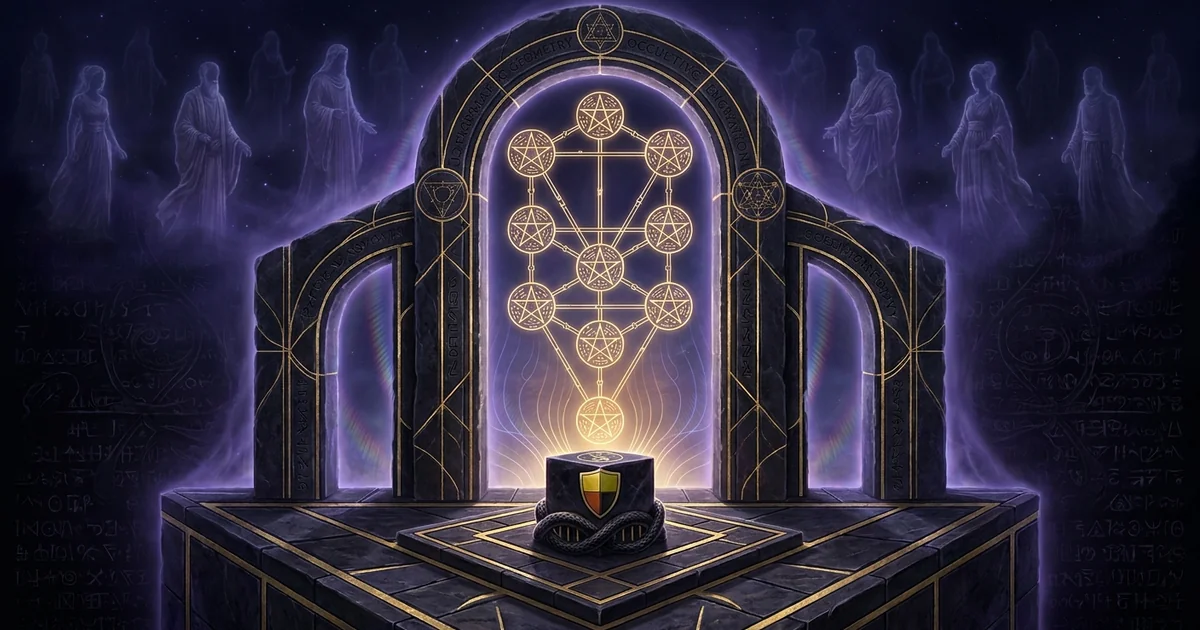
When Arthur Edward Waite and artist Pamela Colman Smith synthesized their seminal 1910 tarot deck, they revolutionized the iconographic landscape of the Minor Arcana. Smith’s visual hermeneutic for the Ten of Pentacles is a masterpiece of multi-layered Hermetic cartography. Rather than presenting an arbitrary assembly of ten coins, Smith arranged the ten golden discs according to the precise geometric layout of the Qabalistic Tree of Life (Otz Chiim), superimposing this metaphysical glyph over the domestic courtyard of an aristocratic manorial estate.
This architectural overlay carries profound semiotic weight. The uppermost pentacle corresponds to Kether, resting above the threshold of the archway, while the lowest pentacle corresponds to Malkuth, situated directly adjacent to the seated patriarch and the domesticated hounds. By mapping the macrocosmic Tree of Life onto the microcosmic social sphere, Smith visually demonstrated that human civilization, ancestral lineage, and urban infrastructure serve as the physical body of the Divine on Earth.
The figures within Smith’s composition illustrate the temporal mechanics of this Sephirotic descent:
- The Seated Patriarch: Positioned at the threshold, enveloped in an intricately embroidered mantle depicting grape clusters, heraldic crests, and mercurial caduceus-like motifs, he embodies the ancestral ego that has survived the entire evolutionary cycle. His back is partially turned to the viewer, signaling his departure from active engagement with the outer world as he gazes inward toward the lineage he has stabilized.
- The Intermediate Generation: A man and woman stand beneath the stone archway, engaged in civic or domestic administration. They represent the active ego-consciousness of the present era—the operators of the institutional machinery.
- The Child and the Domesticated Hounds: Positioned in the lower quadrant, the child grasps the coat of an adult while touching the hound, symbolizing the raw biological life-force entering the civilized matrix.
The archway itself serves as an esoteric gateway, bridging the primordial exterior wildness with the fortified, civil interiority of the ancestral domain. Through Smith’s brushwork, the ten of pentacles symbolism permanently fused Qabalistic metaphysics with the tangible realities of European feudal and bourgeois inheritance.
The Crowleyan Departure: Prudence, Inertia, and the Danger of Stasis
In his 1944 work The Book of Thoth, Aleister Crowley departed sharply from the bucolic, comforting domesticity of the Waite-Smith rendering. Influenced by Lady Frieda Harris’s dynamic, geometric projections, Crowley’s “Ten of Disks” presents a stark, mechanistic vision of the card, stripping away human narrative in favor of pure talismanic force. Crowley titled the card “Wealth,” but his commentary serves as a severe esoteric warning regarding the terminal inertia inherent to the number Ten in the suit of Earth.
Crowley recognized that while the Nine of Disks (Prudence) retained the living, intelligent balance of Venus in Virgo, the Ten marks the descent into complete material absorption. He argued that when wealth achieves total external manifestation, it exhausts its internal psychic momentum. In The Book of Thoth, he asserts that the disks in his card have become heavy, metallic coins stamped with complex cryptographic emblems, arranged inside a dense, labyrinthine fortress. The coins are inert; they no longer circulate.
For Crowley, this state approaches an energetic dead end. The earth has absorbed all available fire, water, and air, arriving at maximum structural density. Consequently, the Crowleyan departure underscores that the Ten of Disks is inherently precarious: it represents the ultimate accumulation that is on the precipice of decay. The only philosophical egress from this condition is the catastrophic or deliberate transmutation of accumulated matter back into spirit—the complete recycling of Assiah back into the primordial spark of the Kether of Wands. Crowley diagnosed that without this cyclical circulation, wealth turns into a necrotizing poison that destroys the very lineage that accumulated it.
Structural Mechanics & Symbolic Geometry: Decanic Attribution and Iconographic Anatomy
Mercury in the Third Decan of Virgo: Analytical Infrastructure and Resource Distribution
The structural mechanics of the Ten of Pentacles are governed by the astrological assignment of Mercury in the third decan of Virgo, an operational zone spanning from 20° to 30° of the mutable earth sign. Virgo is the nocturnal, earthy domicile of Mercury, as well as the sign of its exaltation. In the third decan, the communicative, analytical, and computational dexterity of Mercury is wedded to the granular, categorizing perfectionism of Virgo’s terminal degree.
This astrological convergence does not manifest as poetic contemplation or volatile conceptual breakthroughs; it operates as an administrative engine. Mercury here functions as the master clerk, the civil engineer, the estate lawyer, and the institutional archivist. It provides the analytical infrastructure necessary to convert abstract assets into permanent, self-regulating legal entities:
- Formulation of trusts, endowments, and wills that transcend the mortality of the testator;
- Rigorous actuarial science, land surveying, and architectural drafting;
- The meticulous bookkeeping that prevents systemic entropy from bleeding the estate’s reserves.
In this decan, the agility of Mercury is deliberately slowed down to match the deep, resonant frequencies of the earth element. The mental capacity is deployed to establish structural boundaries, verify titles of ownership, and engineer physical systems capable of withstanding socio-political shocks. The third decan of Virgo represents the harvest fully processed, measured, cataloged, and locked into grain silos to guarantee civic survival through an oncoming winter.
Spatial Topology: The Decagrammatic Arrangement as Tree of Life
The spatial topology of the classic Waite-Smith composition relies on a rigorous geometric armature. The ten pentacles are not scattered casually across the visual field; they construct the Otz Chiim (Tree of Life) across the vertical plane of the human settlement, establishing an esoteric ladder of consciousness.
The distribution of the pentacles forms an intricate systemic relationship between macrocosm and microcosm:
| Pentacle Position | Qabalistic Sephira | Corresponding Iconographic Element in Card | Hermetic Operational Function |
|---|---|---|---|
| Crown (Top) | Kether (1) | The keystone above the arched stone portal | The primordial ancestral origin and transcendent family mythos |
| Upper Pillars | Chokmah (2) & Binah (3) | Left and right architectural borders of the gateway | The structural laws, patrilineal/matrilineal balances, and foundational contracts |
| Central Trunk | Da’ath (Hidden) / Tiphareth (6) | The visual space occupied by the standing couple | The current, operational generation managing the estate’s visible balance |
| Lower Pillars | Chesed (4), Geburah (5), Netzach (7), Hod (8) | Pentacles flanking the human figures and estate walls | The regulatory mechanisms: capital assets, defensive boundaries, civic codes |
| Foundation | Yesod (9) | The space directly above the seated elder and child | The reproductive engine, transgenerational memory, and cellular continuity |
| Base (Bottom) | Malkuth (10) | Placed at the feet of the elder, near the earth and hounds | The final physical ground, concrete masonry, and biological manifestation |
By embedding this decagrammatic arrangement directly into the domestic scene, the visual syntax indicates that spiritual enlightenment and cosmic order are not divorced from the material world. Malkuth is not fallen beyond redemption; rather, Malkuth is the physical garment of the divine. The stone architecture of the city courtyard serves as an Assiatic mirror of the eternal, celestial architecture of the universe.
The Triadic Human Hierarchy and Canine Archetypes as Evolutionary Thresholds
The anthropomorphic landscape of the card is organized along a strict triadic hierarchy that charts the passage of time and the progressive transmission of cultural capital:
[ THE ELDER ]   --> Master of Memory, Transits the Threshold, Internalized Wisdom
      │
      ▼
[ THE COUPLE ]  --> Active Civic Agency, Economic Stewardship, Structural Maintenance
      │
      ▼
[ THE CHILD ]   --> Instinctual Future, Tabula Rasa, Receptive Integration of Lineage
This triadic social hierarchy represents the temporal continuity of consciousness. The elder patriarch, clad in a robe heavy with alchemical insignia, is seated at the boundary line of the home. His historical agency has concluded; his purpose now is to serve as the living archive—the psychopomp of the family’s narrative history. His gaze is directed away from the viewer, indicating that his sensory apparatus is focused upon the invisible, transcendent legacy he is about to surrender to his successors.
The mid-tier couple, standing in conversation beneath the heraldic coat of arms, represents active civic and biological agency. They are the generational bridge, responsible for maintaining the physical integrity of the walls, defending the legal perimeter, and sustaining the socioeconomic standing of the house. They operate within the sphere of Yetzirah, translating ancestral wisdom into daily managerial discipline.
At the lowest biological stratum, the young child stands beside two domesticated hounds. The child reaches out to grasp the hound’s ear, an act signifying the dawn of consciousness within the sensory-motor realm. The hounds themselves are profound esoteric emblems. Across comparative mythology, canines (from Anubis to Cerberus) operate as psychopomps and guardians of thresholds. In the Ten of Pentacles, these dogs are thoroughly domesticated; their predatory nature has been subjugated to the rule of the civilized hearth. They signify the mastery of animal instincts by human consciousness, demonstrating how biological nature is tamed, bred, and incorporated into the enduring civil order of the estate.
Psychological Dynamics & Operational Praxis: Transgenerational Epigenetics and Archetypal Inheritance
Transgenerational Transmission: Ancestral Complexes and Epigenetic Wealth
Viewed through the analytical psychology of Carl Gustav Jung, the Ten of Pentacles shifts from an external tableau of socioeconomic privilege into an internal diagnostic of the ancestral unconscious. Jung posited that the psyche of the newborn child is not a blank slate (tabula rasa), but a deeply inscribed field bearing the structural deposits of ancestral history. The individual ego does not emerge in a vacuum; it operates within the context of an ancestral complex—a vast psychic architecture composed of the unresolved traumas, accumulated adaptations, taboos, and systemic achievements of prior generations.
This dynamic corresponds directly to modern transgenerational epigenetics, which demonstrates that environmental stressors, behavioral paradigms, and chemical imprints are biologically transmitted down the lineage. The “wealth” signified by the Ten of Pentacles is therefore psychological and epigenetic:
- It includes the unconscious resilience developed by ancestors who survived historical catastrophes;
- It encodes family scripts regarding power, scarcity, sovereignty, and worth;
- It carries the latent shadow complexes of past compromises made to secure material safety.
The individual born into the field of the Ten of Pentacles is gifted an enormous apparatus of psychological scaffolding—a secure ground from which to launch individuation. However, this inheritance comes with an exacting energetic cost. The ancestral complex exerts a powerful gravitational pull on the ego, demanding loyalty to the family mythos at the expense of authentic personal divergence. The unconscious mandate of the lineage whispers: We have built this sanctuary through our blood and labor; you are forbidden to live outside its stone boundaries.
Comparative Anatomy: Nine of Pentacles vs. Ten of Pentacles
To accurately delineate the psychic landscape of the Ten of Pentacles, it is necessary to contrast its operational field with that of its developmental predecessor, the Nine of Pentacles.
Nine of Pentacles: Solitary Individuation
- Astrological Engine: Venus in Virgo
- Locus of Consciousness: The solitary, autonomous individual in her enclosed garden (hortus conclusus).
- Source of Capital: Self-cultivated discipline, aesthetic refinement, individual psychic integration.
- Psychological Dynamic: Pure self-containment; the ego has transmuted instinct (the hooded falcon) into refined artistic and economic sovereignty.
- Systemic Scope: Singular and immediate; terminates with the biological lifespan of the sovereign practitioner.
Ten of Pentacles: Systemic Inheritance
- Astrological Engine: Mercury in Virgo
- Locus of Consciousness: The multi-generational collective within the civic, stone-built courtyard.
- Source of Capital: Ancestral codification, legal trusts, institutionalized labor, intergenerational wealth.
- Psychological Dynamic: Surrender of solitary autonomy to systemic duty; the ego is integrated into the larger ancestral and civic matrix.
- Systemic Scope: Transpersonal and permanent; engineered to outlive any single human custodian through legal and cultural codices.
The Nine of Pentacles represents the apex of solitary individuation under the harmonizing governance of Venus. The woman in the vineyard requires no external validation, no ancestral mandate, and no familial scaffolding. Her authority is self-authored; her resources are the immediate yield of her own labor.
In sharp contrast, the Ten of Pentacles, guided by Mercury, shifts the locus from the autonomous self to the intersubjective institution. The private vineyard is replaced by the stone courtyard; the singular woman is replaced by the ancestral patriarch, the operational couple, and the inheriting child. Here, solitary freedom is sacrificed to guarantee long-term security. The ego recognizes that its singular existence is transient, choosing to embed its achievements in an enduring framework that outlasts biological death.
Operative Divinatory Interpretation: Structural Sovereignty vs. Claustrophobic Conformity
In the operative praxis of divinatory hermeneutics, the Ten of Pentacles demands a deep interrogation of systemic context. The practitioner must avoid the superficial error of reading the card merely as an augury of financial bonanzas. Instead, the card diagnoses the subject’s relationship with their foundational structures: their lineage, their institutional affiliations, their legacy, and their cultural paradigm.
When the card operates within a benign, integrated polarity, it signifies Structural Sovereignty:
- The querent is anchored by a robust, syntropic foundation that provides resources, social capital, and existential safety;
- Acknowledgment and integration of ancestral strengths, converting generational lineage into a springboard for current creative endeavors;
- The formalization of chaotic endeavors into sustainable, long-term enterprises—incorporating businesses, establishing trusts, securing real estate, or executing permanent contracts.
Conversely, when the card slips into an unintegrated or oppressive polarity, it reveals Claustrophobic Conformity:
- The individual is held hostage by the expectations, neuroses, and emotional blackmail of an authoritarian family system;
- Stifling traditionalism that penalizes any creative deviation from the ancestral script;
- Golden handcuffs: remaining in a deadening career, an abusive dynastic partnership, or an outmoded corporate structure simply because the material security is too lucrative to abandon.
The diagnostic objective of the practitioner is to determine whether the stone walls of the estate are acting as a protective sanctuary that nurtures the querent’s growth, or as a mausoleum that prevents the soul from pursuing its authentic, extra-familial individuation.
Philosophical Synthesis & Macrocosmic Correspondence: Entropic Completion and the Cybernetic Cycle
The Law of Terminal Manifestation: The Return to the Void
From an esoteric philosophical vantage, the Ten of Pentacles articulates the inexorable Law of Terminal Manifestation. In the mechanics of Hermetic Qabalah, the descent from the archetypal world of Atziluth through the creative world of Briah and the formative world of Yetzirah finds its terminus in the material world of Assiah. Malkuth is the vessel (Kli) that receives the totality of the preceding Sephirotic emanations.
[ Atziluth: Archetypal Emanation ]
               │
               ▼
[ Briah: Creative Gestation ]
               │
               ▼
[ Yetzirah: Formative Structuring ]
               │
               ▼
[ Assiah / Malkuth: Material Saturation ] ──> [ ENTROPIC TRANSITION: Return to Kether ]
Because Malkuth is the terminal receiver, it possesses no independent creative capacity to emanate downward into an eleventh sphere. It is the absolute end of the energetic chain. Once the creative impulse has fully deposited itself into matter, the process of descent terminates. The system has reached maximum density, maximum complexity, and maximum structural stability.
However, according to the fundamental laws of thermodynamics, any closed system that achieves maximum stability and density faces the onset of entropy. Without the infusion of new kinetic libido, the accumulated matter begins its inexorable decay into dust. Therefore, the esoteric mystery embedded within the Ten of Pentacles is that the moment of ultimate materialization is identical with the commencement of dissolution. The material form must eventually collapse to release the trapped divine spark, initiating the cyclical ascent back to Kether. Wealth accumulated to its absolute limit must either circulate or decay; it cannot remain static indefinitely.
“No one who is conscious of the continuity of history can fail to see how the ancestral spirits, so to speak, live on in our social conventions, our laws, and our psychological instincts. The past is not dead; it is not even past. It constitutes the very foundation of the modern ego, providing the structural container without which the individual would dissolve into the chaos of the instinctual unconscious.”
Hermetic Axiomatic Integration: As Above (Kether), So Below (Malkuth)
The foundational Hermetic axiom, “As above, so below; as below, so above,” finds its definitive illustration in the identity between Kether and Malkuth. The Qabalistic aphorism Malkuth is in Kether, and Kether is in Malkuth, but after another manner reveals that the terminal density of the Ten of Pentacles is not a degradation of spiritual purity, but its perfect physical mirror.
In Kether, the Divine is pure, undifferentiated, infinite potentiality—completely unmanifest and devoid of tangible reality. In Malkuth, the Divine achieves its absolute opposite: completely differentiated, concrete, finite manifestation. The Ten of Pentacles is therefore Kether rendered visible, palpable, and historically real. The stone walls of the ancestral domain, the heraldic shields, the ledger books, and the biological bodies of the family lineage are not fallen illusions; they are the living architecture of the Divine inhabiting the material plane.
This Hermetic synthesis destroys the ascetic illusion that spirituality requires the renunciation of matter. The master of the Ten of Pentacles does not flee the physical world; he masters its administrative laws, respects its physical constraints, and uses its resources to build systems that reflect cosmic harmony. Physical legacy becomes an act of high spiritual alignment. True wealth is understood as the deliberate spiritualization of matter and the materialization of spirit.
Societal Infrastructure as the Extended Phenotype of Collective Consciousness
In macrocosmic terms, the Ten of Pentacles charts the phenomenon of the “extended phenotype”—a biological concept pioneered by Richard Dawkins, expanded here into the psycho-cosmological realm. Just as a beaver constructs a dam or a termite builds a cathedral-like mound to regulate its external environment, the human species constructs legal systems, financial architectures, cities, and cultural traditions as an externalized, physical matrix designed to maintain psychic and biological homeostatic equilibrium.
Society’s institutional infrastructure is the physical projection of the collective unconscious. When we observe the vast, interconnected systems of global banking, constitutional law, generational real estate, and municipal utilities, we are looking at the Ten of Pentacles on an evolutionary scale. These systems are the syntropic bulwarks engineered by human consciousness to hold back the primeval chaos of the wilderness:
- They ensure that the hard-won insights of departed ancestors are preserved across historical disruptions;
- They provide a stable material plateau that frees subsequent generations from reinventing fire, agriculture, and governance from scratch;
- They create the physical safety and leisure required for philosophy, science, and the arts to emerge.
Yet, this extended phenotype requires vigilant custodial awareness. When humanity forgets that its institutions were built to serve living consciousness, and instead begins sacrificing living human potential to preserve the dead institutional forms, the balance fractures. The wealth of the Ten of Pentacles is a thermodynamic holding pattern; true mastery resides in circulating that wealth back into the evolutionary cycle rather than guarding dead gold inside an entropic fortress.
Frequently Asked Questions: Resolving Advanced Symbolic and Interpretive Ambiguities
Decoupling Financial Affluence from Ancestral-Systemic Coherence
One of the most persistent analytical errors in reading the Ten of Pentacles is the immediate, unexamined reduction of the card to quantitative cash liquidity or personal monetary luxury. The card does not denote immediate disposable income, an unexpected financial windfall, or speculative market gains; such dynamics belong properly to cards like the Wheel of Fortune, the Ace of Pentacles, or the Six of Pentacles. The Ten of Pentacles diagnoses the structural, systemic, and genealogical integrity of the querent’s operational foundation.
A querent may possess substantial liquid wealth while residing in absolute systemic ruin—characterized by toxic transgenerational trauma, alienated offspring, fractured family alliances, and an absence of any enduring legacy. In such an instance, drawing the Ten of Pentacles does not confirm personal success; it interrogates the hollowness of their material platform.
Conversely, an individual or community of modest economic means may exhibit an exalted Ten of Pentacles if they are embedded within a resilient, deeply integrated ancestral, communal, or cultural lineage that provides unyielding psychological, emotional, and social safety across generations. The true metric of the card is systemic coherence, institutional stability, and transgenerational resilience—not the superficial accumulation of paper currency.
The Hermeneutics of the Reversed Configuration: Systemic Entropy vs. Ancestral Exorcism
When the Ten of Pentacles appears in a reversed or structurally compromised orientation, its hermeneutic polarity splits into two diagnostic trajectories: systemic entropy or deliberate ancestral exorcism.
Systemic entropy illustrates the decaying trajectory of an institutional or family system:
- The progressive dissipation of generational wealth through financial mismanagement, profligacy, or bitter legal battles over inheritance;
- The collapse of real estate holdings, the decay of physical property, or the dissolution of long-standing corporate entities;
- The chronic presence of unaddressed ancestral curses, transgenerational trauma, and systemic secrets that bleed the energetic vitality of living family members.
Conversely, the reversed configuration frequently registers a vital, necessary stage in psychological individuation: ancestral exorcism. Here, the reversal represents the conscious, courageous choice of the individual to sever ties with a pathological lineage complex. It is the refusal to accept the “golden handcuffs” of an inheritance that demands the compromise of the soul’s integrity:
[ Reversed Ten of Pentacles ]
               │
               ├── (Pathology): Systemic Entropy, Disputed Wills, Dynasty Decay
               └── (Liberation): Conscious Severing of Toxic Family Scripts / Ancestral Exorcism
The querent deliberately steps out of the ancestral fortress, accepting temporary material insecurity or disinheritance to liberate their ego from centuries of calcified familial neurosis. In this context, the reversed card marks the heroic rupture that prevents the dead past from devouring the living future.
The Paradox of Mercurial Speed Governing the Static Density of Earth
A common theoretical conundrum in tarot hermeneutics involves the decanic attribution of the rapid, volatile, and airy planet Mercury to the third decan of Virgo—a mutable earth sign governing the dense, seemingly static architecture of the Ten of Pentacles. How can the swift messenger of the gods, characterized by volatility, communication, and intellectual speed, rule over the heaviest and most conservative card in the suit of Earth?
This paradox resolves when one grasps that complex, long-term material holdings cannot survive across time through physical mass alone. Physical structures left unmanaged fall victim to the Second Law of Thermodynamics; stone crumbles, wood rots, and boundaries fade. The force that preserves an estate, a corporation, or a civilization across centuries is not the density of its concrete, but the constant, highly refined administrative intelligence that manages its affairs.
This preservation relies entirely on mercurial mechanisms:
- The continuous updating of accounting ledgers, legal codices, and contractual instruments;
- The precise communication of family protocols, ethical codes, and administrative procedures across generational gaps;
- The intellectual agility required to navigate changing civic, political, and economic landscapes without shattering the foundational core of the estate.
Mercury in Virgo represents the administrative intellect acting as the guardian of physical form. It is the intelligence of the surveyor, the auditor, and the archivist. Without this continuous computational and organizational management, the stone walls of the Ten of Pentacles would collapse into ruin. Thus, the swift, analytical intellect of Mercury is the indispensable stabilizing engine that keeps the static weight of the earth element from succumbing to entropy. :::