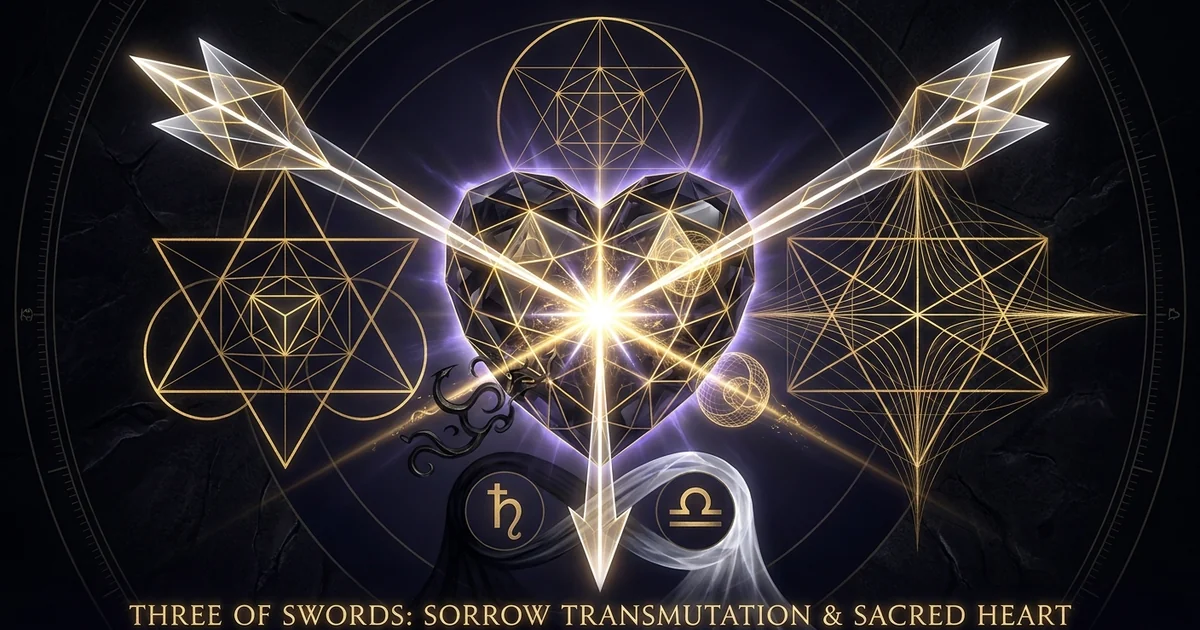
Three of Swords: Sorrow Transmutation and Sacred Heart
Archetypal Thesis & Systemic Paradigm: The Epistemic Cleavage of Binah in Yetzirah
The Triadic Rupture of Egocentric Synthesis
The Three of Swords operates within esoteric cartography not as an omen of vulgar emotional catastrophe, but as an essential epistemic rupture within the psycho-spiritual architecture of consciousness. Within the developmental trajectory of the Tarot’s Minor Arcana, the transition from the dyadic tension of the Two of Swords to the triadic crystallization of the Three represents the catastrophic yet indispensable intrusion of objective reality into an artificial equilibrium. The ego, functioning through the lower faculties of the mental apparatus, constantly manufactures insular narratives designed to protect its self-referential coherence. It constructs an imaginary stasis wherein subjective desire and existential law are falsely equated. The Three of Swords shatters this dynamic. It forces the systemic breakdown of naive, self-contained psychological synthesis through the sharp intervention of supernal principle.
This rupture is fundamentally structural, governed by the metaphysical coordinates of Binah operating within the astral matrix of Yetzirah. As the third Sephira on the Tree of Life, Binah designates the Great Mother, the cosmic matrix of Primordial Form, Saturnian boundary, and radical limitation. When the expansive, luminous vitality of Kether and Chokmah descends into Binah, it encounters the first cosmic constriction—the primordial restriction that establishes finitude, mortality, and structural differentiation. In the world of Yetzirah—the formative, psycho-fluidic astral plane where human ideation, emotional projection, and lower mental forms interact—the imposition of Binah is inevitably registered by the empirical ego as an act of absolute violence. It is the surgical slicing of subjective delusion by universal law.
The three of swords tarot meaning cannot be reduced to the trivialities of mundane bereavement or domestic disappointment. Rather, it represents the ontological condition of consciousness coming into direct, unbuffered contact with the law of cosmic limitation. The card delineates the precise locus where the mind recognizes that its idealized internal models do not command the architecture of the cosmos. The resulting sorrow is the cognitive friction produced by this realization: the agony of a constructed self-concept dissolving upon the unyielding anvil of objective truth.
- Sephiric Attribution: Binah (Understanding, Form, Primordial Limitation, The Great Sea).
- Cosmological World: Yetzirah (The Astral/Formative World of Archetypal Patterns and Ideational Current).
- Astrological Decanate: Second Decan of Libra (10°00’ to 19°59’ Libra).
- Decanic Ruler: Saturn (classical Ptolemaic attribution and Hermetic Order of the Golden Dawn).
- Elemental Attribution: Water of Air (The reflective, form-giving, and receptive sub-element of the intellectual current).
- Hermetic Title: The Lord of Sorrow.
- Structural Mechanics: Imposition of Saturnian law upon the mental medium, converting unstable, ungrounded ideation into concrete, painful existential realization.
Swords Suit Mechanics and the Hyper-Differentiation of Mind
The mechanics of the swords suit are fundamentally tied to the air element, which governs the rational mind, discursive intellection, communicative exchange, and the analytical capacity of the human psyche known in Qabalah as the Ruach. Air is inherently discriminative, volatile, and separating; its operational modality is diairesis—the division of a whole into its constituent parts to achieve clarity. Where the water element binds, dissolves, and unifies through feeling, the air element isolates, cuts, and delineates through conceptual boundaries. When operating unchecked in the lower psyche, this analytical capacity produces excessive intellectualization, alienation, and obsessive compartmentalization.
In the Three of Swords, this hyper-differentiation reaches a critical threshold. The analytical razor of the mind is turned directly upon the subjective core of the organism: the feeling center. The intellect ceases to merely categorize external phenomena and instead performs a radical psychic autopsy on its own emotional dependencies. The swords do not cut outward; they converge inward, penetrating the affective matrix. This reveals the foundational paradox of the air element: its ultimate function is not the endless generation of discursive theories, but the ruthless eradication of falsehood, even when that falsehood constitutes the foundational comfort of the personality.
This elemental dynamic—the water of air—demonstrates why this station is titled the Lord of Sorrow. It is the collision of the fluidic, receptive, and emotional sub-element (Water/Binah) with the volatile, dry, and penetrating macro-element (Air/Yetzirah). The sharpness of intellectual discernment strikes the ocean of feeling, precipitating a structural crisis. The mental apparatus ceases to be an instrument of clever defense mechanisms and becomes an instrument of existential reckoning, enforcing the severe recognition of what is, as opposed to what the ego desired to project.
Transmuting Pathological Sorrow into Objective Lucidity
The esoteric objective of the Three of Swords is the systematic transmutation of pathological sorrow (tristitia) into objective lucidity (sapientia). Pathological grief is essentially circular, regressive, and narcissistic; it is an affective loop wherein the ego mourns the loss of its own projection, identifying as an arbitrary victim of external catastrophe. In this state, the individual remains trapped in an unresolved lamentation that reinforces the sense of an isolated, persecuted selfhood. The intellect is subverted into serving this wound, constructing rationalizations that solidify resentment and petrify the emotional life.
Conversely, the initiatory function of the Three of Swords demands the alchemical distillation of this affective crisis. When sorrow is accepted not as an existential injustice but as an epistemological threshold, the nature of the pain is completely altered. The swords become instruments of release, puncturing the abscess of psychological inflation. Sorrow, in this transpersonal paradigm, is understood as the exact metric of an illusion being stripped away. The intensity of the suffering corresponds precisely to the degree of prior identification with a false image of reality.
By allowing the swords of analytical clarity to penetrate the sentimental defenses of the personality, the practitioner accesses the higher reflective capacities of the Ruach. The collapse of the internal fantasy structure creates a vacuum of absolute honesty. In that vacuum, subjective agony ceases to be mere pathology and instead becomes the operational engine of liberation, establishing an unshakeable ground of objective seeing that paves the way for the profound psychological stillness mapped in the Four of Swords.
Classical Provenance & Textual Lineage: From Marseilles Geometry to the Pierced Heart
The Marseilles Tradition: Curvature, Entanglement, and Floral Emergence
To comprehend the structural evolution of the card, one must examine its historical iconography. In the historical Tarots of the Marseilles pattern—exemplified by the woodcuts of Jean Noblet (c. 1650) and Nicolas Conver (1760)—the Three of Swords contains no anthropomorphic heart, no storm clouds, and no explicit visual narrative of somatic wounding. Instead, the card presents a purely abstract, geometric, and vegetative configuration: two curved, scimitar-like blades cross one another to form an elliptical, mandorla-like vesica, through the center of which a straight, double-edged vertical sword passes, cleaving the intersection.
/ \
      / | \
     |  |  |
     |  |  |
      \ | /
       \ /
This geometric arrangement communicates the archetypal mystery through non-sentimental means. The two intersecting curved blades represent the polar forces of duality—reminiscent of the Two of Swords—held in mutual tension, creating a bounded space of gestation. The third, vertical blade acts as the decisive axis, the resolving principle that shatters the sterile equilibrium of the dual blades. Surrounding and entwining this central metallic intersection are intricate floral tendrils and organic foliage. The Marseilles iconography does not depict passive destruction; it depicts a vegetative generation achieved through mechanical and dialectical tension. The cutting of the sword is shown to be inextricably linked with the germination of life. The flora emerges directly from the sites of friction, demonstrating that the structural wound is the generative precondition for higher organic and spiritual development.
The Golden Dawn Synthesis: Titular Severity and Decanic Attributions
The late nineteenth-century occult revival, driven by the Hermetic Order of the Golden Dawn, shifted the card from vegetative geometry to rigorous astrological, kabbalistic, and talismanic codification. In S.L. MacGregor Mathers’ foundational text Book T, the card was formally christened with its Hermetic title: “The Lord of Sorrow.” The Golden Dawn stripped the imagery of incidental folk elements and positioned it precisely within the framework of their astrological-qabalistic decanic system.
“Three of Swords: The Lord of Sorrow. Binah in the Sphere of Air. Saturn in Libra. Three swords crossed, their points meeting in a heart; around are rays of light, but above are heavy, dark, and threatening clouds. Ruin, disruption, interruption, separation; but also, through its connection with the sphere of Saturn and Binah, it represents that deep sorrow which cleanseth the soul, the realization of the transitoriness of things, and the beginning of wisdom.” — S. L. MacGregor Mathers & W. W. Westcott, The Golden Dawn Cypher Manuscripts and Ritual Papers (Book T) (1888)
“This card is referred to Binah; it represents the realization of the ideal, and its disruption. It is the card of sorrow. Saturn in Libra shows that the intellect has taken a severe, critical, and analytical turn… The card represents the dark, heavy, and impenetrable nature of the element of Air when it is subjected to the concentrated, binding, and restrictive power of Saturn. It is the crystallization of thought into an absolute and unchanging formula, which brings about destruction through its own rigidity.” — Aleister Crowley, The Book of Thoth: A Short Essay on the Tarot of the Egyptians (1944)
The Golden Dawn’s attribution of the card to the second decan of Libra, governed by Saturn, was a masterstroke of esoteric synthesis. Mathers and his circle understood that Binah’s entry into the astral sphere of Air must produce an absolute crisis of form. In their private diagrammatic instructions, the Golden Dawn prescribed that the three swords should meet at a single focal point, piercing a central, symbolic organ of feeling, surrounded by an atmosphere of disruptive, stormy volatility. This design consolidated the card’s meaning: it was not merely an encounter with misfortune, but an initiation into the Saturnian laws of balance, consequence, and karmic necessity.
Pamela Colman Smith’s Synthesis: Marian Mater Dolorosa and the Sacred Heart
In 1909, under the editorial direction of Arthur Edward Waite, artist Pamela Colman Smith fundamentally revolutionized the iconography of the card. Drawing upon her exposure to the Golden Dawn’s secret diagrams, Smith executed an image that became the definitive modern visual grammar of the three of swords symbolism. However, rather than adhering exclusively to Hermetic abstraction, Smith—a convert to Catholicism—synthesized occult geometry with classic Catholic mystical iconography, specifically the traditions of the Mater Dolorosa (the Mother of Sorrows) and the Sacred Heart of Jesus.
   \   |   /
    \  |  /
   ┌───────┐
   │ █ █ █ │
    \  |  /
     \ | /
       v
In the iconography of the Seven Sorrows of Mary, the cardiac center of the Virgin is depicted pierced by seven literal swords, visualizing Simeon’s prophecy in the Gospel of Luke: “Yea, a sword shall pierce through thy own soul also, that the thoughts of many hearts may be revealed.” Smith distilled this multi-sworded Marian emblem down to the triad of the Golden Dawn structure. Concurrently, she invoked the Sacred Heart—the exposed, radiant, yet wounded heart of Christ, crowned with thorns and bleeding, which signifies divine love made vulnerable and luminous through sacrificial suffering.
By isolating the heart, suspending it without an accompanying human torso amidst a grey, tempestuous sky pierced by driving rain, Smith lifted the image out of idiosyncratic human tragedy and cast it as an archetypal, objective transaction. The heart in Smith’s rendering is not an anatomical muscle; it is the solar organ of spiritual consciousness, suspended in the collective astral atmosphere, undergoing a necessary crucifixion by the structural vectors of the mind.
Structural Mechanics & Symbolic Geometry: Astrological Decanates and Qabalistic Anatomy
Saturn in Libra: The Exaltation of Law Within the Sanctuary of Harmony
The astrological engine driving the Three of Swords is the placement of Saturn within the second decan of Libra (10° to 20°), an astrological sector traditionally associated with the pursuit of balanced union, social equilibrium, and aesthetic perfection. In classical astrology, Saturn finds its exaltation in the sign of Libra. This exaltation is not a gentle harmonic; it is the elevation of absolute cosmic law within the sign of balance. Saturn represents time (Chronos), crystallization, structural integrity, boundary, and the inexorable payment of karmic debt. Libra, a cardinal air sign ruled by Venus, seeks harmony, symmetry, and ideal relational constructs.
When Saturn is exalted in the middle decan of Libra—an environment explored in detail through the study of Saturn in Libra—the result is the uncompromising confrontation of ideal forms with the cold reality of temporal existence. The second decan of Libra demands absolute, unvarnished justice. It tests every emotional pact, every romantic contract, and every aesthetic posture for structural integrity. If a relational construct is built upon projection, sentimental compromise, or internal dishonesty, Saturn’s exaltation acts as a structural auditor. The sword falls not out of malice, but because the architecture cannot bear the weight of truth. The pain generated by this decanate is the precise psychic consequence of an untenable ideal collapsing under the weight of reality.
The Symbolic Geometry: The Pierced Triad over Atmospheric Volatility
The visual composition of the Three of Swords is a masterclass in esoteric geometric dynamics. The three swords are arranged in an inverted triadic pattern: two lateral swords enter diagonally from the upper left and upper right quadrants, intersecting within the visceral mass of the heart, while a third, central sword descends plumb along the vertical axis, dividing the heart into two symmetrical lobes.
The two diagonal swords represent the dualistic currents of the discursive intellect: thesis and antithesis, affirmation and denial, memory and anticipation. These lateral blades cross and pin the heart, paralyzing its capacity to pursue subjective comfort. The third, central blade represents the descent of Binah’s absolute judgment, the vertical ray of transcendental reality penetrating the plane of manifestation. The meeting point of these three blades forms a downward-pointing, invisible triangle—the ancient elemental glyph for Water. Thus, through the very medium of the swords (Air), the glyph of Water (the heart, feeling, receptive soul) is geometrically manifested and ritually sealed.
Below and around this suspended cardiac nexus, the atmosphere is choked with heavy, striated nimbostratus clouds discharging diagonal sheets of rain. In esoteric meteorology, this background indicates the hyper-activated, turbulent state of the Yetziratic medium. The clouds represent the condensation of mental forms; the rain represents the release of accumulated tension through tears and catharsis. The atmospheric pressure depicted is extreme: the mental atmosphere has reached critical saturation, and the downpour signifies the unavoidable clearing of the astral skies, washing away the projections that previously obscured spiritual perception.
The Vectoral Physics of Air Piercing the Solar Core (Tiphereth)
Qabalistically, the heart is the anatomical and spiritual analogue to Tiphereth—the sixth Sephira, located at the precise center of the Tree of Life. Tiphereth is the seat of the Sun, the Christ-consciousness, the Higher Self, and the harmonizing balance of the personality. It is the solar furnace of the psyche.
When the Three of Swords depicts the piercing of the heart without a surrounding human body, it demonstrates that this operation is not personal or biological, but an objective metaphysical transaction occurring within the universal anatomy of the psyche. The swords of Binah descend from the Supernal realm, slicing through the Abyss, to strike the solar core of Tiphereth. This vectoral descent accomplishes a vital task: it shatters the solar ego’s capacity for self-deception. Left to itself, Tiphereth can succumb to a golden, solipsistic hubris, viewing itself as the self-generated center of the universe. The Binah-strike introduces the reality of the Supernal Mother—the reality that the ego is subject to cosmic law, finitude, and transience. The piercing of Tiphereth by the Air element is the mechanical requirement for the solar center to open outward, transforming from an introspective, self-admiring light into a radiant, self-emptying vessel of universal empathy.
Psychological Dynamics & Operational Praxis: The Alchemical Mortificatio and Individuation
The Archetypal Mortificatio: The Blackening of the Ego-Ideal
In the lexicon of Jungian depth psychology and classical alchemy, the Three of Swords embodies the stage of the mortificatio and the nigredo—the voluntary and involuntary death of the initial psychological prima materia. The mortificatio is the alchemical operation wherein a psychic structure is subjected to decomposition, putrefaction, and systemic breakdown. It represents the utter failure of the ego’s attempts to organize reality according to its conscious desires.
In his studies of the alchemical opus, Carl Jung observed that individuation is structurally impossible without the systematic dismantling of the persona and the ego-ideal. The ego-ideal is the internal psychological idol: the image of who we believe we “ought” to be, or the idealized projection of how we believe the world “ought” to respond to us. The Three of Swords represents the surgical execution of this psychic idol. It is the threshold where the analytical scalpel of truth punctures the inflated balloon of narcissistic fantasy.
This process is fundamentally characterized by an experience of profound psychological blackness. The mind, which previously relied on its cleverness to insulate itself against trauma, finds its defense mechanisms completely compromised. Intellectualization fails; rationalization collapses; defensive cynicism reveals itself as an exhausted facade. The subject is forced into direct, unmitigated communion with psychic wounding. It is precisely in this state of mortificatio—the absolute deflation of the personal claim to immunity—that the possibility of radical psychological transformation is born.
Pathological Egoic Grief
- Operational Stance: The subject identifies as a passive, arbitrary victim of an unjust circumstance.
- Affective Motion: Cyclic, rumination-driven, and regressive; energy feeds self-pity and resentment.
- Cognitive Function: Rationalization and intellectualization are weaponized to avoid self-accountability.
- Saturnian Expression: Cold calcification, emotional numbness, permanent cynicism, and petrification of the psyche.
- Alchemical State: Stagnant putrefaction without fire; psychic material putrefies without releasing its essence.
Transmutative Sacred Heart Sorrow
- Operational Stance: The subject recognizes sorrow as the mechanical metric of an illusion being stripped away.
- Affective Motion: Linear, cathartic, and transpersonal; emotional energy is mobilized into radical empathy.
- Cognitive Function: Analytical intellect (Air) is turned inward to deconstruct false projections and identifications.
- Saturnian Expression: Conscious acceptance of limitation, boundary, time, and karmic accountability.
- Alchemical State: True mortificatio and nigredo; the ego-ideal dies to liberate the transpersonal Self.
The Swords Suit as Cognitive De-identification and Shadow Integration
The three of swords tarot meaning within an active clinical or diagnostic context highlights the necessity of cognitive de-identification. Most psychological distress originates not from direct sensory events, but from the narrative apparatus of the Ruach that attaches to those events. The swords suit illustrates the mind’s profound capacity to create its own internal hell through obsessive ideation, recursive loops of worry, and rigid belief systems.
When the Three of Swords manifests in the psychological field, it signals an immediate mandate to dis-identify from cognitive structures. The swords that pierce the heart are made of the very thoughts, judgments, and unexamined convictions that the individual has harbored. In this critical juncture, the shadow—specifically the intellectual shadow, consisting of repressed doubts, unacknowledged hypocrisies, and hidden expectations—bursts into the open. The pain experienced is the friction of the shadow forcing its way through the cracked mask of the conscious persona.
Shadow integration within this station requires the individual to stop deflecting the pain onto external actors. If the heart is pierced, the diagnostic question is not: “Who held the sword?” The deeper, operative question is: “What brittle, untenable fantasy did I construct that made this wounding structurally inevitable?” By taking radical ownership of the cognitive architecture that allowed the illusion to flourish, the individual ceases to be a victim of circumstance and becomes an active participant in their own individuation.
Operational Divinatory Integration: Navigating the Threshold of Disillusionment
In practical divination and esoteric psycho-navigation, encountering the Three of Swords is an unambiguous directive: the querent must lean consciously into their cognitive dissonance. The instinct of the lower ego when confronted with this card is to seek immediate comfort, to solicit a palliative narrative, or to project blame onto an external agent (such as an unfaithful partner, a deceptive colleague, or an unpredictable turn of fate). To indulge this avoidance is to abort the initiatory work of the card, perpetuating pathological grief.
Operational integration demands that the reader or practitioner guide the consciousness directly into the wound. The diagnostic protocol unfolds through three precise phases:
- Isolation of the False Premise: Identify the specific idealized expectation or romanticized projection that has suffered destruction. Where was reality denied in favor of an agreeable fiction?
- Deconstruction of the Defensive Intellect: Examine how the air element has been misused—through rationalization, denial, or emotional detachment—to avoid feeling the reality of the situation.
- Active Catharsis and Radical Acceptance: Allow the emotional core (the heart) to experience the full impact of the collapse without reaching for conceptual anesthesia. This is the stage of Saturnian integration: bowing to the reality of the limitation, the loss, or the ending.
The card serves as a diagnostic scalpel. It appears when the threshold of disillusionment has arrived, and it asserts that the fastest way through the storm is not to outrun the clouds, but to stand at the epicenter of the downpour until the false structures of the psyche are completely washed away.
Philosophical Synthesis & Macrocosmic Correspondence: The Sacred Heart as Axis of Transmuted Suffering
Hermetic Polarity: The Transmutation of Mental Agony into Supernal Compassion
The philosophical zenith of the Three of Swords is found in the Hermetic law of Polarity: “Everything is Dual; everything has poles; everything has its pair of opposites; like and unlike are the same; opposites are identical in nature, but different in degree.” Within this Hermetic principle, mental agony and supernal compassion are not two distinct emotional currents, but the lower and higher vibrational frequencies of the exact same energy.
The uninitiated heart is a closed vessel, insulated by protective layers of ego-defense, pride, and tribal loyalty. It loves selectively; it cares conditionally; it extends empathy only to that which reflects its own desires. For such a heart to evolve into an organ of transpersonal, universal awareness, it must be violently opened. The swords act as the crowbars of the spirit. They break open the calcified container of the heart, exposing its raw, pulsating core to the infinite suffering of the world.
“The mortificatio is a most unpleasant operation, but it is entirely necessary. It represents the psychological experience of death, the dark night of the soul, wherein the light of the ego is extinguished… It is only when the ego-will is completely broken and brought to realize its utter helplessness that the true centre of the personality—the Self—can begin to take the place of the ego. Suffering is not an obstacle to individuation; it is the very path along which individuation travels.” — Carl Gustav Jung, Collected Works Vol. 9, Part 2: Aion: Researches into the Phenomenology of the Self (1951)
“The alchemists recognized that without the putrefactio and the mortificatio, no real transmutation could occur. One must enter the blackness; one must endure the piercing of the heart by the sword of discriminative consciousness. It is precisely in the deepest blackness of the nigredo that the seed of the miraculous gold is hidden. The sorrow of the mortification is the catalyst that forces the soul to transcend its infantile attachments.” — Marie-Louise von Franz, Alchemy: An Introduction to the Symbolism and the Psychology (1980)
Once cleaved, the heart undergoes a structural metamorphosis. It ceases to be an organ of personal clinging and becomes the Sacred Heart—the metaphysical nexus through which the suffering of the cosmos is processed, felt, and transfigured. The individual discovers that their personal sorrow is merely a drop within the vast ocean of collective existential pain. The mental agony of feeling isolated in one’s wound is transmuted into the supernal compassion of recognizing that all sentient existence is bound to the same wheel of transience, limitation, and yearning. The wound becomes the portal through which grace enters the mundane vessel.
Cross-Systemic Parallels: Bodhicitta Born from Samsaric Agony
This Hermetic transmutation parallels the core soteriological doctrines of Mahayana and Vajrayana Buddhism, specifically the arising of Bodhicitta—the awakened heart-mind that seeks enlightenment for the benefit of all sentient beings. In Buddhist psychology, authentic Bodhicitta does not arise from comfortable intellectual meditation or pleasant aesthetic conditions. It is born directly from the acute, unshrinking contemplation of dukkha (suffering, unsatisfactoriness, impermanence).
The Tibetan practice of Tonglen (giving and taking) provides a direct functional model for the Three of Swords archetype. In Tonglen, the practitioner visualizes breathing in the dark, heavy, hot smoke of universal suffering—drawing the pain of all beings directly into their own heart. At the center of the heart, this suffering strikes the diamond-hard rock of self-cherishing and ego-clinging, completely shattering it. Upon exhaling, the practitioner radiates out cool, white light, offering peace, liberation, and well-being.
This practice is the structural equivalent of Smith’s suspended, pierced heart. The Three of Swords demonstrates the exact moment the rock of self-cherishing is broken open by the swords of ultimate reality. The pain is not avoided; it is absorbed, processed at the solar center, and transfigured into the fuel of unconditional, transcendent compassion. The practitioner realizes that their wound is not their private property, but the universal human condition demanding awakening.
The Cybernetics of Grief: Error-Correction within Psychic Self-Regulation
Viewed through modern cybernetics and non-equilibrium systems theory, the Three of Swords serves an essential structural role: it functions as a critical negative feedback mechanism within the psychic homeostasis. A system that cannot register internal and external errors is incapable of learning; it is mathematically doomed to drift into entropy, error-catastrophe, and eventual systemic collapse.
+-------------------------------------------------------------+
|                     PSYCHIC SYSTEM                         |
|                                                             |
|  [ Conscious Ego ] ---> (Projects Untenable Ideal Model)    |
|         ^                                      |            |
|         |                                      v            |
|   (Homeostatic)                     [ External Reality ]    |
|   (Rebalancing)                                |            |
|         |                                      v            |
|  [ Transmuted Gnosis ] <--- [ 3 of Swords: Negative Feedback ] |
+-------------------------------------------------------------+
When human consciousness projects an erroneous map of reality—such as an unhealthy psychological dependence, an unviable identity, or a delusional trajectory—it attempts to force the external environment to conform to its internal script. The Three of Swords represents the precise cybernetic moment when the error-signal becomes impossible to ignore. The pain experienced by the system is the abrupt, violent correction of the internal model by external systemic constraints.
Grief, in this scientific paradigm, is not a pathological bug; it is an irreplaceable evolutionary and structural feature of self-regulating intelligence. It is the psychic metabolism down-regulating false assumptions and recalibrating the internal coordinate system to match reality. Without the severe interruption of the Three of Swords, the conscious system would remain locked in degenerative, self-reinforcing informational loops. The incision of the swords resets the cybernetic architecture, clearing the buffer of accumulated cognitive errors and allowing the organism to reorganize at a significantly higher level of psychological complexity and objective stability.
Frequently Asked Questions: Advanced Hermetic & Diagnostic Inquiries
Deconstructing the Literalism of Romantic Heartbreak
The most prevalent error in modern divinatory interpretation is the immediate reduction of the Three of Swords to the narrow parameters of romantic betrayal, infidelity, or domestic melodrama. While the card certainly encompasses the emotional reality of relational severance, interpreting it primarily as a signifier of romantic disappointment strips the archetype of its metaphysical and transformative depth.
When romantic rupture occurs under the auspices of the Three of Swords, it is never an isolated interpersonal event. Esoterically, the romantic partner was functioning as an external mirror upon which the individual projected their own unintegrated anima or animus, their unconscious longing for Edenic wholeness, or their infantile need for absolute security. The collapse of the partnership is merely the external theatre in which the deeper archetypal drama is staged: the necessary execution of the projection itself.
The true focus of the card is not the other person, their moral failings, or the details of the interpersonal rift. The true focus is the state of the querent’s own psyche. The card demands an investigation into why consciousness invested its sovereign light into an external vessel, and it forces the retrieval of that projected energy through the crucible of grief. To read the Three of Swords as merely “he broke my heart” is to remain trapped in the victim-loop of the lower ego; to read it as “the architecture of my projection has been shattered so that my sovereign core can awaken” is the true Hermetic work.
The Operational Dynamics of the Three of Swords Reversed
When the Three of Swords appears inverted, its structural vector is altered, shifting from an external, acute crisis to an internalized, chronic, or convalescent dynamic. The interpretation of the reversal depends entirely upon the maturity and psychological orientation of the querent:
- Pathological Inversion (Repression and Melancholia): In an unintegrated psyche, the reversal signifies the active, terrified refusal to let the swords complete their surgical work. Rather than experiencing the clean, cathartic incision of conscious grief, the individual attempts to pull the swords out prematurely, or pushes them deeper into the subconscious. The pain is not transmuted; it is driven underground, where it calcifies into chronic, low-grade depression, permanent cynicism, suppressed rage, and bitter alienation. The Saturnian force, denied its clean cathartic expression in the astral atmosphere, turns into a slow poisoning of the psychic soma.
- Emancipatory Inversion (Convalescence and Integration): In a self-aware psyche, the inverted card marks the aftermath of the storm. The swords have done their work; the illusions have been successfully put to death; the bleeding of the cardiac core has finally begun to coagulate. The clouds are beginning to disperse, and the subject is moving into the initial stages of cognitive integration. The pain is no longer acute; it has subsided into a quiet, profound, and sober wisdom. The querent is beginning to pull the swords from the heart one by one, not in denial, but in sacred recognition of the lessons they carved into the soul.
       ▲  (Upright: Acute Crisis / Objective Cleavage)
      / \
     /   \
    ───────
       |  (Inverted: Chronic Repression OR Convalescent Integration)
       ▼
The Structural Relationship Between the Two, Three, and Four of Swords
The sequence of the Swords suit from Two to Four traces a complete, dialectical cycle of psychological crisis and resolution. Understanding the Three of Swords requires locating it within this immediate developmental continuum:
- The Two of Swords (The Antecedent: Repressive Stalemate): In the Two of Swords, a blindfolded figure sits motionless before a dark sea, holding two crossed swords over the chest. This is the posture of willful denial, intellectual stalemate, and cold truce. The individual senses that a catastrophic truth exists, but deliberately suppresses the cognitive faculties to avoid feeling the pain of disruption. It is an artificial, unsustainable equilibrium—a cold war of the psyche where feeling is blocked by the rigid crossing of the intellect.
- The Three of Swords (The Rupture: Epistemic Incision): The blindfold of the Two of Swords is violently ripped away. The swords that were held statically crossed in defense are turned directly into the center of the chest. The false truce is broken; the cognitive stalemate collapses into absolute crisis. The suppressed reality can no longer be contained by intellectual barricades. The storm breaks, the heart is pierced, and the individual is forced into radical, raw, and unmitigated feeling. The necessary surgery takes place.
- The Four of Swords (The Consequence: Sanctuary and Repose): Following the violent catharsis and epistemic mortification of the Three, consciousness enters the liminal sanctuary of the Four of Swords. Here, the storm has completely ceased. A sculpted knight lies in motionless repose atop a sarcophagus within a silent cathedral, hands clasped in prayer, with three swords suspended above him and a single sword laid beneath his form. This is the stage of psychological convalescence, mental stillness, and spiritual retreat. The structural wound of the Three has been stabilized; the fever of the discursive mind has broken; the soul rests in a sacred, contemplative tomb, assimilating the severe gnosis carved into its being before emerging renewed into the world.