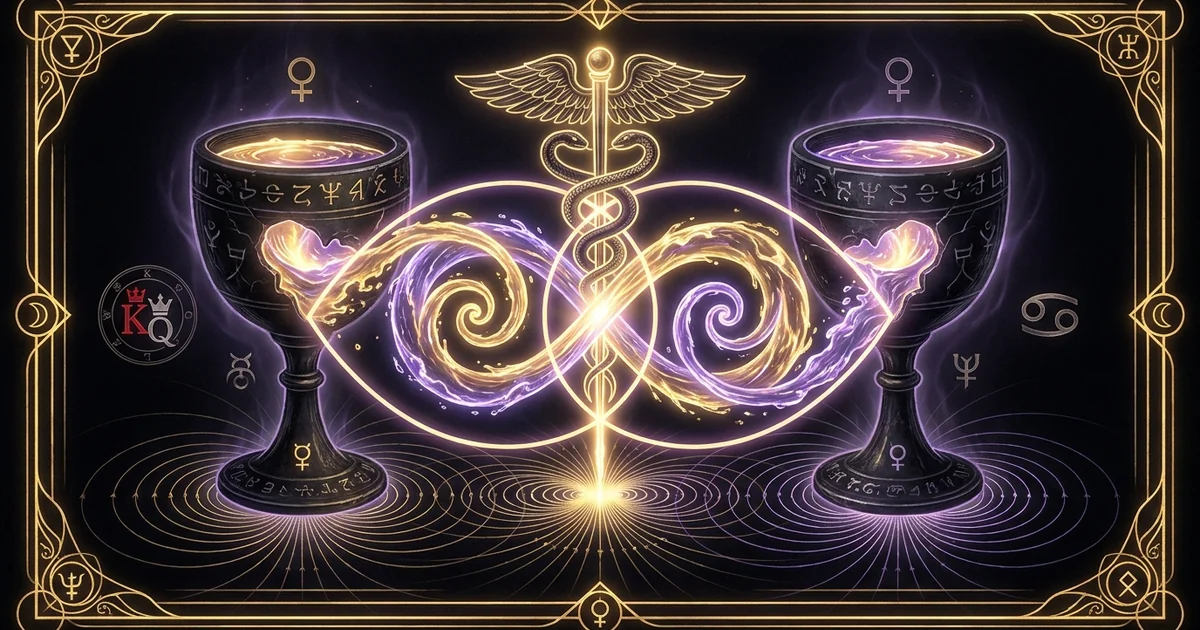
Two of Cups: Alchemical Union and Sacred Interconnection
Archetypal Thesis & Systemic Paradigm: The Dyadic Vessel and Coniunctio
From Monad to Dyad: The Descent of Briatic Fluidity
The Two of Cups constitutes the primordial binary actualization of the emotional-intuitive matrix. Where the Ace of Cups represents the unmanifest, infinite fountain of raw psychic energy—the unconditioned Ketherian downpouring within the elemental world of Water—the Two of Cups marks the structural boundary where this unbounded potential demarcates into self and alterity. In Qabalistic cosmogony, this shift signifies the transition from the pristine Monad to the dynamic Dyad. The solitary source discovers a reflective medium. Through this structural bifurcation, the undifferentiated oceanic feeling divides into two localized vessels, establishing the foundational architecture of relationship.
Within this state-space representation, the water element undergoes an essential crystallization. It ceases to be an uncontained cosmic deluge and instead enters a phase of hydrodynamic calibration. Water demands containment; without boundary, it dissipates into entropy or evaporates into vaporous unreality. In the two of cups tarot meaning, containment is not achieved via the rigid tectonic resistance of Earth, but rather through mutual gravitational capture. Two streams of consciousness, flowing through separate morphological pathways, encounter an inflection point where their systemic velocities synchronize. The card demonstrates that consciousness can only observe its own interior depths when it encounters an equivalent, receptive surface capable of returning an uncorrupted image.
This transition from absolute monism to dyadic polarity represents an ontological descent through the Qabalistic World of Briah (the Creative Realm). Here, the abstract concepts of love, rapport, and mutual recognition are first formulated into functional patterns. The two vessels depicted across centuries of iconographic evolution are not merely cups; they are reciprocal energetic sinks that simultaneously act as sources. The energetic fluid cycles perpetually between them. This continuous circulation forms an enclosed psychological circuit that protects the emergent dyad from psychic dissipation, anchoring the oceanic boundless within a tangible matrix of communion.
The Coniunctio Oppositorum as an Ontological Engine
At the core of the two of cups symbolism lies the ancient alchemical doctrine of the coniunctio-oppositorum—the sacred marriage of antagonistic yet complementary metaphysical forces. Divested of modern romantic trivialization, the coniunctio is an ontological engine that drives cosmic evolution. It is the operative mechanism through which the solar, volatile, active principle (Sol or Sulfur) enters into chemical reconciliation with the lunar, fixed, receptive substrate (Luna or Argent Vive). The two figures participating in the exchange are formal exponents of this psycho-chemical drama. Their interaction models the precise psychological and spiritual equilibrium necessary to generate the Lapis Philosophorum, the Philosopher’s Stone.
Analytical psychology identifies this card as the immediate visual signature of the archetypal transference. Carl Gustav Jung demonstrated that psychic growth remains paralyzed as long as polarized inner tensions remain unconscious and isolated. To catalyze integration, the psyche requires an external theater where its internal schisms can be projected, mapped, and systematically recombined. The Two of Cups provides the precise coordinates for this projective apparatus. The two figures do not merge to the point of obliteration; they maintain a calibrated distance, a sacred interstitium over which their respective psychic contents can be exchanged, assessed, and purified.
The transcendent product of this exchange is not a physical offspring, but a psychological and spiritual Third: a mutual energetic field that exceeds the sum of its individual components. In the vocabulary of Hermetic philosophy, this is the birth of the divine child (infans solaris), residing within the energetic overlap of the two crossed cups. The card implies that individual consciousness achieves its highest operational capacity not through isolation, but through entering a disciplined, symmetrical alliance where each participant serves as both mirror and container for the sacred Other.
Reciprocal Co-Creation vs. Enmeshed Codependency
An exacting structural analysis of the two of cups tarot meaning requires a sharp differentiation between authentic reciprocal resonance and regressive, narcissistic enmeshment. In degenerate relational dynamics, the boundary between the subjects collapses into undifferentiated pathology, effectively dragging the dyad backward into the primordial swamp of the unformed Ace rather than elevating it toward conscious equilibrium. Enmeshment represents a failure of polarity: one vessel parasitizes the volume of the other, generating an asymmetric hydrodynamic condition where flow occurs exclusively in one direction until psychic starvation ensues.
Conversely, the structural mechanics of the Two of Cups demand strict mathematical symmetry. The horizontal alignment of the chalices in the classic Rider-Waite-Smith and Golden Dawn configurations signifies parity of emotional investment, intellectual awareness, and spiritual intent. Neither figure subjugates the other; neither cup is elevated above its twin. The exchange operates via an uncoerced covenant, wherein the integrity of each individual vessel is strictly preserved. Mutual co-creation arises exclusively from this architectural sovereignty. If the individual boundaries dissolve entirely, the resonance ceases, just as two tuning forks must remain physically discrete objects in order to oscillate in harmonic sympathy.
This distinction elevates the card beyond ordinary affective sentiment. It marks the Two of Cups as a dynamic steady-state: a cybernetic feedback system that self-corrects against the twin hazards of emotional estrangement (absolute isolation) and emotional inundation (narcissistic fusion). The relational space between the participants acts as an interactive alchemical crucible, holding the dynamic tension of their differences while allowing their respective emotional matrices to achieve harmonic co-regulation.
Classical Provenance & Textual Lineage: The Lord of Love and the Hermetic Caduceus
The Golden Dawn ‘Book T’ Attribution: The Lord of Love
The rigorous systemic foundation of the Two of Cups was canonized within the late-nineteenth-century curriculum of the Hermetic Order of the Golden Dawn. In Book T: The Tarot of the Golden Dawn, authored by S.L. MacGregor Mathers and W.W. Westcott, the card is ascribed the formal esoteric title: The Lord of Love. This designation was meticulously guarded against sentimental debasement; the Golden Dawn did not use the word “Love” to signify personal infatuation, domestic affection, or erotic obsession. Instead, “Love” was understood as the primordial cosmogonic cohesion that binds atoms, celestial bodies, and opposing souls into functional systemic architectures.
Under the Golden Dawn rubric, this card represents the operationalization of the Sephirah Chokmah (Wisdom) within the World of Briah, under the temporal-spatial governance of the first decan of Cancer, administered by the planet Venus. This composite attribution positions the card as the highest, purest manifestation of the Water element accessible within the operational realm of human experience. The Golden Dawn recognized that because Chokmah represents pure, uninhibited dynamic force, its presence within the receptive, creative waters of Briah produces an immediate, frictionless equilibrium of emotional drive and spiritual receptivity.
“Two of Chalices: The Lord of Love. Harmony of masculine and feminine for union. The first decan of Cancer, governed by Venus. Therein rules the angels of the decan, Ayoel and Chabooyah. It shows the harmony of the opposing sexes, friendship, and communion between persons. Love, affection, warmth, and the mutual desire to blend individual identities into an elevated, unified purpose.”
In Book T, the elemental attribution is explicitly coded as the “Water of Water”—the dynamic essence of the feminine-intuitive current operating upon its own domestic, archetypal ground. As a consequence, the card possesses an intrinsic stability that shields it from volatile external perturbations. The “Lord of Love” is not a volatile temporal condition; it is a metaphysical law asserting that attraction, cohesion, and mutual synthesis constitute the underlying fabric of the manifested universe.
The Waite-Smith Synthesis: The Winged Lion and Caduceus of Hermes
When Arthur Edward Waite directed the artist Pamela Colman Smith in 1909 to execute the imagery for the modern standard Tarot deck, he introduced an iconographic innovation that radically transformed the esoteric depth of the card. Above the human dyad, rising between their extended cups, Smith rendered the caduceus-of-hermes—the primordial Greco-Egyptian staff entwined by dual serpents—crowned not by the traditional pinecone or orb, but by a winged, fiery chimera or red lion’s head. This symbol synthesizes the entire operational trajectory of Western magic.
[ Fiery Winged Lion / Sulfur ]
                     |
       [ Caduceus Core / Axis Mundi ]
              /              \
    [ Serpent: Sol ]     [ Serpent: Luna ]
              \              /
       [ Balanced Transference Zone ]
       [ Left Cup ] <--> [ Right Cup ]
The Caduceus represents the neutralization and transmutation of opposing dynamic currents: the solar serpent (Pingala) and the lunar serpent (Ida) wrapped around the central central axis (Sushumna). By introducing this glyph directly over the two human operators, Waite declared that interpersonal resonance is an initiatory Hermetic operation. The Caduceus is the diagnostic tool of the magus and the physician, indicating healing through the exact counter-balancing of energetic polarities.
The red winged lion crowns this staff with profound alchemical weight. The lion constitutes the fixed, terrestrial fire of the alchemical Red Sulfur—the volatile, primordial drive purified and stabilized through spiritual artifice. Its wings elevate it from an instinctual terrestrial predator into a transcendent spiritual intelligence. Smith and Waite deliberately engineered a visual marriage of alchemical elements: the red lion (Sulfur/Fire) hovers above the green and blue landscape (Water/Earth), while the undulating serpents of the Caduceus model the fluid movement of purified Mercury. The Two of Cups thus ceases to be a simple pastoral scene of courtship; it reveals itself as a fully realized diagram of the Great Work, wherein human emotional affinity provides the basal vessel through which raw terrestrial consciousness is sublimated into divine gnosis.
Crowley’s Attribution: The Marriage of Will and Receptive Fluidity
In The Book of Thoth (1944), Aleister Crowley approached the Two of Cups through his systemic reinterpretation of the Western Mystery Tradition, retaining the Golden Dawn title “Love” while anchoring it rigorously within his Thelemic framework: Love under will. Crowley observed that the card depicts the initial crystallization of the cups suit, wherein the universal mother (Binah) receives the creative flash of the cosmic father (Chokmah), translating absolute unity into operative duality. Crowley wrote:
“The Two of Cups represents the Idea of Love, which must be understood in its highest sense as the mutual absorption of the two in the third. It is the harmony of male and female, interpreted in the largest sense. It is the beginning of the recovery of unity, the first step taken by the Monad to regain its original state through the negation of separation.”
Crowley maintained that this card is inherently harmonious, reflecting the graceful equilibrium of Venus in Cancer. The lotus blossoms depicted in Frieda Harris’s painted plate for the Thoth deck open their petals to deposit crystal-clear waters into two identical chalices, which perpetually overflow without losing volume or spilling upon the abyss below. The exchange is self-replenishing, frictionless, and thermodynamically continuous.
However, Crowley offered a distinct esoteric warning regarding this attribution. Because the card resides in the watery element governed by the luxury and softness of Venus, the dyad faces an inherent danger of stagnation. Crowley noted that love that does not constantly evolve, expand, and submit itself to cosmic purpose degenerates into passive stasis and indolent self-satisfaction. The perfection of the Two of Cups must serve as a launchpad for spiritual transformation; if it becomes a closed, self-congratulatory sanctuary, it violates the dynamic mandate of Chokmah and atrophies into energetic entropy.
Structural Mechanics & Symbolic Geometry: Astrological Decanates and Qabalistic Vectors
Venus in the First Decan of Cancer (0°–10°): The Physics of Cohesion
The astrological coordinate structuring the Two of Cups is the first decan of Cancer, spanning 0° to 10° of the cardinal water sign. In classical Hellenistic and Renaissance astrology, as systematized by Claudius Ptolemy and Heinrich Cornelius Agrippa, this decan is administered exclusively by Venus. The interaction between Venus (the Lesser Benefic, planetary principle of adhesion, aesthetic proportion, and cohesive attraction) and Cancer (cardinal water, the archetype of the protective shell, domestic foundation, and instinctual bonding) generates a unique psycho-physical environment.
| Metric | Qabalistic / Astrological Value | Operational Function |
|---|---|---|
| Sephirah | Chokmah (חָכְמָה - Wisdom) | Primordial Dynamic Impulse, Phallic Will |
| World | Briah (בְּרִיאָה - Creative Realm) | Elemental Ocean of Intuition and Formative Matrix |
| Astro-Decan | Venus in Cancer (0°00’ – 09°59’) | Magnetic Cohesion, Affective Receptivity |
| Essential Dignity | Triplicity Ruler (Water), Term/Face | Frictionless Attraction, Cardinal Instigation |
| Elemental Formula | Water of Water (Sub-elemental Pure) | Capillary Flow, Osmotic Parity, Mirror Alterity |
Cancer is cardinal: it initiates, projects, and constructs boundaries to preserve life. It is the cosmic Crab, carrying its sanctuary upon its back, exquisitely vulnerable internally yet shielded externally by calcified armor. When the adhesive, magnetic principle of Venus is embedded within this cardinal moisture, the primary drive becomes the establishment of a protective relational sanctuary. Venus in the first decan of Cancer seeks to bind the disparate elements of the immediate environment into a coherent, self-sustaining family, tribe, or dyadic covenant.
This decan marks the exact point of the Summer Solstice in the Northern Hemisphere—the threshold where the solar light achieves its maximum zenith and immediately begins its descent into the growing dark. It is a moment of saturated fullness, containing the latent seed of future sacrifice. The astrological physics of this decan are governed by the need to secure connection before the descent begins. Through the decan-venus-in-cancer, love is mobilized as an existential bulwark against isolation. The dynamic is not passive or indolent; it is a focused, strategic alignment of emotional resources, fusing two distinct trajectories into a single, cohesive orbital path.
Chokmah in Briah: Primordial Dynamic Impulse within Archetypal Receptivity
To comprehend the esoteric depth of the Two of Cups, one must analyze its location upon the Tree of Life. The card is situated in chokmah (the second Sephirah, Wisdom, representing the active masculine/dynamic force) within the World of briah (the Archangelic Realm of pure elemental Water). This produces an extraordinary metaphysical condition: the active, penetrating, expressive father-force of the cosmos descending into the cosmic waters of the great Mother.
Chokmah is traditionally characterized by raw, radiant projection (Abba, the Supernal Father). It is pure dynamic radiation, devoid of form, surging outward into the void. When this radiant, expansive impulse is channeled through the Briatic world—the sphere of emotional architecture and intuitive comprehension—it does not create violent collisions. Instead, it encounters a medium that welcomes its full magnitude without resistance. Chokmah in Briah represents the divine expressive will choosing to manifest entirely as receptive relation.
This structural placement resolves the apparent paradox of the card’s serene demeanor. The tranquility of the Two of Cups is not the peace of exhaustion; it is the absolute equilibrium achieved when maximum dynamic power meets infinite receptive capacity. The male figure in the Waite-Smith iconography, draped in the active, fiery patterns of a leopard-skin tunic, embodies the Chokmah impulse: outward, exploratory, initiating. The female figure, clothed in pure lunar blue and white, represents the Briatic matrix: deep, internalizing, preserving. Their meeting is the exact intersection of Force and Form at the supernal boundary of the emotional continuum.
The Hydrodynamics of the Cups Suit: Structural Analysis of the Water Element
The behavior of the Cups suit throughout the Tarot can be modeled through the physical hydrodynamics of liquid water. Water possesses four fundamental physical characteristics that serve as exact analogs for the psychological mechanics of the Two of Cups:
- Capillary Action and Surface Tension: Water demonstrates internal cohesion (attraction of water molecules to one another) and adhesion (attraction of water molecules to other substances). In the Two of Cups, these physical properties govern how psychic boundaries interact. Surface tension allows the emotional vessel to hold its shape without collapsing, while capillary action enables emotional contents to defy gravity, climbing upward toward the partner through mutual affinity.
- The Law of Communicating Vessels: When two open containers are connected by a conduit, liquid spontaneously flows between them until their surfaces reach an identical gravitational elevation, regardless of the individual shapes of the vessels. The Two of Cups operationalizes this law: it demonstrates that genuine psychological rapport establishes an open energetic channel through which emotional, intellectual, and spiritual pressures equalize naturally.
- Universal Solvency: Water is the universal solvent, capable of dissolving rigid, calcified crystal lattices over time. In the dyadic field of this card, the calcified defenses of the individual ego are steadily softened and dissolved by the circulating emotional current, allowing the underlying psychic material to enter into new alchemical solutions.
- Thermodynamic Convection: Heat transfer within fluids generates cyclic circulatory currents. The warm, solar energy introduced by the Chokmah/Sulfur pole drives the ascending emotional flow, while the cooler, stabilizing lunar polarity grounds the descent, establishing a stable, self-regulating convection cell within the relationship.
Psychological Dynamics & Operational Praxis: Transference and the Mirror of Alterity
The Alchemical Transference: Projection and Reintegration of the Anima/Animus
In the clinical framework of analytical psychology, the Two of Cups serves as the premier diagnostic glyph for the phenomenon of anima-animus-projection. Carl Gustav Jung postulated that the contra-sexual soul-image—the Anima in a man, the Animus in a woman—remains deeply embedded within the personal and collective unconscious during early psychological development. Because direct unmediated contact with the autonomous archetype can destabilize ego-consciousness, the psyche instinctively projects these numinous contents onto an appropriate external human counterpart.
“The transference is the natural medium wherein the projection of the contra-sexual archetype is made visible. What appears externally as an intoxicating personal attraction is, at its root, the desperate necessity of the divided self to achieve wholeness through the integration of its own rejected or unintegrated polarity. The alchemical coniunctio, as depicted in the Rosarium Philosophorum, requires this external theater before the internal wedding can be consummated.”
When the Two of Cups appears in a psychological consultation, it signals that the individual has encountered an external mirror of sufficient clarity and resonance to receive the projection of their inner soul-image. This encounter is characterized by an intense sense of familiarity, numinosity, and mutual destiny. The individuals feel they have known each other across ancestral time; this occurs because they are not merely gazing upon a biological stranger, but upon an exteriorized manifestation of their own deepest, unlived archetypal interiority.
The crucial evolutionary demand of the Two of Cups, however, is the subsequent retrieval and conscious assimilation of this projection. If the participants treat the relationship purely as a biological or romantic acquisition, the dynamic eventually atrophies into disillusionment as the human partner fails to sustain the impossible burden of divine projection. The true operational praxis encoded in the card demands that the individual recognize that the divinity glimpsed within the partner’s chalice is ultimately their own latent wholeness, mediated through the sacred grace of the Other’s mirror.
Individual Psyche A                         Individual Psyche B
  [ Conscious Ego ]                           [ Conscious Ego ]
          |                                           |
  [ Unconscious Anima ] --(Projective Mirror)--> [ Partner B Body ]
          ^                                           |
          |                                           v
  [ Partner A Body ] <--(Projective Mirror)-- [ Unconscious Animus ]
          \___________________________________________/
                     The Transference Matrix
The Micro-Praxis: Diagnostic Calibration in Analytical Consultations
In the strategic context of divination and symbolic analysis, the appearance of the Two of Cups requires an immediate operational audit of the client’s relational architecture. The investigator must not limit their inquiry to romantic entanglements; the card applies with equal force to therapeutic pacts, high-stakes intellectual partnerships, and consecrated esoteric alliances. The primary diagnostic task is evaluating the structural integrity and flow rate of the relational circuit.
The analyst must calibrate the reading using three rigorous vectors:
- Symmetry of Energetic Investment: Is the exchange between the participants structurally balanced? The card demands an uncompromised 1:1 ratio of emotional vulnerability, material commitment, and psychic attention. If one participant assumes the role of perpetual benefactor (the overflowing Ace) while the other remains an inert recipient, the dynamic violates the archetypal law of the Two and will quickly devolve into resentment.
- The Nature of the Covenant: What invisible vows govern the dyad? The caduceus hovering above the figures indicates that this union is overseen by a transpersonal principle. The analyst must determine whether the partnership is anchored merely in mutual biological comfort or whether it is dedicated to an external, creative, or spiritual teleology—a shared Great Work.
- Resistance to Triangulation: Does the dyad maintain sufficient internal cohesion to withstand external interference? The Two of Cups represents a closed, sacred perimeter. The analyst must ascertain whether boundary leakage is occurring through unresolved familial attachments, competing social loyalties, or repressed secondary desires.
Reversals, Shadow States, and Dysfunctional Dyads
When the Two of Cups presents as reversed, ill-dignified, or severely afflicted by surrounding cards, it does not merely signify a mild lovers’ quarrel; it denotes the systematic destabilization of the dyadic vessel. The primary shadow manifestations include:
- The Fractured Mirror (Pathological Distortion): The reflective surface of the water becomes turbulent, projecting grotesque, magnified distortions of the shadow self onto the partner. The relationship deteriorates into a projective battlefield where each participant blames the other for their own repressed psychological inadequacies.
- Asymmetric Drainage (Vampiric Entrainment): The law of communicating vessels is violently subverted. One participant punctures the other’s vessel, establishing a parasitical dependency wherein one party’s vitality is systematically drained to sustain the other’s emotional stability.
- The Golden Cage (Enmeshed Narcissism): The dyad seals itself off from the surrounding universe to a pathological degree, developing a private, incestuous mythos that rejects reality. The mutual admiration degenerates into folie à deux, an insulated psychopathology where external critique is demonized, leading directly to stagnation and emotional decay.
- Broken Covenants and Treachery: Because the upright card represents an absolute, sacred alignment under the Hermetic staff, its shadow manifests as the conscious breach of trust. This includes emotional betrayal, sudden withdrawal of investment, or the weaponization of the partner’s exposed vulnerabilities.
Philosophical Synthesis & Macrocosmic Correspondence: The Principle of Polarity and Hexagram 31
Hermetic Axiomatic Alignment: The Kybalion’s Gender and Polarity
The conceptual architecture of the Two of Cups serves as a visual proof of two fundamental Hermetic axioms detailed in The Kybalion: The Principle of Polarity and The Principle of Gender. The Principle of Polarity states: “Everything is Dual; everything has poles; everything has its pair of opposites; like and unlike are the same; opposites are identical in nature, but different in degree.” The Principle of Gender states: “Gender is in everything; everything has its Masculine and Feminine Principles; Gender manifests on all planes.”
The Two of Cups illustrates that creation cannot occur in isolation. Even at the highest metaphysical levels, dynamic force (Yang) remains sterile unless it encounters a medium capable of reflecting, ordering, and sustaining its momentum (Yin). The two figures in the card are not merely sociological representatives of human biological sex; they are operational anthropomorphic diagrams of these two cosmic currents. Their physical stance—standing on equal footing, their bodies angled slightly toward each other—demonstrates that the poles are not in static opposition, but in dynamic attraction.
This attraction is the root of cosmic rhythm. By oscillating between the masculine emissive impulse and the feminine receptive current, the dyad establishes an operational alternating field. This field generates the psychic voltage necessary to manifest higher-dimensional states of consciousness within the lower, denser material planes.
I Ching Cross-Systemic Mapping: Hexagram 31 (咸 - Xian / Mutual Influence)
A rigorous cross-systemic mapping reveals that the Two of Cups is the exact Western esoteric equivalent to Hexagram 31 of the I Ching (咸 - hexagram-31-xian, traditionally translated as “Mutual Influence,” “Sensation,” or “Attraction”). The structural configuration of Hexagram 31 is formed by the trigram Dui (兌 - The Joyful, Lake, representing the youngest daughter and open water) situated over the trigram Gen (艮 - Keeping Still, Mountain, representing the youngest son and stable earth).
   --- ---  Trigram Dui (The Lake, Water, Joyous Openness)
   -------
   -------
   -------  Trigram Gen (The Mountain, Earth, Unshakeable Stillness)
   --- ---
   --- ---
The symbolic physics of this hexagram perfectly mirror the iconography of the Two of Cups. The Lake (water) rests atop the Mountain (earth). The mountain holds the lake securely, providing an unshakeable, elevated foundation that prevents the water from dispersing into chaotic flooding; the water, in turn, permeates the mountain’s crust, moistening its rocks, nourishing its vegetation, and softening its rigid stone. The relationship is utterly symbiotic. The Judgment of Hexagram 31 states:
“Mutual Influence. Success. It is advantageous to be steadfast. To take a maiden to wife brings good fortune.”
King Wen’s commentary explicitly notes that the mountain submits to the influence of the lake above it, just as the male yields to the female in authentic courtship to establish a stable energetic current. The Taoist masters understood that genuine influence does not operate through brute mechanical coercion (which generates friction and counter-resistance), but through quiet, receptive resonance. In the Two of Cups, the open rim of the chalice mirrors the open lines of the Lake trigram, indicating that communication and psychic blending occur through unreserved openness rather than forceful intrusion.
Hermetic: Two of Cups
- Elemental Engine: Venus in Cancer (Cardinal Water) acting upon the Sephirah Chokmah (Wisdom/Drive).
- Geometric Core: Two horizontal, equivalent chalices aligned along an equatorial plane, crowned by the Hermetic Caduceus.
- Psycho-Spiritual Mechanism: Coniunctio oppositorum; balance of conscious ego and projected Anima/Animus; transference matrix.
- Cosmic Principle: Cohesion through sacred covenant; divine Third generated through the equal resonance of dual nodes.
Taoist: Hexagram 31 (咸 - Xian)
- Elemental Engine: Lake (Dui / Soft Water) resting directly over Mountain (Gen / Immovable Earth).
- Geometric Core: Upper trigram opening upward; lower trigram providing structural containment and deep stillness.
- Psycho-Spiritual Mechanism: Spontaneous mutual attraction through empty receptivity; influence without aggressive assertion.
- Cosmic Principle: Harmonic correspondence between heaven and earth; the feminine descends while the masculine supports from below.
The Holographic Nexus: Macrocosmic Sympathy and Quantum Entanglement
When evaluated through modern systemic and cybernetic frameworks, the Two of Cups functions as an intuitive map of macrocosmic sympathy and quantum entanglement. In an entangled physical system, two particles become correlated in such a manner that the physical state of one instantaneously determines the state of the other, regardless of the spatial distance separating them. They cease to exist as isolated classical entities and instead form an indivisible, non-local quantum state.
The Two of Cups transposes this non-local physical reality into the psychological domain. When two human consciousnesses establish a profound, consecrated rapport, their individual neuro-affective circuits become entangled. They begin to function as a unified cybernetic feedback loop. Information, mood, somatic states, and intuitive insights transfer between them without the requirement of explicit linear communication.
This holographic property demonstrates that the dyad is the foundational social atom of the universe. Just as a hologram preserves the image of the entire whole within every fractional part, the microscopic union of two individuals in the Two of Cups mirrors the macrocosmic union of the Creator with Creation. When two individuals gaze into one another’s eyes across the elevated cups, they participate in the self-same dynamic that sustains the rotation of galaxies and the cohesion of atomic nuclei: the sacred, non-local mystery of systemic interconnectedness.
Frequently Asked Questions: Advanced Decryption of the Two of Cups
Is the Two of Cups intrinsically bound to romantic partnerships?
No. To restrict the Two of Cups to the domain of human biological romance is a modern, sentimental reduction that obscures its profound initiatory architecture. The card models any consecrated dyadic covenant where two distinct consciousnesses align to establish a reciprocal, highly calibrated field of mutual resonance.
This encompasses profound therapeutic alliances (the clinical transference between psychoanalyst and patient), esoteric working partnerships (the mutual assistance of two ceremonial magicians or alchemical operators), transformative artistic collaborations, and rare, platonic friendships of deep spiritual affinity. The essential criterion is not erotic intimacy, but the structural parity of the exchange: mutual respect, energetic symmetry, complete vulnerability, and dedication to the emergence of a higher-order relational Third.
How does the Caduceus above the figures alter the card’s magical jurisdiction?
The inclusion of the caduceus-of-hermes crowned by the winged lion radically elevates the card’s operational authority. Without this symbol, the image might simply represent a mundane interpersonal pact or pastoral courtship. The Caduceus transforms the card into a formal Hermetic talisman. It serves as an authoritative statement that the interpersonal dynamic below is monitored, consecrated, and actively transformed by Hermes/Thoth—the archetypal Lord of Magic, Wisdom, and Psychological Integration.
Furthermore, the Caduceus is the ancient symbol of the healing arts. Its presence indicates that the meeting of these two vessels is intrinsically medicinal. The interaction heals the psychological pathology of isolation, reconciles the split between internal polarities, and restores systemic equilibrium to unbalanced emotional fields. The fiery winged lion explicitly links this healing operation to the Great Work of alchemy, confirming that the base emotions exchanged between the participants are being calcined, sublimated, and transmuted into spiritual gold.
What structural features distinguish the Two of Cups from the Lovers (Key VI)?
While both cards visually represent a dyad, their Qabalistic, structural, and evolutionary functions occupy entirely distinct systemic levels. The fundamental differences center on operational scope, cosmic hierarchy, and systemic consequence:
[ Key VI: The Lovers ] --> Major Arcana: Existential Choice / The Path of Zain
                             Crosses the Abyss / Cosmic Macrocosm / Irrevocable
[ Two of Cups ]        –> Minor Arcana: Localized Dyadic Resonance / Chokmah in Briah
Temporal Operational Circuit / Microcosm / Dynamic Tuning
- Arcana Hierarchy: The Two of Cups is a Minor Arcana card, meaning it models a localized, temporal, and situational manifestation of energy. It depicts an immediate, real-time relational state-space. The Lovers (Key VI) is a Major Arcana key, representing a primordial, cosmic archetype that dictates the universal architecture of consciousness itself.
- The Element of Choice vs. The Experience of Resonance: Key VI is astrologically governed by Gemini and assigned to the Hebrew letter Zain (meaning “Sword”). Its fundamental structural mechanism is discernment, division, and existential choice. The Lovers represents the agonizing yet necessary separation of the self from the primal matrix, demanding a conscious decision between spiritual ascension and instinctual entrapment. Conversely, the Two of Cups is governed by Venus in Cancer; it does not divide with a sword, but rather binds with a magnetic current. It models spontaneous, frictionless affinity and mutual resonance.
- Iconographic Supervision: In Key VI, the dyad is presided over by the massive, blinding solar Archangel Raphael, hovering amidst turbulent cosmic clouds above the Tree of Life and the Tree of Knowledge of Good and Evil. The scope is epic, cosmic, and perilous. In the Two of Cups, the supervisory force is the focused, direct Caduceus of Hermes, hovering between two human beings standing upon quiet, cultivable Earth. Key VI is the macrocosmic choice of who one must become; the Two of Cups is the localized reality of meeting the sacred mirror here and now.