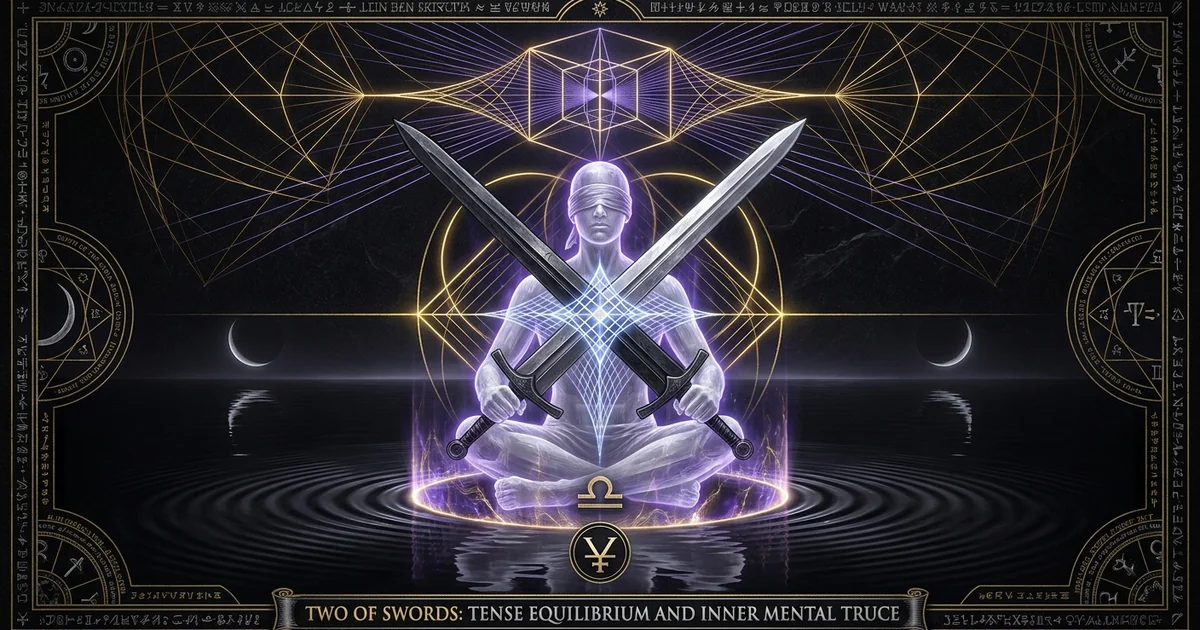
Two of Swords: Tense Equilibrium and Inner Mental Truce
Archetypal Thesis & Systemic Paradigm: The Metastable Dynamic of Intellectual Homeostasis
The Dialectical Impasse: Air Element in Primordial Binary Division
Within the metaphysical cartography of the Hermetic Tarot, the swords suit operates as the diagnostic instrument of the conscious ego, embodying the philosophical element of Air—the pristine, dispassionate medium of discursive intellect, analysis, and discrimination. In Qabalistic taxonomy, Air is assigned to the letter Vau of the Tetragrammaton, designating the son, the synthesizing third principle that perpetually negotiates the generative tension between Fire (Yod) and Water (Heh). Yet, when the pristine singular vector of the Ace of Swords is refracted through the dyadic lens of the number Two, this unconditioned capacity for analytical slicing bifurcates within its own medium. The pure potential of mental clarity divides into two irreconcilable, equivalent cognitive trajectories.
The two of swords tarot meaning cannot be understood as inert vacillation or a passive deficiency of intellect. Rather, it represents an acute dialectical impasse wherein the analytical blade encounters its exact specular double. The swords suit, fundamentally designed to separate truth from falsehood, subject from object, and figure from ground, turns inward upon its own architecture. This binary division splits the mental continuum into diametrically opposed axioms, each possessing identical logical validity and moral weight. The resulting stasis is not born from an absence of thought, but from an overwhelming superabundance of discursive computation. The two vectors cancel each other out through vector opposition, yielding an absolute net zero of outward movement while generating enormous internal systemic stress.
[Vector A: Thesis]  ───► | ◄───  [Vector B: Antithesis]
                        (Net Zero Flux)
Chokmah in Yetzirah: Dynamic Volition Arrested within the Mental Sphere
To map this condition onto the Tree of Life, one must isolate the structural intersection of the second Sephirah, Chokmah (Wisdom), expressing its influence within the astral-formative world of Yetzirah. Chokmah represents the primary masculine emanation: pure, undifferentiated dynamic volition, the primordial kinetic surge outward from Kether before form imposes limitation. It is the unchanneled lightning flash of creative ideation. However, when this torrential Supernal energy descends across the Abyss into the fluid, atmospheric, and highly differentiated domain of Yetzirah (the mental-astral plane governed by the Ruach), its explosive character undergoes a profound structural constriction.
In Yetzirah, the number Two imposes the requirement of relational polarity. The primary kinetic volition of Chokmah finds no immediate path into concrete physical manifestation (Assiah), nor does it harmonize through the mediating emotional center of Tiphereth. Instead, Chokmah’s radiant force is seized and arrested within the intellectual matrix itself. The mind becomes an impenetrable pressure vessel. The outward-directed creative spark of Chokmah is turned laterally into two opposing armaments of equal force. In this environment, the raw masculine impulse is forced into an unnatural holding pattern: an aggressive, hyper-controlled suspension of conflict. Volition is utilized not to strike, but to sustain the stalemate, holding two cosmic principles in an agonizing, millimeter-precise perimeter defense against one another.
Homeostatic Tensegrity: The Energy Requirement of Active Neutrality
The fundamental operational illusion of the Two of Swords is the appearance of absolute tranquility. Pop-cultural interpretations frequently misread the posture as serene meditation or unbothered contemplation. In systemic reality, the card models a state of homeostatic tensegrity: a structural framework where integrity is maintained not through monolithic solidity, but through continuous, high-tension balance between opposing components. This intellectual truce is not an organic cessation of hostility; it is an armed armistice requiring an extraordinary and uninterrupted expenditure of metabolic and psychic energy.
The ego in this state operates like a pilot maintaining an aircraft in a high-velocity hover: the engines fire at maximum capacity simply to remain stationary relative to the ground. The active neutrality encoded in the two of swords tarot meaning constitutes a sophisticated ego-defense mechanism. By holding two incompatible propositions in suspended animation, the consciousness deliberately prevents either proposition from resolving into action. Resolution would inevitably precipitate crisis, guilt, grief, or the permanent collapse of an established worldview. Thus, cognitive armoring is deployed to freeze time within the mental sphere, choosing the exhausting security of dynamic paralysis over the terrifying unknown of an asymmetrical reality.
“There is no doubt that consciousness is continually being enriched by the spontaneous and autonomy-seeking activities of the unconscious… But the suspension of conscious judgment, the holding in balance of the antagonistic forces of the psyche, is the indispensable prerequisite for the appearance of the transcendent function. The ego must endure the tension of the opposites without seeking premature relief through intellectual suppression or impulsive action, for only in the furnace of this prolonged conflict can the unifying third archetype be synthesized.” — Carl Gustav Jung, Psychological Types (Collected Works, Vol. 6, §825)
Classical Provenance & Textual Lineage: The Genesis of the ‘Lord of Peace Restored’
Book T Lineage and the Golden Dawn Hermetic Synthesis
The Hermetic Order of the Golden Dawn formalized the canonical esoteric architecture of the minor arcana through the seminal instructional documents known collectively as Book T (The Sub-Titles of the Tarot Cards). Authored by S.L. MacGregor Mathers and Moina Mathers in the late nineteenth century, Book T attributed the Two of Swords to the first decan of the cardinal Air sign Libra, assigning it the evocative, highly deliberate title of the “Lord of Peace Restored.” This nomenclature is deeply nuanced: the peace designated here is explicitly “restored,” carrying the indelible operational implication that it is secondary, reactive, and post-traumatic.
“Two of Swords: The Lord of Peace Restored. Chokmah of Vau. (Two crossed Swords, uniting their points, with a rose of five petals at their intersection.) A calm mind, balance of forces, contradictory characteristics in the same nature, light and dark, justice and injustice. Truth and untruth; balance of intellect; peace restored after disruption. Moon in Libra.” — S.L. MacGregor Mathers & Moina Mathers, The Golden Dawn: Book T (1888)
This foundational attribution reveals the lineage’s subtle understanding of elemental mechanics. The disruptive, storm-like release of pure Air witnessed in the preceding Ace leaves the Yetziratic field disordered; the “Lord of Peace Restored” is the immediate, desperate Hermetic counter-stroke. It is an intellectual intervention designed to force the chaotic winds of the lower astral plane into a rigid, geometric matrix of absolute order. The early Golden Dawn deck depicted this card not with human figures, but through pure talismanic geometry: two curved or straight scimitars crossing one another, binding an open five-petaled rose within their point of intersection. The rose represented the harmonious mediation of Spirit over the four physical elements, held securely—if precariously—within the vice-like grip of the analytical intellect.
The Smith-Waite Geometric Departure: Water, Stone, and Blindfold
When Arthur Edward Waite collaborated with artist and occultist Pamela Colman Smith in 1909 to produce the Rider-Waite-Smith (RWS) deck, they executed a radical pictorial transformation of Mathers’ abstract talisman. Smith converted the card into an intensely psychological, figurative tableau that defined modern two of swords symbolism. Central to this composition is a woman seated upon a square stone block, clothed in a monochromatic slate-grey robe that seamlessly merges her physical presence with the mineral reality of her seat.
Smith’s dramatic innovation was threefold: the blindfold, the crossed broadswords, and the marine perimeter. By placing a stark white fabric blindfold across the figure’s eyes, Smith visually encoded the conscious severed link to the external sensory apparatus. The figure does not lack sight; rather, ocular perception has been deliberately suppressed. The two heavy steel swords, held upright and crossing horizontally across the pericardial region, form an absolute barrier between the figure’s core and the outer world. In the background, Smith rendered a flat, undisturbed sea dotted with dark, jagged slate reefs, crested by an impossibly thin waxing crescent moon. This landscape underscores the unnatural state of the psychic terrain: the waters of the unconscious are held artificially smooth, constrained from expressing their natural tidal turbulence by the severe presence of stone and steel.
The Thoth Perspective: The Inherent Fragility of Yetziratic Truce
In his 1944 masterpiece The Book of Thoth, Aleister Crowley departed sharply from any romantic or sentimental reading of the “Lord of Peace Restored.” Crowley, working with Lady Frieda Harris, stripped the card of its human figure, returning to a stylized, geometric representation that exposed the raw mechanics of the card’s astrological attribution: the Moon in Libra. For Crowley, the card represented an intrinsically unstable synthesis. While the card is ostensibly peaceful, Crowley emphasized that this peace is structurally undermined by the nature of its planetary ruler.
Crowley observed that the Moon—the archetype of change, flux, instinct, and illusion—is fundamentally ill-suited to govern the intellectual and hyper-rational domain of cardinal Air. Consequently, the apparent balance of the Two of Swords is perpetually one degree removed from dynamic dissolution. Crowley asserted that the “peace” of the Two of Swords is sustained solely because the contradictory thoughts balance one another so perfectly that neither can assert dominance. This balance is maintained by an act of immense will that cannot be sustained indefinitely. It represents the quiet center of a hurricane: an artificial interregnum destined, upon the slightest shift in the Yetziratic atmosphere, to collapse into the violent emotional and intellectual catastrophe embodied by the Three of Swords.
Structural Mechanics & Symbolic Geometry: Astrological Decans and Orthogonal Angles
Decanic Mechanics: The Moon in the First Decan of Libra (0°-10°)
The underlying astrological engine driving the Two of Swords is the placement of Luna within the first decan of the sign Libra, spanning 0°00’ to 09°59’ of the tropical zodiac. In classical astrology, as detailed by Claudius Ptolemy in the Tetrabiblos, Libra is the cardinal Air sign: the equinoctial point of objective calibration, balance, social contracts, and the architectural weighing of dynamic forces. It is the sign wherein the individual self encounters the objective reality of the “Other,” demanding a rigorous adjustment of subjective claims against universal standards.
- Systemic Title: The Lord of Peace Restored
- Tree of Life Coordinate: Chokmah (Wisdom) in the World of Yetzirah (Formative Astral)
- Zodiacal Span: Libra 0°00’ – 09°59’ (First Decan)
- Decan Ruler (Chaldean Order): The Moon (Luna)
- Modality & Element: Cardinal Air
- Hermetic Color Scales: White (Chokmah) mixed with Sky Blue and Emerald-flecked Slate (Yetziratic Libra)
- Elemental Components: Vau (Air) expressing through the reflective, aquatic mirror of the Astral Subconscious
When the Moon, a nocturnal planet characterized by moistness, instinct, fluctuating memory, and subjective feeling, enters the dry, intellectual, and uncompromisingly rational domain of cardinal Air, a structural friction ensues. The Moon seeks emotional integration, flow, and somatic coherence; Libra demands abstract symmetry, intellectual detachment, and mathematical justice. The result of this planetary placement is not an emotional mind, but rather the opposite: an extreme compartmentalization wherein the Moon’s instinctual nature is disciplined and frozen by the Libran scales. The subconscious is made to perform a dry, analytical calculation. The native or situation governed by this decan seeks tranquility not through genuine spiritual release, but through the rigorous suppression of emotional tides, neutralizing every disruptive intuitive impulse with an equal and opposite logical rebuttal.
Vector Analysis of the Crossed Steel: The Orthogonal Axis of Defense
The visual geometry embedded in the classic RWS two of swords symbolism contains a precise geometric diagram of psychological defense. The two broadswords do not hang passively at the figure’s side; they are wielded with both arms raised, muscles locked in isometric tension. The blades cross diagonally, intersecting at right angles to form an “X” that covers the exact physical location of the sternum, directly shielding the fourth chakra (Anahata) and the Qabalistic Sephirah of Tiphereth—the solar center of the spiritual heart, identity, and affective integration.
       /  Blade A
      /
     X   <--- Intersection over Tiphereth (The Solar Heart Center)
    / \
       \  Blade B
This orthogonal crossing creates an absolute psychic and energetic barrier. The vector analysis of this posture reveals two distinct operational forces:
- Vertical Resistance: The upward extension of the blades forms an intellectual antenna, actively defending the consciousness against intrusions from higher, transcendent spiritual solutions that would disrupt the localized equilibrium.
- Horizontal Containment: The lateral crossing creates a closed circuit across the thoracic cavity, entirely severing the cognitive apparatus of the head from the somatic, gut-level emotional realities of the viscera.
The figure utilizes the blades as a personal goniometer, measuring and maintaining the precise spatial angle of self-protection. The intellect acts as its own sentry. By holding the swords in this rigid configuration, the figure renders itself incapable of reaching out to embrace the world or accepting any external object, gift, or solution without first abandoning its defensive posture.
Sensory Attenuation: Blindfold and Tides as Boundary Isolation
The environmental factors framing the central figure in the Two of Swords provide crucial diagnostics regarding the state of consciousness depicted. The blindfold is a deliberate instrument of sensory attenuation. In classical antiquity, blindness was frequently associated with mantic foresight, as seen in figures like Tiresias; however, in the context of the swords suit, the blindfold indicates an intentional epistemic quarantine. The conscious mind has observed that external empirical reality introduces too many chaotic variables into its fragile equilibrium. Consequently, the ego deliberately severs ocular data input. The subject refuses to look at the facts of the matter because the facts would inevitably tip the scales, forcing an immediate, painful decision that the ego is desperate to evade.
Behind the seated figure lies an expansive marine environment: the sea, the primordial glyph of the unconscious, the deep repository of suppressed emotional content. Yet, in this card, the ocean does not churn with the stormy tempest seen in the King of Swords or the broken heart of the Three of Swords. It is depicted as unnaturally smooth, an eerie expanse of water broken only by sharp, tooth-like outcroppings of grey slate. These rocks represent the intrusion of hardened, crystallized mental complexes emerging from the depths of the psyche. The tide is held in an enforced stasis by the wax and wane of the crescent moon above. The entire scene illustrates boundary isolation: sensory input is blocked, emotional depth is kept under strict surveillance, and the ego maintains its artificial, highly volatile peace upon a narrow pedestal of stone.
Psychological Dynamics & Operational Praxis: The Architecture of Defensive Cognitive Truce
Splitting and Compartmentalization as Adaptive Ego Defenses
From the vantage point of contemporary psychodynamics, the Two of Swords serves as an archetypal representation of two primary defense mechanisms: splitting and intellectualized compartmentalization. When an individual confronts an existential reality that contains unacceptable emotional contradictions—such as loving a partner whose values violate one’s ethical baseline, or remaining in a professional environment that degrades one’s psychological integrity—the ego faces acute fragmentation. To survive this double bind without suffering an acute collapse of the self, the mind resorts to radical compartmentalization.
[ Unacceptable Unified Reality ]
                     │
         (Analytical Blade Slices)
                     ▼
  ┌─────────────────────────────────────┐
  │                                     │
  ▼                                     ▼
[Compartment A]                  [Compartment B]
  (Abstract Idea 1)                (Abstract Idea 2)
  (Axiom: "P is True")             (Axiom: "Not-P is True")
  (Affect Neutralized)             (Affect Neutralized)
  └──────────────────┬──────────────────┘
                     │
     (Orthogonal Armoring Sustained)
                     │
                     ▼
       [ Operational Dynamic Freeze ]
The analytical blade of the swords suit is deployed to surgically excise affective components from conceptual ones. The individual retreats from visceral somatic experience into a bloodless, hyper-rational theoretical realm. Both options or worldviews are placed into hermetically sealed intellectual compartments. The individual discusses catastrophic scenarios with chilling neutrality, viewing their own suffering through an academic, detached lens. This intellectualization shields the ego from authentic grief, rage, or panic, but it does so at an exorbitant price: the total alienation of the self from its own life force.
The Dread of Choice: Decisional Catastrophe and Enantiodromic Collapse
At the heart of the Two of Swords lies an unacknowledged existential terror: the dread of the decisive stroke. Every authentic decision involves an act of slaughter. The Latin etymology of the word “decide”—decidere—literally translates to “to cut off.” To make a definitive choice between two mutually exclusive paths is to actively extinguish the potentiality of the path not chosen. For the personality trapped within the psychology of this card, the act of choosing is experienced not as an exercise of agency, but as an existential catastrophe.
This paralysis is exacerbated by the unconscious threat of enantiodromia—the Jungian principle wherein any psychological position pushed to an extreme inevitably flips into its diametric opposite. The individual intuitively senses that if they allow Sword A to descend, dropping their guard, the psychic pressure behind Sword B will not simply vanish; rather, it will return from the shadow realm with destructive fury.
Because the ego lacks the maturity to hold these two truths in creative synthesis, it perceives only the binary trap: make a choice and suffer destruction, or maintain the truce and remain paralyzed. Paralyzed safety is selected every time.
Consultation Dynamics: Mapping the Querent’s Unspoken Intellectual Impasse
When the Two of Swords emerges within an operative consultation, the hermeneutic task of the practitioner is not to tell the querent which sword to drop, but rather to diagnose the hidden boundary conditions maintaining the stalemate. The appearance of this card confirms that the querent is operating under a self-imposed cognitive quarantine. They frequently present their dilemma under the guise of an information deficit, asserting: “I do not know what to do; I need more clarity.” The skilled reader must recognize this statement as an operational deception.
The querent almost never suffers from an absence of data when the Two of Swords is present; they suffer from an excess of data held in symmetrical cancellation. They already know the somatic truth of the situation, but that truth is precisely what the blindfold and the crossed blades are arranged to conceal. In operational praxis, the card highlights an unspoken pact the querent has made with themselves: “If I do not acknowledge the reality I see, I cannot be held responsible for the consequences of taking action.”
The practitioner must illuminate the energetic tax being extracted by this posture. The querent is chronically exhausted, experiencing intellectual brain-fog, tension headaches, muscular tightness in the neck and shoulders, and an inability to feel deep passion or joy. This somatic depletion is the direct result of holding two massive steel swords aloft day after day. The therapeutic intervention involves safely lowering the weapons, allowing the blindfold to drop, and guiding the querent through the initial panic of looking directly at the jagged rocks in the water below.
Philosophical Synthesis & Macrocosmic Correspondence: Pyrrhonian Epoché and the Dynamic Zero
Pyrrhonism and the Practice of Epoché: Suspension of Epistemic Assent
The intellectual architecture of the Two of Swords possesses a profound philosophical parallel in the Hellenistic school of Pyrrhonism, founded by Pyrrho of Elis (c. 360–c. 270 BCE). Central to the Pyrrhonian strategy for dealing with the agony of competing, unresolvable dogmas was the formal practice of epoché (ἐποχή)—the voluntary, radical suspension of judgment or epistemic assent. The Pyrrhonist observed that for every rational argument asserting a truth, an equally persuasive, logically sound argument could be constructed asserting its exact opposite (a principle termed isostheneia, or the equal strength of opposing accounts).
Rather than tormenting themselves by attempting to force a resolution where none was rationally possible, the Pyrrhonist deployed epoché as an active epistemic maneuver. They refused to throw their assent behind either proposition. Crucially, the Pyrrhonists argued that upon the successful execution of this suspension, a miraculous psychological phenomenon occurred: ataraxia (ἀταραξία), or unperturbed, tranquil peace of mind, followed immediately as if by chance, “like a shadow follows a body.”
The Two of Swords is the direct pictorial realization of isostheneia followed by epoché. The figure sits in intentional epistemic neutrality. However, the esoteric cartography of the Tarot issues a dark, implicit warning that ancient Pyrrhonism often glossed over: human beings are incarnate entities existing in time, not disembodied analytical engines. While the intellectual suspension of judgment produces an immediate sensation of localized ataraxia (“The Lord of Peace Restored”), the physical universe does not halt its momentum. The tides of the unconscious continue to rise, and an indefinite epoché inevitably transforms from an enlightened philosophical sanctuary into an agonizing psychological prison.
Comparative Structural Morphologies: Two of Swords vs. Justice and Eight of Swords
To fully grasp the unique functional morphology of the Two of Swords within the Western esoteric tradition, it is instructive to contrast it structurally against other cards within the Tarot schema that share elements of its iconography: specifically Key XI Justice and the Eight of Swords.
Two of Swords: Autonomous Armistice
- Agency: Self-administered, sovereign choice to withdraw and establish boundary defenses.
- Posture: Active, isometric muscular engagement; dual weapons held securely with direct agency.
- Sensory Status: Clean, deliberate blindfold assumed to maintain an internal equilibrium.
- Terrain: Solid stone block situated before an open, calm expanse of the subconscious sea.
- Operational Mechanism: Intellectualization, splitting, strategic compartmentalization, Pyrrhonian epoché.
Eight of Swords: Projected Victimization
- Agency: Relinquished agency; the subject perceives themselves as a helpless captive of external forces.
- Posture: Bound torso, limp limbs, passive containment within an external perimeter of planted blades.
- Sensory Status: Coercive, binding shroud covering the face; cognitive blindness projected onto the environment.
- Terrain: Muddy, tidal marshland suggesting emotional entrapment and lack of solid footing.
- Operational Mechanism: Learned helplessness, catastrophic ideation, externalized locus of control.
The structural divergence between the Two of Swords and Key XI Justice is equally instructive. Justice represents the macrocosmic, objective application of the sign Libra: the scales are held aloft in the left hand, calibrated to cosmic law, while the upright sword in the right hand stands ready to execute the precise cut of universal equilibrium. In the Two of Swords, the scales are nowhere to be found; they have been completely internalized and transformed into two individual weapons. The figure attempts to play the role of Justice within their own private, localized mental landscape. But lacking the transcendent perspective of the cosmic archetype, the mortal mind can only achieve balance through the deadlocked cross of mutual cancellation. It is the scale rendered as an instrument of paralysis rather than evolution.
Macrocosmic Balance: The Cardinal Equinox as Gateway to the Intellectual Underworld
The astrological assignment of this card to the first decan of Libra links the Two of Swords cosmologically to the Autumnal Equinox in the Northern Hemisphere—the astronomical moment when day and night stand in absolute, mathematically precise parity. At the equinox, the solar force is momentarily balanced against the expanding darkness. It is an inflection point of absolute zero, a dynamic balance on the precipice of descent.
From this moment forward, the solar light decreases, and the Sun plunges into the subterranean, introspective depths of the cosmic underworld. The Two of Swords stands precisely at this macrocosmic doorway. It is the gatekeeper of the cognitive autumn. The card marks the moment where the mind attempts to capture and freeze this transient equinoctial balance, resisting the inevitable descent into the dark, emotional waters of Scorpio (as represented by the cups suit) and the painful psychological ruptures of the subsequent sword decans. It is an impossible attempt to hold the universe at a permanent 12:00:00 mark, arresting the wheel of the year through an act of intellectual hubris.
Frequently Asked Questions: Epistemic Queries and Interpretive Nuance
Does the Two of Swords Indicate Willful Ignorance or Strategic Contemplation?
The two of swords tarot meaning encompasses neither simple ignorance nor enlightened, peaceful contemplation; it represents a specialized, temporary cognitive quarantine. Willful ignorance implies a total lack of awareness regarding the existence of a problem, a passive turning away born of apathy or cognitive deficiency. The figure in the Two of Swords is acutely, painfully aware of the problem—so intensely aware, in fact, that they must deploy both arms and two lethal weapons to hold the opposing sides of the conflict apart.
Conversely, genuine contemplation requires an open, porous psychic state where one receptive to intuitive flashes, spiritual guidance, and the organic movement of thought. In the Two of Swords, contemplation is impossible because the mind is locked in an isometric clench. The posture is that of a strategic defensive perimeter established to prevent an immediate psychic breach. It is a necessary tactical triage utilized by the psyche when emotional or intellectual saturation threatens to overwhelm the structural integrity of the conscious self. It buys time, but it resolves nothing.
What Distinguishes the Blindfold in the Two of Swords from the Eight of Swords?
The distinction between the blindfolds in the Two and Eight of Swords lies entirely in the vector of agency and the distribution of power within the psychological field:
[Two of Swords]   ──► Voluntary Sensory Deprivation ──► Strategic Armistice ──► Internal Locus of Control
[Eight of Swords] ──► Involuntary Shrouding         ──► Projected Captivity   ──► External Locus of Control
In the Two of Swords, the blindfold is clean, smooth, and voluntarily maintained. The figure’s hands are completely unbound and actively wielding two massive instruments of destruction; she could lower a single blade at any moment and sweep the cloth from her eyes. The blindfold is an elite operational filter worn to maintain an interior calculation free from the visual noise of the external world.
In the Eight of Swords, the blindfold is part of a complex system of bindings that wrap around the subject’s entire upper body. While esoterically the bindings in the Eight are loose (signaling that the entrapment is maintained by the subject’s own mental conditioning), the psychological experience is one of external victimization. The subject in the Eight feels trapped by an outside persecutor; the figure in the Two knows, on some level, that she is the author of her own silence, holding her weapons drawn to enforce her own boundary condition.
How Does the Reversal of the Two of Swords Function Mechanically?
When the Two of Swords is inverted or undergoes a mechanical dissolution in an operative reading, the hermetic analysis indicates the sudden breach of the boundary condition. The isometric muscular tension fails, and the metastable equilibrium collapses. Reversal signifies that the energy required to maintain the artificial truce has been exhausted, or that an exogenous shock has destabilized the balance, forcing the swords to fall.
This collapse typically unfolds through one of two distinct trajectories depending on the elemental composition of the surrounding spread:
- The Downward Emotional Rupture: The swords lower, the perimeter is breached, and the suppressed waters of the unconscious rush into the conscious ego. The individual is abruptly confronted with all the unintegrated grief, fear, and somatic pain they had kept at bay. This represents the painful, unavoidable transition into the Three of Swords, where the heart, no longer shielded by the crossed blades, is pierced by analytical realization.
- The Disastrous Premature Choice: The individual, unable to endure the agony of prolonged suspension any longer, wildly swings one of the swords without first removing the blindfold. This manifests as a sudden, reckless, and poorly calibrated decision made purely to escape the discomfort of ambiguity. The truce ends not through enlightenment, but through a blind lash that frequently wounds the self or others, precipitating an enantiodromic crisis.
In rare, highly evolved contexts, the reversal can indicate the conscious, deliberate laying down of the weapons. When accompanied by supportive solar or majors archetypes, it marks the querent’s willingness to remove the blindfold, look directly at the hidden stones in the deep water, and bravely step off the solitary rock into the dynamic, turbulent, and authentic currents of psychological life.