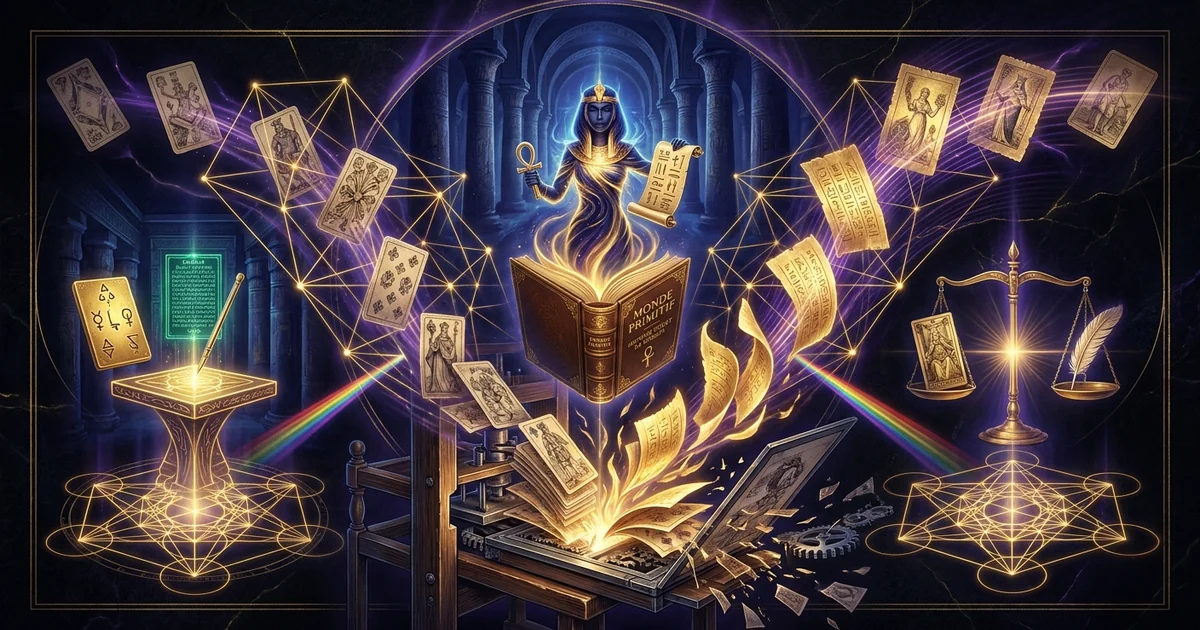
Antoine Court de Gebelin: Egyptian Tarot Hypothesis
Archetypal Thesis & Systemic Paradigm: The Birth of the Hieroglyphic Tarot
Epistemological Rupture: From Ludic Tarocchi to Sacred Hieroglyph
In the eighth volume of his monumental yet idiosyncratic compendium Monde Primitif, Analysé et Comparé avec le Monde Moderne (1781), Antoine Court de Gébelin enacted an epistemological rupture that fundamentally altered the trajectory of Western esoteric thought. Prior to this intervention, the pack of cards known across continental Europe as Tarocchi or the Tarot de Marseille operated primarily within the profane parameters of ludic recreation. Originating in the aristocratic courts of fifteenth-century northern Italy—most visibly in the luxury triumphal cards commissioned by the Visconti and Sforza dynasties—the deck functioned as a complex, trick-taking card game grounded in Renaissance allegorical processions, Christian moral didacticism, and Petrarcan iconography.
Court de Gébelin shattered this conventional paradigm. With singular hermeneutic confidence, he claimed that this humble cardboard pastiche was nothing less than the sole surviving physical fragment of the ancient Egyptian sacerdotal libraries: the fabled Book of Thoth. Through this radical re-evaluation, an artifact of European ludic leisure was converted into an intentional, encrypted hieroglyphic treatise that preserved the theological and philosophical order of a primordial world before the destruction of Alexandria. By asserting that the deck represented an intentional visual encoding of pristine Alexandrian-Egyptian wisdom, Court de Gébelin isolated the cards from their documented socioeconomic history and inserted them into the mythic space of sacred transmission.
This transformation was not merely an eccentric re-attribution; it constituted a structural re-semiotization of the deck. The casual ludic motifs were systematically stripped of their regional Catholic vernacular and read as deep symbolic ciphers. The allegorical triumphs were transformed into the precursors of the [major-arcana], elevated from moral didacticism to a systematic map of metaphysical emergence. Through this interpretive shift, the historical contingencies of woodblock cutters and Italian courtiers were subordinated to an overarching sacerdotal teleology.
The deck was reframed as a carefully curated philosophical curriculum designed by an elite priestly caste to survive the ravages of imperial collapse, cultural amnesia, and religious persecution. The cards had survived across centuries, Gébelin argued, precisely because they had been disguised under the mask of frivolous gaming. The profane player became the unwitting custodian of an initiatory doctrine. In this way, the French scholar established an enduring strategy in Western occult discourse: the discovery of sublime, non-linear metaphysical architectures concealed within plain sight beneath the surface of the mundane world.
The Hermeneutic Screen: Egyptomania and Enlightenment Primitivism
The emergence of Court de Gébelin’s Egyptian hypothesis cannot be understood apart from the intellectual climate of eighteenth-century France, a period caught in the generative tension between Enlightenment rationalism and an escalating Egyptomania. During this era, Europe looked back to classical antiquity through an idealized lens, yet maintained an acute fascination with civilizations perceived to be more ancient, pristine, and authoritative than Greece and Rome. Egypt, mediated through classical historians such as Diodorus Siculus, Plutarch, and Herodotus, emerged as the ultimate source of human knowledge—an empire of pure, non-discursive wisdom whose priestly caste possessed profound insight into the mechanics of the cosmos.
Because Jean-François Champollion would not decipher the Rosetta Stone until 1822, pre-Champollion Enlightenment Europe operated within an intellectual paradigm wherein Egyptian hieroglyphs were conceptualized not as phonetic linguistic markers, but as immediate, ideographic representations of archetypal realities. Following the Neoplatonic treatises of Plotinus and the Hieroglyphica of Horapollo, European intellectuals viewed hieroglyphic script as an ontological language capable of transmitting cosmological truths directly to the soul without the distorting medium of human speech. Court de Gébelin operated at the theoretical zenith of this Enlightenment primitivism. In his view, human history represented an entropic deviation from a singular, primordial golden age characterized by universal speech, universal agricultural sciences, and a pure philosophical theology. Monde Primitif was designed as a massive philological retrieval project to reverse this cultural decline by recovering the surviving fragments of this original unified human culture.
When Court de Gébelin encountered the Tarot de Marseille, the ambiguous and archaic visual iconography of the woodblock prints functioned as a hermeneutic screen. The striking figures—crowned monarchs, winged angels, esoteric beasts, and symbolic cosmic wheels—demanded an intellectual pedigree that early modern Catholic Europe could not provide to his satisfaction. The cards, detached from an explicit written commentary, presented an open symbolic canvas onto which the scholar could project the Enlightenment’s longing for primordial order. In this context, his Egyptian attribution was not an act of conscious intellectual deception, but rather a profound manifestation of [archetypal-projection]. The absence of an identifiable historical author for the Tarot allowed the deck to absorb the immense weight of the [thoth-archetype], serving as an empirical anchor for Court de Gébelin’s theoretical architecture of ancestral illumination.
“If one were to hear the announcement that there still exists today a Work of the ancient Egyptians, one of their Books which escaped the flames that devoured their superb libraries, and which contains their purest doctrine on the most interesting subjects, everyone would undoubtedly be eager to know so precious, so remarkable a Book… This Book actually exists: its pages are scattered throughout the world, yet no one knows it is Egyptian, and everyone possesses it without suspecting it… This Book is the Game of TAROTS, a game which we shall demonstrate is Egyptian in its origin, that its allegories are Egyptian, and that its preservation through so many centuries is a marvel.”
Consciousness Architecture: The Arcana as Psycho-Cosmological State Space
By declaring the Tarot to be a sacred Egyptian book, Court de Gébelin laid the structural foundation for interpreting the deck as a comprehensive psycho-cosmological coordinate framework. The shifts he instituted converted the 78 cards from arbitrary tokens of chance into a state-space representation of the human psyche and its cosmological correspondences. Rather than generating random card combinations for competitive point scoring, the structural mechanics of the pack were re-conceptualized as an initiatory curriculum. The sequences of the cards were read as stages in the emergence of consciousness from the primal mud of chaotic ignorance to the luminous realization of cosmic synthesis.
Within this framework, the cards ceased to be inert pieces of painted pasteboard. They became an dynamic cartography of the interior and exterior worlds. Court de Gébelin established that the Major Trumps did not represent disconnected moral lessons; rather, they formed a cohesive cosmological continuum reflecting the structural dynamics of universal creation, political hierarchy, temporal decay, and ultimate spiritual restoration. Through this systematic reframing, the deck began its historical migration toward the center of Western esoteric cartography. It served as a mirror wherein individual psychological operations could be mapped directly against macrocosmic principles, presaging the later syncretic systems that would weave the cards into the Western Mystery tradition.
From an archetypal perspective, Gébelin’s construction of the Tarot system mirrors what Carl Gustav Jung identified as the fundamental human imperative to project unconscious psychic material onto external systems of order. As Jung observed in The Archetypes and the Collective Unconscious:
“The psychological rule says that when an inner situation is not made conscious, it happens outside, as fate… Archetypal images are among the highest values of the human psyche; they have been used since time immemorial to represent and integrate psychic reality.”
Gébelin intuitively recognized that the Tarot’s symbolic structures held the structural capacity to house these psychic archetypes. The trump cards, once extracted from the triviality of tavern play, became luminous interfaces where the conscious intellect could engage the profound strata of the collective unconscious. The Tarot became an operational cybernetic feedback mechanism: an active field wherein archetypal signs structured the chaos of human experience into an ordered, initiatic journey.
Classical Provenance & Textual Lineage: Monde Primitif and the Mythic Book of Thoth
Monde Primitif (1781): Encyclopedic Universalism and Philological Fabulation
The formal introduction of the Egyptian Tarot occurs in the eighth volume of Court de Gébelin’s sprawling, nine-volume magnum opus, Monde Primitif, published between 1773 and 1782. Operating as a Protestant clergyman, royal censor, and an active leader in Parisian intellectual and Freemasonic circles—most notably the prestigious Lodge of the Nine Sisters (Loge des Neuf Sœurs)—Court de Gébelin positioned his work as the apex of late-Enlightenment encyclopedic universalism. His theoretical ambition rivaled that of Denis Diderot and Jean le Rond d’Alembert, yet his methodology took an unconventional path. Whereas the Encyclopédie was dedicated to empirical dissection, classification, and secular progress, Monde Primitif was driven by an integrative urge to unearth the foundational roots of human speech, mythological symbology, and religious institutions.
Central to Gébelin’s methodology was an uncritical reliance on speculative philology. Writing decades before comparative linguistics was formalized by Franz Bopp and the Brothers Grimm, Gébelin operated under the assumption that linguistic roots held immediate, metaphysical relationships to the things they designated. In his textual analysis of the cards, he performed linguistic fabulations to authenticate his Egyptian claims. He asserted that the word Tarot itself was pure, pristine Egyptian. He claimed it derived from the Coptic terms Tar, signifying “road” or “path,” and Rho (or Ros), signifying “king” or “royal”—thereby translating the name of the deck as the “Royal Road of Life” (Chemin Royal de la Vie).
Similarly, he argued that the word Mat, designating the unnumbered Fool card, derived from the Oriental root Mat, signifying “dead,” “struck down,” or “cracked.” While modern historical linguistics and post-Champollion Egyptology completely dismiss these etymologies as philological fabrications, within the late eighteenth-century French intellectual milieu, these linguistic claims carried substantial rhetorical weight. They provided an ostensibly scholarly foundation for a mythological edifice, granting the Tarot an intellectual pedigree that allowed it to infiltrate the highest tiers of French esoteric and Masonic intellectual society.
Documented Italian Renaissance Provenance
- Temporal Genesis: 1420s–1440s Northern Italy (Milan, Ferrara, Bologna).
- Primary Function: Ludic recreation; courtly trick-taking game (Ludus Triumphorum).
- Iconographic Paradigm: Christian didactic morality, Petrarchan triumphs, medieval heraldry, and standard Italian civic virtues.
- Structural Mechanics: 4 standard suits + 21 moral/allegorical trumps + 1 unnumbered Fool card.
- Linguistic Roots: Trionfi (Triumphs); later Tarocchi (etymology obscure, likely derived from dialectical terms for play or defeat).
- Transmission Vectors: European trade routes, artisanal woodblock printing, urban card-maker guilds.
Gébelin's Alexandrian Sacerdotal Hypothesis
- Temporal Genesis: Primordial Ancient Egypt; preserved through the Burning of Alexandria.
- Primary Function: Sacerdotal book of wisdom, metaphysical curriculum, veiled cosmological cipher.
- Iconographic Paradigm: Hermetic-Heliopolitan theology, astrological decans, Nilotic agriculture, Isis-Osiris mysteries.
- Structural Mechanics: 22 Sacred Hieroglyphic Tablets of the Book of Thoth + 56 Cosmological Quadrants.
- Linguistic Roots: Coptic Tar (“Path”) + Rho (“King”) = “The Royal Road of Life.”
- Transmission Vectors: Disguised as playing cards, carried across Europe by Romani populations (wrongly thought to be Egyptian).
Comte de Mellet and the Hebrew-Egyptian Synthesis: The Proto-Kabbalistic Link
While Court de Gébelin provided the grand macro-historical theory of the Egyptian Tarot, it was his contemporary and collaborator, Louis-Raphaël-Lucrèce de Fayolle, Comte de Mellet, whose contribution decisively shaped the structural mechanics of modern occultism. Included within Volume VIII of Monde Primitif directly following Court de Gébelin’s dissertation is an anonymous essay authored by the Comte de Mellet titled Recherches sur les Tarots, et sur la Divination par les Cartes des Tarots. De Mellet took Gébelin’s broad mythological framework and applied a precise, structural synthesis that introduced a vital syncretic element: the Hebrew alphabet.
De Mellet observed that the number of Major Trumps—twenty-two—corresponded precisely with the twenty-two letters of the Hebrew alphabet. Operating within an esoteric framework that viewed ancient Hebrew as an initiatic derivative of Egyptian hieroglyphics, de Mellet argued that the twenty-two trumps formed an alphabetical, numerical, and cosmological continuum. This insight established the foundation for modern esoteric Tarot. Without de Mellet’s structural intervention, Gébelin’s Egyptian hypothesis might have remained a historical anomaly. By mapping the twenty-two trumps to an alphabetic system traditionally linked to the twenty-two paths of cosmic creation, de Mellet anticipated the entire nineteenth-century Kabbalistic synthesis later codified by Éliphas Lévi and the British Hermetic Order of the Golden Dawn.
+-------------------------------------------------------------------------+
|                  DE MELLET'S STRUCTURAL BLUEPRINT (1781)                |
+-------------------------------------------------------------------------+
|  22 Hebrew Letters  <--->  22 Major Trumps  <--->  Cosmological Decans  |
|                                                                         |
|            [ Proto-Kabbalistic Architectural Foundation ]               |
|                                  |                                      |
|                                  v                                      |
|            Later integrated into Lévi's Kabbalistic Tree               |
|              and the Hermetic Order of the Golden Dawn                  |
+-------------------------------------------------------------------------+
Furthermore, de Mellet was the first to document the explicit practice of cartomancy using the Tarot, systematizing the cards into an operational divinatory manual. He divided the deck into temporal and cosmic registers, mapping the four suits to the four seasons, the court cards to the societal classes of ancient Egypt, and the twenty-two trumps to the progression of human life and cosmic destiny. In doing so, he constructed the structural bridge through which the [thoth-archetype] ceased to be merely an abstract philological curiosity and became an active, operational technology for mantic inquiry.
The Alexandrian Mythos: Constructing the Sacerdotal Transmission Lineage
To explain how an Egyptian sacerdotal book could have reached eighteenth-century Paris without being recognized by academic antiquarians, Court de Gébelin and de Mellet constructed a mythic transmission lineage anchored in the cataclysms of antiquity. They hypothesized that during the twilight of the Egyptian civilization, the high priests foresaw the imminent destruction of their temples, the burning of their libraries, and the historical oblivion awaiting their sacred knowledge. Recognizing that intellectual books written on conventional scrolls would be targeted for destruction, the sages searched for an indestructible medium. They determined that human vice—specifically the universal, obsessive human impulse to gamble—was far more enduring than philosophical virtue.
Consequently, the priests transformed their deepest metaphysical secrets into a set of gaming instruments. By encoding their sacred hieroglyphic doctrines into the cards of a game, they guaranteed that the deck would be copied, handled, and transmitted across cultures and centuries, protected by the armor of human triviality. The Romani people, erroneously identified during the eighteenth century as direct descendants of the ancient Egyptians (hence the colloquial English term Gypsies), were cast as the wandering guardians of this fragmented text. According to Gébelin, these itinerant people had preserved the Book of Thoth and carried it into Western Europe, distributing its fragmented wisdom across the taverns and aristocratic salons of the continent.
This Alexandrian transmission myth served an essential function within 18th-century occultism. As Antoine Faivre notes in Access to Western Esotericism, traditional forms of esoteric thought depend upon the concept of “transmission”—the belief that initiatic knowledge must flow through an unbroken, authenticated chain of custody stretching back to a divine or primordial revelation. By linking the Tarot to the library of Alexandria and the priesthood of Thoth-Hermes, Court de Gébelin provided the Tarot with an irrefutable esoteric lineage. This structural myth endowed the cards with supreme epistemic authority, legitimizing their use not merely as instruments of popular amusement, but as an initiatic curriculum worthy of serious philosophical meditation.
Structural Mechanics & Symbolic Geometry: Reinterpreting the 78 Keys
The Four Elemental Suits as Sacerdotal Castes and Cosmological Quadrants
In his systemic re-reading of the Tarot de Marseille, Court de Gébelin did not restrict his analyses to the Major Trumps. He recognized that if the deck was indeed the complete Book of Thoth, the fifty-six Minor Suit cards must mirror the structural organization of Egyptian civilization and the fundamental divisions of ancient cosmology. He dismantled the conventional association of the suits with medieval European feudalism—wherein Swords represented the nobility, Cups the clergy, Coins the merchant class, and Batons the peasantry—and transposed them onto an ancient, four-fold societal and cosmological structure.
Within Gébelin’s paradigm, the four suits became direct representations of the four primary castes of the Nilotic empire:
- Coupes (Cups): Allocated to the Sacerdotal Caste, representing the priests, libations, religious mysteries, and the element of Water.
- Épées (Swords): Allocated to the Royal and Military Caste, signifying the magistrates, protectors of the state, divine warfare, and the element of Air.
- Deniers (Coins): Allocated to the Commercial and Agricultural Caste, representing wealth, the commerce of the empire, the fruitful silt of the Nile, and the element of Earth.
- Bâtons (Wands/Staves): Allocated to the Pastoral and Artisan Caste, signifying rural life, agricultural labor, organic generation, and the element of Fire.
[ SACERDOTAL SPHERE ]             [ REGAL / MILITARY SPHERE ]
             Coupes (Cups)                     Épées (Swords)
          Element: Water (Water)              Element: Air (Breath)
        Priesthood & Libations              Magistrates & Protection
                   \                               /
                    \                             /
                     \                           /
                      \                         /
                       +-----------------------+
                       |    TETRAMORPHIC AXIS  |
                       +-----------------------+
                      /                         \
                     /                           \
                    /                             \
                   /                               \
        Deniers (Coins)                       Bâtons (Staves)
      Element: Earth (Silt)                Element: Fire (Vitality)
     Commerce & Materiality                 Agriculture & Labor
     [ COMMERCIAL SPHERE ]                   [ ARTISAN SPHERE ]
This structural realignment organized the minor suits into a tetramorphic mandala. The 56 minor cards were no longer viewed as arbitrary numeric accumulations, but as the cosmic quadrant within which the dynamic forces of the universe played out across time and space. The numeric sequence within each suit—from the Ace to the Ten—was conceptualized as the progressive materialization of its respective principle, establishing a geometric symmetry between the abstract archetypes of the Trumps and the material conditions of terrestrial reality.
Re-titling the Trumps: The Papesse as High Priestess and the Maison-Dieu
To maintain the Egyptian attribution, Court de Gébelin engaged in an aggressive programmatic re-titling of the Major Trumps, systematically purging the cards of their explicit Catholic and medieval heraldry. Where the traditional Tarot de Marseille featured late-medieval ecclesiastical authorities, Court de Gébelin excised the Christian signifiers to reveal the “authentic” pagan and Hermetic archetypes that he claimed had been obscured by early modern European printers.
The most prominent example of this re-titling appears in his treatment of Trump II, historically labeled La Papesse (The Popess), an allegorical nod to the medieval legend of Pope Joan. Court de Gébelin categorically dismissed this reading as an ignorant distortion by European artisans. He declared this card to be La Grande-Prêtresse (The High Priestess)—the chief hierophant of Isis, veiled in the mysteries of the temple and holding the sacred volumes of natural law.
Likewise, Trump V, Le Pape (The Pope), was divested of his triple papal tiara and Vatican keys, emerging in Gébelin’s texts as Le Grand-Prêtre (The High Priest), the hierophant of Heliopolis or Osiris, representing the outward transmission of sacred law to the initiated community.
- Trump II: La Papesse $\rightarrow$ The High Priestess (Isis / Sacerdotal Wisdom)
- Re-titled as the guardian of the divine sanctuary, holding the sacred hieroglyphic tablets.
- Trump V: Le Pape $\rightarrow$ The Chief Hierophant (Osiris / Patriarchal Law)
- Interpreted as the celestial father and governor of religious mysteries.
- Trump XII: Le Pendu $\rightarrow$ Virtue of Prudence (Prudentia)
- Inverted the image to depict a man standing upright on one foot, reading the card as an emblem of cautious, intentional movement rather than treachery.
- Trump XVI: La Maison-Dieu $\rightarrow$ The Castle of Plutus / Lightning Strike
- Interpreted as the historic destruction of an earthly tower through divine retribution, symbolizing the triumph of cosmic law over mortal arrogance.
- Trump XVII: L’Étoile $\rightarrow$ The Dog Star (Sirius / Sothis)
- The naked female figure identified directly as Isis pouring the waters of the Nile, with the central star representing the heliacal rising of Sirius announcing the annual inundation.
These adjustments transformed the Trump sequence from a Christian morality play into a dynamic Hermetic pantheon. By re-titling these archetypes, Gébelin decoupled the deck from the institutional dogmas of Roman Catholicism, allowing it to function as an open symbolic architecture that could subsequently interface with [hermeticism] and the Kabbalistic [tree-of-life].
Numerical Archetypes: Decimal Scales and the Sacerdotal Septenary
Beneath the superficial iconography of the cards, Court de Gébelin identified a rigorous mathematical matrix governing the deck’s macro-structure. He perceived that the numerical distribution of the cards was anchored in the sacred geometry of the ancient Pythagoreans and Egyptians, relying heavily on the numbers Three, Four, Seven, and Ten.
The twenty-one numbered trumps were analyzed as three distinct groups of seven—a Sacerdotal Septenary:
- The First Septenary (Trumps I to VII): The Temporal and Physical Domain. Governing the terrestrial manifestation of consciousness, human virtues, and the baseline civil order of the mortal world.
- The Second Septenary (Trumps VIII to XIV): The Moral and Elemental Domain. Governing the structural laws of justice, cosmic equilibrium, interior trials, death, and temperance.
- The Third Septenary (Trumps XV to XXI): The Celestial and Macrocosmic Domain. Governing the astral spheres, the fall of illusion, celestial illumination via Sirius, the Moon, and the Sun, terminating in the cosmic synthesis of the World.
Binding this triadic structure was Le Mat (The Fool), the unnumbered card. Court de Gébelin recognized this zero-point archetype as a symbol of dynamic chaos, cosmic entropy, and the unformed absolute that both precedes and animates the twenty-one stages of manifestation. Meanwhile, the fifty-six Minor Arcana reflected four decimal series of fourteen cards (ten pips plus four court cards), creating an arithmetic harmony between the quaternary structure of the physical elements and the decimal progression of reality.
Through this analysis, Court de Gébelin demonstrated to his Enlightenment contemporaries that the Tarot was not an arbitrary assemblage of images, but an integrated mathematical treatise embodying classical philosophical principles.
Psychological Dynamics & Operational Praxis: The Cartomantic Paradigm Shift
From Symmetrical Game to Asymmetrical Divination: Etteilla’s Instrumentalization
Court de Gébelin conceived of the Tarot primarily as a philosophical, historical, and philological monument; his focus was retrospective, seeking to demonstrate its Egyptian origin rather than to cultivate an active fortune-telling clientele. However, his theoretical formulations acted as the catalyst for one of the most significant shifts in the history of practical divination. Among the avid readers of Monde Primitif was Jean-Baptiste Alliette, a Parisian printmaker and mathematician who published under the anagrammatic pseudonym Etteilla. Alliette immediately perceived the commercial and operational possibilities of Gébelin’s theoretical framework.
Prior to 1781, popular cartomancy was practiced primarily with standard 32- or 52-card piquet decks, utilizing unsystematized folk interpretations. Etteilla recognized that Gébelin’s “Book of Thoth” concept provided the metaphysical architecture required to elevate cartomancy into a formal, sacerdotal praxis. In a series of treatises published between 1783 and 1785, Etteilla popularized and adjusted Gébelin’s theories. He argued that while Gébelin had correctly identified the cards as the Book of Thoth, the printed versions available across France had been corrupted by centuries of uninitiated copyists.
Etteilla took it upon himself to “correct” these supposed corruptions, publishing the first specifically esoteric and divinatory Tarot deck—the Grand Etteilla—which altered the numeric sequence of the cards, placed the creation of the cosmos at the beginning of the trumps, and added explicit divinatory keywords to the borders of each image. Through this development, the Egyptian Tarot transitioned from an intellectual thesis into an operational divination system, establishing professional cartomancy as a lasting feature of the Western esoteric landscape.
Hermeneutic Decoding: Synchronicity as Sacerdotal Alignment
The transition of the Tarot into an operational divination system transformed how human beings interacted with chance and visual narrative. Within the traditional ludic card game, the shuffling and dealing of the cards was governed strictly by statistical probability, an arbitrary distribution meant to create a competitive game between players. Within the new occult paradigm inaugurated by Court de Gébelin and mechanized by Etteilla, the mechanics of the deal were re-sacralized. The random distribution of cards was reframed as a non-random, acausal phenomenon—what Carl Jung would later conceptualize as synchronicity.
Under this hermeneutic model, the shuffling of the cards disrupts the linear, ego-driven consciousness of the querent, allowing the archetypes of the Book of Thoth to configure themselves into an accurate state-space representation of the querent’s inner and outer reality. The act of reading the cards became an interpretive ritual: an act of reading the hieroglyphs of an unfolding situation.
Because the cards were understood to reflect the macrocosmic order of the universe, any layout of the cards generated a symbolic cross-section of the cosmos at that specific moment in time. Divination through the Egyptian Tarot was not presented as common superstition or demonic fortune-telling; it was framed as an initiatic science, a method for reading the fundamental laws of nature through symbolic correspondence.
Projection and Introspection: The Arcana as an Archetypal Mirror
At an operative psychological level, Court de Gébelin’s transformation of the Tarot established an externalized stage for psychic introspection. When a human subject observes an ambiguous, richly layered symbolic image—such as the High Priestess, the Hanged Man, or the Wheel of Fortune—the conscious intellect cannot rely solely on linear, discursive thought to exhaust its meaning. Instead, the mind must activate its mythopoetic faculties, projecting unconscious archetypal materials, repressed emotions, and nascent insights onto the visual field of the card.
By clothing the cards in the authority of an Egyptian initiatic mystery, Gébelin intensified this psychological dynamic. The querent or practitioner did not approach the cards as arbitrary drawings; they approached them with numinous awe, expecting to encounter profound metaphysical truths. This psychological expectancy lowered the threshold of conscious resistance, allowing deep interior dynamics to emerge.
The twenty-two Major Trumps functioned as an archetypal mirror, reflecting the macrocosmic laws of spiritual evolution, the trials of the ego, and the potential paths toward psychic individuation. The reader became an active participant in an initiatory drama, decoding their own life trajectory against the enduring patterns of human archetypal experience.
Philosophical Synthesis & Macrocosmic Correspondence: Hermetic Transmission and the Enlightenment
The Paradox of Reason: Esoteric Historicism within Enlightenment Epistemology
The Egyptian Tarot hypothesis presents a fascinating epistemological paradox: a foundational moment of modern Western occultism born directly out of the intellectual mechanisms of the Age of Enlightenment. Court de Gébelin was neither a medieval mystic nor a romantic irrationalist. He was a dedicated scholar of the Enlightenment who utilized the analytical methods of his era—historical critique, philological comparison, systemic taxonomies, and cross-cultural structural analysis—to advance his conclusions.
His failure was not a failure of reason, but a failure of his historical data. Deprived of the linguistic tools required to read genuine Egyptian inscriptions, his analytical methodology operated upon ungrounded assumptions, creating an elaborate, logically internally consistent theoretical structure that stood upon a false historical premise.
This paradox illustrates the complex relationship between Enlightenment rationalism and esoteric thought. Rather than acting as mutually exclusive intellectual domains, eighteenth-century rationalism frequently served to systematize and formalize esoteric ideas. The Enlightenment imperative to classify, categorize, and discover universal laws was turned inward upon the symbolic archives of Europe.
Court de Gébelin applied the same scientific impulses that drove contemporary botanists and encyclopedists to the allegories of the Tarot de Marseille. In doing so, he constructed an “esoteric historicism” that sought to rescue ancient wisdom from the perceived distortions of medieval superstition, inadvertently birthing the modern occult revival through the very structural methods designed to demystify the world.
“The esoteric form of thought is characterized by four fundamental elements: correspondences, living nature, imagination and mediations, and the experience of transmutation… Court de Gébelin illustrates the supreme application of ‘imagination and mediations,’ using symbolic forms as an active instrument to intermediate between the visible world of human artifacts and the invisible macrocosmic world of primordial archetypes.”
Hermetic Macrocosm-Microcosm Mapping via Late-Platonic Systems
The structural architecture of Court de Gébelin’s Egyptian Tarot is sustained by the classic Hermetic axiom of macrocosm and microcosm, famously articulated in the Tabula Smaragdina and the Corpus Hermeticum: “That which is below is like that which is above, and that which is above is like that which is below, to perform the miracles of the one thing.” Gébelin’s reading of the cards is an explicit mapping of this ontological principle.
Through this prism, the Tarot is understood as an operational microcosm: a complete, miniaturized model of the macrocosmic universe. The cards do not merely symbolize planetary forces, elements, and ethical virtues; they are structural reflections of those realities. By interacting with the cards through meditation, study, or mantic manipulation, the human subject engages directly with the metaphysical axes governing reality.
This conceptual framework relies heavily on Late-Platonic theurgy, as articulated by Iamblichus and Proclus, wherein physical symbols, stones, plants, and images are understood to share an energetic resonance (synthemata) with divine intelligences. Court de Gébelin elevated the printed card into a modern theurgic synthema. By interacting with the archetypal keys of the Book of Thoth, the practitioner was thought to harmonize their internal state with the macrocosmic architecture of the universe, transforming an ordinary card game into a path of Hermetic ascent.
       MACROCOSM (The Divine Architecture)
       [ Cosmological Principles, Decans, Celestial Spheres ]
                              ▲
                              │
               STRUCTURAL SYMBIOSIS / SYNTHEMATA
                              │
                              ▼
       MICROCOSM (The Initiatic Mirror)
       [ 78 Hieroglyphs of the Book of Thoth / Tarot Keys ]
                              ▲
                              │
                PSYCHO-SPIRITUAL INTEGRATION
                              │
                              ▼
       THE INDIVIDUAL SUBJECT (Conscious Individuation)
The Legacy of False Origin: How Myth Generated an Authentic Psycho-Spiritual System
From the standpoint of modern empirical history, academic philology, and Egyptology, Court de Gébelin’s Egyptian hypothesis is entirely without historical foundation. The research of Ronald Decker, Thierry Depaulis, and Sir Michael Dummett in A Wicked Pack of Cards: The Origins of the Occult Tarot definitively proved that the Tarot originated in fifteenth-century northern Italy as a card game, and that its imagery reflects Christian Renaissance iconography rather than the sacerdotal libraries of Memphis or Heliopolis. No card of the Tarot has ever been found in an ancient Egyptian tomb, nor is there any mention of such an artifact in Egyptian records.
Yet, to evaluate Court de Gébelin’s contribution solely on empirical accuracy is to misapprehend how symbolic systems evolve. The historical falsity of the Egyptian attribution does not diminish the functional reality of the system it brought into being. By declaring the Tarot to be the Book of Thoth, Court de Gébelin provided the catalyst that transformed a regional European game into the structural framework of the modern Western Mystery tradition. His mythological narrative provided the initial structural scaffold that allowed later thinkers—including Éliphas Lévi, Papus, Arthur Edward Waite, and Aleister Crowley—to progressively integrate the cards with the Kabbalistic [sephirot], Western astrology, and depth psychology.
Through this continuous process of layered hermeneutic synthesis, the Tarot evolved into an authentic, deeply effective psycho-spiritual system. The Egyptian hypothesis functioned as a necessary mythological chrysalis: a structural fiction that allowed the human psyche to reclaim its own archetypal projections and construct an enduring cartography of consciousness. The myth of origin ultimately validated itself not through the discovery of archaeological artifacts in the sands of Egypt, but through the profound structural coherence, psychological efficacy, and symbolic depth of the esoteric system it set in motion.
Frequently Asked Questions
Historical Validity vs. Esoteric Efficacy of the Egyptian Hypothesis
Did the Tarot originate in ancient Egypt, and does the historical refutation of this hypothesis invalidate its use in esoteric traditions?
Modern archival and material history has thoroughly dismantled the claim that the Tarot originated in ancient Egypt. Historical scholarship has established that the Tarot originated in northern Italy during the first half of the fifteenth century (c. 1420–1440) as a card game called Trionfi (later Tarocchi). The iconography of the original decks—such as the Visconti-Sforza cards—reflects Italian Renaissance culture, Christian allegorical processions, and Petrarchan philosophy, showing no relationship to Egyptian hieroglyphs or theological texts.
However, the esoteric efficacy of a symbolic system does not depend on linear historical provenance; it depends on internal structural cohesion, archetypal integrity, and psychological resonance. When Court de Gébelin re-titled the deck as the Book of Thoth, he enacted a structural paradigm shift that allowed the deck to be consciously realigned with universal archetypal dynamics.
Over the course of two centuries, the Tarot absorbed the projections, meditations, and systematizations of generations of scholars and esoteric practitioners. As a result, the cards transformed into an authentic, highly functional psycho-cosmological system. The Egyptian hypothesis operates as a generative mythos: an imaginative framework that allowed a late-medieval card game to evolve into a universal cartography of the human psyche.
The Linguistic Fallacy of Gébelin’s Etymologies
Why are Court de Gébelin’s linguistic derivations of terms like “Tarot” and “Mat” considered invalid by modern linguistics?
Court de Gébelin’s philological arguments were formulated prior to the 1822 decipherment of the Rosetta Stone by Jean-François Champollion and before the establishment of modern comparative linguistics. His methodology relied on phonetic associations, speculative analogies, and an uncritical synthesis of Coptic dictionaries compiled by early scholars like Athanasius Kircher.
His primary linguistic claim—that Tarot is derived from the Coptic words Tar (“path” or “road”) and Rho or Ros (“king” or “royal”)—is entirely unfounded. In the ancient Egyptian language and its later stage, Coptic, these roots do not combine to form any phrase meaning “Royal Road.” Similarly, his attribution of the word Mat (The Fool) to an Oriental or Egyptian root signifying “murdered” or “struck down” represents a phonetic coincidence rather than a real philological lineage.
Etymologically, the Italian word Tarocchi is of uncertain origin, but historical evidence points toward northern Italian linguistic developments, possibly related to taroccare (a dialectical term meaning “to play the fool,” to trump, or to engage in contentious dispute). Gébelin’s linguistic derivations were philological fabrications that reflected the Enlightenment’s longing for an idealized, primordial language.
The Divergence Between Court de Gébelin and Later French Esotericists
How did later occultists, particularly Éliphas Lévi, alter and evolve Court de Gébelin’s original Egyptian framework?
Court de Gébelin constructed an essentially classical, eighteenth-century Egyptian framework that was descriptive, philological, and heavily focused on agricultural and cosmological cycles (such as the rising of Sirius and Nilotic flooding). While he and the Comte de Mellet noted a numerical correspondence between the twenty-two trumps and the twenty-two letters of the Hebrew alphabet, they did not map the cards systematically onto the Jewish mystical Kabbalah.
This foundational transformation was achieved in the mid-nineteenth century by the French occultist Alphonse Louis Constant, writing under the pseudonym Éliphas Lévi. In Dogme et Rituel de la Haute Magie (1854–1856), Lévi inherited Gébelin’s premise that the Tarot was the ancient Book of Thoth, but he subordinated the overt Egyptian iconography to a comprehensive Kabbalistic and Hermetic synthesis. Lévi directly mapped the twenty-two Major Trumps to the twenty-two paths of the [tree-of-life] connecting the ten divine emanations ([sephirot]).
               [ COURT DE GÉBELIN (1781) ]
         Classical-Egyptian Sacerdotal Mythos
          Agricultural & Cosmological Cycles
                          │
                          ▼
               [ COMTE DE MELLET (1781) ]
       Initial Correlation: 22 Trumps = 22 Letters
                          │
                          ▼
                [ ÉLIPHAS LÉVI (1854) ]
         Comprehensive Kabbalistic Synthesis
             22 Trumps = 22 Tree-of-Life Paths
                          │
                          ▼
            [ GOLDEN DAWN REVISION (1888) ]
       Systematic Astrological & Elemental Mapping
While Court de Gébelin viewed the cards as historical artifacts of an Egyptian past, Lévi transformed them into a dynamic operational keyboard for ceremonial magic and Hermetic philosophy. Later nineteenth- and twentieth-century organizations, such as Papus’s Ordre Martiniste and the British Hermetic Order of the Golden Dawn, built their esoteric systems on Lévi’s Kabbalistic framework, using Gébelin’s Egyptian hypothesis as an ancestral cornerstone while replacing his specific interpretations with an integrated Kabbalistic, astrological, and psychological architecture. :::