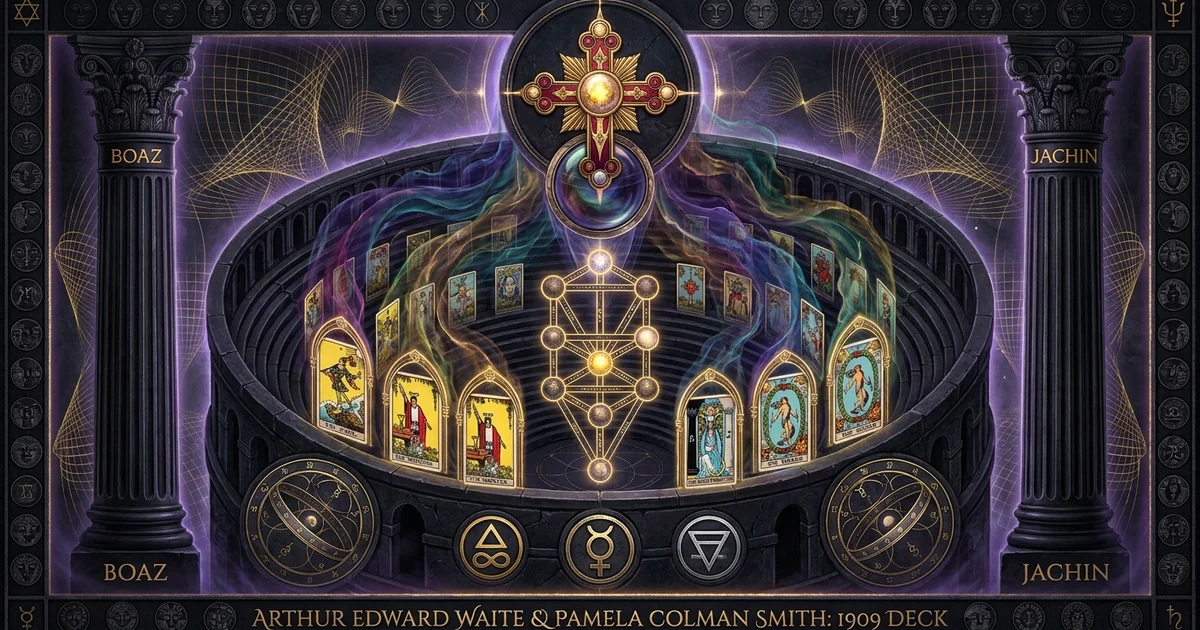
Arthur Edward Waite & Pamela Colman Smith: 1909 Deck
Archetypal Thesis & Systemic Paradigm: The 1909 Epistemological Break
The publication of the 1909 tarot pack—commissioned by Arthur Edward Waite, executed by Pamela Colman Smith, and published by William Rider & Son—marks an ontological fracture in the development of Western esoteric cartography. Prior to this historic intervention, the European cartomantic corpus was dominated by the typographic inertia of the Tarot de Marseille: a system defined by un-scenified minor suits whose numerical permutations demanded mechanical tallying or the uncritical memorization of folkloric axioms. The waite colman smith 1909 rider pack dismantled this mechanical fatalism. Rather than serving as an instrument for predictive event-casting or gambling, the deck was explicitly engineered as a dynamic symbolic interface: a visual, operational apparatus designed to map the interior architecture of the human psyche onto the cosmological coordinates of the Hermetic tradition.
Tarot de Marseille Architecture
- Iconography: Un-scenified Minor Arcana (geometric repetition of suit tokens: swords, batons, cups, coins).
- Interpretive Modality: Mechanical counting, rigid mnemonics, and deterministic external fortune-telling.
- Cosmological Framework: Implicit late-medieval Christian and folk-Renaissance allegories; severed from systematic astrological or Kabbalistic correspondences.
- Trump Organization: Traditional sequence; Trump VIII as Justice, Trump XI as Strength/Force.
- Epistemological Status: External mantic engine; treats human destiny as a fatalistic, preordained succession of worldly events.
1909 Rider-Waite-Smith Pack
- Iconography: Fully scenified Minor Arcana depicting dramatic human archetypes and embodied psychosocial situations.
- Interpretive Modality: Active psychological projection, visionary immersion, and intuitive-archetypal synthesis.
- Cosmological Framework: Explicit Hermetic-Qabalistic scaffolding; systematic integration of the Tree of Life and the 36 astrological decans.
- Trump Organization: Structural inversion; Trump VIII as Strength, Trump XI as Justice to align with Hebrew alphabet and zodiacal sequences.
- Epistemological Status: Internal psychospiritual cartography; treats human consciousness as an operant, evolving state-space capable of self-realization.
The Transmutation of Cartomancy into Psycho-Spiritual Cartography
The core philosophical achievement of the 1909 deck was the conscious transmutation of vulgar cartomancy into an operant psycho-spiritual cartography. In his foundational treatises, Waite rejected the prognostic determinism popularized by eighteenth- and nineteenth-century French occultists such as Etteilla, Éliphas Lévi, and Gérard Encausse (Papus). For Waite, cartomancy was a corrupted vestige of a concealed metaphysical science. The cards were not intended to predict whether a client would inherit money, suffer a fever, or encounter a dark stranger; such applications reduced a sacred hieroglyphic alphabet to the status of an amusement.
Instead, Waite’s mystical tarot reform re-anchored the 78 leaves of the tarot in the interior landscape of the soul. The deck operates as an objective mirror of psychic integration. Each card constitutes a localized nexus of metaphysical forces, converting transpersonal archetypes into visible form. In this framework, the cards delineate the stages of human consciousness as it navigates the tension between temporal fragmentation and divine union. The journey encoded within the sequence reflects the classical Hermetic ascent, wherein the candidate systematically encounters, integrates, and transcends the elemental, planetary, and zodiacal spheres. By establishing a direct visual dialectic between mundane human experience and transcendent spiritual law, the 1909 pack shifted the locus of tarot practice from outward temporal anxiety to inward spiritual transformation.
Pamela Colman Smith’s Synesthetic Imagination and the Visualized Unconscious
This reformative vision would have remained a purely theoretical proposition had it not been for the visionary execution of Pamela Colman Smith. An artist of Jamaican, British, and American heritage deeply embedded in the London avant-garde, Smith was an initiate of the Hermetic Order of the Golden Dawn and an active collaborator in the theatrical circles of William Butler Yeats and the Lyceum Theatre. Her artistic practice was profoundly shaped by synesthesia—the neurological blending of sensory modalities wherein musical compositions induced vivid hypnagogic visions of symbolic form and color.
Smith did not merely illustrate Waite’s esoteric directives; she translated abstract metaphysical propositions into living mythic theater. Drawing upon the aesthetic conventions of the Symbolist movement, Japanese woodblock printing (ukiyo-e), and the dynamic stage-craft of Edward Gordon Craig, Smith imbued the cards with dramatic tension. Figures lean against gravity, gaze across psychological voids, and stand paralyzed beneath heavy cosmic skies. Her linework possesses a stark, graphic immediacy that strips away superfluous decorative historicism in favor of psychological resonance. In her treatment of the minor suits, Smith visualized the collective unconscious decades before Carl Jung formally synthesized the concept. The landscapes she created—the jagged crags of the Five of Cups, the oppressive industrial grayness of the Ten of Swords, the pastoral balance of the Nine of Pentacles—serve as somatic resonant chambers that trigger instinctive, emotional, and archetypal recognition within the percipient.
The Hermetic-Kabbalistic Matrix: Resolving the Veil of External Fortune
Beneath the pictorial accessibility of Smith’s compositions lies the rigorous mathematical and symbolic matrix of the Hermetic Order of the Golden Dawn. In this system, the universe is conceived as a multi-dimensional emanation structured by the Qabalistic Tree of Life. The twenty-two Major Arcana correspond to the twenty-two paths of wisdom (Netivot) connecting the ten divine emanations (sephiroth). The fifty-six Minor Arcana articulate the manifestation of the Tetragrammaton ($Y-H-V-H$) across the four Kabbalistic worlds: Atziluth (Archetypal/Fire/Wands), Briah (Creative/Water/Cups), Yetzirah (Formative/Air/Swords), and Assiah (Material/Earth/Pentacles).
By grounding the deck in this Hermetic-Kabbalistic matrix, Waite and Smith solved the primary theoretical defect of historical cartomancy: its disconnected, arbitrary taxonomy. In the 1909 deck, no card exists in isolation. Every image occupies an absolute structural coordinate within an interconnected cosmology. The cards cease to be static signs and become dynamic topological nodes. When an image is perceived during an operational reading, it activates both the specific phenomenological drama portrayed on its face and the macrocosmic lattice to which it is tethered. The veil of external fortune is thus dissolved; circumstance is revealed to be the outer projection of interior structural dynamics governed by immutable cosmic laws.
Classical Provenance & Textual Lineage: The Golden Dawn, Sola-Busca, and Christian Mysticism
The architectural foundation of the waite colman smith 1909 rider pack was forged in the private initiatory chambers of the Hermetic Order of the Golden Dawn, established in London in 1888. The Order’s operational synthesis drew together diverse strands of Western esotericism—Renaissance Hermeticism, Rosicrucianism, the Christian Kabbalah of Pico della Mirandola and Johannes Reuchlin, John Dee’s Enochian magic, and classical astrological theory—into a single coherent curriculum. Central to this initiatory transmission was a foundational curriculum document that would entirely redefine the destiny of the tarot.
The Hidden Genesis: Mathers’ ‘Book T’ and the Cipher Manuscripts
The esoteric mechanics of the 1909 pack derive directly from the Order’s private curriculum document, Book T: The Tarot, Comprising the Secret Rules for the Interpretation of the Card-Significations, authored primarily by Samuel Liddell MacGregor Mathers. Book T systematized the cryptic hints found in the foundational Cipher Manuscripts, establishing an absolute, invariant system of correspondences. In this internal document, the Minor Arcana were systematically cross-referenced with the thirty-six astrological decans—ten-degree segments of the zodiacal wheel—and the ten sephiroth of the Tree of Life.
The court cards were divorced from their feudal, monarchical origins and re-conceptualized as elemental sub-types under the titles of Kings, Queens, Knights (Princes), and Pages (Princesses). The trumps were mapped sequentially onto the twenty-two letters of the Hebrew alphabet, which in turn corresponded to the three mother elements, seven classical planets, and twelve zodiacal constellations of the ancient cosmogonic text, the Sepher Yetzirah. When Waite engaged Pamela Colman Smith to execute the 1909 deck, he placed this theoretical architecture into her hands, requiring her to build visual narratives that would encapsulate these complex astrological and Kabbalistic dynamics without revealing the inner secrets of the Order.
“The true Tarot is symbolism; it speaks no other language and offers no other signs. Given the outward meaning of its emblems, they do become a kind of alphabet which is capable of indefinite combinations and makes true sense in all. On the higher plane it offers a key to the Mysteries, in a manner which is not arbitrary and has not been derived to any extent from the ordinary methods of occult research… The pictorial Tarot is therefore an allegory of human life, under the guise of an alphabet of pictures, and in its highest aspect it is a sacramental vehicle for the communication of the secret tradition.” — Arthur Edward Waite, The Key to the Tarot (London: William Rider & Son, 1910), pp. xii–xiv.
The Sola-Busca Precedent: British Museum Exposures and Iconographic Synthesis
While Book T provided the theoretical framework, the visual paradigm shift of the 1909 deck required an iconographic precedent. In 1907, the British Museum exhibited black-and-white photographic reproductions of the late-fifteenth-century Sola-Busca tarot, an enigmatic Italian deck previously owned by the Milanese Sola-Busca family. The Sola-Busca pack was historical anomaly: it was the earliest known deck in which the numbered minor suits (pips) were decorated not with geometric groupings of swords, batons, cups, or coins, but with dramatic human figures engaged in classical, mythological, and alchemical tasks.
Pamela Colman Smith visited the British Museum and studied these photographs with deep attentiveness. The visual evidence of this encounter is unmistakable. Smith directly appropriated compositional arrangements from the Sola-Busca for the 1909 deck. Most conspicuously, the Three of Swords—a heart transfixed by three downward-plunging blades against a backdrop of storm clouds and rain—is a direct, modernized distillation of the Sola-Busca Three of Swords. Similarly, the figure in the Eight of Swords, bound and blindfolded amidst a prison of vertical weapons, draws its spatial tension from the Sola-Busca’s Roman soldiers and captured warriors. Smith synthesized the classical, Renaissance-era severity of the Sola-Busca with the clean, linear sensibility of the modern Arts and Crafts movement, humanizing the geometric abstraction of Book T and producing a novel pictorial lexicon.
Waite’s Rupture with the Astral Plane: The Christian-Mystical Imperative
Although Arthur Edward Waite was an adept of the Golden Dawn, rising to the grade of Exempt Adept ($7^\circ=4^\circ$), his intellectual and spiritual trajectory diverged sharply from that of Mathers and Aleister Crowley. Waite despised occultism in the strict sense—he viewed the manipulation of subtle energies, goetic evocation, and astral projection as dangerous spiritual detours that ensnared the soul in the lower psychic astral planes. His primary intellectual commitments lay in high Christian mysticism, the legends of the Holy Grail, Martinism, and the spiritual regeneration of the soul along the path of the Rosicrucian Fama Fraternitatis.
Consequently, Waite instituted a radical mystical tarot reform. In both the design of the cards and their accompanying exegesis in The Pictorial Key to the Tarot (1911), Waite sought to rescue the tarot from the mechanistic magic of Mathers and the deterministic fatalism of French occultists like Lévi and Papus. Waite re-framed the Major Arcana as an esoteric manual for the mystical unio mystica. The Hierophant ceased to be an ecclesiastical tyrant and became the initiator into internal grace; the High Priestess was transfigured into the Shekinah, the uncorrupted divine wisdom behind the veil of the temple; the Fool was elevated from an aimless vagrant to the divine soul embarking on the journey of spiritual incarnation. In executing this reform, Waite severed the tarot from low mantic sorcery and established it as a sacramental instrument designed to illuminate the mystical ascent of the human spirit.
Structural Mechanics & Symbolic Geometry: The Pictorial Minor Arcana and Astrological Architecture
The lasting genius of the 1909 Rider-Waite-Smith pack rests in its functional integration of astronomical geometry with human psychology. Far from being freeform imaginative illustrations, the pictorial Minor Arcana are deeply calibrated symbolic machines. Each numbered card from two through ten embodies a specific intersection of sephirotic energy and astrological mechanics, translating abstract cosmological realities into dynamic pictorial dramas.
To comprehend how the Hermetic-Kabbalistic matrix governs the pictorial execution of the 1909 deck, examine the structural attribution of the Suit of Wands (Fire / Atziluthic Plane). Each pip card manifests the interaction of a specific Sephirah with a zodiacal decan and its planetary ruler, which Pamela Colman Smith then encoded into symbolic human action:
| Card | Sephirah | Title in Book T | Astrological Decan | Decanic Ruler | Iconographic Mechanics |
|---|---|---|---|---|---|
| 2 of Wands | Chokmah (Wisdom) | Lord of Dominion | 1st Decan of Aries ($0^\circ–10^\circ$) | Mars in Aries | A statesman atop a battlement, holding a globe and staff, contemplating the expansion of his sovereign territory. |
| 3 of Wands | Binah (Understanding) | Lord of Established Strength | 2nd Decan of Aries ($10^\circ–20^\circ$) | Sun in Aries | A figure stands with his back turned, looking out over the sea as his ships return; mastery through disciplined vision. |
| 4 of Wands | Chesed (Mercy) | Lord of Perfected Success | 3rd Decan of Aries ($20^\circ–30^\circ$) | Venus in Aries | A floral canopy supported by four wands; harmonious social equilibrium, harvest, and joyful civic stability. |
| 5 of Wands | Geburah (Severity) | Lord of Strife | 1st Decan of Leo ($0^\circ–10^\circ$) | Saturn in Leo | Five youths engaged in competitive, chaotic contest; uncoordinated friction without lethal intent. |
| 6 of Wands | Tiphareth (Beauty) | Lord of Victory | 2nd Decan of Leo ($10^\circ–20^\circ$) | Jupiter in Leo | A laurel-crowned horseman parading amid foot soldiers; public triumph, solar balance, and social recognition. |
| 7 of Wands | Netzach (Victory) | Lord of Valour | 3rd Decan of Leo ($20^\circ–30^\circ$) | Mars in Leo | A lone defender atop a hill fighting off six wands from below; individual courage against systemic resistance. |
| 8 of Wands | Hod (Splendor) | Lord of Swiftness | 1st Decan of Sagittarius ($0^\circ–10^\circ$) | Mercury in Sagittarius | Eight staves flying unimpeded through open air toward the earth; rapid kinetic acceleration and pure communication. |
| 9 of Wands | Yesod (Foundation) | Lord of Great Strength | 2nd Decan of Sagittarius ($10^\circ–20^\circ$) | Moon in Sagittarius | A bandaged sentry leans warily on his staff before a palisade; psychic endurance, vigilance, and protective entrenchment. |
| 10 of Wands | Malkuth (Kingdom) | Lord of Oppression | 3rd Decan of Sagittarius ($20^\circ–30^\circ$) | Saturn in Sagittarius | A man bends under the crushing weight of ten staves, carrying them toward a city; energetic overload and material burden. |
Decanic Geometries: Mapping the 36 Decans onto the Pip Sequences
The distribution of the thirty-six astrological decans across the Minor Arcana follows the ancient Chaldean order of the planets: Saturn, Jupiter, Mars, Sun, Venus, Mercury, and Moon. This order is mapped across the four astrological triplicities—Fire, Water, Air, and Earth—commencing with the first decan of Aries at the vernal equinox and traversing the entire ecliptic.
Smith translated these astronomical realities into the somatic vocabulary of everyday human life. In the Seven of Cups (Venus in Scorpio), the planetary illusion and elemental dissolution of water are rendered as a silhouetted figure awestruck by seven spectral visions emerging from clouds—wealth, vanity, monstrosity, divine illumination—capturing the diffuse, seductive danger of ungrounded desire. In the Two of Swords (Moon in Libra), the balance of an airy, intellectual sign mediated by the receptive Moon is visualized as a blindfolded woman holding two crossed, heavy swords across her chest before a tidal sea; the card captures the precise psychological agony of an enforced mental armistice where intellect and intuition are locked in absolute stalemate.
Smith’s narrative genius ensured that the practitioner does not need to consciously calculate the orbital velocity of Saturn in Leo to immediately grasp the competitive, frictional paralysis depicted in the Five of Wands. The cosmological geometry is integrated into the visual field, allowing the card to speak directly to the human nervous system through posture, color temperature, and spatial perspective.
Sephirotic Vectors: Fourfold Tetragrammatic Descent Across the Suits
The numbered cards also chart the descent of divine force through the sephiroth of the Tree of Life. In Kabbalistic cosmology, creation is not an instantaneous event, but a continuous step-down transformation of energy through ten metaphysical reservoirs, moving from the boundless infinite (Ain Soph) down to the dense physical universe (Malkuth). The four suits map this descent across the four elemental planes of the Tetragrammaton:
- The Aces represent Kether, the primordial, unconditioned source of the element.
- The Twos represent Chokmah, the active, dynamic polarization of the force.
- The Threes represent Binah, the primordial womb wherein force is given structural form.
- The Fours through Nines articulate the moral and astral dimensions of the human microcosm (Chesed to Yesod).
- The Tens represent Malkuth, the ultimate terrestrial realization, density, and crystallization of the elemental vector.
Because each numbered card occupies an identical sephirotic station across the four suits, a rigorous comparative geometry emerges. The Fours (Chesed/Mercy) consistently delineate conditions of consolidation, boundary-drawing, and stability: the civic joy of the Four of Wands, the passive emotional plateau of the Four of Cups, the intellectual rest of the tomb in the Four of Swords, and the avaricious, defensive entrenchment of the Four of Pentacles. Conversely, the Tens (Malkuth/Kingdom) demonstrate what happens when an element reaches maximum density: the fire of Wands becomes an oppressive physical burden; the water of Cups overflows into the perpetual rainbow of familial legacy; the air of Swords culminates in the catastrophic physical death of the ego; and the earth of Pentacles solidifies into ancestral wealth, estate, and biological continuity.
The Major Arcana Alterations: Re-positioning Justice (VIII) and Strength (XI)
The most structurally significant innovation instituted by the 1909 pack was the public alteration of the numerical sequence of the Major Arcana: specifically, the swapping of Trump VIII and Trump XI. In the historical Tarot de Marseille, Justice was designated as Card VIII, while Strength (Force) was designated as Card XI. Waite, executing the secret curriculum of the Golden Dawn, transposed them, publishing Strength as Card VIII and Justice as Card XI.
Historical Tarot de Marseille Sequence:
[VII: Chariot] -> [VIII: Justice] -> [IX: Hermit] -> [X: Wheel] -> [XI: Strength]
1909 Rider-Waite-Smith Correction:
[VII: Chariot] -> [VIII: Strength] -> [IX: Hermit] -> [X: Wheel] -> [XI: Justice]
This structural modification was not an arbitrary whim. It was mathematically mandatory to resolve the internal logic of the Golden Dawn’s attribution of the twenty-two trumps to the twenty-two letters of the Hebrew alphabet and the cosmological markers of the Sepher Yetzirah. Under this system, the Hebrew letter Teth ($\text{ט}$) is traditionally assigned to the zodiacal sign of Leo, while the letter Lamed ($\text{ל}$) is assigned to the sign of Libra.
If Justice occupied position VIII, it would be bound to the letter Teth (Leo), creating an unbearable cosmological dissonance: an airy, intellectual archetype of balance, equilibrium, and legal measurement would be forced into an energetic union with a fiery, instinctual, and solar sign. Conversely, if Strength were positioned at XI, it would be bound to Lamed (Libra), forcing a primal archetype of animal passion and carnal dominion into alignment with the sign of the Scales. By inverting their positions, Waite aligned Strength (Card VIII) with Teth (Leo) and Justice (Card XI) with Lamed (Libra). This restored the organic, uninterrupted sequence of the astrological zodiac along the Hebrew alphabet, repairing the symbolic circuitry of the Tree of Life.
Psychological Dynamics & Operational Praxis: The Archetypal Mirror of Consciousness
Viewed through the lens of twentieth-century depth psychology, the 1909 Rider-Waite-Smith deck operates as a sophisticated psychological projection engine. Long before Carl Gustav Jung formalized his theories of the collective unconscious, archetypes, and active imagination, Waite and Smith engineered an operational apparatus that accomplished these exact clinical and therapeutic functions through the medium of visual art.
Active Imagination and the Tarot Tableau: Pre-Jungian Projections
In The Archetypes and the Collective Unconscious, C. G. Jung observed that the human unconscious communicates not in intellectual syllogisms, but in raw, affect-laden visual archetypes. When an individual confronts an ambiguous, highly dense symbolic image, the conscious ego is forced to suspend its critical linear mechanics. Latent unconscious complexes—repressed anxieties, unintegrated shadow material, transcendent intuitions—are projected directly into the symbolic topography of the external object.
The 1909 pack facilitates this process with exceptional clarity because of Smith’s scenographic Minor Arcana. In the Tarot de Marseille, an individual drawing the Nine of Swords confronts nine curved, interwoven blades—a geometric pattern that addresses only the calculating mind. In the 1909 pack, that same card presents a figure sitting upright in bed, head buried in their hands in an attitude of visceral grief, while nine heavy swords hang like a psychic weight on a black wall above them, and a coverlet carved with roses and the signs of the zodiac drapes over their lower body. This image bypasses the rational defenses of the querent, provoking immediate somatic and emotional identification. The card functions as an apparatus for active imagination; it invites the viewer to enter the space of the bedroom, inhabit the posture of the grieving figure, and bring conscious language to the shadowy torment depicted on the wall.
The Card as Cybernetic Feedback Loop: Breaking Predictive Entrapment
By replacing the predictive fatalism of traditional cartomancy with an archetypal architecture, the 1909 deck transforms divination into a cybernetic feedback loop. Traditional fortune-telling views time as a static, linear channel along which the querent is pulled toward a predetermined future. This model entraps the human subject in a state of passive helplessness: fate is an external force imposed by an indifferent cosmos.
The operational praxis of the 1909 deck completely upends this fatalism. In this system, time is understood not as a deterministic line, but as a dynamic vector space shaped by the interplay of conscious decisions and unconscious imperatives. The spread of cards drawn during a consultation does not forecast an immutable event; it generates an instantaneous state-space assessment of the querent’s psychic field. The consultation operates as a complex feedback mechanism:
$$\text{Field State } (\Psi) \xrightarrow{\quad\text{Consultation}\quad} \text{Symbolic Visualization } (\mathcal{S}) \xrightarrow{\quad\text{Cognitive Reappraisal}\quad} \text{Perturbation } (\Delta \Psi)$$
By rendering visible the unconscious vectors that govern the querent’s behavior, the tarot enables cognitive reappraisal. The moment an individual consciously recognizes the destructive pattern embodied in the Five of Swords (the petty, hollow victory won at the cost of genuine communion) or the static emotional enclosure of the Four of Cups (the apathy that refuses the emerging gift of grace), the psychological state-space changes. The querent is no longer a passive passenger to an inevitable fate; they are the operant pilot of their own individuation.
Hermeneutic Decoding: Spatial Orientation, Chiaroscuro, and Body Postures
The critical analysis of a 1909 spread requires reading beyond the generic keywords found in divinatory manuals. Pamela Colman Smith constructed a sophisticated visual language governed by spatial orientation, chiaroscuro, directional gaze, and physical posture. Every dimensional coordinate within the card’s rectangular frame carries meaning.
The left-hand side of the card traditionally correlates with the receptive, intuitive, past-oriented, and unconscious realm, while the right-hand side represents the active, solar, future-oriented, and conscious plane of manifestation. Figures looking to the left (such as the Queen of Cups staring into her sealed, complex chalice) are absorbed in internal, reflective, and ancestral contemplation. Figures facing to the right (such as the Page of Wands staring boldly forward) indicate an emergence into the world of action, projectivity, and externalization.
Furthermore, horizon lines establish the degree of conscious stability possessed by the figure. In the Page of Pentacles, the horizon line is high and the earth is solid, fertile, and cultivated, signaling grounded sensory attention. In the Seven of Cups, the horizon line has completely vanished into a formless blue ether, indicating that the figure’s ego-boundaries have dissolved into the fluid, unanchored waters of the astral plane. The interplay of light and shadow—the brilliant white sun in the background of the Death card (XIII) juxtaposed with the dark, heavy river—serves as an ongoing hermeneutic prompt: every ending carries the solar seed of cyclical regeneration.
Philosophical Synthesis & Macrocosmic Correspondence: The Tree of Life and the Alchemical Magnum Opus
Beyond its diagnostic utility in personal psychology, the 1909 Rider-Waite-Smith deck remains a masterwork of macrocosmic correspondence. Its seventy-eight cards assemble into an encyclopedic mandala that reflects the cosmological and metaphysical mechanics of the Western esoteric tradition: specifically, the Kabbalistic Tree of Life and the alchemical Magnum Opus.
“Divination methods are simply a playful, imaginative way of tapping the collective unconscious… The archetypes are the structural elements of the psychoid substrate of reality, bridging matter and psyche. In an authentic divinatory system like the Tarot, the synchronistic event acts as a mirror, where the qualitative nature of time in a single moment is caught in an image, showing the individual where they stand within the grand pattern of the unus mundus.” — Marie-Louise von Franz, On Divination and Synchronicity: An Psychology of Meaningful Chance (Toronto: Inner City Books, 1980), pp. 38–41.
The 22 Trumps as the Hebrew Paths of Wisdom (Netivot)
The twenty-two Major Arcana represent the structural ligaments of the Hermetic universe: the twenty-two channels or paths that connect the ten divine sephiroth upon the Tree of Life. In the Kabbalistic text Sepher Yetzirah, these paths are categorized into the Three Mother Letters, the Seven Double Letters, and the Twelve Simple Letters.
Waite and Smith encoded these cosmological classifications directly into the iconography of the trumps:
- The Three Mother Letters—Aleph (Air), Mem (Water), and Shin (Fire)—form the primordial elemental triad. The Fool (Path 11 / Aleph) steps off the cliff into the luminous, airy ether, embodying the primal breath of the Spirit. The Hanged Man (Path 23 / Mem) hangs suspended between heaven and earth above the waters of baptism and alchemical dissolution. The Judgement card (Path 31 / Shin) depicts the final, fiery descent of the Spirit into the tomb, calling forth the resurrection of the dead.
- The Seven Double Letters correspond to the seven classical planets, representing the polarities of human experience: wisdom and folly, wealth and poverty, life and death. The Magician (Path 12 / Beth / Mercury) mediates between above and below; the Empress (Path 14 / Daleth / Venus) presides over physical generativity; the Tower (Path 27 / Peh / Mars) shatters the rigid structures of the dogmatic ego.
- The Twelve Simple Letters correspond to the twelve signs of the zodiac, governing the faculties of the human organism: sight, hearing, touch, and locomotion. Cards like The Emperor (Path 15 / Heh / Aries), The Hermit (Path 20 / Yod / Virgo), and The Star (Path 28 / Tzaddi / Aquarius) depict the stabilization of these cosmic energies within the human psyche.
The Four Elemental Suits as the Tetragrammaton and Archetypal Planes
The architecture of the Minor Arcana serves as a direct mirror of the four-letter name of God, the Tetragrammaton ($Y-H-V-H$), which constitutes the foundational formula of creation in Hermetic Kabbalah. Through this formula, pure unmanifested divinity steps down through four successive, interconnected planes of reality:
- Yod ($\text{י}$): Atziluth (The Archetypal World) / Element of Fire / Suit of Wands. This is the realm of pure spiritual will, divine spark, and primeval intention. In the Wands, Smith consistently depicted scenes of vitality, conquest, vision, and raw energetic drive.
- He ($\text{ה}$): Briah (The Creative World) / Element of Water / Suit of Cups. This is the realm of the cosmic heart, primordial emotion, receptive form, and psychic interiority. The Cups delineate the movement of human affect: romantic communion, tragic loss, emotional saturation, and spiritual ecstasy.
- Vau ($\text{ו}$): Yetzirah (The Formative World) / Element of Air / Suit of Swords. This is the realm of the discriminating mind, linear analysis, dualistic division, and psychological conflict. The Swords are universally portrayed as cutting, sharp, and painful; the human mind, in its effort to parse reality through language and logic, inevitably manufactures suffering, anxiety, and alienation.
- He Final ($\text{ה}$): Assiah (The Material World) / Element of Earth / Suit of Pentacles. This is the ultimate physical realm of concrete realization, biology, labor, and commerce. The Pentacles anchor the cosmic circuit, demonstrating that divine will cannot remain an abstract spiritual aspiration, but must be enfleshed within the concrete reality of soil, coin, craft, and stone.
The Fool’s Journey as the Alchemical Magnum Opus
When viewed in its totality, the Major Arcana delineates an alchemical process of spiritual evolution: the Fool’s Journey. The Fool (Card 0) is not an idiot; he is the prima materia—the unconditioned, chaotic, yet infinitely potentialized raw material of the soul. His traversal of the trumps reflects the classical stages of the alchemical Magnum Opus:
The Alchemical Traversal of the Trumps:
[Card 0: The Fool] (Prima Materia / Unconditioned Potential)
        │
        ▼
[Cards I–VII: Nigredo] (Ego-Differentiation, Worldly Engagement, & Material Entrapment)
        │
        ▼
[Cards VIII–XIV: Albedo] (Inward Descent, Shadow Confrontation, & Purifying Equilibrium)
        │
        ▼
[Cards XV–XVIII: Citrinitas] (The Dark Night of the Soul, Tower-Shattering, & Solar Awakening)
        │
        ▼
[Cards XIX–XXI: Rubedo] (Solar Reintegration, Resurrection, & The Alchemical Chymical Wedding)
The sequence begins with the outward, conscious ego-differentiation of the first seven cards, concluding with the armored victory of the Chariot (VII).
The journey then moves into the inward, purifying realm of the albedo (Cards VIII through XIV), where the soul encounters the inner teacher in the Hermit (IX), confronts the turning wheel of karmic cycles (X), and undergoes internal balance in Temperance (XIV).
The descent deepens into the profound crisis of the nigredo and citrinitas through the encounter with the Shadow in the Devil (XV), the catastrophic demolition of the false ego in the Tower (XVI), and the navigation of the dark night of the soul beneath the haunting light of the Moon (XVIII).
Finally, the sequence culminates in the glorious rubedo (red work): the solar awakening of the Sun (XIX), the transcendent resurrection of the true Self in Judgement (XX), and the final alchemical wedding in the World (XXI). In this ultimate card, the cosmic dancer, surrounded by the laurel wreath of the ouroboros and framed by the four fixed signs of the zodiac, signals the total reintegration of the fragmented human psyche back into the divine source from which it originally emerged.
Frequently Asked Questions: Resolving Anomalies of the 1909 Pack
Historical Authorship and the Erasure of Pamela Colman Smith
Why was the 1909 deck historically attributed almost exclusively to Arthur Edward Waite, and how has contemporary scholarship reclaimed Pamela Colman Smith’s central authorship?
The naming of the 1909 deck as simply the “Rider-Waite” tarot represents a profound historical injustice driven by twentieth-century gender bias and commercial expedience. William Rider & Son held the commercial copyright, and Arthur Edward Waite was an established, prolific author whose name carried commercial authority within the occult marketplace. Pamela Colman Smith, by contrast, was a working-class woman of color operating as a commercial illustrator, painter, and stage designer. Despite receiving only a modest flat-rate commission for illustrating all seventy-eight cards in less than six months during 1909, it was Smith who made the pivotal creative decisions: translating theoretical Golden Dawn notes into narrative scenes, inventing the dramatic poses, designing the costumes, and defining the emotional tone of the Minor Arcana.
Late-twentieth and twenty-first-century scholarship—pioneered by historians like Mary K. Greer, Stuart R. Kaplan, and Ronald Decker—has systematically deconstructed this erasure. Contemporary academic consensus acknowledges that the deck is a co-authored artifact. The modern scholarly designation Rider-Waite-Smith (RWS) restores Smith’s primary role not as an amanuensis executing another man’s vision, but as the visual mythologist who synthesized the collective unconscious into an accessible pictorial lexicon. Without Smith’s synesthetic imagination, the 1909 deck would have remained an obscure, unapproachable occult manual accessible only to initiates of the Golden Dawn.
The Deliberate Blinds in Waite’s Pictorial Key to the Tarot
Did Arthur Edward Waite embed deliberate blinds, omissions, or misdirections in his published texts to protect his secret society oaths?
Arthur Edward Waite faced a profound ethical and esoteric dilemma when publishing the 1909 deck. As a high-ranking initiate and past leader of the Golden Dawn, he was bound by solemn oaths of secrecy never to reveal the inner teachings, manuscripts, and tables of correspondences of the Order—most notably Book T and the Cipher Manuscripts. Yet, Waite passionately believed that the high mystical doctrine of the tarot belonged to all spiritual aspirants, not merely to members of a fractured, quarreling secret society.
To resolve this conflict, Waite employed the traditional esoteric device of the blind. In The Key to the Tarot (1910) and The Pictorial Key to the Tarot (1911), Waite offered descriptions that frequently veil the true Golden Dawn attributions:
- He vigorously denied that the tarot had any authentic historical connection to the Kabbalah or the Hebrew alphabet in his exoteric historical essays, even while deliberately designing the cards to embody those exact correspondences.
- In his divinatory interpretations of the Minor Arcana, he frequently provided banal, superficial, and contradictory meanings derived from French cartomancers like Etteilla, directly undermining the profound decanic and sephirotic mechanics encoded in Smith’s illustrations.
Serious students of the 1909 pack must recognize this bifurcated textual strategy: the visual images designed by Smith under Waite’s private direction contain the authentic, uncorrupted esoteric transmission, whereas Waite’s written text in the Pictorial Key intentionally incorporates blinds designed to turn away the uninitiated dilettante while preserving the sacred mysteries for those possessing the eyes to see.
The Mechanics of Decanic Rulership in Divinatory Practice
How does an operational practitioner utilize the astrological decans of the Minor Arcana to extract precise diagnostic meaning during a consultation?
In practical application, the decanic rulership underlying the Minor Arcana serves as an objective corrective against vague, subjectivist intuition. When a practitioner reads the pip cards through their decanic framework, the card cease to signify a static event and instead reveals an active thermodynamic process occurring within the querent’s psychological field.
For instance, consider the Three of Swords, which corresponds to the Second Decan of Libra ($10^\circ–20^\circ$), governed by Saturn. Libra is the cardinal air sign of partnership, harmony, mental equilibrium, and aesthetic beauty. When the cold, structural, restrictive energy of Saturn is placed within the heart of this harmonizing sign, a severe psychological crisis occurs. The human intellect attempts to apply cold, unyielding, absolute logic to an organic emotional connection. The three swords piercing the heart do not indicate that a physical murder will occur; they indicate that the querent’s conscious ego is undergoing the agonizing yet structurally necessary experience of sorrowful clarity—the surgical severance of a romantic or conceptual illusion by the unyielding blade of objective truth.
By consulting the decanic attributions:
- The sign (e.g., Libra) provides the archetypal arena or environmental medium.
- The planet (e.g., Saturn) provides the active engine or behavioral drive.
- The sephirah (e.g., Binah/Understanding) provides the macrocosmic purpose or structural boundary.
This systemic synthesis elevates tarot reading from superstitious fortune-telling into a rigorous, diagnostic science of the human soul. The cards map the precise location of the conscious subject within the timeless, revolving wheel of the cosmos. :::