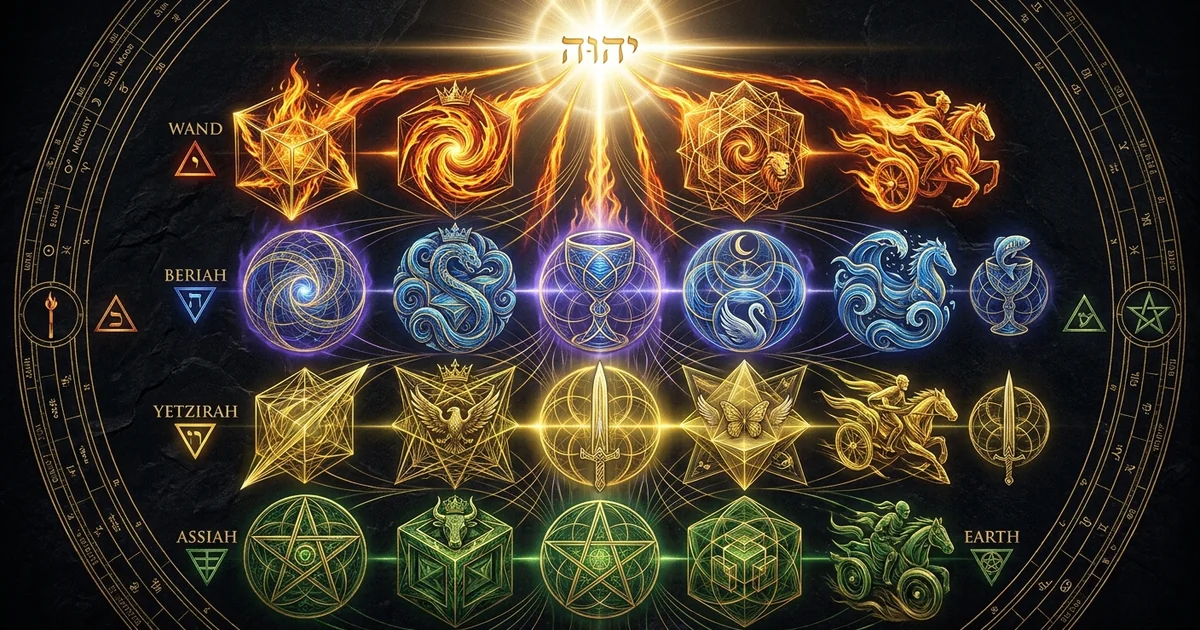
The Four Kabbalistic Worlds: Court Cards and Emanation
Archetypal Thesis & Systemic Paradigm: The Four Worlds as Cosmological Architecture
The Emanationist Descent (Olamot) and Recursive Vector States
The sixteen Court Cards of the Western esoteric Tarot do not function as trivial character sketches, psychological parlor caricatures, or literal portraits of historical courtiers. Within the Hermetic-Kabbalistic synthesis codified by late nineteenth-century esoteric cartographers, these figures serve as high-order functional operators within an emanational cosmology. Rather than depicting static identities, the Court Cards map the ontological “step-down” transformation through which unmanifest divine Will (Ein Sof) progressively condenses into the dense, sensory mechanics of physical matter. This cosmological cascade is formulated across the four Kabbalistic worlds (Olamot): Atziluth (the World of Emanation), Beriah (the World of Creation), Yetzirah (the World of Formation), and Assiah (the World of Action or Manifestation).
In this emanational taxonomy, reality is understood not as an ex nihilo event of temporal creation, but as a perpetual, continuous vector descent. Divine energy radiates from the transcendent supernal source, descending through cascading gradients of increasing density, friction, and specificity. Each world provides a distinct medium with an inherent vibrational coefficient: Atziluth functions as pure, archetype-generating intentionality; Beriah represents the initial containment and systemic modeling of that intentionality; Yetzirah manifests as the dynamic fluidic architecture of psychical and energetic currents; and Assiah marks the crystalline crystallization of form within the space-time continuum.
Macrocosmic Source (Ein Sof)
         │
         ▼
[ Atziluth ] ── Archetypal Vector   ── Pure Will (Chokmah)
         │
         ▼
[ Beriah ]   ── Architectural Matrix ── Primordial Form (Binah)
         │
         ▼
[ Yetzirah ] ── Dynamic Interference ── Psycho-Astral Currents (Tiphereth/Zauir Anpin)
         │
         ▼
[ Assiah ]   ── Crystalline Entropy  ── Material Ground (Malkuth)
The Court Cards operate as dynamic operators across these thresholds. When deployed within an analytical grid, a Court figure indicates the specific operational modality through which transpersonal intent is currently transitioning between these macrocosmic states. The cards map recursive vector states: feedback loops wherein an archetype belonging fundamentally to one world is refracted through the functional apparatus of another. To grasp this dynamic is to transcend the fatalistic limitations of traditional divinatory reading, entering instead into a state-space mechanics of consciousness. The architecture of this transition is governed entirely by the geometric and linguistic blueprint of the sacred name.
The Tetragrammaton (YHVH) as an Algorithmic Structural Engine
The systemic engine regulating this descent is the fourfold formula of the Tetragrammaton: Yod-Heh-Vav-Heh (יהוה). Far from serving merely as a mystical nominalism, the Tetragrammaton operates within the Kabbalah as an algorithmic, recursive algebraic function that governs all structural emergence. Each letter denotes an ontological phase of emergence, which corresponds precisely to one of the Four Worlds, one of the four classical elements, and one specific rank within the Tarot’s court structure. The assignment of the court ranks to the letters of the divine name establishes a dynamic cycle:
The initial letter, Yod (י), correlates to Atziluth, the primordial element of Fire, the supernal Sephirah of Chokmah (Wisdom), and the rank of the King (or Knight in the reformed system of the Golden Dawn and Aleister Crowley). Yod is the point-source, the undifferentiated seminal seed containing the holographic total of the completed process, fully dynamic yet lacking spatial extension.
The first Heh (ה) denotes Beriah, the primal element of Water, the Sephirah of Binah (Understanding), and the Queen. Here, the raw masculine-electric spark of Yod is received into the maternal womb of primal space, where it is measured, contained, and given structural definition through architectural limitation.
The third letter, Vav (ו), corresponds to Yetzirah, the element of Air, the centralized sephirotic cluster centered on Tiphereth (the Zauir Anpin or Microprosopus), and the Prince (the traditional Knight of medieval nomenclature). Vav acts as a dynamic spatial nexus: it is the expressive offspring of the union of Father (Yod) and Mother (Heh), carrying the archetypal design into the psycho-astral currents of volatile thought and relational movement.
Finally, the second or “final” Heh (ה תתאה) corresponds to Assiah, the element of Earth, the terrestrial vessel of Malkuth (the Kingdom), and the Princess (or Page). The final Heh is the actualized vessel into which the forces of the preceding three letters pour their cumulative potencies, providing the material ground where energy reaches equilibrium and physical manifestation. Through the framework of the /sacred-geometry/tetractys-pythagorean-cosmology, this sequence of 1, 2, 3, 4 constitutes the completion of unity in manifestation, rendering the Court Cards the personified structural components of the cosmos itself.
Classical Provenance & Textual Lineage: From Lurianic Kabbalah to the Hermetic Order
Lurianic Tzimtzum, Shevirat ha-Kelim, and the Genesis of the Olamot
The theoretical architecture underpinning the fourfold emanational worldview was fundamentally codified during the sixteenth-century Kabbalistic renaissance in Safed, primarily through the intellectual legacies of Moses Cordovero and Isaac Luria. Prior to this golden age, the concept of the Olamot existed across medieval Jewish mystical literature in fragmented forms, but it was Cordovero’s Pardes Rimonim and Luria’s revolutionary cosmological system—documented by his disciple Chaim Vital in Etz Chayim—that systematized the descent of divine light through the worlds of Atziluth, Beriah, Yetzirah, and Assiah.
As Gershom Scholem elucidates in Major Trends in Jewish Mysticism (1941), Luria fundamentally altered classical creation narratives by positing the doctrine of tzimtzum (צמצום)—the primordial contraction or self-withdrawal of the Ein Sof. Rather than divine creation being an outward expansion, it begins with an internal retraction of God into Himself, carving out an ontological vacuum (tehiru) into which a single ray of supernal light (kav) could penetrate.
Within this void, the progressive manifestation of the Sefirot occurred, initially coalescing into the primordial human form of Adam Kadmon. However, the intensity of the light flowing down through the upper worlds proved too volatile for the lower vessels to contain. This induced the cosmic catastrophe termed shevirat ha-kelim (שבירת הכלים)—the “shattering of the vessels.”
The shards of these shattered vessels plummeted into the lower depths of Yetzirah and Assiah, entangling sparks of divine light (nitzotzot) within the inert, dead shells of matter (kelipot). This catastrophic rupture necessitated the grand project of tikkun (restoration). The four Kabbalistic worlds, therefore, were preserved not as static, pristine crystalline realms, but as dynamic zones of energetic processing, purification, and psychic reconstruction.
[ Ein Sof ] (Infinite Unmanifest)
            │
      [ Tzimtzum ] (Primordial Contraction / The Void)
            │
     [ Adam Kadmon ] (Primordial Anthropos)
            │
 ┌──────────┴──────────┐
 │                     │
[ Supernal Vessels ]   [ Lower Vessels ]
 (Intact / Stable)     (Shattered: Shevirat ha-Kelim)
                       │
       ┌───────────────┴───────────────┐
       ▼                               ▼
[ Divine Sparks (Nitzotzot) ]   [ Coarse Shells (Kelipot) ]
       │                               │
       └───────────────┬───────────────┘
                       │
             [ Emanational Worlds ]
         Atziluth ── Beriah ── Yetzirah ── Assiah
                       │
               [ Tikkun Olam ] (Theurgy & Restoration)
The sixteen Court Cards are the operational custodians of these sparks. Each court figure occupies a precise ontological station situated across the frontier where divine vitality encounters the material resistance of the fallen vessels. When Western occultists encountered these Safedic texts through Christian Kabbalistic intermediaries—such as Johannes Reuchlin, Knorr von Rosenroth’s Kabbala Denudata, and the comprehensive syntheses of Heinrich Cornelius Agrippa in De Occulta Philosophia Libri Tres (1533)—they integrated these dynamics into their symbolic practices, recognizing that divination is not fortune-telling, but the systematic diagnosis of how tikkun is proceeding within the subtle anatomy of the microcosm.
The Hermetic Order of the Golden Dawn and the Codification of ‘Book T’
The direct systemic synthesis linking the four Lurianic worlds, the Tetragrammaton, and the sixteen Tarot Court Cards was formally achieved between 1887 and 1888 within the Hermetic Order of the Golden Dawn. In their foundational instructional curriculum, transcribed within the secret manuscript known as Book T: The Tarot, Samuel Liddell MacGregor Mathers and William Wynn Westcott codified the elemental and Qabalistic attributions of the cards, harmonizing centuries of fragmented occult lore into a unified, mathematically elegant cosmological matrix.
Book T fundamentally rejected the superficial European heraldic readings of the Court as representing petty sovereigns, chivalric riders, and court damsels. Instead, Mathers assigned the Court Cards directly to the sephirotic hierarchy of the /tarot/tree-of-life-kabbalah-tarot, mapping their titles directly across the operational anatomy of the Macroprosopus and Microprosopus. In doing so, the Order established an uncompromising algebraic key: the four ranks of the Court were definitively linked to the four letters of the Tetragrammaton, the four Kabbalistic Worlds, and the four Classical Elements.
“The Court Cards are the four persons of the Name. The Kings are the Letters Yod, and represent the rapid, violent, and active forces of the Father. The Queens are the Letters Heh, and represent the seated, receptive, and enduring forces of the Mother. The Princes are the Letters Vav, and represent the Son, who bringeth the forces of the Father and the Mother into dynamic expression, volatile and balanced. The Princesses are the Letters Heh Final, and represent the Daughter, the earthly executive of the previous three, completing the operation in the physical plane.”
Under this structural dispensation, the Golden Dawn systematized what had previously been vague intuition. Each card ceased to be a simple thematic archetype and became a composite glyph. The card’s rank designated its primary elemental orientation (its World of Origin), while its suit designated its operational medium (its World of Action). This produced a functional coordinate system: sixteen distinct psycho-spiritual vectors governing the descent and circulation of divine energy through nature and the human psyche.
Crowley’s Reformation: The Re-Titling of Knights, Kings, Princes, and Princesses
Despite the brilliance of Mathers’ synthesis, the Golden Dawn retained a naming convention that introduced structural confusion into the taxonomy of the cards. In the standard English tradition popularized by Arthur Edward Waite’s Rider-Waite-Smith deck, the court was designated as King, Queen, Knight, and Page. This ordering disrupted the structural correspondence to the Tetragrammaton: the King was placed at Chokmah (Yod), but the Knight was demoted to an intermediate messenger beneath the Queen, and the Page stood as a nebulous youth at Malkuth.
In The Book of Thoth (1944), Aleister Crowley executed a rigorous taxonomic correction, restoring the exact symmetry of the Kabbalistic tree:
Tetragrammaton    Sephirah      Golden Dawn Title    Crowley Title      RWS Equivalent
────────────────────────────────────────────────────────────────────────────────────────
Yod (י)           Chokmah       King                 Knight             King
Heh (ה)           Binah         Queen                Queen              Queen
Vav (ו)           Tiphereth     Prince               Prince             Knight
Heh Final (ה)     Malkuth       Princess             Princess           Page
Crowley re-titled the traditional “King” as the Knight, depicting him mounted on a galloping charger, clad in dynamic armor, wielding swift weapons, and moving with blinding speed. This visually and conceptually returned the figure to the fiery, phallic, supernal velocity of Yod and Chokmah in Atziluth. The static “seated sovereign” of the medieval tradition had fundamentally obscured the essential nature of Yod, which is seminal, volatile, and swift.
The Queen remained unchanged, firmly rooted in Binah and Beriah, enthroned upon the waters of creation, representing the reflective, receptive form-giver who anchors the force of the Knight.
The traditional “Knight” was systematically renamed the Prince (Vav), seated in a chariot drawn by elemental beasts, reigning over Tiphereth and the formative world of Yetzirah. The chariot signifies that his movement is not inherent and self-derived like that of the Knight, but is the balanced consequence of the forces of the Father and Mother transmitted through him.
Finally, the “Page” was definitively re-titled the Princess (Heh Final), the terrestrial Maiden of Malkuth and Assiah, whose unadorned physical dynamism, rootedness, and potentiality anchor the entire divine circuit. Crowley’s structural reform clarified the Court Cards as a precise energetic circuit: the Knight initiates, the Queen incubates, the Prince articulates, and the Princess grounds.
Structural Mechanics & Symbolic Geometry: The 4x4 Sub-Elemental Matrix and Decanic Geometry
The Sixteen-Fold Matrix: Elemental Rulers of Elements
The internal mechanics of the Court Cards are founded upon a rigorous 4x4 sub-elemental matrix. Because every world in the Kabbalistic schema contains a reflection of all four worlds, and every element contains within itself the fourfold division of the elements, the Court Cards act as specific sub-elemental combinations: the Elemental Rulers of the Elements. The Rank denotes the functional element (the primary mode of action), while the Suit denotes the material element (the realm or medium in which that action occurs).
                 SUIT (Material Medium / Sphere of Action)
                 Wands (Fire)       Cups (Water)       Swords (Air)       Disks/Pents (Earth)
RANK (Mode)     ─────────────────────────────────────────────────────────────────────────────
Knight (Fire)   Fire of Fire       Fire of Water      Fire of Air        Fire of Earth
Queen (Water)   Water of Fire      Water of Water     Water of Air       Water of Earth
Prince (Air)    Air of Fire        Air of Water       Air of Air         Air of Earth
Princess (Earth)Earth of Fire      Earth of Water     Earth of Air       Earth of Earth
This matrix establishes sixteen distinct energetic conditions, each possessing specific thermodynamic, psychological, and dynamic characteristics:
- Knight of Wands (Fire of Fire): Pure, hyper-concentrated velocity. It is the solar flare, the uninhibited creative flash of the Yod of Atziluth operating within the realm of primal Fire. Its nature is swift, violent, highly generative, yet rapidly consumed by its own combustion.
- Queen of Cups (Water of Water): Deep, oceanic receptivity. It represents the Heh of Beriah functioning within the medium of Water. Here is unconditioned empathy, pure psychic permeability, and the vast, unfathomable abyss of the unconscious mind.
- Prince of Swords (Air of Air): Pure intellectual analysis and mental mobility. It represents the Vav of Yetzirah operating through the medium of Air. It manifests as relentless dialectical thought, abstract logic, hyper-rational ideation, and acute cognitive agility unanchored by emotional friction.
- Princess of Disks (Earth of Earth): Absolute material density and fertile quiescence. Representing the Heh Final of Assiah within the realm of Earth, this card embodies the somatosensory reality of the physical world, the dormant seed awaiting spiritual fertilization.
By employing the laws of /tarot/minor-arcana-elemental-dignities, the practitioner can analyze how these sub-elements interact when adjacent in a layout. Where Fire of Fire (Knight of Wands) meets Water of Water (Queen of Cups), a violent mutual neutralization occurs: steam, psychological agitation, and operational opacity. Conversely, where Air of Fire (Prince of Wands) meets Fire of Air (Knight of Swords), the elemental affinities reinforce one another, producing an explosive, self-sustaining acceleration of intellectual and intentional force.
Astrological Anchors: The 36 Decans and Spatial Segments of the Zodiac
Beyond their purely elemental taxonomy, twelve of the sixteen Court Cards are locked into the astrological framework of the celestial sphere. Specifically, the Knights, Queens, and Princes govern thirty-degree arcs of the zodiac, each commanding a sector composed of three consecutive /astrology/zodiac-decans-chaldean-order.
However, following the Hermetic Order of the Golden Dawn’s transmission of Book T, these thirty-degree sectors do not align cleanly with the conventional boundaries of the twelve individual zodiacal signs. Instead, each card governs a transitional arc comprising the final ten degrees (the third decan) of one sign, followed by the first twenty degrees (the first and second decans) of the subsequent sign.
       Transitional Planetary / Decanic Arc of the Upper Court Cards
     ┌────────────────────────┬────────────────────────────────────────┐
     │  Last 10° of Sign A    │   First 20° of Sign B (Consecutive)   │
     │  (Mutable Modality)    │   (Fixed or Cardinal Modality)         │
     └────────────────────────┴────────────────────────────────────────┘
     ▲                                                                 ▲
     └────── 30-Degree Domain of Court Card (Knight, Queen, Prince) ───┘
This offset geometry is structurally essential. The Court Cards do not represent the static state of a single sign; they symbolize the dynamic transformation of consciousness as it passes across zodiacal thresholds. By commanding the third decan of a mutable sign and the first two decans of a cardinal or fixed sign, the Court Card embodies the mechanical act of mediating between structural modalities. For example:
- The Knight of Swords governs from 20° Taurus to 20° Gemini (combining Earth and Air, grounding mental flight into fixed reality).
- The Queen of Swords governs from 20° Virgo to 20° Libra (mediating between analytical mutability and cardinal social balance).
- The Prince of Swords governs from 20° Capricorn to 20° Aquarius (transmuting cardinal structural ambition into fixed, revolutionary systemic vision).
Through this decanic anchoring, the Court Cards act as planetary lords over the Minor Arcana cards (numbered Two through Ten) that populate those decans. A Court Card drawn in a spread commands, modifies, and directs the operational energetic output of the specific decanic Minor Arcana cards lying within its spatial coordinate.
The definitive mathematical, Qabalistic, and astrological alignments of the sixteen Court Cards, establishing their exact position within the celestial sphere and the fourfold emanational matrix:
- Knight of Wands: Yod of Fire | Fire of Fire | 20° Scorpio to 20° Sagittarius (Governs: 7 of Cups, 8 of Wands, 9 of Wands)
- Queen of Wands: Heh of Fire | Water of Fire | 20° Pisces to 20° Aries (Governs: 10 of Cups, 2 of Wands, 3 of Wands)
- Prince of Wands: Vav of Fire | Air of Fire | 20° Cancer to 20° Leo (Governs: 4 of Cups, 5 of Wands, 6 of Wands)
- Princess of Wands: Heh Final of Fire | Earth of Fire | Celestial Quadrant: Libra–Scorpio–Sagittarius (North Celestial Pole)
- Knight of Cups: Yod of Water | Fire of Water | 20° Aquarius to 20° Pisces (Governs: 7 of Swords, 8 of Cups, 9 of Cups)
- Queen of Cups: Heh of Water | Water of Water | 20° Gemini to 20° Cancer (Governs: 10 of Swords, 2 of Cups, 3 of Cups)
- Prince of Cups: Vav of Water | Air of Water | 20° Libra to 20° Scorpio (Governs: 4 of Swords, 5 of Cups, 6 of Cups)
- Princess of Cups: Heh Final of Water | Earth of Water | Celestial Quadrant: Capricorn–Aquarius–Pisces
- Knight of Swords: Yod of Air | Fire of Air | 20° Taurus to 20° Gemini (Governs: 7 of Pentacles, 8 of Swords, 9 of Swords)
- Queen of Swords: Heh of Air | Water of Air | 20° Virgo to 20° Libra (Governs: 10 of Pentacles, 2 of Swords, 3 of Swords)
- Prince of Swords: Vav of Air | Air of Air | 20° Capricorn to 20° Aquarius (Governs: 4 of Pentacles, 5 of Swords, 6 of Swords)
- Princess of Swords: Heh Final of Air | Earth of Air | Celestial Quadrant: Aries–Taurus–Gemini
- Knight of Disks: Yod of Earth | Fire of Earth | 20° Leo to 20° Virgo (Governs: 7 of Wands, 8 of Pentacles, 9 of Pentacles)
- Queen of Disks: Heh of Earth | Water of Earth | 20° Sagittarius to 20° Capricorn (Governs: 10 of Wands, 2 of Pentacles, 3 of Pentacles)
- Prince of Disks: Vav of Earth | Air of Earth | 20° Aries to 20° Taurus (Governs: 4 of Wands, 5 of Pentacles, 6 of Pentacles)
- Princess of Disks: Heh Final of Earth | Earth of Earth | Celestial Quadrant: Cancer–Leo–Virgo (Surrounding the South Celestial Pole)
The Princesses as Planetary Quadrants and Thrones of the Elemental Aces
A critical structural asymmetry exists between the upper twelve Court Cards and the four Princesses (Pages). The Princesses possess no decanic attributions along the ecliptic. Because they represent Malkuth, the terrestrial world of Assiah, they are severed from the zodiacal wheel that belongs fundamentally to the sphere of Chokmah and the planetary mechanisms of Yetzirah.
Instead, the four Princesses rule the four vast celestial quadrants that demarcate the heavens surrounding the celestial poles, governing the foundational terrestrial directions:
                      North Celestial Pole
                               │
            Princess of Wands (Quadrant of Fire)
             [ Libra - Scorpio - Sagittarius ]
                               │
Princess of Swords                             Princess of Cups
(Quadrant of Air)                              (Quadrant of Water)
[ Aries - Taurus - Gemini ]                    [ Capricorn - Aquarius - Pisces ]
                               │
            Princess of Disks (Quadrant of Earth)
               [ Cancer - Leo - Virgo ]
                               │
                      South Celestial Pole
Because of their direct attribution to Malkuth, the Princesses are titled in esoteric tradition as the “Thrones of the Aces.” The Ace of any suit represents the pure, undifferentiated root of its element residing in Kether, the highest supernal point of the Tree of Life. In its primordial state, the Ace is unmanifest potential; it cannot perform functional work in the cosmos without a materialized vessel to receive it.
The Princess provides this exact materialization. The Ace is the divine seed; the Princess is the receptive field. Without the Princess of Disks, the Ace of Disks remains an ungrounded idealization. The Princess, therefore, anchors the transmundane lightning of the Ace into the physical continuum of Assiah. She is the living altar upon which the fire of the Ace falls, making her the essential executive terminus of the entire Kabbalistic emanational current.
Psychological Dynamics & Operational Praxis: Archetypal Complex Decoding and Divinatory Vectors
Jungian Functional Typology and the Court Quaternities
When translated from cosmological cartography into the intrapsychic theater of archetypal psychology, the four Kabbalistic worlds and their corresponding elemental suits match the structural typology formulated by Carl Gustav Jung in Psychological Types (1921). Jung’s functional quaternity—Intuition, Feeling, Thinking, and Sensation—serves as a direct psychological analogue to the Hermetic elements of Fire, Water, Air, and Earth:
- Intuition (Fire / Atziluth): Perception via unconscious conduits; apprehension of archetypal possibilities, creative teleology, and non-linear flashes of systemic insight.
- Feeling (Water / Beriah): Evaluative psychological orientation; establishing qualitative value, emotional resonance, interpersonal cohesion, and ethical hierarchy.
- Thinking (Air / Yetzirah): Conceptual, intellectual discernment; structural ideation, logical coherence, categorization, and objective synthesis.
- Sensation (Earth / Assiah): Conscious perception via the physical sensory organs; somatic awareness, empirical realism, material friction, and operational stability.
The four Court ranks represent the psychological attitude and energetic directionality applied to these functions:
                      Extraverted Attitude (Dynamic / Radiative)
                                    │
                         Knight (Atziluthic Vector)
                                    │
Introverted Form                                            Introverted Form
(Incubating / Depth) ── Queen ───────────── Prince ── (Articulating / Structural)
(Beriah Vector)                                             (Yetziric Vector)
                                    │
                        Princess (Assiatic Vector)
                                    │
                     Somatic / Grounding Attitude (Receptive Execution)
The sixteen Court Cards, through their sub-elemental matrix, thus outline a comprehensive model of human psychic architecture. For instance, the Prince of Cups (Air of Water) embodies the rationalized processing of emotional states: the cognitive intellectualization of deep feeling, producing the archetypes of the romantic poet, the psychological profiler, or the manipulative rhetorician.
The Queen of Disks (Water of Earth) models somatic empathy: the biological maternal instinct, ecological attunement, and the visceral capacity to nurture structural systems into physical fruition.
The Court Cards operate as personified functional vectors within the individuation process. They reveal the current state of equilibrium or discord among the querent’s superior, auxiliary, tertiary, and inferior functions.
Pathological Fixations: Shadow States and Ill-Dignified Polarities
When a Court Card is ill-dignified—whether through adverse elemental contact in a spread or inversion—it does not indicate an intrinsically malevolent individual or a deterministic misfortune. Rather, it signifies an energetic pathology within the emanational cascade: an interruption, stagnation, or hyper-inflation of archetypal force.
Emanational Flow:   [ Inception ] ──► [ Incubation ] ──► [ Modulation ] ──► [ Grounding ]
Pathology Type:       Hyper-Force      Over-Containment     Dissociation       Inertia
Elemental Vector:     Fire (Knight)    Water (Queen)        Air (Prince)       Earth (Princess)
Shadow Expression:    Tyranny          Suffocation          Cynicism           Sterility
When the Father Vector (Fire / Knight) becomes pathologized, the archetype falls into tyrannical destruction, hubris, and volatile burnout. Unchecked by the reflective containment of the Mother (Beriah), the Knight of Wands degenerates into megalomaniacal obsession, leaving a wake of psychic exhaustion and ruined projects.
When the Mother Vector (Water / Queen) is corrupted, her containment becomes suffocating, narcissistic, and paralyzing. The Queen of Swords ill-dignified transforms into hyper-critical emotional frigidity, wielding intellect as a surgical scalpel to sever intimacy, while an ill-dignified Queen of Cups collapses into passive-aggressive martyrdom and psychic enmeshment.
When the Son Vector (Air / Prince) experiences blockage, it produces cold ideological dissociation, nihilism, or intellectual arrogance. Cut off from the somatic reality of the Princess (Assiah), the Prince of Swords operates in sterile, cruel abstractions, constructing logical rationalizations that justify psychic violence.
Finally, pathology within the Daughter Vector (Earth / Princess) results in complete inertia, dense somatic dissociation, and spiritual numbness. Here, the final Heh fails to receive the supernal spark, collapsing into entropy, stubborn materialism, and an inability to manifest creative change.
Father Vector (Yod / Chokmah / Knight)
- Metaphysical Mandate: Dynamic point-source; initiates the primary emanation (Atziluth). Pure centrifugal velocity without historical memory.
- Psychological Operator: The radical, catalytic animus or masculine creative drive. Operates via intuitive epiphany and unmediated will.
- Cognitive Style: Non-linear, eruptive, holistic; prioritizes absolute breakthrough over structural sustainability.
- Shadow Manifestation: Impulsive cruelty, megalomania, rapid burnout, and catastrophic inability to integrate feedback or endure containment.
Son Vector (Vav / Tiphereth / Prince)
- Metaphysical Mandate: Transmuted offspring of Father and Mother; modulates force through form within the formative astral realm (Yetzirah).
- Psychological Operator: The conscious Ego-complex balancing supernal ideals with worldly execution. Operates via conceptual coordination.
- Cognitive Style: Linear, dialectical, structural; prioritizes systematic organization, strategic maneuvering, and architectural cohesion.
- Shadow Manifestation: Cerebral paralysis, pedantic rationalization, cynicism, and ideological cruelty divorced from somatic consequence.
Consultation Dynamics: Recognizing States of Being versus Interpersonal Transferences
In applied divination, the most persistent diagnostic error is the reflexive assumption that an appearing Court Card must signify a specific physical person within the querent’s external environment. While the cards can indicate external figures through projective identification, a rigorous Hermetic-Jungian reading methodology demands a threefold differentiation:
- An Autonomous Intrapsychic Complex: The card represents an unintegrated psychological sub-personality operating within the querent’s unconscious. A Queen of Swords appearing to a querent struggling with grief may indicate an urgent unconscious need to invoke her sovereign mental clarity and establish firm emotional boundaries, rather than pointing to a cold external woman.
- An Interpersonal Transference Vector: The card models an active projection matrix occurring within a relationship. The querent may be projecting their own repressed Knight of Pentacles (laborious, hyper-vigilant duty) onto a partner, subsequently resenting them for the perceived rigidity that the querent has failed to acknowledge internally.
- A Macrocosmic Emanational Phase: The card defines the current developmental stage of an evolving project or life trajectory according to the Y-H-V-H formula. If the Princess of Wands appears at the conclusion of an endeavor, it indicates that the project has not achieved its final, static form, but has instead recycled into an eager, exploratory stage—an Assiatic seed ready to re-ignite the entire macrocosmic circuit.
Philosophical Synthesis & Macrocosmic Correspondence: The Teleological Return and The Daughter’s Awakening
The Formula of YHVH: The Daughter Rising to the Throne of the Mother
The emanational schema of the Four Worlds is not a static linear descent terminating in dead matter. The true esoteric core of the Kabbalistic doctrine of the Court Cards lies in its teleological circularity: the formula of redemption, known in the Hermetic Order of the Golden Dawn as the mystery of the “Daughter awakening the Eld of the All-Father, and being set upon the throne of the Mother.”
In the descending emanational trajectory, the divine spark falls from the Father (Yod) to the Mother (Heh), is communicated to the Son (Vav), and finally precipitates into the material stasis of the Daughter (Heh Final). If this were an open, one-way system, the universe would proceed inevitably toward entropic death—a cosmic dissipation into absolute inertia and material crystallization.
[ 1. Knight / Yod / Father ]
                               │
                               ▼
                    [ 2. Queen / Heh / Mother ]
                               │
                               ▼
                    [ 3. Prince / Vav / Son ]
                               │
                               ▼
            ┌──────► [ 4. Princess / Heh Final / Daughter ]
            │                  │
            │                  ▼ (Spiritual Transmutation)
            │      [ Princess Rises to Throne of Mother ]
            │                  │
            └──────────────────┴──────── (Re-ignites the Supernal Yod)
However, through the Hermetic Great Work, the energetic circuit closes. The Princess, through the awakening of self-consciousness within material form, undergoes spiritual transmutation. She does not remain merely an inert, passive receptor (Malkuth). When she purifies and integrates her material nature, she ascends the Tree of Life, rising to occupy the position of the Supernal Mother (Binah).
Upon ascending the throne of the Mother, she awakens the primal desire of the Father (Chokmah), sparking an entirely new cycle of cosmic emanation at a higher harmonic octave. The Heh Final is recognized as identical in substance to the Heh Primal. Matter reveals itself as crystallized spirit; Assiah is recognized as the visible garment of Atziluth.
Autopoiesis and the Restoration of the Shekhinah in Assiah
This Hermetic formulation directly parallels the central dynamic of Lurianic Kabbalah: the rescue and restoration of the Shekhinah (שכינה)—the immanent Divine Presence exiled within the material universe. In Lurianic thought, the Shekhinah fell into the realm of the kelipot during the shattering of the vessels, wandering in exile, hungry for redemption.
The physical universe of Assiah is the site of this divine exile. The human being’s purpose is to engage in tikkun olam (the repair of the world) by extracting the holy sparks embedded within matter, lifting them back to the supernal realms through intentional, sanctified living (kavanah).
The Tarot Court system is an autopoietic engine designed to track and facilitate this redemption. The Princesses, representing the Shekhinah in Assiah, are the direct conduits through which the spiritualization of matter occurs:
World          Sephirah       Divine Figure       Tarot Rank         Soteriological Status
─────────────────────────────────────────────────────────────────────────────────────────────
Atziluth       Chokmah        Abba (Father)       Knight / King      Transcendent Source
Beriah         Binah          Imma (Mother)       Queen              Supernal Womb
Yetzirah       Tiphereth      Zauir Anpin (Son)   Prince / Knight    Exiled Lover
Assiah         Malkuth        Shekhinah (Daughter)Princess / Page    Exiled / Awaiting Tikkun
When the practitioner engages with the Court Cards, they are assessing how effectively divine intentionality is being materialized and how completely material experience is being spiritualized. It is an autopoietic cybernetic feedback loop: consciousness organizing reality, which in turn feeds back to elevate consciousness.
“The quaternity is an archetypal arrangement that appears spontaneously in the human psyche, modeling the totality of the Self. The transition from the trinity to the quaternity is of monumental psychological significance, for it requires the inclusion of the fourth principle—which has historically represented the material realm, the dark shadow, and the feminine anima. Only through the integration of this fourth, despised element does the system achieve true autopoiesis and psychic wholeness, rescuing the divine image from sterile abstraction and grounding it in historical reality.”
The Court System as an Antidote to Fatalistic Predictive Divination
When the Court Cards are understood within this Kabbalistic-emanational framework, the naive view of divination as passive fortune-telling collapses. In trivial cartomancy, a Court Card is read merely as “a dark-haired man will bring news,” reducing the archetypal framework of the cosmos to domestic gossip. This fatalism disempowers the querent, reinforcing psychological dissociation and externalizing locus of control.
Conversely, the Hermetic methodology recognizes Tarot consultation as an act of participatory theurgy and psychological architecture. When an individual encounters a Court Card, they are viewing an objective snapshot of their psychic system’s emanational pipeline:
[ Traditional Fatalism ]                [ Hermetic-Kabbalistic System ]
        │                                             │
Static Personification                  Dynamic State-Space Coordinate
        │                                             │
Passive Resignation                     Participatory Theurgy (Tikkun)
        │                                             │
"A dark stranger arrives..."            "Vector X is blocked at the Yetziric
                                         threshold; integrate Sensation to ground."
If the Prince of Swords appears in an ill-dignified state, the querent is not doomed to endure an attack from a malicious intellectual rival; rather, they are notified that their own cognitive functions (Yetzirah / Air) have severed their connection from somatic reality (Assiah / Earth) and emotional consequence (Beriah / Water).
The operational task is therefore conscious realignments: restoring the flow of the Tetragrammaton through deliberate, disciplined psychological and spiritual practice. The Court Cards thus evolve from arbitrary divinatory artifacts into a cybernetic navigation console for navigating the subtle currents of the human psyche.
Frequently Asked Questions: Resolving Court Card Attributions and Interpretive Paradigms
Nomenclature Discrepancies: Kings versus Knights Across Historical Traditions
A primary source of confusion for students of Hermetic Tarot is the divergence between the Court nomenclature of the standard Rider-Waite-Smith (RWS) lineage and that of the Golden Dawn and Aleister Crowley’s Book of Thoth. How do these systems align, and why did this split occur?
Tradition                  Father (Yod)    Mother (Heh)    Son (Vav)      Daughter (Heh Final)
──────────────────────────────────────────────────────────────────────────────────────────────
Historical / Pre-GD        King            Queen           Knight         Valet / Page
Golden Dawn (Book T)       King (mounted)  Queen (seated)  Prince (chariot)Princess (standing)
Rider-Waite-Smith (RWS)    King (seated)   Queen (seated)  Knight (mounted)Page (standing)
Crowley (Book of Thoth)    Knight (mounted)Queen (seated)  Prince (chariot)Princess (standing)
The dispute centers on sephirotic attribution. In authentic Qabalah, the Father principle (Yod) belongs to Chokmah, the second Sephirah, representing explosive, raw, dynamic creative force. The Son principle (Vav) belongs to Tiphereth, the sixth Sephirah, representing the balanced, modulated expression of that force within the conscious ego.
When Arthur Edward Waite created the RWS deck with Pamela Colman Smith, he deliberately obscured several secret Golden Dawn attributions to preserve his oath of secrecy. Waite retained the popular, medieval names: King, Queen, Knight, and Page. He positioned the King as a mature, seated sovereign on a throne, and the Knight as a dynamic young man on horseback.
Cosmologically, this inverted the mechanics of Yod and Vav. A seated sovereign represents consolidated, stable authority—which belongs to Tiphereth or the finished state of Malkuth—not the wild, seminal lightning of Chokmah.
Aleister Crowley restored the internal coherence of the system. In the Book of Thoth, Crowley confirmed that the true Yod figure is the mounted, dynamic, galloping warrior—hence he designated him the Knight. The seated or charioted figure, balancing the elemental beasts through the strength of his parental inheritance, is the Prince (Tiphereth).
Practitioners using the RWS deck must conceptually transpose the images: the RWS King must be read with the understanding that beneath his static throne lies the supernal fire of Chokmah, while the mounted RWS Knight represents the intermediate, developmental mental force of Tiphereth.
Decoupling Court Cards from Biological Sex and Gender Essentialism
In historical divinatory literature, the Court Cards were rigidly tied to biological sex and patriarchal gender roles: Kings and Knights were interpreted exclusively as adult men, Queens as adult women, and Pages as young children or adolescents. How does the Hermetic-Kabbalistic paradigm liberate the Court Cards from this crude gender essentialism?
Within Kabbalistic emanationism, “masculine” and “feminine” do not denote biological sex, sociological gender identities, or anatomical determinations. They denote polar energetic vectors within an operative circuit:
- Masculine (Yod / Vav): Projective, centrifugal, initiating, structural, and catalytic forces. It is the vector that moves outward from a point of origin to transform, fecundate, or mobilize.
- Feminine (Heh / Heh Final): Receptive, centripetal, bounding, incubating, and materializing forces. It is the vector that receives, provides spatial geometry, slows velocity into density, and births form.
Every human psyche, regardless of biological sex or sociological gender, possesses an operative Tetragrammaton. A cisgender male querent contains the Queen of Swords as his operational capacity for clinical discernment, boundaries, and emotional self-containment; a cisgender female querent utilizes the Knight of Wands as her capacity for explosive creative initiative and pioneering will.
To reduce the Queen of Wands to “a red-haired woman” or the Knight of Disks to “a dark-complexioned businessman” is to confuse the metaphysical current with an arbitrary physiological container. The Court Cards map states of energetic polarity, psychological attitudes, and developmental phases, rendering them universal functional operators applicable across the spectrum of human identity.
Methodologies for Differentiating People from Situational Phases in Divinatory Layouts
When a Court Card appears in an analytical spread, what explicit procedural rules should the practitioner use to determine whether it indicates an autonomous internal psychological complex, an external person, or a transitional emanational stage?
To resolve this ambiguity, Hermetic cartographers utilize the Positional and Dignity Heuristic, evaluating the card’s placement, its surrounding elemental geometry, and the explicit question framing the consultation:
The operational protocol for determining the functional manifestation of a Court Card within a layout:
-
Spread-Position Geometry:
- Subjective Positions (Self, Subconscious, Crown, Hopes/Fears): The Court Card signifies an Intrapsychic Archetypal Complex. It points to an unintegrated sub-personality, psychological attitude, or functional vector requiring internal cognitive reorganization.
- Relational Positions (Environment, External Influences, The Other): The Court Card indicates an Interpersonal Projection Matrix. It denotes either a concrete individual acting upon the querent’s field or an unconscious projection cast by the querent onto an external figure.
- Process Positions (Outcome, Catalyst, Transitional Pivot): The Court Card marks a Situational Emanational Phase governed by the Y-H-V-H formula, tracking the progress of an event from conceptualization (Knight/Atziluth) to concrete stability (Princess/Assiah).
-
Elemental Interaction Density:
- If a Court Card is flanked by cards of its own suit or elemental family (e.g., the Queen of Cups flanked by the 2 of Cups and 8 of Cups), its function is overwhelmingly Situational and Ambient—it defines the elemental medium of the environment.
- If a Court Card stands in sharp elemental contradiction to its surrounding cards (e.g., the Prince of Swords surrounded by fertile Pentacles), it represents a Distinct Personified Entity—either a disruptive external agent or an acute intrapsychic complex intervening within an alien context.
-
Syntactic Frame of the Inquiry:
- Inquiries framed around agency (“How should I approach this problem?”) yield Court Cards as Operational Modalities (attitudes to embody).
- Inquiries framed around structural timing (“Where does this initiative stand?”) yield Court Cards as Emanational Vectors indicating the stage of descent across the Four Worlds.
By applying this structured heuristic, the practitioner eliminates interpretive ambiguity. The Court Cards cease to be ambiguous, frustrating divinatory anomalies. Instead, they stand revealed in their authentic Hermetic glory: the sixteen dynamic anchors linking human psychological experience to the grand, cascading emanational architecture of the cosmos.