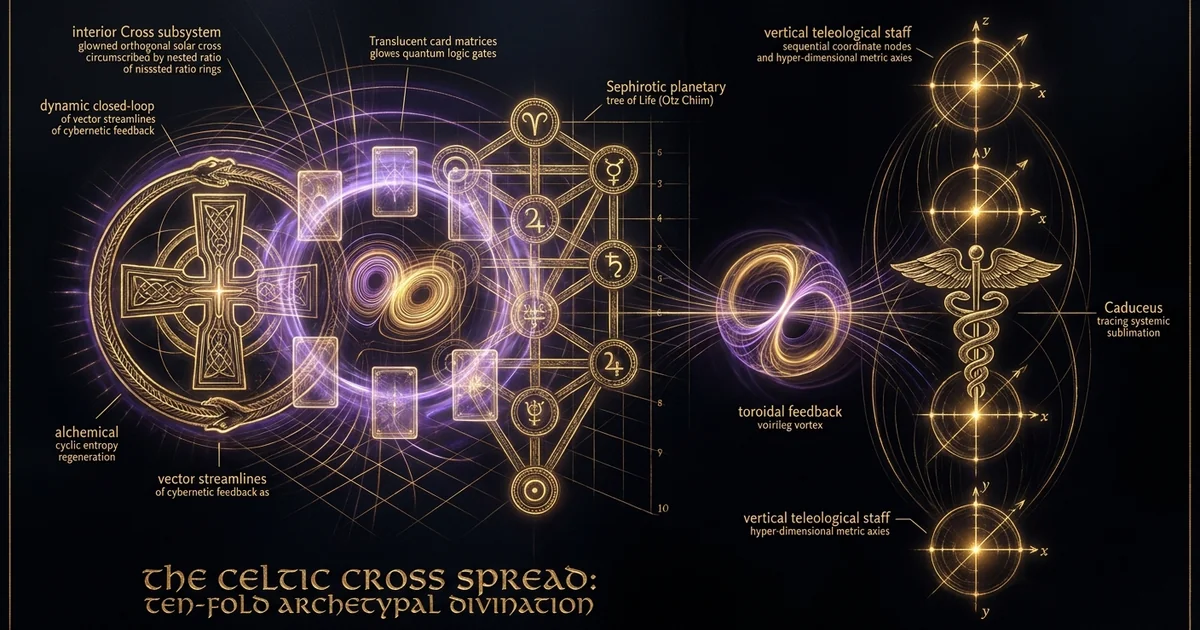
The Celtic Cross Spread: Ten-Fold Archetypal Divination
Archetypal Thesis & Systemic Paradigm: The Ten-Fold Cartography of Consciousness
The Celtic Cross spread is frequently reduced in vernacular culture to a mechanistic fortune-telling device, yet in formal esoteric epistemology, it operates as an advanced topological mapping of psychic state-space. It does not function as an instrument of temporal fatalism. Instead, the spread provides an externalized spatial coordinate matrix that projects the latent, unintegrated tensions of the human unconscious into an observable, geometric field. By mapping seventy-eight multidimensional symbolic vectors across a ten-fold archetypal grid, the spread formalizes an encounter between the ego-consciousness of the querent and the objective psychic realities of the collective unconscious. This structural framework translates the subjective, non-linear pressures of psychological distress into an intelligible, navigable symbolic terrain.
The Dialectical Cross and Teleological Staff as Structural Dualities
The operational architecture of the celtic cross spread tarot divination relies fundamentally on an asymmetric duality: the central, four-quadrant “Cross” (Cards 1 through 6) coupled to the lateral, linear “Staff” or “Wand” (Cards 7 through 10). This structural bifurcation mirrors the foundational geometric division between the circular mandala and the vertical ray. The central Cross acts as an immediate field of dialectical tension. It models the localized, entangled matrix of the querent’s current psychological crisis, mapping how conflicting instinctual drives, immediate past conditions, and unconscious foundations exert simultaneous gravitational pull upon the ego.
Conversely, the Staff operates as an open-ended, teleological vector. While the central Cross is circular, self-referential, and prone to systemic inertia, the Staff extracts psychic libido from this static vortex and channels it into a sequential developmental continuum. It traces the processing of the central crisis through the consultant’s self-concept, their environmental interface, their anticipatory affective states, and their ultimate asymptotic trajectory. By counterpointing the thermodynamic friction of the Cross with the directed intentionality of the Staff, the ten card spread models the process of psychological metamorphosis, ensuring that the consultant does not remain paralyzed within the dialectic, but instead recognizes the directional vector of individuation.
State-Space Formalism and Phase-Space Mapping in Cartomancy
To rigorously understand the cartomantic mechanics of this layout, one must apply the formalisms of dynamical systems theory. The human psyche can be operationalized as an open thermodynamic system moving through a continuous state-space—a mathematical manifold wherein every possible configuration of an individual’s psychological, somatic, and environmental conditions constitutes a single point. Under conditions of psychic equilibrium, this state-space remains fluid and largely unconscious. However, when an individual experiences acute cognitive dissonance, trauma, or existential transformation, the system’s phase-space undergoes a sudden bifurcation, destabilizing the habitual ego-attractor and giving rise to chaotic psychic drift.
The deployment of the Celtic Cross serves as an empirical phase-space reduction method. Each card acts as an operator that projects a discrete slice of the consultant’s multidimensional unconscious onto a localized coordinate axis. The resulting ten-fold array is not an arbitrary assembly of illustrations, but a fixed state-space portrait capturing the system’s instantaneous velocity, trajectory, and latent attractors. The cards do not generate the psychic conditions; rather, through the mechanism of topological isomorphism, the spatial relations between the cards mirror the structural relations between the consultant’s active complexes, rendering the invisible architecture of their psychic landscape explicitly legible.
Jungian Complex Constellation and Synchronistic Topology
This state-space externalization is actuated through what Carl Gustav Jung termed the constellation of a complex. When an autonomous unconscious complex is constellated by intense emotional affect or structural life crises, it inherently reorganizes the conscious field according to its own archetypal pattern. In traditional psychotherapeutic settings, this constellation is observed through behavioral slips, somatic tensions, and oneiric motifs. Within the technical apparatus of the tarot divination layout, the constellated complex acts as an invisible gravitational source that exerts an acausal organizing influence upon the randomized shuffling of the deck.
The ten card spread functions as an acausal archetype-detector. Shuffling introduces controlled physical entropy into the system; the subsequent crystallization of the cards into the ten designated positional slots represents a sudden phase change from absolute randomness to profound structural order. This phenomenon is precisely what Jung defined as synchronicity: an acausal connecting principle wherein an internal psychological reality is mirrored simultaneously by an external, physically disconnected physical event through the medium of subjective and archetypal meaning. The structural geometry of the spread acts as a receptive antenna tuned specifically to intercept and decode these acausal manifestations.
“Synchronicity reveals the presence of an acausal, trans-subjective order in nature, which appears to us as meaningful coincidence… When an autonomous complex is constellated, it alters the probability field of physical events within the subject’s environment. The divination apparatus is therefore not an active causal mechanism, but an operational mandala that permits the underlying holistic order of the unus mundus to be perceived through the lens of archetypal numbers.” — Carl Gustav Jung, Collected Works Vol. 8: The Structure and Dynamics of the Psyche (Princeton University Press, 1960), alongside Marie-Louise von Franz, On Divination and Synchronicity: The Psychology of Meaningful Chance (Inner City Books, 1980).
The ten-fold geometry of the Celtic Cross directly activates the archetypal resonance of the Pythagorean Tetractys and the Qabalistic Decad, concepts explored in depth within the Tetractys and the Decad. Number, as Marie-Louise von Franz demonstrated, is the most primitive and fundamental archetype of order known to human consciousness. The ten positions do not merely house information; they actively configure it according to the mathematical laws of the Decad, wherein the progression from Unity (1) to Totality (10) encompasses every potential manifestation of energetic and psychological differentiation. The spread is therefore an operational, mantic application of sacred geometry.
Classical Provenance & Textual Lineage: From Golden Dawn Cryptography to Waite’s Canon
The widespread ubiquity of the Celtic Cross within modern occultism obscures a remarkably dense and complex archival history. Far from being a primordial folk divination layout recovered intact from ancient Druidic oral traditions—a romantic fiction cultivated by early twentieth-century occult revivals—the spread is the refined product of late nineteenth-century British esoteric syntheses, developed within the fertile, highly secretive crucible of the Hermetic Order of the Golden Dawn.
The Hermetic Order of the Golden Dawn and the Mystery of the Layout’s Genesis
The cryptographic origins of the spread trace back to the foundational manuscripts and instructional monographs circulating among the Inner Order of the Rosae Rubeae et Aureae Crucis (R.R. et A.C.) under the leadership of Samuel Liddell MacGregor Mathers. While official Golden Dawn curricula placed primary emphasis on the vast, complex, multi-tiered divination system known as the “Opening of the Key” (which utilized elemental dignities, counting of cards, and Astrological-Decan correspondences across four full pack deal-outs), the Order concurrently experimented with condensed, geometrically coherent microcosmic spreads.
In the informal papers and teaching notes attributed to prominent adept Florence Farr and documented within the context of Flying Roll No. XI: Cachet of Divination, the Order explored cross-and-staff layouts derived from Rosicrucian consecration patterns. These experimental arrays sought to collapse the monumental machinery of the Opening of the Key into an efficient, portable analytical engine capable of diagnostic application. The central cross configuration was explicitly understood not as an insular cartomantic curiosity, but as an emblem of the Rosy Cross itself: the intersecting vertical and horizontal shafts of the elemental cross surmounted by and anchoring the unfolding rose of human consciousness.
Waite’s Exoteric Codification in The Pictorial Key to the Tarot (1910)
The definitive exoteric unveiling of this internal Order technology occurred in 1910, when Arthur Edward Waite published The Pictorial Key to the Tarot, accompanied by the iconic deck illustrated by Pamela Colman Smith under the imprint of William Rider & Son. In Part II, Section 7, titled “The Outer Method of the Oracles,” Waite formalized and published the spread under the deliberate title “An Ancient Celtic Method of Divination.” Waite’s moniker was a classic esoteric obfuscation; by clothing a sophisticated Rosicrucian psycho-geometry in the fashionable aura of “Celtic” antiquity, he simultaneously protected his vows of secrecy regarding Golden Dawn internal transmission while feeding the Celtic Revival appetite of Edwardian England.
“This mode of divining is of very ancient origin, and it has been preserved by an oral tradition… The first card is placed on the table, face upward, and this represents the person or matter inquired about. The second card is placed across the first, and it is called the covering card; it shows the nature of the obstacles in the matter. The third card is placed above the first, and this represents the person’s aim or ideal; the fourth is placed below the first, and this is the foundation or basis of the matter… The tenth card is that of the Culmination, and shows what may be expected if things proceed as they are now progressing.” — Arthur Edward Waite, The Pictorial Key to the Tarot, Part II: “The Outer Method of the Oracles” (William Rider & Son, 1910).
Waite’s codification was profoundly revolutionary because it stripped away the burdensome, quasi-astrological mathematical tables required by earlier continental systems (such as those of Éliphas Lévi and Papus) in favor of a purely topological, positional hermeneutic. In Waite’s presentation, the precise spatial slot occupied by a card became the primary hermeneutic filter through which its archetypal symbol was decoded. This marked a watershed transition in western occultism: cartomancy transitioned from an exercise in reading objective external omens to a sophisticated method for charting internal phenomenological states.
Textual Divergences: The Transmutation of Position Six and the Orientation of the Cross
A meticulous examination of the archival literature reveals substantial textual divergences in the structural mechanics of the spread between 1910 and the late twentieth-century psychological tarot movement. The most glaring of these historical discrepancies involves the positional assignment and geographic placement of Cards 3, 4, 5, and 6. In Waite’s initial 1910 text, Card 3 is placed above the central pair to denote the conscious ideal, while Card 4 is placed below to designate the foundation. However, in the foundational instructional diagrams, this vertical relationship was occasionally reversed by subsequent commentators who mapped Card 3 to the base (the subconscious underworld) and Card 5 to the crown (the superconscious zenith).
Historical Positional Drift of the Vertical Axis:
Waite (1910 Textual Exposition):
[Position 3: Aim / Ideal / Crown]
|
[Position 1 & 2: Center]
|
[Position 4: Foundation / Root]
Post-Golden Dawn / Modern Hermeneutic Shift:
[Position 5: Superconscious / Ego-Ideal]
|
[Position 1 & 2: Center]
|
[Position 3: Subconscious Substratum]
Furthermore, severe variations exist concerning the directional temporal vectors. While Waite placed the “Behind Him” card (the receding past) to the left and the “Before Him” card (the advancing future) to the right, later Continental and American practitioners frequently inverted these assignments based upon the directional gaze of the figures depicted in the central cards. Similarly, the physical laying of Card 2 across Card 1—the literal “crossing”—is explicitly grounded in Western ritual magic: it is a visual enactment of the crux dissimulata, an energetic locking mechanism designed to bind the mundane inquiry within the protective, sacred bounds of the four elemental quarters before ascending the vertical axis of the Staff.
Structural Mechanics & Symbolic Geometry: The Cross and Staff Subsystems
The operational power of the celtic cross spread tarot divination resides entirely in its relational mechanics. An isolated Tarot card operates as a floating, polysemic signifier containing dozens of latent mythological, psychological, and alchemical meanings. The geometric syntax of the Celtic Cross imposes rigorous constraints upon this polysemy, functioning as a grammatical engine that forces each archetypal symbol into a precise functional role within a larger sentence of consciousness.
The Central Vortex: The Dialectic of Self (Card 1) and Obstacle/Opportunity (Card 2)
At the geometric and psychological nucleus of the layout sit Cards 1 and 2, which together form an inseparable dynamic dipole. Card 1 represents the localized conscious focal point: the primary subjective lens through which the consultant currently experiences their reality. It corresponds to the immediate ego-state or the explicit matter of inquiry. It is the thesis of the system.
Card 2 is placed horizontally or diagonally directly across the face of Card 1, establishing a structural confrontation that is unique in sacred cartomancy. This card is universally termed the “Crossing Card” or the “Covering Card.” In superficial cartomancy, this position is lazily interpreted as a malevolent “obstacle.” In advanced psycho-cosmology, Card 2 acts as the orthogonal perturbing force—an energetic vector operating at a ninety-degree angle to the intentionality of Card 1.
Whether Card 2 features an ostensibly “positive” arcana (such as the Sun or the Three of Cups) or an “aversive” arcana (such as the Three of Swords or the Tower), its functional role remains unchanged: it introduces systemic friction. If Card 2 is highly dignified and harmonious, it can represent an obstacle of complacency, an over-idealization, or an unearned psychic inflation that paralyzes forward momentum. Conversely, if Card 2 is severe, it operates as the necessary catalyst of resistance through which the psychic muscle of the consultant is forced to individuate. Cards 1 and 2 cannot be read independently; they must be interpreted as a single unified interference pattern.
The Microcosmic Matrix: Temporal-Spiritual Quadrants (Cards 3, 4, 5, 6)
Radiating outward from this central nuclear dipole are four positional vectors that establish a four-pole spatial field, transforming the central vortex into a fully differentiated cosmic mandala. This perimeter maps the intersection of two fundamental axes: the vertical axis of ontological consciousness and the horizontal axis of chronological duration.
Cards 3 and 5 govern the vertical, ontic axis. Position 3 (The Base/Root) anchors the mandala in the instinctual, subterranean substrata of the psyche. It maps the unconscious complexes, the biological drives, the transgenerational conditioning, and the repressed somatic memories upon which the current crisis rests. Position 5 (The Crown/Zenith) represents the superconscious altitude: the ego-ideal, the explicit intentional goals, and the highest spiritual or philosophical synthesis of which the consultant is currently capable. By inspecting the distance between Position 3 and Position 5, the practitioner instantly diagnoses the internal vertical split within the consultant’s psyche—the rupture between biological reality and transcendent aspiration.
Cards 4 and 6 delineate the horizontal, temporal axis. Position 4 (The Past/The Retiring Influence) charts the conditions that have recently passed out of active equilibrium; it designates psychic libido that is becoming obsolete, exhausted, or receding into structural memory. Position 6 (The Approaching Phase/The Near Future) points directly to the immediate developmental horizon. It does not predict the ultimate outcome, but rather identifies the very next energetic wave or systemic adaptation that the consultant must integrate before any lasting transformation can occur.
Visual Architecture of the Microcosmic Matrix:
                 [Position 5]
              Crown / Superconscious
                       |
                       |

[Position 4] ------ [Position 1 & 2] ------ [Position 6]
Receding Past         The Central Vortex      Approaching Phase
|
|
[Position 3]
Base / Subconscious
The Ascending Staff: Vectoring Psychic Processing (Cards 7, 8, 9, 10)
Positioned directly to the right of the central mandala is the vertical, four-stage ascending column known as the Staff, the Wand, or the Pillar. The Staff decouples the consultant from the static, insular vortex of the Cross by translating systemic entanglement into a sequential, outward-facing trajectory of psychological processing.
Card 7 (The Querent’s Internal Posture) serves as the foundational anchor of the Staff. It interrogates the consultant’s subjective self-concept, their internal locus of control, and their psychological stance toward the crisis. It reveals whether they perceive themselves as a sovereign agent, a helpless victim, an inflated savior, or an alienated spectator.
Card 8 (The Environmental Crucible) moves directly outward to survey the objective systemic field. It maps the ambient social, institutional, familial, or physical forces acting upon the consultant. This position reveals how the external environment mirrors, resists, or exploits the internal dynamics identified in Card 7.
Card 9 (The Crucible of Affect / Hopes and Fears) represents the psychic gateway through which the entire spread must pass before achieving crystallization. Far from being a passive repository for trivial desires, Position 9 is the psychological Shadow gate. In the human limbic system and deep unconscious, hopes and fears are neurochemically and archetypally isomorphic: they both constitute intense, anticipatory cathexes of psychic libido. This position pinpoints where the consultant is neurotically investing energy into idealized fantasies or catastrophic projections, both of which serve to defend against the raw reality of the present moment.
Card 10 (The Culmination / Asymptotic Trajectory) terminates the Staff. It represents the teleological culmination toward which the entire systemic equation is currently accelerating. It is the mathematical limit of the function defined by the preceding nine cards—an issue developed extensively in Rachel Pollack’s Seventy-Eight Degrees of Wisdom. If the forces mapped in Cards 1 through 9 remain structurally unexamined and unmodified, Card 10 is the inevitable phase change that the system will undergo.
Psychological Dynamics & Operational Praxis: Archetypal Decryption and Synthetic Hermeneutics
The operational praxis of the Celtic Cross strictly demands the rejection of isolated, atomized card interpretation. Novice practitioners frequently read the layout linearly from Card 1 to Card 10, delivering a fragmented sequence of unintegrated insights. In contrast, advanced hermeneutics treats the spread as a non-linear, hyper-connected semiotic network. To extract profound diagnostic and transformative value from the ten card spread, the practitioner must execute structural triangulation across its primary tension vectors.
Triangulating the Conscious Intent (5) against Subconscious Substrata (3)
The most structurally critical diagnostic vector in the entire layout is the vertical axis formed between Position 5 (The Crown) and Position 3 (The Base). This polar axis directly maps the classic psychoanalytic divide between the ego’s conscious teleology and the id’s instinctual, compensatory reality.
Vertical Polarization Analysis:

           [Position 5: Ego-Ideal]
           - Conscious aspiration
           - Intellectualized rationalization
           - Transpersonal striving
                      ^
                      |   Cognitive Dissonance /
                      |   Archetypal Tension
                      v
           [Position 3: Unconscious Base]
           - Instinctual drives
           - Somatic realities
           - Repressed shadow content
When a severe semiotic conflict emerges along this axis—for instance, if Position 5 displays the detached intellectual clarity of the King of Swords while Position 3 reveals the volcanic, instinctual turbulence of the Seven of Wands or The Devil—the practitioner is observing an active, dangerous cognitive dissonance. The consultant may believe they are operating from a framework of pure ethical rationality, yet their entire psychological engine is being driven by suppressed survival rage, territorial insecurity, or unintegrated shadow drives. Conversely, if Position 3 houses high-frequency archetypal symbols such as The Star or The High Priestess while Position 5 is occupied by low-level, obsessive Minor Arcana cards (such as the Four of Pentacles), it reveals that the consultant’s conscious ego is micro-managing trivial mundane anxieties, completely blind to the profound spiritual transformation germinating in their deep unconscious. Effective clinical reading requires bridging this vertical abyss, forcing the conscious ideal in Position 5 to acknowledge, honor, and integrate the chthonic reality of Position 3 through rigorous active-imagination.
Temporal Vector Mechanics: Retrograde Conditioning (4) versus Immediate Phase Transition (6)
A secondary horizontal vector of dynamic tension runs between Position 4 (The Past) and Position 6 (The Approaching Phase). This axis measures the consultant’s temporal elasticity: their capacity to liberate psychic libido from historical conditioning and reallocate it toward forward-facing systemic adaptation.
Linear causality assumes that Position 4 directly causes Position 6. Advanced archetypal cartomancy rejects this simplistic Newtonian view. Often, the card in Position 4 represents a psychological ghost—an archaic coping strategy, an outmoded role, or an energetic attachment that has outlived its functional utility, yet continues to exert a deadening, inertial pull on the present. If an individual displays a heavy, structure-bound card in Position 4 (such as the Four of Cups or the Ten of Swords reversed) alongside a radical, demanding evolutionary catalyst in Position 6 (such as The Fool or the Eight of Wands), the spread flags a crisis of developmental arrest. The system is attempting to execute a phase transition, but the consultant is desperately expending energy dragging an expired past across the event horizon of Card 1. The practitioner’s task here is to facilitate psychic grieving: to assist the consultant in consciously decommissioning the obsolete libido bound in Card 4 so that it can be converted into the requisite fuel for navigating the demands of Card 6.
Shadow Transmutation in the Crucible of Position 9 and Teleological Convergence in Position 10
The transition between the Staff’s penultimate node (Card 9) and its final apex (Card 10) constitutes the crucible of the entire operation. Position 9 must never be read merely as what the consultant “wants or worries about” in a trivial, conversational sense. In formal archetypal psychology, Position 9 is the locus of the Shadow, the repository of the querent’s unowned projections.
The Cross Subsystem (Cards 1–6)
- Structural Form: Mandala / Quadrant Matrix
- Energetic State: Static / Entangled / Dialectical
- Ontological Dimension: Internal field, ontological foundations, past-future temporal cross-section
- Thermodynamic Mode: High friction, circular feedback, systemic entrapment
- Operational Function: Exposes the localized structural paradox of the ego’s immediate crisis
The Staff Subsystem (Cards 7–10)
- Structural Form: Vertical Linear Pillar / Vector
- Energetic State: Kinetic / Directed / Teleological
- Ontological Dimension: Relational interface, environmental sociology, projective shadow, teleological limit
- Thermodynamic Mode: Negentropic channeling, developmental progression, open-loop dissipation
- Operational Function: Forces the integration of internal conflict into active individuation and manifest reality
Because the psyche strives constantly for self-regulation, whatever is repressed from consciousness becomes charged with intense, ambivalent affect. If an individual harbors an unconscious desire to destroy an untenable marriage or resign from an oppressive career, that latent desire will register in Position 9 as a terrifying “fear” of abandonment or financial collapse. The fear is the thin, protective ego-mask worn by the transgressive hope.
When Position 9 is brought into crystalline awareness, the fatalistic momentum of Position 10 is fundamentally altered. Position 10 is not a rigid pronouncement of destiny written in stone; it is merely the extrapolated linear trajectory of the system assuming zero interventions are made in the structural dynamics of Cards 1, 2, and 9. It is an asymptotic horizon. If Position 10 indicates catastrophe (e.g., the Tower, the Five of Pentacles), it does not mean doom is inevitable; rather, it alerts the consultant that their unresolved complexes in Card 3, their stubborn attachments in Card 4, and their neurotically denied projections in Card 9 are actively steering the ship of their life toward the rocks. By intervening directly in the psychological attractors identified in Cards 1, 2, and 7, the consultant shifts the initial conditions of their psychic phase-space, thereby recalculating the trajectory and transforming the ultimate manifestation of Position 10.
Philosophical Synthesis & Macrocosmic Correspondence: Qabalistic Emanation and Cybernetic Feedback
Beyond its profound utility as an instrument of psychotherapeutic diagnosis, the Celtic Cross spread stands as a complete, micro-cosmological model of universal manifestation. When analyzed through the lens of Western Esoteric Qabalah, the ten-fold layout demonstrates a structural correspondence to the Otz Chiim—the Qabalistic Tree of Life—and operates according to the principles of open-system cybernetics.
The Decad and the Tree of Life: Isomorphic Alignments with Sephirotic Emanation
The ten positions of the Celtic Cross are not an empirical accident of cartomantic history; they form an isomorphic projection of the ten Sephiroth of the Tree of Life onto a two-dimensional altar. The process of dealing the cards acts as a mantic recapitulation of the lightning flash (Metatron’s Ray) descending from the formless heights of Kether down into the dense, physical reality of Malkuth.
Sephirotic Projection Matrix onto the Celtic Cross:

Macrocosmic Tree of Life             Celtic Cross Structural Node
------------------------             ----------------------------
Kether (1)                           Position 10 (Teleological Apex)
Chokmah (2) & Binah (3)              Position 5 (Crown) & Position 3 (Base)
Chesed (4) & Geburah (5)             Position 4 (Past) & Position 6 (Future)
Tiphareth (6)                        Position 1 (The Ego / Solar Center)
Yesod (9)                            Position 9 (The Astral / Shadow Matrix)
Malkuth (10)                         Position 7 & 8 (Physical Agency & Environment)
Orthogonal Force (Pechad/Din)        Position 2 (The Transverse Barrier)
In this Qabalistic reading, Position 1 acts as the solar nexus of Tiphareth—the seat of the ego, the central sphere of consciousness that balances the Mercy and Severity of the universe. Position 2 corresponds to the trans-systemic veil or the transverse barrier (frequently linked to the severe, testing trials of Geburah or the abyss of Da’ath) that challenges the ego’s stability. Positions 3 and 5 align with the primordial pillars: the profound, dark, instinctual watery depths of Binah (the great Mother/Matrix) at the Root, and the luminous, seminal, spiritual heights of Chokmah (the great Father/Wisdom) at the Crown. Positions 4 and 6 map the horizontal dynamic between Chesed (the stabilizing, preservative force that retains the past) and Geburah (the severing, transformative force that breaks down old forms to inaugurate the future).
The Staff represents the physical and metaphysical manifestation sequence down through the lower astral and material planes. Position 7 and 8 form the dialectic between the Microcosmic Adam (the individual’s soul in Malkuth/Yesod) and the Macrocosmic World (the material matrix of Assiah). Position 9 is the concentrated sphere of Yesod—the lunar, astral foundation where fantasies, dreams, fears, and sexual-instinctual forms churn prior to manifestation. Position 10, while historically called the “Outcome,” corresponds to the ultimate crystallization: it is Kether made fully manifest in Malkuth, or inversely, the physical seed rising to touch the spiritual summit of Kether, completing the cosmic cycle of the snake swallowing its tail. A comprehensive study of these emanations can be accessed in Tree of Life Kabbalistic Correspondences.
When analyzing the Celtic Cross within the framework of the Four Qabalistic Worlds (Olamot), the layout systematically stratifies psychic reality across every layer of the cosmic order:
- Atziluth (World of Emanation / Pure Spirit): Cards 5 and 10, mapping pure archetypal will and final teleological purpose.
- Briah (World of Creation / Mental Ideation): Cards 1, 2, and 4, mapping the ego’s conceptual synthesis, immediate cognitive friction, and memory constructs.
- Yetzirah (World of Formation / Astral Affect): Cards 3, 6, and 9, mapping deep instinctual base drives, immediate dynamic currents, and the fear/hope astral machinery.
- Assiah (World of Action / Physical Manifestation): Cards 7 and 8, mapping manifest behavioral postures and concrete environmental constraints.
The Celtic Cross as an Open Thermodynamic Cognitive Engine
From the perspective of cognitive cybernetics and information theory, the Celtic Cross operates as an open thermodynamic engine designed to systematically reduce internal psychic entropy. In classical physics, entropy measures the degree of disorder, randomness, and unrecoverable energy loss within a closed system. Left to itself, an unexamined, trauma-burdened human psyche operates as a semi-closed system: its unresolved conflicts spin in recursive cognitive loops, producing massive psychological entropy in the form of chronic anxiety, projection, dissociation, and behavioral paralysis.
The ritualized mechanics of the Celtic Cross spread introduce an anti-entropic (negentropic) operation. By taking the chaotic, unmanageable noise of an internal crisis, externalizing it into a randomized deck, and filtering that randomness through the highly organized, low-entropy geometric matrix of the ten positions, the spread catalyzes an immediate structural reordering. The ten positions act as cybernetic feedback channels. Information is extracted from the consultant’s unconscious, organized into symbolic feedback loops (e.g., how Position 7 conditions Position 8, which feeds into Position 9, reshaping Position 1), and then re-injected into the consultant’s conscious awareness. This recursive feedback loop breaks the static equilibrium of the crisis, transforming stagnant psychic noise into an organized, intelligible narrative of conscious individuation.
Hermetic Microcosm-Macrocosm Integration: Transmuting Mantic Entropy into Coherence
Ultimately, the Celtic Cross spread stands as one of the most brilliant practical executions of the foundational Hermetic axiom formulated in the Emerald Tablet of Hermes Trismegistus: “Quod est inferius est sicut quod est superius, et quod est superius est sicut quod est inferius, ad perpetranda miracula rei unius” (“That which is below corresponds to that which is above, and that which is above corresponds to that which is below, to accomplish the miracles of the One Thing”).
The Hermetic Alchemical Funnel of the Celtic Cross:

[ Macrocosmic Unconscious / Cosmic Entropy ]
                     \      /
                      \    /   (Randomized Shuffle)
                       \  /
             [ The Ten-Fold Matrix ]
             (Cross & Staff Filtering)
                       /  \
                      /    \   (Synthetic Interpretation)
                     /      \
[ Microcosmic Consciousness / Coherent Integration ]
The spread achieves this integration by providing an interface where the personal microcosm collapses into harmony with the transpersonal macrocosm. The consultant sits across the table from a geometric mirror of the universe. What was felt internally as an unbearable, uniquely personal affliction is suddenly depersonalized and elevated into an archetypal drama. If their suffering is reflected by The Hanged Man or the Five of Cups, they are instantly liberated from the solipsistic delusion of their isolated misery: their pain is recognized as a necessary, structural station on the universal archetypal journey of the Major Arcana. The random shuffling of the cards—the mundane, material act of card-laying—becomes the mantic vehicle through which cosmic order enters into dialogic communion with temporal human consciousness. The Celtic Cross transforms divination from a profane parlor game of prognostic speculation into a sacred, cybernetic technology of psychological and spiritual transfiguration.
Frequently Asked Questions: Structural Clarifications and Advanced Mechanics
Resolving Positional Inversion: Crown (Card 5) versus Base (Card 3)
The historical confusion regarding whether the Crown belongs in Position 3 or Position 5 stems from Arthur Edward Waite’s somewhat ambiguous prose in the 1910 The Pictorial Key to the Tarot. As noted in historical textual analyses, Waite originally instructed that the third card be placed “above” and the fourth card “below” the central pair. However, in modern psychological and Golden Dawn lineage practices, the sequence is almost universally standardized to place Card 3 at the bottom (Base/Root) and Card 5 at the top (Crown/Zenith).
Standard Modern Positional Mapping:
       [5: Crown / Conscious Aim]
                   |
[4: Past] -- [1 / 2: Center] -- [6: Future]
                   |
       [3: Base / Unconscious Root]
This structural assignment is grounded in rigorous developmental psychology. When building a spatial mandala, the architect must first establish the subterranean foundations before erecting the roof. Card 3 represents the chthonic base—the archaic, instinctual, subconscious soil out of which the central situation emerged. To place the conscious aim or crown before the subconscious base disrupts the thermodynamic flow of emanation. By establishing Card 3 as the subterranean base and Card 4 as the retreating past, the spread anchors the central vortex in biological and temporal history before allowing Card 5 to articulate the conscious ego-ideal, followed immediately by Card 6 establishing the forward temporal horizon. This sequence accurately mirrors the natural ascent of consciousness from primordial darkness into illuminated conceptualization.
The Directional Hermeneutics of Card 2: Obstacle, Ally, or Orthogonal Matrix?
One of the most persistent errors in cartomantic praxis is the reflexive interpretation of Card 2 as an exclusively adversarial force. Novices frequently assume that if a card such as The Empress, the Six of Wands, or the Ten of Cups appears in Position 2, it is somehow “weakened” or represents an oxymoronic “good obstacle.” This conceptual impasse arises from an impoverished understanding of dialectics.
Card 2 must be understood mathematically as an orthogonal vector. It represents pure, unadulterated alterity—the radical “Not-Self” confronting the “Self” of Card 1. If an inherently joyful, expansive card occupies Position 2, its obstructive quality does not lie in malice, but in its capacity to destabilize through excess, distraction, or premature satisfaction. For example, if Card 1 is the Eight of Pentacles (focused, disciplined, ascetic craftsmanship) and Card 2 is the Three of Cups (social celebration and revelry), the Three of Cups operates as a massive obstacle to the consultant’s focus, luring psychic libido away from essential vocational disciplines. Conversely, a severe card such as the Five of Swords crossing Card 1 may represent the exact boundary-setting, ruthless analytical pruning that the consultant desperately requires to shatter an existing pattern of codependency. Card 2 is neither friend nor foe; it is the structural anvil against which the hammer of Card 1 must strike to forge new consciousness.
Algorithmic Disambiguation of Position 10: Minor vs. Major Arcana Culminations
The systemic interpretation of Position 10 fundamentally hinges upon whether the card that crystallizes at this apex belongs to the Major Arcana or the Minor Arcana. This distinction dictates whether the culmination is an immutable structural imperative or an easily modulated temporal eventuality.
Positional Weight in Card 10:

Major Arcana in Position 10:
[ Transpersonal / Karmic Attractor ]
- High archetypal inertia
- Systemic individuation crisis
- Non-negotiable phase change

Minor Arcana in Position 10:
[ Behavioral / Contextual Trajectory ]
- Low archetypal inertia
- Fluid, contingent outcome
- Highly responsive to conscious ego interventions
When a Major Arcana card occupies Position 10, the spread indicates that the situation has transcended the consultant’s personal ego-control. The inquiry has intersected with a transpersonal, archetypal threshold—what classical occultists termed a “Karmic” or “Destined” phase. The forces driving the system are profound, deep-seated, and structural. The consultant cannot simply alter this outcome through minor tactical adjustments; they must undergo a radical psychological initiation. The outcome represented by a Major Arcana is an existential imperative that must be integrated for the soul’s individuation to proceed.
Conversely, if a Minor Arcana card appears in Position 10, the culmination is entirely contingent, localized, and plastic. The Minor Arcana govern the mundane currents of daily life—the four elemental expressions of fire (will), water (emotion), air (intellect), and earth (matter). A Minor Arcana culmination simply shows where the current mundane trajectory is drifting based upon immediate, short-term habits. If the consultant modifies their conscious behavioral posture in Position 7, directly confronts their environmental dynamics in Position 8, and recalibrates their affective projections in Position 9, the outcome indicated by a Minor Arcana card will effortlessly dissolve and reconstitute itself into an entirely new configuration of possibilities. :::