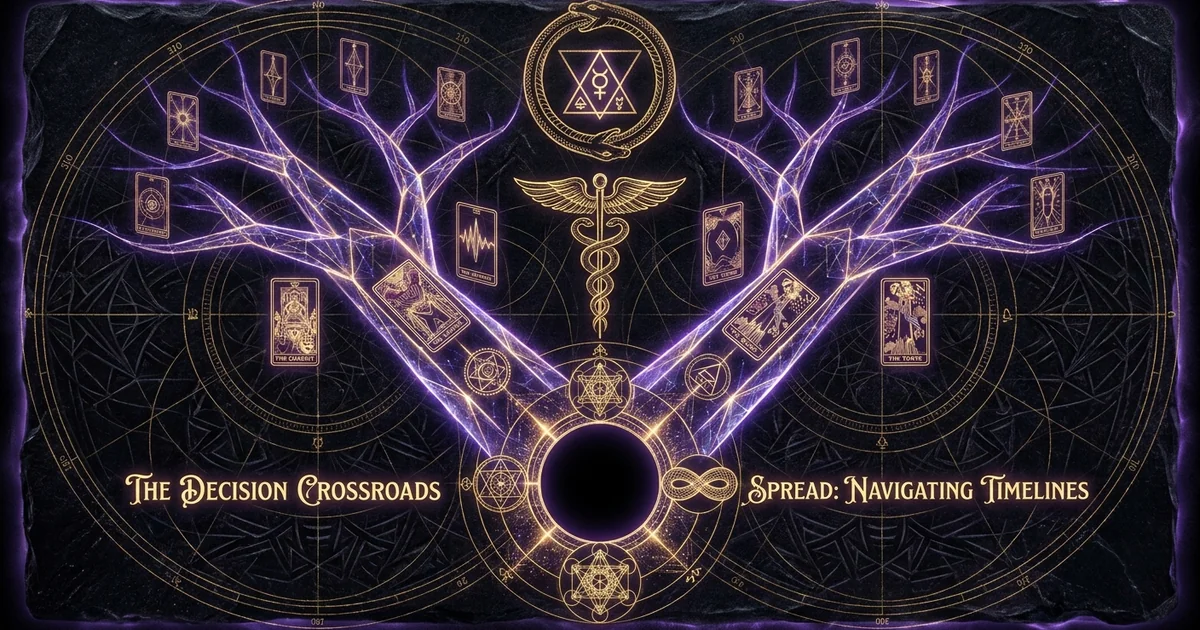
The Decision Crossroads Spread: Navigating Timelines
Archetypal Thesis & Systemic Paradigm: The Bifurcation of Consciousness
Non-Deterministic Teleology and Phase-Space Geometries
Human decision-making represents an entropic critical point where the unconscious psychoid continuum precipitates into conscious material realization, transforming dormant archetypal states into actualized empirical events. Classical divinatory paradigms frequently faltered under the weight of deterministic fatalism, conceiving the future as a linear corridor carved irrevocably through time. Such models reduced the cartomantic spread to a passive mirror of immutable fate.
In contrast, contemporary esoteric hermeneutics reconfigures the tarot spread as a dynamic topological matrix mapping probability amplitudes within multi-dimensional phase space. Within this framework, every card functions not as an index of predetermined fact, but as a symbolic vector delineating the energetic topology of a conscious system at the precipice of bifurcation. When an individual confronts a pivotal threshold, the psyche inhabits a high-entropy state wherein multiple latent trajectories compete for actualization.
By mapping the decision node through symbolic geometries—such as those explored in /sacred-geometry/platonic-solids-phase-space—the cartomancer treats the tarot layout as a mutable coordinate plane. The layout registers both kinetic momentum and potential psychic energy. The decision crossroads is thus understood not as a static geographic intersection, but as a dynamic phase portrait where slight modifications in conscious intent can radically alter the macrocosmic trajectory of the querent’s lived reality.
[ Latent Archetypal Field (Unus Mundus) ]
                                     |
                                     v
                       [ Decision Coordinate (Node 0) ]
                                     |
                  +------------------+------------------+
                  |                                     |
                  v                                     v
       [ Vector Alpha: Branch A ]            [ Vector Beta: Branch B ]
                  |                                     |
                  v                                     v
       [ Actualized Eigenstate A ]           [ Actualized Eigenstate B ]
The Psychoid Substrate of the Decision Node
The theoretical foundation of this navigational model relies upon the concept of the psychoid archetype, formulated during the collaborative dialogue between psychologist Carl Gustav Jung and theoretical physicist Wolfgang Pauli. In The Interpretation of Nature and the Psyche (1952), Jung posited that archetypal structures are not merely intrapsychic phenomena residing in the human brain, but exist at a neutral, psychoid level that transcends the dualism of mind and matter.
At this profound ontological stratum—the unus mundus—meaning and physical manifestation are fundamentally co-extensive. When a querent engages in a decision crossroads tarot spread timelines analysis, the cards drawn do not cause the future, nor are they mechanically caused by the querent’s physical movements. Instead, they represent synchronous configurations of the psychoid substrate manifesting simultaneously in the subjective psychic interior and the objective material exterior.
The act of laying down the cards at a critical crossroads crystallizes the latent archetypal dynamics governing the unconscious. The spread renders visible the hidden psychic currents, repressed fixations, and unconscious teleological attractors that drive an individual toward one timeline over another. In this manner, the crossroads reading acts as an operational instrument of individuation, pulling the autonomic, shadow-driven impulses of the unconscious into the luminous theater of reflective awareness.
“The archetypal representations (images and ideas) mediated to us by the unconscious should not be confused with the archetype as such. The archetype is a psychoid factor that belongs, as it were, to the invisible, ultraviolet end of the psychic spectrum… It does not appear to be capable of consciousness, but possesses properties that can be described as both psychic and physical, bridging the dualism of matter and spirit through acausal meaningful coincidence.” — C.G. Jung & W. Pauli, The Interpretation of Nature and the Psyche (1952)
Quantum Probability Vectors in Archetypal Analysis
The integration of Hugh Everett’s (1957) relative state formulation—commonly termed the Many-Worlds interpretation—provides a rigorous conceptual vocabulary for structural cartomancy. Everett demonstrated that quantum superpositions need not collapse via an external, subjective observer; rather, the universal wave function continuously bifurcates, with every quantum probability vector actualizing across branching, decoherent physical eigenstates. When translated into archetypal cartography, quantum probability tarot operates on the premise that all potential outcomes of a decision pre-exist as latent archetypal patterns within the collective unconscious.
The Decision Crossroads Spread does not attempt to declare which timeline “will” occur in an absolute sense. Instead, it measures the relative probability density and archetypal friction of each branch. The practitioner evaluates the energetic resistance of each path: Branch Alpha may require an expenditure of solar, volitional willpower that exhausts the querent’s psychological reserves, while Branch Beta may align seamlessly with deep-seated instinctual currents, carrying high psychic momentum.
By viewing these potential futures as Everettian branching vectors, the querent transcends passive expectation. The consultation becomes a high-stakes bifurcation reading, allowing the agent to evaluate the psychic costs, instinctual hazards, and transpersonal dividends of each trajectory before collapsing conscious intent into physical action.
Classical Provenance & Textual Lineage: From Pythagorean Y to Golden Dawn Permutations
The Pythagorean Bivium: Moral and Esoteric Cartography of the Fork
The archetypal image of the bifurcated road possesses an ancient intellectual lineage, finding its earliest formal articulation in the Pythagorean Bivium, traditionally symbolized by the Greek letter Upsilon ($\Upsilon$). To the early Pythagoreans, this letter represented the supreme moral and intellectual fork confronting every human soul upon reaching the age of discretion. The central stem of the letter symbolized the undifferentiated state of early childhood or unawakened consciousness, while the two branching arms depicted the divergent paths of human destiny.
The right arm, narrow and arduous, ascended steeply toward virtue, divine order, and intellectual illumination. The left arm, broad and easily trodden, descended toward indulgence, material dissipation, and instinctual entropy. This philosophical motif was preserved through classical antiquity, notably by Xenophon in his recounting of Prodicus’s fable, The Choice of Hercules, wherein the hero must consciously elect between the steep path of Arete (Virtue) and the seductive path of Kakia (Vice).
In Heinrich Cornelius Agrippa’s De Occulta Philosophia Libri Tres (1533), this bifurcated geometry is elevated from a simple moral didactic into an operational cosmological principle. Agrippa asserts that every celestial and terrestrial operation possesses a point of cleavage where natural forces diverge along reciprocal paths of sympathetic affinity or antipathetic discord. In the realm of choice divination, the Pythagorean Bivium serves as the archaic structural archetype underlying all subsequent cartomantic spreads that map divergent temporal streams.
                    [ Arduous Ascent: Arete ]
                            \       /
                             \     /
                              \   /
                               \ /
                                |
                                |
                    [ Undifferentiated State ]
The Golden Dawn Decan Protocols and ‘Book T’ Spreads of Volition
While folk cartomancy historically utilized rudimentary three-card predictive layouts, modern systemic tarot cartography owes its technical rigor to the Hermetic Order of the Golden Dawn. In the foundational curriculum document Book T: The Tarot (c. 1888), authored primarily by S.L. MacGregor Mathers, the Order established an intricate system of spatial correspondences rooted in the Hermetic Qabalah, astrological decans, and the doctrine of elemental dignities.
The Golden Dawn radically transformed cartomancy from isolated fortune-telling into a vector-based, dynamic geometry. Instead of reading cards in hermetic isolation, Book T mandated that the symbolic valences of neighboring cards modify one another through precise elemental interactions: Fire and Air reinforce one another, Water and Earth provide reciprocal stability, while Fire and Water or Air and Earth generate acute systemic friction.
“A card is strong or weak, well-dignified or ill-dignified, according to the cards with which it is associated. Cards of the same suit on either side strengthen it greatly, for good or evil, according to their nature. Cards of opposite nature on either side weaken it greatly… Fire is inimical to Water; Air is inimical to Earth. But Air is friendly to Fire, and Water is friendly to Earth. If a card of Fire fall between two cards of Water, it is crushed and its power destroyed.” — S.L. MacGregor Mathers, Book T: The Tarot (c. 1888)
When applied to questions of volition, the Golden Dawn decan protocols demonstrated that any crossroad spread must account for the temporal momentum inherent in the querent’s current astrological and elemental configuration. A path characterized by ill-dignified combinations—such as the Five of Swords (Air) flanked by the Seven of Cups (Water) and the Eight of Pentacles (Earth)—indicates a trajectory plagued by cognitive dissonance, ungrounded fantasy, and physical stagnation.
Conversely, a path exhibiting pure elemental affinity indicates a smooth, unimpeded channel for the actualization of will. Mastery of these decan and elemental interactions, detailed extensively in our exploration of the /tarot/elemental-dignities-interpretive-engine, provides the analytical mechanism required to systematically assess the viable momentum of each branching timeline.
Qabalistic Pathways of Zayin and Peh: The Sword of Cleavage
Within the cosmological architecture of the Hermetic Qabalah, the mechanics of bifurcation are directly encoded in the paths traversing the Tree of Life. Specifically, the decision node corresponds to the dynamic tension between the Seventeenth Path—governed by the Hebrew letter Zayin (associated with Atu VI, The Lovers)—and the Twenty-Seventh Path, governed by the letter Peh (associated with Atu XVI, The Tower).
The letter Zayin literally translates to “Sword,” signifying the sharp, discriminating faculty of the conscious intellect that cuts away redundancy to execute an unambiguous choice. The Path of Zayin connects Binah (Understanding) on the Supernal Pillar of Severity to Tiphareth (Beauty) at the center of the Tree. It represents the conscious discrimination required to align the personality with the True Will, severing instinctual compulsions in favor of spiritual individuation.
       [ BINAH: Severe Intellect ]
                   \
                    \  (Path of Zayin: The Sword of Cleavage)
                     \
                  [ TIPHARETH: Solar Harmony / True Will ]
                     /
                    /  (Path of Peh: Destructive Actualization)
                   /
       [ NETZACH: Instinctual Force ]
In direct polarity to this, the Path of Peh represents the violent, sudden collapse of unstable structures when an untenable choice is forced by the relentless pressure of reality. Connecting Netzach (Instinct/Desire) to Hod (Intellect), Peh shatters the false compromises constructed by egoic ambivalence.
In a decision crossroads reading, the Path of Zayin acts as the deliberate, surgical cleaving of timelines: by consciously choosing Branch Alpha, the querent wields the sword of Zayin to intentionally slay Branch Beta, refusing to linger in paralyzing ambivalence. When the querent refuses this conscious severing, the energy accumulates until it inevitably activates the Path of Peh, collapsing the entire decision matrix through catastrophic external intervention.
This structural dynamic is deeply grounded in the overarching framework of the /tarot/major-arcana-tree-of-life-mapping, where every choice is ultimately revealed as an ascent or descent along the pathways of consciousness.
Structural Mechanics & Symbolic Geometry: Architecture of the Crossroads Spread
The Nexus: Present State Coordinate and Underlying Inertia (Card 1 & 2)
The 7-Card Decision Crossroads Spread is configured along a dynamic cross-axial topology. It anchors the observer in the immediate ontological present before projecting two distinct, branching vectors into the probability field, ultimately synthesizing the entire operation through a transpersonal teleological fulcrum.
[ Card 7 ]
                       (Synthesizing Fulcrum / Attractor)
                                   ^
                                   |
         Branch Alpha                             Branch Beta
      [ Card 4: Terminal ]                     [ Card 6: Terminal ]
              ^                                        ^
              |                                        |
     [ Card 3: Immediate ]                    [ Card 5: Immediate ]
              \                                        /
               \                                      /
                +--------------[ Card 1 ]------------+
                             (The Nexus)
                                  |
                               [ Card 2 ]
                          (Underlying Inertia)
The foundation of the spread consists of Card 1 (The Nexus) and Card 2 (The Underlying Inertia), which together establish the present state coordinate:
- Card 1 (The Nexus): Placed at the central origin point, Card 1 delineates the querent’s current locus of consciousness. It reveals the explicit, observable nature of the dilemma—the conscious conflict as it presents itself to the ego. It operates as the zero-point coordinate in the phase-space geometry, establishing the precise threshold from which all prospective bifurcations must emerge.
- Card 2 (The Underlying Inertia): Laid directly beneath or crosswise beneath Card 1, Card 2 exposes the unconscious psychic momentum, karmic residue, or somatic conditioning driving the system from below. This card answers the vital question: What unacknowledged current has carried the querent to this precipice? Whether this inertia is composed of repressed fear (e.g., Nine of Swords), instinctual addiction (e.g., The Devil), or unintegrated creative libido (e.g., Ace of Wands), Card 2 represents the physical and psychic momentum that will continue to exert silent force across all potential timelines unless consciously decoupled.
Branch Alpha vs. Branch Beta: Trajectory and Terminal Velocity (Cards 3 through 6)
From the central nexus of Cards 1 and 2, the spread bifurcates symmetrically into two upward-angling diagonal arms: the Left Vector (Branch Alpha) and the Right Vector (Branch Beta). Each branch is systematically structured around two sequential coordinates, distinguishing between proximate manifestation and distal teleology:
- Cards 3 and 5 (The Immediate Operational Reality): Card 3 constitutes the immediate point-of-impact for Branch Alpha, while Card 5 serves the identical function for Branch Beta. These positions detail the proximate landscape: the acute atmospheric, emotional, and pragmatic realities that will manifest during the initial phase of committing to that specific trajectory.
- Cards 4 and 6 (The Terminal Velocity / Teleological Outcome): Card 4 represents the eventual culmination of Branch Alpha, whereas Card 6 reveals the ultimate terminus of Branch Beta. These cards evaluate the long-range teleological trajectory: the systemic transformation of the self, the permanent restructuring of external circumstances, and the final archetypal configuration of the chosen path.
This structural separation between proximate and terminal coordinates prevents the common psychological error of short-term optimization. A querent may be seduced by an exceptionally harmonious immediate card (such as the Three of Cups in Position 3) only to realize that its terminal vector leads to entropic exhaustion or creative stagnation (such as the Four of Cups in Position 4).
Conversely, a painful, cathartic immediate card (such as the Three of Swords in Position 5) may be the mandatory crucible required to reach a terminal state of transcendent illumination (such as The Star in Position 6). This analytical rigor echoes the structural mechanics analyzed in the /tarot/celtic-cross-archetypal-geometry, where isolated cards derive their true significance only from their position along the broader narrative axis.
The Synthesizing Fulcrum: Latent Quantum Attractors (Card 7)
Positioned elevated above the entire spread, equidistant between the terminal points of Branch Alpha (Card 4) and Branch Beta (Card 6), rests Card 7: The Synthesizing Fulcrum. This coordinate must never be interpreted as a simplistic, sentimental compromise or a mundane blending of the two paths. Rather, Card 7 represents the transpersonal teleological attractor—the overarching evolutionary demand of the Self that governs the entire decision space.
In nonlinear dynamical systems, an attractor represents a set of physical states toward which a system tends to evolve, regardless of the initial starting conditions. In the context of quantum probability tarot, Card 7 exposes the systemic lesson that the cosmos is attempting to actualize through the querent, whichever road is traveled.
If Card 7 is an archetypal powerhouse—such as Atu XX (Judgement) or Atu X (Wheel of Fortune)—it signals that both Branch Alpha and Branch Beta are merely divergent pedagogical scenic routes serving the same inexorable teleological breakthrough. Card 7 alerts the cartomancer to the broader cosmic landscape, revealing the transcendent perspective from which the dualities of the egoic crossroads are resolved into systemic harmony.
Psychological Dynamics & Operational Praxis: Navigating Timelines Through Archetypal Decoupling
Active Imagination and State-Space Immersion
The practical execution of a Decision Crossroads Spread demands an operational methodology that extends far beyond intellectual interpretation. The practitioner must utilize Carl Jung’s technique of active imagination to consciously inhabit the state-space represented by each timeline before committing kinetic resources to either. Active imagination, in this context, requires the querent to enter a state of lowered conscious threshold (abaissement du niveau mental), systematically projecting their awareness into the symbolic landscape of each branch.
To execute this immersion, the cartomancer instructs the querent to mentally step into the frame of Card 3 (Branch Alpha: Immediate Reality). The querent must interrogate the figures, inhabit the emotional atmosphere, and register the physical sensations evoked by the symbolism.
From this coordinate, the consciousness moves forward along the vector into Card 4, allowing the somatic and psychological impact of that terminal reality to crystallize fully within the body. The querent then consciously retreats to the neutral origin of Card 1, grounds the nervous system, and repeats the exact protocol along the vector of Branch Beta (Cards 5 and 6).
This process of state-space immersion achieves archetypal decoupling. Neurotic paralysis at a crossroads almost always stems from the ego attempting to solve multidimensional problems using one-dimensional rational calculations. By allowing the unconscious to simulate the lived phenomenological reality of both futures, the querent extracts the instinctual wisdom of the somatic self. The individual no longer relies on theoretical speculation; they have experimentally tasted the energetic fruit of both timelines, stripping the decision of its paralyzing, speculative mystique.
Elemental Dignity Friction: Resolving Contradictory Trajectories
The technical evaluation of each branch necessitates a rigorous audit of elemental dignities. Within any given branch, the relationship between the proximate card and the terminal card indicates the degree of psychic friction inherent to that timeline:
- Elemental Concordance (Air + Fire, Earth + Water): When a branch displays natural elemental affinity, the psychic path of least resistance is established. If Branch Alpha opens with the Knight of Wands (Fire) and concludes with the Six of Swords (Air), the intellectual winds of the terminal state naturally fan the kinetic flames of the immediate action. The timeline operates with organic fluidity, demanding minimal compensatory exertion from the ego.
- Elemental Discordance (Fire + Water, Air + Earth): Conversely, acute elemental friction highlights severe internal conflict. If Branch Beta displays the Queen of Cups (Water) moving directly into the Eight of Wands (Fire), the branch indicates that the immediate emotional surrender demanded by the choice will be aggressively interrupted by chaotic, impatient kinetic impulses. Fire boiled by Water results in energetic dissipation; the querent is warned that this timeline possesses high systemic turbulence, requiring immense volitional vigilance to prevent psychological derailment.
- Elemental Stagnation (Excessive Fixity): If a branch is populated entirely by heavy, fixed Earth cards—such as the Four of Pentacles culminating in the King of Pentacles—the querent must be cautioned against timeline ossification. While the path provides empirical security, it risks trapping the psyche in an unyielding, somatic prison where spontaneous psychic life is extinguished.
Mitigating Ego-Inflation and Divinatory Fatalism
A primary hazard in choice divination is the twin traps of ego-inflation and divinatory fatalism. Fatalism occurs when the querent looks upon an undesirable terminal card and surrenders their agency, believing that the tarot has pronounced an immutable curse. Ego-inflation, the reciprocal delusion, occurs when a querent views an extraordinarily auspicious terminal card (such as Atu XIX, The Sun) and assumes that this reality will manifest effortlessly, without demanding the arduous, conscious integration of the preceding archetypal steps.
Path of Inertia (Egoic Trajectory)
- Psychological Mechanism: Driven by autonomic complexes, repetition compulsion, and the avoidance of psychic tension. The ego defaults to familiar suffering rather than confronting the void of the unknown.
- Elemental Behavior: Marked by elemental stagnation (excess Earth) or emotional drift (uncontained Water). Energy moves passively along the path of least resistance, dictated by Card 2 (Underlying Inertia).
- Archetypal Consequence: Timeline collapse into the shadow. The querent experiences life as an external fate inflicted upon them, remaining an unconscious puppet of archetypal projections.
Path of Volition (Individuation Trajectory)
- Psychological Mechanism: Driven by conscious discrimination (Zayin), the integration of shadow dynamics, and voluntary sacrifice of redundant possibilities.
- Elemental Behavior: Dynamic equilibrium between Fire (Will) and Air (Discrimination), grounded selectively through conscious Earth. Friction is utilized as alchemical heat rather than suffered as neurosis.
- Archetypal Consequence: Progressive timeline crystallization. The querent steps out of deterministic causality, successfully transmuting raw psychic potential into the self-actualized gold of the coniunctio.
The Decision Crossroads Spread dismantles these cognitive distortions by exposing the mechanical pipeline of causation. It reminds the practitioner that a terminal card is strictly dependent on the sustained cultivation of the immediate card, which itself is conditioned by the conscious transmutation of the underlying inertia. If the querent refuses to actively do the psychological work of Card 3, the promise of Card 4 evaporates back into the quantum vacuum of unactualized possibilities.
Philosophical Synthesis & Macrocosmic Correspondence: Hermetic Polarities and Timeline Crystallization
The Hermetic Principle of Polarity in Temporal Unfolding
The philosophical foundation of timeline navigation is articulated within the second and fourth principles of the Hermetic canon: the Principle of Correspondence (“As above, so below; as within, so without”) and the Principle of Polarity (“Everything is Dual; everything has poles; everything has its pair of opposites”). When a conscious entity stands at a decision node, the Hermetic Principle of Polarity dictates that every elected choice inherently generates and conceals its dialectical opposite.
One does not simply choose Path A; one simultaneously represses or exiles the archetypal potential of Path B. In classical occult philosophy, that which is cast out of conscious awareness does not cease to exist; it recedes into the macrocosmic shadow, where it exerts an invisible, magnetic pull upon the physical world.
Therefore, navigating timelines requires not merely selecting an attractive corridor, but consciously honoring and integrating the rejected path. If a querent elects Branch Alpha (a path of rigorous, ascetic discipline represented by the Hermit) and casually discards Branch Beta (a path of communal celebration represented by the Four of Wands), the unintegrated energy of Branch Beta will inevitably return from the outside as an adversarial force—manifesting as sudden, self-sabotaging hedonistic impulses or deep feelings of isolation.
The master practitioner utilizes the Decision Crossroads Spread to inventory what is being sacrificed, allowing the querent to alchemically mourn and internalize the virtues of the abandoned branch before it turns toxic in the collective unconscious.
- Path 17: Zayin (The Lovers) — Connects Binah to Tiphareth. Governed by Gemini (Air). Represents analytical discrimination, the division of the monad into dualities, and the conscious severing of lesser attachments to attain spiritual equilibrium.
- Path 18: Cheth (The Chariot) — Connects Binah to Geburah. Governed by Cancer (Water). Represents the containment and mobilization of conflicting instinctual forces within a single armored vehicle of consciousness, moving the soul across the abyss of indecision.
- Path 23: Mem (The Hanged Man) — Connects Geburah to Hod. Governed by Elemental Water. Represents the voluntary suspension of temporal action, the total sacrifice of the ego’s illusion of choice, and the recalibration of perception from a non-linear, eternal vantage point.
Retrocausal Attractors and Cybernetic Feedback Loops
Modern formulations of physical teleology, specifically the transactional interpretation of quantum mechanics advanced by John Cramer and retrocausal models within systems theory, suggest that temporal unfolding is not exclusively an outward push from the past into the future. Instead, time operates as a bidirectional standing wave: the past offers an initial condition (a retarded wave moving forward in time), while the future exerts a retrocausal teleological pull (an advanced wave moving backward in time). The present moment is the interference pattern generated by the meeting of these two causal vectors.
In the Decision Crossroads Spread, this systemic dynamic is rendered visible through the interaction between Card 2 (The Underlying Inertia, pushing from the past) and Card 7 (The Synthesizing Fulcrum, pulling from the future). The spread functions as an operational cybernetic feedback loop. The querent does not merely gaze into a prospective timeline; the act of conscious observation itself sends a signal down the temporal wire, altering the system’s phase state.
By viewing the terminal cards (Cards 4 and 6), the querent engages in a process of temporal resonance. If the terminal vector resonates with deep psychological coherence, that future acts as a powerful attractor, pulling the querent’s current micro-decisions toward its realization with accelerating ease. The tarot spread thus becomes an instrument of deliberate timeline crystallization—an apparatus that aligns the individual’s conscious agency with the retrocausal attractors of the transpersonal Self.
[ Retarded Wave: Pushing from Past ] ---->
                                                 \
                                            [ Present Moment ]
                                                 /
      <---- [ Advanced Wave: Pulling from Future ]
The Alchemical Coniunctio: Reconciling Abandoned Timelines
The supreme goal of esoteric cartomancy is not mere worldly success, material conquest, or the evasion of suffering; it is the Great Work of internal spiritual integration, known alchemically as the coniunctio oppositorum—the sacred union of opposites. In the context of decision-making, an unchosen timeline represents a fragment of psychic gold left behind in the dark crucible of unmanifested reality.
Whenever an individual executes a profound choice, a phantom self—a psychic doppelgänger—is created, lingering in the liminal spaces of the imagination, whispering what might have been. This fragmentation bleeds vital psychic energy (libido) away from the actualized timeline, weakening the querent’s capacity to fully embody their chosen reality.
The alchemical resolution of the crossroads reading requires the intentional reconciliation of these divergent streams. Through the transpersonal aperture of Card 7 (The Synthesizing Fulcrum), the cartomancer reveals how the psychic nutrients of the abandoned branch can be extracted and metabolized into the primary path.
If Branch Beta contained the expressive artistic freedom of the Empress, but duty demanded the structural fortification of the Emperor in Branch Alpha, the querent must not murder the Empress. Instead, through conscious ritual and psychological integration, the querent brings the Empress into the Emperor’s court. This prevents energetic dissociation, ensuring that the collapsing of probability timelines leads not to psychic mutilation, but to a triumphant, integrated coniunctio of the sovereign self.
Frequently Asked Questions: Advanced Inquiries into Divinatory Bifurcation
Does Collapsing a Probability Timeline Predetermine the Empirical Outcome?
Divination registers probability gradients rather than immutable physical scripts. When a Decision Crossroads Spread is executed, the cards illuminate the precise energetic topography of the system at the exact moment of the reading, under the assumption that the querent’s conscious momentum and unconscious complexes remain constant.
The reading reveals what will spontaneously actualize if the current configuration of psychic energy is allowed to run its course uninterrupted. However, the very act of bringing unconscious trajectories into conscious awareness alters the observer’s relationship to the field.
Consciousness is fundamentally an open thermodynamic system. The moment a querent recognizes that a specific branch leads to terminal exhaustion or psychological entrapment, the subjective awareness of that fact introduces new information into the system, instantly recalibrating the probability distribution. The collapsed timeline is not a stone prison; it is an organic vector.
Subsequent volitional interventions, deep shadow work, or changes in spiritual alignment can shift the terminal velocity of a path, transforming an ill-dignified trajectory into an alchemical initiation. The cards merely show the shape of the riverbed; the conscious will retains the ultimate authority to alter the course of the water.
How Do Inverted Cards Function Across Opposing Decision Vectors?
Within the rigorous framework of elemental and psychoid cartography, an inverted (reversed) card must never be dismissed as an intrinsically “evil” or purely negative omen. Such simplistic dualisms belong to exoteric fortune-telling. In an advanced bifurcation reading, an inversion signals that the archetypal energy of that coordinate is currently blocked, internalized, or operating beneath the conscious awareness of the querent:
- Internalized Psychic Pressure: If an inverted card appears in Position 3 (Branch Alpha: Immediate Reality), it demonstrates that the initial impact of this decision will not manifest as external events, but as a violent psychological or emotional upheaval within the subjective interior. The querent must wrestle with the archetype internally before it can find healthy exteriorization.
- Occluded Momentum: When an inversion appears in a terminal position (Cards 4 or 6), it cautions that the promised outcome of this path is being severely choked by unintegrated shadow material or unacknowledged resistance from Card 2 (Underlying Inertia). The systemic energy cannot complete its circuit.
- Subconscious Vectors: An inverted Major Arcana card within a decision branch indicates that the querent is projecting the card’s archetype onto external figures or institutions. In such instances, the practitioner must guide the querent to retract the projection and claim ownership of the repressed psychic power, thereby restoring the card to its upright, flowing operational state.
Can Multiple Branches Be Traversed Concurrently Without Archetypal Inflation?
Querents paralyzed by the fear of loss often pose this question: Can I not maintain both branches simultaneously, hedging my existential bets? From an esoteric and psychological perspective, the attempt to traverse contradictory archetypal branches concurrently almost invariably leads to profound psychic fragmentation and ego-inflation.
Archetypes are immense energetic structures; attempting to channel two mutually exclusive cosmological vectors splits the ego-consciousness, creating a state of chronic ambivalence that drains the system of creative potency.
Attempting to walk both paths is the classic signature of the puer aeternus—the eternal youth who refuses to commit to any path in order to avoid the painful sacrifices of empirical reality. In doing so, the individual chooses nothing, remaining suspended in an imaginary realm of infinite potential that produces zero actualized fruit.
The only legitimate method for traversing multiple branches is through sequential, phased integration: the querent fully commits the conscious will to one clear, unambiguous path (the Path of Zayin), while intentionally extracting the symbolic, interior values of the alternate path through active imagination and sublimated creative practice. To attempt to inhabit both material trajectories simultaneously is to invite the catastrophic intervention of the Tower (the Path of Peh), which will forcibly shatter the ambivalence and choose for the querent through external collapse.