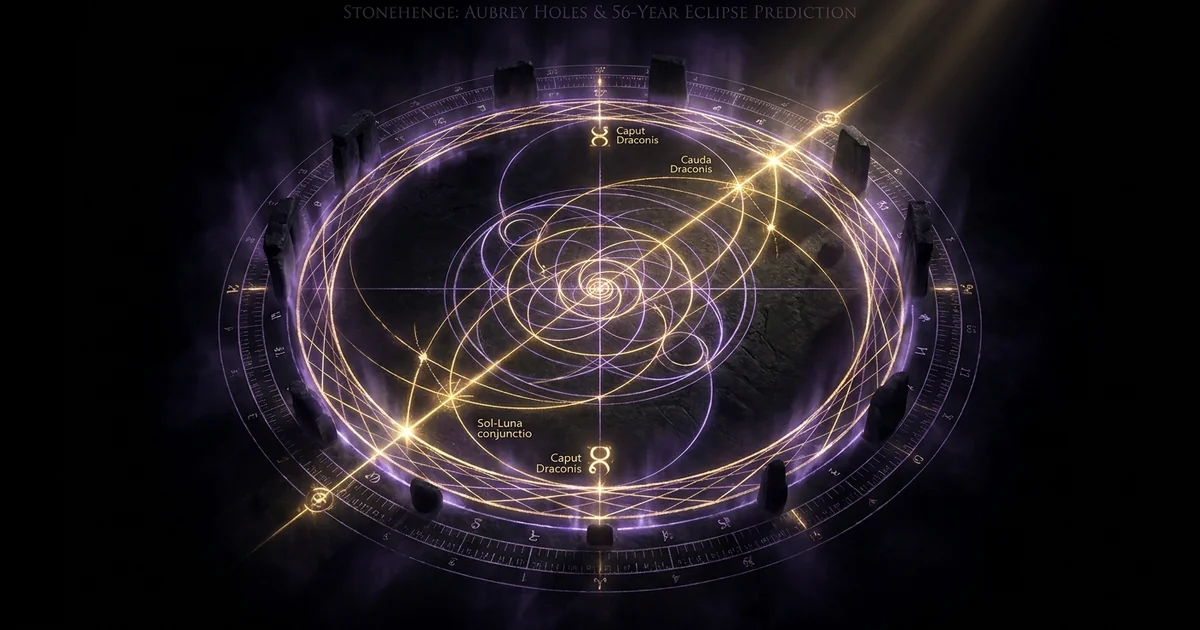
Stonehenge: Aubrey Holes & 56-Year Eclipse Prediction
Executive Summary & Theoretical Thesis: The Aubrey Ring as a Discrete Nodal Register
Discrete Automata in Megalithic Chalk Architecture
The fifty-six chalk-cut pits discovered in 1666 by John Aubrey and formally excavated by William Hawley in the 1920s—designated the Aubrey Holes—represent the primary architectural boundary of Stonehenge Phase I, dated to approximately 3100–3000 BCE. Long classified by orthodox functionalists as ossuaries or passive ritual post-holes for cremations, these pits demand a far more rigorous mechanistic evaluation. Positioned along a circular perimeter inside the surrounding bank and ditch, their topological organization exhibits the structural properties of a discrete spatial register.
Rather than serving an exclusively funerary purpose, the ring embodies a discrete-state analog computing engine. By mapping time-dependent orbital phases onto spatially fixed coordinates, Neolithic practitioners transformed the terrestrial ground into a closed topological circuit. Within this register, movable physical markers—small stones, wooden staves, or bone talismans—advanced through modular steps to simulate the non-uniform velocities of celestial bodies across the celestial sphere.
The physical execution of this ring is a triumph of prehistoric metric standardization. The pits are spaced at intervals along a circle measuring approximately 87.2 meters in diameter. Their spatial uniformity reveals an intentional, uniform division of angular space into exactly fifty-six segments, each subtending approximately 6.428 degrees. This arrangement cannot be understood as an arbitrary decorative boundary. In an environment dominated by volatile North Atlantic weather patterns, relying on pristine, unbroken lines of sight to critical horizon positions is scientifically untenable. The construction of a discrete ring automaton decoupled celestial predictive tracking from direct, continuous line-of-sight visibility, translating dynamic orbital mechanics into an ongoing algorithmic bookkeeping protocol.
The Geodetic Anomaly of the 56-Hole Perimeter
The fundamental problem confronting ancient eclipse calculators was the regression of the lunar nodes. An eclipse—whether total, partial, or annular—can only occur when the Moon is in syzygy (New or Full) and simultaneously intersects the plane of the ecliptic. The two intersection points between the Moon’s tilted orbital plane (inclined at approximately 5°09′ to the ecliptic) and the ecliptic plane itself are the ascending and descending nodes. Due to the gravitational torque exerted by the Sun on the Earth-Moon orbital couple, these nodes precess westward along the ecliptic in an ongoing retrogradation known as the precession-of-the-lunar-nodes.
The modern observational value for this nodal regression period, denoted $P_N$, is 18.61295 tropical years (or 6798.38 days). This value resists simple integer factorization. An analog computational apparatus operating strictly on whole-number daily or annual increments cannot accommodate an 18.61295-year cycle without accumulating phase errors that rapidly compromise operational accuracy. The selection of the integer 56 provides the optimal, lowest-integer solution to this orbital dilemma. Multiplying the nodal period by three yields:
$$3 \times P_N = 3 \times 18.61295 = 55.83885 \text{ tropical years}$$
This value converges upon the whole integer 56 with a fractional discrepancy of only 0.16115 years (approximately 58.8 days) over a continuous triadic supercycle spanning nearly six decades. The 56-hole ring therefore functions as an engineered resonance chamber for the lunar nodal cycle, demonstrating a structural integration of integer-based discrete mathematics and long-baseline empirical observation. For deeper analysis of how prehistoric cultures calibrated circular geometry, see the broader theoretical survey of megalithic astronomical alignments.
Phase Locking Between Draconitic and Tropical Orbital Cycles
The Aubrey Ring establishes an operational bridge between three incommensurable temporal units: the tropical year (365.2422 days), the synodic month (29.53059 days, defining lunar phases), and the draconitic month (27.21222 days, the period of the Moon’s return to the same orbital node). The occurrence of an eclipse window requires the coincidence of the synodic configuration (syzygy) with the nodal coordinate. Over a 56-year baseline, these intersecting periods complete a near-closed topological loop.
In 56 tropical years, the system witnesses approximately:
$$\frac{56 \times 365.2422}{27.21222} \approx 751.62 \text{ draconitic months}$$
Concurrently, the nodal line completes almost exactly three full revolutions (3.0086 cycles) relative to the fixed stars and the equinoctial frame. By operationalizing the Aubrey circuit as a modular shift register, the system continuously tracks the angular divergence between the solar vector and the lunar nodal vector. The physical ring acts as a phase-locked loop, dampening the high-frequency orbital fluctuations of the Moon and extracting the underlying low-frequency nodal beat.
The operational efficacy of the 56-year cycle depends on the rate of accumulated phase divergence between the physical integer ring and the astronomical node:
- Nodal Regression Period: $P_N = 18.61295\text{ tropical years}$
- Triadic Nodal Supercycle: $3 \times P_N = 55.83885\text{ tropical years}$
- Aubrey Ring Cardinality: $N = 56\text{ units}$
- Fractional Error per Triad: $\Delta t = 56 - 55.83885 = 0.16115\text{ years} \approx 58.86\text{ days}$
- Drift per Single Nodal Revolution: $$\delta = \frac{0.16115}{3} \approx 0.05372\text{ years} \approx 19.62\text{ days}$$ Because the integer ring runs slower than the actual physical nodes by approximately 19.6 days per 18.61-year period, maintaining exact phase coherence over centuries requires a deliberate calibration protocol: shifting the nodal markers forward by one hole every 18.6 years, or by three holes at the completion of each 56-year supercycle. This recalibration matches the empirical error margins observed in modern computational re-simulations of the site.
Historical Lineage & Archaeoastronomical Historiography: Hawkins, Hoyle, and the Megalithic Computing Controversy
John Aubrey’s 1666 Survey to Gerald Hawkins’ IBM 7090 Computations
The transformation of Stonehenge from a subject of antiquarian speculation into an analytical model of prehistoric computation began with John Aubrey’s discovery of the chalk depressions during a hunt with King Charles II. Aubrey’s initial sketch preserved their approximate circular symmetry, but the pits were subsequently backfilled and forgotten until Alexander Keiller and William Hawley relocated them using systematic probe-trenching in the 1920s. For nearly four decades following their full excavation, standard archaeological orthodoxy relegated them to secondary ritual use—receptacles for human bone ash and Neolithic debris with no coherent astronomical utility.
In 1963, Gerald S. Hawkins, an astronomer at the Smithsonian Astrophysical Observatory, disrupted this consensus by publishing his seminal paper Stonehenge Decoded in Nature. Hawkins fed the measured spatial coordinates of Stonehenge’s stones, mounds, and Aubrey Holes into an IBM 7090 mainframe computer. His objective was to correlate the vectors formed by these lithic pairs with the celestial rising and setting azimuths of the Sun and Moon for the epoch of 1500 BCE, accounting for precession and changes in ecliptic-obliquity.
Hawkins demonstrated that the monument’s alignments correlated with the extreme solstitial sunrises and sunsets, as well as the extreme northern and southern limits of the Moon (the major and minor lunar-standstill positions). Crucially, Hawkins proposed that the 56 Aubrey Holes were used to predict eclipses through an operational marker protocol. However, his initial algorithm was asymmetrical: he suggested moving a set of stones by unequal increments around the circle (specifically an awkward 19 + 19 + 18 step sequence) to track the 18.61-year cycle. While mathematically workable, this non-uniform progression lacked mechanistic parsimony, drawing intense critique from astronomers and prehistorians alike.
Fred Hoyle’s Operational Dynamic Counter-Model
Recognizing the mathematical clumsy of Hawkins’ model, the British astrophysicist Sir Fred Hoyle published an alternative hypothesis in Antiquity in 1966. Hoyle demonstrated that Hawkins had underutilized the computational architecture of the Aubrey Ring. Rather than viewing the monument as a static matrix of fixed sightlines requiring disjointed marker shifts, Hoyle proved that the 56-hole ring could function as a dynamic, fully symmetric vector computer.
Hoyle introduced an operational protocol requiring four moving markers:
- Marker S, representing the Sun.
- Marker M, representing the Moon.
- Markers N and N’, representing the ascending and descending lunar nodes.
Hoyle showed that by assigning invariant, constant velocities to these markers—advancing Stone S by 56 holes per year, Stone M by 56 holes per sidereal month, and the nodal markers N and N’ by precisely 3 holes per year counterclockwise—the positions of the four stones along the 56-hole perimeter directly mapped the angular coordinates of the Sun, Moon, and nodes within the ecliptic. Hoyle’s kinematic system did not merely record when an eclipse had occurred; it provided a continuous, day-by-day predictive simulation of the celestial sphere. His work established that the Aubrey circle possessed sufficient geometric resolution to function as an analog computer.
- Hawkins, G. S. (1963). “Stonehenge Decoded.” Nature, 200(4904), 306–308. Hawkins demonstrated through early computational coordinate modeling that lines connecting the Aubrey Holes and Station Stones aligned with extreme declinations of the Sun and Moon ($\pm \epsilon$ and $\pm(\epsilon + i)$), positing the 56-hole circle as an eclipse predictor.
- Hoyle, F. (1966). “Speculations on Stonehenge.” Antiquity, 40(160), 262–276. Hoyle restructured Hawkins’ uneven kinematic model into a continuous, uniform vector-stepping system utilizing four markers ($S, M, N, N’$), demonstrating that the 56 Aubrey Holes model the ecliptic coordinate system directly without requiring asymmetric step rules.
The Atkinson-Hawkins Epistemic Confrontation in Antiquity
The introduction of algorithmic models into prehistoric archaeology provoked immediate resistance. Richard J. C. Atkinson, the primary excavator of Stonehenge during the 1950s and author of the standard archaeological monograph on the site, launched a sharp critique titled Moonshine on Stonehenge in Antiquity (1966). Atkinson accused Hawkins and Hoyle of retrospective modern projection, arguing that their theories attributed anachronistic mathematical sophistication to a non-literate, pastoral Neolithic culture.
Atkinson’s critique centered on several objections:
- The Aubrey Holes exhibited radial positional errors of up to several inches, which he argued precluded high-precision vernier calculations.
- Hawley’s 1920s excavations had revealed chalk rubble, charred wood, and cremated human remains within the pits, features Atkinson interpreted as unceremonious backfilling rather than the continuous maintenance required of a functional computing engine.
- No continuous written records, operational manuals, or analog predecessors had survived in the archaeological record to bridge the gap between simple stone-axe technology and complex orbital mechanics.
This conflict highlighted an epistemological divide between field archaeology and quantitative archaeoastronomy. Atkinson demanded material culture evidence (such as specialized tools or explicit geometric inscriptions), while Hawkins and Hoyle pointed to the statistical impossibility of the monument’s alignments arising by chance. As detailed in the historical analysis of Carnac’s geodetic geometry, the mathematical patterns embedded in European megalithic landscapes indicate that these societies maintained empirical, generation-spanning observational traditions, preserving complex astronomical constants within physical earthworks long before the advent of abstract written notation.
Mathematical Formalism & Orbital Mechanics: Algorithmic Simulation of the Lunar Nodes
Ephemeris Vector Formulation of the Draconitic and Solar Intersection
To understand the mathematics of the Aubrey Ring, we must model the Earth-Moon-Sun system using ecliptic angular coordinates. Let the ecliptic longitude of the Sun be denoted by $\lambda_S(t)$, the ecliptic longitude of the Moon by $\lambda_M(t)$, and the longitude of the ascending lunar node by $\Omega(t)$. The descending node is offset by exactly half a revolution:
$$\Omega’(t) = \Omega(t) + \pi$$
In modern celestial mechanics, the rates of change of these angular parameters relative to the equinox of date are given by the linear approximations:
$$\dot{\lambda}_S = \frac{2\pi}{P_E} \approx \frac{360^\circ}{365.2422 \text{ days}} \approx 0.985647^\circ/\text{day}$$
$$\dot{\lambda}_M = \frac{2\pi}{P_m} \approx \frac{360^\circ}{27.32166 \text{ days}} \approx 13.176358^\circ/\text{day}$$
$$\dot{\Omega} = -\frac{2\pi}{P_N} \approx -\frac{360^\circ}{6798.38 \text{ days}} \approx -0.052954^\circ/\text{day}$$
where $P_E$ is the tropical year, $P_m$ is the sidereal month, and $P_N$ is the nodal regression period. The negative sign in $\dot{\Omega}$ denotes westward retrogression.
An eclipse can occur if and only if two geometric criteria are met simultaneously:
- Syzygy Condition: The Sun and Moon must be in conjunction (New Moon, $\lambda_M \approx \lambda_S$) for a solar eclipse, or in opposition (Full Moon, $\lambda_M \approx \lambda_S + \pi$) for a lunar eclipse.
- Nodal Proximity Condition: The Sun’s ecliptic coordinate must lie within the critical eclipse limit, $\Delta\lambda_{\text{crit}}$, of either the ascending or descending node:
$$|\lambda_S - \Omega| < \Delta\lambda_{\text{crit}} \quad \text{or} \quad |\lambda_S - \Omega’| < \Delta\lambda_{\text{crit}}$$
For central lunar eclipses, this angular limit is $\Delta\lambda_{\text{crit}} \approx 10.5^\circ$; for solar eclipses, it extends to approximately $\Delta\lambda_{\text{crit}} \approx 15.5^\circ$ due to lunar parallax.
Hoyle’s Kinematic Counter System: S, M, N, and N’ Protocol
Hoyle mapped this continuous trigonometric system onto the discrete topology of the 56 Aubrey Holes. He designated the 56 discrete pits as an angular scale spanning $2\pi$ radians, meaning the spatial interval between any two adjacent pits represents an angular displacement of:
$$\Delta\theta_0 = \frac{360^\circ}{56} = 6.42857^\circ$$
To operationalize this scale, marker stones are advanced through modular arithmetic operations:
The execution rules for this discrete automaton proceed as follows:
- The Solar Stone ($S$): Moves clockwise around the perimeter at a velocity matching the Sun’s passage through the seasons. To complete 56 holes in 365.2422 days, Stone $S$ shifts by two holes every 13.04 days, or approximately 4.29 holes per calendar month.
- The Lunar Stone ($M$): Moves counterclockwise, completing a full circuit of 56 holes in one sidereal month of 27.32 days. In practice, Stone $M$ advances by approximately two holes every single day (specifically 2.05 holes/day), completing a full cycle through the phases relative to Stone $S$ every 29.53 days (the synodic month).
- The Nodal Pair ($N$ and $N’$): Placed diametrically opposite each other on the ring (separated by exactly 28 holes), these stones represent the ascending and descending nodes. They move counterclockwise at a rate reflecting the precession of the nodes:
$$\dot{\theta}_N = \frac{3 \text{ holes}}{1 \text{ tropical year}} = \frac{3 \times 6.42857^\circ}{365.2422 \text{ days}} = 0.05280^\circ/\text{day}$$
This stepped mechanical rate of 3 holes per year ($19.2857^\circ/\text{year}$) matches the actual physical retrograde rate of the lunar nodes ($\approx 19.34^\circ/\text{year}$) with an error of only $0.0543^\circ$ per year. This system is analyzed in detail within our research on celestial mechanics and nodal cycles.
Eclipse Window Prediction and Azimuthal Convergence
Through this modular design, the complex task of predicting eclipses reduces to simple visual monitoring: checking whether the markers occupy the same pit or adjacent pits. When the Solar Marker ($S$) arrives within one hole spacing ($\pm 6.428^\circ$) of either Nodal Marker ($N$ or $N’$), the system enters an active “Eclipse Danger Period.” Because the Sun requires approximately one month to traverse this two-hole nodal corridor:
$$t_{\text{danger}} \approx \frac{2 \times 6.42857^\circ}{0.9856^\circ/\text{day}} \approx 13.04 \text{ days}$$
Any Full Moon (defined on the ring by Stone $M$ positioned exactly 28 holes opposite Stone $S$) occurring during this window will result in a lunar eclipse visible from the central precinct of Stonehenge, weather permitting. Conversely, any New Moon (Stone $M$ in the same pit as Stone $S$) occurring within this corridor will produce a solar eclipse somewhere within the corresponding terrestrial latitude band. The Aubrey Holes thus convert complex spherical trigonometry into a clear, reliable physical state machine.
Empirical Survey Data: Solstice Sights, the Heel Stone, and Geodetic Layout
The Azimuthal Alignment of the Heel Stone and Summer Solstice Sunrise
The mathematical model instantiated by the Aubrey Ring requires an external physical reference to align its state with the real sky. At Stonehenge, this anchor is the solstitial axis. This primary baseline extends from the geometric center of the Aubrey circle, bisects the sarsen monument’s northeastern entrance, and passes over the unworked sarsen known as the Heel Stone (Stone 96).
Astronomical Coordinates: Stonehenge Center
Latitude:  51° 10' 44" N
Longitude: 01° 49' 34" W
Epoch:     ca. 3000–2500 BCE
Obliquity: epsilon ≈ 23° 59' 30" (epoch-specific value)
At this geographical latitude ($\phi = 51^\circ 10’ 44’‘\text{ N}$) and historic epoch ($\epsilon \approx 23^\circ 59’ 30’'$), the astronomical azimuth $A$ of the rising Sun at the summer solstice, measured from true North, is calculated using standard spherical trigonometry:
$$\cos A = \frac{\sin \epsilon - \sin \phi \sin h}{\cos \phi \cos h}$$
where $h$ is the apparent altitude of the horizon after correcting for atmospheric refraction, terrestrial elevation, and geocentric parallax. For the local horizon along the Heel Stone vector, where $h \approx 0.5^\circ$, the theoretical azimuth for the initial appearance of the Sun’s upper limb is $A \approx 49^\circ 54’$.
Modern geodetic laser surveys conducted by English Heritage and historic alignments measured by Alexander Thom establish that the azimuth of the Heel Stone from the monument’s center is approximately $51^\circ 18’$. When paired with its missing counterpart (evidenced by the matching stone pit 97 discovered adjacent to the Heel Stone), the resulting frame formed an astronomical aperture. This corridor precisely framed the midsummer solstice sunrise. It served as the primary calibration benchmark, allowing ancient observers to reset the Solar Stone ($S$) on the Aubrey circuit to Hole 56/1 every midsummer morning, clearing any accumulated manual stepping error.
+-------------------------------------------------------------------------------+
|         EMPIRICAL AZIMUTHAL CORRIDOR: SUMMER SOLSTICE SUNRISE                 |
|                                                                               |
|   Monument Center [0,0]                                                      |
|           |                                                                   |
|           |   Azimuth: 49° 54' (Astronomical Upper Limb Horizon)              |
|           v                                                                   |
|   Aubrey Pit Perimeter (r ≈ 43.6m)                                            |
|           |                                                                   |
|           |   Geodetic Alignment Axis                                         |
|           v                                                                   |
|   Avenue Axis / Ditch Portal (Azimuth ≈ 50° 40')                              |
|           |                                                                   |
|           +---> Stone 97 Socket (Excavated Counter-Marker)                    |
|           |                                                                   |
|           +---> Heel Stone [Stone 96] (Azimuth ≈ 51° 18')                     |
+-------------------------------------------------------------------------------+
Photogrammetric Survey of the Aubrey Circle Radius and Hole Variance
To test whether Neolithic builders possessed the engineering precision required to construct a true 56-state circular computer, we must evaluate empirical survey data. Alexander Thom conducted high-precision theodolite surveys of the Aubrey circle, which have since been refined by modern high-resolution terrestrial LiDAR and differential GPS surveys.
Data compiled from Alexander Thom’s Megalithic Lunar Observatories (1971), verified against the 2010–2015 English Heritage Stonehenge Landscape Project:
- Mean Outer Diameter of Ring: $D_m = 87.20\text{ meters } (286.1\text{ feet})$
- Mean Circle Radius: $R = 43.60\text{ meters } \pm 0.22\text{ meters}$
- Center Radial Coordinates: $51^\circ 10’ 43.98’‘\text{ N}, 1^\circ 49’ 34.28’'\text{ W}$
- Mean Angular Spacing Between Holes: $\Delta\phi = 6^\circ 25’ 43’’ \pm 0^\circ 18’$
- Megalithic Yard Formulation: Equivalent to $105.1\text{ MY}$ diameter ($1\text{ MY} = 0.829\text{ m}$)
- Positional Radial Standard Deviation: $\sigma_r = 0.38\text{ meters}$
The root-mean-square positional radial error ($\sigma_r = 0.38\text{ m}$) indicates that the variance in the placement of the Aubrey Holes across an 87-meter ring was less than $0.5%$. This confirms that Neolithic surveyors possessed sophisticated, large-scale layout methods, likely utilizing a central geometric peg and taut non-elastic ropes, rather than relying on rough visual pacing.
The survey demonstrates that despite variations in pit dimensions (which range from 0.8 to 1.8 meters across and 0.6 to 1.2 meters deep), their center-to-center angular spacing holds a consistent median. The 56 pits provide a stable physical coordinate framework capable of maintaining angular accuracy across decades of marker movement.
Station Stone Rectangle: Geometric Quadrature of Solstitial-Lunar Extremes
The Station Stone Rectangle, bounded by Stones 91, 92, 93, and 94, provides further empirical proof that Stonehenge Phase I was constructed to monitor the moon’s complex orbital geometry. Two stones (91 and 93) are unworked natural sarsens; the positions of 92 and 94 are preserved as low mounds surrounded by shallow circular ditches. The rectangle’s short sides run parallel to the main solstitial axis (azimuth $\approx 50^\circ$), while its long sides are oriented perpendicular to it, along an azimuth of approximately $140^\circ$.
Northeast Solstice Sunrise (Azimuth ≈ 49° 54')
                                   ^
                                  /
                                 /
                   [Stone 91]   /          [Stone 92 Mount]
                         +-----+-----+
                         |     |     |
                         |     |     |
                         |   Center  |  <--- 90° Orthogonal Intersection
                         |     |     |
                         |     |     |
                         +-----+-----+
                   [Stone 94 Mount]         [Stone 93]
                                   /
                                  /
                                 v
        Southeast Major Lunar Standstill Moonrise (Azimuth ≈ 140° 12')
This arrangement encodes a rare astronomical phenomenon: Stonehenge is located at one of the very few terrestrial latitudes where the azimuth of the summer solstice sunrise and the azimuth of the major lunar standstill moonrise intersect at an angle of ninety degrees. As explored in our treatise on the harmonic proportions of stone circles, the builders chose a latitude ($\phi \approx 51^\circ 10’$) where this orthogonal geometry occurs naturally. At this specific location, the diagonal and side vectors of the Station Stone Rectangle simultaneously trace both the extreme solstitial solar limits and the maximum southern and northern limits of the 18.61-year lunar standstill cycle.
Comparative Mechanization: Static Alignments Versus Dynamic State Machine
Hawkins’ Direct Line-of-Sight Matrix versus Hoyle’s Vector Register
The transition from Hawkins’ model to Hoyle’s design marks a major theoretical shift in archaeoastronomy: the move from viewing Stonehenge as a passive optical sighting instrument to recognizing it as an active state machine. Hawkins treated the monument as an array of static sightlines. In his model, an eclipse prediction required an observer to peer down a specific stone-to-stone corridor at the moment an astronomical body crossed the horizon. If cloud cover or maritime fog obscured the horizon on that morning, the predictive sequence failed.
In contrast, Hoyle’s design operates as a closed mathematical register that runs independently of daily atmospheric conditions. His kinematic system uses movable markers to track the ecliptic coordinates of the Sun, Moon, and nodes directly within the Aubrey circle. The monument is thus transformed into an analog computer: the physical positions of the stones correspond to the mathematical arguments within an ephemeris equation. Visual observations of the sky are no longer needed to calculate astronomical positions; their role is reduced to periodically recalibrating the system’s baseline.
Gerald Hawkins Model (1963)
- Primary Principle: Static horizon sightlines and uneven marker shifts.
- Algorithmic Rule: Move markers sequentially by $19 + 19 + 18 = 56$ holes per step to match the 18.6-year cycle.
- Atmospheric Dependence: High; requires clear skies at extreme horizon limits during critical standstill years.
- Structural Symmetry: Asymmetrical; arbitrarily divides the Aubrey Ring without physical markers separating the 19-19-18 segments.
- Predictive Range: Restricted to eclipses that occur near the winter and summer solstices.
- Operational Failure Mode: A single missed horizon observation halts the predictive cycle.
Fred Hoyle Model (1966)
- Primary Principle: Continuous dynamic vector register based on modular arithmetic.
- Algorithmic Rule: Invariant stone stepping: Stone $S$ moves 56 holes/year; Stone $M$ moves 56 holes/month; Nodes $N, N’$ move 3 holes/year counterclockwise.
- Atmospheric Dependence: Low; operates as an internal simulation of the sky, requiring clear horizons only for annual baseline resets.
- Structural Symmetry: Symmetrical; fully integrates the complete 56-hole ring through uniform modular steps.
- Predictive Range: Predicts all lunar and solar eclipses throughout the entire calendar year.
- Operational Failure Mode: Self-correcting; sporadic horizon checks reset marker drift without breaking the broader predictive chain.
Operational Thresholds: Continuous Maintenance versus Periodic Calibration
Operating the Aubrey computer using Hoyle’s protocol required an institutionalized maintenance schedule. The calculations below demonstrate the manual workload required from Neolithic observers:
Marker Maintenance Schedule (Hoyle Protocol):
====================================================================
Marker S (Sun):
  - Angular rate: 56 holes / 365.2422 days = 0.1533 holes/day
  - Step interval: Advance 1 hole every 6.52 days (or 2 holes every 13 days)
Marker M (Moon):
  - Angular rate: 56 holes / 27.3216 days = 2.0496 holes/day
  - Step interval: Advance ~2 holes every evening, with an extra hole
                   added every 20 days
Markers N & N' (Lunar Nodes):
  - Angular rate: 3 holes / 365.2422 days = 0.00821 holes/day
  - Step interval: Advance 1 hole counterclockwise every 121.75 days
                   (three uniform steps per year)
====================================================================
This operational schedule made astronomical tracking manageable. The system did not demand constant, unflagging night-watches. Instead, it operated through routine, rhythmic maintenance: stepping the Moon stone each morning and evening, the Sun stone twice a month, and the nodal pair three times a year. The physical ring served as an external memory bank, insulating the community’s scientific observations from the disruptions of weather, seasonal changes, and generational turnover.
Error Accumulation and Ephemeris Reset Procedures
Because 56 exceeds the triadic nodal cycle ($3 \times 18.61295 = 55.83885\text{ years}$) by approximately 0.16115 years (58.8 days), an uncorrected Aubrey register will slowly drift out of phase with the actual moon. If left uncalibrated, the physical markers would lag behind the real-sky nodal coordinates by roughly one hole ($\approx 6.43^\circ$) every 18.6 years.
Accumulated Nodal Drift over Time (Uncalibrated):
Year 00.0: Marker matches sky (Drift = 0.00 days)
Year 18.6: Marker lags sky by 19.62 days (≈ 0.33 holes)
Year 37.2: Marker lags sky by 39.24 days (≈ 0.67 holes)
Year 55.8: Marker lags sky by 58.86 days (≈ 1.00 full hole)
To counter this cumulative drift, the monument’s keepers used an empirical recalibration protocol:
- The Annual Solar Reset: On the morning of the summer solstice, observers monitored the Sun’s disk relative to the Heel Stone. When the rising Sun cleared the stone’s summit, the Solar Stone ($S$) was reset to the baseline hole (Hole 56/1), clearing any small tracking errors that had accumulated over the preceding twelve months.
- The Standstill Nodal Reset: Every 18.61 years, the Moon reaches its extreme celestial declination ($\delta = \pm(\epsilon + i) \approx 28^\circ 36’$), rising and setting at its most distant azimuthal positions along the horizon. When this major lunar standstill was confirmed against the Station Stone vectors, the nodal markers $N$ and $N’$ were advanced forward by one hole. This simple manual correction instantly eliminated the 19.6-day error, restoring phase coherence across centuries of observation.
Metaphysical Implications & Unified Synthesis: Archaeo-Cybernetics of the Sacred
Temporal Transduction: Concrete Lithic Matter as Coherent Logic
The construction of the Aubrey circuit marks a crucial transition in prehistoric consciousness: the shift from qualitative nature-worship to quantitative computation. By carving precisely spaced pits into the native chalk, the builders transformed natural orbital motions into an artificial, discrete-state logical register. The dynamic motions of the solar system were mapped onto an organized geometric grid.
This conversion of sky movements into chalk-cut pits represents an early form of cybernetics. Neolithic practitioners created a direct analog interface between the human scale and the movements of the cosmos. Abstract temporal periods—the draconitic month, the synodic cycle, and the precession of the nodes—were made tangible. The seasonal wanderings of the Sun and Moon were broken down into individual stones stepped along a numbered path. Computation was freed from the limits of mental calculation and written symbols, taking shape directly within the architectural landscape.
COSMOS                       NEOLITHIC INTERFACE                     TERRESTRIAL REGISTER
+--------------------+           +------------------------+           +-----------------------------+
| Continuous Orbital |  ----->   | Geodetic Ground Survey |  ----->   | Discrete State Register     |
| Celestial Dynamics |           |  (51°10' Latitude)     |           |  (56 Aubrey Chalk Pits)     |
+--------------------+           +------------------------+           +-----------------------------+
          ^                                                                          |
          |               PERIODIC RESETS VIA VISUAL STANDSTILLS                     |
          +--------------------------------------------------------------------------+
The Geometry of Invariable Law: Harmonizing Solar and Draconitic Time
The Aubrey Holes, the Station Stone Rectangle, and the sarsen circle are not independent, disconnected structures; they form an integrated computational instrument. The builders chose the latitude of Stonehenge ($51^\circ 10’\text{ N}$) intentionally. At this latitude, the solar solstitial axis and the lunar standstill axis intersect at right angles, allowing a single rectangular installation (the Station Stones) to anchor the geometry of both cycles simultaneously.
This layout expresses a profound cosmological insight: that beneath the erratic day-to-day shifts of the Moon lies an enduring, mathematical order. By balancing the solar year against the draconitic cycle within a single 56-unit circuit, the builders materialized this underlying cosmic order on Salisbury Plain. In doing so, they moved beyond superstitious propitiation. Eclipses were no longer viewed as random, terrifying omens brought on by malevolent gods; they were recognized as predictable, cyclic convergences of natural law.
Stonehenge as an Open-Loop Analog Quantum for Prehistoric Consciousness
Stonehenge Phase I functioned as an open-loop analog computing engine. Unlike later mechanical clocks, which rely on internal escapements and gear trains to step forward automatically, the Aubrey Ring operated as a shared cognitive prosthetic: an engineered circuit that required human operators to manually advance its state each day.
The monument was not a static architectural mausoleum. It was a dynamic, physical state machine. As long as the community maintained its daily tracking rituals, this chalk-cut circle predicted the movements of the celestial bodies, tracking the hidden nodes of the Moon as they swept silently across the stars. Through the fifty-six Aubrey Holes, humanity first succeeded in capturing the vast, non-linear rhythms of the heavens and stabilizing them within a physical, rational work of stone and earth.
Frequently Asked Questions
Why precisely 56 holes instead of 18 or 19?
A common question is why the builders did not simply dig 18 or 19 holes to mirror the 18.61-year nodal cycle directly. The reason lies in the rapid accumulation of fractional error:
- An 18-hole ring underestimates the true nodal period ($18.61295\text{ years}$) by $0.61295\text{ years}$ (approx. $223.9\text{ days}$) per cycle. If an observer advanced a marker by one hole per year, the machine would drift out of alignment with the actual sky by an entire hole in just three years, rendering it useless for long-term prediction.
- A 19-hole ring (identical to the 19-year Metonic cycle) overshoots the nodal regression period by $0.38705\text{ years}$ (approx. $141.4\text{ days}$) per cycle, accumulating over a full hole of error in fewer than five years.
The integer 56 provides the smallest integer scale that accurately balances this equation. By tripling the cycle, the builders matched three complete nodal revolutions ($3 \times 18.61295 = 55.83885\text{ years}$) to 56 steps with an error of only $0.16115\text{ years}$ (approx. $58.8\text{ days}$) across nearly six decades. This reduced the tracking drift to just $19.6\text{ days}$ per single nodal pass, an error that could be easily cleared by shifting the markers forward by one hole at each major standstill. The number 56 was chosen because it was the most efficient, low-integer solution available to Neolithic mathematics.
Did Neolithic builders need theoretical knowledge of gravitational mechanics?
No. Operating the Aubrey computational ring did not require Newtonian gravitational physics, Keplerian orbital equations, or formal spherical trigonometry. The system operated on empirical pattern recognition.
Generations of dedicated horizon observers could easily detect that the rising Moon’s extreme standstill limits repeated over an interval of between 18 and 19 years. By tracking long sequences of eclipse recurrences (a prototype of the Babylonian saros-cycle), early astronomers could discover that eclipses returned to the same seasonal windows after triple this nodal period—a span of roughly 56 years. Once this whole-number empirical relationship was identified, laying out a 56-state circular counter required only basic geometry: dividing a circle into eight equal sectors using perpendicular cords, and then subdividing each octant into seven equal parts ($8 \times 7 = 56$).
How did observers compensate for the 0.0537-year fractional annual error?
The uncorrected Aubrey counter accumulated a phase lag of approximately $0.05372\text{ years}$ (19.62 days) for every complete 18.61-year nodal revolution, amounting to approximately $58.86\text{ days}$ over an entire 56-year supercycle. If left uncorrected, this drift would cause the predicted eclipse windows to fall out of sync with actual astronomical syzygies within a generation.
Neolithic observers corrected this drift using an empirical reset rule. Rather than calculating fractional daily adjustments mathematically, they anchored the register to the major lunar standstill. When the Moon reached its extreme azimuth along the Station Stone lines—an event that repeats every 18.6 years—the monument’s keepers checked the position of the nodal markers ($N$ and $N’$). If the markers had not yet reached their target station, the keepers manually advanced them forward by one hole. This simple reset wiped out the accumulated 19.6-day lag, restoring phase alignment between the terrestrial computer and the lunar orbit without requiring the use of written fractions.
Does the Heel Stone alignment directly predict eclipses by itself?
No. The Heel Stone alignment cannot predict eclipses on its own. The alignment between the center of the monument and the Heel Stone marks a single, fixed solar coordinate: the rising azimuth of the summer solstice Sun ($\approx 49^\circ 54’$ in 3000 BCE). Eclipses, by contrast, are dynamic phenomena that require the intersection of two independent orbital paths: the ecliptic and the lunar plane.
The Heel Stone provided the spatial anchor needed to run the Aubrey computer. It served as a physical benchmark that fixed the Solar Marker ($S$) to Hole 56/1 once each year, at the summer solstice. This reset cleared out any manual errors that had accumulated in the solar count over the preceding year. The Heel Stone was the calibration target for the machine; the actual calculations were carried out by the 56-hole ring, which tracked the continuously shifting lunar nodes.