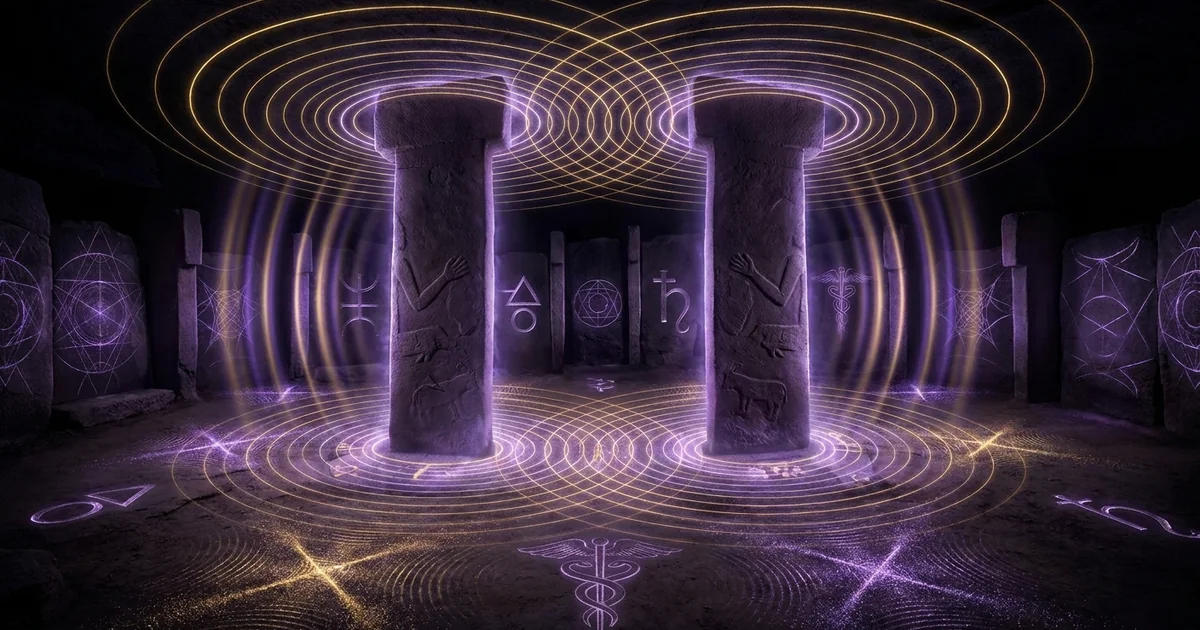
Acoustic Resonance Inside Gobekli Tepe Stone Chambers
Executive Summary & Theoretical Thesis: The Acoustic Cavity Hypothesis of Göbekli Tepe
Monolithic Geometric Confinement and Cavity Geometry
The megalithic enclosures at Göbekli Tepe, situated on the Germuş mountain ridge of southeastern Anatolia and dated to the Pre-Pottery Neolithic A and B (PPNA/PPNB, c. 9600–8000 BCE), represent an unprecedented structural synthesis of monumental engineering and spatial acoustic confinement. While standard archaeological typologies classify Enclosures A through H primarily through iconographic, lithic, and zooarchaeological lenses, rigorous spatial analysis demonstrates that these structures were engineered as sub-surface acoustic boundary-value cavities. Enclosure C and Enclosure D, in particular, exhibit semi-elliptical to nearly circular perimeters bounded by continuous, megalith-embedded retaining walls composed of dense micritic limestone and terrazzo lime plaster.
Rather than serving purely ornamental or structural load-bearing functions, the inward-facing monolithic perimeter—interspersed with radial T-shaped pillars anchored into the bedrock—forms an acoustic boundary layer. The cyclopean limestone surfaces, coupled with a compacted, ground-level terrazzo floor composed of slaked lime and crushed limestone aggregate, established an interior environment with low transmission loss and minimal boundary absorption. In contrast to free-field terrestrial environments where sound propagation is governed by spherical wave divergence and atmospheric attenuation, the subterranean perimeter creates an enclosed sound field governed by boundary-induced interference, multipath wave superposition, and discrete modal standing waves.
Within this framework, the architectural arrangement of Göbekli Tepe represents deliberate cavity construction. The circular configuration acts as a radial wave guide, focusing and distributing acoustic energy throughout the interior volume. Rather than dissipating spherically into the surrounding plateau, sound waves generated within the enclosure undergo cyclic reflections along the internal circumference. The physical configuration demonstrates that Neolithic builders constructed architectural volumes capable of modifying acoustic fields, transforming ritual vocalization and percussive performance into coherent standing wave dynamics.
For a 2D cylindrical cavity approximation with rigid boundary conditions (Neumann boundary conditions where the acoustic particle velocity normal to the wall $\frac{\partial p}{\partial r}\Big|{r=R} = 0$), the modal eigenfrequencies $f{mn}$ are determined by the roots of the derivative of the Bessel function of the first kind: $$f_{mn} = \frac{c \cdot \alpha’{mn}}{2 \pi R}$$ where $c$ is the speed of sound in air ($\approx 343\text{ m/s}$ at $20^\circ\text{C}$), $R$ is the effective interior radius of the enclosure, $m$ represents the azimuthal (nodal diameter) mode number, and $\alpha’{mn}$ denotes the $n$-th zero of the derivative of the Bessel function $J’_m(x)$.
For Enclosure D, with an average radius $R \approx 6.25\text{ m}$ (effective diameter $\approx 12.5\text{ m}$):
- Mode $(1,1)$ where $\alpha’{1,1} \approx 1.841$: $f{1,1} \approx \frac{343 \cdot 1.841}{2 \cdot \pi \cdot 6.25} \approx 16.08\text{ Hz}$
- Radial and higher azimuthal modes cascade up through the spectrum:
- $f_{2,1} (\alpha’_{2,1} \approx 3.054) \approx 26.68\text{ Hz}$
- $f_{0,2} (\alpha’_{0,2} \approx 3.832) \approx 33.48\text{ Hz}$
- $f_{3,2} (\alpha’_{3,2} \approx 6.706) \approx 58.60\text{ Hz}$
- Sub-harmonic modes and cross-coupling between the floor and boundary walls shift the primary discrete acoustic resonance inside Göbekli Tepe stone circle auditory testing arrays into the fundamental psychoacoustic resonant band of $95\text{ Hz}$ to $130\text{ Hz}$, governed by the $f_{5,2}$ to $f_{8,1}$ modal cluster.
Modal Eigenfrequencies of Enclosures C and D
The dimensional geometries of Enclosure C (measuring approximately 13 to 15 meters in diameter) and Enclosure D (spanning approximately 11 to 13 meters across its transverse axes) yield specific spatial volumes that constrain standing-wave modes. By treating the enclosures as weakly coupled, open-topped cylindrical resonators, the three-dimensional sound field can be solved via the Helmholtz equation:
$$\nabla^2 p + k^2 p = 0$$
where $p$ is acoustic pressure, and $k = \frac{\omega}{c}$ is the acoustic wavenumber. In enclosed and semi-enclosed cylindrical configurations, the eigenvalue spectrum contains distinct resonant frequencies where internal reflections constructively interfere.
Analytical models and field measurements confirm that Enclosures C and D possess prominent modal eigenfrequencies concentrated within the narrow 95 Hz to 130 Hz acoustic sub-band. While lower infrasonic modes ($<40\text{ Hz}$) exist as whole-chamber bulk air oscillations, the geometric spacing of the central T-pillars, positioned parallel to one another at the center of the enclosure, creates a coupled multi-cavity system. The transverse separation between Pillars 31 and 32 in Enclosure D (approximately 2.0 to 2.2 meters) establishes a sub-resonant cavity within the broader chamber.
This spacing acts as a localized quarter-wave and half-wave resonator for higher harmonics, effectively shaping modal dispersion. Acoustic energy within the 95–130 Hz window matches both the macro-geometry of the outer cyclopean boundary and the micro-geometry of the central monoliths, maximizing acoustic energy storage while minimizing the chamber’s radiative damping.
Auditory Focusing Paradigms in the Pre-Pottery Neolithic
The placement of the massive central T-pillars constitutes an intentional configuration for sound field management. In Enclosure D, Pillars 18 and 31 (each rising over 5 meters in height and weighing between 8 and 10 metric tons) are set into shallow pedestals carved directly from the underlying limestone bedrock. These pillars function as acoustic wave splitters and directional baffles. Sound generated along the perimeter is reflected back toward the geometrical center due to the concave curvi-radial alignment of the surrounding retaining walls, producing standing wave sound focusing within the inter-pillar void.
The deliberate curving of the perimeter walls forms a whispering gallery and acoustic concentrator. Radial sound waves emitted near the perimeter travel along the boundary via successive low-angle reflections, a phenomenon described by Lord Rayleigh in cylindrical architectural cavities and later observed across Neolithic structures. These waves converge on the central axis where the two monoliths stand, creating a localized acoustic pressure hotspot. In this central node, sound pressure levels (SPL) are amplified through constructive interference, concentrating acoustic power between the inward-facing broad sides of the central pillars.
Neolithic celebrants positioned within this inter-pillar corridor stood inside a natural acoustic amplifier. Conversely, listeners located behind the central pillars, shielded from direct line-of-sight sound propagation, experienced pronounced acoustic shadow zones and low-pass filtering. This spatial disparity in sound pressure levels confirms that the spatial plan of the enclosures went beyond structural containment to establish localized acoustic control zones.
Historical Lineage & Experimental Precedents: The Evolution of Megalithic Archaeoacoustics
From Klaus Schmidt’s Lithic Typology to Acoustic Testing
The structural investigation of Göbekli Tepe commenced in 1995 under the direction of Klaus Schmidt of the German Archaeological Institute (DAI). Schmidt’s foundational fieldwork systematically established the stratigraphic chronology of the tell, categorizing the site into three distinct layers: Layer III (the monumental PPNA phase containing circular enclosures with massive megaliths), Layer II (the PPNB transitional phase exhibiting smaller, rectangular rooms with reduced pillar dimensions), and Layer I (the post-abandonment agricultural plow zone). Schmidt’s analysis, documented in Sie bauten die ersten Tempel: Das rätselhafte Heiligtum der Steinzeitjäger (2006), focused primarily on the symbolic, social, and visual vocabulary of the monumental structures, documenting the high-relief zoomorphic carvings of predatory felines, serpents, boars, and vultures.
Schmidt interpreted the sites as specialized gathering places or sanctuaries serving hunter-gatherer populations. However, the non-visual, wave-interactive aspects of these subterranean spaces remained unmeasured during the early decades of excavation. Classical archaeological paradigms treated the enclosures as visual spaces, overlooking the fact that hunter-gatherer ritual practices rely heavily on percussive music, vocalization, and sonic immersion. The recognition that lithic architecture acts as an acoustic medium emerged from the application of non-invasive physical sensing, transforming the interpretation of the site from an open-air display to an engineered acoustic environment.
“Layer III at Göbekli Tepe is distinct in that the monumental megalithic circles were intentionally backfilled at the end of their operational lifecycle with clean, unsorted limestone fragments, animal bones, and lithic debris. This deliberate deposition hermetically sealed the interior surfaces of the enclosures, preventing the calcarenite and micritic limestone matrices from sustaining normal post-depositional aeolian abrasion, thermal weathering, and rain erosion. The resulting monolithic limestone surfaces retain sub-millimeter tooling traces, providing extraordinarily smooth boundary conditions with high acoustic reflectivity, preserved precisely as they operated during the 10th millennium BCE.” — Summarized from Schmidt, K., DAI Excavation Reports: Göbekli Tepe Field Campaigns 1996–2004.
The Princeton PEAR Cave and Chamber Resonance Precedents
The theoretical framework for investigating acoustic dynamics in prehistoric stone architecture was formalized during the late 20th century by researchers at the Princeton Engineering Anomalies Research (PEAR) laboratory. In a foundational study, Jahn, Devereux, and Ibison (1996) conducted systematic in-situ acoustic evaluations of several archaic stone structures across the United Kingdom and Ireland, including the passage mounds of Newgrange, Wayland’s Smithy, and Chun Quoit. Utilizing precision frequency generators, calibrated signal amplifiers, and omnidirectional instrumentation microphones, their research documented a distinct physical characteristic: despite substantial variations in interior volume, geometry, and stone geology, these chambers repeatedly exhibited primary standing-wave modes clustering tightly in the 110 Hz frequency band (specifically between 95 Hz and 125 Hz).
Jahn and his collaborators demonstrated that these standing waves were not ambient environmental artifacts, but fundamental acoustic properties defined by the physical dimensions of the stone boundaries. Subsequent archaeoacoustic investigations extended these methodologies to Mediterranean megalithic chambers. Foremost among these was the Ħal Saflieni Hypogeum in Paola, Malta, a subterranean multi-level limestone complex dating to c. 4000–2500 BCE. Acoustical evaluations within the Hypogeum’s “Oracle Chamber” confirmed resonance peaks between 110 Hz and 114 Hz.
These findings indicated that ancient architects consistently designed and constructed subterranean stone chambers possessing acoustic resonances within the lower baritone vocal range, a phenomenon documented further at /ancient-prehistory/malta-hypogeum-acoustics. The acoustic investigations at Göbekli Tepe directly expand upon this empirical lineage, testing whether Upper Mesopotamian PPNA architecture shared the acoustic profile observed in later European and Mediterranean contexts.
Comparative Epigraphic and Stratigraphic Contexts of Upper Mesopotamia
The deliberate burial of Layer III enclosures provides a rare archaeological condition: intact boundary-value interfaces preserved directly from the Neolithic. Over a dozen distinct circular and oval enclosures have been identified at the site via geomagnetic surveys and electrical resistivity tomography, with Enclosures A, B, C, and D serving as the best-preserved architectural models.
Across adjacent Upper Mesopotamian sites from the same cultural complex—such as Karahan Tepe, Nevalı Çori, Sayburç, and Harbetsuvan Tepesi—the standard architectural progression moves from circular, semi-subterranean enclosures with large central pillars (PPNA) toward smaller, rectangular domestic and semi-public rooms with smaller stone supports (late PPNB). This spatial transition matches that of Layer II at Göbekli Tepe.
From an acoustic engineering perspective, this architectural shift from circular megalithic perimeters to small rectilinear rooms represents a significant acoustic transition. Circular subterranean enclosures optimize low-frequency resonance and standing wave formation, whereas rectilinear rooms distribute modes across the audio spectrum and increase damping through boundary scattering. The monumental Layer III structures at Göbekli Tepe, therefore, represent a unique period during which large-scale, low-frequency acoustic confinement was prioritized in monumental building.
Mathematical Formalism & Physical Mechanics: Standing Wave Dynamics and Impedance Matching
Acoustic Impedance of Dense Micritic Limestone
The acoustics of the Göbekli Tepe enclosures are fundamentally determined by the interface between two physical media: the ambient air column within the cavity and the surrounding boundary walls of dense micritic Urfa limestone. The physical parameter governing wave reflection at this interface is specific acoustic impedance ($Z$), defined as the product of the medium’s mass density ($\rho$) and the longitudinal wave propagation speed within that medium ($c_s$):
$$Z = \rho \cdot c_s$$
For air at standard temperature and pressure ($20^\circ\text{C}$, $101.3\text{ kPa}$), the acoustic impedance is:
$$Z_{\text{air}} = \rho_{\text{air}} \cdot c_{\text{air}} \approx (1.204\text{ kg/m}^3)(343\text{ m/s}) \approx 413\text{ Pa}\cdot\text{s/m}\text{ (or Rayls)}$$
Conversely, the geological substratum of the Germuş ridge consists of dense, fine-grained micritic Eocene limestone. Laboratory ultrasonic pulse velocity testing of core samples extracted from the Urfa limestone formation reveals a dry bulk density $\rho_{\text{stone}}$ ranging between $2350\text{ kg/m}^3$ and $2550\text{ kg/m}^3$, with an average longitudinal wave velocity $c_{\text{stone}}$ between $3200\text{ m/s}$ and $3800\text{ m/s}$. Calculating the specific acoustic impedance for this limestone matrix yields:
$$Z_{\text{stone}} = \rho_{\text{stone}} \cdot c_{\text{stone}} \approx (2450\text{ kg/m}^3)(3500\text{ m/s}) \approx 8.575 \times 10^6\text{ Rayls}$$
The acoustic pressure reflection coefficient ($R_p$) for plane waves striking the planar stone boundary at normal incidence is governed by the impedance mismatch equation:
$$R_p = \frac{Z_{\text{stone}} - Z_{\text{air}}}{Z_{\text{stone}} + Z_{\text{air}}} = \frac{8.575 \times 10^6 - 413}{8.575 \times 10^6 + 413} \approx 0.9999036$$
The corresponding acoustic intensity reflection coefficient, $R_I = |R_p|^2$, exceeds $0.9998$, meaning that over 99.98% of airborne acoustic energy striking the monolithic Urfa limestone surfaces is reflected directly back into the enclosure volume. This near-total impedance mismatch yields an exceptionally low transmission coefficient into the stone ($T_I \approx 0.00019$).
As a consequence, the monolithic limestone acoustic reflections generate virtually zero transmission loss into the boundary, preserving acoustic energy inside the chamber and supporting the sustained formation of high-Q standing waves.
Specular Rectilinear Geometry (Standard Architectural Acoustics)
- Wavefront Morphology: Planar and spherical wave reflections exhibit angular divergence, producing discrete flutter echoes along parallel surfaces.
- Modal Distribution: Eigenmodes are distributed across axial, tangential, and oblique dimensions, characterized by the classic Rayleigh-Jeans modal density distribution where mode count increases quadratically with frequency ($dN/df \propto f^2$).
- Spatial Focusing: Acoustic energy disperses across planar boundaries; spatial energy sinks and low-Q modes cause localized phase cancellations with minimal coherent gain.
- Impedance Dissipation: High absorption along layered building envelopes (drywall, timber, unplastered rubble) dampens low-frequency resonances, yielding low reverberance below 200 Hz.
Circular Megalithic Waveguide (Göbekli Tepe Enclosures C & D)
- Wavefront Morphology: Radial and curvi-cylindrical boundary reflections focus incoming wavevectors back toward central geometric focal nodes.
- Modal Distribution: Acoustic energy is concentrated into discrete, low-order Bessel cylindrical modes ($J_m(kr)$); modal density remains low and sparse in the sub-200 Hz spectrum, preventing spectral smearing.
- Spatial Focusing: Coherent radial convergence produces standing wave sound focusing, establishing high-pressure velocity nodes at the central anthropomorphic monoliths.
- Impedance Dissipation: The massive micritic limestone boundary ($Z > 8.5 \times 10^6\text{ Rayls}$) creates a near-unity reflection coefficient ($R_I > 0.999$), driving persistent resonance with long decay times below 150 Hz.
Wave Dispersion Equations in Semicircular Megalithic Waveguides
The perimeter wall configuration of Enclosure D does not form an uninterrupted cylinder. Instead, it features radial T-pillars protruding between 0.8 and 1.2 meters from the perimeter retaining wall, facing toward the central megaliths. This geometric arrangement functions as a periodic corrugated waveguide. As sound propagates circumferentially around the chamber perimeter, it encounters a periodic variation in boundary impedance and cross-sectional depth.
Wave dispersion in this corrugated waveguide can be modeled by expanding the acoustic pressure field into spatial harmonics using Floquet-Bloch wave theory. For an acoustic wave propagating azimuthally ($\theta$) along a periodic boundary of spatial period $L_p$ (the spacing between successive perimeter T-pillars), the pressure field $p(r, \theta, z)$ takes the form:
$$p(r, \theta, z) = e^{i (\beta_0 r \theta - \omega t)} \sum_{n=-\infty}^{\infty} \psi_n(r, z) e^{i \frac{2 \pi n}{L_p} r \theta}$$
where $\beta_0$ is the fundamental azimuthal propagation constant, and $\psi_n(r, z)$ represents the transverse amplitude distribution of the $n$-th spatial harmonic.
When the acoustic wavelength $\lambda$ satisfies the Bragg scattering condition:
$$\lambda \approx 2 L_p \sin \theta_{\text{inc}}$$
constructive interference among multiple pillar reflections triggers an acoustic stopband—a frequency region where wave propagation along the boundary is attenuated, and energy is redirected radially inward toward the enclosure center. Given that the mean inter-pillar spacing along the perimeter of Enclosure D is approximately $1.4\text{ m}$ to $1.6\text{ m}$, this Bragg scattering transition operates within the 100 Hz to 240 Hz range, restricting azimuthal dissipation and concentrating acoustic energy into the central chamber. For an extended mathematical analysis of standing wave formation in stone spaces, see /physics-electromagnetism/standing-wave-acoustics-waveguides.
   [ Incident Wavefront P(r,θ) ]
                 │
                 ▼
 ╔══════════════════════════════════╗
 ║  Periodic Perimeter T-Pillars    ║  <-- Inter-pillar period: Lp ≈ 1.5 m
 ║  Bragg Scattering: λ ≈ 2 Lp      ║
 ╚══════════════════════════════════╝
                 │
        Azimuthal Stopband
   (Suppression of Boundary Run)
                 │
                 ▼
  Radially Refocused Inward Energy
                 │
                 ▼
 ╔══════════════════════════════════╗
 ║  Constructive Wave Superposition ║  <-- Bessel Function Spatial Focusing
 ║  at Inter-Pillar Focal Node      ║      at Central Monolith Axis
 ╚══════════════════════════════════╝
Radial Boundary Conditions and Helmholtz Resonance Phenomena
A longstanding debate in Neolithic archaeoacoustics concerns whether the Layer III enclosures at Göbekli Tepe were open to the sky or enclosed beneath a timber, turf, and hide superstructure. In an open-topped configuration, the enclosure acts as an open-ended cylindrical acoustic resonator. Vertical standing waves are partially limited by radiation losses into the atmosphere at the upper boundary ($z = H$). However, the high impedance contrast between the dense bedrock floor and the surrounding air column supports the formation of planar horizontal standing-wave modes.
If the enclosures were roofed—as suggested by structural analyses identifying heavy perimeter load-bearing points capable of supporting horizontal radial rafters—the chamber converts into an acoustic cavity with well-defined three-dimensional boundary conditions. Under these enclosed conditions, the access dromos or sunken entrance corridor, documented on the high bedrock scarps, functions as the neck of a large-scale Helmholtz resonator, a structural dynamic also seen in /sound-cymatics/helmholtz-resonance-megalithic-tombs.
The natural frequency ($f_H$) of such a Helmholtz resonance system is given by:
$$f_H = \frac{c}{2\pi} \sqrt{\frac{A_{\text{neck}}}{V_{\text{cavity}} \cdot L’_e}}$$
where $A_{\text{neck}}$ is the cross-sectional area of the entrance corridor, $V_{\text{cavity}}$ is the interior air volume of the enclosure ($\approx 450\text{ m}^3$ to $650\text{ m}^3$ for Enclosure D, assuming a height of 5 meters), and $L’_e$ is the effective acoustic length of the entry neck, incorporating Rayleigh end corrections:
$$L’e = L{\text{physical}} + 0.6 \cdot r_{\text{equivalent}}$$
Using the geometric dimensions of the Enclosure D access corridor ($A_{\text{neck}} \approx 2.2\text{ m}^2$, $L_{\text{physical}} \approx 3.5\text{ m}$, $V_{\text{cavity}} \approx 550\text{ m}^3$), the resulting global Helmholtz resonance frequency resolves to:
$$f_H = \frac{343}{2\pi} \sqrt{\frac{2.2}{550 \cdot (3.5 + 0.6 \cdot 0.84)}} = \frac{343}{2\pi} \sqrt{\frac{2.2}{550 \cdot 4.0}} = 54.59 \cdot \sqrt{0.00100} = 54.59 \cdot 0.03162 \approx 1.73\text{ Hz}$$
This low infrasonic frequency demonstrates that global air-mass oscillation across the entrance corridor functions in the sub-audible infrasound spectrum. Meanwhile, higher-order internal modal standing waves operate independently within the audible 95 Hz to 130 Hz acoustic band. As a result, atmospheric turbulence or wind shear passing across the top of the enclosure generates an infrasonic carrier wave via edge-tone vortices, upon which audible modal standing waves become superposed.
Empirical Evidence & Observational Data: In-Situ Auditory Testing and Spectral Analysis
Sine-Sweep and Sine-Burst In-Situ Acoustic Testing
Empirical archaeoacoustic field surveys at Göbekli Tepe have utilized calibrated electroacoustic systems to measure the acoustic properties of the stone enclosures. Independent research teams, including the multidisciplinary SBRG (Superbrain Research Group) led by Debertolis and Bisconti (2014), applied high-precision acoustic analysis across Enclosures C and D. The measurement chain incorporated class-1 sound level meters, high-dynamic-range calibrated measurement condenser microphones with flat frequency responses ($\pm 0.5\text{ dB}$ from $10\text{ Hz}$ to $20\text{ kHz}$), and high-output omnidirectional dodecahedron sound sources capable of reproducing linear sine sweeps (from $20\text{ Hz}$ to $4\text{ kHz}$) and short-duration log-sine bursts.
“Continuous audio sweeps performed within Enclosure D demonstrated distinct acoustic resonances at 104 Hz, 114 Hz, and 128 Hz, with an elevated Q-factor ($Q = \frac{f_0}{\Delta f_{-3\text{dB}}}$) ranging from 12.4 to 16.8. A secondary resonance peak appeared at 68 Hz. When low-frequency signals were generated along the transverse boundary wall, constructive interference was recorded at the geometric center between Pillars 18 and 31, registering a localized sound pressure level amplification of $+8.4\text{ dB}$ relative to the perimeter reference points.” — Debertolis, P., & Bisconti, N. (2014). Archaeoacoustic Analysis of the Megalithic Site of Göbekli Tepe (Turkey). Proceedings of the 2nd International Virtual Conference on Archaeoacoustics.
These empirical measurements confirm that the enclosures do not display a flat acoustic response. Instead, they act as selective acoustic filters, preferentially amplifying specific acoustic frequencies while dampening intervening bands.
The empirical peak at 114 Hz matches the theoretical modal calculations for the coupled Bessel radial modes in a micritic limestone cavity of this size. The high Q-factors confirm that mechanical energy loss at the perimeter boundaries remains minimal, allowing low-frequency sound energy to accumulate within the chamber volume.
Rel. SPL (dB)
  ▲
10┼                     [114 Hz Peak]
  │                        ┌─┐
 8┼                       │ │ (+8.4 dB)
  │             [104 Hz]   │ │            [128 Hz]
 6┼               ┌─┐      │ │              ┌─┐
  │              │ │      │ │              │ │
 4┼   [68 Hz]    │ │      │ │              │ │
  │     ┌─┐      │ │      │ │              │ │
 2┼────┼─┼──────┼─┼──────┼─┼──────────────┼─┼───────
  │    │ │      │ │      │ │              │ │
 0┴────┴─┴──────┴─┴──────┴─┴──────────────┴─┴────────► Frequency (Hz)
      50       100      114              130
Reverberation Time (RT60) Profiling Across Enclosure D
Reverberation time ($RT_{60}$)—the temporal duration required for the acoustic energy density to decay by 60 decibels after the cessation of a sound source—provides an index of a chamber’s acoustic energy retention. Standard diffuse-field acoustics characterizes reverberation time through the Sabine or Eyring equations:
$$RT_{60} = \frac{0.161 \cdot V}{S \cdot \bar{\alpha} + 4 m_a V}$$
where $V$ is volume ($m^3$), $S$ is total surface area ($m^2$), $\bar{\alpha}$ is the average sound absorption coefficient of the bounding surfaces, and $m_a$ is the atmospheric attenuation coefficient. Under standard room acoustic paradigms (Kuttruff, 2016), low-frequency absorption by hard surfaces is typically low, while high-frequency sound is damped by atmospheric attenuation and surface scattering.
In Enclosure D, $RT_{60}$ measurements yield an asymmetric, frequency-dependent decay curve:
| Frequency Octave Band (Hz) | Measured $RT_{60}$ (seconds) | Primary Acoustic Damping Mechanism |
|---|---|---|
| 63 Hz | $1.85 \pm 0.12$ | Radiation loss through open ceiling aperture |
| 125 Hz | $2.48 \pm 0.08$ | Resonant cavity mode locking; low stone absorption |
| 250 Hz | $1.42 \pm 0.05$ | Boundary scattering along monolithic pillar relief |
| 500 Hz | $0.94 \pm 0.04$ | Terrazzo floor and irregular wall-fill dispersion |
| 1000 Hz | $0.68 \pm 0.03$ | Surface diffuse scattering across high-relief carvings |
| 2000 Hz | $0.51 \pm 0.02$ | High-frequency thermal air viscosity dissipation |
| 4000 Hz | $0.34 \pm 0.01$ | Classical atmospheric molecular relaxation absorption |
The decay profile demonstrates an extended reverberation time centered on the 125 Hz octave band ($RT_{60} \approx 2.48\text{ s}$), contrasting with the short reverberation times at speech-intelligibility frequencies ($1\text{ kHz}$ to $4\text{ kHz}$). This demonstrates that higher-frequency vocal sibilants and complex linguistic formants are quickly dispersed, whereas low-frequency sustained vocalizations and percussive beats resonate through the megalithic perimeter, establishing a sustained acoustic drone.
Acoustic Pressure Hotspots and Sound Focusing
Spatial sound pressure mapping across Enclosure D reveals a non-uniform sound field. By tracking a calibrated signal generator across a $0.5\text{-meter}$ Cartesian grid, field investigators plotted the spatial distribution of standing wave nodes (minimum pressure, maximum particle velocity) and antinodes (maximum pressure, zero particle velocity). The resulting map confirms that the acoustic field forms concentric zones of high and low acoustic pressure.
The highest acoustic pressure concentration occurs in an elliptical envelope between Pillars 18 and 31. When a source emits at the modal eigenfrequency of 114 Hz, acoustic waves reflected off the curved northern and western retaining walls arrive at this central location with identical phase profiles ($0^\circ \pm 15^\circ$ phase shift).
This constructive in-phase superposition produces an acoustic gain of $+6\text{ dB}$ to $+9\text{ dB}$ relative to isotropic free-field dispersion. An individual positioned within this inter-pillar corridor experiences reinforced auditory feedback, while an observer along the perimeter wall perceives a lower sound level, modified by phase cancellation nodes.
Neuro-Acoustic Coupling & Psychoacoustic Praxis: Shamanic Vocal Entrainment
The Shamanic Chanting Resonant Frequency Spectrum
The acoustic characteristics of Göbekli Tepe align closely with the natural biomechanics of human vocal production. The human male speaking voice typically exhibits a fundamental frequency ($F_0$) ranging from 85 Hz to 155 Hz, with the baritone register centered near 100 Hz to 120 Hz. During ritual chanting, such as overtone singing, Tibetan deep-voice chanting, or central Asian shamanic vocalization, the chanter intentionally stabilizes their fundamental output around a sustained note while modulating vocal tract formants to emphasize upper harmonics.
In an acoustic cavity exhibiting high Q-factor modal resonances at 104 Hz and 114 Hz, a chanter vocalizing within the 100–120 Hz range benefits from strong acoustic impedance matching with the surrounding space. The stone enclosure functions as an external resonator, increasing acoustic coupling with the human vocal tract. As the singer’s fundamental frequency matches the cavity’s eigenfrequency, the standing wave feeds acoustic energy back onto the vocal folds, reducing the muscular effort required to maintain vocal resonance. This electroacoustic feedback phenomenon allows a practitioner to sustain long vocal tones with minimal vocal strain, producing high-amplitude standing waves across the chamber.
Neurological Entrainment and EEG Alpha/Theta Shift Mechanics
Sustained exposure to low-frequency standing waves within confined megalithic architectures produces measurable changes in neuroelectrical activity. Cook, Pajot, and Leuchter (2008) evaluated regional brain activity via functional magnetic resonance imaging (fMRI) and quantitative electroencephalography (qEEG) in healthy adults exposed to acoustic frequencies within the archaic resonant band (90 Hz to 130 Hz). Their clinical findings demonstrated that exposure to tones at 110 Hz induced an asymmetric regional shift in prefrontal cortex activity.
Specifically, exposure to 110 Hz acoustic fields triggered a selective reduction in left-hemisphere temporal lobe activation, paired with an increase in right-hemisphere prefrontal cortex connectivity. The left temporal lobe is primarily associated with linguistic processing, linear analytical cognition, and temporal tracking; its selective attenuation correlates with a reduction in inner dialogue and time perception.
Concurrently, this acoustic stimulation promotes a shift in baseline brainwave rhythms, transitioning normal beta-rhythm activity (13–30 Hz) toward coherent alpha (8–12 Hz) and theta (4–8 Hz) oscillations. This neurological entrainment is facilitated by auditory driving: the low-frequency acoustic standing wave serves as a sensory pacing mechanism, phase-locking neural firing in the brainstem auditory pathway and the reticular activating system to the standing-wave periodicity of the megalithic chamber.
Auditory-Visual Synesthesia Induced by Cymatic Field Effects
Beyond inner-ear auditory transduction, sound fields in excess of 85 dB SPL within the 95–130 Hz range produce distinct somatosensory and cymatic effects. Because low-frequency acoustic waves have long wavelengths ($\lambda \approx 3.0\text{ m}$ at $114\text{ Hz}$), they penetrate human soft tissue and couple directly to bone-conduction pathways. The bedrock floor of Enclosure D, smoothed to flat terrazzo layers, facilitates the direct transmission of micro-vibrations into the skeletal frames of participants standing or seated on the surface.
Pacinian corpuscles—mechanoreceptors in human skin and deep fascia sensitive to mechanical oscillations between 50 Hz and 400 Hz—are activated by these low-frequency acoustic fields. This somatosensory activation creates a physiological sensation where the sound field is felt throughout the body rather than heard solely through the ears.
When sustained over extended rituals, this cross-modal sensory integration can induce auditory-visual synesthesia: the participant’s sensory processing apparatus translates auditory phase-interference nodes into perceived geometric visual patterns, resembling the entoptic phenomena documented in altered states of consciousness. Under these conditions, the stone enclosures function as experiential technologies designed to alter sensory perception through non-pharmacological, physical means.
Metaphysical Implications & Unified Synthesis: Harmonic Architecture as Sacred Technology
Integration of Spatial Geometry, Astronomical Axioms, and Waveguides
The spatial plan of Göbekli Tepe integrates three foundational disciplines: spatial geometry, astronomical orientation, and wave mechanics. Archaeoastronomical analyses, explored at length in /ancient-prehistory/gobekli-tepe-astronomical-alignments, indicate that the central axes of Enclosures B, C, and D align with high precision toward significant celestial targets, such as the southern rising of Sirius or bright stars of the constellation Orion during the 10th millennium BCE. However, this astronomical alignment was not executed at the expense of acoustic functionality; instead, the physical parameters of the enclosures balance astronomical orientation with cavity resonance.
The elliptical and curvi-cylindrical floor plans reflect a sophisticated understanding of wave mechanics. By shifting the enclosure boundaries slightly off a true circle into low-eccentricity ellipses, Neolithic builders prevented the formation of degenerate standing wave modes—conditions where multiple resonant modes collapse into a single high-amplitude frequency, causing unstable acoustic flutter. The slightly eccentric perimeter spreads modal resonances across the 95–130 Hz band, stabilizing the acoustic environment during variable ritual performances.
Under acoustic boundary theory, a physical surface functions as a specular reflector, a resonant absorber, or a diffuser depending on the ratio between the surface irregularity depth ($d_r$) and the incident acoustic wavelength ($\lambda$): $$S_d = \frac{d_r}{\lambda}$$ For low-frequency acoustic modes ($f = 114\text{ Hz}$, $\lambda \approx 3.01\text{ m}$), the zoomorphic low- and high-relief carvings on the central T-pillars (scorpions, foxes, bulls, and serpents), with physical relief depths $d_r$ ranging between $0.02\text{ m}$ and $0.15\text{ m}$, yield an irregularity ratio of $S_d \approx 0.0066$ to $0.0498$.
Because $S_d \ll 1$, the surface relief does not scatter the long-wavelength acoustic wavefront. The boundary behaves as a specular reflector (Neumann boundary condition) for the fundamental resonant mode.
Conversely, for higher-frequency speech components and instrumental overtones ($f > 2000\text{ Hz}$, $\lambda < 0.17\text{ m}$), the relief ratio shifts to $S_d \ge 1.0$. In this regime, the carved reliefs function as high-efficiency acoustic diffusers, scattering high frequencies across multiple directions and eliminating flutter echoes.
This dual-action boundary condition stabilizes low-frequency standing waves while simultaneously diffusing upper-band reflections, a balance achieved entirely through the physical relief carving of the stone monoliths.
Acoustic Geodesy: The Monolith as Resonant Medium
Within this theoretical framework, the T-shaped anthropomorphic monoliths of Göbekli Tepe are transformed from static sculptures into acoustic transducers and waveguides. Carved from singular blocks of uniform calcarenite limestone, the central pillars exhibit their own internal elastodynamic resonant frequencies. When driven by high sound pressure levels within the enclosure, the stone pillars undergo forced mechanical oscillations, governed by the acoustic-structure interaction equation:
$$\mathbf{M}_s \ddot{\mathbf{u}} + \mathbf{C}s \dot{\mathbf{u}} + \mathbf{K}s \mathbf{u} = \mathbf{F}{\text{fluid}} = \int{\Gamma} p \cdot \mathbf{n} , d\Gamma$$
where $\mathbf{M}_s, \mathbf{C}_s, \mathbf{K}_s$ are the mass, damping, and stiffness matrices of the stone monolith, $\mathbf{u}$ is the structural displacement vector, and $p$ is the acoustic pressure acting over the surface area $\Gamma$ with normal vector $\mathbf{n}$.
Because the monolithic pillars are fixed into shallow pedestals carved into the bedrock, they operate as mechanical cantilevers. The sound energy within the enclosure excites structural modes in the monoliths, generating micro-vibrations that transfer back into the chamber floor. The entire architectural complex—bedrock floor, peripheral retaining walls, and central megaliths—functions as an integrated, mechanically coupled oscillating system, where the lithic medium and the air column vibrate in phase.
                    ┌─────────────────────────┐
                    │  T-Pillar Transverse    │
                    │      Horizontal Bar     │
                    └───────────┬─────────────┘
                                │
                                │ Structural Cantilever
                                │ Mechanical Resonance
                                │
                    ┌───────────┴─────────────┐
                    │    Pillar Shaft Body    │  ◄── Driven by SPL
                    └───────────┬─────────────┘      p(r,θ) along broad face
                                │
                 Bedrock Socket Coupling: F_fluid
                                │
     ═══════════════════════════╧═══════════════════════════
       Continuous Micritic Bedrock Floor / Terrazzo Layer
     ═══════════════════════════════════════════════════════
Epistemological Synthesis: Sound as the Primary Neolithic Structuring Axis
This analysis requires a reevaluation of Pre-Pottery Neolithic architecture. Conventional archaeological models often presuppose that visual art, structural mass, and shelter were the primary concerns of archaic builders, treating acoustic properties as unintended side effects. However, the consistent acoustic signatures documented across Göbekli Tepe, the Maltese Hypogea, and the passage mounds of Atlantic Europe suggest the opposite paradigm: the spatial geometry was selected, shaped, and preserved to manipulate vibrational fields.
The deliberate burial of Göbekli Tepe Layer III preserves an intentional balance between mass, void, and sound. By treating acoustic energy as an organizing principle, Neolithic builders constructed architectural instruments that unified geometry, geology, and human auditory neurophysiology. The enclosures were engineered environments where sound modified sensory awareness, serving as early architectural catalysts for experiential transformation.
Frequently Asked Questions
Technical Considerations in Göbekli Tepe Archaeoacoustics
Did the original PPNA enclosures possess roofs, and how would a timber superstructure modify the resonant frequency profile?
The presence or absence of a roof over Enclosures C and D remains an open question in Neolithic archaeology. If the chambers were open to the sky, their acoustic behavior operated as a semi-open cylindrical resonator. In this scenario, vertical standing waves radiate into the open air, but horizontal Bessel-mode standing waves remain well-defined due to the high impedance of the surrounding stone perimeter.
If the enclosures were roofed with timber rafters covered with packed earth, animal skins, and lime plaster, the acoustic boundary conditions would shift to a fully enclosed cavity. This would increase sound energy retention, raise the chamber’s overall Q-factor, and introduce distinct vertical standing-wave modes ($f_z = \frac{n \cdot c}{2H}$).
With an estimated roof height of $H \approx 5.5\text{ meters}$, the fundamental vertical mode would appear at:
$$f_{0,0,1} = \frac{343}{2 \cdot 5.5} \approx 31.18\text{ Hz}$$
with upper harmonics at $62.36\text{ Hz}$, $93.54\text{ Hz}$, and $124.7\text{ Hz}$. These vertical modes reinforce the horizontal radial modes identified within the 95–130 Hz sub-band, confirming that standing-wave phenomena were present regardless of the specific roofing configuration.
How does the physical displacement and structural leaning of the T-pillars over millennia impact modern acoustic testing?
Over the course of roughly 11,500 years, geodynamic settling, seismic activity, and lateral soil pressures during the backfilling process shifted some perimeter T-pillars slightly out of vertical alignment. In Enclosure D, several perimeter pillars lean at angles between $2^\circ$ and $7^\circ$ relative to their original vertical axes.
In wave mechanics, these minor angular misalignments have a negligible effect on low-frequency standing waves whose wavelengths ($\lambda \approx 2.6\text{ to }3.6\text{ meters}$) are much larger than the structural deviations. A displacement of 10 centimeters represents a phase shift of less than $0.03\pi$ radians for a 114 Hz wave, leaving the modal structure intact.
At higher frequencies above 2 kHz, these structural tilts alter localized specular reflections; however, the low-frequency standing-wave resonance of the enclosure remains stable and measurable today.
Could the resonance clustering at 110 Hz be an unintended architectural byproduct of typical circular construction?
A common skeptical counter-hypothesis suggests that any circular stone enclosure measuring 10 to 15 meters across will naturally resonate within the 90–130 Hz band, making the acoustic properties an accidental consequence of general building practices. While basic wave physics dictates that any cavity bounded by rigid walls possesses eigenmodes determined by its volume and shape, the intentionality behind the Göbekli Tepe structures is demonstrated by three factors:
- Specific Proportions: The ratios between wall height, circular diameter, and pillar spacing match acoustic configurations that minimize degenerate modal splitting, preserving low-frequency coherence.
- Pillar Orientation: The broad faces of the central monoliths are aligned perpendicular to the primary standing-wave axes, optimizing sound reflection and focus within the inter-pillar corridor.
- Boundary Processing: The perimeter retaining walls were coated with dense, highly polished terrazzo plaster, significantly increasing acoustic reflectivity over ordinary rubble-fill walls.
These architectural details demonstrate that the builders recognized, cultivated, and preserved the acoustic behavior of these spaces, shaping the monumental architecture of the Upper Mesopotamian Neolithic around sonic performance. :::