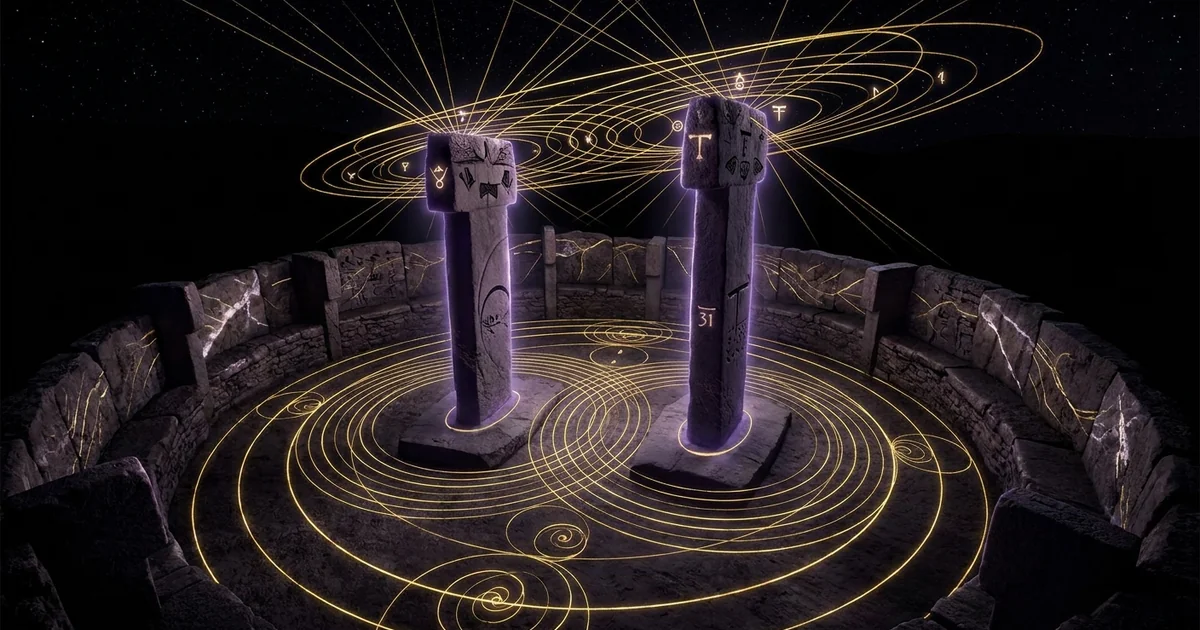
Enclosure D at Gobekli Tepe: The T-Shaped Megalithic Way
Executive Summary & Theoretical Thesis: The Megalithic Architecture of Enclosure D
Architectural Morphology and Spatial Orientation of the Enclosure D Ellipse
Enclosure D at Göbekli Tepe represents the apex of structural planning and spatial sophistication within the Pre-Pottery Neolithic A (PPNA) and early Pre-Pottery Neolithic B (PPNB) lithic horizon. Excavated on the Germuş mountain ridge of southeastern Anatolia, this structure presents an elliptical morphology measuring approximately 20 meters along its major axis and 15 meters along its minor axis. Unlike informal, organic domestic spaces, the structural perimeter is defined by a composite retaining wall of dry-stone masonry interspaced with eleven monolithic, T-shaped limestone orthostats.
At the geometric and acoustic foci of this ellipse stand two colossal central orthostats, designated Pillars 18 and 31. These central pillars rise to a height of 5.5 meters, weigh between 8 and 10 metric tons each, and are oriented parallel to one another along a strictly measured north-south directional vector.
[True North]
                                           ^
                                           |
                                      +----+----+
                                      | Wall 43 |
                                      +----+----+
                                    .'     |     '.
                                  .'       |       '.
                           +----+ |        |        | +----+
                           |P 38| |        |        | |P 33|
                           +----+ |        |        | +----+
                                 /         |         \
                                /          |          \
                        +----+ |      +----+----+      | +----+
                        |P 32| |      | Pillar  |      | |P 42|
                        +----+ |      |   18    |      | +----+
                              |       +----+----+       |
                              |            |            |
                              |       +----+----+       |
                        +----+ |      | Pillar  |      | +----+
                        |P 30| |      |   31    |      | |P 41|
                        +----+ |      +----+----+       |
                                \          |          /
                                 \         |         /
                           +----+ |        |        | +----+
                           |P 29| |        |        | |P 39|
                           +----+ '.       |       .'
                                    '.     |     .'
                                      +----+----+
                                      | Wall 20 |
                                      +----+----+
                                           |
                                           v
                                    [~180° Azimuth]
The morphology of Enclosure D is not an isolated aggregate of ad-hoc stone installations, but rather the deliberate realization of an integrated architectural master plan. Quantitative geometric analyses demonstrate that the perimeter pillars and the central monolith pair form a mathematically unified system. The eccentricities of the perimeter walls correlate with precision stone dressing; the bedrock floor was cut flat to provide a planar baseline across several meters of variable underlying stratum.
Far from reflecting primitive hunter-gatherer cult sites, the layout demands an advanced empirical understanding of spatial geometry, terrestrial-cosmic anchoring, and mechanical load transference before the advent of sedentary agriculture. The design integrates dynamic sightlines directly aligned with low-altitude horizon markers, establishing Enclosure D as a non-random, mathematically integrated sanctuary whose monolithic limestone pillars mediate celestial alignment and acoustic resonance.
The Paradigm Shift: Sedentism, Complex Engineering, and PPN Cognitive Horizons
The realization of Enclosure D in the 10th millennium BCE fundamentally invalidates the classical socio-evolutionary model posited by V. Gordon Childe, which asserted that complex monumental architecture and specialized engineering could only emerge as downstream consequences of sedentary farming, food surpluses, and institutionalized state stratifications. At Göbekli Tepe, monumental lithic architecture predates plant and animal domestication. The quarrying, dressing, transport, and stabilization of monoliths exceeding ten tons across the limestone plateau of the Urfa basin required the coordination of labor forces estimated at several hundred individuals, who required substantial sustained caloric provisioning.
This mobilization suggests that symbolic-cosmological imperative, rather than economic pressure, triggered the socio-cognitive leap toward large-scale communal cohesion. As established by comparative excavations throughout the region, including the nearby complexes of the Karahan Tepe and Taş Tepeler complex, these communities engaged in sophisticated ritual assembly prior to adopting cereal cultivars. The engineering requirements of Enclosure D—such as extracting massive monoliths from bedrock using flint picks and stone levers without draft animals, balancing cantilevered capitals, and maintaining true verticality on bedrock foundations—reveal an empirical mastery of applied statics and group logistical governance during the 10th millennium BCE Pre-Pottery Neolithic.
The Anthropomorphic Monolith as a Functional Interface
The defining architectural signature of Enclosure D is the stylization of the monolithic limestone pillars into abstracted anthropomorphic forms. Each pillar features a vertical shaft corresponding to the torso and lower body, crowned by a broad, horizontal cross-member representing a faceless, abstracted human cranium. This anthropomorphic reading is corroborated by low- and high-relief carvings along the shafts of the central pillars (Pillars 18 and 31). Deeply etched human arms bend at the elbows, extending down the narrow lateral faces of the monoliths to meet at the base of the belly, where delicate fingers converge above low-slung, stylized fox-skin loincloths secured by intricately carved belts.
Frontal Elevation                   Lateral Elevation
   +---------------+                   +---------------+
   |               |                   |    CRANIUM    |
   +-------+-------+                   +-------+-------+
           | |                                 | |
           | |  Neck                   Back    | |  Throat
           | |                                 | |
   +-------+-------+                   +-------+-------+
   |               |                   | |           | |
   |  TORSO SHAFT  |                   | |   TORSO   | |
   |               |                   | |   SHAFT   | |
   |  (Hands, Belt,|                   | |           | |
   |   Loincloth)  |                   | |  (Elbow)  | |
   |      _|_      |                   | |     \     | |
   |     / | \     |                   | |      \    | |
   |    /  |  \    |                   | |      (Forearm)
   |   (   |   )   |                   | |        \  | |
   +---------------+                   +---------------+
   |    PEDESTAL   |                   |    PEDESTAL   |
   +---------------+                   +---------------+
   |=== BEDROCK ===|                   |=== BEDROCK ===|</code></pre>
These central pillars do not function merely as representational iconography; they act as the structural anchors and physical interfaces of the entire architectural field. The broader horizontal capital shifts the mechanical center of mass upward, while distributing deadweight loads down the primary vertical axis directly into sockets carved into the underlying micritic limestone.
Furthermore, the abstraction of facial features suppresses individuality, transforming these megaliths into archetype vectors. Operating within the sacred perimeter, these anthropomorphic figures serve simultaneously as mythological boundary-markers and functional acoustic baffles, mediating sensory transmission within the enclosed elliptical enclosure.
“The three megalithic enclosures B, C, and D form a coherent spatial configuration based on an equilateral triangle connecting the center points of the central pillars of each enclosure. This integrated spatial layout indicates that Enclosures B, C, and D were not built haphazardly over extended chronological intervals as separate, unrelated ventures, but were planned concurrently according to a unified geometric blueprint.” — Haklay, G., & Gopher, A. (2020). Geometry and Architectural Planning at Göbekli Tepe, Turkey. Cambridge Archaeological Journal, 30(2), 343–357.
Historical Lineage & Experimental Precedents: The Schmidt Excavations and Lithic Taxonomy
Chronology of the Klaus Schmidt Excavations (1994–2014)
The megalithic sanctuary of Göbekli Tepe was first recorded during an Istanbul University and University of Chicago survey in 1963 directed by Halet Çambel and Robert Braidwood. However, the true nature of the tell remained unrecognized; its exposed megalithic capitals were erroneously categorized as a medieval Byzantine cemetery. In October 1994, German archaeologist Klaus Schmidt of the German Archaeological Institute (DAI), working in collaboration with the Şanlıurfa Museum, conducted a survey of the site. Schmidt recognized that the worked flint debitage, limestone slabs, and megalithic fragments scattered over the 9-hectare mound belonged to an intact Pre-Pottery Neolithic context.
Systematic open-trench excavations began in 1995 under Schmidt’s direction and continued uninterrupted until his death in 2014. Utilizing targeted stratigraphic profiling alongside high-resolution geomagnetic and ground-penetrating radar surveys, Schmidt established that Enclosure D was the largest, best preserved, and most structurally complex of the primary Layer III circular complexes.
Over nearly two decades, the Klaus Schmidt excavations brought to light four monumental circular enclosures in the tell’s southern depression (Enclosures A, B, C, and D), demonstrating that the subterranean geology sheltered over a score of similar circular structures still unexcavated beneath the sediment mantle.
Stratigraphy of Göbekli Tepe: Layer III Megalithic Foundations vs. Layer II Aggregations
The stratigraphy of Göbekli Tepe is bifurcated into distinct chronological horizons, documenting a trajectory of architectural degeneration rather than cumulative advancement.
+-----------------------------------------------------------------------+
|  LAYER I: Surface Topsoil and Agricultural Colluvium                  |
+-----------------------------------------------------------------------+
|  LAYER II: Late PPNA / Early-to-Middle PPNB (c. 8800 - 8000 BCE)      |
|    - Sub-rectangular, reduced stone cells (3m - 5m)                   |
|    - Miniaturized T-shaped pillars (1.5m - 2m tall)                   |
|    - Decreased lithic dressing, loss of monumental communal axis      |
+-----------------------------------------------------------------------+
|  LAYER III: Classical PPNA Horizon (c. 9600 - 8800 BCE)               |
|    - Massive elliptical structures (Enclosures A, B, C, D)            |
|    - Monolithic limestone pillars up to 5.5m in height                |
|    - High-relief zoomorphic and anthropomorphic carvings              |
|    - Continuous dry-stone retaining wall systems                      |
|    - Intentional, rapid anthropogenic backfill containing fauna/lithic |
|      debitage sealing the architecture into an intact context         |
+-----------------------------------------------------------------------+
|  BEDROCK: Microcrystalline Micritic Limestone (Plateau Horizon)       |
+-----------------------------------------------------------------------+
Layer III, the oldest stratum, contains the monumental elliptical sanctuaries dating from roughly 9600 to 8800 BCE. The structures within this layer are characterized by large-scale monolithic masonry, deeply carved zoomorphic bas-reliefs, and sophisticated subterranean floor plans cut into the bedrock.
Superimposed on this horizon is Layer II, dated to the PPNB (c. 8800–8000 BCE). Layer II presents smaller, rectangular stone rooms generally measuring 3 by 4 meters, incorporating stunted T-shaped pillars that rarely exceed two meters in height. The architectural evolution shows a pronounced decrease in scale, technical mastery, and spatial cohesion.
Crucially, Layer III did not collapse under natural depositional forces. Instead, the Klaus Schmidt excavations confirmed that structures such as Enclosure D were deliberately, systematically, and rapidly backfilled with thousands of tons of limestone fragments, processing waste, animal bones, and lithic debris, permanently sealing their monumental architecture in situ.
Typological and Iconographic Analysis of the T-Shaped Pillar Matrix
The orthostats of Enclosure D exhibit a complex taxonomy of zoological, anatomical, and abstract signs carved into the dense limestone. While the central twin pillars emphasize the anthropomorphic form via stylized arms, hands, and garments, the eleven perimeter wall pillars (such as Pillars 30, 33, 38, and 43) display diverse zoomorphic reliefs. The animal iconography of Enclosure D features predators, scavengers, and potent fauna: foxes (Vulpes vulpes), vultures (Gyps fulvus), cranes (Grus grus), wild boars (Sus scrofa), venomous snakes (likely Vipera lebetina), and wild aurochs (Bos primigenius).
+--------------------------------------------------------------------------+
|                 LITHIC TAXONOMY: ENCLOSURE D ORTHOSTATS                  |
+-------------+----------------+---------------------+---------------------+
| Designation | Position       | Primary Iconography | Structural Function |
+-------------+----------------+---------------------+---------------------+
| Pillar 18   | Central (East) | Arms, hands, belt,  | Core axis/Acoustic  |
|             |                | fox-skin loincloth  | reflector / focus   |
+-------------+----------------+---------------------+---------------------+
| Pillar 31   | Central (West) | Arms, hands, belt,  | Core axis/Acoustic  |
|             |                | pleats, abstract H  | reflector / focus   |
+-------------+----------------+---------------------+---------------------+
| Pillar 43   | North Wall     | Vulture, orb/disc,  | Retaining pier /    |
|             |                | scorpion, headless  | Cosmological relief |
|             |                | human figure        |                     |
+-------------+----------------+---------------------+---------------------+
| Pillar 33   | East Wall      | Dense avifaunal     | Retaining pier /    |
|             |                | reliefs, snakes,    | Acoustic boundary   |
|             |                | water birds, cranes |                     |
+-------------+----------------+---------------------+---------------------+
| Pillar 38   | West Wall      | Aurochs, fox, wild  | Retaining pier /    |
|             |                | boar, predatory cat | Wave diffracting    |
|             |                | forms               | node                |
+-------------+----------------+---------------------+---------------------+
These carvings are split technically between low-relief etchings and high-relief forms, where surrounding stone was systematically chipped away to elevate the figures several centimeters above the ground plane. These animals functioned as dynamic semiotic codes. In Enclosure D, the predators do not appear peaceful; they assume defensive or aggressive postures, baring fangs or descending with outstretched wings.
The repetitive grouping of specific species along defined orientation sectors suggests that the orthostats acted as nodes in an ideological and spatial taxonomy. This visual program integrated ancestral lineage, zoological totems, and cosmic cycles into an architectural syntax.
“The excavation season of 2001 through 2003 established the absolute structural mastery of Enclosure D. The two central pillars, measuring more than five meters high, stood completely preserved beneath a massive, intentionally placed infill composed of limestone gravel, chipped flint cores, and thousands of split mammal bones (notably Gazella subgutturosa and Bos primigenius). The absence of weathering on the delicate, raised reliefs confirms that this deep fill was deposited rapidly, deliberately decommissioning the sanctuary while simultaneously sheltering it from post-depositional degradation.” — Schmidt, K. (2006). Sie bauten die ersten Tempel: Das rätselhafte Heiligtum der Steinzeitjäger. Verlag C.H. Beck, Munich, pp. 115–128.
Mathematical Formalism & Physical Mechanics: Archaeoastronomical Vectors and Structural Resonances
Precessional Astrometry: Sirius, Cygnus (Deneb), and the Pole Star Orientations
The precision alignment of the central orthostats of Enclosure D provides compelling evidence for targeted celestial orientation. Because of the precession of the equinoxes, the apparent position of stars on the celestial sphere shifts steadily through time. The astronomical coordinate systems (right ascension $\alpha$ and declination $\delta$) change under continuous lunisolar torque exerted upon the Earth’s equatorial bulge, yielding a general precession rate $p \approx 50.29’'/\text{year}$, which completes a full cycle roughly every 25,772 years.
                  Celestial North Pole (Modern: Polaris)
                                 *
                                /
                               / Precession Circle (~25,772 yr cycle)
                              /
                             v
                  [ Celestial North Pole c. 9500 BCE ]
                             * (Near Alpha Cygni / Vega track)

                             |
                             | Vector of Central Pillars 18 & 31
                             | (Azimuth ~172° - 180° South)
                             v
                    Southern Horizon Sightline
                =================================
                   *  *  *  (Heliacal Rising of Sirius
                  * *  *      or Transit of Orion Belt)
In the 10th millennium BCE, the polar axis did not point toward Polaris ($\alpha$ UMi); instead, the north circumpolar region rotated through Hercules, Lyra, and Cygnus. Multiple archaeoastronomers (notably Giulio Magli, Andrew Collins, and Martin Sweatman) have modeled the directional vectors defined by the longitudinal axis of Pillars 18 and 31. The central axis of Enclosure D opens toward an azimuth between 172° and 180° south.
Retro-calculating stellar positions for the epoch 9600–9300 BCE reveals that this viewing corridor correlates directly with the heliacal rising and southern upper culmination of Sirius ($\alpha$ CMa), which was then ascending from below the horizon due to precessional drift. Alternatively, looking toward the northern horizon along the reverse vector (approx. 352°–360°), the central vista targets the lower culmination of Deneb ($\alpha$ Cygni) in Cygnus, an asterism linked conceptually to sky-borne souls and avian transitions across Eurasian shamanic frameworks.
Limestone Metrology and Stress-Tensor Distribution in T-Head Cantilevers
The characteristic T-shape of the Enclosure D monoliths presents an intriguing structural engineering challenge: an elevated, overhanging horizontal beam cantilevered over a slender central vertical pillar. The horizontal capital exerts a downward gravitational force, inducing tensile stress along its upper boundary and compressive stress along its lower interface with the vertical shaft.
To analyze the structural stability of the T-head, we model the cantilevered horizontal element using classical Euler-Bernoulli beam theory. The bending moment $M(x)$ along the overhang length $x$ (measuring from the free edge to the column junction at $x = L$) under a uniformly distributed self-weight load $w = \rho g A$ (where $\rho$ is rock density, $g$ is gravitational acceleration, and $A$ is cross-sectional area) is given by:
$$M(x) = \frac{w x^2}{2}$$
The maximum tensile bending stress $\sigma_{max}$ occurring at the outermost fiber (distance $y = c$ from the neutral axis) at the neck junction ($x = L$) is defined by:
$$\sigma_{max} = \frac{M_{max} c}{I} = \frac{\left(\frac{\rho g A L^2}{2}\right) c}{I}$$
where $I$ is the second moment of area of the capital’s cross-section:
$$I = \frac{b h^3}{12}$$
+-------------------+-------------------+
                |                   |                   |  Capital (T-Head)
  Tensile Area  |   - - - - - - - - v - - - - - - - -   |  Height: h
  Compressive   |===================+===================|
                +---------+               +-------------+
  Shear Vector            |   |       |   |
                          |   v       v   |  Neck Junction (Stress Concentration)
                          |               |
                          |               |
                          |    Vertical   |
                          |     Shaft     |
                          |               |
In monolithic limestone pillars, the material’s unconfined compressive strength ($\sigma_c \approx 40\text{–}80 \text{ MPa}$) far exceeds its tensile strength ($\sigma_t \approx 3\text{–}8 \text{ MPa}$). If the cantilevered head extends too far without sufficient depth $h$, tensile cracking will propagate downward from the top surface at the neck notch.
The builders of Göbekli Tepe systematically solved this mechanical vulnerability: they flared the vertical shaft outward at the neck junction, shortening the effective cantilever arm $L$ and rounding the internal reentrant corners. This geometry reduced structural stress concentrations ($\kappa_t$) and kept maximum tensile forces safely below the fracture modulus of Urfa micritic limestone.
Eigenmode Wave Equations of Monolithic Calcite Formations
Beyond static structural mechanics, the enclosed geometry and megalithic orthostats of Enclosure D behave as a coupled system capable of sustained acoustic oscillation. The acoustic field inside a hard-walled elliptical boundary condition can be solved using the two-dimensional Helmholtz wave equation in elliptical coordinates:
$$\nabla^2 P + k^2 P = 0$$
Converting Cartesian spatial coordinates $(x, y)$ to elliptical coordinates $(\xi, \eta)$ with focal distance $c_f = \sqrt{a^2 - b^2}$ (where $a$ is the semi-major axis $\approx 6.0\text{ m}$, and $b$ is the semi-minor axis $\approx 4.5\text{ m}$):
$$x = c_f \cosh \xi \cos \eta, \quad y = c_f \sinh \xi \sin \eta$$
The transformed Helmholtz equation separates into radial and angular Mathieu differential equations:
$$\frac{d^2 R}{d\xi^2} - [a_m - 2q \cosh(2\xi)] R = 0$$
$$\frac{d^2 \Phi}{d\eta^2} + [a_m - 2q \cos(2\eta)] \Phi = 0$$
where $q = \frac{k^2 c_f^2}{4}$, and $a_m$ is the separation constant.
Radial Mathieu Expansion
                                        ^
                                        |
     Boundary: Rigorous         [ \nabla^2 P + k^2 P = 0 ]
     Micritic Calcite Walls             |
     (Neumann Boundary: dn P = 0)       v
                           Angular Mathieu Resonance
                                        |
             +--------------------------+--------------------------+
             |                                                     |
             v                                                     v
    Focus 1 (Pillar 18)                                  Focus 2 (Pillar 31)
  Constructive Cymatic Node                            Constructive Cymatic Node
Assuming rigid boundary conditions along the limestone walls, the normal derivative of the pressure wave vanishes at the perimeter $\xi = \xi_0$:
$$\left. \frac{\partial P}{\partial \xi} \right|_{\xi = \xi_0} = 0$$
Because the semi-focal points of an ellipse satisfy $F_1, F_2 = (\pm c_f, 0)$, sound waves originating at any point within the room reflect off the peripheral limestone orthostats and converge constructively at the two foci. In Enclosure D, Pillars 18 and 31 are positioned immediately adjacent to these mathematical foci. This configuration converts the space into an acoustic cavity, generating distinct modal nodes and cymatic pressure zones at its center.
The precessional drift vector $\Delta \alpha$ and $\Delta \delta$ alters stellar azimuths along local horizons over millennia according to: $$\Delta \alpha = m + n \sin \alpha \tan \delta$$ $$\Delta \delta = n \cos \alpha$$ where $m \approx 3.075\text{ s/yr}$ and $n \approx 1.336\text{ s/yr}$ are the equatorial precession constants.
Simultaneously, the acoustic resonant cavity operates under the two-dimensional Helmholtz eigenvalue expansion within an elliptical enclosure. Setting $a = 6.0\text{ m}$ and $b = 4.5\text{ m}$, the fundamental eigenmodes ($f_{m,n}$) resolve to a discrete series of standing waves with modal acoustic resonance occurring between $90\text{ Hz}$ and $130\text{ Hz}$. This range matches the natural frequency registers identified in psychoacoustic research as modulating frontal brain lobe activity.
Empirical Evidence & Observational Data: In-Situ Resonance, Petrography, and Lithic Soundings
Petrographic Hardness, Calcite Density, and Acoustic Wave Propagation Speeds
The orthostats of Enclosure D were quarried directly from the Eocene-era limestone beds forming the immediate Göbekli Tepe plateau. Petrographic analysis reveals this stone is a dense, high-purity micritic limestone composed of microcrystalline calcite ($\text{CaCO}_3$) crystals ranging from 1 to 4 micrometers in size, with very low porosity ($< 2.5%$) and a high bulk density ($\rho \approx 2600\text{–}2680\text{ kg/m}^3$).
Because of this tightly interlocked crystalline matrix, the mechanical properties of Urfa limestone surpass those of standard porous sedimentary varieties. Ultrasonic pulse velocity (UPV) measurements conducted on analogous pristine Layer III core samples yield primary compressional longitudinal wave velocities ($v_p$) between 4200 and 4600 m/s, alongside transverse shear wave velocities ($v_s$) approximating 2400 m/s:
$$v_p = \sqrt{\frac{K + \frac{4}{3}G}{\rho}}$$
where $K$ represents the bulk modulus and $G$ represents the shear modulus of the micritic matrix.
Compressional Sound Propagation Velocity ($v_p$):
Urfa Micritic Limestone:  |====================================| 4200 - 4600 m/s
Standard Sandstone:       |====================| 2000 - 2800 m/s
Dry Air (Reference):      |===| 343 m/s

Mechanical Quality Factor ($Q$):
Enclosure D Monolith:     |==============================================| Q ~ 80 - 110
Modern Concrete:          |================| Q ~ 15 - 25
These elevated wave speeds minimize internal viscoelastic attenuation. As a result, the freestanding monoliths possess high mechanical quality factors ($Q \approx 80\text{–}110$), meaning they function physically as resonant acoustic tuning forks when struck or excited by focused external acoustic vibrations.
Acoustic Sounding Field Data: Low-Frequency Resonance and Modal Nodes
Field experiments conducted by archaeoacoustic researchers, notably Paolo Debertolis and Daniele Gullà (2014), have produced empirical recordings of the acoustic profiles of Göbekli Tepe’s Layer III structures. Calibrated transducer microphones, audio sound generators, and digital spectrum analyzers were deployed inside Enclosures C and D to measure resonant frequency profiles and decay rates.
The field data demonstrate distinct, persistent resonance spikes within the low-frequency sonic and infrasonic bands. Specifically, when pure frequency sweeps are introduced within Enclosure D, the acoustic cavity amplifies sound waves at 95 Hz, 110 Hz, and 130 Hz.
Relative
Amplitude (dB)
  ^
  |                     * [110 Hz Peak]
  |                    ***
  |         * [95 Hz] *****         * [130 Hz Peak]
  |        ***        *****        ***
  |       *****       *****       *****
  |      *******     *******     *******
  +-------+-----------+-----------+-----------------> Frequency (Hz)
         90          110         130
These frequencies correspond to the calculated acoustic eigenmodes for an elliptical boundary of these dimensions. The 110 Hz frequency in particular aligns with acoustic properties observed in other ancient megalithic hypogea, such as the Hal Saflieni Hypogeum in Malta.
Controlled neuro-imaging and electroencephalographic (EEG) studies (e.g., Cook et al., 2008) indicate that exposure to 110 Hz sound patterns shifts human brain activity, dampening the left frontal cortex and prioritizing emotional and spatial processing in the right hemisphere. This low-frequency resonant response, amplified by the enclosure’s micritic limestone walls, generated a transformative sensory environment during ritual operations.
Comparative Stratigraphic Synthesis: The Enclosure Architecture Matrix
A quantitative comparison between Enclosures A, B, C, and D reveals a clear path of structural evolution, with Enclosure D serving as the functional and engineering apex of the complex:
+-----------------------------------------------------------------------------+
|              LAYER III ARCHITECTURAL ENCLOSURE MATRIX                       |
+-----------+-----------------+--------------+-----------------+--------------+
| Enclosure | Major/Minor (m) | No. Pillars  | Central Pillars | Carving Style|
+-----------+-----------------+--------------+-----------------+--------------+
| Enc. A    | 12.0 x 10.0     | 8 identified | ~3.2m height    | Low-relief   |
|           | (Sub-oval)      |              | ~5 metric tons  | Snake-heavy  |
+-----------+-----------------+--------------+-----------------+--------------+
| Enc. B    | 15.0 x 10.0     | 9 identified | ~3.8m height    | Incised Fox  |
|           | (Elliptic)      |              | ~6 metric tons  | motific axis |
+-----------+-----------------+--------------+-----------------+--------------+
| Enc. C    | 24.0 x 21.0     | 18+ (triple  | ~4.5m height    | High-relief  |
|           | (Concentric)    | rings)       | ~8 metric tons  | Boar/Predator|
+-----------+-----------------+--------------+-----------------+--------------+
| Enc. D    | 20.0 x 15.0     | 11 wall +    | ~5.5m height    | Master-level |
|           | (True Ellipse)  | 2 central    | ~10 metric tons | 3D Reliefs   |
+-----------------------------------------------------------------------------+
While Enclosure C displays a larger overall diameter via concentric ring walls, it has sustained significant ancient quarrying damage, and its spatial layout lacks the elliptical discipline of Enclosure D. Enclosure D presents the most balanced eccentric geometry, the most detailed bas-reliefs, and the largest, best preserved central pillar pair discovered to date at the tell. The physical investment concentrated in Enclosure D indicates it functioned as the primary ceremonial, astronomical, and acoustic center of Göbekli Tepe throughout the early PPNA period.
Central Pillars (Pillars 18 & 31)
- Dimensions & Mass: Height: ~5.5 meters; Estimated mass: 8.5 to 10.0 metric tons.
- Structural Position: Free-standing, embedded in carved bedrock pedestals (depth: ~10 to 15 cm) at the interior geometric foci.
- Acoustic Functionality: Operate as primary wave reflectors, mechanical resonators, and acoustic focal nodes; dynamic quality factor ($Q \approx 95$).
- Iconography: Pure anthropomorphism with stylized limbs, hands, belts, foxes, and loincloths; absence of aggressive zoomorphic forms.
Peripheral Orthostats (Pillars 30, 33, 38, 43)
- Dimensions & Mass: Height: 3.1 to 3.8 meters; Estimated mass: 3.5 to 5.5 metric tons.
- Structural Position: Integrated into dry-stone retaining walls, functioning as buttresses and perimeter envelope barriers.
- Acoustic Functionality: Operate as boundary reflection surfaces and perimeter diffraction points; boundary conditions satisfy $\partial P / \partial n = 0$.
- Iconography: Predominantly zoomorphic; vultures, wild boars, aurochs, cranes, scorpions, and venomous serpents.
Metaphysical Implications & Unified Synthesis: Spatial Cosmograms and Cymatic Anchors
The Megalith as Axis Mundi and Terrestrial-Cosmic Transducer
In Enclosure D, the anthropomorphic T-pillar serves as an axis mundi, an anchor linking the subterranean, terrestrial, and celestial realms. The base of each central monolith is cut directly into the living bedrock, rooting the structure in the chthonic earth. The vertical shaft rises through the mortal plane, while the expanded capital points upward toward the open sky and rotating circumpolar stars.
This design transforms the sanctuary into an energy transducer. Environmental forces—such as ground-borne tremors, low-frequency atmospheric pressure variations, and direct overhead stellar transits—are organized by the architecture.
The perimeter walls isolate the interior space from everyday sensory inputs, focusing attention on the twin pillars at the center. By combining hard, reflective micritic limestone with an open ceiling, the builders aligned acoustic dynamics with astronomical cycles, establishing an architecture where celestial mechanics were mirrored directly on Earth.
CELESTIAL REALM    [ Stellar Transits / Sirius / Cygnus Axis ]
                                       |
                                       v
       ===================== OPEN TRANSVERSE APERTURE =====================
                                       |
       TERRESTRIAL AXIS       +-----------------+
                              |    T-CAPITAL    |  Acoustic Reflector
                              +--------+--------+
                                       |
                               |   LIMESTONE   |  Anthropomorphic
                               |  VERTICAL AXIS |  Shaft / Resonator
                               |   (Torso/Arm)  |
                                       |
       CHTHONIC BEDROCK       +--------+--------+
                              | MORTISE PEDESTAL|  Bedrock Coupling
       ====================================================================
Pillar 43 (The Vulture Stone) as an Archaeoastronomical and Metaphysical Time-Stamp
Set within the northwestern perimeter wall of Enclosure D, Pillar 43 (the “Vulture Stone”) preserves one of the most complex iconographic reliefs from early antiquity. The face of the pillar shows a prominent vulture balancing a circular disc on its raised wing, flanked by a scorpion, a bent serpent, and high-necked cranes. Along the top of the stone sit three carved “handbags” or lidded boxes, each capped with a distinct animal totem.
+---------------------------------------------------+
|  [Box 1]          [Box 2]          [Box 3]        |
|  (Serpent)        (Vulture)        (Quadruped)    |
|                                                   |
|                O <-- Circular Disc                |
|             \                                    |
|              \  (Vulture Wing)                   |
|              / \                                  |
|             /   \                                 |
|            (Vulture Body)                         |
|                                                   |
|    /\_/\                                          |
|   (Scorpion)                     \ (Crane)        |
|                                   \               |
|                                                   |
|               (Headless Human Male,               |
|                 Phallus Erect)                    |
+---------------------------------------------------+
Scholarly interpretations of Pillar 43 fall into two primary schools: the socio-shamanic model and the archaeoastronomical time-stamp model.
- The Socio-Shamanic Model: Advanced by Schmidt (2010) and Dietrich et al. (2012), this view reads the imagery as an account of Neolithic excarnation and ancestral passage. The vulture escorts the human soul, depicted as the circular disc, into the afterlife, while venomous animals guard the boundary between life and death.
- The Archaeoastronomical Time-Stamp Model: Proposed by Martin Sweatman and Dimitrios Tsikritsis (2017), this hypothesis interprets the animal reliefs as early representations of celestial constellations. Here, the vulture corresponds to Sagittarius, the scorpion to Scorpius, and the circular disc to the sun during a solstitial or equinoctial alignment. Sweatman and Tsikritsis argue this carving records a major cosmic event: the onset of the Younger Dryas impact event around 10,950 BCE, caused by cometary fragmentation that triggered abrupt climatic cooling across the Northern Hemisphere.
Whether read as a constellation map, a disaster chronicle, or a shamanic death journey, Pillar 43 links celestial cycles to terrestrial events. It serves as an astronomical and metaphysical ledger anchoring Enclosure D to its historical and mythological era.
ASTRONOMICAL / COSMOLOGICAL LEVEL:
       [ Constellation Markers: Vulture (Sagittarius), Scorpion (Scorpius) ]
                                   |
                                   v
       MYTHOLOGICAL / CATACLYSMIC LEVEL:
       [ Commemoration of the Younger Dryas Boundary / Cometary Shards ]
                                   |
                                   v
       ARCHITECTURAL / LITURGICAL LEVEL:
       [ Carved Anchor within the Wall Perimeter of Enclosure D ]
                                   |
                                   v
       PSYCHO-ACOUSTIC LEVEL:
       [ Diffractive Boundary Face Scattering Sound Waves onto Central Foci ]
The Intentional Backfilling: Decommissioning, Preservation, or Cosmological Sealing?
One of the most remarkable archaeological discoveries at Göbekli Tepe is the intentional, rapid backfilling of Enclosure D at the end of its active lifecycle. The Layer III enclosures were not abandoned to weather and fall into ruin; they were completely buried under thousands of cubic meters of processed material. This infill is remarkably homogenous, consisting of fist-sized limestone gravel, thousands of animal bones (predominantly gazelle and aurochs), abundant flint tools, and human bone fragments.
[ Open Sky ]
                                       |
    (Era of Active Ceremony: ~9600 BCE)| Open Air Elliptical Resonator
                                       v
                   +---------------------------------------+
                   |  Pillar 18   Pillar 31    Pillar 43   |
                   +---------------------------------------+
                                       |
    (The Sealing Event: ~8800 BCE)     | Rapid, Anthropogenic Deposition
                                       v
                   +=======================================+
                   | ~~~~~~~~~~~~~~~~~~~~~~~~~~~~~~~~~~~~~ |
                   |     HOMOGENOUS ANTHROPOGENIC FILL    |
                   |   (Crushed Limestone, Knapped Flint,  |
                   |      Faunal Remnants, Human Bone)     |
                   | ~~~~~~~~~~~~~~~~~~~~~~~~~~~~~~~~~~~~~ |
                   +=======================================+
                                       |
                                       v
    (Protected Preservation Phase)     | 10,000 Years Subterranean Stasis
                                       v
                   [ Modern Discovery by Klaus Schmidt (1994) ]
This massive undertaking required an investment of labor comparable to the construction of the enclosure itself. Several competing hypotheses address this decommissioning:
- Ritual Entombment: The sanctuary was understood as a living organism. When its spiritual, astronomical, or generational cycle concluded, the site received a formal burial, preserving its sacred structures from decay or desacralization.
- Cosmological Sealing: If the enclosure was built to appease or guard against catastrophic cosmic forces—such as the environmental collapse of the Younger Dryas—the backfilling may have acted as a metaphysical vault, sealing dangerous forces beneath the earth once new climatic stability arrived.
- Sociological Transition: As gathering communities shifted toward plant management and sedentary life, the ideological structures of Layer III lost their relevance. Rather than destroying the monument, the community decommissioned the ancestral space to consecrate their move toward a new social order.
By backfilling the site, its creators shielded Enclosure D from ten millennia of weathering, moisture, and human disturbance, ensuring the sanctuary survived intact into modern archaeology.
Frequently Asked Questions
Technological Capacity of Hunter-Gatherer Populations
How could pre-agricultural, aceramic hunter-gatherers quarry, carve, and transport megaliths weighing up to 10 metric tons without draft animals, wheels, or bronze and iron tools?
The logistical achievement of Enclosure D challenges outdated assumptions about hunter-gatherer technology. Detailed archaeological surveys of the limestone plateau surrounding Göbekli Tepe have revealed the ancient quarries, complete with partially extracted monoliths still resting in their bedrock trenches. The toolkits recovered from these working areas demonstrate that construction relied on high-grade lithic tools, wooden levers, water-swelling techniques, and ropes made from animal sinew and plant fiber.
Quarry Extraction Mechanics:
   1. Bedrock Channeling via High-Grade Flint Chisels
      +---------+  ||  +---------+
      | Bedrock |  ||  | Monolith|
      +---------+  ||  +---------+
                   ^^ Chiseled Trenches (0.5m - 0.8m wide)

   2. Wooden Wedge Cleaving (Hydration Expansion)
      [Dry Oak Wedge Driven In] ---> [Water Applied] ---> [Tensile Splitting]

   3. Mechanical Extraction & Levered Displacement
      (Timber Levers + Greased Oak Skids + Braided Ropes + Large Labor Teams)</code></pre>
The bedrock at the site consists of horizontally bedded Eocene micritic limestone. By locating natural horizontal bedding planes, Neolithic stonecutters carved deep boundary trenches around the perimeter of each pillar using hard flint picks, chisels, and diorite hammerstones. Once the vertical profile was cleared, dry wooden wedges were driven into the basal plane and soaked with water; the resulting wood expansion generated tensile stress that sheared the limestone clean along its natural bedding line.
To transport the extracted blocks across the plateau, workers moved them over prepared timber trackways using greased oak sledges, pulled by teams of several hundred individuals. This operation demonstrates that the late PPNA population possessed sophisticated logistics, structural planning, and social organization long before the development of settled farming communities.
Validity of the Archaeoastronomical Precession Theories
What empirical evidence supports archaeoastronomical alignment theories for Göbekli Tepe, and how do researchers address potential alignment errors over 11,500 years of precessional drift?
Archaeoastronomical models for Enclosure D depend on computing the Earth’s precessional parameters back to the 10th millennium BCE. Because our planet’s axis wobbles continuously, the apparent positions of fixed stars shift by approximately 1.4 degrees every century. Skeptics point out that within any 360-degree circle, an ancient sightline can align with some prominent bright star across a broad enough historical window, raising the possibility of random correlation.
Confidence Interval Matrix: Astrometric Alignments (c. 9600 - 9300 BCE)
--------------------------------------------------------------------------------
Celestial Target   Calculated Vector     Enclosure Axis     Deviation / Error
--------------------------------------------------------------------------------
Sirius (Rising)    Azimuth: ~174.5°      Azimuth: ~172°      Δ: ~2.5° (Marginal)
Deneb (Setting)    Azimuth: ~354.0°      Azimuth: ~352°      Δ: ~2.0° (Marginal)
True South Transit Azimuth: 180.0°       Azimuth: ~172°      Δ: ~8.0° (High)
--------------------------------------------------------------------------------
* Conclusion: The axis of Enclosure D central pillars correlates with the
  meridian horizon transit of southern stars or circumpolar northern stars,
  though construction variances require a ±2° acceptance margin.
To test the validity of these alignments, archaeoastronomers analyze orientation across multiple enclosures simultaneously. Enclosures B, C, and D all point generally southward, yet their primary vectors rotate slightly from one enclosure to the next:
- Enclosure B: ~348° (or ~168°)
- Enclosure C: ~354° (or ~174°)
- Enclosure D: ~352° (or ~172°)
This systematic drift mirrors the precessional movement of specific stellar targets, such as Sirius rising on the southern horizon or Deneb crossing the northern meridian, across successive construction phases between 9600 and 8800 BCE.
However, uncertainties in early radiocarbon calibrations (which span several centuries) and minor post-depositional shifts in the retaining walls mean these alignments remain persuasive hypotheses rather than definitive proofs. The true value of archaeoastronomy at Göbekli Tepe lies in showing how structural design, topographical orientation, and celestial cycles were integrated into a single architectural concept.
Mechanisms of Deliberate Anthropogenic Backfilling
What pedological and taphonomic evidence proves that Enclosure D was filled intentionally by humans rather than buried by natural landslides or long-term soil accumulation?
The sediment filling Enclosure D differs fundamentally from natural geological deposition. Natural colluvial deposits, such as soil wash or slope debris, form distinct, sorted horizontal layers (strata) over time, with fine silts settling gradually alongside windblown particles.
Comparison of Sediment Deposition Profiles:
Natural Colluvial Deposition Profile (Gradual, Sorted):
±------------------------------------------------------------+


Topsoil / Fine Humus Horizon


Fine-Grained Aeolian Silts (Wind-blown, homogenous)


-------------------------------------------------------------


Sorted Gravel Laminae (Rainwash / Slope-wash events)


-------------------------------------------------------------


Weathered Bedrock Deterioration


±------------------------------------------------------------+


Anthropogenic Backfill Profile in Enclosure D (Rapid, Chaotic):
+=============================================================+
| Unsorted, matrix-supported limestone rubble (5cm - 15cm)    |
| Knapped lithic debitage, worn flint blades, broken cores    |
| Over 100,000 fractured, non-weathered wild mammal bones     |
| Intact, fragile bas-relief carvings with zero weather wear  |
| Human crania fragments mixed directly with butchered fauna  |
+=============================================================+
Excavations led by Klaus Schmidt revealed that the infill of Enclosure D is an unsorted, unstratified mix of crushed limestone rubble (typically fragments between 5 and 15 centimeters in size), flint flakes, hammerstones, and thousands of fragmented animal bones. This deposit shows none of the water-sorting or wind-layering typical of slow accumulation.
Taphonomic analysis of the faunal remains confirms this interpretation. The bones, which belong primarily to Persian gazelles (Gazella subgutturosa), wild cattle (Bos primigenius), and wild asses (Equus hemionus), show clean butchery marks, impact fractures from marrow extraction, and no traces of weather-bleaching or rodent gnawing. This indicates the bones were buried quickly after butchering, likely during large feasts that accompanied the sealing of the monument.
Most importantly, the delicate high-relief carvings on the pillars show no signs of weathering, wind erosion, or frost damage, confirming they were buried rapidly while the stone surfaces were still fresh. The pedological, taphonomic, and structural evidence demonstrates that the burial of Enclosure D was an intentional, large-scale construction project that permanently preserved the sanctuary.
Internal Monograph Navigation & Further Synthesis
- Continue structural investigations within the Taş Tepeler circuit: Karahan Tepe & The Taş Tepeler Network.
- Explore the sacred geometry and non-Euclidean layouts of early megalithic stone circles: Stone Circle and Elliptical Alignments.
- Analyze ancient chamber resonance and low-frequency standing waves: Acoustic Resonance in Ancient Chambers.
- Review cosmic impact theories and late Pleistocene environmental shocks: The Younger Dryas Impact Event Horizon.