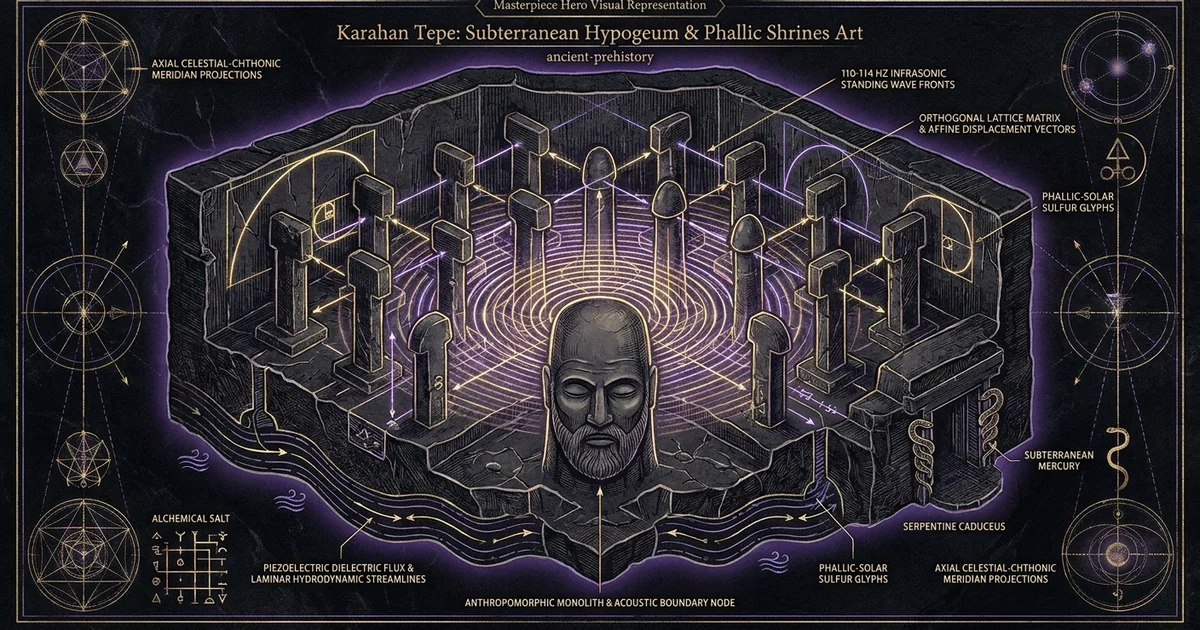
Karahan Tepe: Subterranean Hypogeum & Phallic Shrines Art
Executive Summary & Theoretical Thesis: The Subterranean Paradigm at Taş Tepeler
Morphological Inversion: From T-Shaped Epigeal Enclosures to Chthonic Hypogea
The archaeological landscape of Upper Mesopotamia underwent a profound spatial reorientation during the transition between the Pre-Pottery Neolithic A (PPNA) and Pre-Pottery Neolithic B (PPNB) horizons. While the classical monumentalism of Göbekli Tepe is defined by sub-aerial, circular enclosures circumscribed by dry-stone perimeter walls and free-standing, aniconic T-shaped pillars, excavations at Karahan Tepe reveal an abrupt architectural divergence. Here, monumental construction ceases to be an act of epigeal elevation and becomes instead an aggressive subterranean excavation. Within the broader network mapped under the /ancient-prehistory/tas-tepeler-neolithic-network, Karahan Tepe establishes a paradigm wherein spatial sanctification occurs through the subtractive removal of geological strata rather than the additive accumulation of dressed masonry.
This morphological inversion is most pronounced in Structure AB, an oblong, subterranean hypogeum carved directly into the living limestone bedrock of the Tektek Mountains. By sinking the sanctum beneath the contemporary surface layer, the architects established a definitive chthonic-threshold that separated ritualized space from the mundane surrounding plateau. This architectural strategy transformed the structural role of the bedrock from a passive foundation into an active, enclosing envelope. The living rock was not merely a medium upon which architecture was staged; it served as the ceiling, walls, and floor simultaneously, creating an unyielding lithic matrix that permanently dictated acoustic behavior, atmospheric insulation, and spatial syntax.
The deliberate containment of this subterranean hypogeum fundamentally reconfigures our understanding of early Neolithic ideological frameworks. Whereas the sub-aerial enclosures at Göbekli Tepe opened vertically to the celestial sphere, Karahan Tepe’s subterranean installations enforced a total interiority. Access was strictly mediated through narrow, contrived openings, compelling the human body into direct, prolonged tactile contact with the cold, resonant limestone substrate. This shift signifies a theoretical evolution: from cosmic observation platforms to womb-like, subterranean chambers engineered for containment, sensory restriction, and somatic transformation.
Karul, N. (2021). ‘Buried Buildings at Karahan Tepe.’ Türk Arkeoloji ve Etnografya Dergisi, 82, 21–34. Documenting the empirical discovery, stratigraphy, and systematic deliberate backfilling of the hypogeum complex (Structure AB), verifying that the carved bedrock features—including the human head pillar and surrounding phalli—belong to a single, uncompromised depositional event dated to the late 10th to early 9th millennium cal BCE.
The Monolithic Interface: The Bedrock-Integrated Human Head
At the western perimeter of Structure AB, protruding directly from the smoothed vertical bedrock wall, rests an anomalous, hyper-stylized human head. Carved in situ from the native calcarenite limestone, the head measures approximately 1.5 meters in height and leans forward into the chamber at an aggressive oblique angle. Unlike the free-standing statuary discovered at Nevalı Çori or the aniconic anthropomorphic stelae characteristic of early Göbekli Tepe, this colossal portrait is structurally non-severable from the mountain itself. The neck seamlessly transitions into the living rock face, establishing an ontological synthesis between human physiology and geological mass.
The facial morphology displays an austere, severe economy of line: a prominent, angular nose bridge, sunken orbital sockets devoid of incised pupils, and tightly compressed lips set in a horizontal grimace. Beneath the chin, the lower jaw merges into an undulating, serpentine relief that winds along the western wall, visually and structurally linking the anthropomorphic head to the floor of the hypogeum. The directional gaze of this karahan tepe tas tepeler subterranean hypogeum human head pillar is not directed upward toward the chamber’s ceiling or any theoretical celestial opening, but downward across the chamber’s interior space, maintaining a fixed ocular vector over the floor.
This placement designates the monolithic head as the primary focal transducing node of the entire architectural assembly. By positioning the head as an immovable projection of the perimeter wall, the builders ensured that any acoustic, optical, or somatic event occurring within the hypogeum transpired directly beneath its gaze. The head functions not as a decorative ornament or commemorative effigy, but as the governing intelligence of the architectural volume—the sentient articulation of the living bedrock within which the initiates were confined.
Bioacoustic and Hydraulic Hypotheses of Structure AB
The material execution of Structure AB strongly suggests that its programmatic function was governed by acoustic and hydraulic criteria rather than utilitarian habitation. Measuring roughly 8.5 by 6.0 meters, with a subterranean depth exceeding 2.0 meters, the chamber acts as a semi-enclosed acoustic cavity. Because limestone possesses an exceptionally low acoustic absorption coefficient ($\alpha \approx 0.01 - 0.03$ in the low-frequency range), the interior surfaces operate as near-perfect acoustic reflectors. Sonic energy introduced into the space is not absorbed but redirected, generating complex standing-waves and cymatic-modal-nodes that interact directly with the human vestibular and neurological systems.
Simultaneously, the presence of distinct micro-channels, stepped thresholds, and smoothed floor inclinations indicates an engineered engagement with liquid mechanics. Rainwater, run-off, or introduced ceremonial fluids were directed along carved bedrock gutters that traverse the threshold between the upper plateau and the floor of the hypogeum. These hydraulic conduits run proximate to the phallic monoliths, suggesting that controlled liquid inundation was employed to alter the chamber’s physical properties.
When filled to even a shallow depth of a few centimeters, a subterranean limestone pool drastically alters the chamber’s acoustic impedance. The water surface functions as an acoustic mirror, substantially increasing low-frequency reverberation times and transforming the space into an operational helmholtz-resonance chamber. In combination with the complete, deliberate backfilling that sealed the hypogeum at its decommissioning—a homogeneous pack of sterile limestone chips and crushed sediment documented during the necmettin karul excavations—these physical characteristics demonstrate that Structure AB was engineered as an instrument for non-linear sensory modulation.
Historical Lineage & Archaeological Precedents: The Taş Tepeler Complex
Stratigraphic Horizon: Transition from PPNA to Early PPNB
The chronological position of Karahan Tepe within the greater Pre-Pottery Neolithic matrix of Upper Mesopotamia has been definitively anchored through accelerator mass spectrometry (AMS) radiocarbon assays obtained from animal collagen, short-lived macrobotanical remains, and micro-charcoal locked within the deliberate infill layers. These dates establish that the primary construction and utilization phases of the central ceremonial sector, including Structure AB, fall comfortably between 9400 and 8200 cal BCE. This positioning places the site directly across the terminal PPNA and the emergent Early PPNB horizons, a transformative phase characterized by the sedentarization of complex hunter-gatherer communities prior to the domestication of founder crops.
CHRONOLOGICAL HORIZON (Upper Mesopotamia)
  BCE:  9500        9000        8500        8000        7500        7000
        |-----------|-----------|-----------|-----------|-----------|
  PPNA: [=== Göbekli Tepe Layer III ===]
  PPNB:             [=== Karahan Tepe Structure AB ===]
                    [=== Göbekli Tepe Layer II ===]
                    [=== Nevalı Çori / Çayönü Early Phase ===]
This chronological horizon places Karahan Tepe partly contemporary with, and partly subsequent to, Göbekli Tepe Layer III (the monumental round enclosures C and D). However, Karahan Tepe exhibits architectural features that anticipate the spatial rationalization of Göbekli Tepe Layer II (the smaller, sub-rectangular enclosures). Crucially, the stratigraphy of Karahan Tepe demonstrates that its subterranean complexes were not constructed as crude precursors to epigeal architecture, but as a hyper-specialized, parallel evolutionary branch of monumental stonework. The stratigraphy reveals a sequence of continuous occupation, remodeling, and ultimately, an elaborate, highly choreographed ritual termination phase wherein the entire hypogeum was buried beneath hundreds of tons of sterile lithic debitage.
The precise phasing of the necmettin karul excavations indicates that the carving of Structure AB occurred during the floruit of the site’s monumental period. It was not a subterranean basement to an above-ground dwelling, but a discrete, free-standing hypogeal installation surrounded by contemporary circular and sub-rectangular structures, such as the grand Structure AA. The stratigraphic isolation of Structure AB confirms that its subterranean nature was an explicit, primary architectural requirement from its initial inception, reflecting ideological developments unique to the late 10th millennium BCE.
Ministry of Culture and Tourism of the Republic of Turkey, & Istanbul University Department of Prehistory. Excavation Reports and Stratigraphic Matrices of the Tektek Mountains Pre-Pottery Neolithic Survey: Karahan Tepe Sector AB. Directed by Prof. Dr. Necmettin Karul. The dataset provides micro-stratigraphic analysis confirming the intentional, non-erosional, single-event anthropogenic burial of Structure AB utilizing crushed autochthonous limestone matrix.
Comparative Morphology: Urfa Region Enclosures vs. Karahan Tepe Hypogea
Morphological comparison across the sites of the Taş Tepeler project—including Göbekli Tepe, Sefer Tepe, Sayburç, Harbetsuvan Tepesi, and Çakmaktepe—reveals a regional continuity punctuated by localized structural variations. In the classical Göbekli Tepe archetype, the megalithic T-pillars were quarried from adjacent limestone terraces, dragged into the enclosure boundaries, and erected vertically into carved rock pedestals or set within dry-stone walling, as cross-referenced in /ancient-prehistory/gobekli-tepe-acoustic-sanctuaries. Their structural stability depended on masonry backfill and geometric balance.
In contrast, Structure AB at Karahan Tepe entirely bypasses additive construction. The forty-three phallic stelae within the chamber are not free-standing pillars set into mortises; the majority are carved directly out of the bedrock floor, remaining physically attached to the underlying planetary crust. This subtractive method required an astonishing expenditure of labor, as stonecutters had to chisel away thousands of cubic meters of surrounding dense calcarenite to leave the intended forms standing in high relief.
Furthermore, while the iconography of Göbekli Tepe is heavily weighted toward fierce zoomorphic representations—predatory felines, vipers, scorpions, vultures, and boars—Karahan Tepe pivots toward explicit, aggressive anthropomorphism and phallocentrism. Animals are not absent, but they are subordinated to the human form. The focus shifts from the outer predatory wilderness to the human body, its reproductive organs, its cranial anatomy, and its somatic transitions through subterranean space. The spatial distribution reflects this conceptual evolution: from a concentric, outward-looking circular gathering arena to a deeply privatized, highly restrictive, linear pathway through the earth.
Excavation Chronicles: Necmettin Karul and Modern Archaeo-Stratigraphy
Although Karahan Tepe was initially identified in 1997 through surface surveys conducted by Bahattin Çelik, systematic scientific excavations did not commence until 2019 under the direction of Necmettin Karul within the framework of the Istanbul University Göbekli Tepe Culture and Karahan Tepe Excavations Project (later consolidated under the broader Taş Tepeler Project umbrella). Prior to modern excavation, only the upper tips of several T-shaped pillars were visible above the windblown sediment of the Tektek Mountains.
The subsequent removal of topsoil revealed an astonishingly dense spatial matrix. Over 250 pillars have been documented across the site’s higher plateaus. When excavation operations expanded into the natural depression on the western slope, the archaeological team unmasked Structure AB, buried intact beneath an anthropogenic seal. The excavation methodology required meticulous micro-stratigraphic peeling to differentiate between the natural geological bedrock, the monolithic elements carved from that same bedrock, and the deliberate lithic fill consisting of crushed limestone gravel, stone axes, broken pestles, and occasional faunal remains.
The pristine state of the subterranean chamber is directly attributable to this deliberate decommissioning process. Karul’s archaeo-stratigraphic documentation established that the phallic pillars suffered virtually zero post-depositional mechanical damage or weathering prior to excavation. The Neolithic occupants had carefully packed fine, soft sediments directly around the carved phalli and the colossal human head before backfilling the remaining volume with heavier rubble, ensuring the permanent preservation of the sanctuary’s morphological integrity. This acts as undeniable proof that the burial was an act of sacred entombment rather than a chaotic abandonment or defensive destruction.
Mathematical Formalism & Physical Mechanics: Cavity Acoustics and Archaeoastronomy
Helmholtz Resonance and Eigenmode Distribution in Bedrock Cavities
To evaluate the bioacoustic hypothesis of Structure AB with laboratory rigor, the chamber must be modeled as an acoustic cavity enclosed by rigid boundaries. The physical interaction of sound waves within a subterranean bedrock chamber cut from dense limestone is governed by the three-dimensional scalar wave equation for acoustic pressure $p(\mathbf{r}, t)$:
$$\nabla^2 p - \frac{1}{c^2} \frac{\partial^2 p}{\partial t^2} = 0$$
where $\nabla^2$ is the Laplace operator and $c \approx 343 \text{ m/s}$ represents the speed of sound in air at $20^\circ\text{C}$. For a semi-enclosed, sub-rectangular volume of dimensions $L_x \approx 8.5 \text{ m}$, $L_y \approx 6.0 \text{ m}$, and $L_z \approx 2.0 \text{ m}$, the theoretical modal resonant frequencies (eigenmodes) under idealized Neumann boundary conditions (rigid walls, where the normal velocity gradient $\frac{\partial p}{\partial n} = 0$) are determined by the equation:
$$f_{n_x, n_y, n_z} = \frac{c}{2} \sqrt{\left(\frac{n_x}{L_x}\right)^2 + \left(\frac{n_y}{L_y}\right)^2 + \left(\frac{n_z}{L_z}\right)^2}$$
where $n_x, n_y, n_z \in \mathbb{N}_0$ are the mode integers.
Applying the chamber dimensions to the low-frequency boundary problem yields discrete axial and tangential standing-waves:
- Axial mode $(1, 0, 0)$: $f_{100} = \frac{343}{2} \sqrt{\left(\frac{1}{8.5}\right)^2} \approx 20.18 \text{ Hz}$
- Axial mode $(0, 1, 0)$: $f_{010} = \frac{343}{2} \sqrt{\left(\frac{1}{6.0}\right)^2} \approx 28.58 \text{ Hz}$
- Tangential mode $(1, 1, 0)$: $f_{110} = \frac{343}{2} \sqrt{\left(\frac{1}{8.5}\right)^2 + \left(\frac{1}{6.0}\right)^2} \approx 34.99 \text{ Hz}$
Furthermore, when modeling the hypogeum as an acoustic Helmholtz resonator accessed via its narrow crawlspace aperture (cross-sectional area $S_0 \approx 0.45 \text{ m}^2$, effective neck length $L’ \approx 2.8 \text{ m}$, and cavity volume $V \approx 102 \text{ m}^3$):
$$f_H = \frac{c}{2\pi} \sqrt{\frac{S_0}{V \cdot L’}} \approx \frac{343}{2\pi} \sqrt{\frac{0.45}{102 \cdot 2.8}} = \frac{343}{2\pi} \sqrt{0.001575} \approx 2.17 \text{ Hz}$$
Sub-audible pressure differentials driven by external wind shear across the aperture excite this infrasonic fundamental mode ($f_H \approx 2.2 \text{ Hz}$), which couples non-linearly with the human neurological delta/theta threshold (2–7 Hz), while vocalization within the chamber directly drives the lowest acoustic eigenmodes ($f \sim 20-110 \text{ Hz}$).
The presence of the 43 monolithic phalli protruding from the bedrock floor disrupts simple planar wave reflections. The pillars act as irregular scattering centers, converting specular reflections into diffuse sound fields. At frequencies whose wavelengths are comparable to the diameter and spacing of the phalli ($\lambda \sim 0.3 - 1.0 \text{ m}$, corresponding to $340 - 1100 \text{ Hz}$), the pillar array acts as a natural phononic crystal or acoustic diffuser. Conversely, at low frequencies ($\lambda > 4 \text{ m}$, $f < 85 \text{ Hz}$), the pillars do not scatter the wave field; instead, the entire lithic ensemble vibrates as a cohesive unit.
Through the phenomenon of lithic-transduction, mechanical vibrational modes in the bedrock directly couple with air-pressure fluctuations, generating standing-waves that match the somatic frequencies of the human cardiovascular and central nervous systems, as mathematically surveyed in /sound-cymatics/helmholtz-resonance-subterranean-chambers.
Acoustic Damping and Waveguide Filtering in Serpentine Crawlspaces
The entrance to Structure AB is not an open doorway, but an elongated, serpentine crawlspace carved through the bedrock. This passage operates hydrodynamically and acoustically as an acoustic waveguide with a severely restricted cross-section. For an acoustic waveguide of varying cross-sectional area, acoustic wave propagation is described by the Webster Horn Equation:
$$\frac{1}{S(x)} \frac{\partial}{\partial x} \left( S(x) \frac{\partial p}{\partial x} \right) - \frac{1}{c^2} \frac{\partial^2 p}{\partial t^2} = 0$$
where $S(x)$ represents the cross-sectional area as a function of the axial distance $x$.
Because the crawlspace exhibits radical variations in direction and cross-sectional dimension—constricting at multiple points down to less than 0.5 square meters—it functions as an acoustic low-pass filter. High-frequency acoustic components produced outside the hypogeum (e.g., wind noise, mundane animal vocalizations, speech on the surrounding plateau) are attenuated exponentially through spatial scattering and high viscous damping along the rough calcarenite boundary layer:
$$p(x) = p_0 e^{-\alpha_d x}$$
where $\alpha_d$ is the attenuation coefficient directly proportional to the boundary roughness and the frequency squared ($\alpha_d \propto \omega^2$).
Consequently, an initiate crawling through this serpentine channel experiences rapid sensory deprivation. The ambient high-frequency soundscape of the surface environment is systematically stripped away. By the time the subject traverses the final threshold into the main chamber, only low-frequency, subterranean vibrations persist. The waveguide enforces an acoustic isolation that primes the human auditory cortex for the amplified, modal standing waves of the interior hypogeum.
Archaeoastronomical Vectors: Precessional Alignments of the Aperture
Subterranean architectures, despite their chthonic orientation, maintain precise geometric dialogues with the celestial canopy via their directional entry apertures. In the field of archaeoastronomy, the orientation of a subterranean passage is evaluated against the apparent shift in celestial coordinates caused by the precession-of-equinoxes—a 25,772-year cycle wherein the rotational axis of the Earth traces a cone across the celestial sphere.
$$\sin \delta = \sin \epsilon \cos \alpha \sin \lambda + \cos \epsilon \sin \beta$$
For the latitude of Karahan Tepe ($\phi \approx 37^\circ 05’ \text{ N}$), the precessional shift alters the declination ($\delta$) and right ascension ($\alpha$) of target stars over millenary timescales. During the operational period of Structure AB (c. 9400–8500 cal BCE), the obliquity of the ecliptic was approximately $\epsilon \approx 24.2^\circ$. Calculations adapting the astronomical models established by Magli (2016) demonstrate that the entrance aperture and directional visual axis from the bedrock human head align with high fidelity toward specific low-horizon stellar trajectories.
Celestial North Pole (c. 9000 BCE)
       * (Vega / Alpha Lyrae)
      /
     / Precessional Path
    v
  [ Aperture Vector: Azimuth ~165°–170° ]
    |
    +--> Southern Meridian Transit: Crux-Centaurus / Beta Orionis (Rigel)
At the 9th millennium BCE horizon, the directional vector of the hypogeum’s aperture (oriented south-southeast at an azimuth of approximately $168^\circ \pm 2^\circ$) intercepted the meridian transit of the constellation Cygnus (Deneb) or the rising path of Sirius ($\alpha$ Canis Majoris), which was then making its initial emergence above the local southern horizon after centuries of obscuration.
The serpentine crawlspace served as a collimator: it blocked out the diffuse atmospheric glow of the daytime sky, permitting someone positioned deep within the hypogeum, looking upward through the aperture, to observe the transit of stellar bodies even during astronomical twilight. The architectural axis linked the chthonic-threshold of the underworld directly to specific, periodic stellar apparitions.
Empirical Evidence & Spatial Topography: The Carved Bedrock Phallic Forest
Topographical Survey of the Subterranean Hypogeum
Structure AB occupies a sub-rectangular basin excavated to an average depth of 2.2 meters below the adjacent natural bedrock terrace. The walls are not vertical planes of uniform angle; they taper slightly outward toward the top, creating a trapezoidal cross-section that stabilizes the surrounding stone mass against lateral tectonic shear. The excavation uncovered a total chamber floor surface area of approximately 51 square meters, entirely carved from a single, contiguous stratum of homogeneous Eocene limestone.
STRUCTURE AB: SCHEMATIC TOPOGRAPHY
+-----------------------------------------------------------------+
| [ Entrance Aperture: Serpentine Crawlspace ]                    |
|       \                                                         |
|        \--> [ Vestibular Compression Zone ]                     |
|                   |                                             |
|                   v                                             |
|  +-----------------------------------------------------------+  |
|  |  (North Wall)                                             |  |
|  |                                                           |  |
|  |  [Colossal Head]                                          |  |
|  |         | (Gaze Vector)                                   |  |
|  |         v                                                 |  |
|  |      |   |   |   |   |   |   |   |   |   |   |            |  |
|  |     === === === === === === === === === === ===           |  |
|  |      |   |   |   |   |   |   |   |   |   |   |   (43 Phalli)|
|  |     === === === === === === === === === === ===           |  |
|  |      |   |   |   |   |   |   |   |   |   |   |            |  |
|  |                                                           |  |
|  |  [Carved Drainage Gutter] ---------------------> [Sump]   |  |
|  +-----------------------------------------------------------+  |
+-----------------------------------------------------------------+
The spatial layout is non-isotropic. The northern and western margins are dominated by sculptural interventions, while the southern quadrant terminates in a slightly elevated, stepped platform that leads toward an auxiliary exit. The floor is leveled with high precision, displaying a slight declination ($< 1.5^\circ$) toward the southeast corner where a bedrock-hewn drain empties into a subterranean sump. This topographic gradient corroborates the hypothesis that fluid control was intrinsic to the chamber’s programmatic design.
Surrounding the central hypogeum are interconnected, shallower installations, cut benches, and cupule matrices. Spatial syntax analysis reveals that the hypogeum was the most inaccessible locus within the entire architectural sector. One could not access Structure AB directly from the public concourses; rather, movement was funneled through a series of increasingly restrictive thresholds, culminating in the single-file, low-clearance serpentine entry.
Monolithic Phallic Pillars: Lithic Transduction and Spatial Grid
The defining visual and spatial phenomenon of Structure AB is the carved bedrock phallic forest. A total of 43 upright stone stelae occupy the chamber floor. Crucially, the majority of these pillars were not imported or socketed into mortises; they are integral monolithic projections of the bedrock floor itself. The builders systematically quarried the negative space around each pillar, sculpting the hard calcarenite into distinct, upright ithyphallic forms ranging in height from 0.6 to 1.8 meters.
The spatial arrangement of these pillars avoids linear Euclidean regularity, displaying instead a topological clustering that mirrors biological or cymatic distribution patterns. The stelae are graduated in height: the tallest pillars stand in the central and rear sectors, while shorter, stockier pillars flank the entrance threshold. Each pillar exhibits clear anatomical detailing—tapering shafts, swelling coronae, and incised dorsal lines—leaving no doubt as to their deliberate phallic signification.
From the perspective of materials science and structural physics, the monolithic attachment of the pillars to the underlying bedrock enables direct lithic-transduction. Mechanical wave energy (seismic tremors, acoustic resonance, low-frequency rhythmic percussion) propagating through the geological formation travels directly up the vertical axes of the pillars without experiencing the impedance mismatches and acoustic attenuation that occur at the dry-joint interfaces of assembled masonry. The entire floor of the chamber functions as an acoustic transducer, vibrating sympathetically with low-frequency energy.
Serpentine Crawlspace Chambers: Threshold Transitions and Spatial Compression
The serpentine crawlspace chambers that provide the sole access into Structure AB represent a deliberate manipulation of architectural proxemics and somatic psychology. Rather than excavating an open, accessible staircase, the Neolithic builders tunneled through the solid stone, creating a sinuous path that forces an adult human to crawl on hands, knees, or abdomen to advance.
This physical contortion induces profound psychological and physiological shifts. In spatial syntax theory, such a passage represents a maximal depth value, imposing severe restrictions on human agency. The initiate is subjected to:
- Complete elimination of erect posture, inducing somatic vulnerability.
- Progressive loss of natural daylight, resulting in rapid pupil dilation and heightening tactile awareness of the jagged limestone surfaces.
- Pronounced spatial compression that increases heart rate, alters respiration patterns, and triggers mild claustrophobic stress responses.
This sensory restriction abruptly resolves as the crawlspace terminates at an elevated portal overlooking the floor of the hypogeum. The initiate drops from this confined horizontal duct down into the vertical volume of the hypogeum, transitioning instantaneously from spatial compression to an expansive encounter with the carved bedrock phallic forest and the towering, unblinking human head pillar.
Metaphysical Implications & Unified Synthesis: Psychopomp Iconography and Chthonic Art
Comparative Phenotype: Anthropic Head as Universal World-Axis
The integration of a solitary, oversized human head protruding directly from the subterranean bedrock represents a radical transformation in Neolithic ontology. In traditional archaeological interpretation, anthropomorphic depictions are frequently relegated to generic “ancestor worship” or simplistic hero-cult categories. However, viewed through the lens of esoteric structuralism and physical context, the Karahan Tepe head operates as an axis mundi—a localized world-axis connecting the deep underworld with the realm of human consciousness.
The structural anchoring of the head to the native rock face ensures that the image cannot be removed, traded, or repositioned; it is eternally bound to that specific coordinate on the planet’s surface. In this arrangement, the mountain itself possesses a human countenance. The anthropomorphic phenotype is not portrayed as distinct from nature, but as an emergent property of the lithic material. The head is a psychopomp—a bridge between the inert, chthonic bedrock and the dynamic somatic vitality of the living beings who descended into its presence.
This design mirrors esoteric formulations of the Primordial Human or Cosmic Anthropos found across archaic lineages, where the cosmos is understood not as an empty container, but as an organic, living body. By locating the head beneath the ground rather than elevated toward the sky, Karahan Tepe subverts classical celestial hierarchies. The locus of highest cognitive and visionary experience is situated directly within the deep geological substrate.
Epigeal Enclosures (e.g., Göbekli Tepe Enclosure C/D)
- Spatial Orientation: Sub-aerial, circular, open vertically toward the celestial dome.
- Structural Assembly: Additive masonry; dressed limestone pillars set into free-standing pedestals.
- Iconographic Focus: Zoomorphic dominance; wild predators (felines, scorpions, vultures, boars) in high relief.
- Acoustic Mechanics: Open-air reverberation, higher dissipation, outward acoustic propagation.
- Initiatory Dynamic: Collective gathering, peripheral visibility, communal astronomical alignment.
Hypogeal Sanctums (e.g., Karahan Tepe Structure AB)
- Spatial Orientation: Subterranean, carved directly into the living bedrock, fully enclosed matrix.
- Structural Assembly: Subtractive excavation; monolithic pillars and head left standing as integral rock.
- Iconographic Focus: Explicit anthropomorphic dominance; phallic stelae and the colossal human head.
- Acoustic Mechanics: Helmholtz cavity resonance, waveguide low-pass filtering, intense standing waves.
- Initiatory Dynamic: Solitary/restricted ingress, spatial compression, somatic-auditory transformation.
Phallicism as Generative Transduction vs. Vulgar Fertility Notions
Nineteenth- and twentieth-century archaeology frequently reduced ancient phallic iconography to “fertility cults”—a broad, simplistic categorization that fails to address the complex metaphysical mechanics of the Neolithic mind. At Karahan Tepe, the 43 monolithic phalli cannot be interpreted through the lens of vulgar agrarian fertility, as the site was constructed and used by complex hunter-gatherers prior to the establishment of domesticated agricultural economies.
Instead, the phallic stelae of Structure AB function as symbols of generative transduction—the metaphysical projection of life-force (virilitas, prana, or primordial vitality) out of the formless, inert void of the bedrock. In many esoteric traditions, the phallus is not merely a sexual organ, but the primordial symbol of concentrated creative will, the masculine/active pole piercing the feminine/passive receptive matrix of the Earth.
Carved directly from the subterranean limestone floor, the phalli represent an act of lithic vivification. The bedrock is depicted as actively generating masculine, erect forms. By moving through this dense array of stone projections, initiates were surrounded by an explicit visualization of eternal, unyielding life-force frozen in stone, juxtaposed against their own transient, soft, organic bodies. The phallic forest functions as an energetic matrix, transmuting the subterranean chamber from a tomb into a crucible of radical ontological regeneration.
The Subterranean Hypogeum as the Primordial Womb-Tomb Archetype
The synthesis of the colossal human head, the serpentine crawlspace, and the carved phallic forest within an enclosed bedrock hollow unites the dual archetypes of the Womb and the Tomb into a single architectural space. The chamber is structurally a womb: it is reached through a narrow, dark, sinuous canal (the serpentine crawlspace), bathed in subterranean darkness, and associated with fluid accumulation via the carved drainage channels. It represents the primeval maternal interior of the Earth.
Simultaneously, the chamber functions as a tomb: it is sunk beneath the earth, completely enclosed by cold stone, and governed by the immobile, severe countenance of the anthropic head. The human initiate who descends into Structure AB undergoes a symbolic, somatic death. Deprived of normal sensory cues, enveloped by the amplified low-frequency standing-waves of the limestone cavity, and confronted by the unblinking stone gaze of the bedrock head, the initiate’s mundane ego-identity is systematically dismantled.
This architectural dynamic represents the archetypal cycle of initiation:
- Regression to the primordial embryonic state (ingress through the serpentine canal into the bedrock womb).
- Somatic dissolution through sensory deprivation and acoustic standing-wave saturation.
- Ontological reconstitution within the generative field of the lithic phalli.
- Re-emergence through the elevated threshold back into the epigeal light of the upper plateau.
Karahan Tepe’s Structure AB stands as humanity’s earliest documented architectural apparatus for deliberate, controlled spiritual transformation—a machine carved from the bones of the earth to bridge the abyss between humanity, stone, and the cosmos.
Frequently Asked Questions
Dating Validation: How Was Structure AB Confirmed to the 9th Millennium BCE?
The chronological framework of Structure AB has been confirmed through intensive radiocarbon ($^{14}\text{C}$) dating programs directed by the Taş Tepeler Project using Accelerator Mass Spectrometry (AMS). Because limestone itself cannot be radiocarbon dated, chronologies are determined by dating organic matrices stratigraphically sealed within the anthropogenic backfill layers.
Excavators retrieved bone collagen from faunal remains (primarily wild gazelle, aurochs, and ovicaprids consumed during ritual decommissioning meals), along with charred macrobotanical seeds and micro-charcoal specimens locked within the dense, undisturbed sedimentary matrix immediately overlying the carved bedrock floor. The calibrated results consistently fall within the narrow interval of 9400 to 8200 cal BCE, firmly situating the construction, active use, and deliberate sealing of Structure AB across the terminal Pre-Pottery Neolithic A (PPNA) and Early Pre-Pottery Neolithic B (PPNB) transition.
Acoustic Function: Did Neolithic Builders Intentionally Engineer Resonance?
While contemporary materialists often dismiss ancient acoustics as happy structural accidents, the convergence of empirical architectural geometry, low-pass filter waveguides, and surface reflectivity in Structure AB provides strong evidence of intentional acoustic planning. In cave and megalithic studies globally, as documented by Iégor Reznikoff (2008), concentration of artistic interventions correlates directly with points of maximal acoustic resonance.
At Karahan Tepe, the deliberate smoothing of the dense limestone walls, the calculated volume-to-aperture ratio characteristic of Helmholtz resonators, and the implementation of a serpentine crawlspace that attenuates external high frequencies all demonstrate an advanced empirical understanding of sound behavior. The builders may not have conceptualized the wave equation in modern mathematical notation ($\nabla^2 p - \frac{1}{c^2} \frac{\partial^2 p}{\partial t^2} = 0$), but their tactile, empirical mastery of sonic performance allowed them to sculpt a chamber that drove the lowest audible and infrasonic eigenmodes, directly targeting somatic and psychoacoustic responses.
Artistic Divergence: Why Does Karahan Tepe Depict Realistic Human Heads Unlike Göbekli Tepe?
The transition from the predominantly zoomorphic and aniconic iconography of Göbekli Tepe to the explicit, anthropocentric focus of Karahan Tepe marks a profound ideological and evolutionary leap in the Neolithic consciousness. At Göbekli Tepe, human identity is largely abstracted; the monumental T-pillars represent stylized, broad-shouldered anthropomorphic forms whose heads are horizontal slabs devoid of facial features, often guarded or threatened by predatory animals.
By the time Structure AB at Karahan Tepe was carved, human consciousness had begun to view itself not merely as one participant among equals within a terrifying, zoomorphic cosmos, but as the governing intelligence of that cosmos. The emergence of realistic, detailed human facial traits—complete with pronounced brows, noses, lips, and necks—signifies an ontological consolidation. The human phenotype moved from the periphery to the exact center of metaphysical reality, claiming the living bedrock of the earth as an extension of the human mind and body.
Access Restriction: What Was the Practical Purpose of Serpentine Crawlspaces?
The practical purpose of the serpentine crawlspaces was multi-tiered, operating across acoustic, physical, and psychological domains. From a spatial control perspective, the narrow, winding geometry rendered rapid or group entry physically impossible. Ingress was restricted to one individual at a time, moving in an entirely vulnerable, prone posture. This dynamic prevented public assembly, ensuring that access to the hypogeum was an elite, highly regulated initiatory experience.
From an environmental and sensory perspective, the crawlspace acted as a physical airlock and acoustic waveguide. It sealed the subterranean hypogeum from external weather extremes, blocked ambient wind noise, and eliminated daylight. The initiate was forced through a prolonged, claustrophobic transition that systematically lowered their physiological threshold, ensuring that when they finally emerged into the resonant, phallus-filled hypogeum before the gaze of the monolithic head, the psychological and sensory impact was maximal, unmediated, and transformative.