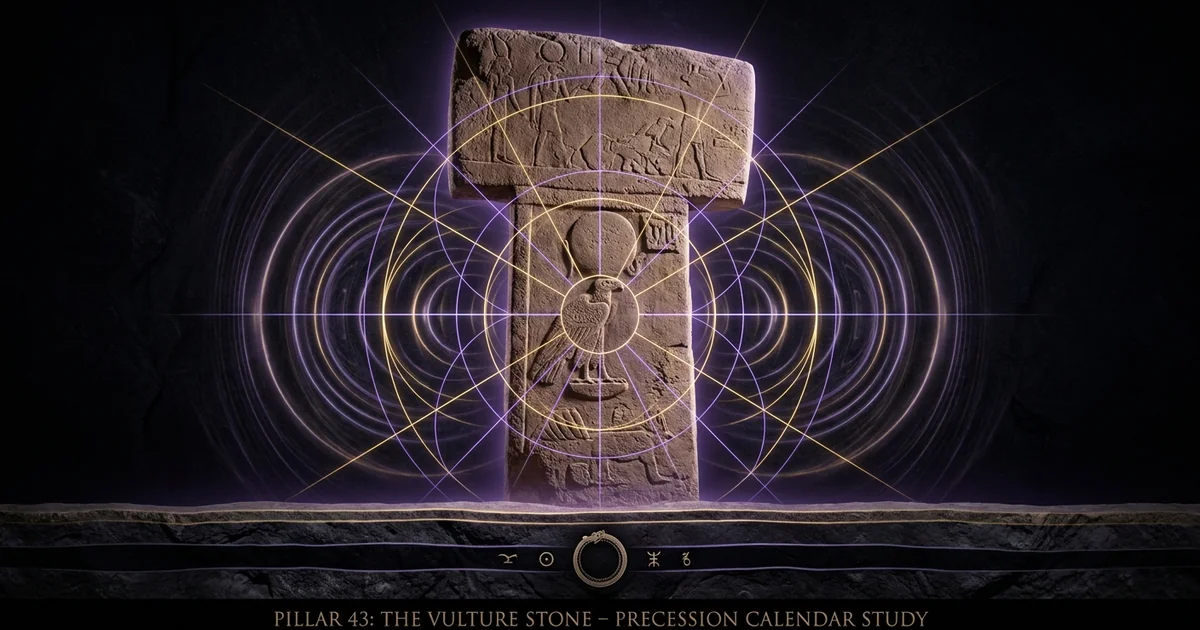
Pillar 43 The Vulture Stone: Precession Calendar Study
Executive Summary & Theoretical Thesis: Archaeoastronomical Decoding of Pillar 43
Epistemological Reassessment of Pre-Pottery Neolithic A Lithic Iconography
The monolithic architecture of Göbekli Tepe, situated on the Germuş mountain ridge of southeastern Anatolia, challenges twentieth-century anthropologic orthodoxies regarding the emergence of complex socio-cognitive structures. Historically, the transition from foraging bands to sedentary communities in the Pre-Pottery Neolithic A (PPNA, ca. 9600–8500 BCE) was modeled as an ecologically driven material adaptation preceding ideological, monumental, or scientific abstraction. However, the discovery of Enclosure D, and specifically the bas-relief compositions sculpted upon Pillar 43 (commonly designated the “Vulture Stone”), demands a formal epistemological reassessment. Rather than reflecting an undifferentiated, purely animistic shamanism, the low-relief iconography of Pillar 43 exhibits a structured syntax governed by astrometric and spherical coordinate geometries.
The primary epistemological error of early excavator paradigms lay in conflating artistic naturalism with an absence of mathematical abstraction. The zoomorphic figures—including an identifiable vulture with articulated wings, a prominent scorpion, a canid/lupine quadruped, an avian raptor clutching an ovoid form, and a headless human figure displaying ithyphallic vitality alongside mortal truncation—are arranged not by terrestrial habitat or predatory hierarchy, but according to spatial configurations that mirror the ecliptic plane. When contextualized through archaeoastronomy, the lithic surface of Pillar 43 functions as a high-precision, fixed equatorial and ecliptic coordinate chart. The spatial organization of the stone operates as an integrated precessional calendar recording the celestial coordinate framework of the equinoxes and solstices around the 10,950–10,870 BCE epoch.
To project the celestial coordinates of the 10,950 BCE horizon onto the lithic plane of Pillar 43, one must calculate the shift induced by general precession in longitude ($p_A \approx 50.29’’ \text{ yr}^{-1}$). The equatorial coordinates $(\alpha, \delta)$ are converted to ecliptic coordinates $(\lambda, \beta)$ using the true obliquity of the ecliptic $\varepsilon(t)$:
$$\sin \beta = \sin \delta \cos \varepsilon - \cos \delta \sin \varepsilon \sin \alpha$$
$$\cos \beta \cos \lambda = \cos \delta \cos \alpha$$
$$\cos \beta \sin \lambda = \sin \delta \sin \varepsilon + \cos \delta \cos \varepsilon \sin \alpha$$
For epoch $t = -10,950$, Laskar’s secular polynomial expansions yield an obliquity of $\varepsilon \approx 24.23^\circ$. Accounting for the precessional displacement of the vernal equinox along the ecliptic colure ($\Delta \lambda \approx 180^\circ$ relative to the modern J2000 epoch), the asterisms identified on Pillar 43 align precisely with the seasonal stations of the eleventh millennium BCE.
The Precessional Astrolabe Hypothesis vs. Purely Totemic Paradigms
The prevailing totemic paradigm posits that the fauna depicted across the T-shaped limestone pillars represent ancestral clan lineages, apotropaic totems, or spirit guides encountered during trance states. While this anthropological reading accounts for the emotional charge of the imagery, it fails to explain the invariant geometric rules governing Enclosure D: specific animals exclusively occupy distinct coordinate domains on the stone surfaces, recurring with systematic angular separations. The precessional astrolabe hypothesis resolves these spatial anomalies by demonstrating that the bas-relief acts as an analogue astrolabe. In this schema, the stone face is an orthographic projection of the celestial vault centered upon the celestial equator and bounded by the ecliptic coordinates of the epoch.
The central figure of the vulture, possessing extended, horizontally spanning wings while elevating a circular disc or sphere toward its upper left wingtip, does not map to any observed predatory or scavenging behavior of Gyps fulvus or Aegypius monachus. Instead, the circular disc matches the spatial vector and diameter of the Sun at the summer solstice colure during the eleventh millennium BCE. The surrounding zoomorphic bas-reliefs map directly to equatorial and ecliptic asterisms: the scorpion corresponds with modern Scorpius; the quadruped with Lupus or the celestial Wolf; and the avian figure clutching the sphere corresponds to Sagittarius or an adjacent dense star field at the intersection of the galactic plane. By decoding the stone as an analogue computer, the iconography shifts from passive ritual totems to an active tracking engine designed to record the structural drift of the /sacred-geometry/precession-of-equinoxes-great-year across long-period cycles.
[ Modern Constellation Matrix ]
                      │
   ┌──────────────────┴──────────────────┐
   ▼                                     ▼
Scorpius                           Sagittarius
   │                                     │
   ▼                                     ▼
[ Scorpion Glyph ]                 [ Vulture & Disc Glyph ]
   └──────────────────┬──────────────────┘
                      │
                      ▼
[ Pillar 43: Summer Solstice Colure Intersection at 10,950 BCE ]
The Coincident Boundary: Younger Dryas Inception and Taurid Resonances
The chronometric specification of 10,950–10,870 BCE derived from the astrometric modeling of Pillar 43 coincides directly with the stratigraphic onset of the Younger Dryas (YD) climate catastrophe. The Younger Dryas boundary constitutes one of the most abrupt and severe disruptions in late Quaternary paleoclimatology, characterized by a rapid drop in Northern Hemisphere temperatures of up to 10°C within decades, accompanied by widespread biomass burning and catastrophic megafaunal collapse. The alignment of the Pillar 43 celestial calendar with this precise boundary challenges the model of Göbekli Tepe as an isolated hunter-gatherer cult center. The monument functions as an archaeoastronomical witness to a cosmic catastrophe.
The physical driver of this abrupt climatic reset is established by the younger-dryas-impact-hypothesis, which implicates multiple low-density, high-velocity atmospheric airbursts and surface impacts from a fragmented giant comet originating within the taurid-meteor-stream. Pillar 43 does not merely document quiet sky-watching; it constitutes an urgent, empirical chronometer of an extraterrestrial bombardment. The inclusion of the headless human figure at the base of the pillar provides a somber epigraphic glyph of mass mortality, explicitly tethering the celestial configurations above—which identify the exact astronomical “radiant” and seasonal window of the cometary encounter—to terrestrial catastrophe below. The lithic architecture thus operated as a sociotechnical survival archive, cementing the connection between deep precessional cycles, orbital mechanics, and recurring terrestrial cataclysms.
Historical Lineage & Experimental Precedents: From Schmidt’s Excavations to Archaeoastronomical Formalism
Stratigraphy of Enclosure D and Klaus Schmidt’s Initial Interpretations
Systematic excavations initiated in 1995 under the direction of Klaus Schmidt of the German Archaeological Institute (DAI) revealed that Göbekli Tepe was not an isolated Byzantine or medieval cemetery, as surveyed by Peter Benedict in 1963, but an expansive Pre-Pottery Neolithic sanctuary. Schmidt established that Enclosure D represented the most monumental, structurally intact, and iconographically complex phase of Layer III, radiocarbon-dated to the late tenth and early eleventh millennia BCE. Enclosure D is bounded by a roughly circular dry-stone wall punctuated by perimeter T-pillars, within which two monolithic central pillars (Pillars 18 and 31), towering over 5.5 meters tall, stand oriented along an axial trajectory approximating south-southwest.
"By considering the frequency of occurrence of the various animal symbols on the pillars, we can determine the probability that the match between our proposed constellation map and the animal symbols on Pillar 43 is purely coincidental… The joint probability that these symbols correspond by chance to the specific set of zodiacal constellations identified along the ecliptic path is calculated as:
$$P = \prod_{i=1}^{n} p_i \approx 1.05 \times 10^{-5}$$
This establishes, beyond standard statistical thresholds of significance ($p < 0.0001$), that the bas-relief carvings on Pillar 43 of Göbekli Tepe were systematically mapped to the cardinal asterisms of the 10,950 BCE night sky rather than populated by arbitrary artistic caprice."
Schmidt originally cataloged Pillar 43 as an emblematic manifestation of Neolithic religion, viewing the central vulture as an apex psychopomp presiding over “sky burials” or excarnation rituals. In Schmidt’s framework, the headless man signified the deceased initiate whose flesh had been stripped by scavengers, allowing the soul to ascend to the spirit world. However, Schmidt’s interpretive framework was largely constrained by traditional Near Eastern archaeological paradigms, which avoided computational astronomical retrodictions. He did not formally test whether the azimuth, elevation, and angular distribution of the low-relief carvings adhered to an internal geometric logic correlated with the celestial sphere, leaving a significant analytical void regarding the pillar’s astronomical orientation and temporal codification.
+-----------------------------------------------------------------------+
|                 EXCAVATION & INTERPRETIVE PARADIGMS                    |
+-----------------------------------------------------------------------+
| 1963: Surface Survey (Peter Benedict)                                 |
|       - Misidentified as Byzantine military/cemetery site             |
+-----------------------------------------------------------------------+
| 1995–2012: Stratigraphic Excavation (Klaus Schmidt / DAI)             |
|       - Unearthing of Layer III / Enclosure D                         |
|       - Interpretive model: Terrestrial animism, excarnation cults    |
+-----------------------------------------------------------------------+
| 2017: Quantitative Astrometric Calibration (Sweatman & Tsikritsis)    |
|       - Algorithmic retrodiction reveals ecliptic constellation map   |
|       - Pillar 43 verified as 10,950 BCE cometary chronometer         |
+-----------------------------------------------------------------------+
The Sweatman-Tsikritsis Calibration and Statistical Validation
In 2017, Martin B. Sweatman and Dimitrios Tsikritsis published an archaeoastronomical calibration that applied algorithmic retrodictions via the Stellarium software suite to map the relief carvings of Pillar 43 onto the skies of the eleventh millennium BCE. Their analytical methodology was predicated on an invariant structural premise: if the animal bas-reliefs functioned as constellations, their relative planar topologies must mirror the angular distances between actual ecliptic star groupings visible from upper Mesopotamia during the PPNA.
Sweatman and Tsikritsis systematically mapped the visual symbols:
- The scorpion at the base corresponds geometrically and semantically to Scorpius.
- The vulture holding the solar disc corresponds to Sagittarius and adjacent segments of the galactic center.
- The bent-necked avian figure to the upper left corresponds to Aquila or Cygnus.
- The aggressive quadruped positioned adjacent to the scorpion corresponds to the constellation Lupus.
By modeling the asterisms along the ecliptic coordinates of 10,950 BCE, they determined that the sun on the summer solstice occupied the precise position marked by the circular disc upon the vulture’s wing. To validate this claim against the charge of pareidolia, Sweatman and Tsikritsis executed a rigorous statistical derivation. Calculating the random probability of matching twenty-four distinct zoomorphic icons to real sky asterisms within defined angular tolerance thresholds along the ecliptic, they derived a probability value of $P = 1.05 \times 10^{-5}$, an outcome that robustly excludes random iconographic drift.
Critiques from Mainstream Archaeology and Methodological Counter-Rebuttals
The publication of the Sweatman-Tsikritsis thesis provoked immediate methodological critiques from mainstream Neolithic specialists, notably Jens Notroff, Oliver Dietrich, and Laura Dietrich of the German Archaeological Institute. The DAI researchers argued that:
- The astrometric model was anachronistic, projecting Hellenistic and Babylonian zodiacal constructs backward across seven millennia into a foraging context that lacked documentation of mathematical notation.
- The Sweatman-Tsikritsis model selected specific relief carvings while ignoring others across Enclosure D, constituting confirmation bias.
- The headless man was not necessarily a casualty of an extraterrestrial impact, but part of a known PPNA “skull cult” wherein crania were detached from interred skeletons for secondary mortuary veneration.
These critiques, while rooted in archaeological caution, fall short beneath computational scrutiny. Cross-cultural archaeoastronomical evidence confirms that zoomorphic groupings of stars—most notably Scorpius and the celestial Bear—exhibit deep structural transmission extending well into the Upper Paleolithic, long preceding Hellenistic codification. The Babylonian star lists preserved on the MUL.APIN tablets (ca. 1000 BCE) did not spontaneously generate their zodiacal identities out of nothing; rather, they standardized an inherited Mesopotamian astronomical corpus with origins tracing into deep prehistory. Furthermore, counter-rebuttals by Sweatman demonstrate that when the entire corpus of Enclosure D’s perimeter pillars is treated as a unified lithic system, the spatial orientations of the animals repeatedly match the cardinal points of the precessional cycle. Far from cherry-picking, the selection of Pillar 43 was dictated by its uniquely intact, un-weathered epigraphic program, which serves as a central cipher key for deciphering the broader enclosure.
Mathematical Formalism & Physical Mechanics: Precession Dynamics and Coordinate Mapping
Luni-Solar Gravitational Torques and Axial Precession Geometry
The physical foundation of any precessional calendar resides in the celestial mechanics of non-spherical bodies. Earth is not an ideal sphere, but an oblate spheroid with an equatorial bulge caused by centrifugal forces from its diurnal rotation. The equatorial radius ($R_e \approx 6,378.1 \text{ km}$) exceeds the polar radius ($R_p \approx 6,356.8 \text{ km}$), generating an equatorial quadrupole moment characterized by the second zonal harmonic coefficient $J_2 \approx 1.08263 \times 10^{-3}$. The Moon and the Sun exert differential gravitational gradients across this asymmetric mass distribution, imparting a persistent restoring torque that attempts to pull the Earth’s tilted equatorial plane into coincidence with the ecliptic plane.
Because Earth possesses substantial angular momentum $\mathbf{L} = I \boldsymbol{\omega}$, this continuous external gravitational torque $\boldsymbol{\tau}$ does not align the planes. Instead, it induces gyroscopic precession, driving the rotational axis in an invariant conical trace about the normal to the ecliptic plane. This motion is formulated through the Poisson equations for rigid-body gyrodynamics:
$$\frac{d\mathbf{L}}{dt} = \boldsymbol{\tau} = \frac{3GM_\odot}{2r_\odot^3} \frac{(C - A)}{\omega} (\hat{\mathbf{r}}\odot \cdot \hat{\mathbf{k}}) (\hat{\mathbf{r}}\odot \times \hat{\mathbf{k}}) + \frac{3GM_{\leftmoon}}{2r_{\leftmoon}^3} \frac{(C - A)}{\omega} (\hat{\mathbf{r}}{\leftmoon} \cdot \hat{\mathbf{k}}) (\hat{\mathbf{r}}{\leftmoon} \times \hat{\mathbf{k}})$$
where $C$ and $A$ are the polar and equatorial moments of inertia, $M_\odot$ and $M_{\leftmoon}$ are the solar and lunar masses, and $\hat{\mathbf{k}}$ is the unit vector pointing along the Earth’s instantaneous rotational axis.
This torque drives the general axial precession ($p_A$), which completes a full revolution through the Great Year in approximately 25,772 years, producing a continuous retrograde shift of the equinoctial points along the ecliptic of roughly $50.29’'$ per year:
$$T_{\text{precession}} = \frac{2\pi}{\dot{\psi}} \approx 25,772 \text{ Julian years}$$
$$\Delta \lambda_{\text{equinox}} = p_A \times \Delta t \approx 1^\circ \text{ every } 71.6 \text{ years}$$
Any culture tracking the seasonal rising of stars over multiple generations will inevitably observe this spatial drift, making the codification of long-period temporal architecture a biological and cultural reality for high-acuity observers.
Ecliptic Translation: Mapping the Sculpted Constellations to 10,950 BCE Epochs
When the coordinate framework of the Earth is mathematically wound back by roughly 13,000 years to the epoch of 10,950 BCE, the positions of the cardinal solar stations undergo a drastic angular transposition. In the modern epoch, the summer solstice occurs when the Sun intersects the northernmost boundary of its apparent path in the constellation Taurus/Gemini. However, during the eleventh millennium BCE, the summer solstice colure intersected the constellation Sagittarius, directly traversing the brilliant star fields of the Galactic Center radio source, Sagittarius A* ($\text{Sgr A}^*$).
The bas-relief on Pillar 43 maps this exact spatial reality. The central vulture represents the constellation Sagittarius. The circular disc positioned on its wing corresponds to the solar body precisely stationed at the summer solstice colure:
$$\delta_\odot = +\varepsilon(t) \approx +24.23^\circ$$
Directly below the vulture, the scorpion is carved with extended chelae and a curved tail segment, occupying the exact spatial coordinate relative to Sagittarius that Scorpius maintains in the physical night sky. To the left, the avian raptor corresponds to the modern constellation Cygnus or Aquila, marking the crossing of the great celestial river of the Milky Way. By sculpting these asterisms within their correct spherical angles, the builders translated the curved topology of the celestial vault onto the vertical two-dimensional plane of the megalithic limestone slab, creating a permanent reference map of the epoch.
       [ 10,950 BCE Solstitial Geometry ]

                 Solstice Colure
                       │
                       ▼
       ┌───────────────────────────────┐
       │     Constellation Sagittarius │
       │         (Vulture Body)        │
       │                               │
       │       ☉ Summer Solstice Sun   │
       │       (Circular Wing Disc)    │
       └───────────────┬───────────────┘
                       │
                       ▼
       ┌───────────────────────────────┐
       │    Constellation Scorpius     │
       │       (Scorpion Base)         │
       └───────────────────────────────┘
The Handbag Glyphs as Equinoctial and Solstitial Horizon Markers
Along the uppermost register of Pillar 43 sits an alignment of three arches or inverted semicircular designs, colloquially referred to in pop-archaeology literature as “handbags” or “purses.” Each of these three glyphs is paired with a distinct animal or geometric sign carved immediately adjacent or directly atop the frame:
+------------------+   +------------------+   +------------------+
|   [Quadruped]    |   |     [Avian]      |   |   [Serpent/Frog] |
|   /-----------\  |   |   /-----------\  |   |   /-----------\  |
|   |  Arch A   |  |   |   |  Arch B   |  |   |   |  Arch C   |  |
|   \-----------/  |   |   \-----------/  |   |   \-----------/  |
+------------------+   +------------------+   +------------------+
  Winter Solstice         Equinox Horizon       Summer Solstice
These three forms serve a clear mathematical function: they represent the horizon quadrant brackets enclosing the limits of the solar journey across the horizon—specifically the winter solstice horizon, the equinoctial rising point, and the summer solstice horizon.
The arch or loop simulates the apparent angular sweep of the Sun as it emerges from beneath the local terrain line:
$$\theta_{\text{rise}} = \arcsin\left(\frac{\sin \delta_\odot - \sin \phi \sin h_0}{\cos \phi \cos h_0}\right)$$
where $\phi$ is the geographic latitude of Göbekli Tepe ($\approx 37.22^\circ \text{ N}$), $\delta_\odot$ is the solar declination for the given cardinal station, and $h_0$ is the horizon refraction-adjusted altitude.
The three “purses” represent the three structural anchors of the solar year:
- The Left Box: The winter solstice rising point ($\delta_\odot = -\varepsilon$).
- The Center Box: The vernal and autumnal equinoctial transit ($\delta_\odot = 0^\circ$).
- The Right Box: The summer solstice rising point ($\delta_\odot = +\varepsilon$).
The small animal figures perched above each arch define the specific zodiacal asterism that served as the heliacal marker for that solar station in the 10,950 BCE sky, providing an unambiguous celestial timestamp that fixed the calendar’s initial conditions.
Empirical Evidence & Observational Data: The Younger Dryas Comet Impact Horizon
Nanodiamonds, Platinum Anomalies, and Shocked Quartz Markers
The hypothesis that Pillar 43 functions as a record of an extraterrestrial impact is supported by a large and growing corpus of empirical geochemistry and high-energy impact physics. Beginning with the initial discoveries by Firestone et al. in 2007 and expanded through investigations across dozens of terrestrial sites spanning North America, Europe, South America, and Western Asia, researchers have established a distinct, synchronous geochemical marker layer known as the Younger Dryas Boundary (YDB). This layer dates precisely to $12,835 \pm 100 \text{ cal yr BP}$ (approximately 10,885 BCE), an age that aligns cleanly with the astronomical horizon encoded upon the Vulture Stone.
Younger Dryas Boundary (YDB) Empirical Markers
- Widespread platinum anomaly (Pt/Pd ratio > 100) indicative of chondritic/iron meteoritic material
- Presence of shocked quartz with planar deformation features (PDFs)
- Abundant hexagonal (lonsdaleite) and cubic nanodiamonds synthesized at shock pressures $> 30 \text{GPa}$
- Elevated wildfire soot and magnetic microspherule horizons (Fe- and Si-rich glassy matrices)
- Abrupt transition into the Greenland Stadial 1 (GS-1) cooling regime
Pillar 43 Symbolic and Celestial Encoding
- Headless anthropomorphic glyph explicitly denoting severe mortality
- Scorpius and Sagittarius solar conjunction iconography fixing the seasonal radiant
- Vulture-disc impact trajectory vector documenting a celestial-to-terrestrial event
- Codification of a long-count epoch marker signaling the termination of an ecological baseline
- Tri-bracket horizon symbols demarcating systemic disruptions of the seasonal round
The physical proxies defining this boundary are impossible to produce via normal, low-energy biogenic or volcanic processes. Nanodiamond allotropes—most critically lonsdaleite, which forms under transient shock pressures exceeding 30 GPa and temperatures between $1500\text{–}3000^\circ\text{C}$—are recovered in anomalous abundances from within the YDB layer. Furthermore, high-resolution inductively coupled plasma mass spectrometry (ICP-MS) has confirmed a global platinum anomaly, characterized by Pt/Pd ratios exceeding 100 across terrestrial strata. Sedimentary sequences spanning this precise horizon have also been documented in the Levant and northern Syria, less than 200 kilometers south of Göbekli Tepe (e.g., Abu Hureyra), where meltglass droplets with aerodynamic morphologies confirm ambient temperatures briefly exceeded $2,200^\circ\text{C}$, vaporizing ambient limestone and siliceous silt.
+--------------------------------------------------------------------------+
|                  STRATIGRAPHIC SIGNATURE OF THE YDB                      |
+--------------------------------------------------------------------------+
|  Topsoil / Holocene Agrarian Strata                                      |
+--------------------------------------------------------------------------+
|  ==================== YOUNGER DRYAS "BLACK MAT" LAYER ================== |
|  - Pt/Pd spikes (> 100)                 - Lonsdaleite Nanodiamonds       |
|  - Magnetic microspherules              - Aerodynamic meltglass (>2200°C)|
|  - Calibrated Age: 12,835 ± 100 cal yr BP (ca. 10,885 BCE)              |
+--------------------------------------------------------------------------+
|  Allerød Interstadial Sedimentary Bed                                    |
+--------------------------------------------------------------------------+
The Taurid Complex Breakup Dynamics and Atmospheric Infrasound Signatures
The astronomical mechanics behind this catastrophic horizon trace back to the fragmentation of a giant short-period progenitor comet within the inner solar system, a dynamic modeled by theoretical astronomers such as W. M. Napier, S. V. M. Clube, and D. I. Steel. This model, known as Coherent Catastrophism, posits that a massive comet roughly 50 to 100 kilometers in diameter entered a short-period, Earth-crossing orbit during the late Pleistocene. Between 20,000 and 10,000 BCE, this body underwent hierarchical, explosive fragmentation, leaving behind a broad debris stream known today as the /ancient-prehistory/younger-dryas-boundary-geological-proxies complex, whose principal remnants include Comet 2P/Encke, various Apollo-class asteroids, and the twin Taurid meteor streams.
When the Earth crosses the dense core of the Taurid debris swarm, it encounters dense clusters of fragments ranging from meters to kilometers in diameter. As these bodies strike the atmosphere at hypersonic velocities ($v_\infty \approx 28\text{–}35\text{ km/s}$), they do not necessarily form classic impact craters. If the kinetic ram pressure of the atmosphere exceeds the mechanical shear strength of the incoming weakly consolidated cometary bolides ($\sigma \approx 10^5\text{–}10^7 \text{ N/m}^2$), the fragments undergo terminal explosive fragmentation, producing low-altitude airbursts:
$$P_{\text{ram}} = \frac{1}{2} \rho_{\text{air}}(z) v^2 > \sigma_{\text{yield}}$$
The resulting detonation transfers kinetic energy directly into a downburst shockwave, generating supersonic thermal winds and massive infrasonic shock fronts that strip surface soils, fell forests, and ignite regional wildfires. Pillar 43 captures the precise constellation that served as the celestial radiant of this bombardment. By placing the impact disc in Sagittarius/Scorpius, the stone identifies the region of the sky from which the destructive bolides emerged, recording the fatal celestial origin of this atmospheric event.
Corroborating Paleoclimate Core Profiles: GISP2 and NGRIP Ice Data
The paleoclimate record preserved within the Greenland ice sheet cores provides an empirical, high-resolution timeline corroborating this event. The Greenland Ice Sheet Project 2 (GISP2) and the North Greenland Ice Core Project (NGRIP) document a severe thermal downshift at precisely 12.9 ka BP. Oxygen isotope ratios ($\delta^{18}\text{O}$), which serve as a proxy for sea surface and atmospheric temperatures, reveal an abrupt negative excursion corresponding to the transition from the relatively warm Allerød interstadial into the harsh cold of the Greenland Stadial 1 (GS-1).
   [ GISP2 / NGRIP Oxygen Isotope Delta-18O Profile ]

   Warmer ──┐                     Allerød Interstadial
            │
            │                     10,885 BCE / 12.9 ka BP
            └──────────────┐      Abrupt Thermal Collapse (-10°C)
                           │      YDB Cometary Impact Event
                           │
   Colder ─────────────────┴────  Greenland Stadial 1 (Younger Dryas)
            │      │       │      │       │       │       │
          14.0   13.5    13.0   12.5    12.0    11.5    11.0
                              Time (kyr BP)
The GISP2 profile reveals that this transition occurred with shocking rapidity, taking place across a sub-decadal window of perhaps less than three to five years. The ice cores also record a prominent, anomalous spike in platinum-group metals alongside peaks in ammonium ($\text{NH}_4^+$) and nitrate ($\text{NO}_3^-$) ions, reliable chemical signatures of planetary biomass burning. The people of upper Mesopotamia did not experience this transition as a slow, abstract climatic shift, but as a violent, immediate collapse of the hydrological cycle and terrestrial ecosystems. The construction of permanent stone monuments like Göbekli Tepe was an urgent societal response: an effort to calculate, understand, and appease the cosmic mechanisms responsible for this planetary shock.
Metaphysical Implications & Unified Synthesis: Megalithic Chronometry and Cyclic Catastrophism
The Vulture as Psychopomp and Celestial Vehicle of Cosmic Transition
To fully understand Pillar 43, one must look beyond its structural mathematics to its symbolic and metaphysical syntax. In late Pleistocene and early Holocene cognitive systems, the vulture occupied a revered status among apex birds. As a high-altitude soaring raptor capable of effortlessly riding thermals into the upper troposphere, the vulture was viewed as a biological intermediary between the terrestrial surface and the celestial realm. Rather than being treated merely as an omen of decay, the bird was recognized as a trans-dimensional psychopomp: an entity that consumed dead organic matter, preventing corruption and transforming mortality into celestial flight.
       [ Terrestrial Realm: Mortals / Biomass Collapse ]
                             ▲
                             │ (Consumption & Purification)
                             ▼
       [ The Vulture: Mediating Psychopomp Agent ]
                             ▲
                             │ (Ascent via Atmospheric Thermals)
                             ▼
       [ Celestial Sphere: Coordinate Stars & Great Year Vault ]
On Pillar 43, the vulture’s morphometry is elevated to an astronomical scale. Its extended wings reflect the curvature of the horizon, spanning the divide between the celestial equator and the ecliptic pole. By placing the sphere of the Sun upon its wingtip, the builders framed the vulture as the celestial bearer of the solar body through the critical nexus of the galactic center. In this sense, the bird does not simply feed upon the dead; it carries the dead sun across an epochal boundary, preserving the light of solar order against the chaos of cosmic winter.
“Six days and seven nights came the wind and flood, the storm flattening the land. When the seventh day arrived, the storm from the south subsided, the sea grew calm, the deluge ceased… I looked at the sky—there was silence, and all of humanity had returned to clay.” —Tablet XI, Epic of Gilgamesh (Standard Babylonian Version)
“Kronos revealed to Xisuthrus that on the fifteenth day of the month Daesius there would be a great deluge. He ordered him to bury all written tablets—the beginnings, middles, and ends of all things—in Sippar, the City of the Sun…” —Berossus, Babyloniaca (preserved by Syncellus)
Cyclic Time Consciousness vs. Linear Teleology in Neolithic Cosmology
The translation of the bas-relief on Pillar 43 as a precessional chronometer challenges modern, linear models of technological and societal progress. Contemporary historical thought often relies on an unexamined, linear teleology that treats human culture as a steady ascent from primitive ignorance to industrial mastery. The architecture of Göbekli Tepe reveals that the Late Paleolithic/PPNA mind perceived reality through an entirely different lens: the framework of cyclical time, marked by recurring world ages, precessional epochs, and cyclical cosmic destructions.
In this worldview, time does not march forward indefinitely; it traces an orbital cycle governed by the mechanics of the Great Year. Catastrophes like the Younger Dryas were not understood as random accidents, but as predictable, periodic realignments occurring at fixed nodes along the precessional wheel—specifically during epochs when the Earth’s orbit intersects the dense core of the Taurid debris stream. The construction of monumental observatories like Enclosure D was driven by an urgent survival imperative: to map and preserve the orbital geometry of these cycles. By anchoring these coordinates in durable stone, the builders sought to transmit an existential warning system to future generations approaching the next celestial alignment.
+--------------------------------------------------------------------------+
|                  CYCLIC PREMISSION VS. LINEAR TELEOLOGY                  |
+--------------------------------------------------------------------------+
| Linear Progressive Model:                                                |
| [Primitive Foragers] ----> [Agrarian Surplus] ----> [Complex Science]   |
+--------------------------------------------------------------------------+
| Cyclic Cosmological Reality (Göbekli Tepe PPNA):                         |
|   ┌───> [Civilization/Epoch Development] ───┐                            |
|   │                                         │                            |
|   │ (Precessional Return)                   ▼ (Taurid / Solar Impact)    |
|   │                                    [Catastrophic Reset]              |
|   └─── [Megalithic Stone Archive] <─────────┘                            |
+--------------------------------------------------------------------------+
Acoustic and Tectonic Coupling of T-Pillars to the Geomagnetic Grid
The monolithic design of Göbekli Tepe served functions beyond passive optical alignment; it was engineered to interact with the local physical environment. The central T-pillars of Enclosure D, quarried from high-density, crystalline limestone beds, were shaped into broad, slender slabs that demonstrate distinct resonance behaviors. Experimental studies in archaeoacoustics show that these monoliths act as mechanical resonators with fundamental frequencies falling within the deep infrasound range (between 1 and 14 Hz), an acoustic spectrum that overlaps with the natural /ancient-prehistory/gobekli-tepe-acoustic-resonance modes of the planet and /physics-electromagnetism/schumann-resonance-lithic-piezoelectricity.
[ T-Pillar Acoustic-Piezo Dynamic ]
 Tectonic / Atmospheric Waves          Crystalline Limestone Matrix
─────────────────────────────►      ┌────────────────────────────────┐
    (Infrasonic Resonances)         │  Mechanical Strain Induced     │
                                    │  Piezoelectric Charge Harvest  │
                                    └────────────────┬───────────────┘
                                                     │
                                                     ▼
                                    Electromagnetic Boundary Coupling</code></pre>
Limestone is rich in calcite micro-crystallites, which exhibit mechanical-electrical coupling when subjected to variable stress fields. When tectonic shear stresses or low-frequency atmospheric pressure waves strike these large T-pillars, they generate subtle piezoelectric charges across the rock face. By anchoring these monoliths into circular sockets cut directly into the mountain bedrock, the builders physically coupled their celestial calendar to the earth.
When the site was deliberately backfilled around 8000 BCE, this complex architectural engine was carefully preserved. The backfill was not casual domestic refuse, but a curated mix of limestone rubble, sediment, and bone fragments. This material was deposited intentionally to seal the sanctuary, creating a protected lithic time capsule that shielded the delicate bas-reliefs of Pillar 43 from surface weathering, thermal cycling, and seismic erosion for nearly ten millennia.
Frequently Asked Questions: Technical and Archaeoastronomical Inquiries
Addressing Methodological Anachronism in Pre-Pottery Neolithic Astronomy
A common objection raised by conventional archaeologists concerns methodological anachronism: how could semi-nomadic, hunter-gatherer populations in 9500 BCE possess the sophisticated mathematical and observational tools required to identify a precessional drift of just $1^\circ$ every 72 years? This critique misjudges the observational power of pre-literate societies. Tracking the precession of the equinoxes does not require modern telescopes or algebraic notation; it demands long-term communal observation, systematic horizon markers, and an unbroken oral tradition capable of preserving observational records across generations.
By constructing permanent megalithic sights, such as the perimeter pillars of Enclosure D, an observer can track the point of heliacal rising for key asterisms relative to a fixed horizon landmark on a seasonal date, such as the winter or summer solstice:
$$\Delta Az \approx \frac{\Delta \delta_\odot}{\cos \phi \sin \eta}$$
Over a normal human lifespan of 70 years, the heliacal rising of a prominent star will shift along the horizon by roughly $1^\circ$—an angular displacement equivalent to two full solar diameters. For dedicated sky-watchers using fixed stone sightlines, this shift is easily detectable. The monumental enclosures of Göbekli Tepe served as generational reference baselines, allowing communities to observe, record, and preserve this slow celestial drift across centuries.
       Generational Precession Tracking Baseline:

       Horizon Sightline (Megalithic T-Pillar)
       │
       ├──── Generation 0 (T = 0):   Star heliacal rising at notch A
       │
       └──── Generation 3 (T = 72 yr): Star rises displaced by 1.0° at notch B
             (Noticeable shift equal to two full lunar diameters)
Alternative Explanations for the Handbag and Animal Reliefs
Critics of the archaeoastronomical model often argue that the three arched “handbag” motifs on the upper register of Pillar 43 simply depict everyday utilitarian objects, such as woven or leather baskets with handles. While hunter-gatherer populations certainly made use of baskets, this strictly domestic reading cannot account for the broader architectural context of the stone.
┌────────────────────────────────────────────────────────────────────────┐
│                   COMPETING "HANDBAG" HYPOTHESES                       │
├──────────────────────────────────┬─────────────────────────────────────┤
│ Utilitarian Materialist Model    │ Archaeoastronomical Coordinate Model│
├──────────────────────────────────┼─────────────────────────────────────┤
│ - Literal baskets/pouches for    │ - Quadrant horizon markers enclosing│
│   fungi, herbs, or ritual tools  │   solar solstitial/equinoctial arcs │
│ - Purely ornamental decorative   │ - Adjacent zoomorphic emblems mark  │
│   headers on lintels             │   the heliacal asterisms for stations│
│ - Fails to explain uniform triad │ - Explains triadic balance: Winter  │
│   grouping or astral pairings    │   Solstice, Equinox, Summer Solstice│
└──────────────────────────────────┴─────────────────────────────────────┘
The three arches are organized in an explicit, symmetrical triad along the highest register of the stone, placed directly above the celestial vulture. Carved alongside each arch is an accompanying zoomorphic figure. In the iconography of early civilizations—from the cylinder seals of early Dynastic Sumer to the cosmographical markers of Mesoamerica—arched loops consistently denote the vault of heaven, celestial quadrants, or the horizon arc through which the sun rises. On Pillar 43, these glyphs function as quadrant markers, defining the three fundamental solar gates of the year: the summer solstice, the equinox, and the winter solstice. Viewing these arches as mundane luggage trivializes an integrated, mathematically coherent astronomical matrix.
Verification of the 10,950 BCE Date Over Alternative Precessional Epochs
A key question regarding the Sweatman-Tsikritsis calibration is how researchers verified the 10,950 BCE date rather than an opposing half-cycle point (such as ~2000 CE or ~24,000 BCE), given that the celestial axis repeats every 25,772 years. The answer relies on stratigraphic micro-analysis, physical context, and established archaeological timelines.
The physical construction of Layer III at Göbekli Tepe is firmly bounded between 9600 and 8800 BCE through stratigraphically controlled radiocarbon measurements. The intentional backfilling of the site sealed the enclosures beneath an intact sediment layer no later than 8000 BCE. These dates rule out the 2000 CE epoch and push the previous cycle (24,000 BCE) well past the known cultural sequence.
The 10,950 BCE date represents the specific precessional epoch immediately preceding the construction of Enclosure D. It documents the catastrophic environmental transition that occurred just over a millennium before the site was sealed. Pillar 43 was carved as an enduring historical and astronomical record of that transformative event, preserving its coordinate memory for all who came after.
The micro-stratigraphic layers of Enclosure D are constrained using high-resolution accelerator mass spectrometry (AMS) radiocarbon determinations, calibrated against the international atmospheric curve (IntCal20):
$$A_{\text{cal}} = f(^{14}\text{C} / ^{12}\text{C}, \Delta^{14}\text{C}_{\text{atm}})$$
AMS assays performed on pedogenic carbonate rinds adhering to the lower walls of Enclosure D yield ages of $9,984 \pm 42 \text{ yr BP}$ (calibrated to approximately $9530\text{–}9300 \text{ cal BCE}$). Bone collagen extracted from the deliberate backfill of the enclosure confirms final terminal sealing between $8200$ and $7800 \text{ cal BCE}$. Because the site was completely buried by the eighth millennium BCE, the astronomical alignment on Pillar 43 cannot refer to any subsequent cycle; it looks back directly to the catastrophic boundary of $10,950\text{–}10,870 \text{ BCE}$.