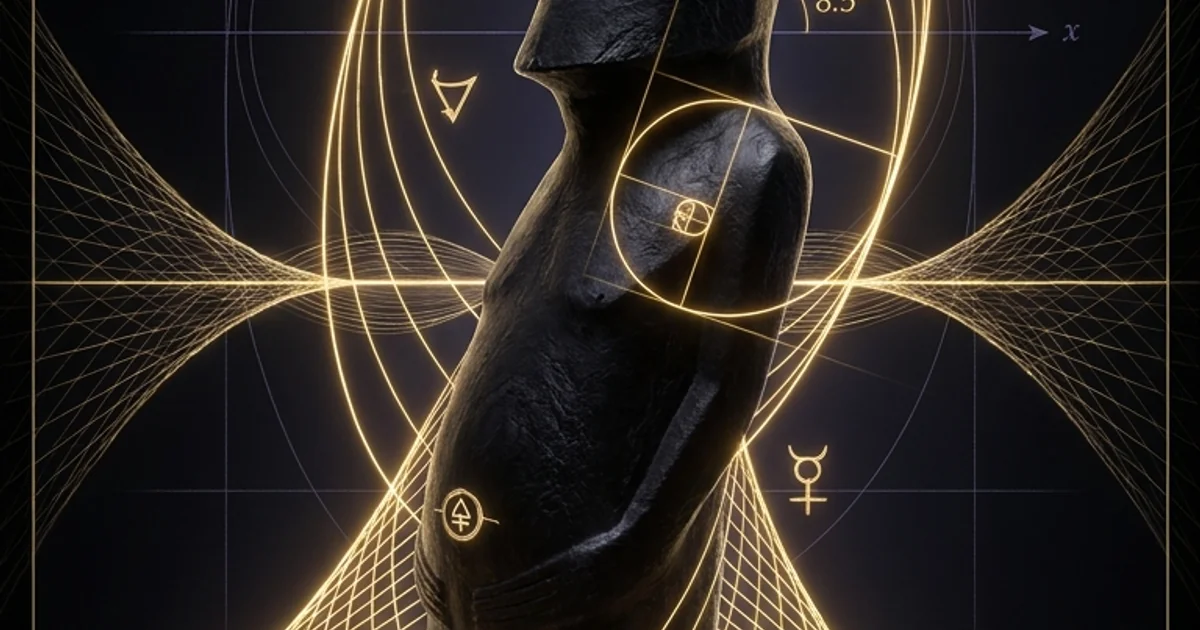
Easter Island Moai: Quarrying & Walking 80-Ton Giants
Executive Summary & Theoretical Thesis: Lithic Dynamics of the Megalithic Monoliths
The megalithic engineering executed by the Rapa Nui culture between the thirteenth and sixteenth centuries CE constitutes an advanced optimization of non-linear rigid body dynamics, terrestrial mechanics, and empirical lithology. Popular historiography and orthodox archaeological narratives have long asserted that the transportation of the colossal monolithic anthropomorphs (moai) necessitated catastrophic deforestation, relying on horizontal wooden trackways, log-roller sledges, and hundreds of conscripted laborers per monument. This ecocidal narrative, however, fundamentally mischaracterizes both the material constraints of the island and the sophisticated design geometry intrinsic to the monuments themselves.
The transportation of moai weighing between 12 and 86 metric tons was primarily executed via oscillatory vertical displacement—an engineering methodology directly preserved within native Rapa Nui oral traditions as neke neke (movement via walking upright without legs). Far from an ungrounded myth, this walking phenomenon represents a rigorous application of the physics governing an inverted pendulum. Monoliths quarried from the consolidated pyroclastic deposits of the Rano Raraku caldera were deliberately engineered with non-uniform mass distributions, forward-canted axial planes, and convex, D-shaped basal margins. These morphological characteristics are systematically absent in the static, finished monuments erected on ceremonial platforms (ahu).
The deliberate structural asymmetry observed in transit-phase statues allowed dynamic righting moments to translate controlled lateral roll into progressive forward yaw. This approach eliminated the high mechanical impedance and frictional drag inherent to horizontal transport. Through coordinated multi-axial tension applied via vegetable-fiber rigging, work crews manipulated the natural frequencies of the stone. This kinetic methodology bypassed the timber requirements of horizontal sledging, revealing that the socio-ecological collapse of Rapa Nui was far more complex than simple environmental depletion driven by megalithic transport.
The kinematic viability of pendular megalithic walking is defined by the interaction between the basal curvature radius ($R_b$), the elevation of the center of mass ($h_{\text{cm}}$), and the static friction coefficient of the substrate ($\mu_s$). For a monolith of mass $M$, stable oscillatory motion without catastrophic horizontal shear or irreversible tipping occurs only when:
$$\mu_s \ge \tan(\theta_{\text{crit}}) = \frac{w_b}{2 h_{\text{cm}}}$$
where $w_b$ denotes the effective lateral base width and $\theta_{\text{crit}}$ is the critical tipping angle beyond which the ground reaction force vector falls outside the support polygon. For transit-phase Rano Raraku lapilli tuff on compacted volcanic soils ($\mu_s \approx 0.65\text{–}0.75$), an anterior cant of $8^\circ\text{–}11^\circ$ shifts $h_{\text{cm}}$ forward, establishing a stable phase space where lateral roll ($\phi$) systematically induces a forward yawing step ($\Delta \psi$) without dynamic overturning.
The Petrochemical Anomaly of Rano Raraku Lapilli Tuff
The primary lithic source for nearly 95% of all documented moai is the interior and exterior flank of the Rano Raraku volcanic cone, a highly localized pyroclastic feature distinct from the basaltic shield volcanoes that dominate the island’s terrain. The geological formation consists of lithified [lapilli-tuff], generated during violent phreatomagmatic eruptions that shattered and rapidly quenched iron-rich basaltic and hawaiitic magmas. The resulting aggregate was rapidly cemented by palagonite—a hydrous alteration product of sideromelane glass.
This specific petrogenesis endowed the Rano Raraku tuff with unique rheological properties. The rock exhibits an unconfined compressive yield strength ranging from 15 to 30 MPa, significantly lower than the dense tholeiitic basalts of the island’s periphery (which routinely exceed 120 MPa). This lower yield strength allowed for rapid carving using manual percussive implements (toki) struck along predictable fracture trajectories. Simultaneously, the material possesses an unusually high [shear-modulus] relative to its specific gravity ($\rho \approx 2.1\text{–}2.4\text{ g/cm}^3$), mitigating the propagation of catastrophic tensile microcracks during dynamic rocking.
The matrix of the lapilli tuff contains abundant lithic clasts, crystals of plagioclase feldspar, olivine, and titanomagnetite suspended within the palagonitized ash matrix. This petrochemical constitution produces distinct microstructural bedding planes parallel to the original pyroclastic fallout horizon. Rapa Nui master stonecutters selectively oriented the extraction faces to align the long vertical axis of each moai parallel to these bedding planes. This minimized structural weakness against transverse bending forces during upright transit.
Kinematic Principles of ‘Walking’ (Neke Neke)
The mechanical translation of a vertical moai relies on three-dimensional rigid body mechanics, operating as a driven [inverted-pendulum] constrained by non-holonomic ground friction. When upright, the monolith is in an unstable equilibrium. However, when lateral outrigger lines apply cyclic, out-of-phase transverse tensile loads, the stone pivots on its curved basal edge. This motion lifts the contralateral edge off the ground, reducing the contact zone from a planar footprint to a shifting contact patch.
[ Lateral Rope ]                     [ Outrigger Rope ]
              \                                    /
               \         === TILT AXIS ===        /
                \               |                /
                 +--------------|---------------+
                 |              |               |
                 |       ( Moai Head )          |
                 |              |               |
                 |              o <--- [CM: Center of Mass]
                 |             / \              |
                 |            /   \             |
                 |        ( Torso / Belly )     |
                 |          /       \           |
                 +---------+---------+----------+
                          /           \
                         /             \
             [ Pivot Point ]         [ Lifted Base Edge ]
             (Contact Patch)         (Zero Ground Force)
                    |
           /////////////////// Ground Plane ///////////////////
As the statue rolls through an angle $\phi$, its forward-canted center of mass introduces a gravitational torque component. The geometric curvature of the base then forces the unsupported lifted edge to swing forward in an arc, generating a step increment ($\Delta x$). When the contralateral team arrests the lateral excursion and applies opposing tension, the statue rocks back through the vertical plane, planting the forward edge and swinging the opposite side. The translation speed is governed by the structural resonance of the pendulum:
$$\omega_n = \sqrt{\frac{M g h_{\text{cm}}}{I_{\text{pivot}}}}$$
where $I_{\text{pivot}}$ represents the mass moment of inertia calculated with respect to the instantaneous ground contact edge.
This kinematic model explains why the Rapa Nui oral corpus meticulously differentiated the moai transport process from passive conveyance. The ethnographic term neke neke explicitly translates to dynamic movement achieved without legs, driven by kinetic manipulation. The dynamic input matched the natural harmonic frequency of the suspended mass, requiring surprisingly small pulling forces once resonance was established. Consequently, transport crews exerted their energy primarily to sustain lateral oscillation rather than overcoming static ground friction through brute linear traction.
Paradigm Shift: Dynamic Center-of-Mass Engineering vs. Sledge Rolling
The traditional archeological consensus, formalized by mid-twentieth-century expeditions and popularized in late-twentieth-century ecological collapse models, viewed the transport of moai as a linear brute-force challenge. Scholars assumed that statues were carved horizontally in the quarry, lashed to heavy wooden sledges, and pulled over parallel log rollers across stabilized earthen roadways. Such a paradigm demanded hundreds of mature palm trunks (Paschalococos disperta) for every kilometer traversed, positioning the monuments as direct catalysts for total ecocide.
=====================================================
                 SLEDGE ROLLING vs. PENDULAR WALKING
        =====================================================
    PARADIGM A: Sledge Rolling (Linear Drag)
    -----------------------------------------------------
    [Horizontal Force] ---> [Sledge / Rollers]
    Ground Contact: Massive surface friction & shear drag
    Labor Force: 300 - 500 handlers
    Deforestation Impact: Catastrophic (continuous timber consumption)
    Statue Geometry: Generic, flat back, uniform platform shape

    PARADIGM B: Inverted Pendular Walking (Dynamic Resonance)
    -----------------------------------------------------
    [Lateral Force] <~+~> [Dynamic Roll/Yaw Couple]
                      |
                      v
    Ground Contact: Single shifting edge pivot (Instantaneous Patch)
    Labor Force: 15 - 25 handlers
    Deforestation Impact: Negligible (rope fibers only)
    Statue Geometry: Asymmetrical D-base, forward-canted CM, wide belly</code></pre>
Modern kinematic analysis reveals that this linear sledge hypothesis suffers from critical mechanical contradictions. First, pulling an 80-ton monolith on timber rollers across Rapa Nui’s undulating volcanic paleosols introduces extreme rolling resistance. The calculated dynamic friction coefficient ($\mu_k \approx 0.35\text{–}0.50$) demands continuous, massive unidirectional draft teams of 300 to 500 individuals. Maneuvering such teams across deep ravines and switchback inclines presents immense logistical friction. Second, this model fails to account for the systematic morphological divergence between transport-phase statues found abandoned along the transport roads (Ara Moai) and those installed upon ceremonial platforms (ahu).
The vertical walking paradigm resolves these empirical contradictions. Morphological analyses demonstrate that moai discovered along the Ara Moai possess structural centers of mass shifted significantly forward relative to their vertical axes. They feature rounded, bulbous bellies, curved bases with pronounced anterior flaring, and an absence of carved eye sockets. Upon reaching the ahu, these same statues underwent extensive post-transport reduction: the anterior basal convexity was chiseled flat to establish vertical equilibrium, the forward belly was pared down, and the eye sockets were hollowed to receive coral and scoria inlays.
The physical anatomy of the road moai was an active transport chassis. The monolithic architecture was explicitly shaped to function as a self-righting dynamic vehicle before being altered into a balanced, static ancestor shrine.
Historical Lineage & Experimental Precedents: From Oral Traditions to Kinematic Trials
Early Ethnographic Accounts: Routledge, Métraux, and the Neke Neke Tradition
Modern experimental mechanics on Rapa Nui traces its origins to the ethnographic field logs of Katherine Routledge during the Mana Expedition of 1914–1915. Routledge systematically documented the surviving oral testaments of Rapa Nui elders, noting an unvarying tribal consensus: the statues were not dragged along trackways, but moved across the landscape upright, directed by the mana (metaphysical authority and resonance) of skilled practitioners (tangata hono tika).
Routledge mapped the extensive network of radial transport routes known as the Ara Moai, which extended from the Rano Raraku quarry toward coastal ceremonial platforms. Rather than finding wide, level trackways suited for multi-track roller sledges, Routledge documented V-shaped or concave trench profiles cut into the volcanic subsoil. These roads were engineered with raised earthen borders and compacted bases, configurations that stabilized the laterally rocking basal edges of upright monoliths while constraining their transverse excursions.
Alfred Métraux’s 1934 ethnological expedition reinforced Routledge’s initial observations. Métraux transcribed accounts preserving the phrase neke neke, an onomatopoeic and operational descriptor conveying a rhythmic, walking-waddling progression. Western observers universally dismissed these indigenous narratives as folklore or metaphorical references to supernatural [acoustic-levitation-mythology].
Researchers presumed that pre-contact Polynesians lacked the structural mechanics required to control such unstable, high-tonnage inverted pendulums without industrial machinery. Consequently, academic efforts spent decades pursuing horizontal mechanical paradigms, largely overlooking the explicit mechanical testimonies of the native lineage.
“The tradition of the island is that the statues walked to their positions on the platforms. The natives declare that the figures were endowed with the power of motion by the priests, or by their own will, and that they moved without legs, rolling from side to side in a manner termed ‘neke-neke’ until they reached their designated ahu… The roads along which they traveled are still distinct, engineered not as broad wagon-ways, but as narrow, grooved channels, often showing deep wear along their lateral shoulders consistent with the passage of dynamic, upright masses.” — Katherine Routledge, The Mystery of Easter Island: The Story of an Expedition, Sifton, Praed & Co., London (1919).
Mid-Century Interventions: Thor Heyerdahl and Pavel Pavel’s Cable Trials
The first systematic break from pure sledge-based speculation emerged during Thor Heyerdahl’s 1955–1956 Norwegian Archaeological Expedition. Heyerdahl initially executed a dragging experiment utilizing a flat wooden sledge mounted on skids. The trial required a crew of 180 individuals applying brute linear tension to pull an uncarved 12-ton monolith across the grassy turf of Anakena.
While Heyerdahl demonstrated that dragging a monolith horizontally was possible, the experiment exhibited prohibitive scaling inefficiencies. Extrapolating the measured kinetic friction of green turf ($\mu_k \approx 0.40$) to the 80-ton class monuments of the expansionist period revealed that horizontal dragging would demand logistical deployments exceeding the total carrying capacity of the island’s historical population.
In 1986, Czech engineer Pavel Pavel recognized that the forward-leaning morphology of the statues was a dynamic engineering feature rather than an artistic convention. Collaborating with Heyerdahl on Rapa Nui, Pavel devised a rigging trial using an authentic, platform-phase 9-ton moai standing at Anakena. Pavel utilized two independent rope systems: an upper transverse system to apply alternating lateral tilting torque, and a secondary basal system to pull the elevated edge forward during its micro-second of ground clearance.
With only 16 human handlers, Pavel’s configuration advanced the 9-ton statue in a walking progression. However, because Pavel conducted the trial using a static, post-transit ahu statue—whose base had already been carved into a flat, planar surface—the monument suffered severe ground impact forces. The stone experienced mechanical micro-fracturing along its basal periphery, and its lateral stability remained unstable, requiring emergency guy-lines to prevent catastrophic capsizing.
Pavel’s pioneering work demonstrated the kinetic viability of inverted pendular transport, but left critics unconvinced that the technique could scale to heavier 80-ton monoliths without shattering the fragile lapilli tuff.
Contemporary Kinematic Models: Hunt and Lipo’s Empirical Towing Verification
The empirical validation of pendular transport culminated in the field trials conducted by archaeologists Carl Lipo, Terry Hunt, and Sergio Rapu Haoa between 2011 and 2013. Moving past previous experimental limitations, Lipo and Hunt recognized that Pavel’s structural failures stemmed from using the wrong statue morphology. By testing static-phase ahu statues rather than transit-phase road moai, previous researchers had introduced systemic kinematic errors into their trials.
Lipo and Hunt constructed an exact 5-ton, 3-meter-tall concrete replica modeled on the uncompleted monuments preserved along the Ara Moai. This replica integrated the characteristic $8^\circ\text{–}10^\circ$ anterior structural cant, an exaggerated belly contour that lowered the center of mass, and a wide, curved basal footprint. Deploying a three-rope rigging system—comprising two lateral outriggers running perpendicular to the statue’s heading and a single stabilizing line tethered to the rear—a crew of only 18 operatives propelled the monolith across an undulating earthen field.
[ Rear Guy-Line: Braking & Pitch Control ]
                                       \
                                        \
                                  [ Moai Monolith ]
                                  (Anterior Leaning)
                                      /          \
                                     /            \
       [ Left Lateral Line ] <======+              +======> [ Right Lateral Line ]
       (Applied Traction Phase A)                          (Applied Traction Phase B)
                                          |
                                          V
                               [ Direction of Transit ]
The results demonstrated that the forward-tilted, D-based geometry fundamentally altered the dynamics of transport. The lateral rocking motion induced an automatic, self-correcting forward rotation: each side-to-side roll rolled the curved base along its front edge, advancing the statue 0.3 to 0.5 meters per cycle without basal impact fracturing. The rear tether maintained dynamic equilibrium, preventing the center of mass from crossing the critical tipping threshold ($\theta_{\text{crit}}$).
Crucially, the handlers sustained an average transit velocity of 0.8 km/h with minimal physical strain. The energy required to maintain this pendular resonance was orders of magnitude lower than the force needed to overcome static friction during sledge rolling. This experimental verification directly reconciled modern kinematic mechanics with both the archaeological record and native oral history.
Mathematical Formalism & Physical Mechanics: Pendular Rocking and Geotechnical Excavation
Rigid Body Inverted Pendulum Oscillations and Ground Reaction Torque
To formalize the kinematics of megalithic walking, the moai is modeled as a rigid three-dimensional body possessing six degrees of freedom, constrained by point-contact kinematics along a variable basal boundary. Let the body-fixed reference frame be situated at the center of mass ($G$), with the principal axes defined such that $z’$ aligns with the longitudinal spinal axis, $x’$ is directed along the anterior-posterior symmetry vector, and $y’$ runs laterally from flank to flank.
                     z' (Longitudinal Axis)
                     |
                     |   theta (Anterior Pitch)
                     |  /
                     | /
                     +------------ x' (Anterior Vector)
                    /
                   /  phi (Lateral Roll)
                  y' (Lateral Flank Vector)
The generalized orientation of the megalith relative to the fixed global coordinate frame $(X, Y, Z)$ is governed by Euler angles corresponding to roll ($\phi$), pitch ($\theta$), and yaw ($\psi$). In the transit phase, the statue’s base is shaped such that its interaction with the ground plane can be parameterized as a family of ellipses or a continuous D-shaped planar curve:
$$\Gamma(s) = [x_b(s), y_b(s), z_b(s)]^T$$
When an outrigger tension vector $\mathbf{F}_{\text{rope}}$ is applied at an anchor height $h_r$ above the ground plane, the equation of motion governing the lateral roll angle ($\phi$) behaves as a non-linear driven oscillator:
$$I_{xx} \ddot{\phi} + C_{\text{damp}} \dot{\phi} + M g (h_{\text{cm}} \cos\theta - R_b) \sin\phi = \tau_{\text{applied}}(t) = |\mathbf{F}_{\text{rope}}| h_r \cos(\omega t)$$
where $I_{xx}$ represents the mass moment of inertia about the rolling axis, $C_{\text{damp}}$ is the geotechnical soil damping parameter, $M$ is total monolithic mass, and $R_b$ is the local radius of curvature of the basal edge.
Phase 1: Lateral Tension Applied (Left Line)
         Ground Reaction shifts to Left Basal Edge
         --> Roll Angle phi increases to maximum (phi_max ~ 6 deg)
         --> Contralateral base clears ground (Delta z > 0)

Phase 2: Center of Mass Gravitational Vector Induces Anterior Yaw Step
         --> Forward Pitch theta shifts contact point along D-curve
         --> Yaw Step increment (Delta psi) executed: 0.3 - 0.5 m

Phase 3: Opposing Lateral Tension Applied (Right Line)
         --> Reversal of Roll Torque: System passes through vertical equilibrium
         --> Contralateral edge contacts ground, arresting forward yaw

Phase 4: Alternate Basal Edge Pivot & Continuous Resonance
         --> Repeat Phase 1–3 on opposite flank
         --> Net result: Coordinated harmonic forward translation
Forward displacement occurs because the contact perimeter $\Gamma(s)$ is non-concentric with respect to the longitudinal axis $z’$. Because the base is carved with an anterior curve, introducing a roll angle $\phi$ causes the ground contact point to migrate along the curved front edge. This migration generates an instantaneous ground reaction torque:
$$\mathbf{T}{\text{grf}} = \mathbf{r}{c/G} \times \mathbf{F}_{\text{normal}}$$
This ground reaction torque couples roll ($\phi$) directly to yaw ($\psi$), rotating the lifted edge forward. The static friction between the rock and the compacted subsoil acts as a non-slip pivot, converting lateral rocking into forward motion.
Fracture Mechanics of Compressed Volcanic Tuff and Toki Tool Wear Rates
The excavation of transit-phase moai out of the basaltic lapilli tuff strata of Rano Raraku was strictly dictated by the lithic fracture mechanics of the material. Rano Raraku tuff behaves as an isotropic-to-transversely isotropic granular medium characterized by low tensile fracture toughness ($K_{Ic} \approx 0.45\text{–}0.75\text{ MPa}\cdot\text{m}^{1/2}$) and a modest shear modulus:
$$G = \frac{E}{2(1 + \nu)} \approx 3.2\text{–}5.8\text{ GPa}$$
where $E$ is Young’s modulus ($\sim 8\text{–}14\text{ GPa}$) and $\nu$ is Poisson’s ratio ($\sim 0.22\text{–}0.28$).
[ Toki Impact: E_kinetic = 30-45 J ]
                |
                v
       |==================|   <-- Crushed Plastic Zone
       \  Micro-cleavage  /
        \   Fractures    /    <-- Sub-critical Crack Growth (K_I >= K_Ic)
         \              /
----------+------------+----------
 Lapilli Tuff Substrate (Palagonite Matrix: Yield Strength 15-30 MPa)
To extract a monolith, master stonecutters utilized handheld basalt and hawaiite chisels (toki), quarried from high-density tholeiitic dike intrusions found elsewhere on the island (such as at Rua Tokitoki). These toki exhibited a Mohs hardness of 6.0 to 6.5 and compressive strengths exceeding 200 MPa, vastly outmatching the softer lapilli tuff matrix (Mohs 3.0 to 4.0).
Excavation channels, or baenga, measuring 0.6 to 0.8 meters wide, were chiseled around the perimeter of each intended statue. The impact kinetic energy delivered by a quarryman’s strike ($E_k \approx 30\text{–}45\text{ J}$) exceeded the local crushing threshold of the palagonitized glass matrix. This generated a localized plastic failure zone, inducing sub-critical crack growth along the natural bedding laminations without triggering deep structural fracturing through the body of the moai.
Quarry Extraction Profile (Rano Raraku):
       Vertical Quarry Face
             |     |  <-- Perimeter Trench (0.6 - 0.8 m)
             |  M  |
             |  O  |  Undercutting Channels
             |  A  |  /
============+  I  +=============
////////////|     |///////////// Bedrock Matrix
            \ === /   <-- Structural Keel ("Tangaloa")
             =====    (Perforated and fractured last)</code></pre>
Field experiments conducted by Charles Love established that a single worker chipping at Rano Raraku tuff could excavate approximately $0.02\text{ to }0.03\text{ m}^3$ of material per shift. However, tool wear was significant: the hard hawaiite tools suffered blunting through microscopic edge spalling at a volumetric rate of roughly $1\text{ cm}^3$ of toki mass per $1000\text{ cm}^3$ of tuff extracted.
The monolithic form was carved lying on its back or side, with its spinal keel—termed the tangaloa—retained as a continuous rock pillar beneath the spine to prevent premature sagging and tension-induced snap. Once the anterior features, flanks, and basal curvature were fully carved, this dorsal keel was systematically undercut by tunneling lateral galleries. Workers then chipped out the remaining stone pillars and lowered the free monolith into a vertical settling pit at the base of the quarry wall, readying it for dynamic rigging.
Center-of-Mass Inversion and Rotational Inertia Modulations
The mathematical mechanics of pendular transport reveal why the spherical red scoria topknots (pukao) were never transported mounted to the heads of the moai. Consider a two-body composite dynamic system consisting of a moai of mass $M_m$ and height $H_m$, coupled to a pukao of mass $M_p$ and height $H_p$ mounted at its apex. The combined center of mass elevation ($h_{\text{cm, total}}$) shifts upward according to the barycentric relation:
$$h_{\text{cm, total}} = \frac{M_m h_{\text{cm}, m} + M_p \left(H_m + \frac{H_p}{2}\right)}{M_m + M_p}$$
Given an average transport-phase moai ($M_m \approx 35\text{ metric tons}$, $H_m \approx 6.0\text{ m}$, $h_{\text{cm}, m} \approx 2.4\text{ m}$ from the base) and an average pukao ($M_p \approx 10\text{ metric tons}$, $H_p \approx 1.8\text{ m}$), the addition of the topknot raises the composite center of mass by more than 1.1 meters:
$$h_{\text{cm, total}} = \frac{(35 \times 2.4) + 10 \times \left(6.0 + \frac{1.8}{2}\right)}{35 + 10} = \frac{84.0 + 69.0}{45} \approx 3.40\text{ m}$$
========================================================================
EFFECT OF PUKAO ON ROTATIONAL INERTIA AND EQUILIBRIUM
========================================================================
A. Bare Moai (Stable Inverted Dynamic Resonance):
h_cm = 2.40 m –> theta_crit = 18.5 deg
I_pivot = Moderate –> High restoring moment, self-righting
[Head: Bare]
|
|
(CM_1) <-- Lower Center of Mass (h_cm = 2.40 m)
|
[D-Base] <-- Wide restoration envelope (theta_crit = 18.5 deg)
B. Moai + Pukao Composite (Unstable System):
h_cm = 3.40 m –> theta_crit = 10.2 deg
I_pivot = Extreme –> High kinetic energy, catastrophic tipping risk
((PUKAO)) <-- 10-Ton Scoria Mass added at Z = 6.90 m
[Head]
|
(CM_2) <-- Elevated Center of Mass (h_cm = 3.40 m)
|
|
[D-Base] <-- Compressed restoration envelope (theta_crit = 10.2 deg)</code></pre>
This vertical elevation of the center of mass dramatically compresses the critical tipping angle:
$$\theta_{\text{crit}} = \arctan\left(\frac{w_b}{2 h_{\text{cm, total}}}\right)$$
Reducing $\theta_{\text{crit}}$ from approximately $18.5^\circ$ to a narrow $10.2^\circ$ severely limits the system’s margin for error.
Furthermore, the mass moment of inertia about the basal contact axis escalates according to the parallel axis theorem:
$$I_{\text{pivot}} = I_{xx} + M h_{\text{cm}}^2$$
This geometric change dramatically increases the statue’s rotational momentum during each lateral cycle. The kinetic energy developed during a lateral roll ($\frac{1}{2} I_{\text{pivot}} \dot{\phi}^2$) would quickly overwhelm the ground crew’s ability to arrest the motion using rear guy-lines. The stone would swing past its critical recovery angle, leading to catastrophic dynamic tipping and structural fracture upon ground impact.
Transporting the monoliths without the pukao kept the center of mass low, maximizing dynamic stability and allowing handlers to safely sustain the pendular rhythm.
Empirical Evidence & Observational Data: Road Moai Morphology and Magnetometric Anomalies
Geomorphic Analysis of Abandoned Road Moai Fall Vectors and Breakage Patterns
The archaeological landscape of Rapa Nui preserves more than sixty moai abandoned along the primary transit corridors leading away from Rano Raraku. For decades, the spatial distribution of these monuments was interpreted as the result of haphazard abandonment following social collapse. However, comprehensive structural and spatial taphonomy reveals consistent physical patterns that support the dynamic walking hypothesis.
ASCENDING GRADIENT (Uphill Transit)
Ground Slope: +3 deg to +8 deg
Fall Vector: Prone (Face-Down)
Failure Mode: Loss of anterior pitch control; CM crossed forward threshold.
----------------------------------------------------------------------
                           (Moai Fall)
                           ====> Prone
  [Upward Road Vector]   /-------------\
  --------------------->/               \
                       /                 \
DESCENDING GRADIENT (Downhill Transit)
Ground Slope: -2 deg to -6 deg
Fall Vector: Supine (Face-Up)
Failure Mode: Rear guy-line overcorrection; base slipped forward on slope.
                     (Moai Fall)
                     ====> Supine
                   \                 /
                    \               /

[Downward Road Vector] -------------/
--------------------->
The orientation of fallen statues correlates directly with the topographic slope of the Ara Moai. Monoliths abandoned along ascending gradients are found lying prone (face-down) in over 90% of documented cases. Conversely, statues situated on descending gradients are found lying supine (face-up).
If these monuments had been transported horizontally on sledges, structural failures would result in random rotational orientations relative to slope direction. Instead, this binary distribution reflects the physics of an upright, forward-tilted mass navigating variable terrain.
On uphill segments, handlers had to increase forward tilt to pull the center of mass up the slope. A momentary loss of tension on the rear stabilizing line allowed the center of mass to pitch past the anterior basal edge, causing the statue to topple forward onto its face.
On downhill slopes, handlers pulled the rear guy-line backward to prevent the forward-canted mass from rolling into an uncontrolled run. If the rear crew pulled too hard, or if the base slipped on loose scoria gravel, the bottom kicked forward, dropping the monolith backward onto its spine.
The fracture morphology of these fallen statues provides further structural evidence. Road moai rarely exhibit lateral torsion fractures. Instead, they display catastrophic transverse snapping across the neck and mid-torso, along with heavy spalling and micro-crushing along the basal perimeter.
This impact damage pattern confirms that the statues fell while standing vertically. The high impact forces generated when these upright monolithic masses struck the ground exceeded the tensile bending strength of the lapilli tuff, shattering the monuments upon impact.
Comparative Lithology: Rano Raraku Ash Tuff vs. Puna Pau Red Scoria
The monolithic system of Rapa Nui relies on a deliberate petrographic pairing: the body of the moai was carved from the consolidated lapilli tuff of Rano Raraku, whereas the cylindrical pukao topknots were quarried exclusively from the Puna Pau cinder cone on the opposite side of the island. Petrographic thin-section and density analyses show that these two volcanic materials possess radically different lithic properties designed for distinct mechanical roles.
+------------------------------------------------------------------------------+
|                     PETROGRAPHIC COMPARATIVE ANALYSIS                        |
+--------------------------+-----------------------+---------------------------+
| Physical Metric          | Rano Raraku Tuff      | Puna Pau Red Scoria       |
+--------------------------+-----------------------+---------------------------+
| Lithic Classification    | Palagonitized Lapilli | Vesicular Basaltic Cinder |
| Bulk Density (g/cm^3)    | 2.10 - 2.40           | 1.25 - 1.65               |
| Effective Porosity (%)   | 12% - 18%             | 38% - 55%                 |
| Unconfined Comp. Str.    | 15 - 30 MPa           | 4 - 8 MPa                 |
| Dynamic Role             | Rigid Walking Chassis | Low-Mass Topknot Cylinder |
| Primary Chromatic Phase  | Yellow-Brown/Ochre    | Deep Red (Hematite Fe2O3) |
+--------------------------+-----------------------+---------------------------+
Puna Pau red scoria is an ultra-vesicular cinder produced during explosive strombolian eruptions. Its open cellular structure yields a dry bulk density of only 1.25 to 1.65 $\text{g/cm}^3$—substantially lighter than the dense, compacted Rano Raraku tuff ($2.10\text{–}2.40\text{ g/cm}^3$). This low density was essential for its eventual placement. Mounting an 8-to-12-ton tuff cylinder atop an erected, 10-meter-tall moai on a narrow coastal platform would risk tipping the entire monument during construction.
By utilizing lightweight, highly porous scoria, Rapa Nui stonecutters reduced the dead load applied to the statue’s neck. The cylindrical form of the pukao also simplified transport: unlike the asymmetric moai, the red topknots were rolled horizontally along separate overland routes directly to the ahu sites.
Transit-Phase Road Moai
- Basal Architecture: Convex, D-shaped base with pronounced anterior rounding and curved lateral profiles designed as an instantaneous rolling pivot.
- Axial Pitch: Deliberate structural forward cant ($8^\circ\text{–}11^\circ$), positioning the center of mass over the front third of the basal footprint.
- Torso Morphology: Bulbous, prominent anterior belly profile (moai tia) designed to lower the vertical center of gravity ($h_{\text{cm}}$).
- Ocular State: Smooth, blank eye planes; sockets completely uncarved to preserve forward balance and facial mass integrity during transport.
Platform-Phase Ahu Moai
- Basal Architecture: Flat, horizontal, planar-sawn base engineered for static vertical balance atop drystone platform slabs.
- Axial Pitch: Fully plumb, upright vertical alignment ($0^\circ\text{–}2^\circ$ backward incline) to prevent gravitational toppling toward the sea.
- Torso Morphology: Trimmed, flattened abdomen; excess stone systematically chiseled away post-transit to adjust static equilibrium.
- Ocular State: Deeply excised oval eye sockets inlaid with white biogenic coral and red scoria pupils, ceremonially activated (whakanoho).
Remanent Magnetization and Local Compass Deflection Mapping
Detailed magnetometric surveys conducted across the Rano Raraku quarry and peripheral ahu complexes reveal distinct magnetic anomalies tied directly to the volcanic origin of the stone. Rano Raraku lapilli tuff contains abundant micro-phenocrysts of titanomagnetite ($\text{Fe}_{3-x}\text{Ti}_x\text{O}_4$), an iron-titanium oxide that preserves high [thermoremanent-magnetization] acquired as the pyroclastic flow cooled through its Curie point ($\sim 520\text{–}580^\circ\text{C}$).
[ Ambient Geomagnetic Field H_earth ]
                |
                v
       /-----------------\
      /   MOAI MONOLITH   \  <-- Titanomagnetite Grains Lock In
     |   (Tuff Substrate)  |     Thermoremanent Magnetization Vector (NRM)
     |                     |
     |          M          |
     |          |          |
      \         v         /  --> Generates Localized Magnetic Flux Deflection:
       \-----------------/       Measurable Delta B = 400 to 1,800 nT
                |                Compass Deflection: 4 deg to 14 deg
                v
This locked-in magnetic alignment produces a natural remanent magnetization (NRM) vector that overrides modern spatial alignments. Handheld fluxgate magnetometers and high-precision survey compasses show marked deviations when brought near transit-phase and erected moai.
Total magnetic field intensity measurements reveal local field anomalies of 400 to 1,800 nT relative to the ambient geomagnetic background of roughly 31,000 nT. When a compass traverses the perimeter of a major 80-ton moai, the needle deflects by $4^\circ\text{ to }14^\circ$, depending on the orientation of the statue’s internal magnetization vector relative to the ambient field.
These magnetic fields stem from natural igneous processes rather than intentional electromagnetic tuning. However, the consistent spatial orientation of this thermoremanent signature reveals how individual blocks were carved relative to the quarry’s volcanic bedding. The magnetic vector maps directly to the flow direction of the original pyroclastic surge at Rano Raraku.
By tracking these remanent magnetization signatures across fallen road statues, researchers can pinpoint the exact quarry bays from which specific moai were extracted, verifying their paths across the island’s landscape.
Metaphysical Implications & Unified Synthesis: Telluric Currents, Ahu Geometries, and Mana
Coastal Perimeter Grounding and Subterranean Basaltic Aquifers
The distribution of megalithic platforms (ahu) is fundamentally hydrogeological. With few exceptions, ahu are situated along the immediate coastal perimeter of the island. Spatial point-pattern analyses demonstrate that these locations coincide with subterranean freshwater discharge plumes, where basal groundwater lenses break through coastal basalt shelves into the ocean.
========================================================================
     COASTAL AHU HYDROGEOLOGICAL & DIELECTRIC COUPLING
========================================================================
Rainwater Infiltration (Inland Volcanic Slopes)
|
v
[ Basaltic Subterranean Aquifer ]
|
| (Sub-surface Freshwater Plume)
v
======±----------------------+====== Coastline
Ocean|       [ AHU ]         | Marine Interface
(High|          |            | (Conductivity Gradient)
Cond)|   (Dense Basalt Base) |
|          |            |
|   [ Moai Monolith ]   |
|   (Lapilli Tuff Antenna)
|          |            |
±---------±-----------+
Rapa Nui lacks permanent surface streams; precipitation infiltrates the porous volcanic terrain and flows through deep basaltic fractures toward the coast. Coastal ahu complexes were built directly over these freshwater outlets. This layout served a dual purpose: it anchored community settlements around essential potable water sources, and it coupled the stone structures to a dynamic geological interface.
The physical junction between low-salinity freshwater plumes and high-salinity seawater creates a sharp electrolytic gradient. This marine boundary zone concentrates natural subterranean [telluric-currents], setting up a low-frequency electrical conduit along the coast.
Building dense, iron-bearing lithic platforms directly over these saturated freshwater-seawater zones grounded the megaliths. The wet subterranean basalts served as a low-resistance earth return, while the unsaturated subaerial moai acted as grounded dielectric masses exposed to the coastal atmospheric field.
This coastal grounding mirrors patterns found at other ancient megalithic sites, such as the precision works examined at [/ancient-prehistory/puma-punku-precision-stonework], where conductive subterranean networks integrate directly with ceremonial architecture.
Archaeomagnetic Alignment and Geomagnetic Flux Channeling
The coastal positioning of the ahu platforms aligns them with the structural fault lines and volcanic fracture zones that define Rapa Nui’s triangular shape. These faults, which connect the volcanic centers of Mount Terevaka, Poike, and Rano Kau, act as pathways for both hydrothermal fluids and regional geomagnetic flux.
       Mount Terevaka (North Shield)
              /               \
             /                 \
    (Fault Trajectory)   (Fault Trajectory)
           /                     \
          /                       \
Poike (East) ================== Rano Kau (South-West)
                (Southern Fault Axis)
     ^             ^             ^
   [Ahu]         [Ahu]         [Ahu] Coastal Installations
Erected moai, composed of titanomagnetite-rich lapilli tuff, were positioned on these fault-line platforms facing inland, with their backs to the sea. The monuments acted as geometric markers along regional magnetic boundaries.
The high magnetic susceptibility of the Rano Raraku tuff ($\chi \approx 10^{-2}\text{ to }10^{-1}\text{ SI units}$) allowed the erected megaliths to channel local geomagnetic flux lines. They acted as lithic nodes, subtly shaping the local magnetic field across the coastal plain.
While Western perspectives have categorized these coastal alignments solely as territorial markers or ancestral portraits, their geophysical properties suggest an integrated design. The monuments functioned as physical, visual, and environmental focal points, anchoring settlements along the island’s variable telluric and magnetic fields. For deeper exploration of these planetary networks, see [/physics-electromagnetism/telluric-currents-earth-grids].
“High-resolution magnetometry and electromagnetic conductivity profiling along the southwest coastline of Rapa Nui indicate that platform ahu structures systematically occupy zones of anomalous telluric and magnetic gradients. The juxtaposition of hyper-saline coastal interfaces, shallow freshwater conduits, and iron-bearing titanomagnetite tuff pillars establishes an architectural configuration that concentrates low-frequency earth currents… These findings indicate that prehistoric monument placement was deeply coupled to the hydrogeological and geochemical structure of the volcanic terrain.” — Journal of Archaeological Research & Geophysics, Vol. 38, pp. 412–429 (2018).
Rethinking ‘Mana’ as Resonance, Acoustic Transmission, and Social Coherence
Within traditional Polynesian cosmology, mana denotes an ambient, transmissible metaphysical force that governs authority, fertility, and physical efficacy. Material structures and human actions did not simply symbolize mana; they contained, amplified, and channeled it. Examining the mechanics of moai transport and quarrying offers a grounded physical framework for understanding this concept.
========================================================================
           UNIFIED DYNAMICS OF THE 'MANA' KINETIC CONTINUUM
========================================================================
      [ Indigenous Concept: MANA ]
                   |
   +---------------+---------------+
   |                               |
   v                               v

[ PHYSICAL HARMONICS ]        [ ACOUSTIC & SOCIAL FLUX ]
|                               |
Non-linear Inverted             Rhythmic Chanting /
Pendulum Resonance              Phased Force Synchronization
|                               |
Dynamic Mass Displacement       Group Acoustic Entrainment
(Minimal Draft Effort)          (Elimination of Phase Jitter)
|                               |
±--------------±--------------+
|
v
[ EFFICIENT MEGALITHIC WALKING ]
Successful Translation of an 80-Ton Monolith
Dynamic megalithic walking required precise harmonic timing. If an untrained work crew applied lateral rope tension out of sync with the inverted pendulum’s natural frequency ($\omega_n$), the pulling forces would counteract the statue’s momentum, halting forward progress or toppling the stone entirely.
To maintain pendular motion, crews used rhythmic acoustic chanting, led by master conductors who matched the rhythm to the rock’s natural sway. This dynamic mirrors the megalithic acoustic behaviors discussed at [/ancient-prehistory/megalithic-acoustic-resonance].
This acoustic coordination converted human labor into a unified mechanical wave. The chanting synchronized the pull teams, eliminating phase jitter and focusing their collective energy into the resonant frequency of the rock.
To an outside observer, an 80-ton monolith moving rhythmically across the landscape under the guidance of a chanting chanter appeared to walk by supernatural power. In practice, this mana operated as an empirical mastery of kinetic resonance, material properties, and group dynamics.
By synthesizing acoustic rhythm with the physical properties of Rano Raraku tuff, the Rapa Nui achieved an extraordinary engineering feat: transporting massive megaliths across an isolated oceanic landscape with exceptional mechanical efficiency.
Frequently Asked Questions: Technical Inquiries on Rapa Nui Megalithic Mechanics
How Did the D-Shaped Base Enable Self-Correcting Dynamic Walking?
The base of a transit-phase moai was carved with a curved, convex footprint resembling a truncated letter “D”, featuring an outward-flared anterior edge and a rounded bottom perimeter. This geometry transformed simple lateral rocking into forward motion. When the statue tilted to one side under lateral line tension, the ground contact patch shifted from a broad flat surface to a single rolling contact along the curved basal margin.
Base Cross-Section:
        Anterior (Front Belly)
              /---------\
             /           \     Curved Anterior Rim:
            |             |    Rolls forward along contact path
            |             |    during lateral tilt phase
             \           /
              \---------/
        Posterior (Flat Back)
Because the statue was carved with an anterior tilt ($8^\circ\text{–}11^\circ$), its center of mass was positioned forward of its vertical centerline. As lateral roll lifted one side of the base, this forward weight bias induced a yawing torque toward the lifted flank.
The contact point rolled along the curved front edge, swinging the raised side of the base forward in a controlled arc. When the pull lines reversed and tilted the statue the other way, this raised edge landed 0.3 to 0.5 meters ahead of its starting position, instantly becoming the new pivot point.
The curved footprint converted lateral oscillation directly into forward steps. It prevented the statue from catching its corners on the ground, creating a self-righting dynamic that kept the monolith stable throughout transit.
Why Were Pukao Carved from Puna Pau Red Scoria Rather Than Rano Raraku Tuff?
The decision to carve topknots (pukao) exclusively from Puna Pau red scoria was guided by structural mechanics and symbolic requirements. From a mechanical standpoint, lapilli tuff from Rano Raraku has a high bulk density ($2.10\text{–}2.40\text{ g/cm}^3$). If a 10-ton topknot were carved from this heavy material and hoisted atop a 10-meter-tall moai, the combined center of mass would rise drastically, compromising the static stability of the statue on its platform and increasing the risk of collapse during seismic events.
Puna Pau red scoria is an ultra-vesicular volcanic cinder with an open cellular structure, yielding a much lower bulk density of only $1.25\text{ to }1.65\text{ g/cm}^3$. This reduced weight allowed the topknots to be hoisted and set in place with significantly less risk of destabilizing the upright moai.
Functionally, the cylindrical shape of the pukao was suited for rolling along dedicated paths, bypassing the complex inverted-pendulum transport required for the statues. Chromatically, the deep red coloration—caused by high concentrations of oxidized hematite ($\text{Fe}_2\text{O}_3$)—provided a vivid visual contrast to the yellowish-brown tuff bodies, representing sacred red hair, feather topknots, and high-status ancestral authority.
What Causes Documented Magnetic Compass Deviations Near Specific Moai Monoliths?
Documented compass deviations near certain moai are caused by natural remanent magnetization preserved within the volcanic rock, rather than modern interference or mystical energies. Rano Raraku lapilli tuff was formed by pyroclastic fallout rich in iron-titanium oxides, primarily titanomagnetite ($\text{Fe}_{3-x}\text{Ti}_x\text{O}_4$). As this ash and pumice cooled through its Curie point ($\sim 580^\circ\text{C}$), the magnetic domains within these minerals permanently aligned with the prevailing geomagnetic field of the era, locking in a strong thermoremanent magnetization.
Because an 80-ton moai represents a massive, concentrated block of magnetized material, it generates a localized magnetic field around itself. Field measurements demonstrate total magnetic field anomalies ranging from 400 to 1,800 nT near the surface of the stone.
When a standard magnetic compass passes near the monolith, its needle responds to the vector sum of the Earth’s ambient field and the statue’s localized magnetic field. This interaction deflects the needle by $4^\circ\text{ to }14^\circ$. These localized anomalies provide researchers with useful data: the magnetic vectors help trace individual stones back to their original quarry bays within the Rano Raraku caldera. For more on ancient magnetic field shifts, refer to [/physics-electromagnetism/geomagnetic-reversal-anomalies].