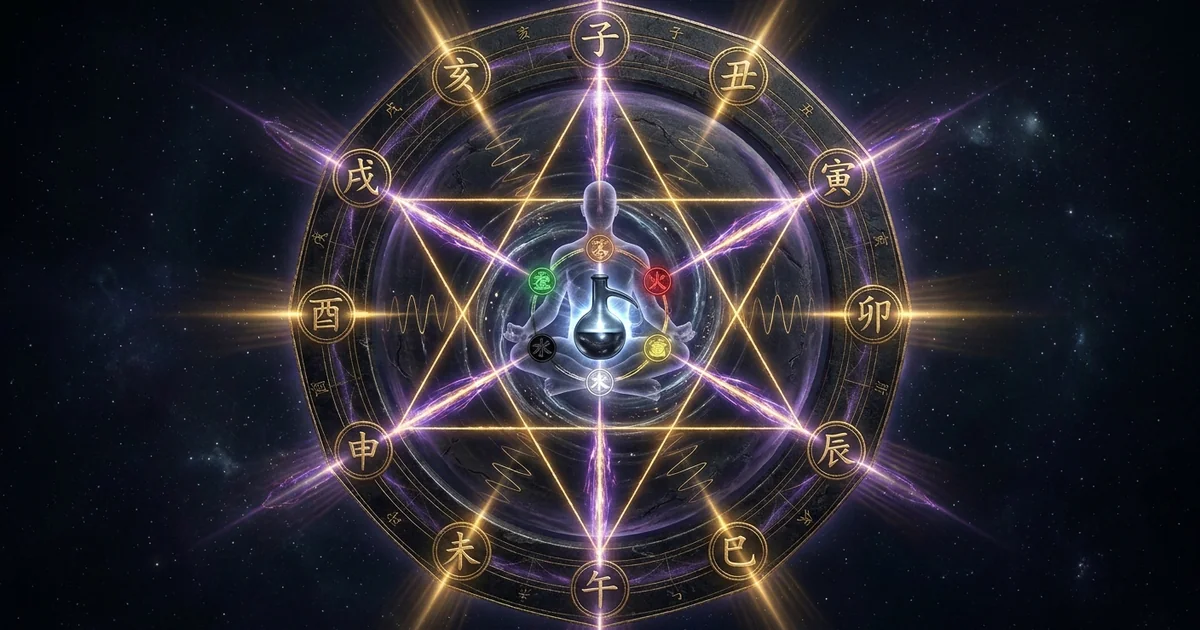
Clashes and Combinations: Earthly Branch Dynamics BaZi
Archetypal Thesis & Systemic Paradigm: The Vector Field of Di Zhi Dynamics
Earthly Branches as Spatial Phase Space and Somatic Grounding
Within the diagnostic architecture of BaZi (Eight Characters) chronomancy, the Earthly Branches (Di Zhi, 地支) constitute the dense, localized spatial matrix through which celestial energies condense into concrete somatic, psychological, and relational realities. While the Heavenly Stems (Tian Gan, 天干) model the disembodied, conscious intentionality and mental projections of the psyche, the Earthly Branches represent the manifest, biological, and instinctual ground of existence. In structural terms, if the Heavenly Stems represent pure ideation, vector potential, and externalized social presentation, the Earthly Branches represent the physiological chassis, the somatic unconscious, and the temporal phase space wherein these concepts either anchor or dissipate.
This duality forms the foundation of classical /astrology/bazi-four-pillars-foundations. Without the rooting mechanism provided by the Branches, the celestial vectors of the Stems remain ephemeral abstractions—psychic contents unintegrated into physical behavior or material circumstance. The twelve Earthly Branches operate as a non-linear coordinate matrix mapping the seasonal, diurnal, and structural distribution of Qi across twelve discrete phases of terrestrial manifestation. Each branch is an energetic vessel containing variable concentrations of the Five Elements (Wu Xing, 五行) locked within subterranean energetic chambers known as the Hidden Stems (Cang Gan, 藏干). Consequently, evaluating the dynamic tensions among the Branches is not a study of static points on a wheel, but an inquiry into the thermodynamics of the corporeal vessel, mapping where energy accumulates, where it ruptures, and where it achieves cohesive synthesis.
Dynamic Equilibrium vs. Deterministic Fatalism
Traditional fortune-telling frameworks have obscured the functional physics of the Four Pillars by imposing moralistic and fatalistic binaries upon complex energetic movements. Popular interpretations habitually categorize the Six Clashes (Liu Chong, 六沖) as catastrophic omens of ruin and the Six Combinations (Liu He, 六合) or Three Harmonies (San He, 三合) as markers of fortune and effortless grace. Such interpretations represent an epistemological degradation of classical Chinese metaphysics. In systemic analysis, the cosmos does not traffic in sentimental valuations of “good” or “bad.” Instead, it operates via thermodynamic self-regulation, seeking dynamic equilibrium across polarized fields.
A branch interaction is an archetypal phase transition. When viewed through the lens of analytical psychology and cybernetics, an energetic clash represents a violent systemic decompression—an acute disruption of inertia necessary to prevent terminal stagnation. Conversely, an unchecked combination can signify systemic calcification, psychological enmeshment, and the pathological refusal of the ego structure to adapt to evolutionary imperatives. By stripping the Earthly Branch interaction metrics of deterministic fatalism, one restores the Zi Ping model to its authentic operational status: a rigorous psycho-cosmological coordinate framework modeling the stress-strain relationships, structural compensations, and individuation thresholds of human consciousness.
Vector Mechanics of Qi: The Polarized Spacetime Continuum
The mechanics governing bazi clashes combinations earthly branches dynamics are grounded in the polarized spacetime continuum of Yin and Yang. The twelve branches are mapped along a spatial axis reflecting directional orientations (North, South, East, West, and their cross-quarters) and a temporal axis reflecting diurnal hours and solar terms (Jie Qi, 節氣). Every branch possesses a dynamic vector orientation determined by its intrinsic elemental polarity, its internal Hidden Stems, and its positional coordinate relative to the Taiji (the center of the chart). When two or more branches enter spatial proximity or transit relationships, their latent energy vectors undergo mathematical modulation.
These branch interactions act as a chronobiological clock. The cyclical rotation of transiting years, months, and days triggers specific internal subterranean chambers within the natal matrix, activating latent neurobiological pathways, archetypal complexes, and behavioral defaults. Rather than viewing the chart as a static natal imprint, it must be understood as an evolving dynamical system. Here, the vector mechanics of Qi govern the mobilization, transmutation, or destruction of root support (Gen, 根), compelling the individual consciousness to continuously renegotiate its internal alignment with the macrocosmic field.
“Time is a qualitative, fourfold continuum which contains an inherent disposition to unfold in meaningful coincidences… The ancient Chinese concept of time, as expressed in the I Ching and related divinatory matrices, views structural events not as consequences of past linear causes, but as simultaneous, spatialized energetic conditions occurring within a unified archetypal field.” — Marie-Louise von Franz, Time: Rhythm and Repose (1978)
Classical Provenance & Textual Lineage: From Han Cosmologies to the Zi Ping Canon
The Epistemological Shift: From Han Dynasty Nayin to Song Dynasty Solar Branches
The structural mechanics governing modern BaZi analysis did not emerge ex nihilo; they are the product of centuries of epistemological distillation. During the Han Dynasty, astrological and cosmological systems were inextricably bound to the Nayin (納音, Melodic Tone) system, heavily influenced by cosmological texts like Jing Fang’s Jing Shi Yi Zhuan (京氏易傳). The Nayin paradigm calculated energetic resonances using complex associations of musical harmonics, associating pairs of Heavenly Stems and Earthly Branches with specific acoustic and physical frequencies. In this early framework, destiny analysis was primarily focused on macrocosmic omens, ritual compliance, and the collective fate of dynastic lineages. The natal Earthly Branches were subordinate to cosmic acoustic resonance, and the individual subjective consciousness had not yet become the central axis of divination.
The major theoretical shift occurred during the Five Dynasties and early Song Dynasty under the revolutionary methodology pioneered by Master Xu Ziping (徐子平). In his foundational work, Yuan Hai Zi Ping (淵海子平, Deep Sea of Zi Ping), Xu Ziping abandoned the preeminence of the Year Pillar and the Nayin systems, shifting the ontological anchor of the chart to the Day Master (Ri Yuan, 日元) located on the Day Stem. This transformation altered the diagnostic value of the Earthly Branches. Rather than serving as passive markers of dynastic or ancestral lineage within the Nayin acoustic grid, the Branches became solar-aligned physical groundings for the Day Master. Master Ziping formalized the mechanics of the Six Clashes, Three Harmonies, and Six Combinations as direct mathematical equations based on the solar calendar, rooting human psycho-physiology directly within the seasonal dynamics of the ecliptic.
       Han Dynasty Cosmology (Jing Fang)
         [ Nayin Melodic Tones & Acoustic Harmonics ]
         [ Year Pillar Dominance / Macrocosmic Fate ]
                           │
                           ▼
          Tang Dynasty Transition (Li Xu-Zhong)
         [ Tri-Pillar Assessment: Year / Month / Day ]
         [ Nascent Elemental Weights & Interactions ]
                           │
                           ▼
          Song Dynasty Revolution (Xu Ziping)
         [ Four Pillars Architecture / Day Master Axis ]
         [ Solar-Aligned Earthly Branches (Di Zhi) ]
         [ Mathematical Codification of Liu Chong / San He ]
                           │
                           ▼
         Ming/Qing Classical Realism (Di Tian Sui)
         [ Elimination of Superstitious Folk Directives ]
         [ Ren Tie Jiao: Thermodynamic Elemental Physics ]
The Canonical Authority of Di Tian Sui and Yuan Hai Zi Ping
The codification of Earthly Branch mechanics reached its intellectual zenith with the writing of the Di Tian Sui (滴天髓, Dripping Heavenly Marrow), traditionally attributed to Liu Bowen of the Ming Dynasty, and its subsequent mid-Qing Dynasty annotation by Ren Tie Jiao (任鐵樵). While Yuan Hai Zi Ping established the diagnostic nomenclature and operational classifications of Branch behaviors, Di Tian Sui elevated the discipline by formulating an integrated physics of elemental movement. Ren Tie Jiao systematically excised the accretions of superstitious folklore, star spirits (Shen Sha, 神煞), and mechanistic fortune formulas that had degraded the tradition.
Instead, Di Tian Sui established the fundamental canon governing subterranean structural clashes and alliances: an Earthly Branch is not merely a signifier; it is an elemental reservoir with distinct behavioral parameters. Ren Tie Jiao demonstrated that the outcome of a clash or combination is entirely dependent upon the contextual thermodynamics of the natal matrix—namely, the seasonal command (Yue Ling, 月令), the dryness or dampness of the internal terrain, and the relative structural support offered by adjacent Pillars. Through this lineage, branch dynamics ceased to be superstitious omens and became an analytical science of elemental equilibrium.
“Earthly branches are silent and stationary, waiting to be activated. When branches combine, their Qi becomes focused and unified, yet this may result in either prosperity or binding bondage. When branches clash, their Qi is stirred into turbulent motion; if the root is decayed, the clash will tear it from the earth, but if the hidden fire or metal is blocked, the clash will liberate its light. Examine carefully the seasonal order; an activated branch within its season cannot be overcome, whereas an out-of-season branch subjected to clash is reduced to dust.” — Liu Bowen (Di Tian Sui, annotated by Ren Tie Jiao)
The Evolution of Branch Interaction Metrics Across Dynastic Commentaries
Across dynastic transitions, the conceptualization of the six clashes liu chong and harmonic structures evolved from literal interpretations to sophisticated relational dynamics. Early commentators often asserted that a clash invariably destroyed both interacting branches, viewing the dynamic as a catastrophic collision between mutually exclusive cosmic forces. By the time of the late Qing Dynasty, commentators like Shen Xiao Zhan in Zi Ping Zhen Quan (子平真詮) had refined the metric, asserting that the outcome of a clash depends on the specific battle between the dominant and subordinate elements within the /astrology/hidden-stems-cang-gan-mechanics.
This evolution marked an epistemological transition from binary to multidimensional systems thinking. Dynastic scholars recognized that in a clash between Zi (Rat, Yang Water) and Wu (Horse, Yang Fire), the Yang Water inherently damages the Yang Fire under equal volume; however, if the Wu Horse is situated within a blazing summer Month Branch, surrounded by supporting Wood elements, the Wu Horse does not break. Instead, the intense solar heat boils and evaporates the invasive Zi Water, turning the clash against the theoretical aggressor. Thus, the lineage reveals a progressive discovery of complex systemic rules: branch interactions are contextual, thermodynamic, and structurally dynamic.
Structural Mechanics & Symbolic Geometry: Clashes, Harmonies, and Transformations
The Six Clashes (Liu Chong): Polarity Reversals, Spatial Oppositions, and Root Excavation
The Six Clashes (Liu Chong, 六沖) represent the most acute structural disruptions within the BaZi architecture. Geometrically, the clashes operate across precise 180-degree oppositions on the zodiacal wheel, pitting directly antagonistic polarities, seasons, and elements against one another:
- Zi (Rat, Water) vs. Wu (Horse, Fire): North vs. South; Midnight vs. Noon; Winter Solstice vs. Summer Solstice.
- Chou (Ox, Wet Earth) vs. Wei (Goat, Dry Earth): North-Northeast vs. South-Southwest; Cold, frozen soil vs. Scorching, arid earth.
- Yin (Tiger, Yang Wood) vs. Shen (Monkey, Yang Metal): East-Northeast vs. West-Southwest; Spring dawn vs. Autumn twilight; The axe striking the growth of the forest.
- Mao (Rabbit, Yin Wood) vs. You (Rooster, Yin Metal): Pure Cardinal East vs. Pure Cardinal West; Spring Equinox vs. Autumn Equinox; Shearing blades pruning tender growth.
- Chen (Dragon, Wet Earth) vs. Xu (Dog, Dry Earth): East-Southeast vs. West-Northwest; The water reservoir of spring vs. The fire reservoir of autumn.
- Si (Snake, Yang Fire) vs. Hai (Pig, Yang Water): South-Southeast vs. North-Northwest; The expanding solar heat of early summer vs. The gathering cold of early winter.
                    Zi (Rat, Water) [0°]
                           ▲
                           │
       Hai (Pig)           │           Chou (Ox)
            \              │              /
   Xu (Dog)   \            │            /   Yin (Tiger)
        \       \          │          /       /
         \        \        │        /        /
You (Metal)───────┼────────┼────────┼─────── Mao (Wood) [90°]
 [270°]   \        \       │       /        /
           \        \      │      /        /
     Shen (Monkey)    \    │    /    Chen (Dragon)
            /              │              \
        Wei (Goat)         │           Si (Snake)
                           │
                           ▼
                    Wu (Horse, Fire) [180°]
When a Liu Chong manifests between two branches, the operational result is root excavation (Ba Gen, 拔根) or latent activation (Fa Dong, 發動). In natal chart analysis, if an Earthly Branch serves as the primary metabolic root (Gen) for a Heavenly Stem, a violent clash targeting that branch destabilizes the foundation. For example, if a Jia (Yang Wood) Day Master relies exclusively on an active Yin (Tiger) branch in the Day Pillar for vitality, and an incoming Shen (Monkey) branch clashes with the Yin, the structural coherence of the Day Master is undermined. The metal contained within the Shen directly cuts the Wood within the Yin.
However, the Six Clashes do not function solely as instruments of destruction. In systemic mechanics, when two Earth branches—such as the clash between the cosmological gates of Chen (Dragon) and Xu (Dog), or Chou (Ox) and Wei (Goat)—collide, the primary nature of Earth is not destroyed; rather, it is agitated and expanded. The clash breaks open the locked elemental vaults (Mu Ku, 墓庫), releasing the subterranean Hidden Stems. If the liberated hidden Qi consists of favorable elements (Yong Shen, 用神), the clash triggers a breakthrough, releasing vital resources that were previously trapped within inert psychological or somatic structures.
The Three Harmonies (San He) and Seasonal Directional Alliances (San Hui): Triadic Phase Transformations
Contrasting sharply with the disruptive polarization of the clashes are the structural unifications known as the Three Harmonies (San He, 三合) and the Seasonal Directional Alliances (San Hui, 三會). The Three Harmonies construct an equilateral triangular geometry across the zodiac, establishing a tripartite lifecycle system for each of the primary elements:
- Water San He (Shen-Zi-Chen): Shen (Birth/Zhang Sheng) $\rightarrow$ Zi (Peak/Di Wang) $\rightarrow$ Chen (Grave/Storage/Mu Ku).
- Wood San He (Hai-Mao-Wei): Hai (Birth) $\rightarrow$ Mao (Peak) $\rightarrow$ Wei (Grave/Storage).
- Fire San He (Yin-Wu-Xu): Yin (Birth) $\rightarrow$ Wu (Peak) $\rightarrow$ Xu (Grave/Storage).
- Metal San He (Si-You-Chou): Si (Birth) $\rightarrow$ You (Peak) $\rightarrow$ Chou (Grave/Storage).
The systemic elegance of the San He alliance lies in its synthesis of distinct temporal stages. It binds the initial impulse of an element (its birth branch), its absolute energetic apex (its cardinal peak branch), and its entropy-arresting containment chamber (its storage branch) into a singular energetic circuit. When all three branches assemble within a chart, the individual identities of the branches dissolve, yielding to the absolute dominance of the transformed element.
The Seasonal Directional Alliances (San Hui, 三會) represent an even more concentrated concentration of elemental force. By uniting three contiguous branches of a single season—Yin-Mao-Chen for Spring Wood, Si-Wu-Wei for Summer Fire, Shen-You-Xu for Autumn Metal, and Hai-Zi-Chou for Winter Water—the San Hui captures the uninterrupted climate of an entire quadrant of space-time. While a San He triad functions like an alchemical engine that transfigures disparate lifecycle phases into a unified purpose, a San Hui alliance acts as an immovable tectonic mass, monopolizing the chart’s energetic distribution and altering how all other elements behave.
The Six Combinations (Liu He) and the Latent Substructures of Hidden Stems (Cang Gan)
The Six Combinations (Liu He, 六合) operate along horizontal spatial axes, reflecting planetary alignment and orbital symmetry:
- Zi and Chou: Combine to foster Earth (or retain Cold Water).
- Yin and Hai: Combine to foster Wood.
- Mao and Xu: Combine to foster Fire.
- Chen and You: Combine to foster Metal.
- Si and Shen: Combine to foster Water (with underlying Fire-Metal friction).
- Wu and Wei: Combine to foster Sun and Moon, radiating pure Earth and Fire.
The mechanics of the Liu He demonstrate how localized cohesion occurs between adjacent polarities. Yet, these configurations cannot be decoded by surface appraisals of the outer branch animals alone; their dynamic behavior depends on the latent substructures of the Hidden Stems (Cang Gan, 藏干). Every branch houses primary (Ben Qi, 本氣), secondary (Zhong Qi, 中氣), and residual (Yu Qi, 餘氣) elemental frequencies. When a Liu He combination forms, these internal subterranean Stems engage in subtle micro-exchanges.
Branch Combination Matrix and Elemental Hidden Stems:
┌──────────────┬───────────────────┬───────────────────┬──────────────────────┐
│ Branch Pair  │ Polar Identities  │ Dominant Cang Gan │ Alchemical Output    │
├──────────────┼───────────────────┼───────────────────┼──────────────────────┤
│ Zi + Chou    │ Yang Water / Yin  │ Gui (Water) / Ji, │ Earth (Solidified    │
│              │ Earth             │ Gui, Xin          │ Mud / Frozen Soil)   │
├──────────────┼───────────────────┼───────────────────┼──────────────────────┤
│ Yin + Hai    │ Yang Wood / Yang  │ Jia, Bing, Wu /   │ Wood (Moist Growth / │
│              │ Water             │ Ren, Jia          │ Vital Sprouting)     │
├──────────────┼───────────────────┼───────────────────┼──────────────────────┤
│ Mao + Xu     │ Yin Wood / Yang   │ Yi (Wood) / Wu,   │ Fire (Combustion of  │
│              │ Earth             │ Xin, Ding         │ Timber and Dry Soil) │
├──────────────┼───────────────────┼───────────────────┼──────────────────────┤
│ Chen + You   │ Yang Earth / Yin  │ Wu, Yi, Gui /     │ Metal (Refined Ore / │
│              │ Metal             │ Xin (Metal)       │ Damp Auric Chamber)  │
├──────────────┼───────────────────┼───────────────────┼──────────────────────┤
│ Si + Shen    │ Yang Fire / Yang  │ Bing, Wu, Geng /  │ Water (Complex Fluid │
│              │ Metal             │ Geng, Ren, Wu     │ Tension / Dissolving)│
├──────────────┼───────────────────┼───────────────────┼──────────────────────┤
│ Wu + Wei     │ Yang Fire / Yin   │ Ding, Ji / Ji,    │ Unified Earth /      │
│              │ Earth             │ Ding, Yi          │ Blazing Solar Center │
└──────────────┴───────────────────┴───────────────────┴──────────────────────┘
Consider the combination of Yin (Tiger) and Hai (Pig). On the surface, it is a combination that yields Wood. Looking deeper, Hai houses Ren (Yang Water) and Jia (Yang Wood), while Yin houses Jia (Yang Wood), Bing (Yang Fire), and Wu (Yang Earth). The primary Water of Hai nourishes the primary Wood of Yin, creating an organic synergy that cultivates generative vitality. However, the internal Water of Hai can simultaneously extinguish the delicate infant Fire (Bing Fire) nestled inside the Yin branch if the ambient temperature of the chart is excessively cold. Thus, a combination does not uniformly preserve or nurture; it may suffocate internal creative potentials while presenting an external facade of peace and cohesion.
These mechanics run parallel to Western archetypal astrology, where apparent harmonies can mask deep structural tension. For further structural comparison between triadic harmonies and harmonic planetary geometries, see /astrology/planetary-aspects-archetypal-tensions.
Psychological Dynamics & Operational Praxis: Archetypal Tension and Individuation
Liu Chong as Catalytic Disruption: Shadow Projection, Somatic Crisis, and Breakthrough
When translated into Jungian archetypal psychology, the six clashes liu chong operate as violent intrusions of the Shadow into conscious awareness. The conscious ego structure, anchored by the Day Master and its supportive natal frameworks, seeks stability, systemic predictability, and continuity. A Liu Chong occurring either between natal branches or induced through the transiting Ten-Year Luck Pillars (Da Yun, 大運) shatters this psychological homeostasis. The clashed branch represents an unconscious, disowned, or neglected archetypal complex demanding conscious recognition.
CONSCIOUS EGO AXIS
   (Day Master / Root Support)
               │
               │  [ Chronic Structural Repression ]
               ▼
   [ Somatic / Latent Tension ]
               │
       LIU CHONG ACTIVATION (Transit or Natal Axis)
               │
               ├───────────────────────────────┐
               ▼                               ▼
    [ Catastrophic Breakdown ]     [ Individuation Catalyst ]
    - Ego-Fragmentation            - Shadow Assimilation
    - Somatic Symptom Formation     - Neurosis Deconstruction
    - Destructive Acting-Out       - Psychic Phase Transition
When an individual experiences a Mao-You (Rabbit vs. Rooster) clash along the Day-Month axis, the pure, organic, flexible Wood archetype collides with the sharp, discerning, analytical Metal archetype. Psychologically, this does not manifest as an abstract idea, but as intense emotional friction: relational codependency suddenly attacked by hyper-critical detachment, or artistic intuition paralyzed by severe structural critique. If the ego refuses to assimilate the challenging polarity, the tension drops into the somatic layer, producing migraines, musculoskeletal tension, or hepatic and neurological distress.
Conversely, when navigated with psychological literacy, this disruptive clash serves as a breakthrough moment. The clash shatters an outworn persona, liberating the individual from toxic loyalty to a static self-image and accelerating individuation.
San He and Liu He as Cohesive Synthesis: Ego Integration and Relational Bonding
If clashes act as psychic particle accelerators, the three harmonies san he and liu he configurations represent cohesive synthesis, ego stabilization, and psychic integration. The San He trines integrate diverse instincts into a unified purpose. An individual who activates a complete Fire Trinity (Yin-Wu-Xu) synthesizes expansive visionary ambition (Yin), radiant executive charisma (Wu), and the capacity to contain and preserve creative accomplishments (Xu). The disparate drives of the psyche align in service of a single overarching goal.
Yet, this integration carries shadow qualities of its own. Excessive branch combinations can manifest as systemic inertia, psychological calcification, and emotional dependency. When a BaZi chart is overwhelmed by combinations without the balancing friction of clashes or dynamic controls, the psyche frequently suffers from an inability to establish firm personal boundaries. The individual becomes enmeshed within family systems, stagnant relationships, or institutional hierarchies, mistaking a lack of friction for genuine harmony. Under these conditions, combinations form a psychological cage that insulates the ego from the transformational crises essential for mature individuation.
Liu Chong (The Six Clashes)
- Primary Psychic Function: Catalytic disruption, shadow surfacing, rupture of stagnant ego defenses.
- Somatic Signature: Acute sympathetic nervous system arousal, kinetic shifts, episodic somatic discharges.
- Structural Trigger Condition: 180-degree spatial opposition across the zodiacal axes.
- Pathological Expression: Chronic fragmentation, internal volatility, somatic burnout, structural failure of elemental roots.
- Individuation Outcome: Emancipation from outworn psychological narratives, structural differentiation, radical transformation.
San He (The Three Harmonies)
- Primary Psychic Function: Cohesive integration, instinctual synthesis, purposeful alignment of drives.
- Somatic Signature: Parasympathetic stabilization, cellular cohesion, metabolic equilibrium.
- Structural Trigger Condition: 120-degree trinal alliance joining Birth, Peak, and Grave lifecycle stages.
- Pathological Expression: Psychological inertia, relational codependency, systemic enmeshment, resistance to necessary change.
- Individuation Outcome: Structural stabilization, consolidation of creative power, systemic maturity.
The Operational Decryption Protocol: Pillar Positioning, Transit Triggers, and Elemental Balance
To diagnose the operational impact of clashes and combinations, the investigator must analyze the specific Pillar locus within the Four Pillars framework. Each pillar operates as an energetic layer of human experience:
- Year Pillar (Ancestral / Social Layer): Houses the individual’s transgenerational inheritance, broader sociopolitical environment, and ancestral archetypes. A clash here disrupts one’s social standing or prompts a break from cultural conditioning.
- Month Pillar (Parental / Professional Layer): Represents early upbringing, the familial hearth, and the primary career trajectory. Disruptions here typically destabilize vocational identity or renegotiate parental bonds.
- Day Pillar (Somatic / Spousal Layer): The Day Branch (Spouse Palace) directly underlies the Day Master, representing the physical body and primary intimate partnership. A clash here manifests as somatic illness, profound relationship restructuring, or an internal psychological crisis.
- Hour Pillar (Subconscious / Legacy Layer): Represents private aspirations, the deep subconscious, creative output, and children. Clashes here affect long-term life direction, investment of vital force, and the transgenerational integration of wisdom.
Operational decryption requires observing how incoming transits (Da Yun or the annual Liu Nian, 流年) engage this natal landscape. If a transit introduces a clash to the Month Pillar while simultaneously completing a Three Harmonies structure with the Day and Hour Pillars, the subject undergoes professional dislocation that simultaneously fuels domestic or creative integration. The analyst must weigh elemental volume, seasonal dominance, and directional vectors to determine whether the structural matrix will expand or collapse under the incoming transit pressure.
Philosophical Synthesis & Macrocosmic Correspondence: Hermetic Axioms and Chronobiology
Microcosm-Macrocosm Isomorphism: The Hermetic Law of Polarity in Chinese Cosmography
The systemic architecture of Earthly Branch interactions demonstrates the universal Hermetic maxim: “As above, so below; as within, so without.” The second Hermetic principle, the Law of Polarity, states that everything is dual, possessing poles of opposites that are identical in nature yet different in degree. In Chinese cosmography, this exact operational reality is encoded through the structural dynamic between the Six Clashes and the Combinations. The clashes are not foreign intrusions into an otherwise orderly universe; they are the natural counter-weights to harmony, providing the necessary kinetic tension that keeps cosmic and human systems from devolving into entropic stagnation.
This macrocosmic geometry reflects the same cosmological tensions mapped in the Hexagram configurations of the I Ching. For a deeper examination of these structural archetypes, consult /iching/trigram-elemental-vectors. Just as the polarized trigrams of Fire and Water (Li and Kan) contain and define each other, the spatial axis of Zi and Wu represents not a destructive rupture, but an indivisible circuit of cosmic circulation. The macrocosmic field cycles endlessly between structural concentration (combinations) and energetic dispersion (clashes). The individual BaZi chart serves as an isomorphism of this universal field, reflecting the macrocosmic architecture within human consciousness.
Chronobiological Phase Locking: Circadian and Circannual Rhythms of the 12 Branches
The twelve Earthly Branches bridge metaphysical archetypes and biological reality through circadian and circannual rhythms. Traditional Chinese Medicine (TCM) maps the distribution of vital energy across the twelve principal organ meridians throughout the twenty-four-hour diurnal cycle, dedicating a two-hour double-hour (Shi Chen, 時辰) to each branch. This chronobiological phase-locking demonstrates that branch interactions correspond directly to somatic and metabolic rhythms.
- Zi (Rat): 23:00–01:00 | Gallbladder Meridian | Winter Solstice Axis (0° Ecliptic) | Polar Archetype: Pure Seed Yin shifting to Yang.
- Chou (Ox): 01:00–03:00 | Liver Meridian | Mid-Winter Storage (30° Ecliptic) | Deep filtration, internal emotional recalibration.
- Yin (Tiger): 03:00–05:00 | Lung Meridian | Early Spring Impulse (60° Ecliptic) | Oxygenation, somatic awakening, primordial Qi mobilization.
- Mao (Rabbit): 05:00–07:00 | Large Intestine Meridian | Spring Equinox Axis (90° Ecliptic) | Elimination, directional somatic expansion.
- Chen (Dragon): 07:00–09:00 | Stomach Meridian | Late Spring Moist Soil (120° Ecliptic) | Nutritive grounding, digestion, reservoir gathering.
- Si (Snake): 09:00–11:00 | Spleen Meridian | Early Summer Flame (150° Ecliptic) | Metabolic transformation, intellectual focus.
- Wu (Horse): 11:00–13:00 | Heart Meridian | Summer Solstice Axis (180° Ecliptic) | Peak consciousness, cardiovascular circulation, solar culmination.
- Wei (Goat): 13:00–15:00 | Small Intestine Meridian | Mid-Summer Heat (210° Ecliptic) | Assimilation of nutrients, sorting the clear from the turbid.
- Shen (Monkey): 15:00–17:00 | Bladder Meridian | Early Autumn Metal (240° Ecliptic) | Fluid filtration, systemic boundary management.
- You (Rooster): 17:00–19:00 | Kidney Meridian | Autumn Equinox Axis (270° Ecliptic) | Filtration of essence (Jing), consolidation of reserves.
- Xu (Dog): 19:00–21:00 | Pericardium Meridian | Late Autumn Fire Storage (300° Ecliptic) | Somatosensory shielding, relational defense, thermal protection.
- Hai (Pig): 21:00–23:00 | Triple Burner (San Jiao) | Early Winter Water (330° Ecliptic) | Systemic fluid and thermal regulation, metabolic repair.
When a native chart undergoes an intense clash, the systemic destabilization regularly manifests within these exact chronobiological circuits. A violent natal or transit clash against the Chou branch routinely provokes hepatic stress, impaired metabolic detoxification, or erratic neuro-chemical surges during the 01:00–03:00 window. Conversely, clashes involving the Wu branch directly perturb the Heart meridian and the cardiovascular system, manifesting as palpitations, sleep architecture disruption, and acute anxiety crises. The Earthly Branches are not abstract cultural symbols; they are structural representations of biological and temporal phase spaces.
BaZi as a Non-Linear Dissipative Dynamical System
The interaction mechanics of the Four Pillars can be understood through the lens of modern complexity science, particularly Nobel laureate Ilya Prigogine’s formulation of non-linear dissipative structures. Prigogine demonstrated that open thermodynamic systems far from equilibrium maintain their internal organization by actively dissipating entropy into their surrounding environment. When exposed to external energetic perturbations, such systems encounter bifurcation points—critical moments of instability where the system must either collapse into chaos or reorganize at a higher level of structural complexity.
FAR-FROM-EQUILIBRIUM PSYCHE
           │
           │  [ External Transit Perturbation ]
           ▼
    BIFURCATION POINT (Liu Chong / Dynamic Structural Friction)
           │
           ├───────────────────────────────┐
           ▼                               ▼
  [ Systemic Dissolution ]       [ Higher-Order Self-Organization ]
   - Pathological Entropic Drag   - Structural Individuation
   - Somatic / Ego Breakdown      - Expanded Psychic Capacity
In this framework, the BaZi matrix is a non-linear dissipative structure. The combinations (San He and Liu He) provide internal cohesion and systemic self-stabilization, preventing the premature dispersal of psychic energy. However, if left uninterrupted, this internal cohesion leads to thermodynamic equilibrium—which, in living systems, equals psychological and systemic death.
The Six Clashes act as necessary perturbations that push the system far from equilibrium. A Liu Chong destabilizes the chart’s current psychological balance, forcing the individual into an existential bifurcation point. The clash disrupts entrenched patterns of behavior, dismantling defensive ego structures to permit self-organization at a higher level of consciousness. Thus, the apparent disruptions of the Earthly Branches are an essential cybernetic feedback loop through which the human psyche evolves toward maturity.
Frequently Asked Questions: Advanced Branch Interaction Mechanics
Does an Earthly Branch Clash Always Signify Calamity or Destabilization?
No. The characterization of the Six Clashes (Liu Chong) as fundamentally calamitous is an oversimplification of classical Zi Ping mechanics. The objective impact of a clash depends on the programmatic role of the clashed elements: specifically, whether the clash impacts the Favorable Element (Yong Shen, 用神) or the Unfavorable Element (Ji Shen, 忌神).
                            ANATOMY OF A CLASH
                                    │
            ┌───────────────────────┴───────────────────────┐
            ▼                                               ▼
[ Clash Targets Unfavorable (Ji Shen) ]         [ Clash Targets Favorable (Yong Shen) ]
            │                                               │
            ▼                                               ▼
- Liberation of Stagnant Potential             - Destruction of Psychological Grounding
- Demolition of Entrenched Complexes            - Somatic Decompensation & Boundary Rupture
- Vocational & Psychological Breakthrough       - Environmental Destabilization
If an individual possesses a chart with excessive Water that drowns the Day Master’s vitality, the Water element operates as an oppressive Ji Shen. Should an incoming transit introduce a vigorous Wu (Horse, Fire) or Chen/Xu (Earth) clash that attacks and walls off this uncontrolled Water, the individual does not experience calamity. Instead, they experience a liberating breakthrough—the dissolution of chronic depression, the severing of toxic attachments, or a sudden emergence of agency. A clash is merely focused structural agitation. When it destabilizes pathology, it produces liberation; only when it shatters the core supportive root (Gen) of the Day Master does it result in physical, psychological, or situational trauma.
Can a San He or Liu He Combination Fully Neutralize an Impending Liu Chong?
In the structural hierarchy of branch dynamics, combinations and clashes routinely moderate, redirect, or suspend one another, but a combination rarely eradicates the kinetic tension of a clash. The interplay is governed by spatial proximity, seasonal command (Yue Ling), and elemental dominance.
Structural Resolution Mechanisms in Branch Clashes & Combinations:

1. Proximal Mediation (Spatial Proximity):
   [ Clashing Branch A ] ─── [ Neutralizing Branch B ] ─── [ Target Branch C ]
         (Clash is intercepted and structurally diffused across the spatial axis)

2. Energetic Priority Hierarchy:
   Directional Alliance (San Hui)  ──►  Overrides all clashes absolute
   Three Harmonies (San He)         ──►  Shields core elements; internal tension remains
   Six Combinations (Liu He)        ──►  Suspends clash if bond energy > clash energy

3. Latent Preservation:
   [ Combined State ] + [ Clash Pressure ] = Latent Subterranean Frictional Charge
When an Earthly Branch is simultaneously targeted by a clash and a combination, classical theory recognizes that “combination resolves clash” (He Neng Jie Chong, 合能解沖)—provided the combining branches sit directly adjacent to one another. For instance, if a natal Mao (Rabbit) is flanked directly by a Xu (Dog) branch, their tight Six Combination forms an energetic bond. If an incoming You (Rooster) attempts to clash the Mao, the Mao-Xu bond absorbs the impact, mitigating structural damage to the Mao.
However, this does not erase the kinetic force. Instead, the clash applies pressure to the combination itself, straining the bond and often activating the Hidden Stems within all three branches. If the incoming clashing element matches the prevailing season, it can rupture the combination entirely, forcing the branch to confront the opposition directly.
How Do Hidden Stems (Cang Gan) Behave When a Branch Is Simultaneously Clashed and Combined?
When an Earthly Branch is trapped within a concurrent clash and combination, the internal Hidden Stems (Cang Gan) enter an agitated state known as subterranean elemental friction. The combination binds the primary outer branches, preventing overt separation, while the clash destabilizes the internal chambers, pitting the internal elements directly against one another.
Consider a scenario where a natal Yin (Tiger) branch experiences a simultaneous combination with Hai (Pig) and a clash from Shen (Monkey):
                   CONCURRENT CLASH AND COMBINATION

                   Hai (Pig) [Ren Water, Jia Wood]
                              │
                              │  (Liu He Combination Axis)
                              ▼
  Shen (Monkey) ────────► Yin (Tiger) ◄──────── Shen (Monkey)
[Geng, Ren, Wu]          [Jia, Bing, Wu]        (Liu Chong Axis)
                              │
                              ▼
                SUBTERRANEAN ELEMENTAL FRICTION
  1. Geng Metal (in Shen) strikes Jia Wood (in Yin).
  2. Ren Water (in Hai & Shen) extinguishes Bing Fire (in Yin).
  3. Residual Wu Earths engage in systemic consolidation.
In this energetic crucible, the external appearance remains stable because the Yin-Hai combination prevents structural collapse. Internally, however, the Hidden Stems engage in severe elemental warfare:
- The Yang Metal (Geng) within the incoming Shen branch cuts the Yang Wood (Jia) within the Yin branch.
- Simultaneously, the Yang Water (Ren) housed within both Shen and Hai douses the vital Yang Fire (Bing) inside the Yin branch.
- The internal creative drive (Bing Fire) is snuffed out by hidden water, while the structural roots (Jia Wood) sustain damage from hidden metal.
The psychological manifestation of this configuration is distinct: outwardly, the individual projects cohesion, partnership, and professional continuity, but inwardly struggles with acute cognitive dissonance, anxiety, and hidden structural depletion. The subterranean stems exhaust themselves until the dynamic is resolved by seasonal shifts or external transits that decisively break the combination or exhaust the clashing vector. Decoding these hidden branch interactions allows the practitioner to see beyond surface appearances and accurately evaluate the internal energetic state of the system.