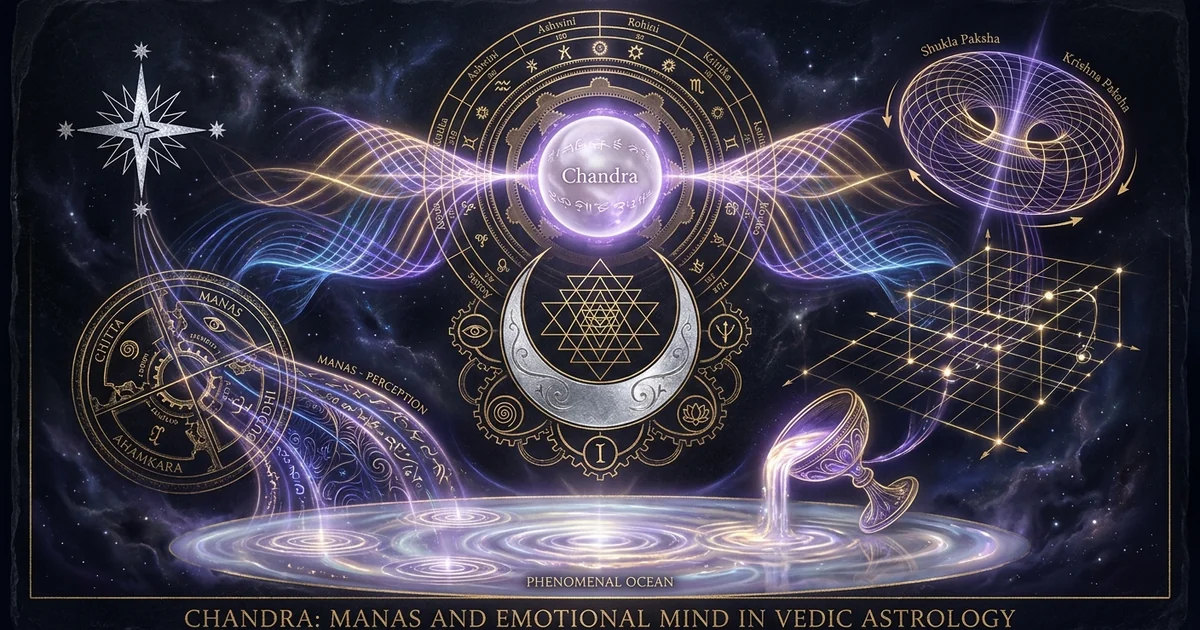
Chandra: Manas and Emotional Mind in Vedic Astrology
Archetypal Thesis & Systemic Paradigm: Chandra as the Reflective Interface of Consciousness
In the classical taxonomy of Jyotish (Vedic astrology), celestial bodies are not conceived as distal, mechanistic engines exerting crude gravitational influence upon terrestrial biology. Rather, they represent macrocosmic projections of micro-psychic architecture. Within this psycho-cosmological coordinate framework, Chandra (the Moon) serves as the primary operational substrate of Manas—the lower cognitive apparatus, perceptual routing mechanism, and reactive affective center within the quaternary framework of the Antahkarana. While contemporary Western astrological interpretations frequently reduce the lunar principle to a generalized index of emotional interiority, sentimentality, or instinctual safety, classical Vedic epistemologies accord Chandra a far more systemic, computational role: it is the cybernetic interface through which unconditioned consciousness engages phenomenal temporality.
The Antahkarana Matrix: Differentiating Manas, Buddhi, Ahamkara, and Chitta
To comprehend the operational mechanics of the Moon in the natal chart, one must situate it precisely within Samkhya philosophy and the structural topology of the mind (Antahkarana). The mind is not a monolithic entity; it is a four-tiered cognitive continuum comprising Chitta (the foundational repository of subconscious memory and impression), Ahamkara (the principle of ego-individuation and subjective ownership), Buddhi (the higher deterministic intellect, moral discrimination, and sovereign will), and Manas (the processing terminal of sensory inputs and affective impulses). Chandra rules Manas.
As the regent of Manas, Chandra does not formulate ethical mandates or engage in long-range strategic calculus—functions properly ascribed to Buddhi (governed by Mercury/Budha and Jupiter/Guru). Instead, Chandra coordinates the immediate data-stream arriving through the ten senses (Jnanendriyas and Karmendriyas). It oscillates continuously between Sankalpa (conception, volition, assimilation of experience) and Vikalpa (doubt, conceptual variation, structural rejection). When the rashi chart jyotish reveals a compromised Moon, the operational failure does not occur at the level of abstract intellect; rather, it manifests as an inability to mediate sensory input without acute affective distortion, causing the entire Antahkarana to oscillate in a perpetual state of cognitive reactivity.
Epistemological Divergence: Solar Ontological Radiance vs. Lunar Phenomenological Mirroring
Vedic psycho-cosmology models the psyche as an energetic dyad constituted by Surya (the Sun) and Chandra. Surya represents the Atman—the self-luminous, transcendental, unconditioned witness (Sakshi) that subsists outside temporal contingency. The Sun generates light; it is ontological presence. Conversely, Chandra possesses no intrinsic luminosity. It is fundamentally reflective, cool (Sheetala), fluctuating, and receptive. Epistemologically, while Surya denotes ontological reality as it is in itself, Chandra denotes phenomenological reality as it is perceived and mediated by the embodied subject.
Human experience is not lived within the blazing, undifferentiated ontology of the Sun; mortals inhabit the reflective, conditioned twilight of the Moon. A human being encounters the cosmos exclusively through the sensory translations rendered by Manas. If the lunar mirror is warped, fractured by malefic rays, or starved of solar irradiance, the subject’s apprehension of reality becomes warped, irrespective of the Sun’s intrinsic strength. Thus, while Surya signifies the spiritual seed and cosmic destiny, Chandra provides the fertile psycho-somatic matrix (Prakriti) within which that seed either germinates or atrophies. In the calculus of lived human experience, the chandra moon manas vedic astrology mind matrix operates as the central clearinghouse of mortal fate.
The Cybernetic Feedback Loop: Sensory Input, Affective Inscription, and Samskaras
The functional architecture of Chandra operates as a cybernetic feedback loop that continuously transcribes ephemeral reality into permanent psychic architecture. External stimuli strike the sensory organs; Manas (Chandra) immediately registers the qualitative tone of the contact (Vedana—pleasurable, painful, or neutral), triggering rapid affective attraction (Raga) or aversion (Dvesha). These reactive pulses are subsequently claimed by Ahamkara (“This is happening to me”) and submitted to Buddhi for rationalization.
Critically, every iteration of this loop deposits a residual trace (Samskara) into the unconscious substrate of Chitta. These Samskaras coagulate into dynamic behavioral patterns (Vasanas), which subsequently predispose the lunar apparatus to perceive future incoming stimuli through pre-existing neurotic or harmonious filters. Chandra, therefore, is not merely an emotional register; it is the physical and subtle CPU managing the inscription, storage, and retrieval of conditioned responses. The planetary state of Chandra indicates whether the native possesses an elastic, resilient psychological processing loop or one characterized by rigid defensive fixations and affective decompensation.
Classical Provenance & Textual Lineage: The Lunar Matrix in Vedic Codices
The ontological priority assigned to the lunar apparatus in Indian metaphysical thought is anchored in the earliest shruti and smriti literatures. The relationship between the celestial orb and the neurobiology of the macrocosmic and microcosmic entities is systematically articulated throughout Vedic, Puranic, and classical astrological scriptures.
Rigvedic Cosmogenesis: ‘Candrama Manaso Jatah’ and the Cosmic Mind
The foundational cosmological justification for equating Chandra with Manas emerges directly from the Purusha Sukta of the Rigveda (10.90.13):
$$\text{“Candramā manaso jātaś cakṣoḥ sūryo ajāyata |”}$$
This cosmogonic revelation establishes that during the sacrificial self-differentiation of the Purusha (the cosmic anthropomorphic unity), the Moon emerged specifically from the divine Manas, while the Sun arose from the eye (Chakshu). This is not metaphorical poetry; it is an epistemological blueprint. The physical Moon is explicitly recognized as the cosmic analog of the cosmic psychic organ. Consequently, the fluctuations of the celestial Moon directly entrain the mental fields of all biological entities nested within the terrestrial bio-sphere. Because the individual mind (Vyashti Manas) is an isomorphic holographic fragment of the cosmic mind (Samashti Manas), the natal Moon maps the structural integrity, latent vulnerabilities, and cognitive limitations of the native’s subjective perceptual matrix.
The Parashari Canon: Chandra as the Karaka of Relationality and Motherhood
In the definitive astrological treatise Brihat Parashara Hora Shastra (BPHS), Maharishi Parashara methodically outlines the structural attributes, physical forms, and psychological functions of the Grahas. Parashara classifies Chandra as the primary significator (Karaka) of the maternal archetype (Matri Karaka), physiological fluids (Rasa), and psychological constitution.
“Chandra is predominantly sattvic, intelligent, possesses a round body, is an eloquent speaker, auspicious-eyed, fickle-minded (chitta-chanchala), and amorous.”
The classical characterization of Chandra as chitta-chanchala (“fickle” or “restlessly oscillating”) provides crucial insight into the Vedic comprehension of neuro-affective dynamics. This restlessness is not inherently pejorative; rather, it refers to cognitive neuroplasticity. The mind must be fluid, malleable, and hyper-responsive to ambient environmental shifts in order to preserve physiological life. Parashara’s simultaneous designation of the Moon as the maternal principle connects early infantile developmental dynamics with long-term psychic stability. The maternal bond constitutes the primary emotional conditioning chamber where the neonate’s Manas acquires its baseline orientation toward trust, safety, and sensory homeostasis. When Parashara evaluates the affliction of the Moon in early life, he diagnoses the fragmentation of this maternal mirror, which directly engenders early mortality (Balarishta) or enduring psychological fractures.
Jaimini Sutras and the Delineation of Chara Karakas: The Soul’s Material Reflection
Within the non-linear, aphoristic paradigm of the Jaimini Upadesha Sutras, the analytical gaze shifts from fixed significations (Sthira Karakas) to variable temporal indicators (Chara Karakas). In this framework, Chandra’s role as the vessel of experiential processing is further amplified through the dynamics of the Atmakaraka (the planet at the highest longitudinal degree in any sign, indicating soul destiny) and the Amatyakaraka (the intellectual and executive agency).
Whenever Chandra assumes the status of Atmakaraka or interacts intimately with it in the Karakamsha, the individual’s spiritual trajectory becomes inextricably linked with the mastery of affective polarity. Jaimini emphasizes that material manifestations, relational conflicts, and spiritual awakenings occur through the mirror of planetary projections onto the Moon. In the Jaimini paradigm, chart interpretation without extensive evaluation of the Moon’s dispositor and the houses reckoned from the Moon (Chandra Lagna) is considered completely blind to the actual phenomenological life of the native.
Structural Mechanics & Symbolic Geometry: Dignity, Paksha Bala, and Nakshatra Cartography
Determining the precise operational caliber of Chandra in a given nativity requires evaluating three interdependent structural axes: positional dignity (Kshetra Bala), positional phase luminosity (Paksha Bala), and asterism resonance (Nakshatra placement).
Lunar Dignity & Phase Coordinate Engine:
+-----------------------------------------------------------------------------------+
|                           CHANDRA COGNITIVE SPECTRUM                              |
|                                                                                   |
|  AMAVASYA (0°-12° from Sun)                              PURNIMA (180° from Sun)  |
|  Paksha Bala: 0 units                                    Paksha Bala: 60 units    |
|  Direction: Hyper-Subjective / Dissociative              Direction: Integrated    |
|  Neuro-Mode: Inward Processing / Psychic Void            Neuro-Mode: Radiant Mind |
+-----------------------------------------------------------------------------------+
                                          |
                                          v
+-----------------------------------------------------------------------------------+
|  TAURUS / ROHINI (3° Exaltation)               SCORPIO / JYESHTHA (3° Debilitation)|
|  - Sensory Grounding                           - Perceptual Hypervigilance         |
|  - High Affective Coherence                    - Affective Volatility              |
|  - Neurochemical Balance                       - Paranoia / Psychic Porosity       |
+-----------------------------------------------------------------------------------+
Paksha Bala as Quantitative Luminosity: The Shukla and Krishna Paksha Dynamic
Unlike the outer planets, whose static positional dignities dominate interpretation, Chandra’s primary structural strength derives from its angular separation from the Sun—a variable quantified as Paksha Bala (phase strength). In the system of Shadbala (six-fold planetary potency), Paksha Bala constitutes the single most important parameter for lunar assessment. The lunar cycle is split into two halves: Shukla Paksha (the waxing phase, moving from the New Moon, Amavasya, to the Full Moon, Purnima) and Krishna Paksha (the waning phase, returning to Amavasya).
The formula for determining Paksha Bala operates linearly based on longitudinal elongation:
$$\text{Paksha Bala (in Virupas)} = \frac{|\text{Longitude of Chandra} - \text{Longitude of Surya}|}{3}$$
When this separation equals 180 degrees (opposition/Full Moon), Paksha Bala reaches its theoretical maximum of 60 Virupas. Parashara asserts that a waxing Moon possessing high Paksha Bala (specifically from Shukla Paksha Ashtami through Krishna Paksha Saptami) behaves as a natural benefic (Shubha Graha), projecting psychological resilience, self-soothing capacity, and social charm.
Conversely, when the Moon approaches the Sun (within 72 degrees of conjunction) and its illumination wanes below critical thresholds, it transforms into a functional malefic (Papa Graha). This Ksheena Chandra (depleted, dark Moon) starves Manas of the illumination necessary to regulate subconscious instinct. Even if posited in an ostensibly auspicious sign, an Amavasya Moon with minimal Paksha Bala can render the native prone to psychic exhaustion, depressive withdrawals, and somatic vulnerability.
Zodiacal Polarities: Exaltation in Vrishabha (Rohini) vs. Debilitation in Vrischika (Jyeshtha)
The spatial extremes of lunar functionality crystallize in its positions of exaltation (Uchcha) and debilitation (Neecha). Chandra achieves deep exaltation at 3 degrees of Vrishabha (Taurus), situated squarely within the constellation Rohini, governed by the cosmic creator Prajapati.
Chandra in Vrishabha (Exalted - 3° Rohini)
- Somatic Architecture: Fixed, earthy, venereal ground provides stabilizing counterweight to lunar volatility.
- Perceptual Processing: High sensory coherence; optimal translation of sensory input into aesthetic, metabolic, and emotional stability.
- Psychological Archetype: The secure, integrated child; radical receptivity; low baseline anxiety; natural capacity for self-regulation.
- Vulnerability: Lethargy, sensory fixation, emotional complacency, inertia.
Chandra in Vrischika (Debilitated - 3° Jyeshtha)
- Somatic Architecture: Fixed water, ruled by Mars and co-ruled by Ketu; a toxic, subterranean hydrothermal environment.
- Perceptual Processing: Hyper-reactive, paranoid, over-vigilant; constant anticipation of catastrophic boundary dissolution.
- Psychological Archetype: The hyper-vigilant survivor; constant probing of the psycho-affective underworld; chronic psychic porosity.
- Vulnerability: Emotional volatility, vindictiveness, severe psychosomatic distress, terror of betrayal.
The exaltation in Taurus stabilizes the restless oscillation of Manas by anchoring it in the physical senses, pragmatic resource acquisition, and material continuity. Conversely, the debilitation in Scorpio—specifically in the fiery, militaristic asterism Jyeshtha—strips the Moon of its reflective equanimity. Here, Manas plunges into the murky waters of subterranean power struggles, sexual-emotional entanglements, and existential dread. The psyche lacks an organic platform of trust; it must constantly deploy hypervigilant defense mechanisms to defend its porous boundaries against perceived destruction.
The 27 Nakshatras: The Lunar Mansions as Granular State-Spaces of Consciousness
The 12-sign zodiacal wheel (Rashi) provides merely a macroscopic, structural sketch of the psychological apparatus. The absolute core of Vedic lunar analysis resides within the 27 Nakshatras—a primordial lunar zodiac composed of equal $13^{\circ}20’$ arcs across the ecliptic. Chandra traverses approximately one Nakshatra per diurnal cycle, spending roughly 24 hours embedded within the mythic, archetypal field of each station.
The natal Moon’s Nakshatra (Janma Nakshatra) constitutes the fundamental cognitive baseline of the incarnated entity. It determines the psychological archetype through which all worldly impressions are received, contextualized, and translated:
- Ashwini (Ketu-governed, Aries): Sparks rapid, instinctual, initiating impulses; nervous excitability; an urgency to heal or initiate movement.
- Rohini (Moon-governed, Taurus): Induces hyper-sensuous receptivity, aesthetic immersion, and emotional seductiveness.
- Ardra (Rahu-governed, Gemini): Generates cognitive turbulence, existential angst, intellectual hyper-analysis, and transformative emotional storms.
- Magha (Ketu-governed, Leo): Imprints deep ancestral conditioning, aristocratic self-worth, and a compulsion toward historical continuity.
- Jyeshtha (Mercury-governed, Scorpio): Instills hyper-alert defensiveness, competitive jealousy, and protective occult acumen.
- Mula (Ketu-governed, Sagittarius): Initiates deep psychical decompression, systemic deconstruction of belief patterns, and existential alienation.
- Revati (Mercury-governed, Pisces): Manifests oceanic empathy, boundary dissolution, psychic impressionability, and transcendence of linear logic.
Understanding the vedic moon signs through the granular prism of its Nakshatra eliminates the broad-brush generalities of superficial astrology, exposing the specific psycho-spiritual dynamics governing the native’s cognitive hardware.
Psychological Dynamics & Operational Praxis: Chandra Lagna and Chart Interpretation
In high-level Vedic chart synthesis, the analysis does not terminate with the physical Ascendant (Udaya Lagna). The practitioner is mandated to rotate the horoscope, establishing the degree of the natal Moon as the primary Ascendant. This technique is known as Chandra Lagna.
The Chandra Lagna Shift: Decoding the Experiential Reality of the Native
While the Udaya Lagna reveals the external, objective, socio-somatic container—the physical body, social trajectory, and the material stage upon which destiny transpires—the Chandra Lagna unveils the internal phenomenological processing of that destiny. The Chandra Lagna is the horoscope of subjective apperception.
+-------------------------------------------------------------------+
|               THE EPIDEMIOLOGY OF THE DUAL ASCENDANT              |
|                                                                   |
|   UDAYA LAGNA (Physical Ascendant)   -->   Objective Material Reality |
|   - Structural somatic destiny            - Tangible achievements  |
|   - External socioeconomic status         - Material circumstances |
|                                                                   |
|   CHANDRA LAGNA (Lunar Ascendant)    -->   Phenomenological Reality|
|   - Internal subjective processing       - Mental health / Sukha   |
|   - The "lived" emotional experience      - Psychological stress   |
+-------------------------------------------------------------------+
A native possessing a powerful Tenth House from the Udaya Lagna may attain undisputed professional eminence and sociopolitical power. However, if the Tenth House from Chandra Lagna contains virulent malefics, or if the Moon itself occupies the Sixth, Eighth, or Twelfth houses (Driksthanas) devoid of support, the individual will experience their worldly success as chronic stress, mental anguish, and alienation. They live not in the objective reality of their external triumphs, but in the subjective reality mapped by the lunar Ascendant. Thus, Chandra Lagna serves as the ultimate arbiter of Sukha (contentment, psychological ease) versus Dukha (existential friction, grief).
Chandra Yogas: Sunapha, Anapha, Durudhura, and the Vacuum of Kemadruma
Classical authorities delineate several architectural planetary groupings surrounding the Moon, known collectively as Lunar Yogas. These configurations diagnose the level of psychological insulation or exposure the native experiences:
- Sunapha Yoga: Planets (excluding the Sun, Rahu, and Ketu) occupying the 2nd house from Chandra. This imbues the mind with self-derived intellectual, verbal, and financial confidence; the emotional field has a forward-looking security buffer.
- Anapha Yoga: Planets occupying the 12th house from Chandra. The native possesses innate subconscious reserves, derived from healthy integration of past karmic imprints, aiding sleep, psychic restoration, and self-restraint.
- Durudhura Yoga: Planets occupying both the 2nd and 12th houses from Chandra simultaneously. The psyche is flanked by supportive archetypal energies; the individual possesses emotional balance, resilience under pressure, and systemic psychological support.
- Kemadruma Yoga: The complete absence of planets in both the 2nd and 12th houses from Chandra, with no compensatory support from the lunar angles.
Kemadruma Yoga occurs strictly when there are no planets (excluding the Sun, Rahu, and Ketu) in the 2nd and 12th houses counted from Chandra. Its classical interpretation points to profound poverty, mental desolation, erratic behavior, and social alienation.
Rigorous Technical Verification of Cancellations (Bhanga): True Kemadruma is exceptionally rare due to numerous classical cancellation clauses codified by Varahamihira in Brihat Jataka:
- If there are planets in a Kendra (houses 1, 4, 7, 10) from the Lagna, the yoga is cancelled.
- If there are planets in a Kendra from Chandra itself, the yoga dissolves.
- If Chandra is conjunct a planet, or aspected by all planets, or aspected by the dispositor of Chandra, the yoga is cancelled.
- If full planetary aspects fall upon the Moon from powerful natural benefics (Jupiter, Venus, well-associated Mercury), the negative effects vanish.
When canceled, Kemadruma often transforms into a profound asset for contemplative, monastic, or intense intellectual pursuits, converting existential isolation into radical cognitive self-reliance and ascetic focus.
Without supportive planetary forces in flanking houses, the lunar mind floats in a cognitive void. The native perpetually struggles with an internal sense of exposure, an inability to lean on external psychological frameworks, and a deep-seated vulnerability to existential isolation.
Synthesizing the Sudarshana Chakra: Triangulating Lagna, Surya, and Chandra
The pinnacle of diagnostic synthesis in the Parashari paradigm is the deployment of the Sudarshana Chakra. This advanced framework requires the astrologer to draw three concentric wheels: the inner wheel governed by the physical Ascendant (Udaya Lagna), the middle wheel governed by the Lunar Ascendant (Chandra Lagna), and the outer wheel governed by the Solar Ascendant (Surya Lagna).
Each house is then interpreted simultaneously through all three perspectives:
- The Physical Wheel (Lagna): Indicates the structural, biological, and worldly manifestation of the house affairs.
- The Mental Wheel (Chandra): Indicates the psychological experience, emotional satisfaction, and personal resonance of those affairs.
- The Soul Wheel (Surya): Indicates the evolutionary, spiritual purpose and ultimate divine significance of those affairs.
When a specific house (such as the 7th House of partnership or the 10th House of vocation) is afflicted from the physical Lagna but highly supported from Chandra Lagna, the native encounters systemic objective difficulties in that domain, yet remains psychologically untouched, deriving internal fulfillment despite external chaos. Conversely, if a house is objectively prosperous from the physical Lagna but severely afflicted from the Moon, external riches and accolades will simply breed internal torment and neurosis.
Philosophical Synthesis & Macrocosmic Correspondence: Chronobiology and the Vimshottari Framework
The ultimate demonstration of Chandra’s central role in Vedic psycho-cosmology lies in the mechanics of temporal unfolding. In Jyotish, planetary transits (Gochara) do not dictate fate in isolation; they merely trigger the deeper chronological unfolding of the natal chart via the dynamic planetary period systems known as Dashas.
The Vimshottari Dasha Engine: Unfolding Destinal Time from the Janma Nakshatra
Of the dozens of conditional dasha systems preserved in classical literature, Maharishi Parashara explicitly designates the 120-year Vimshottari Dasha as universally applicable to humanity in the present cosmic epoch (Kali Yuga). The mathematical architecture of this foundational temporal engine is anchored exclusively to a single coordinate: the precise longitudinal position of Chandra at the moment of the first breath.
$$\text{Dasha Balance at Birth} = \left( \frac{\text{Arc remaining in Janma Nakshatra}}{13^{\circ}20’} \right) \times \text{Total Period of Nakshatra Lord}$$
The entire 120-year trajectory of an individual’s material incarnation—the sequence of which planetary archetypes will awaken, when karmas will mature, and when death will occur—is calibrated entirely by the Moon’s passage through its natal Nakshatra. If Chandra were simply an indicator of superficial moods, it would be mathematically absurd to anchor the entire chronological architecture of destiny to its position. This mechanics demonstrates the foundational premise of Vedic astrology: fate is an unfolding of consciousness. Objective temporal reality does not happen to a person; rather, the time-stream is projected outward from the conditioned sensory matrix of Manas. The Janma Nakshatra is the psychic seed crystal from which subjective time and objective fate continuously unfurl.
Jungian Active Imagination and the Anima: The Moon as Archetypal Bridge to the Unconscious
The deep structural affinity between the Vedic lunar archetype and modern depth psychology is unmistakable. In the psychoanalytic system of Carl Gustav Jung, the psyche is understood as an engine balanced between solar consciousness (the Ego complex) and the uncharted oceanic depths of the collective and personal unconscious. Within this framework, Chandra maps seamlessly onto both the personal unconscious and the archetypal Anima—the feminine, reflective soul-image that mediates between the ego and the transcendent Self.
“The Moon is the mother of all things, the vessel that receives the light of the Sun, transmuting objective masculine light into feminine, subjective psychological reality. Without this reflective mediation, the solar radiance would blind and incinerate the ego.”
Chandra provides the container (Vasana) without which the raw, blinding archetypal energy of the Atman (Surya) cannot be assimilated by the human nervous system. Just as the physical Moon cools the scorching rays of the Sun into gentle, silvery light suitable for biological growth, so too does Manas temper the absolute truth of pure Spirit into forms, symbols, archetypes, and relational currents accessible to mortal consciousness. When an astrologer engages in lunar chart delineation, they are mapping the native’s archetypal bridge to the unconscious. Afflictions to the Moon manifest precisely as the pathological dissociation from the feminine, somatic alienation, and the sudden emergence of destructive complexes from the unconscious deep.
Chitta Vritti Nirodha: Yogic Remediation and the Stabilization of Lunar Fluctuations
The ultimate convergence between Vedic astrology and Classical Yoga (as articulated in Patanjali’s Yoga Sutras) resides in the stabilization of the lunar mind. Patanjali defines the supreme purpose of Yoga as:
$$\text{“Yogaś-citta-vṛtti-nirodhaḥ” (1.2)}$$ (Yoga is the cessation of the modifications and fluctuations of the mental field).
Because Chandra governs the Vrittis—the turbulent, sensory whirlpools that continually destabilize human awareness—the classical remedies (Upayas) prescribed in Jyotish are essentially cybernetic stabilization routines for the lunar node:
- Mantra and Japa: Rhythmic sound repetition directly entrains the oscillating frequency of Manas, decoupling it from reactive external sensory inputs.
- Shiva Archana: The archetype of Shiva (Chandrashekhara, the one who wears the crescent Moon in his hair) symbolizes the absolute mastery of consciousness over the mind. By invoking Shiva, the native aligns the unstable Manas with transcendent awareness.
- Soma and Dietetics: The Moon governs all physiological fluids (Rasa) and the nervous system’s baseline tonicity. Classical Ayurveda prescribes lunar-stabilizing herbs (such as Brahmi, Shankhpushpi, and pure dairy fats) to coat the neurological myelin sheaths, providing the physical substrate for mental equanimity.
- Gemological Remediation (Mukta / Pearl): The application of an authentic, natural, unblemished Pearl set in silver serves as an energetic and psychological resonator, stabilizing the water element (Jala Tattva) within the psycho-somatic matrix.
These remedial procedures are not crude superstitious interventions designed to alter external planetary trajectories. They are precise, microcosmic bio-energetic adjustments designed to polish the lunar mirror, ensuring that Manas ceases to produce distorted, reactive illusions, and instead reflects the clear light of the Atman.
Frequently Asked Questions: Technical Discriminations in Lunar Jyotish
Resolving Discrepancies: Why Prioritize the Moon over the Sun in Vedic Chart Analysis?
A frequent point of confusion for students trained in Western tropical astrology is the absolute preeminence given to the Moon over the Sun in Vedic natal synthesis. In Western astrology, one’s fundamental identity is almost universally framed through the Sun sign. However, Vedic astrology recognizes that the Sun represents the unmanifest soul-potential—an abstract, transpersonal, and relatively static spiritual reality.
A spiritual seed cannot bear fruit without soil. Chandra provides the psychological, emotional, and neurobiological soil (Prakriti) through which the spiritual intent of the Sun must be realized. If an individual possesses an exalted Sun in Aries (suggesting immense innate authority and spiritual will) but a deeply afflicted, debilitated Moon in Scorpio devoid of Paksha Bala, the solar impulse remains functionally trapped. The native’s chronic emotional turbulence, relational hypervigilance, and somatic exhaustion prevent them from actualizing the solar potential. Conversely, a native with a modest or technically compromised Sun, but blessed with an exceptionally powerful, well-aspected, luminous Moon, will lead a deeply contented, socially effective, and psychologically integrated life. Jyotish prioritizes the Moon because human beings live within the subjective processing of their circumstances, not within the abstract potential of their ideals.
Evaluating Weak Luminosity: Does a Combust Moon (Amavasya) Invalidate Favorable Sign Placements?
The phenomenon of the New Moon (Amavasya), where Chandra enters the exact longitudinal degree of Surya, presents a complex interpretive problem. When any planet approaches within close range of the Sun, it suffers combustion (Asta). For the Moon, combustion means a total loss of Paksha Bala; it is starved of illumination.
When an Amavasya Moon is posited in its signs of rulership (Cancer) or exaltation (Taurus), a profound paradox emerges. The sign placement provides structural resilience (Kshetra Bala), ensuring that the native possesses high aesthetic discernment, biological stamina, and deep innate capacity for relational connection. However, the absence of Paksha Bala turns the mental light entirely inward.
Such a Moon does not necessarily indicate psychological pathology or low intelligence; rather, it invalidates the Moon’s capacity for easy, uninhibited outward emotional expression. The mind operates in a deep, hyper-subjective, often mystical or hyper-contemplative state. The native frequently feels invisible to others, experiences intense bouts of psychological fatigue, and struggles with clinical or sub-clinical depressive episodes due to a systemic deficit of emotional vitality. Therefore, a favorable sign placement preserves the architectural integrity of the cognitive vessel, but combustion fundamentally alters the fuel source, forcing the native to consciously generate internal illumination rather than casually absorbing it from the ambient social environment.
Operational Distinctions: How Does the Nakshatra Lord Alter the Expression of the Rashi Lord?
In the structural hierarchy of a horoscope, Chandra is mediated by a dual-rulership dynamic: the ruler of the zodiacal sign (Rashi Lord) and the ruler of the asterism (Nakshatra Lord). These two planetary entities govern entirely different dimensions of cognitive processing.
The Rashi Lord sets the macroscopic, socio-environmental, and behavioral theater in which the mind operates. It dictates the structural parameters, outer conditioning, and broad material resources accessible to Manas. For instance, if Chandra resides in Makara (Capricorn), the Rashi Lord is Shani (Saturn). The baseline psychological operating environment is therefore defined by Saturnian motifs: discipline, sobriety, material realism, pessimism, delayed gratification, and structural boundary formation.
In contrast, the Nakshatra Lord governs the subtle, instinctual, and subconscious engine driving the psychic organism. It reveals the primal karmic impulse and the implicit motivation underlying the native’s actions. If that same Capricorn Moon occupies the Nakshatra Shravana, the Nakshatra Lord is Chandra itself, imprinting an intense instinctual need for oral learning, listening, receptivity, and philosophical wisdom beneath the cold, Saturnian exterior. If the Moon instead occupies Dhanishta (ruled by Mangala/Mars), the native’s outer Saturnian composure is violently undercut by a fierce, competitive, rhythmic, and martial subconscious drive. Chart interpretation that ignores the Nakshatra Lord’s modification of the Rashi Lord remains entirely superficial, mistaking the external institutional framework of the mind for its underlying motivational current.