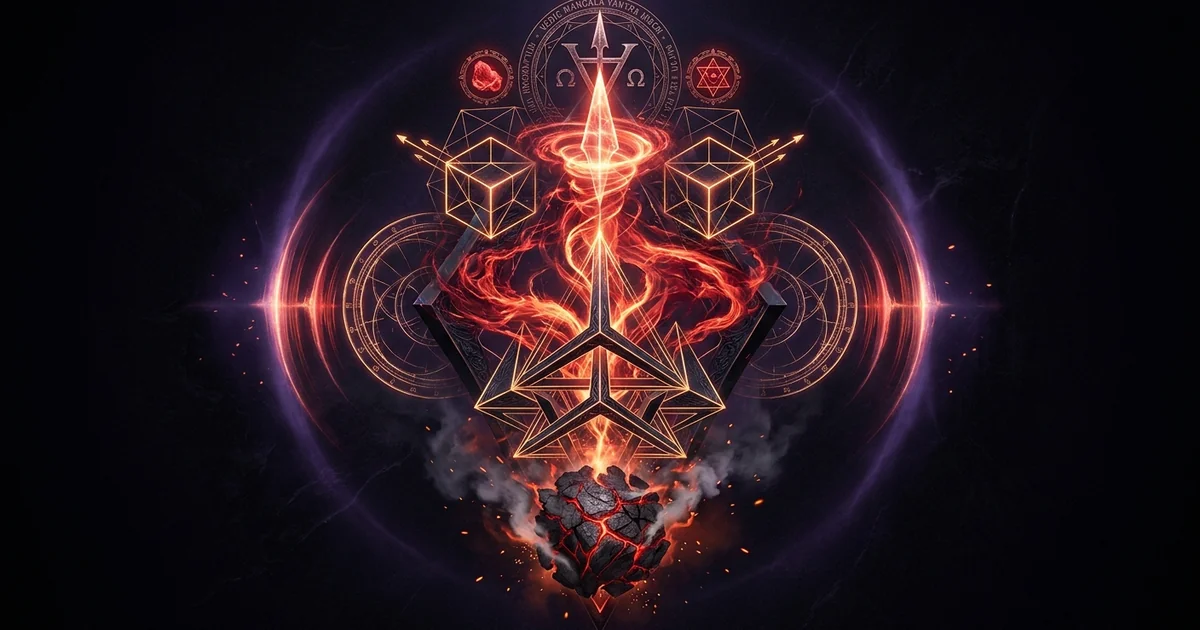
Mangala: Primal Courage and Karmic Fire in Jyotish
Archetypal Thesis & Systemic Paradigm: Mangala as the Thermodynamic Engine of Will
In the psycho-cosmological matrix of Jyotish, Mangala (the planet Mars) operates not as an arbitrary herald of misfortune or blind catastrophe, but as the foundational thermodynamic engine of incarnate consciousness. Within the architecture of the /astrology/vedic-navagraha-planetary-system, the Navagrahas function as dynamic, cybernetic feedback nodes that map the descent of unconditioned awareness into the constraints of spacetime. Within this teleological descent, Mangala represents the vector of kinetic expenditure. If the sovereign Sun constitutes the primary, transcendent source of radiant identity (Atman), Mangala is the focused beam of executive action (Paurusha) that translates ontological purpose into physical modification of the environment. Consciousness cannot execute self-actualization in a material medium without a localized expenditure of force. Mangala supplies the requisite kinetic energy, commanding the voluntary musculature, the catalytic enzymes of metabolism, and the somatic assertion required to imprint intentionality onto a resistant world.
The Metaphysics of Tejas: Solar Heat vs. Martial Combustion
The energetic continuum of the fire element (Agni tattva) manifests through distinct cosmological gradations within Vedic metaphysics. While /astrology/surya-archetype-solar-consciousness radiates Tejas as an unfluctuating, self-sustaining luminary radiance—the pure ontological presence of being—Mangala governs Krodha-Agni and Pachaka-Agni: the combustion generated through friction, resistance, and the thermodynamic breakdown of matter. Surya is the unmoving king at the center of the celestial organism, whereas Mangala is the field commander who enters the temporal trenches of contingency. This distinction is vital for understanding the psycho-energetics of action. Solar heat illumines and reveals, providing systemic coherence and moral order (Dharma); martial heat consumes, divides, and transforms through targeted stress.
Surya: Solar Tejas & Radiance
- Metaphysical State: Unconditioned luminescence; source of systemic coherence and core selfhood (Atman).
- Mode of Operation: Centripetal authority; radiates outward without experiencing mechanical friction or exhaustion.
- Psychic Correlate: Self-evident existence, conscious intentionality, sovereign will, and systemic integration.
- Physiological Domain: Cardiac vitality, ocular perception, systemic constitutional heat, and arterial flow.
Mangala: Martial Agni & Combustion
- Metaphysical State: Conditioned kinetic release; application of targeted heat through the friction of matter.
- Mode of Operation: Centrifugal projection; localized exertion that breaks resistance via biological effort.
- Psychic Correlate: Executive execution (Paurusha), boundary enforcement, territorial drive, and surgical discernment.
- Physiological Domain: Muscular contraction, erythrocyte proliferation, bone marrow synthesis, and enzymatic fire (Pitta).
Martial energy is intrinsically combustible because its evolutionary purpose demands the transformation of potential energy into kinetic output. This thermodynamic conversion inevitably produces heat, physical wear, and psychic friction. Where Surya asserts “I am,” Mangala asserts “I act, I penetrate, I demarcate.” Without this martial ignition, the contemplative realizations of the higher faculties remain suspended in inert abstraction. Mangala is the alchemical catalyst that breaks psychological inertia (Tamas), forcing consciousness out of undifferentiated latency into the empirical crucible of experience.
Bhumiputra: Terrestrial Embodiment and the Primal Drive
Classical iconography and Puranic genealogies designate Mangala by the patronymic Bhumiputra—the “Son of the Earth” (Bhumi or Dharani). This nomenclature is not merely symbolic ornamentation; it points directly to the biological and evolutionary imperative of boundary setting, territory, and somatic survival. Emerging from the primeval terrestrial matrix, Mangala represents the evolutionary threshold where raw geochemical matter acquires defensive, self-preserving consciousness. As Bhumiputra, Mars rules the somatic boundary: the skin’s capacity to register trauma, the muscular wall that repels penetration, and the neurochemical triggers that execute the acute stress response.
The terrestrial lineage of Mangala anchors the spirit directly to the survival drives of the mammalian organism. The territorial imperative—the innate mandate to carve out space, secure resources, and preserve physical integrity against environmental incursions—is the baseline operational architecture through which Mangala functions. The planet governs real estate (Bhumikaraka), minerals, heavy industrial infrastructure, and mechanical engineering precisely because these disciplines represent the subjugation and reorganization of dense terrestrial matter through focused force. Far from being a purely transcendental or ethereal mechanism, Mangala represents the sacred gravity of physical incarnation, demanding that the individual establish structural roots within the empirical terrain before attempting transpersonal ascent.
The Shadow of the Will: Deconstructing Malefic Determinism
The unrefined fatalism that frequently characterizes popular astrological delineations has relegated Mangala to a simplistic classification as a “cruel” (Krura) or naturally malefic (Papa) planet, associating its transits and configurations exclusively with bloodshed, interpersonal violence, litigation, and accidents. This perspective reveals an unintegrated, pre-rational relationship to conflict. Seen through the lens of analytical depth psychology, Mangala constitutes the instinctual apparatus that classical Freudianism termed the aggressive drive and that Carl Gustav Jung integrated into his formulation of the active Shadow. When the ego rejects its native martial capacity—fearing conflict, disowning its aggressive instincts, or projecting an artificial persona of unconditional compliance—Mangala does not dissipate. Instead, it undergoes unconscious regression, projecting its unintegrated heat into the outer environment where it manifests fatefully as external adversaries, sudden injuries, or catastrophic boundary violations.
The integration of the martial archetype is an indispensable prerequisite for the individuation process. As Jung documented in his investigations of the unconscious, psychic wholeness cannot be attained by pruning instinctual potencies, but by assimilating their dynamic tension into conscious awareness. Mangala represents precisely that razor-edged capacity to sever unconscious identifications, withstand moral and somatic confrontation, and maintain ego integrity under psychological pressure. Without a functional martial complex, the psyche remains developmentally infantilized, incapable of erecting the boundaries necessary to preserve its own psychic differentiation. The so-called malefic character of Mangala is simply the systemic reaction of consciousness encountering its own disowned capacity for force.
Classical Provenance & Textual Lineage: The Genesis of the Vedic Warrior Planet
Puranic Cosmogony: The Sweat of Shiva and the Terrestrial Matrix
The mythic genesis of Mangala, detailed across the Shiva Purana and the Matsya Purana, articulates the profound cosmological relationship between divine ascetic heat (Tapas) and physical incarnation. According to the foundational narrative, while Lord Shiva was immersed in deep, world-transcending meditation (Samadhi) upon Mount Kailash, an intense droplet of sweat fell from his furrowed brow onto the terrestrial sphere below. The Earth, personified as the goddess Bhumi, received this drop of transcendent perspiration, which immediately transformed into a blazing, four-armed infant of radiant crimson hue. This child was nourished and fostered by Bhumi, forever earning the name Bhauma or Bhumiputra, before ascending to the celestial sphere through arduous penance to receive planetary sovereignty as Mangala.
“Mangala is characterized by blood-red eyes, an unsteady mind, generous instincts, a bilious constitution (Pitta Prakriti), an easily angered disposition, and a slender waist accompanied by a lean, muscular physique. He commands the marrow within the bones (Majja), governs the Southern direction, represents the Kshatriya varna, and serves as the Commander-in-Chief (Senapati) within the planetary cabinet.” — Maharishi Parashara, Brihat Parashara Hora Shastra, Chapter 3, Slokas 23–24 (trans. R. Santhanam, 1984)
This cosmogony establishes Mangala as an alchemical byproduct of supreme spiritual concentration meeting dense, terrestrial receptive matter. Perspiration is the somatic excretion of internal heat generated through sustained labor or rigorous internal heat (Tapas). Thus, Mangala does not emerge from casual or recreational activity; he is born from the concentrated internal friction of the absolute divinity. When this divine ascetic heat strikes the terrestrial sphere, it condenses into an independent, driving intelligence that contains both the destructive intensity of Shiva’s transpersonal fire and the receptive, binding weight of the Earth. The Vedic warrior planet is fundamentally Shiva’s somatic resolve manifest in the theater of time and space.
Parashara’s Functional Classification: Pitta Prakriti and Kshatriya Dharma
Maharishi Parashara’s systemic codification of the planetary hierarchy positions Mangala as the Senapati, the supreme Commander-in-Chief of the planetary cabinet, standing in structural complement to the regal hegemony of Surya. Where Surya maintains the ontological authority of the state, Mangala enforces its borders and ensures internal security. Within the Ayurvedic diagnostic framework integrated into classical Jyotish, Parashara attributes to Mangala a constitutional dominance of Pitta-dosha (the biological fire and water principle responsible for catabolism, metabolic transformation, and visual perception). Mangala rules the Majja Dhatu (bone marrow), the deep, vascularized tissue nested inside the skeletal framework where hematopoiesis takes place.
This physiological rulership is functionally exact. Through its dominion over bone marrow, Mangala governs the genesis of erythrocytes (red blood cells) and the biological vitality of the immune system. Parashara aligns Mangala with the Kshatriya varna—the warrior-protector caste. This sociological classification signifies that Mangala’s primary ethical mandate is not unbridled aggression, but Dharma-rakshana: the righteous defense of the vulnerable, the preservation of ethical order through strategic violence, and the maintenance of systemic equilibrium. When functional alignment is sustained, the martial impulse serves the collective architecture with absolute fidelity, subordinating personal preservation to the transcendent dictates of the lineage or the state.
Saravali and Brihat Jataka: Classical Epistemology of Planetary Strength
In the classical treatises of Varahamihira (Brihat Jataka) and Kalyana Varma (Saravali), the operational capacity of Mangala is evaluated through precise mathematical and spatial mechanics, most notably within the system of Shadbala (the six-fold diagnostic measurement of planetary strength). Kalyana Varma repeatedly emphasizes that a planet’s empirical output cannot be determined by superficial zodiacal placement alone, but through its systemic balance across temporal, positional, motional, and directional matrices. Within the computational matrix of Shadbala, Mangala achieves supreme directional strength—Digbala—in the 10th house (Karma Bhava), the midheaven or zenith of the astrological chart.
The convergence of Mangala’s Digbala in the 10th house provides profound operational insight into the nature of the martial drive. The 10th house is the domain of public action, social status, executive responsibility, and the pragmatic execution of one’s societal role. When the kinetic heat of Mangala is positioned at the zenith of the sky, its destructive volatility is bound to the structures of societal duty and visible leadership. Under this alignment, raw survivalist aggression is sublimated into decisive executive competence, strategic brilliance, and the capacity to endure the weight of systemic command. Varahamihira notes in Brihat Jataka that an exalted or Digbala-endowed Mars in the 10th house produces individuals whose authority is undisputed, who excel in the sciences of engineering, statecraft, and martial tactics, transforming kinetic friction into cultural legacy.
Structural Mechanics & Symbolic Geometry: Delineation of Dignities, Drishti, and Dosha
Spatial Vectoring: The Asymmetrical Drishtis (4th, 7th, and 8th Aspects)
The planetary aspects (Drishtis) in Jyotish represent the directional projection of planetary consciousness across the 360-degree zodiacal field. While all planets cast a universal full aspect onto the 7th house from their position—representing the reciprocal confrontation with the “Other”—Mangala possesses unique, asymmetrical special aspects (Vishesha Drishti) that project its kinetic consciousness onto the 4th house and the 8th house from its placement. These aspects are not arbitrary edicts; they represent the structural vectoring of martial fire toward specific psychological and systemic pressure points.
The 4th house aspect projects martial focus onto the foundation of emotional security, the psychological home (Sukha Bhava), the internal sanctuary, and maternal nurturance. When Mangala casts its gaze four houses forward, it injects dynamic tension, physical restlessness, or conflict into the private interiority of the psyche. This intervention prevents the individual from settling into regressive emotional complacency, demanding that emotional security be actively forged through psychological effort rather than passively inherited. Conversely, the 8th house aspect vectors martial scrutiny into the sphere of crisis, structural rupture, the occult mysteries, shared subterranean assets, and biological longevity (Ayur Bhava). Mangala’s 8th-house gaze operates with surgical intensity, actively dismantling psychic and material structures that have outlived their evolutionary utility, compelling consciousness to confront mortality and radical regeneration.
The Alchemical Arc: Exaltation in Capricorn (Makara) vs. Debilitation in Cancer (Karka)
The absolute zenith of Mangala’s functional capacity is realized in its sign of exaltation (Uchcha), Capricorn (Makara), up to its precise degree of maximum power at 28 degrees. Conversely, its nadir occurs in its sign of debilitation (Neecha), Cancer (Karka), falling to its lowest operational point at 28 degrees. This dynamic arc articulates an indispensable alchemical truth: fire is rendered potent and generative only when bounded by cold, unyielding structure, and it is degraded into volatile inefficiency when submerged in unstable, emotional waters.
Capricorn is a cardinal earth sign governed by Saturn (Shani), the cosmic architect of time, boundary, duty, and austerity. When the explosive, forward-driving combustion of Mangala is introduced to the cryogenic, disciplined architecture of Saturnian earth, its kinetic force is systematically pressurized, channelled, and directed. The saturnine crucible does not extinguish the martial flame; rather, it transforms an erratic wildfire into the focused, hydraulic thrust of an engine piston. In Capricorn, Mars learns temporal delay, patience, strategic endurance, and the capacity to subordinate immediate gratification to long-range objectives. The warrior is elevated into the master strategist.
In radical contrast, Cancer is a cardinal water sign ruled by the Moon (Chandra), representing the fluid, non-linear currents of emotion, subjective attachment, psychological sensitivity, and maternal domesticity. When the intense, dry, and penetrating heat of Mangala is cast into the fluctuating oceanic waters of Cancer, the kinetic energy loses all structural integrity. The fire attempts to boil the water, while the water suffocates the fire, producing psychological scald, erratic emotional volatility, passive-aggressive maneuvers, and defensive hostility. In Cancer, Mangala cannot deploy its strength directly or cleanly; instead, it oscillates between hypersensitive retreat and unprovoked emotional outbursts, mistaking subjective wounds for existential threats.
Kuja Dosha: Mechanics of Interpersonal Combustion and Relational Friction
One of the most widely discussed—and routinely misunderstood—structural principles in synastry and natal delineation is Kuja Dosha (commonly designated as the “blemish of Mars” or Manglik Dosha). This planetary condition occurs when Mangala occupies the 1st, 2nd, 4th, 7th, 8th, or 12th houses from the Ascendant (Lagna), the Moon (Chandra), or the planetary significator of relationship, Venus (Shukra). Superstitious interpretations frame Kuja Dosha as an inescapable curse destined to destroy marital harmony or bring premature death to the spouse. Rigorous astrological mechanics, however, demonstrate that Kuja Dosha represents a specific thermodynamic over-pressurization of the ego-boundary within relational matrices.
Each of the houses implicated in Kuja Dosha directly establishes or sustains interpersonal equilibrium:
- The 1st House: Imposes the personal will and physical temperament directly upon the partner.
- The 2nd House: Injects martial friction into shared resources, domestic discourse, and familial speech.
- The 4th House: Destabilizes the private domestic sanctuary, breeding internal domestic restlessness.
- The 7th House: Directly confronts the marital partner, producing overt conflict over authority and agency.
- The 8th House: Threatens relational longevity through sudden structural crises, hidden financial friction, or sexual tension.
- The 12th House: Disrupts the bed pleasures (Shayya Sukha), subconscious boundaries, and psychological surrender necessary for intimate union.
Kuja Dosha signifies that the native possesses an elevated operational voltage that cannot be readily contained within conventional, passive domestic models. The martial current demands dynamic expression; when it is denied external, purposeful deployment—such as through demanding physical vocations, athletic endeavors, or autonomous intellectual enterprises—it turns inward upon the marital vessel, burning the delicate cords of interpersonal intimacy. The classical cancellations of this dosha (Kuja Dosha Bhangas)—such as Mars occupying its own signs of Aries or Scorpio, its exaltation in Capricorn, or the mitigating aspect of an exalted Jupiter—demonstrate that when Mangala possesses structural integrity, its relational friction is integrated into mutual ambition and shared resilience.
Psychological Dynamics & Operational Praxis: Archetypal Integration and Alchemical Remediation
The Shadow of Aggression: Transmuting Fury into Dispassionate Discernment
From the perspective of Jungian depth psychology, an unintegrated Mangala is the direct architect of severe psychic splitting, typically organizing consciousness into polarized victim-perpetrator dynamics. When an individual represses their martial capacity due to social conditioning, religious dogma, or early developmental trauma, the instinctual drive undergoes immediate descent into the personal Shadow. Here, denied legitimate expression, it calcifies into passive-aggressive hostility, chronic somatic inflammation, paranoid hypervigilance, or catastrophic projections of enmity onto neutral external actors. The individual perceives the external world as predatory, failing to recognize that the predator is their own disowned and starved martial vitality crying out for conscious assimilation.
The psychological reclamation of Mangala demands the conscious ownership of personal agency, somatic strength, and the capacity to deliver an unequivocal “no.” In the alchemical work of individuation, the initial confrontation with the Shadow is essentially an initiation into martial fire. The psyche must develop the stomach for conflict; it must tolerate the anxiety of displeasing the collective and survive the guilt of breaking identification with the tribe. This reclamation transforms blind, reactive fury (Krodha) into dispassionate, surgical discernment (Viveka). The integrated warrior does not fight out of emotional contagion; they deploy boundary-defining force with the calm, detached precision of a surgeon excising necrotic tissue.
- Temporal Resonance: Tuesday (Mangalavara); the planetary hour (Hora) of Mars.
- Elemental Principle: Agni Tattva (The Fire Element, specifically combustive and catalytic heat).
- Alchemical Metal: Pure Copper (Tamra), representing high thermal and electrical conductivity.
- Mineral Resonance: Unblemished Red Coral (Pravala), harvested from organic marine structures.
- Presiding Archetype: Lord Kartikeya (Skanda/Murugan), Commander of the Divine Armies; Hanuman, exemplar of devoted strength.
- Somatic Domains: Erythrocytes, muscular architecture, Majja Dhatu (bone marrow), motor cortex, male reproductive essence (Shukra / virility).
Internalized Martial Cultivation: Hatha Yoga, Pranayama, and Bodily Disciplines
Because Mangala is Bhumiputra, remediation cannot remain a purely cognitive or abstract enterprise; it must be systematically grounded in the physical body (Annamaya Kosha). Classical disciplines like Hatha Yoga provide a profound, somatic methodology for transmuting erratic martial combustion into stable internal vitality. Practices that cultivate core internal heat (Uddiyana Bandha, Agnisar Kriya, and Kapalabhati) deliberately activate the Manipura Chakra—the energetic plexus situated at the solar plexus, which serves as the subtle anatomical seat of the fire element.
Through the disciplined retention of breath (Kumbhaka) paired with rigorous asana practice, the volatile kinetic fire of Mars is systematically prevented from discharging into blind, external movement. Instead, it is forced down into the deep physical tissues, burning away visceral toxicity, stimulating cellular repair, and steadying the erratic fluctuations of the nervous system. The practitioner learns to dwell within sustained physical tension and intense somatic sensation without reacting impulsively. This internalized martial cultivation breaks the automatic loop of stimulus-and-reaction, building the neurological and energetic capacity to maintain composure amidst the most chaotic external pressures.
Planetary Upayas: Archetypal Remediation of Afflicted Martial Currents
Within the epistemological framework of Jyotish, remedial measures (Upayas) are frequently mischaracterized as transactional superstitious offerings intended to appease an anthropomorphic celestial deity. In authentic traditional praxis, Upayas are precise, cybernetic recalibrations of the individual’s subtle and physical energetic matrices. To remediate an afflicted, combust, or poorly placed Mangala is to consciously realign the flow of Tejas within the biopsychic organism.
The classical methodologies of martial remediation operate across multiple complementary vectors:
- Physiological and Dietary Calibration: The pacification of aggravated Pitta through cooling, blood-purifying botanical agents (such as Neem, Manjistha, and Amalaki) and the systemic avoidance of excessively heating, chemically denatured, or violently acquired foods.
- Archetypal Invocation: Sustained meditation upon Lord Kartikeya (the six-headed general of divine consciousness who extinguishes demonic pride) or Hanuman (the embodiment of absolute martial power completely surrendered to divine service). These invocations recalibrate the martial drive, ensuring kinetic power remains subservient to spiritual wisdom.
- Intentional Physical Mortification and Service: Engaging in structured physical exertion that serves the collective good, such as voluntary service involving strenuous manual labor, physical rescue operations, or blood donation. Blood donation acts as a direct, physical fulfillment of the martial tax, releasing biological vitality to preserve the life of another.
- Vibrational Resonance: The precise sonic recitation of the Mangala Gayatri or the classical Vedic Bhauma Sukta, which systematically harmonizes the vibratory frequency of the bone marrow and motor nerves with the macrocosmic celestial source.
Philosophical Synthesis & Macrocosmic Correspondence: Mars within the Universal Architecture
Hermetic Alignment: Geburah on the Tree of Life and the Martial Sphere
The psycho-cosmological mechanics of Mangala demonstrate absolute structural identity with the Western Hermetic and Qabalistic architecture of the Tree of Life (Otz Chiim). Within this macrocosmic glyph, Mars corresponds directly to the fifth Sephirah: Geburah (translated as Severity, Strength, or Judgment), situated across from Chesed (Mercy) on the Pillar of Form. Geburah is the cosmic principle of dynamic catabolism. It is the necessary surgical blade of the cosmos that prunes away superfluous manifestation, shatters outworn psychic structures, and incinerates the illusions of systemic permanence.
“The shadow is a moral problem that challenges the whole ego-personality, for no one can become conscious of the shadow without considerable moral effort. To become conscious of it involves recognizing the dark aspects of the personality as present and real. This act is the essential condition for any kind of self-knowledge, and it therefore, as a rule, meets with considerable resistance… The instinctual drives, especially those pertaining to aggression and self-assertion, cannot be permanently denied without severe psychic enfeeblement.” — Carl Gustav Jung, Aion: Researches into the Phenomenology of the Self (1951), Chapter 2: “The Shadow”
In the Western esoteric tradition, Geburah is the sphere that corresponds to /tarot/the-tower-geburah-destructive-grace—the sudden, uncompromising lightning flash of transcendent insight that levels the false towers constructed by the uncalibrated ego. Just as the Tree of Life collapses into unchecked, cancerous proliferation if the expansive generosity of Chesed is not held in check by the severe, demarcating discipline of Geburah, so too does individual consciousness devolve into boundless spiritual inflation if Surya’s radiant light is not balanced by Mangala’s uncompromising operational reality testing. Mangala/Geburah is the universal enforcement of structural economy: everything that cannot sustain its evolutionary legitimacy under extreme pressure is dissolved back into primal matter.
The Cybernetics of Struggle: Evolutionary Necessity of Structural Entropy
When analyzed through the paradigm of complex dynamical systems and modern cybernetics, Mangala represents the essential perturbation agent—the non-negotiable stressor that prevents complex homeostatic systems from devolving into entropic stagnation. Living systems do not grow, adapt, or evolve under conditions of frictionless, unbroken comfort. Biological and psychological systems require dynamic resistance, periodic crisis, and mechanical friction to stimulate higher orders of self-organization. Mangala is this evolutionary friction.
The martial current generates structural entropy in the short term—breaking down muscle tissue, provoking crisis in relationships, and shattering the fragile equilibrium of existing socio-political structures—specifically to compel systemic self-correction. In physiological terms, skeletal muscle undergoes microscopic tearing when subjected to martial loads; the biological organism responds not by merely patching the tear, but by synthesizing additional protein structures to supercompensate, producing greater physical strength. In precisely the same manner, Mangala’s psychological disruptions tear through fragile, defensive ego adaptations, forcing the individual to dismantle defensive, codependent psychological structures and construct an integrated, resilient identity capable of navigating an uncertain world.
The Spiritual Warrior: Dissolving Ahamkara through Alchemical Courage
Ultimately, within the highest contemplative apex of the Vedic tradition, Mangala serves the liberation of consciousness by acting as the executioner of the false self. The primary enemy that Mangala is cosmologically commissioned to destroy is not an external foe, a rival, or a worldly impediment, but Ahamkara—the ego-generating faculty that manufactures the illusion of separate, independent existence. The true spiritual warrior (Dharmik Yoddha) understands that the ultimate field of war (Kurukshetra) is the localized psyche itself.
The highest evolutionary expression of Mangala is not earthly victory or territorial dominion, but the transcendent courage required to surrender the conditioned ego to radical spiritual realization. This surrender is not a passive, tamasic retreat, but an act of supreme kshatriya resolve: it takes immense courage to walk knowingly into the fire of self-transformation, to lay down the defensive armaments of the conditioned persona, and to permit the alchemical fire of awareness to incinerate every false identification. When Mangala is elevated to this sovereign height, the Son of the Earth completes his cosmic circuit, transmuting raw survivalist heat into the pristine, unshakeable diamond body of the liberated soul.
Frequently Asked Questions: Technical Demystifications of Martial Influences
Is Kuja Dosha an Irrevocable Curse for Matrimonial Longevity?
No. Kuja Dosha is not an irrevocable curse, nor is it a sentence of relational disaster. In traditional Jyotish, it represents a state of elevated energetic and executive charge within the interpersonal houses of the chart. The widespread superstition surrounding this condition ignores the extensive array of cancellations (Bhangas) formulated in foundational texts like Brihat Parashara Hora Shastra and Deva Keralam. If Mars is in its own sign (Aries or Scorpio), its sign of exaltation (Capricorn), or configured in mutual aspect with an intrinsically benefic and strong Jupiter or Venus, the debilitating volatility of the dosha is dramatically mitigated, transmuting the configuration into productive ambition.
Furthermore, Kuja Dosha operates with practical utility when both partners in a union share the placement (a principle known as Dosha Samyam). When two individuals possess comparable martial intensities, the voltage between them is normalized: neither partner collapses under the other’s boundary assertions, and relational friction is converted into dynamic collaborative momentum, mutual defense, and sexual compatibility. To remediate Kuja Dosha requires the deliberate establishment of strong personal boundaries, shared physical and creative goals, and the mature recognition that dynamic friction in an intimate partnership is a catalyst for individual growth rather than a systemic failure.
How Does Mangala Differ Fundamentally Between Aries (Mesha) and Scorpio (Vrischika)?
Although Mangala claims planetary rulership over both Aries (Mesha) and Scorpio (Vrischika), the operational mode of the martial fire in these two signs is radically polarized through their elemental and modal differences:
- Aries (Mesha): This is Mangala’s Moolatrikona and daytime domicile, characterized by Cardinal Fire (Chara Agni). Here, Mars operates with centrifugal, initiatory propulsion. It is the unmediated spark of self-assertion, manifest as outward physical courage, pioneering enterprise, athletic assertion, and direct, honest confrontation. The fire in Aries burns quickly, brightly, and without hidden motives, seeking to overcome obstacles through decisive frontal assault.
- Scorpio (Vrischika): This is Mangala’s nighttime domicile, characterized by Fixed Water (Sthira Jala). Here, martial heat is submerged into subterranean psychological depths, manifesting as pressurized psychic stamina, strategic endurance, tactical silence, and an intense capacity for occult research and depth psychological investigation. Scorpio’s martial fire does not engage in reckless frontal conflict; it waits with absolute patience, operating like an alchemical furnace that uses continuous heat to distill power, execute subtle interventions, and regenerate consciousness through crisis.
What Occurs Psycho-Energetically When Mangala Is Retrograde (Vakri)?
When Mangala enters retrograde motion (Vakri), it reaches its maximum proximity to the Earth, simultaneously attaining its highest degree of motional strength (Chesta Bala) within the Shadbala framework. Because the planet appears to reverse its trajectory across the zodiacal backdrop, its thermodynamic kinetic current is turned sharply inward upon the native’s internal architecture.
Psycho-energetically, Mangala Vakri generates an intense internal pressurization of the will. Instead of kinetic energy discharging smoothly into physical action, it undergoes profound contemplation, questioning, and internal friction before breaking onto the surface. This can produce individuals with astonishing strategic patience, unconventional modes of conflict execution, and the ability to master complex technical and mechanical systems through sustained internal trial. If the native is unintegrated or psychologically fragmented, however, Retrograde Mars can manifest as severe repressed hostility, chronic neuromuscular tension, hesitation followed by explosive outbursts, or autoimmune friction where the body’s defensive fire attacks its own cellular structures. Integration requires cultivating intentional avenues for sustained, physical, and creative release, accompanied by deep self-reflection regarding personal ambition and the ethical deployment of force. :::