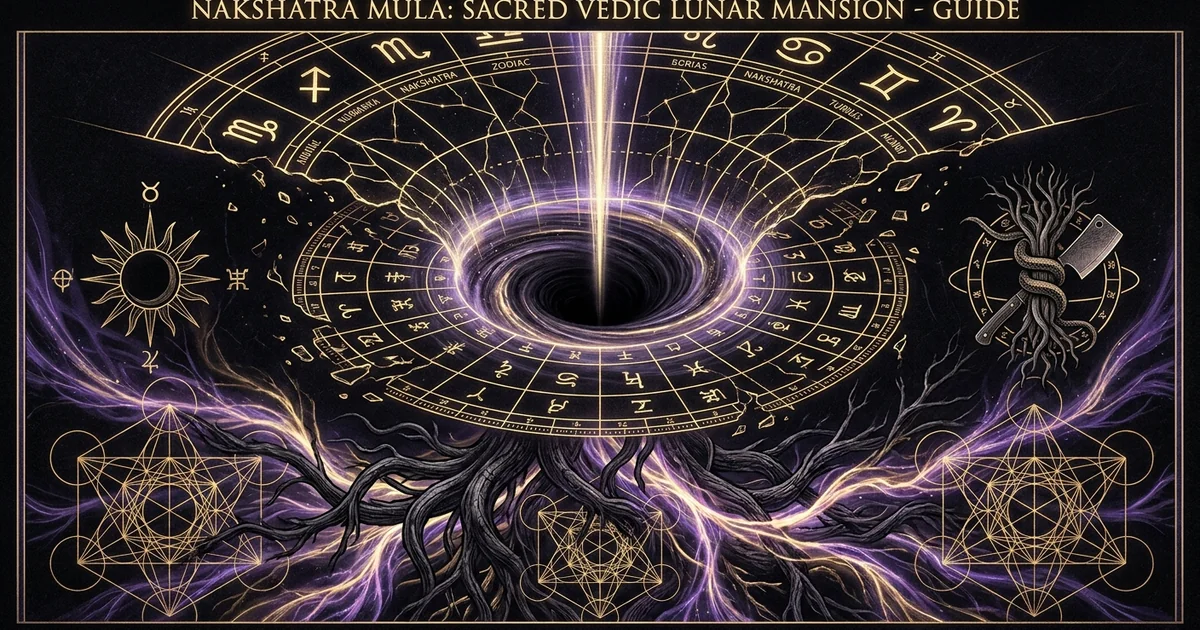
Nakshatra Mula: Sacred Vedic Lunar Mansion - Guide
Archetypal Thesis & Systemic Paradigm: The Primal Void and Nirriti’s Architecture of Dissolution
Nirriti and the Archetype of Total Systemic Reset
Within the analytical taxonomy of the 27 Nakshatras Jyotish matrix, Mula Nakshatra—occupying the initial arc from 00°00’ to 13°20’ of sidereal Sagittarius (Dhanus)—operates not merely as an astrological sector, but as an ontological threshold. Exoteric astrological manuals routinely mischaracterize this lunar mansion through a framework of unmitigated malefic fatalism, reducing its complex psycho-cosmic mechanics to crude prognostications of catastrophe, destitution, and lineage ruin. Yet, an examination of the mula nakshatra vedic astrology meaning reveals an architecture designed not for punitive annihilation, but for structural hygiene.
Mula represents the systemic circuit-breaker of sidereal consciousness: an autonomous cosmic regulatory mechanism engineered to enforce entropy upon obsolete karmic configurations that have exceeded their evolutionary utility.
Presiding over this catabolic domain is the Vedic goddess Nirriti, an archaic deity whose presence predates the classical Hindu pantheon. Designated across Vedic literature as Alakshmi—the structural antithesis of Lakshmi’s generative, cohesive, and sustaining abundance—Nirriti personifies absolute dissolution, non-existence, and the unyielding void.
In archetypal analysis, Nirriti does not represent evil; rather, she is the thermodynamic necessity of system clearance. Where Lakshmi governs systemic coherence, resource consolidation, and morphological preservation, Nirriti commands the catabolic pathway, stripping psychic and material superstructures back to their zero-point foundations.
The nirriti (goddess of dissolution) deity operates as the cosmological surgeon who severs the soul’s pathological fixation on calcified forms, dismantling identity constructs that impede the progression of consciousness toward its teleological aim.
“Nirṛtiḥ parastād avatāt | tasya mūlam parastāt | avastād vichṛtau | … The primordial void demands the terminal grain; let the practitioner offer oblations not to sustain the form, but to appease the devouring silence of Nirriti, lest the foundation turn to stone and the living spirit petrify within its own unyielding scaffolding.”
The Pralaya Principle within Sidereal Consciousness
To comprehend Mula’s functional operation, one must contextualize it within the cyclical mechanics of pralaya—the cosmic dissolution cataloged across Vedic cosmology. In classical Puranic literature, pralaya is articulated at various cosmological scales: naimittika (periodic dissolution occurring during Brahma’s slumber), prakritika (total reabsorption of elemental matter into the unmanifest prakriti at the conclusion of a cosmic age), and atyantika (absolute individual dissolution attained via liberating gnosis). Mula functions as the interiorized, psychological iteration of atyantika pralaya operating within the psychic continuum.
When planetary configurations activate Mula, consciousness undergoes an acute compression phase. Every artificial psychological construct—the egoic defense mechanisms, the inherited family myths, and the compensatory sociopolitical identities—is subjected to intense existential pressure.
This process directly mirrors the thermodynamic laws governing physical systems, wherein an open system experiencing an insurmountable influx of entropy must either catastrophically collapse or reconstitute itself at a higher order of complexity. Mula systematically denies the subject the capacity to sustain the structural status quo, enforcing the collapse phase so that genuine autopoiesis can occur from an uncompromised ontological baseline.
The Galactic Core Coordinate: Aligning Microcosm with Macrocosm
The cosmological potency of Mula is not an arbitrary symbolic designation; it is anchored in observational astrophysics. Sidereally, this mansion directly aligns with the dense stellar field containing the Galactic Center—designated in classical Jyotish codices as Vishnunabhi, the cosmic navel of Vishnu, and identified in modern radio astronomy as the supermassive black hole Sagittarius A*. Spanning approximately 3° to 5° of sidereal Sagittarius (within Mula’s first and second quarters), this astrophysical anchor exerts the supreme gravitational authority of our galaxy, drawing billions of solar systems around its event horizon.
The esoteric correspondence between the Galactic Center and Mula illuminates the Nakshatra’s operational role as an experiential singularity. At the event horizon of a supermassive black hole, standard space-time geometries break down, and physical laws yield to infinite density.
Similarly, when consciousness aligns with Mula, personal historical narratives and micro-level karmic trajectories are pulled into the gravitational field of macrocosmic, transpersonal destiny. The illusion of absolute human autonomy evaporates.
The personal ego discovers that its localized desires are subordinate to the sweeping imperatives of Galactic evolution. Consequently, the crisis of Mula is invariably an experiential confrontation with the absolute; the individual will is compelled to yield to the transcendent gravitational pull of the Void, transitioning from personal agency to transpersonal instrumentality.
Classical Provenance & Textual Lineage: The Gandanta Crisis in Vedic Hermeneutics
Vedic Codices: From Vichrit to Mula
The historical trajectory of this asterism demonstrates an evolution in human apprehension of ontological rupture. In the earliest layers of the Vedic canon, notably the Atharvaveda (XIX.7) and the Taittiriya Samhita, the mansion does not bear the singular designation Mula (meaning “the root”), but is consistently invoked in the dual or plural as Vichrit or Vichritau. Philologically derived from the Sanskrit root vi-chṛt, the name translates precisely as “the untiers,” “the looseners,” or “those who sever bonds.”
This nomenclature establishes that the archaic Vedic rishis perceived these stars (primarily Lambda, Epsilon, Mu, and Zeta Scorpii, forming the curved tail and stinger of the scorpion, reaching into the Sagittarius void) as an active surgical apparatus designed to cut ancestral, biological, and karmic ties.
The Taittiriya Brahmana explicitly pairs Vichrit with the imperative to release the fetters of Varuna and the corruptive grip of Nirriti. The text outlines precise sacrificial protocols required to placate the destabilizing emanations of this star group, acknowledging that an individual born under its ascendant ingress risked becoming a vector of systemic severance. As the Vedic lexicon consolidated into classical Jyotish through the Vedanga Jyotisha and later canonical Samhitas, the plural Vichrit collapsed into the singular Mula.
This linguistic evolution marked a conceptual deepening: the phenomenological act of “untying” (vichrit) was recognized as an investigation into the radical, primordial source of all phenomena—the subterranean “root” (mula) from which the tree of manifestation (Samsara) derives its transient vitality.
The Abhukta Mula Phenomenon in Brihat Parashara Hora Shastra
The foundational codex of predictive Vedic astrology, the Brihat Parashara Hora Shastra (BPHS), formalizes Mula’s most severe operational doctrine under the designation of Abhukta Mula. Parashara establishes an uncompromising structural taxonomy regarding the developmental hazards associated with births occurring within the initial degrees of this Nakshatra, particularly when intersecting the critical terminal degree of the preceding sign.
The Jyeshtha-Mula transition constitutes the most severe Brahma-Gandanta (karmic knot) within the sidereal zodiac, localized specifically at the threshold between 29°59’ Scorpio (Jyeshtha Pada 4) and 00°01’ Sagittarius (Mula Pada 1). This boundary represents a dual thermodynamic rupture:
- Elemental Transmutation (Tattva Sandhi): A radical, unbuffered transition from Jala Tattva (absolute dissolution within oceanic water) to Agni Tattva (primordial, combustible fire).
- Planetary Governance Shift (Graha Sandhi): A sharp leap from the rulership of Mercury (Budha—analytic discernment, communicative preservation, egoic logic) to Ketu (the South Node—sensory annihilation, void states, hyper-intuitive non-attachment).
Parashara’s treatment of Abhukta Mula—traditionally defined as the final two ghatikas (48 minutes of arc) of Jyeshtha and the initial two ghatikas of Mula—stipulates profound ancestral destabilization. Classical translations of the BPHS dictate that an infant born during this exact interface would cause the ruin of the father, the maternal lineage, or the broad ancestral estate, prompting ancient practitioners to mandate an immediate twelve-year separation between the child and the biological father, culminated by extensive shanti (appeasement) rituals.
Decoded through contemporary depth psychology, this rigorous ancient taboo preserves a profound insight: individuals embodying the Abhukta Mula signature function as psychic lightning rods for inherited generational trauma. They carry an overwhelming concentration of unintegrated ancestral shadow material.
The child’s subconscious matrix is so heavily saturated with the family system’s unresolved debts, repressions, and entropic tendencies that their mere presence acts as an accelerant, burning through lineage dynamics to force systemic integration or terminal collapse. This acute inflection point represents a central chapter in the broader cartography of the Gandanta karmic knot transformation.
Classical Medieval Syntheses: Varahamihira and Kalyanavarma
As the classical era matured into the medieval scholastic phase, master astrologers consolidated the behavioral and structural manifestations of Mula. In the Brihat Samhita, Varahamihira systematically maps Mula’s rulership across terrestrial affairs, assigning to it:
- Medicines and subterranean practitioners (bheeshaj),
- Miners and extractors of hidden elements,
- Philosophers of non-dual reality,
- Those who live by radical destruction, violence, and systemic subversion.
Varahamihira observes that planetary transits across Mula routinely coincide with tectonic shifts in human leadership and devastating agrarian or subterranean crises, affirming the asterism’s volatile, ungrounding baseline.
Corroborating this classical perspective, Kalyanavarma writes extensively in his eighth-century magnum opus, Saravali, on the behavioral architecture of native Mula placements. He notes that subjects born with the Moon or the Ascendant in Mula possess a fundamentally uncompromising, proud, and penetrating psychological constitution.
Kalyanavarma emphasizes that while these individuals are frequently alienated from their primary kin and subjected to sudden reversals of wealth, they possess an unmatched capacity for profound scholarship, esoteric investigative labor, and total institutional restructuring.
The medieval texts consistently maintain this dialectic: Mula strips away all baseline guarantees of worldly comfort, but in return, grants an incisive cognitive capacity capable of dissecting reality down to its elemental mechanics.
Structural Mechanics & Symbolic Geometry: Anatomy of the Tied Bundle of Roots
The Tied Bundle of Roots Symbol and Subterranean Dynamics
The primary glyph assigned to Mula within the 27 Nakshatras Jyotish canon is the tied bundle of roots symbol. This geometric and botanical visual contains a multidirectional hermeneutic key.
Botanically, the root system is entirely subterranean, operating within the absolute darkness of the earth (bhumigat). It is invisible to superficial observation, yet it constitutes the foundational support structure without which the visible trunk, branches, foliage, and fruit cannot exist.
Consequently, Mula governs everything obscured beneath the surface of manifest reality: the unconscious mind, structural roots, underground geological strata, fossilized lineage histories, classified intelligence, and the foundational metaphysical laws governing temporal physics.
MANIFEST REALITY (Above Ground)
                  Branches, Foliage, Fruit of Samsara
               ======================================= [Surface Threshold]
                                 | |
                                /   \
                               /  |  \
                              /   |   \
                             ( Tied    )  <-- MULA's Domain:
                            (  Root     )     Subterranean compression,
                             ( System  )      unconscious memory,
                              \   |   /       catabolic extraction
                               \  |  /
                                 \ /
                                  ▼
                   PRALAYA / THE GALACTIC CORE
The deliberate depiction of these roots as tied together reveals the restrictive structural mechanics of the mansion. It denotes bound energy, constriction, and the karmic coils of fate.
The tied bundle is an exact structural representation of unresolved ancestral patterns that have been bound into the subtle body across multiple evolutionary incarnations. These roots must be manually untied, inspected, aerated, and, if found necrotic, decisively excised.
The symbol simultaneously evokes the herbalist’s or apothecary’s harvest: roots wrenched violently from the soil, bound together, dried, and crushed to yield their medicinal or poisonous essences. In this respect, Mula embodies the process wherein psychological suffering is compressed and distilled into spiritual medicine.
Ketu as Planetary Overlord: The Inward Catabolic Vector
The operational mechanics of Mula are significantly dictated by its planetary ruler, Ketu, the South Node of the Moon. Within the psycho-cosmic mechanics of Jyotish, Ketu operates as the ultimate catabolic, inward-drawing vector.
While Rahu (the North Node) signifies voracious sensory ingestion, systemic expansion, material ambition, and external psychic projection, Ketu represents the absolute rejection of the sensory apparatus—sensory deprivation, psychic amputation, hyper-spiritual isolation, and radical liberation (moksha).
Ketu operates without a physical head; it possesses no eyes to gaze outward at the phenomenal world, forcing its perceptive energy inward into the formless voids of subtle anatomy.
When Ketu’s programmatic mandate governs Mula—a mansion situated within the fiery, principled, and expansive sign of Sagittarius ruled by Jupiter (Guru)—a unique structural friction emerges. Jupiter provides a grand philosophical, visionary framework, while Ketu relentlessly torches all dogmatic, ungrounded assumptions within that framework.
Ketu here acts as a cosmic solvent. Its presence within Mula accelerates the dissolution of material security, triggering unpredictable events that strip the native of external crutches.
This process forces an ontological reckoning: the individual is denied lasting solace in external structures, compelling them to discover the indestructible, unconditioned consciousness that remains when all transient anchors have been severed.
The Four Padas: Navamsha Trajectories from Aries to Cancer
The 13°20’ arc of Mula is structurally partitioned into four equal developmental quadrants or Padas (each spanning 03°20’), which map sequentially into specific Navamsha (D9) sub-matrices. This four-stage descent delineates the specific psychological pathway through which Mula processes its structural deconstruction:
Pada 1: Aries Navamsha (00°00’ to 03°20’ Sagittarius)
Governed by Mars (Mangala), this Pada absorbs the absolute shock of the Gandanta boundary. It manifests as raw, combustible energy, physical volatility, and an urgent impulse to burn away previous karmic identities. The ego experiences an existential identity crisis, often expressing itself through defensive aggression, revolutionary zeal, and acute physiological tension. It represents the catabolic fire initiating the breakdown of calcified structures.
Pada 2: Taurus Navamsha (03°20’ to 06°40’ Sagittarius)
Governed by Venus (Shukra), this quadrant shifts the deconstructive vector directly into the arena of material security, biological lineage, and financial solvency. Here, Mula’s catabolic mechanics target sensory attachments, personal values, and familial wealth. The individual experiences significant disruptions within their material stability, exposing the inherent transience of earthly possessions and forcing the consciousness to cultivate non-attachment to sensory forms.
Pada 3: Gemini Navamsha (06°40’ to 10°00’ Sagittarius)
Governed by Mercury (Budha), this Pada directs Mula’s disruptive power into the cognitive, relational, and intellectual faculties. The crisis becomes profoundly epistemological. The individual’s cherished belief systems, linguistic categories, and analytical dogmas are fractured. Communication breakdowns and profound intellectual disillusionment compel the native to transcend reliance on discursive logic in favor of direct, non-conceptual gnosis.
Pada 4: Cancer Navamsha (10°00’ to 13°20’ Sagittarius)
Governed by the Moon (Chandra), this final Pada represents the deep oceanic culmination of the Mula initiation. Operating in a water Navamsha within a fire Rashi, it induces profound affective dissolution. The emotional ego experiences an intense underworld descent, characterized by feelings of cosmic abandonment, existential loneliness, and the breakdown of familial safety nets.
Yet, it is precisely within this quadrant that the deepest spiritual integration occurs; having systematically dismantled the physical (Pada 1), material (Pada 2), and intellectual (Pada 3) scaffolding, the consciousness finally rests in pure, unconditioned interior awareness, completing its preparation for the evolutionary consolidation of Purva Ashadha.
Psychological Dynamics & Operational Praxis: Individuation through Primal Deconstruction
Jungian Nigredo and the Descent into the Underworld
Viewed through the structural framework of Jungian analytical psychology, Mula is the celestial signature of the nigredo—the foundational blackening phase of the alchemical opus. Carl Gustav Jung, drawing extensively upon classical Hermetic and alchemical codices in his late masterworks, characterized the nigredo (putrefactio) as the unavoidable psychological stage wherein the established, ego-directed personality must be subjected to mortification and decomposition.
This phase represents the painful, conscious encounter with the Personal and Collective Shadow, stripping the persona of its pride, social adaptations, and illusions of supremacy.
The mula nakshatra vedic astrology meaning maps directly onto this catabolic requirement. Mula does not facilitate gentle spiritual ascension; it orchestrates the nekyia—the archaic descent into the subterranean underworld.
Individuals configured with major personal planetary placements (Sun, Moon, or Ascendant) within this asterism are perpetually summoned to confront the subterranean strata of the unconscious. They are denied the luxury of existing within superficial psychological illusions.
If they attempt to construct an identity upon fragile societal banalities, Mula’s operational mechanics manifest as external catalytic crises—sudden terminations, systemic betrayal, or profound existential disquiet—demolishing the persona and forcing the individual to descend into the psychic abyss to retrieve the fragmented, repressed components of the primordial Self.
“No psychic value can come into being without the destruction of its opposite. The devouring mother, the chthonic feminine in her terrible aspect, is not a pathological aberration but an indispensable archetypal necessity; she dissolves that which has become brittle and sterile in order to liberate the germinating core of the Self from its calcified encasement.”
Piercing the Brahma Granthi: The Spiritual Physiology of Mula
In the esoteric physiology of Tantra and Hatha Yoga, the human subtle body contains three major energetic nodes or “knots” (granthis) that restrict the upward trajectory of Kundalini Shakti through the central channel (Sushumna Nadi). The first and most foundational of these is the Brahma Granthi, positioned in the subterranean nexus between the Muladhara (root) and Svadhisthana (sacral) chakras.
The Brahma Granthi governs humanity’s primal biological entrapments: the instinctual terror of physical annihilation, obsessive clinging to material existence, ancestral biological continuity, and foundational sexual conditioning.
Mula corresponds precisely to the dynamic, often agonistic process of piercing (bhedana) this primal knot. As the asterism governing the structural transition out of the water-dominated, deeply psychic realm of Scorpio and into the fiery, transcendent aspiration of Sagittarius, Mula represents the conscious activation of the subtle root.
The individual cannot ascend to the higher spiritual centers (Vishuddha, Ajna, Sahasrara) while the Brahma Granthi remains intact and congested with unresolved material and ancestral survival complexes.
The destabilizations native to Mula are the physiological and psychological symptoms of this knot being ruptured. The subtle body’s foundational programming is torn open, releasing suppressed instinctual currents so that the serpentine life-force can uncoil from the base of the spine and initiate its ascent toward higher states of self-realization.
Remedial Praxis: Transmuting Destruction into Occult Mastery
Navigating the volatile currents of Mula requires an operational methodology rooted in direct engagement rather than defensive avoidance. Classical, compensatory efforts to appease this mansion via conventional prayers for worldly wealth are structurally counterproductive; Nirriti does not barter with egoic preservation.
Instead, the operational praxis must align symmetrically with the archetype itself: through conscious, voluntary deconstruction and the rigorous pursuit of subterranean gnosis, directly evoking the alchemical necessity of nigredo and shadow integration.
-
Subterranean and Radicle Research Disciplines: The catabolic intelligence of Mula must be granted an authentic systemic outlet. Individuals dominated by this asterism achieve operational stability when engaged in professions that excavate, investigate, and restructure: depth psychoanalysis, genealogical reconstruction, forensic accounting, nuclear physics, underground geology, archaeogenetics, and advanced occult or metaphysical research. By willingly spending their days peeling back surface phenomena to expose subterranean roots, they satisfy the cosmic demand of the asterism without needing that deconstructive force to shatter their personal architecture.
-
The Cultivation of Voluntary Asceticism (Tapas): Because Mula systematically terminates external dependencies, the practitioner must develop an interior psychology of non-possessiveness (aparigraha). Engaging in structured, voluntary ascetic disciplines—periodic fasting, silent retreats, systemic decluttering of material possessions, and rigorous meditative isolation—preemptively harmonizes the subtle body with Ketu’s catabolic vector. By proactively divesting from trivialities, the practitioner neutralizes the shock of external stripping.
-
Ancestral Reconciliation (Pitri Tarpanam): Given Mula’s classical provenance as the repository of inherited lineage karma (Abhukta Mula), conscious ancestral propitiation becomes non-negotiable. Ritual offerings of clean water, black sesame seeds, and dedicated meditative awareness to the ancestral lineage serve to pacify the chaotic psychic static lingering in the subtle body. The practitioner consciously acts as the terminal node of their family tree: an individual conscious enough to absorb, process, and permanently resolve the intergenerational debts, traumas, and toxic pathologies of their biological line, transforming an ancestral curse into an evolutionary breakthrough.
Philosophical Synthesis & Macrocosmic Correspondence: Polarity and Hermetic Integration
The Ardra-Mula Axis: Atmospheric Destruction vs. Subterranean Obliteration
The sidereal zodiac operates upon a profound principle of geometric polarity: any given Nakshatra exists in continuous energetic dialogue with its directly opposing counterpart 180 degrees away across the wheel. Mula (00°00’ to 13°20’ Sagittarius) stands in absolute opposition to Ardra (00°00’ to 13°20’ Gemini), forming one of the most volatile structural axes within the celestial matrix.
A comparative evaluation of these mansions reveals the full spectrum of systemic catabolism:
Ardra (00°00' - 13°20' Gemini)
- Deity: Rudra (The God of Atmospheric Storms and Destructive Howling)
- Ruler: Rahu (The North Node of the Moon / Material/Cognitive Projection)
- Elemental Matrix: Vayu (Air / Atmosphere / Intellect / Synaptic Grid)
- Modus Operandi: Atmospheric violence; tearing down illusions via lightning-flash cognitive ruptures, intellectual disillusionment, and sensory storms.
- Somatic Nexus: The cranial nerves, sensory perception, and the cerebral cortex.
Mula (00°00' - 13°20' Sagittarius)
- Deity: Nirriti (The Primordial Goddess of Dissolution and the Void)
- Ruler: Ketu (The South Node of the Moon / Spiritual Amputation)
- Elemental Matrix: Agni-Prithvi (Subterranean Fire / Molten Earth / Magma)
- Modus Operandi: Chthonic obliteration; uprooting the foundation from below, pulling the structural base into the void, absolute extraction of roots.
- Somatic Nexus: The base of the spine, the Muladhara chakra, and the skeletal foundation.
While Ardra shatters the conceptual mind through external storms and emotional tears, forcing the subject to perceive the limitations of human logic, Mula induces a subterranean tectonic collapse that pulls down the entire foundational reality from beneath the feet. Ardra is the storm that strips the leaves and snaps the upper branches; Mula is the earthquake that liquefies the soil and rips the root network clean out of the bedrock.
Together, this Rahu-Ketu polarized axis ensures that consciousness cannot remain permanently entrapped in either external intellectual intellectualization (Ardra) or calcified structural dogma (Mula).
Hermetic Polarity and the Rhythm of Pralaya
Applying the Hermetic axiom of Rhythm—which dictates that every system breathes, oscillating between manifestation and reabsorption—Mula represents the macrocosmic exhalation of the absolute. It is the celestial manifestation of entropy working in service of life. The manifest universe can only sustain its dynamic creative momentum if there exists an equal, opposite capacity for deconstruction.
If Brahma’s generative inhalation (srishti) operated unchecked by the rhythm of dissolution, the cosmos would choke on its own calcified detritus; forms would multiply infinitely, petrifying into a horrific, unyielding stasis.
Mula embodies the universal immune system. It dissolves forms that have completed their evolutionary cycle, returning their foundational atoms back into the undifferentiated cosmic substrate (mula-prakriti) so they can be recombined into higher, more sophisticated morphological expressions.
The practitioner who integrates this Hermetic truth ceases to perceive personal losses, endings, and deconstructions through the infantile lens of emotional injury. Instead, they recognize these ruptures as the sublime, rhythmic exhalations of the cosmos, clearing space for spiritual emergence.
Mula’s Role in the Macrocosmic Evolution of Humanity
In mundane astrology—the study of planetary cycles mapped across collective historical epochs, geopolitical shifts, and civilization-level transformations—transits across Mula mark moments of systemic reckoning. Because Mula houses the Galactic Center, transiting outer planets (Saturn, Jupiter, and the Lunar Nodes) moving through this sector repeatedly coincide with the collapse of institutional monopolies, the exposure of systemic corruption, and the terminal breakdown of unsustainable socioeconomic models.
Historical analyses show that when major planetary conjunctions activate Mula, entrenched ideological paradigms are forcibly uprooted. Financial structures built on fraudulent representations of value disintegrate; theological dogmas that have strangled spiritual intuition are fractured; and political empires that have grown detached from their structural foundations undergo acute internal decomposition.
Mula acts as the macrocosmic sieve of human history, separating eternal truth (Sanatana Dharma) from temporary, opportunistic societal constructs. It guarantees that whatever is artificial, brittle, and ungrounded in systemic reality is cleared away, ensuring the evolutionary continuity of our collective consciousness.
Frequently Asked Questions: Demystifying Mula Nakshatra
Is Mula Nakshatra inherently cursed or dangerous?
Mula Nakshatra is not inherently cursed; its reputation for danger within vernacular astrological traditions stems from the ego’s instinctual resistance to transformation. Classical texts designated Mula as a formidable asterism because it systematically refuses to compromise with human illusions, superficial desires, or ancestral stagnation.
When an individual operates with intense clinging to material security, social prestige, or unexamined familial conditioning, Mula’s catabolic intelligence operates like a surgical blade, amputating those dependencies to preserve the soul’s deeper integrity.
For the individual anchored in unconscious indulgence, this stripping is experienced as catastrophe. Conversely, for the spiritual aspirant, the philosophical investigator, or the conscious practitioner of psychological shadow integration, Mula is an exceptionally generous benefactor.
It provides an unparalleled capacity to penetrate deceptive surfaces, perceive ultimate realities, and achieve liberating states of spiritual sovereignty (moksha). Its “danger” is directly proportional to the volume of unexamined egoic illusion a person insists on defending.
How does Mula relate to the Galactic Center astronomically?
Mula directly encompasses the astronomical coordinates of the Galactic Center (Vishnunabhi), specifically within its first and second quarters (between approximately 03° and 05° sidereal Sagittarius). Observational astrophysics confirms that this region contains Sagittarius A*, the supermassive black hole around which our entire Milky Way galaxy revolves.
This astronomical alignment infuses Mula with its signature gravitational and ontological properties. Astrologically and psychologically, a supermassive black hole represents a point of infinite density and gravity—a cosmic sinkhole from which no localized, light-bearing matter can escape in its previous configuration.
Consequently, placements within Mula operate under this intense macrocosmic pull. The native feels an interior imperative to orient their life around foundational, transpersonal truths rather than localized cultural fads.
It creates an innate, relentless hunger to comprehend the absolute center of things—the radical core of consciousness itself—while continuously drawing the native into deep experiential resets where the personal identity is pulled into alignment with the cosmic center.
What are the most effective psychological and spiritual remedies for Mula afflictions?
The most effective remediation for planetary tensions within Mula requires leaning into the energetic mechanics of the mansion rather than attempting to construct defensive, superficial barriers against them. The optimal operational modalities include:
-
Depth Psychological Shadow Integration: Actively engaging in psychoanalytic therapy, active imagination, and dream analysis to systematically inspect the unconscious roots of behavior. Rather than repressing neuroses, the practitioner traces them down to their archaic, somatic, and ancestral roots.
-
Genealogical and Ancestral Healing: Consciously breaking multi-generational family pathologies by acknowledging and reconciling inherited traumas. Participating in dedicated ancestral remembrance rituals (Shraddha, Pitri Tarpanam) pacifies the erratic subtle-body static historically associated with Abhukta Mula.
-
Voluntary Detachment and Ascetic Praxis: Engaging in intentional simplicity, structural fasting, and the continuous clearing of accumulated psychic and material detritus. Practicing non-possessiveness (aparigraha) ensures that Ketu does not need to engineer traumatic external losses to teach the lesson of non-attachment.
-
Dedicated Esoteric and Research Labor: Directing the mind’s penetrating intelligence into the study of root systems: occult sciences, astrology, historical lineage analysis, underground sciences, or technical deconstruction. Channelling the surgical focus of Nirriti into profound scholarship transforms an otherwise destabilizing catabolic energy into singular, penetrating intellectual mastery.