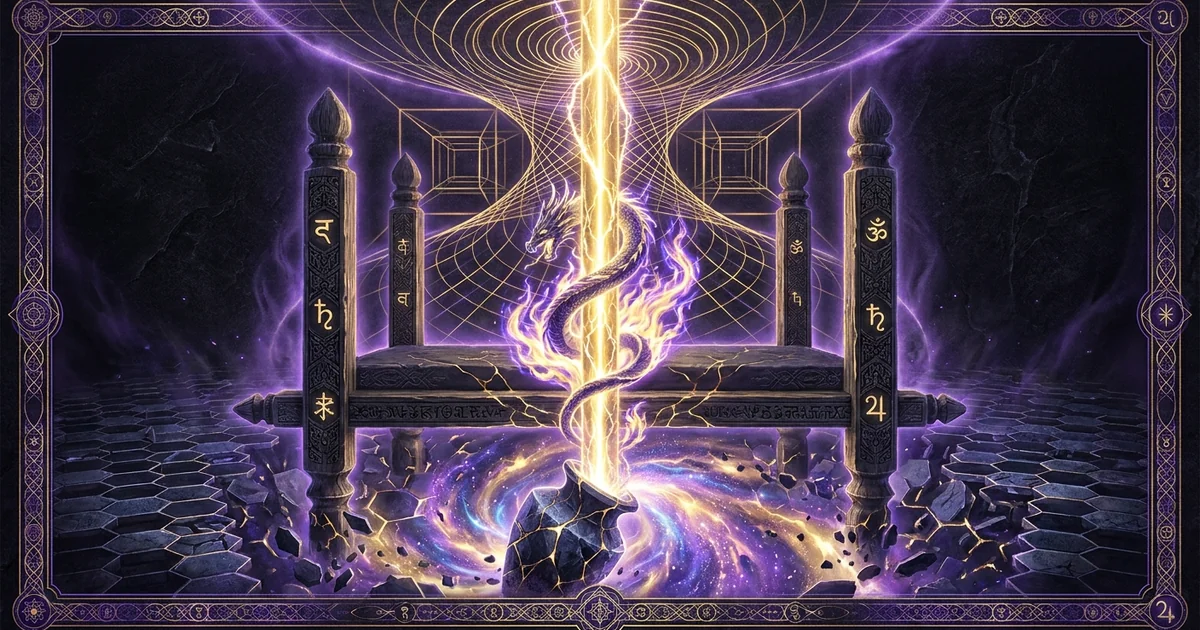
Nakshatra Purva Bhadrapada: Sacred Vedic Lunar Mansion
Archetypal Thesis & Systemic Paradigm: The Threshold of Sacrificial Dissolution
The Coordinate Topology of Kumbha-Meena Transition
Within the sidereal architecture of the twenty-seven lunar mansions, Purva Bhadrapada occupies an anomalous and destabilizing vector. Operating from 20°00’ Kumbha (Aquarius) to 03°20’ Meena (Pisces), this twenty-fifth nakshatra represents an ontological crisis within the cosmological framework of Jyotish. It marks the precise structural rupture where the macrocosmic social scaffolding, hyper-rational ideation, and collective systemic orders of Saturnian Kumbha suffer a deliberate, violent collapse into the unconditioned, oceanic, and non-dual dissolution of Jovian Meena. The lunar mansion does not offer a gentle transition; instead, it functions as an energetic event horizon.
The transit across this boundary forces an abrupt epistemological paradigm shift. While the early and middle degrees of Kumbha consolidate collective karma and construct sweeping humanitarian or ideological systems, the late degrees—governed by Purva Bhadrapada—interrogate the ultimate futility of these temporal structures. Here, the individual ego-complex encounters the realization that societal mechanisms, however optimized, cannot resolve the fundamental problem of existential alienation. The trajectory across this boundary demands the absolute dismantling of psychic calcifications, establishing a psycho-cosmological coordinate where the individual is severed from collective consensus and compelled to confront the transpersonal abyss.
This topological transition demonstrates that spiritual evolution is non-linear. The final decan of Kumbha does not merely evolve into Meena; it must undergo an ontological death. As established in systematic evaluations of the /astrology/nakshatras-overview-jyotish, lunar mansions situated at the convergence of air and water elements, or crossing rashi boundaries (sandhi), manifest profound psychological instability. Purva Bhadrapada sits upon the tectonic fault line where intellectual mastery exhausts its parameters, precipitating a state-space collapse that forces consciousness to surrender its conceptual frameworks to the formless waters of the absolute.
Aja Ekapada: The Primordial Axis of the Unmanifest Cosmic Pillar
The presiding deity of this domain is Aja Ekapada, an archaic Vedic divinity whose name translates philologically as the “Unborn, One-Footed One.” Far from representing an arbitrary zoomorphic oddity, Aja Ekapada embodies the transcendent, primordial axis mundi—the singular, unmoving pillar (skambha) that anchors the unmanifest void to the manifest universe. The single foot symbolizes non-dual focus: an immovable ontological root planted in cosmic darkness, while the upper manifestation unleashes sudden, catalytic atmospheric electricity. Aja Ekapada is the lightning strike that descends from the trans-cosmic aether to shatter terrestrial complacency, mirroring the proto-Shiva/Rudra archetypal complex.
In this context, the “one foot” represents the unwavering station of pure, unconditioned consciousness that remains totally unperturbed during the catastrophic dissolution of phenomena. It is the solitary root of being that endures when every transient psycho-somatic structure is razed. The deity is intimately linked with the celestial serpent of the upper atmosphere, representing dormant, highly concentrated cosmic energy capable of instantaneous release. The lightning attributed to Aja Ekapada does not merely destroy; it illuminates the totality of the psychic landscape in a blinding, non-dual flash, exposing the illusory nature of phenomenal duality.
Through the archetype of Aja Ekapada, the nakshatra demands absolute singular devotion to transcendental reality at the expense of all contingent forms. This deity does not negotiate with the temporal ego. The one-footed posture indicates an intense, concentrated tapas (psycho-spiritual heat)—a vertical alignment that pierces through the horizontal planes of manifestation. By standing upon a solitary limb, Aja Ekapada withdraws from the dialectical oscillations of attraction (raga) and aversion (dvesha), establishing a stationary center of gravity around which the apocalyptic dissolution of karmic structures can unfold without destabilizing the eternal ground of reality.
The Funeral Bed as Alchemical Nigredo and Telos
The primary primary symbol assigned to Purva Bhadrapada is the front legs of the funeral cot (mancha or shayana), an image directly linked to mortality, terminal rest, and the physical vehicle upon which the corpse is transported to the cremation grounds (shmashana). This glyph anchors the nakshatra to an uncompromising confrontation with systemic impermanence. Rather than signifying morbid fatalism, the funeral cot operates as an initiatory crucible: the site of radical alchemical transmutation where the calcified forms of individual identity undergo terminal putrefaction.
In the language of Western hermeticism, this symbol represents the absolute culmination of the nigredo—the blackening stage of the magnum opus where base matter must decay before the golden dawn of spiritual illumination can emerge. The front legs of the bed support the head and upper torso of the deceased, signifying that the intellect, the pride of the rational mind, and the conscious apparatus of the ego are the precise elements subjected to sacrificial immolation. To lie upon the bed of Purva Bhadrapada is to submit the finite self to the purifying fire of transcendent reality.
The esoteric telos of this mansion is the systematic evacuation of egoic sovereignty. The funeral bed demarcates the ultimate threshold where individual agency ceases and the soul is laid bare before the absolute. It serves as a stark reminder that the structures constructed under Saturn’s governance in Kumbha are ultimately scaffolding intended for the pyre. In this catalytic space, death is understood not as the cessation of consciousness, but as the supreme rite of passage: an intentional ego-death indispensable for liberation from the cyclic imprisonment of samsara.
Classical Provenance & Textual Lineage: The Vedic and Puranic Foundations
The Rig Vedic Exegesis of Aja Ekapada as Atmospheric Lightning
The textual pedigree of Purva Bhadrapada traces to the oldest strata of Indo-European spiritual literature. In the Rig Veda Samhita, particularly within the hymns addressed to the Vishvedevas (All-Gods), Aja Ekapada appears alongside Ahir Budhnya (the serpent of the cosmic deep) as an atmospheric deity of fierce majesty. In Mandala X, Sukta 65, verse 13, the seer invokes Aja Ekapada alongside the ocean, the firmament, and the celestial waters, designating this entity as an indispensable cosmological pillar holding apart heaven and earth.
तं वो अ॒जमेक॑पादं धी॒भिर्ऋ॒भुं शंस॑ध्वमु॒थ्यं॑ ।
सु॒रा॒धसो॑ म॒रुतो॒ विष्णुरेषां॒ पू॒षा भगो॒ सवि॒ता नो॑ जुषन्त ॥
The Vedic hermeneutics surrounding Aja provide two simultaneous, non-contradictory etymological trajectories: A-ja as “the Unborn” (the eternal, uncreated reality) and Aja as the Caprine/Goat figure, capable of navigating treacherous, sheer vertical cliffs impossible for lesser beasts. The caprine association signifies the power of vertical ascent across metaphysical precipices, while the metaphysical definition denotes the immutable source of all manifest existence.
Classical exegetes identify Aja Ekapada as the lightning bolt born from the atmospheric storm cloud—a manifestation of fire (Agni) dwelling within the celestial waters (Apas). This primordial lightning is not ambient electricity; it is the instantaneous descent of divine will into the phenomenal cosmos. It shatters the calcified barriers of matter, acting as the celestial instrument through which cosmic order (Rta) is asserted over entropy. The Rig Vedic conception does not present this deity as a domestic benefactor, but as an awe-inspiring, transcendent cosmic force whose flash illuminates the void, bridging the absolute unmanifest with the temporal world.
“अज एकपादुदगात्पुरस्तात् । विश्वानि भूतानि प्रतिमोदमानः । तस्य देवाः प्रसवं यन्ति सर्वे । पूर्वभाद्रपदासो अमृतस्य गोपाः ॥”
“Aja Ekapada has ascended in the East, bringing joy to all manifest beings through his incandescent light. All the gods align themselves with his divine impulse. The stars of Purva Bhadrapada are the eternal guardians of immortal nectar (amrita), purifying through sacrificial flame.”
The Taittiriya Brahmana: Nakshatra Ishti and Sacrificial Liturgy
The liturgical mechanics of the lunar mansions receive their definitive classical systematization in the Taittiriya Brahmana (III.1.2). In the section detailing the Nakshatra Ishtis—the specialized sacrificial rituals engineered to harmonize the sacrificer with specific cosmic frequencies—Purva Bhadrapada is assigned the foundational potency known as yajamana shakti. This power is explicitly defined as the capacity to elevate the sacrificer (yajamana) from the terrestrial realm into the celestial world of the immortals through the rigorous, uncompromising application of internal and external sacrificial heat (tapas).
The liturgical verses explicitly position Aja Ekapada as the custodian of celestial fire. The sacrifice executed under the auspices of Purva Bhadrapada requires the total surrender of temporal possessions and egoic self-interest. The ritual text states that through this nakshatra, the cosmic order extracts its tribute: the individual must offer their own conditioned identity into the sacred fire to secure a body composed of pure solar energy. The yajamana shakti of Purva Bhadrapada operates through purification by ordeal.
The Taittiriya Brahmana establishes that the ultimate harvest of this asterism is the procurement of spiritual brilliance (brahmavarchas), which cannot be bestowed upon a vessel corrupted by psychological attachments. The text contextualizes the nakshatra’s fierce quality not as an affliction, but as the cosmic kiln in which the raw clay of human consciousness is fired into impervious spiritual ceramic. The nakshatra acts as the celestial sacrificial grounds, where the obsolete iterations of the self are consumed by the divine flame to sustain the equilibrium of the cosmos.
Varahamihira and Parashara: Classical Attributions and Guna Distribution
In the foundational compendiums of classical Jyotish—the Brihat Samhita of Varahamihira and the Brihat Parashara Hora Shastra—the operational character of Purva Bhadrapada is codified with analytical precision. Varahamihira, in Chapter XV of the Brihat Samhita, categorizes this lunar mansion as Ugra (fierce, aggressive, and severe), assigning it dominion over acts involving violence, the containment or release of poisonous substances, warfare, executions, devastation by fire, and the systematic destruction of outworn structures. He writes that under its influence fall murderers, jailers, ascetics practicing severe mortifications, and those engaged in transactions involving lethal implements.
उग्रः क्रूरो वधबन्धताडनादिषु सिद्धिमति ।
पूर्वाभाद्रपदायां च चोराधिव्याधिनाशनम् ॥
This classification aligns with Parashara’s systemic assignment of the gunas (the three fundamental qualities of cosmic nature). Purva Bhadrapada operates with an overarching primary attribution of Tamas at the macrocosmic level, a secondary internal attribution of Sattva, and a tertiary operational layer of Rajas. This specific triad—Tamas-Sattva-Rajas—illuminates the internal mechanics of the mansion. The Tamasic exterior manifests as destruction, inertia-breaking violence, and confrontation with decay; however, this heavy shroud conceals an intensely illuminated core of pure Sattvic aspiration.
The guna-tamas operates here not as ignorance, but as the crushing gravity required to trigger a spiritual collapse inward, forcing the Sattvic seed to awaken under extreme pressure. Parashara defines Purva Bhadrapada’s primary motivational drive as Artha (material acquisition or structural realization), which ultimately collapses under its own weight, demonstrating the fundamental insufficiency of temporal wealth and driving the soul toward the radical renunciation demanded by the subsequent sign of Meena.
Structural Mechanics & Symbolic Geometry: Degrees, Padas, and Planetary Rulerships
The 20°00’ Kumbha to 03°20’ Meena Mathematical Matrix
The mathematical architecture of Purva Bhadrapada encompasses an arc of 13°20’, divided across a critical zodiacal junction. The first 10°00’ (from 20°00’ to 30°00’ Kumbha) anchor the asterism within the fixed air sign of Saturn, while the concluding 03°20’ (from 00°00’ to 03°20’ Meena) project the mansion into the cardinal waters of Jupiter. This spatial deployment creates a profound structural dialectic between Saturnian containment and Jovian transcendence, establishing an internal tension that characterizes all planetary placements within this zone.
+--------------------------------------------------------------------------------+
|                   PURVA BHADRAPADA ARCHITECTURAL DIVISION                      |
+--------------------------------------------------------------------------------+
| Degree Span            | Rashi Span      | Planetary Matrix    | Primary Tattva|
| 20°00' - 23°20' Kumbha | Kumbha (Aquarius)| Saturn / Mars (Nav) | Vayu / Tejas  |
| 23°20' - 26°40' Kumbha | Kumbha (Aquarius)| Saturn / Venus (Nav)| Vayu / Prithvi|
| 26°40' - 30°00' Kumbha | Kumbha (Aquarius)| Saturn / Merc (Nav) | Vayu / Vayu   |
| 00°00' - 03°20' Meena  | Meena (Pisces)   | Jupiter / Moon (Nav)| Jala / Jala   |
+--------------------------------------------------------------------------------+
The Kumbha portion of the nakshatra operates within the ultimate perimeter of the intellectual, systemic mind. Here, the air element (Vayu tattva) reaches its highest state of rarefaction and ideological crystallization. The native or transit operating within these degrees seeks to reform the cosmos through radical intellectual systems, sociological paradigms, or revolutionary asceticism. However, as the degrees advance toward the 30th parallel of Kumbha, the Saturnian vessel experiences severe structural fatigue. The rigid ideological frameworks can no longer contain the chaotic, trans-rational currents pressing against them.
Upon crossing the zero-degree threshold into Meena, the nakshatra enters the rashi sandhi—the boundary line between air and water, fixed and dual, Saturn and Jupiter. In these final 3°20’, the structural matrix dissolves entirely into Jala tattva (the water element). The intellectualized anguish of late Kumbha surrenders to the oceanic, non-conceptual mourning and ecstatic release of early Meena. The mathematical matrix thus charts an explicit journey from mental reification to somatic and psychic dissolution.
- Pada 1: 20°00’ – 23°20’ Kumbha | Mesha Navamsha (Mars). Driven by catalytic will, pioneering asceticism, raw combustion, and militant idealism. Primary tattva: Fire within Air.
- Pada 2: 23°20’ – 26°40’ Kumbha | Vrishabha Navamsha (Venus). Fixation upon structural manifestation, dark aestheticism, sensual-ascetic dichotomy. Primary tattva: Earth within Air.
- Pada 3: 26°40’ – 30°00’ Kumbha | Mithuna Navamsha (Mercury). Hyper-intellectualization of the void, occult scholarship, linguistic precision applied to systemic deconstruction. Primary tattva: Air within Air.
- Pada 4: 00°00’ – 03°20’ Meena | Karka Navamsha (Moon). Pushkara Navamsha. The baptismal waters; emotional dissolution of the ego-construct; oceanic empathy following catastrophic purgation. Primary tattva: Water within Water.
Jupiter as Planetary Ruler vs. Saturnian Containment
The cybernetic tension within Purva Bhadrapada is magnified by its planetary rulership. The nakshatra is assigned in its totality to Guru (Jupiter) under the Vimshottari Dasha system. This creates a volatile psycho-dynamic: Jupiter’s expansive, meaning-seeking, and philosophical impulse must operate within the restrictive, cold, and boundary-enforcing environment of Saturn’s sign for three-quarters of its journey.
This collision of Jupiter and Saturn generates an existential crisis. Jupiter demands infinite expansion, divine grace, and cosmic coherence, but the Saturnian terrain of late Kumbha imposes relentless empirical limits, systemic cynicism, and the crushing weight of collective karma. Consequently, the Jupiter of Purva Bhadrapada is not the benevolent, optimistic teacher of Dhanu (Sagittarius) or Meena; it is the severe, disillusioned hierophant who has looked into the abyss of human limitation and chosen the path of radical renunciation.
This dynamic generates intense moral and philosophical absolutism. The planetary ruler insists on transmuting the base lead of Saturnian reality into the philosophical gold of cosmic wisdom, but the process requires violent distillation. The expansion here is not outward into worldly abundance, but downward and inward into the foundational roots of reality—a vertical descent through the scaffolding of the mind to discover the non-dual ground beneath it.
The Four Padas: Navamsha Trajectories from Mesha to Karka
The sub-navamsha divisions of Purva Bhadrapada chart a rigorous developmental progression across the four quadrants of consciousness:
[ Pada 1: Mesha Navamsha ]  --> Catalytic Ignition (Mars/Tapas)
[ Pada 2: Vrishabha Navamsha] --> Material Crucible (Venus/Form)
[ Pada 3: Mithuna Navamsha ] --> Intellectual Deconstruction (Mercury/Void)
[ Pada 4: Karka Navamsha ]   --> Oceanic Dissolution (Moon/Pushkara)
Pada 1 (20°00’ to 23°20’ Kumbha) falls into the Mesha (Aries) navamsha, governed by Mangala (Mars). This pada combines the airy detachment of Kumbha with the raw, combustive vitality of cardinal fire. It manifests as a fierce, aggressive spiritual warriorhood. The individual seeks to impose will upon destiny through extreme discipline, asceticism, or ideological revolution. The shadow here is catastrophic burnout and an authoritarian urge to cleanse the world through fire.
Pada 2 (23°20’ to 26°40’ Kumbha) enters the Vrishabha (Taurus) navamsha, governed by Shukra (Venus). This pada anchors the lightning of Aja Ekapada into the dense realm of physical matter, finance, and sensual form. It creates profound psychological cross-pressures: the soul feels the imperative of renunciation while being anchored by material desires and the pursuit of security. If integrated, it allows the individual to build resilient external vessels capable of withstanding spiritual crisis; if unintegrated, it degenerates into hoarding, dark sensual indulgences, and profound cynicism.
Pada 3 (26°40’ to 30°00’ Kumbha) projects into the Mithuna (Gemini) navamsha, ruled by Budha (Mercury). Here, the intellectualism of Kumbha reaches its apex. This is the domain of the dark philosopher, the occult researcher, and the deconstructive critic. Consciousness operates with surgical detachment, analyzing the decay of human institutions and the mortality of the mind itself. The danger in this pada is total intellectual alienation—a cold, analytical nihilism that perceives the mechanisms of the universe while remaining blind to its living pulse.
Pada 4 (00°00’ to 03°20’ Meena) crosses into the Karka (Cancer) navamsha, presided over by Chandra (the Moon). This pada undergoes a radical qualitative transmutation. It is designated as a Pushkara Navamsha—an astronomical coordinate possessing exceptional regenerative and healing potencies. The cold, analytical detachment of the prior padas dissolves into the deep, maternal, and restorative waters of Karka. The suffering endured during the earlier stages of the crucifixion upon the funeral cot is metabolized into universal empathy, devotional surrender (bhakti), and mystical illumination. The soul ceases to intellectualize its agony and surrenders into the cosmic ocean of being.
Psychological Dynamics & Operational Praxis: The Shadow of Aja Ekapada
Ego-Death, Thanatophobia, and the Alchemical Crucible
In clinical practice and psychological astrology, individuals with significant personal placements (Lagna, Moon, or Sun) in Purva Bhadrapada inevitably encounter acute states of existential crisis. The primary psychological complex is structured around the confrontation with mortality, ego-collapse, and the ultimate meaninglessness of temporal forms—an experience that manifests diagnostically as thanatophobia or an obsessive-compulsive drive to control the external environment against impending decay.
“The shadow is a moral problem that challenges the whole ego-personality, for no one can become conscious of the shadow without considerable moral effort… But if the shadow is recognized as an active component of the psyche, it turns out to be an indispensable bridge to the dark roots of our instinctual life, where the primordial dragon of the deep awaits either our surrender or our catastrophic dismemberment.”
The archetype of the front legs of the funeral bed operates within the personal unconscious as an unyielding memento mori. The individual is chronically aware of the fragile, provisional nature of human existence. This often precipitates early-life trauma involving unexpected loss, societal upheaval, or systemic betrayal, effectively shattering the naive illusion of safety that sustains the conventional ego. The Purva Bhadrapada psyche is consequently forced into the alchemical crucible early in life; it cannot afford the luxury of superficial optimism.
The psychological operation required here is the deliberate navigation of the /archetypes/jungian-shadow-individuation. The ego must submit to its own dismemberment. When the individual resists this process, the shadow of Aja Ekapada manifests as intense self-destructive tendencies, morbid fascinations, deep melancholia, and an unconscious compulsion to sabotage their own worldly success. When embraced, the crucible burns away the peripheral accretions of the false self, leaving behind a resilient, immovable psychological core that has already died to the world and therefore possesses no remaining fear of dissolution.
The Two-Faced Mask: Bilateral Asymmetry and Societal Ambivalence
Classical iconographical depictions sometimes attribute two faces to Purva Bhadrapada (Janus-like in its orientation), reflecting the deep internal split characteristic of its psychological expression. One face looks outward toward the societal collective with a mask of compliance, civic duty, and humanitarian concern, while the other face looks inward into the abyssal void of existential dread, cosmic isolation, and dark fascination with the taboo.
[ THE JANUS SPLIT OF PURVA BHADRAPADA ]
                        |
       +----------------+----------------+
       |                                 |
[ The Exoteric Mask ]           [ The Esoteric Abyss ]
- Societal Compliance           - Existential Isolation
- Humanitarian Systems          - Occult Dismantlement
- Altruistic Idealism           - Thanatological Fascination
This psychological asymmetry produces extreme behavioral oscillations. The individual can alternate between periods of ascetic withdrawal and bouts of unrestrained indulgence; between selfless, radical dedication to the elevation of the downtrodden and cold, Machiavellian detachment from individual human sentiment. In notable astrological studies, such as the works of B.V. Raman, this mansion is frequently prominent in the charts of profound visionaries, radical reformers, or notorious criminals who operated outside societal ethical norms.
This dichotomy stems directly from the nakshatra’s position at the edge of the abyss. The Purva Bhadrapada native perceives that the rules governing societal consensus are arbitrary fictions. If the personality lacks ethical integration, this realization degenerates into sociopathic manipulation, where the individual treats the world as an illusory stage for the exercise of raw power. Conversely, if integrated, it produces a fearless, uncompromising prophet who speaks uncomfortable truths to corrupt institutions, indifferent to personal safety or social approval.
Integrative Praxis: Navigating Transmutational Crisis in Consultation
When analyzing a nativity dominated by Purva Bhadrapada, the consulting Jyotishi or archetypal counselor must operate with clinical precision, avoiding both superficial reassurances and deterministic fatalism. The transmutational crisis indicated by this asterism cannot be bypassed through palliative affirmations; it must be navigated through conscious ritualization and deliberate psychological sacrifice.
[ CRISIS OF STRUCTURAL COLLAPSE ]
                  │
                  ▼
   [ VOLUNTARY ASCETIC DISCIPLINE ]  <-- Transmutes involuntary devastation
                  │
                  ▼
   [ SHADOW CONFRONTATION & INTEGRATION ]
                  │
                  ▼
   [ RADICAL EGO-SURRENDER (BHAKTI/GNOSIS) ]
                  │
                  ▼
   [ SOTERIOLOGICAL LIBERATION ]
The primary therapeutic mandate is the conversion of involuntary crisis into voluntary tapas. If the native does not consciously cultivate disciplines of self-renunciation, physical austerity, contemplative isolation, and deep psychological inquiry, the energy of Aja Ekapada will materialize externally as sudden catastrophic events—financial ruin, severe health crises, relational betrayals, or legal confrontations that violently strip away their points of security. The conscious assumption of the funeral bed archetype requires the client to deliberately put to death outdated identities, toxic attachments, and rigid ideological dogmas.
Practical remedial integration involves grounding this volatile, atmospheric current. Engagement with transformative disciplines—such as classical Pranayama, deep somatic shadow work, the study of Advaita Vedanta or non-dual philosophies, and active service to the dying or marginalized—provides a constructive channel for the nakshatra’s intense energies. The practitioner must guide the individual to recognize that their profound internal alienation is not an idiosyncratic pathology, but a functional vocation: they are structural gatekeepers stationed at the exit of the temporal world, tasked with demythologizing the illusions of the ego to prepare the soul for liberation.
Philosophical Synthesis & Macrocosmic Correspondence: Hermetic Polarities and The Dual Bhadrapadas
Purva Bhadrapada vs. Uttara Bhadrapada: The Two Halves of the Mancha
Purva Bhadrapada cannot be comprehensively understood in isolation; it forms an indissoluble, dialectical dyad with its cosmic twin, Uttara Bhadrapada. Together, these mansions constitute the complete funeral cot or sacrificial platform (mancha), spanning from 20°00’ Kumbha to 26°40’ Meena. Purva Bhadrapada represents the front legs of this vehicle—the site of catalytic ignition, death, and atmospheric crisis—while Uttara Bhadrapada represents the rear legs, presiding over the subsequent states of stillness, preservation within the depths, and integration into the cosmic oceanic matrix.
Purva Bhadrapada: The Active Crucible
- Deity: Aja Ekapada (The Unborn One-Footed Serpent-Goat / Celestial Lightning)
- Symbol: Front Legs of Funeral Bed (Head/Intellect placed on pyre)
- Atmosphere: Violent Combustion, Rupture, Atmospheric Tapas
- Alchemical Phase: Solve (Active Dissolution, Purgation, Nigredo)
- Psychological State: Existential Agony, Deconstruction of Identity, Reckoning
- Vector: Upward and Outward Lightning Descent striking the earth
Uttara Bhadrapada: The Deep Abyss
- Deity: Ahir Budhnya (The Serpent of the Deep Ocean Waters)
- Symbol: Back Legs of Funeral Bed (Submerged Foundation/Rest)
- Atmosphere: Oceanic Quiescence, Subterranean Pressure, Stillness
- Alchemical Phase: Coagula (Crystallization of the Transformed Soul)
- Psychological State: Non-dual Equanimity, Mystical Surrender, Peace
- Vector: Inward and Downward serpentine coils anchoring the deep
The relationship between their presiding deities reinforces this polarity. Aja Ekapada is the fire of the atmospheric heights, erratic and destructive; Ahir Budhnya is the serpentine power dwelling in the unplumbed depths of the subterranean waters. The soul undergoes violent purgation in Purva Bhadrapada, experiencing the absolute collapse of the ego, so that it may enter the sanctuary of /astrology/uttara-bhadrapada-nakshatra-meaning in a state of tranquil, unshakeable stillness. Purva Bhadrapada executes the painful, necessary sacrifice; Uttara Bhadrapada preserves and redeems the consecrated essence.
The Western Zodiacal Parallels: Late Aquarius Decan III and Pisces Decan I
In the Western tropical framework, the astronomical terrain occupied by Purva Bhadrapada corresponds symbolically to the third decan of Aquarius and the initial decan of Pisces. Decan III of Aquarius (traditionally associated with the Moon or Venus in different hermetic lineages, but structurally characterized by Saturn and Uranus) represents the terminal limits of the collective socio-political imagination. It is the zone where ideological utopianism either collapses into totalitarian rigidity or undergoes an anarchic revolution to break free from its own sterile intellectualization.
The transition into Decan I of Pisces (traditionally governed by Saturn, with Jupiter as sign ruler) introduces the decan of the “labyrinth” and the sacrificial voyage. Here, Western hermeticism places the imagery of the sea monster, the nocturnal voyage across the Styx, and the voluntary surrender of the personal will to divine providence.
The parallels between the sidereal nakshatra and the Western decanic structure illustrate a shared archetypal vision:
- The final decan of the fixed air sign represents the exhaustion of the intellectual apparatus.
- The initial decan of the mutable water sign represents the immediate submersion into the prima materia.
- Both traditions locate the crisis of individuation at this boundary, demanding that the adept pass through the ordeal of psychic dismemberment before achieving spiritual illumination.
Hermetic Axioms: The Serpent Lightning and the Coagulation of the Waters
The overarching macrocosmic function of Purva Bhadrapada corresponds precisely to the primary axiom of Western esoteric alchemy: /esoteric-systems/alchemy-solve-et-coagula (dissolve and coagulate). Purva Bhadrapada is the supreme astrological embodiment of the Solve phase. Its operation strips away all composite forms, breaks down psychic accretions, and reduces the calcified structures of the ego to their unconditioned prima materia through the agency of atmospheric fire and lightning.
       [ THE COSMIC ALCHEMICAL CIRCUIT ]
                       │
                       ▼
       [ PURVA BHADRAPADA : SOLVE ]
       - Lightning of Aja Ekapada
       - Atmospheric Fire & Heat (Tapas)
       - Immolation of the Ego-Vessel
                       │
                       ▼
       [ UTTARA BHADRAPADA : COAGULA ]
       - Serpentine Coils of Ahir Budhnya
       - Primordial Cosmic Waters (Apas)
       - Crystallization of the Diamond Body
Without the ruthless dissolution enacted by Purva Bhadrapada, the subsequent coagulation (Coagula) of the spiritual body in the depths of Meena would be impossible. If the base metal is not thoroughly purified in the fire of the funeral pyre, any attempt to rebuild the vessel merely reconstitutes the original dysfunction. Purva Bhadrapada ensures that the purification is absolute. It is the celestial lightning that strikes the ocean, charging its dark waters with the divine potentiality required to manifest the golden seed of the true, immortal Self.
Frequently Asked Questions: Technical and Esoteric Clarifications
Why is Purva Bhadrapada associated with both a goat and a dragon?
The dual iconography of Purva Bhadrapada—frequently alternating between a caprine entity (the one-footed goat) and a draconic or serpentine figure—originates in the multifaceted etymological and mythological nature of its deity, Aja Ekapada. In Sanskrit, Aja functions simultaneously as a noun meaning “he-goat” and as a profound metaphysical compound meaning “unborn” (a- without, ja birth).
The caprine symbolism conveys the capacity of the goat to ascend sheer, vertical mountain precipices where no other creature can find footing. Esoterically, this denotes the rare ability of the initiate under this nakshatra to scale the vertical axis of consciousness (Sushumna Nadi), traversing metaphysical abysses that would destroy an unprepared mind. The goat represents the sure-footed, uncompromising ascetic who walks the razor’s edge between phenomenal existence and absolute voidness.
Conversely, the serpentine or draconic attribution stems from Aja Ekapada’s classical Vedic status as a deity of the atmospheric realm (Antariksha), intimately allied with Ahir Budhnya (the serpent of the cosmic deep). In the Vedic worldview, atmospheric lightning is perceived not as a static bolt, but as an incandescent, serpentine dragon striking downward from the cloud-ocean above. It is the celestial fire serpent descending to earth, making Aja Ekapada the proto-cosmic dragon of lightning, balancing the subterranean water dragon of the next lunar mansion.
How does Pada 4 differ functionally from Padas 1 through 3?
Pada 4 (00°00’ to 03°20’ Meena) operates as an entirely distinct energetic regime compared to the three preceding padas. Padas 1, 2, and 3 are confined within the fixed air sign of Kumbha, meaning they are bound to Saturnian structures, rational systems, societal dynamics, and intense mental friction. In these first three quarters, the transformative heat (tapas) of the nakshatra expresses itself primarily as psychological crisis, ideological frustration, and intellectual deconstruction.
Pada 4 breaks through the rashi sandhi into Meena, completing the transition from air to water, and simultaneously enters a Karka (Cancer) navamsha, which is universally designated as a Pushkara Navamsha. This mathematical point possesses extraordinary powers of spiritual regeneration, redemption, and emotional integration. In Pada 4, the dry, agonizing confrontation with the funeral bed transforms into a baptismal immersion in the cosmic waters.
Functionally, while Padas 1 through 3 execute the painful, deconstructive Solve phase of the alchemical process, Pada 4 provides the preliminary bridge to Coagula. The suffering experienced under the Kumbha portion of the nakshatra is metabolized into universal compassion, mystical gnosis, and profound empathy for all conditioned life. Natal planets placed in this fourth pada frequently exhibit great spiritual resilience, converting personal adversity into transpersonal wisdom and creative genius.
Is Purva Bhadrapada inherently inauspicious or destructive in natal horoscopy?
To categorize Purva Bhadrapada as purely “inauspicious” (ashubha) is an error of exoteric astrology, which mistakenly equates psychic comfort and material stability with spiritual success. Classical texts designate this nakshatra as Ugra (fierce) and Daruna (terrible), correctly recognizing that its operational mechanics involve conflict, rupture, and the destruction of external forms. It is not an auspicious coordinate for mundane celebrations, material acquisitions, or trivial worldly pursuits.
However, from an evolutionary and soteriological perspective, Purva Bhadrapada is among the most sacred and necessary stations of the zodiac. Its destructive mandate is never gratuitous; it is ruthlessly targeted against the delusions of the ego, systemic corruption, and the spiritual stagnation that results from an over-identification with temporal forms. It operates like a controlled forest fire that burns away dead underbrush, preventing catastrophic conflagration and enabling new, robust life to take root.
In natal horoscopy, a prominent Purva Bhadrapada confers extraordinary psychological penetration, an immunity to superficial deceptions, the capacity for profound renunciation, and the potential to achieve genuine mystical realization. The destructive power of the asterism only manifests pathologically when an individual clings to obsolete identities and refuses to surrender to the transformative process. For the soul willing to lie upon the sacrificial bed and submit its finite self to the lightning of Aja Ekapada, this nakshatra serves as the gateway to liberation.