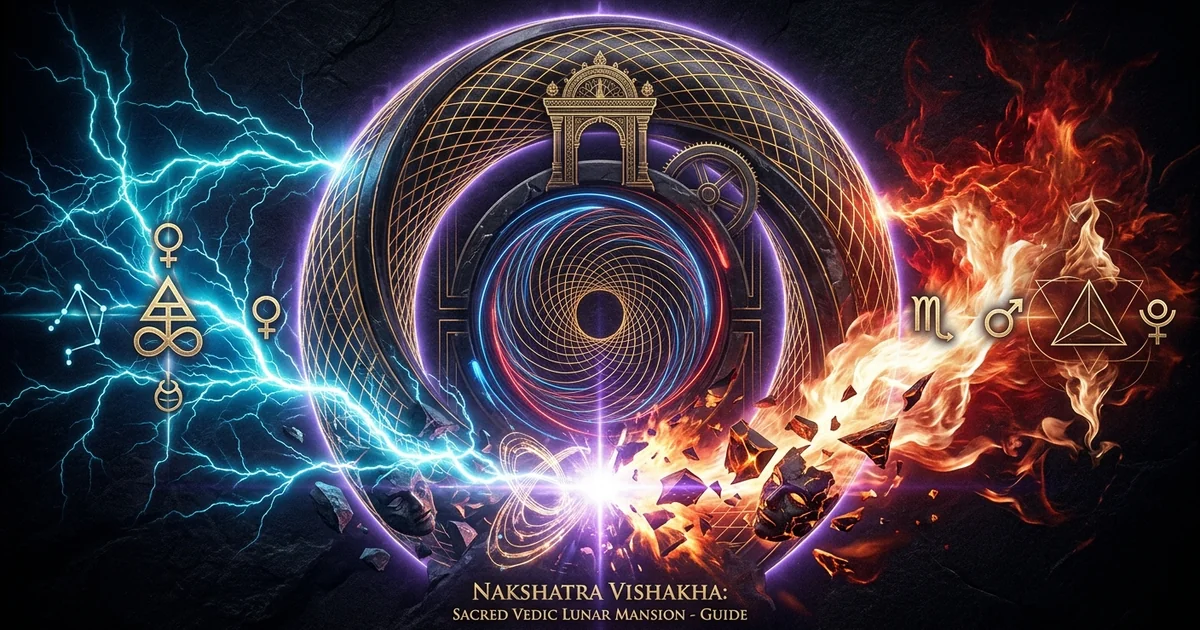
Nakshatra Vishakha: Sacred Vedic Lunar Mansion - Guide
Archetypal Thesis & Systemic Paradigm: The Bifurcated Vector of Vishakha
Occupying the pivotal interface between sidereal Libra (20°00’) and Scorpio (03°20’), Nakshatra Vishakha serves as the psycho-cosmic threshold where individual harmony dissolves into transmutative alchemical crisis. Within the canonical architecture of the 27 nakshatras jyotish matrix, Vishakha occupies the sixteenth station: an energetic nexus where equilibrium ceases to be an end in itself and instead becomes the raw fuel for evolutionary breakthrough. Governed by the dual deities Indra and Agni, this asterism manifests the bifurcated dynamic of atmospheric sovereignty and primordial fire. The station operates not as a passive marker of temperament, but as an acute vector of teleological consciousness—an engine designed to shatter stasis in pursuit of an uncompromising evolutionary horizon.
The Mechanics of Vyapani Shakti: The Power to Pervade and Achieve
The operational core of Vishakha is defined in Vedic cosmogony by vyapani shakti—the sovereign capacity to pervade, permeate, and achieve concrete fruition across multiple existential planes. Derived from the Sanskrit root vyap (to diffuse, encompass, or saturate), this shakti establishes an energetic imperative: whatever objective is claimed by the native consciousness must be completely colonized, assimilated, and brought to unyielding manifestation. Unlike the preceding asterism Nakshatra Swati, which disperses prana through mercurial and airy adaptations via Vayu, Vishakha consolidates diffuse intentionality into a unified, penetrating ray.
This pervasion operates through a dual-stage energetic cycle: first, a horizontal expansion that surveys the systemic landscape, followed by a vertical, piercing descent that captures the target of desire. In the realm of cognitive dynamics, vyapani shakti generates an acute hyper-fixation. The psyche ceases to register secondary environmental stimuli, marshaling all somatic and intellectual reserves toward a single teleological summit. Consequently, the vishakha nakshatra vedic astrology meaning cannot be parsed through conventional paradigms of static balance; it represents a relentless drive that tolerates no peripheral interference until its systemic imperative is fully actualized.
The Liminal Chasm: Bridging Sidereal Libra and Scorpio
The astronomical and symbolic terrain of Vishakha straddles one of the most volatile structural divides in the sidereal zodiac. The first three quarters (padas) anchor themselves within the intellectual, balance-seeking, Venusian domain of Tula (Libra), while the final quarter plunges into the subterranean, Mars-Ketuvian waters of Vrishchika (Scorpio). This liminality produces an irreconcilable ontological tension. In Libra, the archetype seeks consummate social diplomacy, objective justice, and aesthetic refinement; yet, the impending proximity of Scorpio infects this harmony with an existential suspicion of superficiality.
- Total Span: 20°00’ Tula (Libra) to 03°20’ Vrishchika (Scorpio)
- Pada 1: 20°00’ – 23°20’ Tula | Mesha (Aries) Navamsha | Ruled by Mars (Kinetics/Will)
- Pada 2: 23°20’ – 26°40’ Tula | Vrishabha (Taurus) Navamsha | Ruled by Venus (Resource/Fixity)
- Pada 3: 26°40’ – 30°00’ Tula | Mithuna (Gemini) Navamsha | Ruled by Mercury (Dialectics/Strategy)
- Pada 4: 00°00’ – 03°20’ Vrishchika | Karka (Cancer) Navamsha | Ruled by Moon (Pushkara Navamsha / Emotional Crucible)
- Vimshottari Planetary Lord: Brihaspati (Jupiter)
- Esoteric Syzygy: Indra (Cosmic King/Lightning) & Agni (Sacrificial Priest/Fire)
This structural boundary constitutes an alchemical cleave. The ego recognizes that interpersonal mediation and aesthetic elegance can no longer resolve the deeper demands of individuation. To cross into Scorpio, the outward harmony of Libra must be intentionally surrendered to the transformative fire of the chthonic depths. The native undergoes an existential conversion where the polished mask of social accommodation cracks, revealing an unyielding will to power and absolute psychological truth.
Teleological Drive: The Alchemical Tension of Dual Motivation
The bifurcation inherent to Vishakha creates an acute thermodynamic pressure within the psyche. Governed macrocosmically by Brihaspati (Jupiter) under the Vimshottari dasha system, the nakshatra imposes an unyielding mandate toward moral righteousness, expansive wisdom, and philosophical sovereignty. However, this high-minded Jovian impulse is forced to articulate itself through the sensual, material substrates of Venus (ruler of Libra) and the militant, confrontational substrates of Mars (ruler of Scorpio).
This divergence generates the classic “split branch” morphology implied by the word Vishakha itself (from vi, apart/divergent, and shakha, branch). The consciousness experiences a simultaneous pull toward lofty spiritual realization (dharma) and raw, visceral conquest (artha/kama). Far from producing paralysis, this psychic friction acts as a hyper-concentrated crucible. The internal friction accelerates the libido, transmuting divided ambitions into an obsessive, laser-focused vehicle for evolutionary advancement. The native is propelled forward not by inner peace, but by the relentless friction of their own irreconcilable dualities.
Classical Provenance & Textual Lineage: The Canonical Codices of the Fire-Lightning Dualism
The analytical history of Vishakha traverses three millennia of textual evolution, migrating from the sacrificial cosmologies of the late Vedic period to the psychological and predictive compendiums of classical Jyotish. Across these codices, the asterism is consistently identified as an ontological fulcrum: the structural point where cosmic order (rita) is maintained not through tranquil symmetry, but through the decisive, combative interventions of the divine pantheon.
Vedic Lineage: The Taittiriya Brahmana and the Nakshatra Sukta
The foundational locus for the metaphysical mechanics of Vishakha resides in the Taittiriya Brahmana (1.5.1) and the associated recensions of the Nakshatra Sukta. Within these archaic liturgies, the asterism is designated as Dvidha (the bifurcated or two-branched one) and explicitly placed under the conjoined sovereignty of the divine pair, Indragni. This pairing is unique within the lunar zodiac; while other mansions are assigned single tutelary deities or complementary pairs acting in unison, the indra & agni deity nexus represents a catalytic convergence of atmospheric force and terrestrial hunger.
“Indrāgnī dhiyena viśākhe… te naḥ kṣemaṁ dharayantu |
Viśākhe nakṣatram indrāgnī devatā |
Pravāpaṁ kṛṇvantī madhyamānāḥ | Tad devā abhyarakṣantu sarve.”
Hermeneutic Translation:
“Indra and Agni, arriving through intentional cosmic action, establish the bifurcated Vishakha… May they uphold and sustain our enduring security (kshemam). Vishakha is the asterism; Indra-Agni are its sovereign deities. Scattering the chaff, they harvest the divine essence within the churn of the central field. May all the shining ones preserve and protect this transformative labor.”
The liturgical focus on madhyamānāḥ—the churning or threshing of the field—reveals that archaic Vedic seers perceived Vishakha as an agricultural and cosmological separator. The asterism does not merely facilitate generic growth; it presides over the violent extraction of grain from husk, the segregation of the immortal nectar (soma) from mortal residue. The convergence of lightning (Indra) and sacrificial combustion (Agni) provides the thermodynamic energy required to execute this radical division, providing safe harbor (kshemam) only after the labor of purification is complete.
Varahamihira and Kalyanavarma: Hellenistic Syntheses and Classical Jyotish Compendiums
As Jyotish systematized its interpretive matrices during the classical golden age, the raw mythopoetic forces of the Vedas were codified into human behavioral phenotypes. In the Brihat Samhita (Chapter XV, verse 16), Varahamihira delineates the psychological footprint of the Vishakha native with diagnostic precision, observing that those born when the Moon traverses this asterism are irshyalu (prone to intense jealousy or competitive envy), lubdho (covetous or sharply driven by acquisition), dyutiman (possessing a radiant, penetrating physical presence), vachalo (acerbic, authoritative, and persuasive in speech), and kalahapriya (drawn toward conflict as an arena of self-validation).
Writing three centuries later in the Saravali (Chapter 26, verses 65–68), Kalyanavarma refines these observations into a psycho-structural analysis. Kalyanavarma notes that while the native suffers from an agonizing internal restlessness and a persistent tendency to view peers as existential rivals, their capacity for relentless work (vyavasaya) and institutional mastery (shastra-vid) ensures ultimate triumph over all detractors. Kalyanavarma underscores the moral ambiguity of the asterism: the native is capable of profound ethical compromise in the pursuit of their objective, yet ultimately attains a state of worldly sovereignty that commands universal submission.
Epistemological Shifts: From Archaic Ritualism to Internalized Alchemical Psychology
The historical trajectory of Vishakha’s nomenclature reveals an esoteric interiorization of its mechanics. In the earliest Vedic registers, the asterism is frequently styled as Radha, an ancient appellation signifying “the gracious one,” “success,” or “the focal point of devotion.” This archaic title links Vishakha directly to its cosmic counter-station, Nakshatra Anuradha (“that which follows Radha”), establishing a paired continuum of teleological conquest followed by devotional surrender.
As the centuries progressed, the exoteric ritualism of the sacrificial fire pit (yajna) yielded to the internal alchemy of the subtle body (sukshma sharira). Medieval commentators recognized that the fire of Agni and the lightning of Indra were not distant meteorological or liturgical phenomena, but specific channels of biological and psychic energy. Indra came to be identified with the intellectual ego and the mastery of the sensory apparatus (indriyas), while Agni was identified with the awakening of internal fire and digestive-transformative heat (jatharagni and kundalini). Consequently, Vishakha transformed from an exterior altar of conquest into the interior crucible of self-realization.
Structural Mechanics & Symbolic Geometry: The Triumphal Arch and the Potter’s Wheel
The symbolic codification of Vishakha bypasses naturalistic, passive animal totems, operating instead through human mechanical contrivances that represent threshold crossing and radical structural metamorphosis. The two primary glyphs assigned to this asterism—the Triumphal Arch (Torana) and the Potter’s Wheel (Kulala Chakra)—reveal the dynamic interplay between linear conquest and cyclic transmutation that governs the consciousness of the native.
THE TORANA (TRIUMPHAL ARCH)
                 [Exterior Threshold of Conquest]
                                |
             +------------------+------------------+
             |                                     |
      Indra's Vector                         Agni's Vector
 (Atmospheric Lightning)                 (Chthonic Combustion)
             |                                     |
             +------------------+------------------+
                                |
                                v
                   THE POTTER'S WHEEL (CHAKRA)
              [Interior Centripetal Transmutation]
                                |
                                v
               VESSEL OF INDIVIDUATED SOVEREIGNTY
The Triumphal Arch (Torana): The Threshold of Initiatory Conquest
The triumphal arch, or Torana, constructed from auspicious branches, leaves, and martial spoils, is an ancient emblem of celebratory passage. Unlike a static domestic doorway, the Torana is erected exclusively to honor the return of victorious sovereigns from the field of battle. It represents a boundary condition: a point of no return that separates the grueling, unglamorous labor of military campaign from the radiant, elevated state of sovereign recognition.
From the perspective of depth psychology, this triumphal arch / potter wheel symbol denotes an initiatory threshold. To pass through the Torana of Vishakha, the ego must have successfully confronted its shadow, endured the trials of competitive isolation, and achieved decisive mastery over the objective world. The arch frames the hero’s arrival into collective visibility. However, this symbol carries a latent warning: the arch is unsupported by interior rooms; it is a liminal marker suspended between two worlds. The triumph it celebrates is momentary, an ephemeral peak of validation that immediately demands entry into a new and more demanding theater of psychic war.
The Potter’s Wheel: Centripetal Acceleration and Malleable Transmutation
Contrasting sharply with the linear, outward ascent of the triumphal arch, the secondary symbol of Vishakha is the potter’s wheel (Kulala Chakra). The potter’s wheel is a machine of pure rotational inertia, centripetal acceleration, and intense mechanical friction. It requires raw, shapeless clay—extracted from the dark, chthonic earth—to be thrust onto a rapidly spinning axis, where the firm, steady application of the artisan’s hands molds the malleable mass into a functional, resilient vessel.
The Triumphal Arch (Torana)
- Vector Dynamic: Linear, exteriorized, ascending vector oriented toward worldly conquest and social elevation.
- Psychic Domain: The conscious ego; public validation, competitive triumph, and visible markers of hierarchy.
- Material Expression: The gateway of political, military, or intellectual victory over peripheral opposition.
- Existential Hazard: Hubristic identification with exterior honors, resulting in sensory inflation and political downfall.
The Potter's Wheel (Kulala Chakra)
- Vector Dynamic: Cyclic, centripetal, interiorizing vector oriented toward structural reshaping and purification.
- Psychic Domain: The somatic unconscious; the raw instincts, neuroses, and elemental drives subjected to intense pressure.
- Material Expression: The prolonged labor of craft, repetitive self-discipline, and thermodynamic endurance under crisis.
- Existential Hazard: Fixation upon perpetual suffering; masochistic entrapment within cycles of destruction and reformation.
The potter’s wheel serves as a master metaphor for the psycho-spiritual trajectory of the native. The individual cannot achieve functional integrity through passive intellectualization. They must be placed upon the spinning wheel of worldly trials, enduring the friction of intense emotional heat and relentless pressure until the chaotic, unrefined contents of the subconscious are forged into an enduring vessel capable of holding the divine nectar of sovereign consciousness.
Planetary Rulership Dynamics: Jupiter’s Vimshottari Governance over Venusian and Martian Fields
The planetary architecture of Vishakha establishes an acute dialectic between its Vimshottari lord, Brihaspati (Jupiter), and the sign rulers of its zodiacal domicile: Shukra (Venus) in Libra and Mangala (Mars) in Scorpio. In orthodox Jyotish, Jupiter and Venus share an antagonistic relationship (tatkalika and naisargika shatrutva) as the respective preceptors of the Devas and the Asuras. Jupiter represents transcendental law, abstract wisdom, and vertical spiritual aspiration, whereas Venus governs immanent aesthetic beauty, sensory fulfillment, and the horizontal preservation of form.
When Jupiter’s expansiveness operates within the Venusian matrix of Libra, it creates an insatiable desire for the idealization of earthly relations. The native does not merely seek a partner or a creative output; they demand that the partner or artifact embody transcendent perfection. When the nakshatra crosses into the Martian territory of Scorpio in Pada 4, Jupiter’s expansive righteousness combines with the kinetic, penetrative force of Mars. This synthesis births an unyielding warrior-priest archetype: a psychological disposition that views internal spiritual transmutation and external strategic confrontation as identical expressions of cosmic duty (dharma).
The Mythic-Theological Matrix: Indra and Agni as Dialectical Polarity
The governing theological engine of Vishakha is unique in the lunar pantheon: it does not seat a single deity upon its throne, but binds together Indra, the King of the Gods, and Agni, the Divine Sacrificial Fire. This syzygy constitutes a cosmic feedback loop wherein celestial authority and terrestrial aspiration converge, generating the thermodynamic current that drives the asterism’s relentless agency.
INDRA (Sovereign Lightning / Atmospheric Will / Ego Zenith)
                                |
                                v
               [Descent via the Vajra (Thunderbolt)]
                                |
                                v
              =====================================
              THE TORANA (INITIATORY EGO THRESHOLD)
              =====================================
                                ^
                                |
               [Ascent via Kundalini / Internal Tapas]
                                |
                                ^
       AGNI (Sacrificial Priest / Terrestrial Fire / Primal Urge)
                                |
                                v
       VYAPANI SHAKTI: INTEGRATED FRUITION & SOVEREIGNTY
Indra: Atmospheric Will, Sovereignty, and the Hubris of the Senses
Indra represents the supreme apex of divine power within the middle atmosphere (antariksha). Wielding the thunderbolt (vajra) forged from the bones of the sage Dadhichi, Indra is the dragon-slayer who fractures the stone enclosures of Vritra to liberate the cosmic waters of consciousness. He signifies executive cognitive agency, sovereign will, political supremacy, and the strategic deployment of power. In the human psyche, Indra corresponds to the illuminated ego-complex at its absolute zenith of capability and command.
Yet, embedded within the Indra archetype is the perennial shadow of sensory excess and existential paranoia. Etymologically linked to the indriyas (the five sensory organs and five motor organs), Indra is perpetually vulnerable to the lure of physical intoxication and somatic gratification. Furthermore, his status as king is never absolute; he sits upon an unstable throne, plagued by the terror that an ascetic’s penance (tapas) or a rival’s conquest might depose him. This generates the archetypal Indra neurosis: brilliant administrative and strategic competence overshadowed by a chronic suspicion of potential rivals.
Agni: The Consuming Priest, Sacred Transmutation, and Primal Instinct
Positioned at the opposing pole of this divine circuit is Agni, the primordial priest (purohita) and messenger of the cosmos. If Indra represents the lightning that descends from above, Agni is the flame that ascends from the earth below. Agni is the cosmic mouth (mukham) through which the gods consume the offerings of mortals; he is the universal solvent that accepts raw, impure, chaotic matter and, through the catalytic agony of combustion, reduces it to immaculate, crystalline light.
Agni operates as the instinctual, biological, and metabolic base of the Vishakha architecture. He represents the burning desire to transform, the visceral hunger that refuses to leave the soul dormant in states of complacent ease. Agni does not rationalize; he consumes. In the developmental trajectory of the Vishakha native, Agni acts as the relentless dissatisfaction that burns away superficial pleasures, demanding that the individual cast their illusions, security blankets, and false accommodations into the furnace of self-transmutation.
The Syzygy of Indra-Agni: The Dynamic Circuit of Divine Will
When Indra and Agni are conjoined within Vishakha, they construct a closed thermodynamic circuit. Indra provides the architectural blueprint, the cognitive strategy, and the structural lightning of purposeful will. Agni provides the raw fuel, the subterranean passion, and the unyielding thermodynamic heat necessary to execute that will. It is the marriage of the King and the Priest, the General and the Alchemist.
This syzygy resolves the riddle of the asterism’s split nature. The lightning bolt of Indra strikes down into the terrestrial matter of Agni, igniting a sustained combustion that burns away psychic dross. The native possessed of this integrated circuit is neither an idle dreamer nor a mindless brute; they become an instrument of teleological conquest, combining cold strategic intelligence with a fiery, inexhaustible engine of execution.
Psychological Dynamics & Operational Praxis: The Shadow of Envy and the Art of Decisive Realization
In the clinical and diagnostic realm, Vishakha outlines a distinct psychodynamic structure characterized by hyper-focus, structural isolation, and intense vulnerability to shadow projections involving status, comparison, and material or spiritual territoriality. Understanding this asterism requires examining both its pathological deviations and its path toward transformative integration.
The Archetypal Complex: The Asura of Comparison and Fratricidal Ambition
The most acute psychic pathology native to Vishakha is the complex of Irshya—an intense, destabilizing mixture of malignant envy, bitter rivalry, and chronic existential comparison. Because the asterism is oriented toward the Torana of solitary achievement, the native tends to measure their value through external status and zero-sum metrics of dominance. When an archetype’s ultimate purpose is to stand alone beneath the triumphal arch, the success of a sibling, peer, or colleague is registered by the unconscious as an existential threat.
“The confrontation with the shadow is frequently lived out in the projection of the hostile brother, the rival who embodies everything the conscious ego refuses to integrate… Where ambition is divorced from the transpersonal Self, the shadow takes the form of an insatiable envy, a tormenting consciousness of the other’s light, which the ego seeks either to usurp or extinguish in order to secure its own precarious supremacy.”
— C.G. Jung, Aion: Researches into the Phenomenology of the Self (Collected Works, Vol. 9, Part 2, §120)
This dynamic often manifests as an “Asura complex,” wherein the native feels unjustly excluded from the divine banquet of recognition. They observe the effortless grace of others with resentment, concluding that they must conquer life through sheer force, tactical cunning, and unrelenting labor. Left unintegrated, this complex degenerates into paranoia, vindictiveness, and relational isolation, as the native burns their bridges in the pursuit of absolute, uncontested dominance.
The Pada Breakdown: Four Modulations of Consciousness across Navamsha
The evolutionary mechanics of Vishakha unfold across its four quarters or padas, which translate the macrocosmic fire-lightning vector into specific psychological frameworks across the Navamsha (D9) harmonic chart:
- Pada 1 (20°00’ – 23°20’ Libra | Mesha Navamsha): Ruled by Mars. This is the kinetic apex of the asterism. The balance of Libra is violently destabilized by an influx of Martian fire. Here, the native exhibits raw ambition, pioneer instincts, martial sharpness, and high physical endurance. The primary psychological task is restraining impulsiveness and directing explosive energy into constructive institutional architecture rather than self-destructive confrontations.
- Pada 2 (23°20’ – 26°40’ Libra | Vrishabha Navamsha): Ruled by Venus. The focus shifts toward the materialization of ambition. The kinetic lightning of Indra is grounded into the fertile earth of Taurus. The native possesses immense endurance, commercial acumen, and an obsession with securing tangible assets, luxury, and artistic mastery. The psychological trap is avarice and an absolute refusal to surrender control over material resources.
- Pada 3 (26°40’ – 30°00’ Libra | Mithuna Navamsha): Ruled by Mercury. The dialectical intellect dominates. This quarter manifests as brilliant rhetorical capacity, strategic mastery, propaganda, and high-level legalistic or administrative maneuvers. The native conquers through the spoken and written word, dissecting opponents’ arguments with surgical precision. The existential danger is intellectual cynicism, deceit, and the instrumentalization of human relationships.
- Pada 4 (00°00’ – 03°20’ Scorpio | Karka Navamsha): Ruled by the Moon. This is the esoteric crucible of Vishakha, holding the exalted status of Pushkara Navamsha. Here, the asterism plunges into the oceanic depths of Scorpio. The external markers of triumph dissolve into an internal emotional crisis. The native is forced to burn their egoic ambitions in the fire of psychological vulnerability. It produces profound mystics, depth psychologists, and spiritual masters who have emerged from the underworld of their own trauma to heal and guide others.
Clinical Praxis: Transmuting ‘Radha-Shakti’ in Contemplative Self-Mastery
To resolve the pathological deviations of Vishakha, operational praxis must focus on interiorizing the competitive impulse. The native must be guided to recognize that the “rival” they seek to defeat is not an external peer, but their own inner inertia and fragmentation. This is the great transmutation of Vishakha back into its archaic identity as Radha: the single-minded focus of the soul toward divine realization.
Clients with a prominent Vishakha placement must cultivate deliberate practices of contemplative boundary-setting and non-comparative self-evaluation. In clinical frameworks influenced by Jungian archetypes in Vedic astrology, this involves integrating the shadow through intentional tapas (disciplined spiritual heat). By dedicating their immense capacity for relentless focus to creative mastery, philosophical scholarship, or contemplative arts, the destructive, fratricidal fire of the Asura is transmuted into the sacred combustion of the alchemical vessel, transforming destructive envy into genuine individuation.
Philosophical Synthesis & Macrocosmic Correspondence: The Alchemical Threshold of Individuation
Beyond individual psychology, Vishakha represents an overarching metaphysical principle within the systemic evolution of consciousness: the moment where the universe resolves its fundamental polarities through the crucible of a decisive, conscious choice.
Hermetic Parallels: Coincidentia Oppositorum and the Great Work
In the Western esoteric lineage, Vishakha mirrors the Hermetic axiom of polarity and the alchemical coincidentia oppositorum (the coincidence of opposites). The asterism embodies the critical phase of Separatio followed by Calcinatio. The raw base metal of unexamined ego-consciousness is segregated from its unconscious attachments and subjected to the direct flame of the philosophical furnace.
Indra corresponds precisely to the Solar King, representing conscious sovereignty, philosophical gold, and celestial agency, while Agni corresponds to the Chthonic Dragon or the subterranean sulfur that fuels the transformation from within the darkness of the earth. Vishakha is the moment of their chemical wedding (coniunctio), an event that is initially experienced not as peaceful union, but as a violent storm of lightning and fire that shatters the vessel of the unrefined self. Only when this storm is weathered does the true adept emerge, crowned under the Triumphal Arch of the Philosopher’s Stone.
Macrocosmic Cyclical Evolution: Vishakha as the Autumnal Cleave
In the cyclical progression of the macrocosmic year in the northern hemisphere, Vishakha occupies the autumnal decline where the equilibrium of the Libra equinox collapses irrevocably into the shortening, dying light of late autumn. It is the cosmic executioner: the sickle that cuts down the harvest. The golden, balanced days of social harvest are terminated by the cold realization of impending winter.
This macrocosmic position explains why the ancient texts associate Vishakha with threshing and winnowing. Nature itself is separating the grain that will sustain life during the freeze from the dead stalk that must be turned into the soil to rot. Vishakha enforces this existential triage upon the human soul. It demands that the individual consciously choose what core essence is worth preserving through the underworld journey of Scorpio, casting aside all superficial, non-essential psychic luggage.
Cross-System Concordance: Human Design and Qabalistic Resonances
The structural mechanics of Vishakha find rigorous cross-system validation within both the Qabalistic Tree of Life and the Rave Mandala of Human Design:
- Vedic System: Nakshatra Vishakha (Padas 1–4: 20°00’ Libra to 03°20’ Scorpio)
- Planetary Dynamic: Jupiter (Lord of Nakshatra) mediating Venus (Libra) and Mars (Scorpio)
- Qabalistic Correlate: The Path of Peh (The Tower, Mars) intersecting the Path of Tiphereth (The Sun) across Geburah (Severity)
- Human Design Gate: Gate 28 (The Game of Life / The Struggle for Purpose) bridging into Gate 44 (Coming to Meet) and Gate 1 (Self-Expression)
- I Ching Hexagram: Hexagram 28 (Da Guo / Preponderance of the Great) transitioning to Hexagram 43 (Kuai / Breakthrough / Decisiveness)
Within the Qabalistic framework, the energetic tension of Vishakha corresponds to the descent from Geburah (Severity/Fire) across the veil into Tiphereth (Sovereign Beauty/Harmony). It reflects the shattering of false, brittle structures seen in The Tower (Path of Peh), an experience necessary to clear the field for genuine sovereign authority. In Human Design, the Scorpio quadrant of Vishakha corresponds precisely to the Spleen Center’s Gate 28, the Gate of the Player, whose systemic mechanics demand a relentless struggle with the fear of death in order to extract authentic individual purpose from mortal existence. In both systems, the thematic core remains consistent: a non-negotiable trial through which consciousness discovers its true substance by refusing to capitulate to the fear of its own dissolution.
Frequently Asked Questions: Analytical Clarifications on Vishakha
Why is Vishakha often associated with obsession, fixation, and rivalry?
The association of Vishakha with obsession and rivalry stems directly from its teleological architecture and its mythic-theological pairing. Governed macrocosmically by Jupiter, the asterism possesses a vision of grand expanse and ultimate righteousness. However, within the Venusian matrix of Libra, this Jovian impulse becomes intensely focused on securing specific, worldly ideals of success, beauty, and status. Because the symbol of the asterism is the solitary Triumphal Arch—a structure that permits only one conqueror to pass through at a time—the unintegrated consciousness operates from a zero-sum paradigm.
This cognitive posture views the achievements of others as an existential threat to its own sovereign validation. The presence of the Indra-Agni dynamic creates a state of internal thermodynamic arousal: the lightning of Indra focuses the cognitive senses onto the objective with acute intensity, while the fire of Agni fuels an insatiable appetite that cannot be quieted until the objective is conquered. When this vector is untethered from a transpersonal spiritual purpose, it naturally defaults to the Asuric shadow of Irshya (malignant envy), generating the obsessive patterns and contentious rivalries extensively documented in classical Jyotish codices like the Brihat Samhita and Saravali.
How does the placement of the Moon in Vishakha differ between Libra and Scorpio?
The operational expression of the Moon in Vishakha shifts dramatically depending on whether it falls within the first three padas (Libra) or the fourth pada (Scorpio):
- Padas 1 to 3 (20°00’ to 30°00’ Libra): Here, the lunar consciousness operates in the intellectual, diplomatic, and relational sphere of Venus. The mind seeks balance, institutional alliances, and social elevation, using strategic charm, persuasive rhetoric, and calculated maneuvers to achieve its ambitions. The existential struggle remains focused on the exterior stage: negotiating legal contracts, establishing political dominance, or curating public visibility. The shadow manifests primarily as envy of social peers and transactional pragmatism masked as diplomacy.
- Pada 4 (00°00’ to 03°20’ Scorpio): The Moon crosses the transformational border into Martian waters and enters the Cancer Navamsha, an exalted Pushkara Navamsha position. In this station, the external theater of Libra collapses. The emotional body (manas) is plunged into a transformative crisis where superficial strategies lose all efficacy. The native must confront their deepest psychological fears, emotional dependencies, and unconscious shadows. The struggle is no longer about defeating an exterior rival beneath the arch, but about transmuting the unrefined instincts of the subconscious into spiritual gold. This pada produces profound emotional resilience, mystical depth, and therapeutic mastery, moving from worldly ambition to genuine alchemical individuation.
What is the operational significance of the Potter’s Wheel versus the Triumphal Arch?
The Potter’s Wheel (Kulala Chakra) and the Triumphal Arch (Torana) represent the complementary esoteric engines of Vishakha: an interior centripetal process and an exterior linear passage. The Triumphal Arch is the exoteric emblem of the asterism. It signifies the crossing of a major life threshold, the completion of an arduous trial, and the public coronation of the conscious ego. It looks forward and outward, marking the structural victory of the individual over peripheral resistance. It is the monument erected after the war has been won.
Conversely, the Potter’s Wheel is the esoteric engine that makes passing through that arch possible. It operates in the background through cyclic rotation, friction, and sustained heat. The clay of the unrefined personality must be centered upon the spinning axis of spiritual discipline and subjected to the firm, unyielding pressure of life’s trials. While the Triumphal Arch celebrates the finished hero, the Potter’s Wheel is the hidden, often painful process that shapes the raw material of the soul into an enduring, functional vessel. Without the centripetal discipline of the Potter’s Wheel, any passage through the Triumphal Arch remains an empty, hubristic performance that ultimately shatters under the weight of its own unintegrated shadow. :::