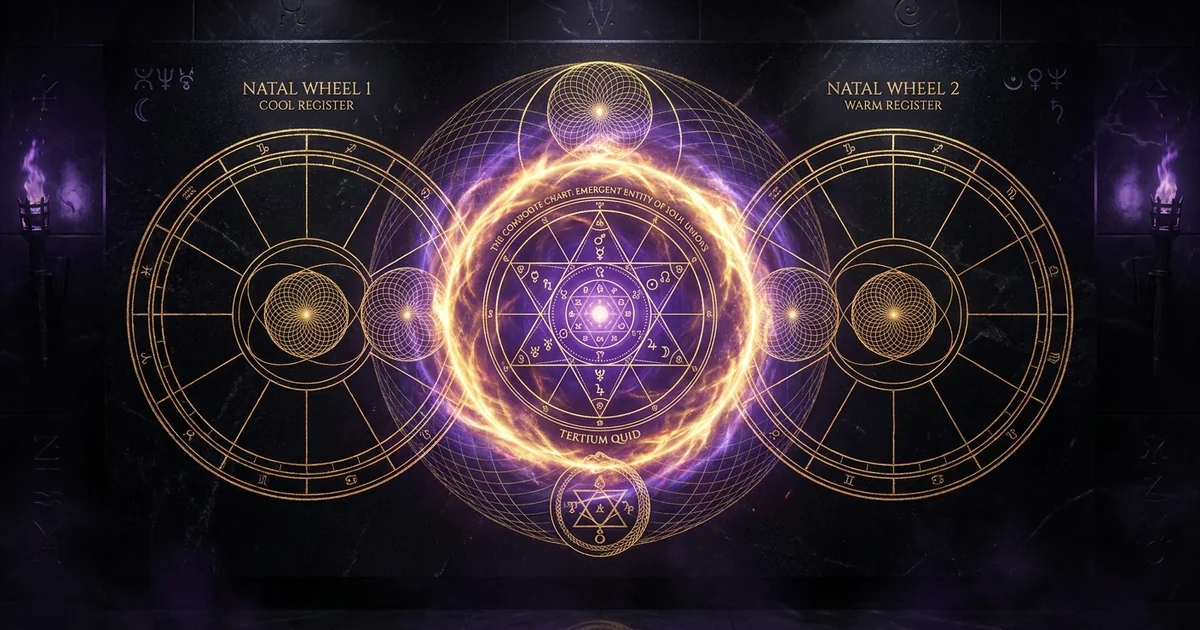
The Composite Chart: Emergent Entity of Soul Unions
Archetypal Thesis & Systemic Paradigm: The Relational Third Entity
Beyond Dyadic Mechanics: The Emergent Relational Field
Standard astrological synastry operates upon an inherently dualistic, linear paradigm. When mapping the relational dynamic between two discrete subjects, traditional comparative technique overlays one natal chart upon another, projecting planetary vectors across orbital thresholds to measure friction, affinity, and mutual psychic excitation. This approach functions much like classical Newtonian mechanics: Planet A in Person One’s nativity casts an aspect toward Planet B in Person Two’s nativity, eliciting a predictable, localized behavioral reaction. Yet, as complex systems theory and modern relational psychoanalysis demonstrate, a bonded dynamic cannot be comprehensively understood merely through the reactive, behavioral ping-pong of its constituent elements.
The composite chart transcends this linear causality by generating an autonomous, non-linear coordinate framework. Rather than asking how one individual affects the other, the composite method synthesizes the mathematical midpoints of both natal positions, producing a single, self-contained horoscope. This resultant chart acts as the state-space representation of the relationship itself as an independent psycho-spiritual organism. Through the deployment of midpoint astrology, the composite framework ceases to describe two autonomous agents negotiating boundaries; it demarcates an emergent field of consciousness possessing its own evolutionary imperatives, boundary parameters, and structural teleology.
In this systemic paradigm, the composite chart represents the energetic matrix that comes into existence at the moment two psyches enter into an enduring orbit. It operates not as an aggregate or compromise, but as a genuine emergent property—an autopoietic entity whose psychological morphology cannot be derived solely from the isolated traits of the participants. The participants do not merely interact within this field; they are subsumed by it, conditioned by its archetypal atmosphere, and drafted into service by its non-negotiable systemic drives.
The Transpersonal Geometry of Consciousness
The emergence of this relational field demands a radical reappraisal of astrological geometry. In individual nativities, planets symbolize localized functional organs of the human psyche: the Sun orchestrates integrated ego-identity, the Moon regulates somatic and affective safety, and Mercury routes epistemological data. However, within the structural parameters of the composite chart astrology midpoint relationship, these planetary symbols are displaced from individual neurobiology and re-anchored into a shared, transpersonal architecture.
The composite placements delineate how the collective entity experiences reality. A composite Sun does not describe how Partner A shines, nor how Partner B perceives vitality; it charts the ontological core, creative impulse, and systemic purpose of the relationship as an autonomous third presence. Consequently, two people with radically non-harmonious nativities may generate an exceptionally stable, creative composite configuration, just as two natively harmonious subjects can produce a composite chart burdened by severe structural tension. The transpersonal geometry of the midpoint chart functions as an impersonal crucible, organizing the psychic material of both individuals into systemic pathways that neither participant could manifest in total isolation.
Synastry (Dyadic Interplay)
- Ontological Status: Multi-subjective; two distinct discrete consciousnesses interacting.
- Causal Architecture: Linear, reciprocal stimulus-and-response mechanics (Planet A triggers Planet B).
- Interpretive Focus: Subjective behavioral experience, interpersonal friction, psychological projection, emotional resonance.
- Structural Model: Dynamic dualism; continuous negotiation across individual psychic boundaries.
- Field Dynamics: Localized activations operating within the discrete framework of each individual’s separate natal chart.
Composite Chart (Third Entity)
- Ontological Status: Autonomous emergent organism; a unified, non-local third presence.
- Causal Architecture: Holonomic, non-linear structural teleology; systemic field-state imperatives.
- Interpretive Focus: Objective relationship purpose, collective destiny, institutional lifespan, autonomous evolutionary path.
- Structural Model: Gestalt synthesis; an indivisible, self-regulating psycho-spiritual system.
- Field Dynamics: Supra-individual operational field that conditions, bounds, and transforms both human participants.
This shift from the personal to the structural necessitates an altered mode of consultation and interpretation. One no longer diagnoses interpersonal friction through the lens of personal culpability. Instead, the practitioners of composite analysis interpret the stress fractures of the chart as necessary homeostatic adjustments within an overarching evolutionary crucible. The relational third entity enforces its own field equations, compelling the human constituents to integrate psychological material that would otherwise remain dormant in their single lives.
The Alchemical Vessel and the Third Presence
The philosophical foundations of the composite chart correspond directly with the alchemical opus described by Carl Gustav Jung in his foundational treatise, Mysterium Coniunctionis. The alchemical vessel—the vas hermeticum—must remain hermetically sealed so that disparate, antagonistic elements (prima materia) can undergo dissolution (solutio), purification (calcinatio), and ultimate synthesis. The composite chart is precisely this alchemical vessel translated into celestial coordinates.
Within this framework, relational union is understood through the doctrine of the coniunctio: the sacred marriage of polarities that culminates not in the victory of one pole over the other, but in the miraculous birth of the filius philosophorum—the Philosopher’s Child. This child is the metaphysical analogue of the third entity relationship. It is an autonomous, qualitative presence distinct from the parents who catalyzed its genesis. Jung recognized that when two psychological systems engage deeply, an energetic tension is constellated that summons what he termed the transcendent function. This function acts as a living bridge between conscious and unconscious polarities, transforming sheer contradiction into an emergent synthesis.
The composite horoscope is the map of this transcendent function. It articulates the precise archetypal pressures that the union must withstand to forge psychospiritual gold from interpersonal lead. The partners do not simply inhabit a shared domestic or emotional contract; they are interlocked within a living, psychic mandala. When individuals lament that they “do not recognize themselves” within the perimeter of a specific partnership, they are intuitively detecting the psychic gravitational pull of this third entity, which bends individual ego-expression to serve its own systemic teleology.
Classical Provenance & Textual Lineage: The Midpoint Evolution
The Hamburg School and Uranian Halbsummen
The methodological ancestry of the composite chart does not belong to classical Hellenistic or medieval Arabic astrology, which relied primarily on whole-sign geometries, temporal rulers, and planetary aspects. Its structural lineage instead stems directly from the early twentieth-century German astrological revolution, specifically through Alfred Witte and the Hamburg School of Astrology. Rejecting traditional astrological mysticism in favor of rigorous, empirical mathematical coordinates, Witte introduced the operational mechanics of midpoints—termed Halbsummen (half-sums).
Witte posited that the energetic intersection between two planetary bodies is not merely an empty expanse of zodiacal space, but an acute focal axis of planetary energy. When the midpoint between two celestial bodies is activated by a third body, a precise archetypal synthesis crystallizes. This foundational insight laid the groundwork for viewing astrological charts not as static geometric arrangements, but as interconnected, dynamic webs of vibrational axes. However, Witte’s initial deployment of Halbsummen remained anchored within the individual nativity or focused on collective transits affecting a single locus of consciousness. The conceptual leap toward computing the midpoint matrix between two separate individuals had not yet occurred, remaining latent within the radical mathematics of the Hamburg School.
Ebertin’s Cosmobiology and Structural Harmonics
The bridge between Witte’s Uranian system and modern psycho-astrology was constructed by Reinhold Ebertin. In his seminal 1940 text, The Combination of Stellar Influences, Ebertin stripped the Hamburg School of its speculative hypothetical planets (such as Cupido, Hades, and Zeus) and refined midpoint analysis into the empirical discipline of cosmobiology. Ebertin focused relentlessly on the energetic potency of planetary structures, demonstrating that midpoints represent clear physical, biological, and psychological conditions within the subject.
“The midpoint (half-sum) between two planets shows the point where their combined energies are brought to a focus. It represents the psychological and physical synthesis of two separate cosmic principles, creating a new and distinct structural manifestation that operates with the full intensity of an actual planetary conjunction.”
Ebertin’s harmonic analysis altered the paradigm of astrology from static signs to vibrational lines of force. Although cosmobiology initially evaluated individual human beings and critical medical conditions, Ebertin demonstrated mathematically that midpoints operate through hard aspects (conjunctions, squares, oppositions, semi-squares, and sesquiquadrates) with absolute precision. This empirical verification of midpoint mechanics created the mathematical framework required for modern relational charting. If midpoints could successfully unite distinct planetary principles within an individual’s psyche, the identical geometric algorithm could theoretically weave the planetary vectors of two distinct human beings into a single, cohesive planetary lattice.
The 1970s Breakthrough: Townley, Hand, and the Relational Shift
The decisive historical mutation that produced the modern composite chart occurred during the early 1970s, spearheaded by American astrologers John Townley and Robert Hand. In 1974, Townley published The Composite Chart: The New Astrology of Relationships, formalizing the procedural algorithm of compiling the midpoints between two natal horoscopes to generate an integrated, twelve-house birth chart for the relationship itself. Townley demonstrated that this new chart could be read holistically, utilizing classical house and sign parameters, yet yielding an interpretation centered entirely on the couple destiny rather than individual subjective experience.
This work was elevated to structural and academic maturity by Robert Hand in his monumental 1975 volume, Planets in Composite: Analyzing Human Relationships. Hand systematized the interpretive literature, laying out clear delineate rules for every planetary combination, house placement, and major aspect. Crucially, Hand contextualized the composite chart within emerging paradigms of humanistic psychology, existential philosophy, and systems theory. He legitimized the composite wheel not as an esoteric novelty, but as an indispensable diagnostic tool capable of revealing the deep, transpersonal evolutionary currents operating beneath the surface of domestic partnerships.
During this era of foundational codification, intense debates erupted regarding the mathematical calculation of composite house cusps. The astrological community fractured over two divergent methodologies: the Derived Ascendant method (computing the midpoint of the Midheavens and calculating the Ascendant from relational latitude) versus the pure Midpoint Ascendant method (calculating the direct spatial midpoint between the two natal Ascendants). This technical dispute reflected an underlying metaphysical division regarding whether spatial geometry or temporal continuity held primacy in charting the operational architecture of human consciousness.
Structural Mechanics & Symbolic Geometry: Calculating the Midpoint Coordinate System
Mathematical Calculation: Absolute Longitude and Shorter Arc Equations
The mathematical construction of the composite chart requires translating each planet’s position from zodiacal signs into absolute ecliptic longitude, spanning 0°00’00" to 359°59’59" starting from the vernal equinox (0° Aries). The algorithm operates by determining the spatial half-sum between the identical planetary bodies of both natal nativities, explicitly adhering to the rule of the shorter arc (an angular separation of less than 180°).
Let $\lambda_1$ represent the absolute ecliptic longitude of a planet in Chart A, and $\lambda_2$ represent the absolute ecliptic longitude of the corresponding planet in Chart B. The absolute angular difference between the two planetary vectors is defined as:
$$\Delta\lambda = |\lambda_1 - \lambda_2|$$
If $\Delta\lambda < 180^\circ$, the composite midpoint ($\lambda_C$) is derived via the standard arithmetic mean:
$$\lambda_C = \frac{\lambda_1 + \lambda_2}{2}$$
If $\Delta\lambda > 180^\circ$, computing the simple arithmetic mean would erroneously calculate the “far arc” (the axis point separated by more than 180°), misplacing the relational core. To solve for the shorter arc under conditions where $\Delta\lambda > 180^\circ$, an offset of $360^\circ$ is introduced:
$$\lambda_C = \left( \frac{\lambda_1 + \lambda_2 + 360^\circ}{2} \right) \pmod{360^\circ}$$
This operation is executed across all ten planetary bodies, the Lunar Nodes, and the Chironic archetype. The resultant coordinates create a synthetic celestial array, grounding the complex psychological physics of the relationship into an integrated planetary matrix.
The Horizon Dilemma: Midpoint Ascendant versus Derived Reference Systems
While the calculation of composite planetary bodies is universally standardized across schools of modern astrology, the determination of the chart’s structural horizon—the composite Ascendant and the subsequent house cusps—remains one of the most critical structural dilemmas in esoteric cartography. Because the composite chart does not occur at a singular, localized moment in historical space-time, it lacks an organic local horizon. Astrologers must therefore determine the angles through one of two primary geometric methodologies.
The first method is the Pure Midpoint Method. In this system, every house cusp is calculated independently by finding the exact shorter-arc midpoint between the equivalent house cusps of both natal charts (e.g., the midpoint of Natal Ascendant A and Natal Ascendant B yields the Composite Ascendant). The primary structural limitation of this technique is planispheric distortion: because the zodiac rises obliquely across the ecliptic at rates that vary by latitude, the mathematical midpoints of twelve separate houses frequently violate the laws of spherical geometry. Cusps can compress, invert, or display bizarre asymmetric geometries, occasionally causing the Ascendant and Midheaven to form impossible non-quadrant angles (such as an Ascendant forming a sextile or trine to the Midheaven rather than an approximate square).
The second, widely preferred technique is the Derived Midpoint Method (frequently termed the Midheaven/Ascendant Derived Method). This approach preserves spatial and astronomical coherence:
- The exact shorter-arc midpoint between the Midheaven (Medium Coeli) of Chart A and the Midheaven of Chart B is calculated to establish the permanent Composite Midheaven ($MC_C$).
- A geographical reference latitude is established. This is traditionally the geographic latitude where the relationship first materialized, or where the couple permanently resides.
- Using the derived $MC_C$ and this relational geographic latitude, the Ascendant, Descendant, Imum Coeli, and the intermediate house cusps are derived utilizing standard astronomical equations of oblique ascension via a selected quadrant house system (such as Placidus, Koch, or Regiomontanus).
This derived method ensures that the composite chart retains the astronomical integrity of a true terrestrial sky, maintaining organic quadrant geometries and guaranteeing that the Ascendant stands in an authentic perpendicular-orbital relationship to the Midheaven.
Aspect Structures and Planispheric Geometry in Midpoint Charts
Aspect structures in the composite chart carry a profound operational charge that differs qualitatively from natal aspects. Because the planets are themselves derived from the synthetic convergence of two distinct orbits, composite aspect formations act as deep systemic feedback loops. They delineate the self-regulating circuits through which the relational organism processes psychological and material energy.
Major aspects in the midpoint chart—particularly the hard planetary alignments of conjunctions ($0^\circ$), squares ($90^\circ$), and oppositions ($180^\circ$)—constitute the structural load-bearing walls of the union. While soft aspects (trines and sextiles) indicate intrinsic behavioral ease, fluid communication, and unearned comfort within the field, they frequently lack the dynamic tension required to preserve structural integrity over extended temporal cycles. Conversely, hard aspects generate deliberate evolutionary friction. A composite Mars-Saturn square, for instance, does not represent a static interpersonal dispute; it is a structural mechanism demanding that the relationship master endurance, emotional austerity, and the disciplined distribution of collective resources.
Furthermore, closed geometric aspect configurations—such as T-Squares, Grand Crosses, and Yods—in a composite chart must be read as integrated teleological engines. When an outer transpersonal planet anchors the apex of a composite T-square, it commandeers the entire relational vehicle, transforming the intimate lives of the participants into a crucible for that archetypal force. The participants are repeatedly drawn into relational crises centered on that focal planet until they construct mature psychological vessels capable of metabolizing its transpersonal demands.
Psychological Dynamics & Operational Praxis: Decoding Core Composite Signatures
The Composite Luminary Core: Sun as Identity and Moon as Affective Soil
The structural evaluation of any composite chart must begin with the relational luminaries. The Sun and Moon delineate the fundamental existential polarity of the relationship entity: its core conscious purpose versus its non-verbal emotional bedrock. The composite Sun reveals the essential raison d’être of the partnership. It is the creative heart, the central animating fire, and the teleological trajectory of the third entity.
If the composite Sun is placed in the Tenth House, the relationship itself demands public visibility, shared worldly ambition, and societal legacy. The individuals may be intensely private in their individual nativities, yet the moment they mobilize as a unit, their social field demands that they function as an institutional, public force. Conversely, a composite Sun residing in the Twelfth House pulls the union into esoteric isolation, spiritual retreat, or hidden labor away from societal validation. If the constituent partners attempt to project a Twelfth House composite Sun into a flashy, public-facing brand, the relationship will undergo severe psychic exhaustion and homeostatic pushback, because the structural imperative of the field demands inward, mystical, or subliminal consolidation.
To analyze the architecture of a composite chart systematically, the practitioner must execute the following sequential protocol:
- Structural Horizon & Angularity: Evaluate planets closely conjunct (within $5^\circ$) the composite Ascendant, Descendant, Midheaven, and Imum Coeli to identify the immediate atmospheric and teleological presence of the union.
- Luminary Diagnostics: Analyze the zodiacal sign, house, and aspect matrix of the composite Sun (the core evolutionary identity) and composite Moon (the emotional and somatic ecosystem).
- Nodal Evolution Vector: Trace the axis from South Node (unconscious relational baseline and ancestral karma) to North Node (teleological growth edge and unintegrated destiny).
- Transpersonal Anchor Identification: Locate outer planets (Saturn, Uranus, Neptune, Pluto) making tight major aspects to composite personal planets, pinpointing where the union acts as an instrument of collective archetypal transformation.
The composite Moon establishes the affective climate, the emotional and somatic baseline, and the instinctual safety parameters of the third entity. It dictates how the couple constructs psychological security, handles emotional crisis, and creates an energetic home. A composite Moon in Scorpio demands absolute emotional transparency, visceral vulnerability, and periodic psychosexual purging; superficial pleasantries will inevitably destabilize the relationship from within. A composite Moon in Taurus, by contrast, thrives upon rhythmic somatic predictability, financial grounding, and physical continuity. The composite Moon is the unconscious emotional soil of the third entity: if this soil is toxic, neglected, or depleted of its archetypal nutrients, no degree of solar ambition can prevent the organism from withering.
The Structural Crucible: Saturnian Duty versus Plutonian Transformation
The outer planets within the composite architecture establish the transpersonal parameters through which the relationship is tested, structurally reinforced, or radically dismantled. Among these, composite Saturn and composite Pluto represent the twin forces of preservation and catharsis—the architectural girders and the alchemical underworld of the union.
Composite Saturn is the absolute arbiter of institutional longevity. It represents the structural commitment, the social contracts, the inescapable mutual burdens, and the temporal endurance of the relationship. A relationship lacking strong Saturnian composite aspects often evaporates when early emotional or physical fascination subsides. However, Saturn’s placement also delineates where the third entity feels intrinsically inadequate, cautious, or inhibited. When composite Saturn conjoins personal composite planets or squares the luminaries, the union is initiated into severe tests of patience, material limitations, or protracted periods of isolation. The participants are challenged to construct real, terrestrial responsibility; failure to accept Saturn’s discipline results in the crystallization of emotional coldness, transforming the partnership into an architectural prison.
Composite Pluto, conversely, marks the ground where the relationship must undergo relentless psychological death and resurrection. Pluto represents the subterranean, autonomic evolutionary drive that strips away individual ego-delusions. Wherever Pluto lands in the composite chart, the union encounters power dynamics, systemic complexes, psychological projection, and the necessity of complete energetic purging. A composite Venus-Pluto conjunction, for example, demands that the relationship transcend superficial or bourgeois models of affection. It plunges the partners into raw, volcanic emotional territory where obsession, jealousy, and profound sexual-emotional bonding become the crucible through which the constituent egos are shattered and reassembled into a more authentic, transpersonal state of union.
Angular Activations: Ascendant Expression and Midheaven Teleology
The angles of the composite chart—the Ascendant/Descendant and Midheaven/Imum Coeli axes—are the primary structural conduits through which the internal psycho-spiritual energy of the relationship materializes into external manifestation. Planets positioned in close proximity to these angles exercise disproportionate control over the life of the union.
The composite Ascendant defines the relationship’s energetic interface with the world. It is the relational persona, the physical aura, and the immediate psychological impression projected into the environment. When third parties encounter the couple, they encounter the composite Ascendant rather than the individual sun signs of the two people. A composite Ascendant in Aries presents as dynamic, combative, pioneering, and self-directed, even if both individuals are internally gentle and introverted. A composite Ascendant in Libra radiates social equilibrium, diplomatic grace, aesthetic coherence, and an intense imperative for partnership balance.
The composite Midheaven ($MC$), on the other hand, charts the public destiny, worldly vocation, and collective contribution of the relationship. It reveals what the third presence is building in the macrocosmic theater. Planets conjunct the composite Midheaven demand that the union achieve concrete, visible accomplishments. A composite Mars conjunct the Midheaven will drive the union toward shared professional conquests, entrepreneurial ventures, or social activism, requiring active engagement with worldly challenges. The opposite pole, the Imum Coeli ($IC$), anchors the ancestral root system, the private sanctuary, and the deep, invisible energetic undercurrents that sustain the relationship when public illumination fades.
Philosophical Synthesis & Macrocosmic Correspondence: Alchemical Coniunctio and Relational Destiny
The Non-Local Field: Relational Entanglement in Hermetic Axiom
The operational reality of the composite chart provides profound confirmation of the foundational Hermetic axiom: As above, so below; as within, so without. When two consciousnesses bond through intimate vows, sustained geographic proximity, or deep psychic entanglement, their individual wavefunctions coalesce into an indivisible state-space matrix. This phenomenon mirrors quantum entanglement, wherein two particles that have once interacted cannot be mathematically described as independent systems, but must be understood through a singular, non-local quantum state.
The composite chart is the astrological translation of this non-local field. It demonstrates that relationships are not merely sociological agreements or evolutionary accidents born of biological necessity. They are metaphysical architectures designed to anchor specific celestial archetypes onto the physical plane. Through the composite lens, we discover that human beings do not simply “choose” one another out of isolated preference; rather, they are drawn together by the emergent imperative of a third presence that requires their combined somatic and psychic coordinates to incarnate into historical time.
“The conjunctio oppositorum is not an assertion of unity achieved by wiping out differences; it is an archetypal reality in which the opposing poles are preserved, yet caught up in a higher synthesis… The creation of the third presence—the unio mentalis materialized—demands the sacrifice of the individual’s claim to total autonomy, yielding to the reality of the transformed vessel.”
The Nodal Axis as Karmic Vector and Systemic Trajectory
The composite nodal axis constitutes the evolutionary compass of the third entity. While personal nodal axes delineate individual developmental trajectories, the composite Lunar Nodes map the shared karmic lineage, behavioral defaults, and structural evolution of the partnership itself.
The composite South Node represents the baseline comfort zone, the instinctual equilibrium, and the accumulated archetypal patterns that the relationship inherits at its inception. It is the energetic default state toward which the union gravitates when exhausted or traumatized. However, an over-reliance on South Node behaviors inevitably results in relational stagnation, decay, and psychological entropy. The energetic lifeblood of the union drains away when the participants use the relationship solely to indulge ancestral regressions or unexamined emotional loops.
The composite North Node indicates the teleological evolutionary attractor of the union—the difficult, unfamiliar, and deeply necessary path of shared development. The relationship must orient itself toward the sign and house parameters of the North Node to fulfill its existential mandate. If the composite North Node is located in the Eleventh House in Sagittarius, the couple destiny must move beyond insular domesticity to embrace collective ideological networks, humanitarian causes, community building, and expansive philosophic horizons. Fulfilling the demands of the composite North Node frequently requires deliberate, conscious effort from both parties, functioning as the evolutionary price of admission for psychic coherence and spiritual longevity.
Transits and Progressions to the Composite: Temporal Activation of Collective Destiny
Perhaps the most astonishing empirical evidence for the structural reality of the composite chart resides in its chronobiological responsiveness. The composite chart does not remain a static geometric abstraction; it breathes, ages, and responds dynamically to the real-time motions of the cosmos. Major transits, secondary progressions, and solar arc directions to composite coordinates mark clear, objective shifts in the life, domestic conditions, and existential trajectory of the union.
When transiting Saturn crosses the composite Ascendant, the entire relationship crosses a critical threshold into solemn responsibility, public consolidation, or catastrophic structural failure. Transiting Uranus crossing the composite Sun can catalyze sudden domestic disruptions, radical lifestyle renovations, or an abrupt rupture of the relational bond, regardless of whether either partner’s natal Sun is being touched by Uranus. The third entity experiences its own developmental rites of passage, its own existential crises, and its own temporal reckonings.
Composite Midpoint Dynamics: Secondary Progressions
─────────────────────────────────────────────────────────────
[Progressed Composite Sun]  ──> [Triggers Composite Angles]
            │                               │
            ▼                               ▼
  [Ego-Evolution of Union]         [Material Milestones / Crisis]
Through secondary progressions, the composite chart reveals its unfolding, organic timeline. As the progressed composite Sun advances roughly one degree per year, it forms aspects to the natal positions of the composite framework, initiating distinct eras in the couple’s history. A relationship can enter a thirty-year progressed solar cycle through a specific composite house, completely reshaping the priorities, economic focus, and psychological climate of the home. The two participants live within the progressed weather of the third presence, experiencing the transpersonal ripening of a shared destiny that continually guides, tests, and expands their individual souls.
Frequently Asked Questions: Technical & Esoteric Inquiries
Discrepancies Between Composite and Davison Time-Space Charts
A source of recurring confusion within esoteric cartography is the technical and ontological distinction between the midpoint composite chart and the Davison Relationship Chart. While both systems seek to map the third entity of a human relationship, they approach the problem through fundamentally different mathematical and philosophical dimensions.
The composite chart, as developed by Townley and Hand, is an un-localized spatial abstraction. It computes the direct mathematical midpoints of celestial longitudes along the ecliptic ring, generating an idealized geometric web. The Davison Time-Space chart, developed by Ronald Davison, calculates an actual physical moment in terrestrial history: it determines the exact midpoint in absolute time between the two births, and the exact physical midpoint in terrestrial latitude and longitude between the two birth locations.
The essential distinction is that a Davison chart is an astronomical reality that genuinely occurred under the sky at a specific terrestrial coordinate, permitting genuine primary directions, standard planetary speeds, and an organic celestial horizon. The composite chart, conversely, is a purely symbolic, holographic matrix of midpoints. In operational praxis, both systems provide profound insight: the composite chart serves as an exceptional structural and psychological diagnostic of the relationship’s internal dynamic, while the Davison chart operates with extraordinary efficacy in mapping objective terrestrial events, environmental intersections, and external biographical milestones across the couple’s material timeline.
The Problem of Opposite Midpoints (Near vs. Far Arc)
A complex mathematical crisis emerges when two natal planets reside in an exact or near-exact opposition to one another, separated by approximately $180^\circ$. In spherical geometry, if Planet A is at $2^\circ$ Gemini and Planet B is at $2^\circ$ Sagittarius, their angular separation is precisely $180^\circ$. In this symmetrical scenario, there is no inherent “shorter arc”—the midpoint could be located with equal mathematical justification at either $2^\circ$ Virgo or $2^\circ$ Pisces.
Standard algorithmic software defaults to automated selections that can introduce major distortion into the chart architecture. When this geometric dilemma arises, the esoteric practitioner cannot rely on mechanical computation, but must assess the holistic harmonic matrix of the entire chart. The astrologer evaluates the clustering of the other composite planetary bodies:
- If the rest of the composite chart exhibits a dominant concentration of mass in the elemental triplicity of Earth and Water, the $2^\circ$ Virgo orientation will likely preserve the homeostatic coherence of the psychic field.
- Alternatively, the practitioner analyzes the planetary aspects formed by the two potential midpoints to other composite positions. The valid midpoint orientation will almost universally generate harmonious or structurally dynamic aspect networks that interlock cleanly with the chart’s luminary and angular matrix, while the false “far arc” will sit isolated, disconnected from the systemic operational field.
Interpreting Unaspected Planets in Composite Architecture
In natal astrology, an unaspected planet is an isolated psychic function—an autonomous internal complex that operates sporadically, oscillating between complete latency and overwhelming, erratic eruption. Within the architecture of a midpoint chart, an unaspected planet represents a profound systemic anomaly: a shared planetary function that has not been wired into the relational organism’s central nervous system.
An unaspected composite Venus, for example, indicates that the expression of love, social harmony, and aesthetic values operates in isolation from the relationship’s core purpose (the Sun), its emotional security (the Moon), and its structural survival mechanisms (Saturn). The couple may experience sudden, incandescent moments of deep romantic affection, yet find it remarkably difficult to integrate that love into the daily pragmatic scaffolding of the partnership. The feeling remains beautiful, but unanchored.
To interpret an unaspected composite planet accurately, the astrologer must look directly to its house placement and its planetary ruler. The house position becomes the exclusive, concentrated pressure valve through which that isolated energy discharges into terrestrial reality. If an unaspected composite Mercury resides in the Ninth House, the couple will find intellectual and communicative alignment almost exclusively through shared philosophical pursuits, foreign journeys, or continuous academic studies. Outside of that specific environmental perimeter, the communicative circuitry reverts to an unintegrated, silent state, waiting for the specific environmental keys that unlock its latent potential.