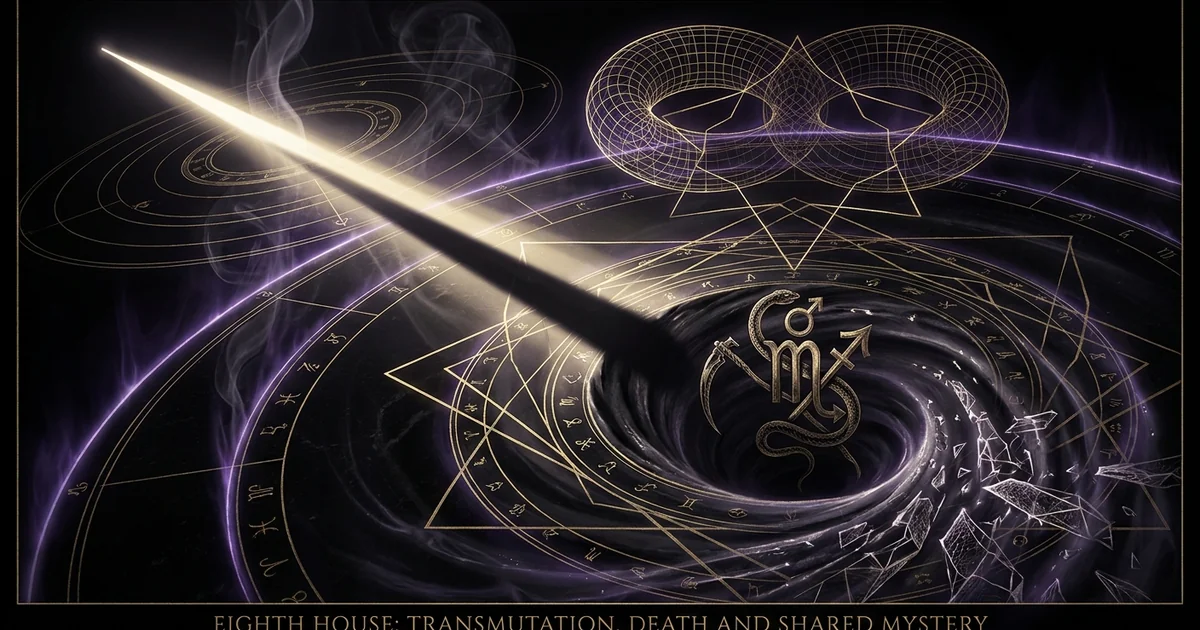
Eighth House: Transmutation, Death and Shared Mystery
Archetypal Thesis & Systemic Paradigm: The Threshold of Inconjunct Dissolution
The Non-Beholding House: Asyndeton and Ego Blind Spots
In the geometric architecture of Hellenistic astrology, celestial space is mapped through the optic logic of planetary rays. A house derives its capacity to dialogue with the emergent self—the Horoskopos or First House—solely through the major Ptolemaic aspect configurations derived from the sacred geometries of the circle: the sextile ($60^\circ$), square ($90^\circ$), trine ($120^\circ$), and opposition ($180^\circ$). The Eighth House occupies a structural coordinates sector that systematically defies this ocular discourse. Situated at an interval of $210^\circ$ clockwise (or $150^\circ$ counter-clockwise in zodiacal order) from the Ascendant, the Eighth House lies in asyndeton—unconnected, unyoked, and literally “not-beholding” (amethekton).
This non-beholding condition establishes the fundamental eighth house astrological meaning: it is an existential blind spot within the psychic architecture. Because the conscious ego (anchored at the eastern horizon) cannot cast an aspectual ray into this terrain, the Eighth House functions as a dark chamber where consciousness experiences an interruption of continuity. It is an operational zone of radical alterity. What transpires here does not belong to the curated narrative of selfhood; rather, it represents the systemic, autonomous forces that act upon the individual from beyond the threshold of self-awareness. Within the systemic schema of natal chart houses, the Eighth House is not merely a sector of external misfortune, but the point where the localized self confronts its operational perimeter and registers the shock of structural non-sovereignty.
The mechanics of astrological aversion (apophora or asyndeton) emerge from the Euclidean division of the $360^\circ$ circle by the primary harmonic integers: $2$ (opposition, $180^\circ$), $3$ (trine, $120^\circ$), $4$ (square, $90^\circ$), and $6$ (sextile, $60^\circ$). The Eighth House cusp falls at $150^\circ$ (the quincunx) or five whole signs from the First House. Lacking a common denominator among the Pythagorean harmonies that govern Ptolemaic aspect theory, this $5:12$ semi-perimeter ratio produces an acoustic and visual vacuum. The First House ego is blind to the Eighth House; the planets positioned here operate without visual coordination with the Ascendant, manifesting phenomenologically as fate, sudden catabolism, somatic possession, or systemic interventions experienced as alien to the conscious will.
Thermodynamic Entropy as Metaphysical Precondition
When divested of superstitious fatalism, the Eighth House emerges as the cosmological engine of psychic entropy. In non-equilibrium thermodynamics, a closed system that maintains complete isolation from its environment inevitably approaches maximum entropy, resulting in thermal stasis and systemic death. To preserve vitality, an open system must continually import negative entropy from the outside world, a process requiring the periodic destabilization, catabolic breakdown, and reorganization of its internal structures. The Eighth House governs this mandatory catabolism within the psycho-spiritual economy.
Far from being an arbitrary theater of morbidity, this house represents the thermodynamic price of evolutionary complexity. The localized ego tends to fossilize its cognitive schemas, mistaking its temporary boundaries for an eternal preserve. The Eighth House introduces the evolutionary solvent. It demands the surrender of structural equilibrium so that higher-order coherence may emerge. When an individual undergoes the dissolution of an obsolete psychological complex, the subjective experience is phenomenologically indistinguishable from dying. The terror associated with this sector is the instinctive horror of the bounded ego confronting the Second Law of Thermodynamics: the structural recognition that all forms, contracts, bodies, and psychic constructs are transient dissipative systems bound to surrender their captured energy back to the cosmic plenum.
The Transmutation of Bounded Selfhood into Relational Debt
The structural placement of the Eighth House immediately following the Seventh House of contractual partnership reveals its role in systemic entanglement. In the Seventh House, two sovereign entities encounter one another at the Western horizon; they sign treaties, form partnerships, and establish an alter ego. In the Eighth House, the romantic and legal illusions of independent sovereignty collapse into the brutal realities of relational thermodynamics. The boundary between mine and thine dissolves into shared liabilities, transgenerational legacies, and systemic debt.
This sector coordinates the profound, often agonizing compromises required when an autonomous self binds its destiny to an external other. It is the systemic antithesis to the Second House polarity of autonomous physical survival (ousia). Where the Second House accumulates and secures individual energetic reserves to fortify private agency, the Eighth House demands that these reserves be leveraged, pooled, merged, or forfeit to collective structures. It represents the psychic and material taxation imposed upon the self by the simple fact of existing within an interconnected matrix: mortgages, dowries, estate taxes, emotional entanglements, and the inescapable psychic debts inherited from ancestral bloodlines.
Classical Provenance & Textual Lineage: From Epikataphora to Mors
Hellenistic Foundations: Epikataphora and the Falling Gate
In the earliest strata of Hellenistic astrology, the Eighth House was designated not by its eventual medieval title of physical death, but by the dynamic spatial term Epikataphora—the “downward fall” or “the falling gate.” Situated immediately above the Western horizon (the Dysis), this house was observed as a place where the diurnal motion of the cosmos sweeps celestial bodies downward, carrying them from the light of the upper hemisphere down into the subterranean abyss of the hypogeion. It was classified alongside the Sixth, Third, and Twelfth houses as an idle, non-productive sector (argos), precisely because it lacked the optical aspect line to the Horoskopos.
DIURNAL ROTATION OF THE CELESTIAL SPHERE
======================================================
Above Horizon (Visible Hemisphere)
                    Midheaven [MC] (House 10)
                               ^
                               |
House 9 (Sublime)              |              House 11 (Good Daimon)
                               |
House 8 [EPIKATAPHORA] ------->|               House 12 (Bad Daimon)
(Planets forced DOWNWARD       |               (Aversion to ASC)
 into Underworld darkness)     |
-------------------------------+-----------------------> Horizon
Descendant [Dysis] (House 7)   |               Ascendant [Horoskopos] (House 1)
                               |
House 6 (Bad Fortune)          |               House 2 (Gate of Hades)
                               |
                               v
                     Imum Coeli [IC] (House 4)
Below Horizon (Subterranean Abyss / Hypogeion)
Vettius Valens, writing in the second century CE, treated the Eighth House with cold analytical gravity. In the Anthologiae, Valens links this place to death, weakness, deep-seated stagnation, loss of agency, and external crises that arrive without warning. Because the Eighth House is succedent to the setting pivot, planets found here are in a state of deceleration and systemic vulnerability. They represent wealth derived from the dead, legal battles over alienated property, and the bodily decay that accompanies the decline of solar vital force.
“The eighth place, falling below the setting pivot, is an idle sign, alien from the Ascendant, carrying with it death, decay, crises, and losses. When benefics are situated here or aspect this place, they grant wealth from inheritances or profits from deceased estates, but not without fear, danger, and litigation. Malefics positioned here, however, bring violent deaths, bodily ruin, and the destruction of livelihoods through alien claims and unexpected accusations.”
The Medieval Reification: Mors, Inheritance, and Ultimate Reckoning
As the Hellenistic technical corpus was translated into Middle Persian, Arabic, and eventually Latin, the polysemic, process-oriented understanding of Epikataphora crystallized into the fatalistic nomenclature of the Latin West: Mors (Death). Medieval practitioners operating within intensely hierarchical, patriarchal, and land-bound societies reified the house into concrete legal and mortuary terms. Guido Bonatti, the thirteenth-century Italian master, formalized the Eighth House as the primary indicator of the manner, timing, and forensic nature of mortality, as well as the testament, the wealth of the marriage partner, and ancient, unrecovered claims.
This historical shift was not a corruption of the tradition, but an acute materialization of its mechanics. In feudal Europe, where land and sovereign titles could rarely be generated ex nihilo through individual enterprise, the Eighth House governed the primary mechanism of socioeconomic mobility: dynastic inheritance through death. The mors house became the domain of wills, dowries, alien subsidies, and the inevitable financial settlement that occurs when a mortal form vacates its social position. Abu Ma’shar had previously emphasized this material reality in his Kitāb al-milal wa-d-duwal, pointing out that the Eighth House is always the ousia (Second House) of the Seventh: the material substance, monetary reserves, and functional capital possessed by the other party.
Arabic Cartographies: The Atazir of Danger and Shared Testament
The Islamic golden age transformed the operational dynamics of the Eighth House by integrating complex temporal systems of time-lords and directional arcs known as atazir (al-tasyīr). Astrologers such as Al-Kindi, Albumasar, and Al-Biruni mapped the migration of the hyleg (the vital life-giver) through primary directions. When the directed degree of the Ascendant or the Sun encountered the ray or the bound of the Eighth House ruler, or an atazir passed through the cusp of the Eighth House, the native was understood to enter a climacteric year of mortal peril, severe psychic affliction, or total structural collapse.
Furthermore, Arabic practitioners refined the system of Lots (Arabic Parts), utilizing the Lot of Death, the Lot of Inheritance, and the Lot of Treachery—all calculated through intricate geometrical relationships anchoring back to the Eighth House cusp and its diurnal or nocturnal masters. These cartographies viewed the Eighth House not as an isolated pocket of personal psychology, but as a fatalistic ledger where social debts, occult alliances, and biological vulnerability met their sovereign reckoning. The atazir of the Eighth House measured the exact chronological friction between human illusion and divine decree.
Structural Mechanics & Symbolic Geometry: Quadrant Topology and the Axis of Ousia
The Succedent Nocturnal Vector: Stabilizing Seventh-House Entanglements
Topologically, the Eighth House is classified as a succedent-house (epanaphora), meaning it follows and stabilizes the cardinal dynamic unleashed at the angular pivot. The Seventh House initiates the encounter: the handshake, the wedding vows, the open confrontation with the enemy, or the contractual agreement. However, an angle is intrinsically unstable; it is pure momentum. The Seventh House cannot sustain the relationship on its own; it merely initiates the structural bridge.
The Eighth House, as the succedent sector of the western quadrant, absorbs the kinetic energy of the Seventh House and institutionalizes it. It provides the material and psychological ballast that makes a partnership binding. The cost of this stabilization is the forfeiture of unilateral freedom. When two systems merge, an irreversible structural entrenchment occurs: bank accounts are joined, bloodlines intermingle, operational secrets are shared, and psychological projections take root. The Eighth House is the subterranean basement where the practical, systemic, and energetic debts of the contractual union are anchored and audited.
QUADRANT DYNAMICS: THE SEVENTH TO EIGHTH HOUSE TRANSITION
======================================================================
Angular 7th House                      Succedent 8th House
(The Pivot of Encounter)               (The Entrenchment of Merger)
------------------------------------   ------------------------------------
- Kinetic, initiate, visible           - Potential, fixating, obscured
- Contractual pacts established        - Contractual costs extracted
- Encounter with the Alter Ego         - Visceral dissolution of autonomy
- Bilateral agreement signed           - Shared collateral surrendered
Polarity Analysis: House 2 (Autochthonous Resource) versus House 8 (Systemic Resource)
To fully comprehend the Eighth House, it must be contextualized through its direct structural opposition: the Axis of Ousia (Substance). The Second House represents autochthonous resources—that which is born of the native’s own body, soil, and direct labor. It is the food one eats, the personal savings locked in one’s vault, the intrinsic sense of self-worth that shields the nascent ego from external annihilation. It is static, protective, and oriented toward the consolidation of matter.
Second House: Autochthonous Ousia
- Thermodynamic Mode: Anabolic (accumulation, assimilation, physical growth).
- Relational Vector: Autonomous, internal, strictly individual boundary.
- Economic Nature: Personal income, tangible liquid capital, somatic assets.
- Psychological Ground: Self-worth, security, biological self-preservation.
- Aspect to Ascendant: Sextile (Harmonic $60^\circ$ communication with self).
Eighth House: Systemic / Alien Ousia
- Thermodynamic Mode: Catabolic (decay, fusion, entropic transformation).
- Relational Vector: Interpersonal, transpersonal, systemic entanglements.
- Economic Nature: Loans, debts, taxes, inheritances, alienated estates.
- Psychological Ground: Existential surrender, taboos, deep intimacy.
- Aspect to Ascendant: Inconjunct ($150^\circ$ aversion; non-beholding silence).
The Eighth House, sitting $180^\circ$ opposite, represents alien substance—the wealth of the collective, the resources of the partner, the credit extended by an institution, and the ancestral biological inheritance coded into DNA. While the Second House seeks to preserve its boundary against contamination, the Eighth House requires the deliberate rupture of that boundary to allow metabolic exchange with the wider world. In the Eighth House, one discovers that total independence is an evolutionary fiction: one survives only through credit, grace, systemic interdependence, and the eventual surrender of one’s material body to the ecological soil that furnished it.
Planetary Joys and Domicile Friction: The Saturnine and Martian Resonances
It is a profound structural reality of Hellenistic systemics that no planet finds its planetary joy (chara) within the Eighth House. While the Sixth House rejoices in Mars, the Twelfth in Saturn, and the Third in the Moon, the Eighth House remains an empty sanctuary—a place where no classical wanderer rests easily. This structural vacancy reinforces its status as an unassimilable zone, an experiential crucible that resists domestication by any single planetary archetype.
Despite this absence of planetary joy, the Eighth House maintains a deep technical and operational affinity with the two traditional malefics: Saturn (Chronos) and Mars (Ares). Saturn resonates with the Eighth House through the principles of time, structural decay, ancestral legacy, chronic debt, and the inexorable termination of contracts. Saturn is the chilling realization of mortality and the boundary of the law. Mars, conversely, operates as the acute agent of the Eighth House: the scalpel of the surgeon, the sudden severance of tissue, the fever that heralds infection, and the violent breach of psychological borders that characterizes sexual penetration and psychological trauma. Where Saturn represents the cold, lingering weight of the tomb, Mars represents the visceral blow that opens the door to the underworld.
Psychological Dynamics & Operational Praxis: The Catabolic Shadow and Individuation
The Jungian Shadow and Transgenerational Phantoms
In archetypal and depth psychology, the non-beholding nature of the Eighth House locates it as the primary cartographic sector of the unconscious shadow-archetype. Unlike the Twelfth House, which represents the oceanic, undifferentiated collective unconscious and self-undoing through dissociation, the Eighth House coordinates the catabolic shadow: those highly specific, repressed, and instinctually charged realities that have been severed from conscious ego identification because they threaten the individual’s moral, cultural, or familial survival.
Here dwell what psychoanalysts call transgenerational phantoms—unmourned grief, unspeakable crimes, disowned sexualities, and financial betrayals buried within the genealogical tree. These ancestral complexes, though banished from the dinner table, do not perish; they sink into the succulent soil of the Eighth House, where they exert a silent, subterranean gravitational pull upon the native’s conscious choices. Planets positioned within this house behave like subterranean springs or unexploded ordinance: the individual finds themselves perpetually ambushed by their own instinctual drives, compulsively recreating scenarios of betrayal, loss, and radical exposure until the unconscious contents are integrated through conscious psychological mortification.
“The shadow is a moral problem that challenges the whole ego-personality, for no one can become conscious of the shadow without considerable moral effort. To become conscious of it involves recognizing the dark aspects of the personality as present and real. This act is the essential condition for any kind of self-knowledge, and it therefore, as a rule, meets with considerable resistance… It is not the conscious will that decides, but an obscure compulsion.”
Erotic Merging, Power Dynamics, and Archetypal Surrender
The modern reduction of the Eighth House to crude sexuality misses its archetypal essence. The Eighth House governs sex not as recreational play (which belongs to the solar, expressive domain of the Fifth House), but as an erotic death ritual—the French petite mort. It is the experience of sexual union as the obliteration of ego boundaries, where two autonomous consciousnesses collapse into an undifferentiated visceral circuit. In this sacred chamber, intimacy cannot be separated from vulnerability, and vulnerability cannot be separated from the terror of annihilation.
Consequently, the Eighth House is the native arena of profound power dynamics. Where individuals dare to merge their bodies, their finances, or their deepest psychic realities, the specters of control, subjugation, and paranoia immediately arise. The ego, terrified of being devoured by the alien system it has entered, erects desperate defenses: manipulation, financial withholding, sexual bargaining, and psychological warfare. Operational mastery of the Eighth House requires moving beyond these defensive postures into true psychological surrender: the willingness to allow the localized identity to “die” within the relational crucible so that a transformed, unified entity may be born.
THE DIALECTIC OF EIGHTH-HOUSE INTIMACY
======================================================================
[ Stage 1: The Lure of Merger ]
          |
          v
[ Stage 2: Acute Boundary Panic & Ego Terror ]
          |
          v
[ Stage 3: Power Contests, Manipulation & Retaliation ]
          |
          v
[ Stage 4: Catabolic Collapse of the Controlling Ego ]
          |
          v
[ Stage 5: Structural Transmutation & Rebirth ]
Operational Chart Praxis: Delineating the House Ruler and Transiting Triggers
In the clinical application of natal astrology, analyzing astrological house 8 requires a disciplined, step-by-step diagnostic protocol. The investigator must never read the house merely through planets occupying its degrees; one must trace the circuit back to its planetary source—the domicile ruler of the sign on the Eighth House cusp.
The condition, sign placement, and aspectual network of this ruler reveal how the native encounters structural catabolism and financial or psychological entanglement:
- Ruler of the Eighth in Angular Houses: Binds the crises, inheritances, and transformational cataclysms of the Eighth directly into the native’s public life, partnerships, or domestic foundations. Crises become the primary engine of personal destiny.
- Ruler of the Eighth in Cadent Houses: Indicates that systemic dissolutions occur in hidden, mentalized, or foreign environments, often operating through profound cognitive crises, chronic somatic expressions, or long periods of exile before psychic rebirth occurs.
- Condition of the Cusp Ruler by Sect: A day-chart Eighth House ruled by a well-placed diurnal benefic (Jupiter) allows crises to resolve through philosophical insight, institutional intervention, or profitable legal reconciliations. Conversely, a night chart where the Eighth House is dominated by an afflicted Saturn indicates heavy transgenerational debts, severe physical or financial liabilities, and protracted legal entanglements over the dead.
Transits of the outer planets (Uranus, Neptune, Pluto) crossing the Eighth House cusp, or transiting Saturn forming a square or opposition to planets inside the house, consistently activate what Dane Rudhyar identified as the transpersonal mandate. These transits systematically dismantle every material, financial, and relational structure that has outlived its evolutionary utility, forcing the native into a period of acute psychological inventory where only that which is essential, indestructible, and spiritually authentic survives the catabolic purge.
Philosophical Synthesis & Macrocosmic Correspondence: Nigredo, Ouroboric Transmutation, and Cybernetics
The Alchemical Nigredo: Putrefaction Preceding Illumination
In Western esoteric alchemy, the Great Work (Opus Magnum) cannot proceed directly from the leaden state of crude nature (prima materia) to the solar glory of the Philosopher’s Stone. The process must systematically inaugurate with the nigredo stage of transmutation—the blackening, the putrefaction (putrefactio), the spiritual death (mortificatio). The Eighth House is the precise astrological coordinate of this nigredo.
THE ALCHEMICAL PHASES OF THE HOUSES
======================================================================
House 1 - 7: Physical Genesis & External Expansion (Prima Materia)
                               |
                               v
House 8: Mortificatio & Nigredo (The Dissolution of Lead)
                               |
                               v
House 9 - 11: Albedo & Citrinitas (Philosophical Rectification)
                               |
                               v
House 12 - MC: Rubedo (The Transmuted Stone / Selfhood Redefined)
During the nigredo, the matter is sealed inside the hermetic vessel (vas Hermetis) and subjected to sustained, indirect fire until it rots, loses its distinct form, and turns to a foul, viscous ash. Astrologically, this is the crucible of House 8. The psychic complexes, illusions of self-sufficiency, and rigid attachments of the native are cooked in the heat of interpersonal crisis and biological limitation.
To bypass this stage through premature spiritual bypassing is an alchemical impossibility; the matter must rot before its crystalline matrix can reassemble. The archetype of the Death card archetype in the Tarot echoes this mechanical necessity: the sickle cuts down emperors and paupers alike, turning their temporal forms into fertilizer for the unmanifest potential of the coming dawn.
Cybernetic Feedback Loops: Error Correction through Structural Collapse
Viewed through the contemporary lens of cybernetic systems theory, the Eighth House acts as the critical negative feedback and error-correction loop of the natal chart. In cybernetics, a system that lacks an error-correction mechanism will continuously amplify its deviations until it experiences catastrophic structural failure. If a human personality continues to expand its Second-House accumulation and Seventh-House relational contracts without any self-regulating, homeostatic check, it risks systemic hypertrophy and systemic madness.
The Eighth House supplies this non-negotiable feedback mechanism. It is the systemic friction that informs the ego that its current map of reality is failing to account for the territory. When the Eighth House triggers a crisis—be it an economic bankruptcy, the betrayal of an intimate partner, a severe medical diagnosis, or an overwhelming existential collapse—it is executing a hard-reset protocol. It purges obsolete operational software, strips away illusions of control, and forces the complex adaptive system of the psyche to reorganize itself at a higher level of complexity and integration. Structural collapse is not the end of the system; it is the system’s final, desperate attempt to save itself from fossilized stasis.
Macrocosmic Seasons: The Autumnal Cross-Quarter Threshold
The macrocosmic resonance of the Eighth House is intimately bound to the seasonal rhythm of the solar cycle, specifically the autumnal cross-quarter threshold. In the Northern Hemisphere, this corresponds to the Sun’s transit through mid-autumn (astronomically linked to the fixed sign Scorpio), the historical time of Samhain, the Day of the Dead, and the final harvest. The brilliant colors of late summer have faded; the leaves detach from the branches and descend to the cold mud, beginning the slow process of biological decomposition.
This seasonal descent captures the mystery of cosmic conservation laws. Energy is neither created nor destroyed; it can only be transformed from one state into another. The Eighth House proves that death is the supreme ecological servant of life. The decaying leaf becomes the rich humus that will feed the dormant seeds buried deep within the Ninth and Tenth house terrain of the zodiacal wheel. Without this autumnal descent into darkness, without the unglamorous rot of fallen things, the cosmic cycle would halt in barren sterility. The Eighth House guarantees the continuous, ouroboric rotation of the macrocosm: life consuming itself to feed its own eternal return.
Frequently Asked Questions: Resolving Symbolic Paradoxes of the Eighth House
Disentangling Modern Scorpio Archetypes from Classical House 8 Mechanics
A pervasive distortion in contemporary psychological astrology is the uncritical conflation of the Eighth House with the sign Scorpio—an artifact of the twentieth-century “Twelve-Letter Alphabet” popularized by modern archetypal synthesizers. While both archetypes unquestionably share an affinity for psychological penetration, instinctual power, taboos, and the dynamics of death and regeneration, their mechanical provenance is fundamentally distinct.
Scorpio is a fixed, nocturnal, water sign ruled traditionally by Mars. It represents emotional cohesion, sustained instinctual focus, martial defense, and the brooding, tactical consolidation of interior energy. The Eighth House, conversely, is a topological sector of the sky—a dynamic, succedent space governed by asyndeton (aversion to the Ascendant), diurnal descent (Epikataphora), and the governance of alien resources (ousia aliena).
Conflating the two collapses a complex structural coordinate system into a purely emotional personality profile. An individual may possess an Eighth House in Gemini, Aries, or Taurus; the structural experience of aversion, debt, crisis, and ego-dissolution remains entirely intact, operating through the unique elemental, modal, and planetary mechanics of that specific cusp sign and its localized ruler, completely divorced from Martian-Scorpionic qualities.
TAXONOMIC SEPARATION: SCORPIO VERSUS THE EIGHTH HOUSE
======================================================================
Archetype / Domain          Scorpio (Zodiacal Sign)      Eighth House (Topological Sector)
-------------------------   --------------------------   ---------------------------------
Category                    Zodiacal Sign (Fixed Water)  House Coordinate (Succedent/Idle)
Planetary Ruler             Mars (Classical)             None (Vacant / No Planetary Joy)
Optical Aspect to Ascendant Dependent on Sign Position   Permanently Inconjunct ($150^\circ$)
Primary Mechanistic Focus   Instinctual consolidation    Systemic debt, catabolism, death
Interpreting Malefics and Benefics Placed within the Eighth House
The interpretation of planetary bodies within the Eighth House requires navigating the paradox of benefics and malefics functioning inside an aversion zone. When traditional benefics (Jupiter and Venus) reside here, they do not erase the structural reality of crisis and mortality; rather, they mitigate the violence of the catabolism and offer unique socioeconomic and psychological salvations.
Jupiter in the Eighth can signify ease in legal settlements, substantial inheritances, generous credit from financial institutions, and a philosophically peaceful reconciliation with one’s own mortality. Venus in the Eighth softens relational friction, manifests financial gain through marriages or business liquidations, and facilitates a gracious letting go of emotional complexes.
Conversely, when traditional malefics (Mars and Saturn) occupy the Eighth House, they sharpen the edge of the crisis vector. Saturn here can indicate heavy ancestral debts, severe administrative barriers to receiving what is owed, protracted legal battles over wills, chronic fear of physical decay, and a calcified terror of vulnerability that blocks deep intimacy.
Mars introduces acute friction, sudden financial amputations, explosive conflicts over shared resources, forensic crises, and violent ruptures of boundaries. Yet, under disciplined psychological and operational integration, a malefic in the Eighth House produces unparalleled capacity: Saturn grants formidable forensic discipline, deep emotional stoicism, and masterful debt remediation, while Mars yields the decisive courage of the surgeon who cuts through toxic rot to preserve the systemic life of the whole organism.
Navigating Inconjunct Transits and Synastric Eighth-House Overlays
Synastric overlays into the Eighth House universally unleash intense, highly volatile, and compulsive interpersonal dynamics. When another individual’s personal planets (particularly the Sun, Moon, Venus, or Mars) fall into an individual’s natal Eighth House, they land precisely within that native’s conscious blind spot. The house person feels viscerally seen, unsettled, and exposed in their most defended and taboo psychological sectors.
The planet person acts as a living catalyst for the house person’s unconscious shadow material. If both parties operate with high self-awareness and ethical integrity, this overlay fosters profound emotional intimacy, psychological healing, and spiritual transmutation. However, under the sway of unintegrated ego defenses, this dynamic rapidly deteriorates into manipulative games of control, sexual obsession, financial entanglement, and boundary violations.
Navigating transits across this inconjunct axis demands a conscious posture of non-attachment and rigorous operational hygiene. When transiting planets enter the Eighth House, the conscious ego must abandon its illusion of absolute sovereignty. Resistance to the catabolic demands of the house—attempting to cling to outmoded contracts, hoard depreciating emotional resources, or suppress rising shadow material—inevitably manifests externalized crises. The practitioner must counsel psychological surrender: auditing one’s debts, confronting repressed ancestral material, renegotiating damaged relational boundaries, and intentionally cooperating with the natural, necessary decay that clears the path for the soul’s next structural evolution.