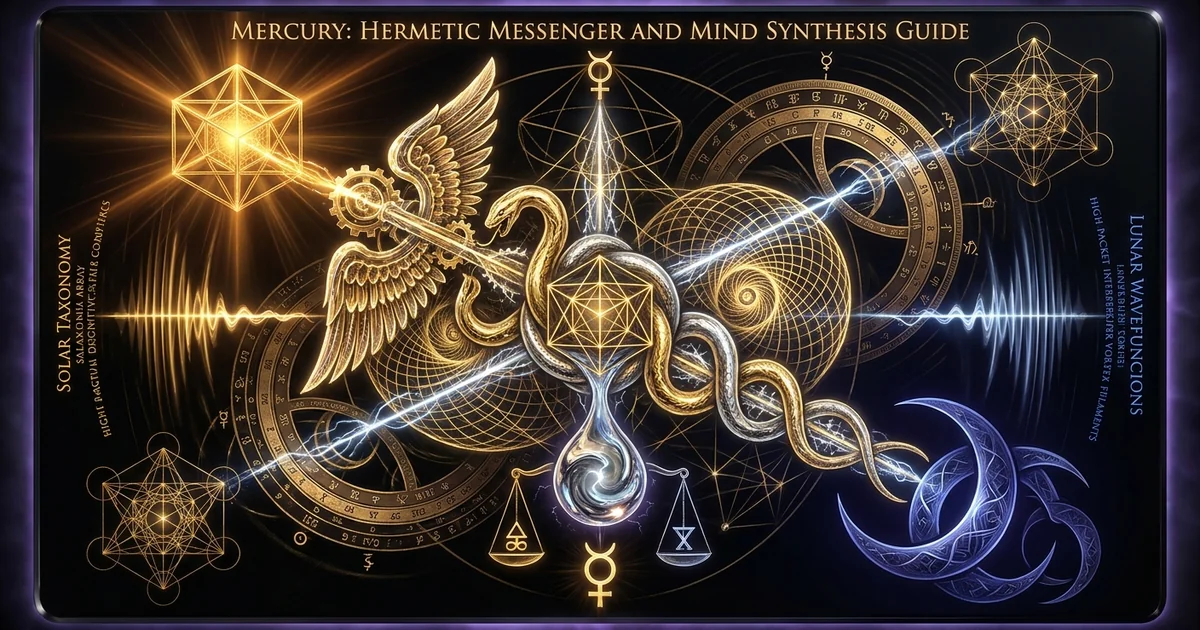
Mercury: Hermetic Messenger and Mind Synthesis Guide
Archetypal Thesis & Systemic Paradigm: The Psychodynamic Mediator of Cognitive Syntax
The Transducer of Consciousness: Bridging Solar Volition and Lunar Receptivity
In the architecture of esoteric astrology, Mercury functions not merely as the significator of colloquial speech or commercial exchange, but as the primary psychodynamic transducer of the human psyche. Operating at the structural nexus where subjective experience meets objective reality, the planet serves as the operative language compiler of consciousness. Within the triadic core of the inner planets, the Sun embodies radiant teleology, central volition, and the undifferentiated ontic core, while the Moon represents the somatic baseline, the rhythmic continuum of memory, and instinctual reception. Without an intermediary, these two fundamental poles remain dialectically isolated: the solar will cannot articulate its imperative into the temporal world, and the lunar sensorium cannot elevate its instinctual impressions into coherent self-awareness.
Mercury resolves this systemic impasse by establishing a cybernetic feedback loop between the core archetypal will and the fluid perceptual field. By translating somatic data into intelligible linguistic and mathematical tokens, the Mercurial principle allows the organism to construct an interior cartography of its external environment. Through this mechanism, detailed in our systemic analysis of planetary archetypes, the planetary archetype governs the neural and systemic gating mechanisms through which an organism continuously updates its internal model of reality relative to environmental perturbations.
The mercury astrology archetype meaning extends beyond mechanical computation into semantic formulation. It constitutes the cognitive syntax through which raw sensory input is categorized, contextualized, and transformed into meaning. In the absence of Mercurial transduction, consciousness remains either blindingly solipsistic (an unmanifest solar light) or overwhelmingly undifferentiated (a chaotic lunar flood). Mercury acts as the epistemological prism, breaking the absolute light of the Sun into a distinct spectrum of concepts, propositions, and symbols, while simultaneously giving rational architecture to the instinctual tides of the Moon.
The Duplex Nature of the Mercurial Complex: Volatility and Coagulation
Analytical psychology illuminates the structural ambiguity of this planetary principle through the figure of the alchemical Mercurius. Unlike the celestial bodies that occupy unambiguous moral or operational classifications in classical systems, Mercurius is fundamentally duplex. It operates simultaneously as a volatile solvent (solutio) and an arresting coagulant (coagulatio). In psychological dynamics, this duality reflects the mind’s concurrent capacity to dismantle calcified dogmas and assemble disparate observations into coherent theoretical frameworks. Mercury is the cognitive psychopomp who escorts the ego across the liminal threshold between conscious awareness and the chthonic unconscious, yet it is equally the trickster whose semantic instability can collapse certainty into epistemological chaos.
This fundamental ambivalence prevents the psychic system from succumbing to terminal entropic stagnation. When cognitive structures become rigid, tyrannical, and disconnected from somatic reality, the Mercurial complex manifests in its chthonic, destabilizing modality—introducing slips of the tongue, parapraxes, cognitive dissonance, and paradoxical insights that dissolve ideological calcification. Conversely, when the psyche is threatened by chaotic disintegration, Mercury functions as the coagulant, deploying syntax, logic, and semiotic structuring to weave an ordering framework over psychic fragmentation. The Mercurial drive toward individuation relies entirely upon this dynamic equilibrium: the persistent oscillation between dissolution and synthesis.
“Mercurius consists of the most extreme opposites; on the one hand he is unquestionably of a divine nature, on the other hand he is the lowest base material… He is the process by which the lower is transformed into the higher, and the higher into the lower… He is the duplex nature of the unconscious, which is both dark and light, beast and angel, the trickster and the guide of souls.” — Carl Gustav Jung, Alchemical Studies, Collected Works Vol. 13 (1967), Princeton University Press, §267–271.
Classical Provenance & Textual Lineage: From Thoth-Hermes to Hellenistic Epistemology
The Thothian Blueprint: Mathematics, Measurement, and Cosmological Order (Ma’at)
The historical trajectory of the Mercurial principle crystallizes in the Nilotic basin with the figure of Djehuty (Thoth), the ibis-headed divinity of Hermopolis Magna (Khemenu). Within the Old and Middle Kingdom cosmological frameworks, Thoth was neither a decorative deity of scribes nor a trivial messenger. He was the primary architect of cosmological coherence, revered as “the reckoner of the stars, the measurer of the earth, and the master of divine words (Medu Neter).” Egyptian theological metaphysics posited that the universe was sung into manifest existence through the precise vibrational and syntactic execution of speech; Ptah conceived creation within his heart (solar intentionality), but Thoth voiced the architecture into manifest reality through calibrated phonemes and structural measurement.
In this primary Nilotic blueprint, measurement is intrinsically bound to Ma’at—the ontological principle of equilibrium, truth, and cosmic order. Thoth does not merely invent arithmetic and script as instrumental utilities; he establishes the metrics through which celestial cycles, seasonal inundations, and moral actions are weighed. In the Osirian psychostasia (the weighing of the heart), it is Thoth who stands before the scales, recording the exact moral-ontological density of the deceased against the feather of Ma’at. His quill fixes the dynamic life into an eternal semiotic record, demonstrating that from its archaic provenance, the Mercurial function has operated as the non-negotiable metric validating whether a structure coheres with cosmic law.
Following the conquests of Alexander the Great and the subsequent syncretic crucible of Ptolemaic Alexandria, Djehuty fused with the Hellenic Hermes to produce Hermes Trismegistus (“Thrice-Great Hermes”). This syncretic entity served as the patron of the Hermetic sciences: astrology, theurgy, and alchemy. In the foundational treatises of the Corpus Hermeticum, most notably the Poimandres (Libellus I) and Mind unto Hermes (Libellus XI), this synthesis shifts from bureaucratic accounting to an esoteric epistemology of universal interpenetration. Hermes acts as the recipient and transmitter of Nous (Cosmic Mind), demonstrating that human discursive intelligence (logos) is an isomorphic microcosm of the ordering intellect that animates the planetary spheres.
The Hellenistic Synthesis: Planetary Neutrality and Epicyclic Phasis in Ptolemaic Systems
When Hellenistic astrologers codified the mathematical and interpretative frameworks of celestial divination between the 2nd century BCE and the 2nd century CE, they encountered a structural problem regarding Mercury’s classification within the traditional binaries of sect (hairesis) and temperament. While Jupiter and Venus were unequivocally designated as benefics, and Saturn and Mars as malefics, Mercury refused binary containment. Claudius Ptolemy, synthesizing centuries of Babylonian observational records and Aristotelian physics in his Tetrabiblos (c. 150 CE), resolved this by defining Mercury as an inherently “convertible” (communis) entity whose essential nature fluctuates according to planetary configuration.
“Mercury is situated midway between the spheres of the Sun and the Moon, and is therefore common to both natures… He is dry because of his proximity to the Sun, but moist because of his proximity to the sphere of the Moon, which is closest to the Earth. Moreover, he changes his nature rapidly from one to the other, being made dry and masculine when configured with diurnal and heating planets, but moist and feminine when associated with moistening and nocturnal stars, adapting his power wholly to the character of those planets with which he is joined.” — Claudius Ptolemy, Tetrabiblos (c. 150 CE), trans. F.E. Robbins, 1940, Book I, Chapter 5.
Ptolemaic mechanics explicitly codified Mercury’s epistemological mutability through its astronomical visibility and aspectual connections. Mercury’s diurnal or nocturnal sect, masculine or feminine gender, and dry or moist complexion were shown to be entirely contingent upon its planetary environment:
Complexion Calculation Factors:
1. Solar Phase:
   - Oriental (rising before the Sun)  --> Imparts heat and dryness (diurnal, masculine)
   - Occidental (setting after the Sun) --> Imparts cold and moisture (nocturnal, feminine)
2. Aspectual Configuration:
   - Configured with benefics/malefics  --> Adopts the quality of the configuring planet
   - Unaspected / Isolated             --> Operates according to zodiacal bounds (termini)
Classical authors consistently recognized Mercury as the only planetary wanderer (planetes) possessing unrestricted ontological immunity across systemic divides. In Hellenic myth and astrological praxis, Hermes Psychopompos crosses unhindered between Olympus (the supernal realm), the earthly plane (the conscious intermediate realm), and Tartarus (the chthonic subconscious). This uninhibited spatial mobility mirrors the operations of human thought, which can instantly oscillate between sublime mathematical abstractions, mundane instrumental actions, and primal emotional repressions without experiencing a terminal rupture in subjective continuity.
Structural Mechanics & Symbolic Geometry: Domiciles, Rays, and Epistemic Circuitry
Gemini and Virgo Duality: Kinetic Dissemination vs. Analytical Sifting
The distribution of planetary domiciles within traditional astrology maps the dual operational modes through which consciousness engages with the phenomenological sphere. Mercury rules two signs situated in mutable cross-aspect: Gemini (diurnal air) and Virgo (nocturnal earth). This gemini-virgo-polarity articulates the dual components of information theory: data ingestion and data filtration.
In Gemini, Mercury operates in a yang, aerial environment characterized by rapid transmission, non-linear networking, and dialectical synthesis. Gemini represents the mind as an expansive transmitter-receiver array, collecting disparate data points across an extensive horizontal plane. Here, Mercury prioritizes intellectual curiosity, linguistic dexterity, and the kinetic dispersal of concepts. It establishes horizontal linkages between previously unconnected systems, operating through inductive logic and lateral thinking. However, without a corrective mechanism, Gemini’s cognitive modality risks structural superficiality, scattering psychic energy across ephemeral novelties without achieving systemic cohesion.
GEMINI MODALITY (Horizontal/Kinetic)
[Raw Sensory Input] ---> [Lateral Distribution] ---> [Network Nodes]
                              |
                              v
VIRGO MODALITY (Vertical/Taxonomic)
[Network Data] ---> [Empirical Filtration] ---> [Functional Taxonomy]
Virgo represents the essential corrective phase: the yin, nocturnal, earthy domicile where Mercury is simultaneously positioned in its sign of exaltation. Here, the planet ceases horizontal dissemination in favor of vertical integration and rigorous analytical filtration. Virgo treats data not as a dynamic play of signs, but as an empirical taxonomy requiring purification. It sifts the essential from the superfluous, operating through deductive analysis, structural diagnosis, and practical application. If Gemini is the linguistic compiler assembling raw vocabulary, Virgo is the syntax checker and diagnostic debugger that purges semantic errors and tests the functional integrity of the code against concrete reality.
In Johannes Kepler’s Harmonices Mundi (1619), Mercury’s extreme orbital eccentricity ($e \approx 0.2056$) provides an astronomical baseline for this psychological tension. Kepler observed that Mercury encompasses a wider range of motion and velocity variations than any other classical planet, traversing the musical interval of a major tenth between its aphelion and perihelion. For Kepler, this pronounced kinematic variability reflected Mercury’s role as the acute, volatile, and infinitely adaptable intellectual force of the solar system, alternating between the rapid traversal of conceptual space and sharp, punctuated halts.
The Three-Phase Synodic Rhythm: Heliacal Risings, Inferior Conjunctions, and Stationary Halts
The orbital path of Mercury relative to the Earth and Sun generates an elegant geometric pattern that rhythmically recalibrates the collective cognitive field. Over an approximate eight-year cycle, Mercury executes twenty-two to twenty-three synodic encounters with the Sun, creating a dynamic, rotating equilateral triangle across the zodiac. This geometry arises from Mercury’s three annual retrogradation periods, which routinely occur within the signs of a single triplicity (element) before migrating into the subsequent elemental triad.
The synodic cycle proceeds through distinct astronomical phases, each carrying specific epistemological dynamics:
The inferior conjunction marks the profound core of this rhythm. Here, Mercury sits directly between the Earth and the Sun in celestial longitude. Within traditional delineation, this represents the death and rebirth of the cognitive paradigm. When Mercury reaches exact alignment within a fraction of a degree—entering the condition of being cazimi—it undergoes an archetypal purification within the solar furnace, dissolving outdated cognitive scripts to initialize a new epistemological cycle. As Mercury separates from the Sun, it achieves heliacal rising as the morning star (Lucifer/Phosphoros), emerging before dawn to inaugurate a phase of proactive, pioneering, and outward-directed intellectual exploration.
The retrograde station that precedes this renewal represents an intellectual decompression valve. Explored technically in our examination of Mercury retrograde mechanics, this phase signals a withdrawal of attention from forward-directed instrumental output. It compels the mind to re-evaluate, revise, and deconstruct its operational assumptions, demonstrating that human cognition requires periodic introspective phases to prevent systemic error cascades.
Qabalistic Pathworking: The 12th Path of Beth Linking Kether to Binah and the Sephira Hod
Within the Hermetic Qabalah, the cosmic syntax of Mercury maps across two primary nodes on the Tree of Life: the eighth Sephira, Hod, and the 12th Path of the Tree, assigned to the Hebrew letter Beth and embodied in Tarot Trump I, The Magus.
THE TREE OF LIFE ARCHITECTURE FOR MERCURY
        [Kether: Crown/Monad]
                  |
                  |  Path 12 (Beth - The Magus)
                  v
         [Binah: Primordial Form]
                  .
                  .
        [Hod: Sephira 8 - Intellectual Splendor]
Hod (Splendor) sits at the base of the Pillar of Severity (Form), directly counterbalancing Netzach (Victory/Emotion) on the Pillar of Mercy (Force). While Netzach represents primal astral dynamics, affective currents, and artistic inspiration, Hod provides the structural matrices required to contain and translate these non-verbal forces. Hod is the realm of intellectual analysis, formal logic, ritual magic, and the specific semantic protocols of the occult sciences. It is the celestial laboratory wherein raw energetic potency is categorized and directed through symbolic notation.
Heinrich Cornelius Agrippa, in his Three Books of Occult Philosophy (1533), details the mathematical and cosmological dignity of Mercury through the Scale of the Number Eight:
“The eighth scale belongs to the world of intellect and to Mercury… for Hod represents that divine splendor which breaks forth into the multiplicity of sciences, letters, and numbers, distributing the intelligences to human speech.” — Heinrich Cornelius Agrippa, Three Books of Occult Philosophy, Book II, Chapter 27.
Connecting the primordial monad of Kether (The Crown) to the maternal matrix of Binah (Understanding) is the 12th Path of the Tree of Life. In the Sepher Yetzirah, this path is designated as the “Transparent Intelligence,” corresponding to the letter Beth (meaning “House”—the container of form).
As detailed in the esoteric cartography of the Sephira Hod on the Tree of Life, the Magus stands on this path as the active manipulator of elemental reality. He does not generate energy through personal will alone; he channels the raw, unmanifest potential of the supernal triad down through his intentionality, using the tools of the four elements to construct reality on the material plane. Path 12 demonstrates that Mercury operates as the foundational conscious bridge through which divine unity enters structural comprehension.
Psychological Dynamics & Operational Praxis: Natal Chart Decoding and Cognitive Deconditioning
Aspectual Architectures: Mercury-Saturn Cognitive Rigor vs. Mercury-Neptune Intuitive Synthesis
The placement and configuration of Mercury within the natal chart planets provides an exact diagnostic blueprint of an individual’s cognitive architecture. The aspectual configurations Mercury forms with the outer planets demonstrate how discursive consciousness interfaces with transpersonal and structural archetypes.
COGNITIVE ARCHITECTURAL SPECTRUM
========================================================================
MERCURY-SATURN                                          MERCURY-NEPTUNE
[Skeptical Realism]        [Balanced Synthesis]      [Fluid Mysticism]
------------------------------------------------------------------------
- Axiomatic structures     - Coherent modeling       - Non-linear symbolic
- Deductive rigor          - Epistemic plasticity    - Semantic diffusion
- Heavy cognitive gating   - Adaptive filtering      - Permeable thresholds
When Mercury forms major aspects with Saturn, the psyche constructs an epistemological architecture founded upon boundary preservation, structural skepticism, and deductive precision. In hard aspect (conjunction, square, opposition), Mercury-Saturn configurations enforce strict cognitive gating. The individual frequently experiences an internal intellectual censor, resulting in depressive realism, epistemological anxiety, or a methodical refusal to accept propositions devoid of empirical validation. The mind works slowly, deliberately, and with profound architectural stamina, building cognitive frameworks designed to withstand critical deconstruction. The potential pathology is intellectual ossification: the refusal to accommodate experiential data that violates pre-existing, defensive models of reality.
Conversely, Mercury-Neptune aspectual dynamics dissolve these structural fortifications. Under the influence of Neptune, the linear discursive apparatus becomes permeable to archetypal imagery, transpersonal intuition, and mythopoeic motifs. The native thinks not in syllogisms, but in symphonies of feeling, aesthetic resonance, and intuitive impressions. In hard aspects, this configuration creates significant semantic instability: the individual may struggle with quantitative reasoning, linear organization, or objective discernment, falling prey to cognitive distortion and projection. However, when integrated, Mercury-Neptune facilitates an exceptional capacity for symbolic, non-local synthesis, allowing the individual to articulate subtle spiritual dynamics that remain fundamentally opaque to purely analytical modalities.
Retrograde Phasis as Internalized Epistemology and Shadow Hermeneutics
In classical delineation, a natal retrograde Mercury was frequently interpreted as an accidental debility, indicative of impaired speech or delayed educational development. Modern psychological astrology, informed by Jungian typology, reveals this assessment as a fundamental misunderstanding of introverted cognitive processing. A native born with Mercury retrograde does not possess an inferior intellect; rather, their cognitive architecture is structurally insulated from exteriorized social conditioning.
Direct Prograde Mercury
- Processing Mode: Linear, deductive, and forward-indexing.
- Orientation: Externalized social consensus, objective verification, rapid real-time communicative response.
- Epistemology: Data is absorbed from consensus reality, categorized via standardized semantic protocols, and immediately redeployed into the relational field.
- Cognitive Vulnerability: Susceptibility to cultural programming, uncritical acceptance of prevailing orthodoxies, and vulnerability to discursive groupthink.
Retrograde Mercury
- Processing Mode: Non-linear, retrospective, and recursive.
- Orientation: Introverted, reflective, intuitive, and resistant to standard semantic protocols.
- Epistemology: Sensory input is decoupled from immediate reaction, drawn downward into the unconscious, and compared against deep mnemonic or archetypal impressions.
- Cognitive Vulnerability: Communication delays, social hesitation, feelings of intellectual isolation, and alienation from standardized educational frameworks.
Natal retrograde Mercury represents an engine of shadow hermeneutics. The individual possesses an innate skepticism toward official narratives, intuitive pattern-matching capabilities, and a distinct ability to perceive what has been omitted from a discourse. This cognitive orientation excels at deconstructive analysis, historical revision, and the reclamation of suppressed or forgotten knowledge, refusing to accept consensus interpretations until the underlying premises have been independently verified through internal reflection.
Operational Praxis: Deciphering Mercury’s Condition in Consultative Delineation
To extract functional diagnostic intelligence regarding an individual’s cognitive processing, the consulting astrologer must execute a rigorous, multi-tiered structural analysis of Mercury’s classical condition:
-
Evaluation of Sect and Solar Phasis: Determine whether Mercury is oriental (rising prior to the Sun at dawn) or occidental (setting after the Sun at dusk). Oriental Mercury operates with proactive, exploratory, and pioneering intellectual force, generating hypotheses and driving theoretical inquiry forward. Occidental Mercury functions with contemplative, reflective, and inductive gravity, synthesizing events post facto, demonstrating historical acumen and systematic assessment.
-
Assessment of Solar Proximity (Combustion Spectrum): Calculate the precise arc of separation between Mercury and the solar disc:
- Sub Radiis (Under the Sun’s Beams): Within 15° of the Sun. Cognition operates under the heavy influence of the central identity, somewhat obscured from external observation.
- Combust: Within 8°30’ of the Sun. Intellectual objectivity is frequently consumed by the subjective imperatives of the solar ego. Discursive reasoning becomes dogmatically fused with personal identity, resulting in intellectual defensiveness.
- Cazimi (In the Heart of the Sun): Within 16 to 17 minutes of arc. This marks a radical ontological state. The planet is not destroyed; it is purified and elevated into the inner sanctuary of the solar authority. Cazimi Mercury grants profound conceptual clarity, exceptional intellectual authority, and a direct conduit to archetypal insight.
-
Analysis of Essential and Accidental Dignity: Locate Mercury within its zodiacal environment using the classical hierarchy of Ptolemaic dignities. A Mercury in Gemini or Virgo operates from a position of systemic competence, possessing the structural tools to execute its functions. Conversely, a Mercury situated in its signs of detriment or fall (Sagittarius and Pisces) must rely on unconventional operational pathways, substituting holistic intuition, philosophical leaps, and artistic expression for formal linear protocols.
-
Aspectual Configuration and Reception: Map the lines of communication between Mercury and the remaining planetary pantheon. Does Mercury enjoy mutual reception with its domicile ruler? Is it hemmed in by malefics, or granted structural support by a trine from Saturn or an illumination from Jupiter? These configurations dictate whether the native’s cognitive hardware operates with ease or must evolve through persistent developmental friction.
Philosophical Synthesis & Macrocosmic Correspondence: The Alchemical Mercurius and Universal Synthesis
The Universal Solvent and the Prima Materia: Liquid Quicksilver as Philosophical Spirit
In the Western esoteric tradition, the astrological archetype of Mercury finds its most profound physical and chemical manifestation in the elemental metal hydrargyrum—liquid quicksilver metal. Alchemists recognized quicksilver as the physical embodiment of the universal paradox: an earth-derived metal that refuses rigid solidification at ambient room temperature, persistently evading structural containment while mirroring its environment with pristine reflective fidelity.
THE ALCHEMICAL TRIPTYCH
[Sulphur]  --- (Active/Soul/Solar Will)
    |
[MERCURIUS] --- (Mediating Spirit / Liquid Quicksilver / Transmutative Solvent)
    |
[Salt]     --- (Passive/Body/Physical Form)
Within the alchemical triptych formulated by Paracelsus—comprising Sulphur (the soul/solar will), Salt (the body/physical vehicle), and Mercury (the spirit/animating intellect)—Mercurius is the dynamic, mediating agent. It is both the prima materia (the primordial chaos, the crude unrefined psychological substrate) and the ultima materia (the Philosophers’ Stone, the fully actualized, integrated self).
As explored in our studies of Mercurius as the prima materia in alchemy, psychic transmutation remains impossible without the application of the philosophical quicksilver. If the consciousness of the adept remains calcified within the rigid ego-structures of Salt, it cannot receive the spiritual illumination of Sulphur. The alchemical quicksilver must be introduced as the universal solvent (alkahest) to break down, liquefy, and dissolve these fixed dogmas. The mind must become fluid, acknowledging its shadow paradoxes, before it can undergo the coagulatio of spiritual rebirth.
Information Theory and Modern Epistemology: Mercury as the Negentropic Operator
When transposed into modern scientific paradigms, the Mercurial principle aligns precisely with the foundations of cybernetics and information theory. In 1948, Claude Shannon defined information not as meaningful content, but as the reduction of uncertainty—a mathematical measure of entropy. The physical universe, governed by the Second Law of Thermodynamics, tends inexorably toward entropic dispersion, decay, and chaotic noise.
INFORMATION THEORY METRICS
========================================================================
Entropic State:      [Raw Environmental Noise / Disorder]
                              |
Negentropic Action:  [MERCURY OPERATOR / MAXWELL'S DEMON]
                     (Gating, Taxonomizing, Synthesizing)
                              |
Syntropic Product:   [Coherent Structural Signal / Actionable Data]
========================================================================
The Mercurial operator is the archetypal Maxwell’s Demon: the cognitive entity that stands at the partition between systems, observing the velocities of incoming particles, sorting the hot from the cold, the signal from the noise. Mercury acts as the negentropic transducer of reality. By ingesting the chaotic sensory wash of the environment, filtering it through taxonomic structures, and assembling it into predictive models, Mercury decreases systemic entropy within the cognitive field.
This cybernetic operationalization directly validates the core Hermetic axiom from the Emerald Tablet: Quod est superius est sicut quod est inferius (“That which is Above corresponds to that which is Below”). This axiom is not an assertion of naive magical equivalence; it is an assertion of systemic isomorphism. The micro-syntax of the human intellect mirrors the macro-geometry of cosmological mechanics. Mercury is the cosmic messenger precisely because it is the systemic operator that maintains topological fidelity between the objective cosmos and subjective perception.
The following correspondence matrix presents the multidimensional signatures of the Mercurial archetype across symbolic, physical, and anatomical domains:
- Macrocosmic Planet: Mercury (Hermes, Stilbon)
- Alchemical Element / Metal: Quicksilver / Hydrargyrum ($\text{Hg}$)
- Qabalistic Sephira: Hod (Splendor / Numerical Archetype: 8)
- Qabalistic Path: 12th Path of the Tree of Life (Beth - The Magus)
- Tarot Arcana: Trump I - The Magician / The Magus
- Hellenistic Domiciles: Gemini (Diurnal/Nocturnal Air) and Virgo (Diurnal/Nocturnal Earth)
- Planetary Exaltation: Virgo (specifically culminating at $15^\circ$ Virgo)
- Planetary Debilities: Sagittarius (Detriment), Pisces (Detriment and Fall)
- Temporal Assignment: Wednesday (Dies Mercurii / Mercredi)
- Physiological Systems: Cerebrospinal Nervous System, Respiratory Apparatus (Bronchial Network), Thyroid Gland, Hands, Peripheral Neural Synapses
- Information Theory Dynamic: Negentropy; Noise-to-Signal Gating Processor; Language Compiler
Frequently Asked Questions: Resolving Classical and Modern Astrological Paradoxes
Resolving Dignity Anomalies and Interpretive Dilemmas
Why is Mercury uniquely assigned both its planetary domicile and its exaltation to the exact same sign (Virgo)?
In traditional astrological schemas, every planetary body possesses distinct signs for its domicile (where it feels at home and manages its resources) and its exaltation (where it is elevated to an idealized, noble expression). The Sun finds domicile in Leo but exaltation in Aries; the Moon in Cancer and Taurus; Saturn in Capricorn/Aquarius and Libra. Mercury alone holds its nocturnal domicile and its exaltation within the sign of Virgo, with the exaltation degree specifically calculated at $15^\circ$ Virgo.
This structural anomaly resolves when analyzing the technical demands of the Mercurial function. In other planetary bodies, the domicile represents the sign that provides the optimal energetic environment for the planet’s baseline urges, while the exaltation represents an environment that idealizes its capacity for public, heroic action. For Mercury, however, the highest philosophical ideal of its function is its practical execution. The Mercurial archetype requires no separation between its operational home and its supreme state of perfection.
Virgo—as a cold, dry, earthy mutable sign—provides an exceptional operational field for Mercury. While Gemini expresses Mercury’s expansive kinetic potential, Virgo demands analytical discrimination, functional diagnosis, empirical sifting, and absolute precision. The exalted state of human intellect is not the unbounded accumulation of ideas (Gemini), but the precise, virtuous, and practical refinement of data into wisdom that serves life (Virgo). Thus, classical astrologers recognized that Mercury reaches its peak operational purity precisely where it is most grounded in taxonomic earth.
How does Mercury operate in its classical conditions of Detriment and Fall (Sagittarius and Pisces), and does this signify impaired intelligence?
Modern consultative astrology frequently errs by translating the classical terms “detriment” (enantion) and “fall” (tapeinoma) into qualitative intellectual deficiencies. To suggest that individuals with Mercury in Sagittarius or Pisces possess “weak” minds is an analytical error that conflates quantitative data processing with total cognitive capacity.
In Sagittarius (the sign opposite its Gemini domicile), Mercury is in detriment because the expansive, fire-driven, teleological nature of Jupiter’s sign resists micro-level analysis. Sagittarius operates through overarching philosophical syntheses, broad generalities, and visionary leaps. A Sagittarian Mercury disdains the granular data collection required by classical logic; it perceives the entirety of the mountain range but stumbles over the immediate terrain.
In Pisces (the sign opposite its Virgo domicile and exaltation), Mercury is simultaneously in its detriment and fall. The water-bound, oceanic, oceanic-boundary-dissolving environment of Jupiter’s nocturnal sign actively resists terrestrial categorization. Linear syntax breaks down under the weight of non-verbal, emotional, and spiritual imagery.
COGNITIVE PARADIGMS BY SIGN ORIENTATION
========================================================================
DOMICILE / EXALTATION (Gemini & Virgo)
Linear Discursive Logic --> Empirical Taxonomies --> Granular Precision

DETRIMENT / FALL (Sagittarius & Pisces)
Gestalt Pattern Recognition --> Mythopoeic Reasoning --> Holistic Synthesis
========================================================================
Rather than signifying intellectual failure, Mercury in detriment or fall designates an alternative cognitive processing modality. These natives operate via gestalt pattern recognition, mythopoeic reasoning, and holistic semantic synthesis. They bypass the analytical assembly line entirely, arriving at conclusions through non-linear intuitive leaps. While they may struggle with traditional linear protocols, standardized testing, or bureaucratic precision, they excel within artistic, poetic, visionary, and mystical frameworks where linear logic proves completely inadequate.
Operational Rules for Planetary Warfare and Combustion
What is the precise computational and qualitative distinction between Combustion and Cazimi for Mercury?
The proximity of Mercury to the Sun represents one of the most volatile interpretative axes in natal and horary astrology, demanding strict computational precision:
SOLAR PROXIMITY ZONES (MERCURY)
[ > 15°00' Arc ]   ===> FREE FROM THE RAYS (Full Independent Visibility)
[ 8°30' to 15°00' ] ===> UNDER THE SUN'S BEAMS (Sub Radiis: Diminished Independence)
[ 0°17' to 8°30' ]  ===> COMBUST (Incinerated Discursive Objectivity)
[ 0°00' to 0°16' ]  ===> CAZIMI (In the Heart of the Sun: Divine Illumination)
-
Combustion ($0^\circ 17’$ to $8^\circ 30’$ separation): When Mercury is combust, it is made invisible by the overpowering light of the solar body. In psychological dynamics, the discursive intellect is blinded by the imperious will of the central ego. The individual struggles to decouple what they think from who they are. Intellectual critique is received as an existential assault on the self. Discursive objectivity is lost; the mind becomes an instrument dedicated entirely to rationalizing the demands, insecurities, and projections of the solar identity.
-
Cazimi ($0^\circ 00’$ to $0^\circ 16’$ or $0^\circ 17’$ separation): The condition of being cazimi (from the Arabic kaṣmīmī, “in the heart”) represents an astronomical and qualitative phase transition. When Mercury enters this minute core of the solar disc, it is no longer burned; it is welcomed into the inner sanctuary of the King. The debilitating friction of combustion ceases. In psychological delineation, cazimi grants a piercing, diamond-like clarity of mind. The native’s discursive intelligence becomes a direct transmission channel for archetypal insight and solar teleology. Far from suffering intellectual blindness, the native experiences an exceptional amplification of conceptual power, visionary communication, and intellectual authority.
How does Mercury’s planetary phase (Oriental vs. Occidental) alter its practical manifestation in the chart?
The distinction between Mercury’s appearance as a Morning Star (Phosphoros / Oriental) or an Evening Star (Hesperos / Occidental) fundamentally alters the vector of cognitive expression. This condition is determined entirely by whether Mercury rises before the Sun or sets after it:
-
Mercury Oriental (Rising before the Sun): Mercury is situated zodiacally earlier than the Sun, appearing on the eastern horizon before dawn. This oriental phasis imparts a masculine, diurnal, and heat-oriented quality to the mind. The native exhibits a proactive, inquisitive, and pioneering intellect. They are intellectual instigators who formulate hypotheses rapidly, enjoy exploratory debates, and thrust their ideas aggressively into the world. The cognitive vector points outward toward future possibilities, prioritizing swift technological, commercial, or structural execution.
-
Mercury Occidental (Setting after the Sun): Mercury is situated zodiacally later than the Sun, remaining visible on the western horizon after dusk. This occidental phasis imparts a feminine, nocturnal, and moisture-oriented quality. The native’s intellectual style is reflective, historical, inductive, and contemplative. Occidental Mercury processes information through retrospective digestion, synthesizing events after they have unfolded. These individuals excel as editors, historians, deep analysts, and philosophical hermeneuts who contextualize contemporary developments within historical and archetypal precedents.
By systematically applying these technical parameters—sect, solar phasis, combustion degrees, and essential dignity—the astrologer decodes the exact cognitive wiring through which the individual constructs, navigates, and transforms their perceived reality. Mercury emerges not as an ephemeral guide of trivia, but as the master architect of the epistemic interface: the sovereign messenger who ensures the micro-syntax of the human soul remains attuned to the living intelligence of the cosmos. :::