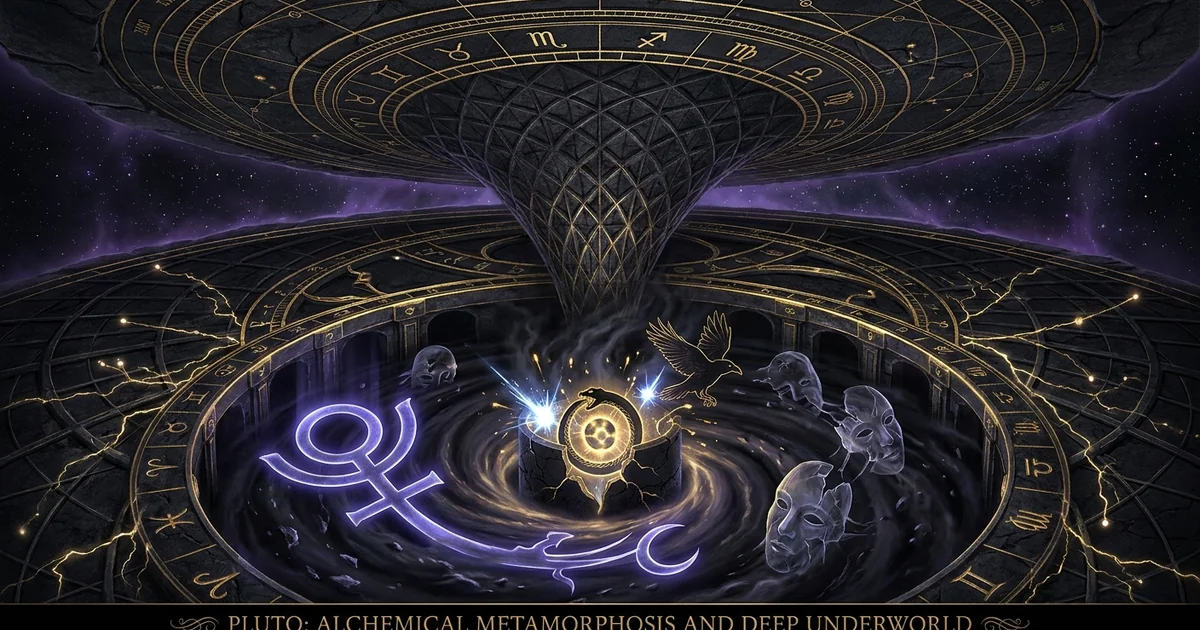
Pluto: Alchemical Metamorphosis and Deep Underworld
Archetypal Thesis & Systemic Paradigm: Pluto as the Psychodynamic Singularity
Thermodynamics of Catabolic Transformation
Within the psycho-cosmological mechanics of archetypal astrology, Pluto functions not as a malefic agent of arbitrary catastrophe, but as the supreme thermodynamic governor of psychic entropy. In biological systems, catabolism denotes the metabolic phase wherein complex cellular compounds are broken down into fundamental units, releasing the chemical energy required to sustain life. Transposed to the architecture of the psyche, Pluto administers an identical structural imperative: the irreversible breakdown of outworn psychic structures that have ossified into evolutionary liabilities. Whereas the personal planets govern the acquisition and preservation of egoic identity within normative consciousness, Pluto operates as an archetypal sink—a point of infinite density and gravity toward which stagnant psychic energy is dragged to be recycled into primordial libido.
This catabolic dynamic operates through systemic inevitability. When conscious awareness calcifies around anachronistic self-concepts, defense mechanisms, or archaic security attachments, the psychic economy shifts from a state of dynamic homeostatic equilibrium toward entropic dead-lock. In accordance with the principles set forth in depth psychology, the psyche will not indefinitely tolerate static crystallization. Pluto intervenes as the compensatory drive of the collective unconscious, dissolving the petrified scaffolding of the personality through involuntary encounters with powerlessness, loss, and radical destabilization. This process does not represent the negation of life; rather, it constitutes the merciless preservation of vital evolution against the inertia of form, compelling the ego to yield its hoarding of identity back to the undifferentiated matrix of being.
Within an analytical framework of the planetary archetypes overview, Pluto acts as the ontological solvent. Where traditional delineations fall into moralistic bifurcations of “good” and “evil,” an energetic approach identifies Plutonian events as pure systemic corrections. The pain experienced during Plutonian passages is directly proportional to the degree of conscious resistance the ego exerts against its own inevitable transubstantiation. By breaking the structural bonds that hold obsolete psychic complexes together, Pluto liberates massive reservoirs of bound energy, facilitating a transition from petrification to radical renewal.
The Transpersonal Threshold and Ego Annihilation
Pluto establishes the absolute outer boundary of the classical planetary sequence, acting as a portal between the structured cosmos of personal and socio-cultural experience and the oceanic formlessness of the deep trans-Neptunian field. In the lexicon of transpersonal psychology, Pluto represents the threshold of radical ego annihilation. Where the inner planets construct the vessel of individuality, and Saturn’s structure, boundaries, and time establishes the perimeter of the conscious personality, Pluto deconstructs the foundational axioms upon which the illusion of egoic autonomy rests.
This deconstruction is fundamentally distinct from the dissolving, nebulous boundary-diffusion associated with Neptune. Neptune dissolves boundaries through ethereal yearning, mystification, and psychic osmosis; Pluto obliterates them through structural collapse, biological confrontation, and visceral exposure to the instinctual underworld. It is the encounter with what Carl Gustav Jung termed the objective psyche—a reality so overwhelmingly autonomous that the conscious mind cannot assimilate it without undergoing a total structural reorganization.
                                PSYCHODYNAMIC SINGULARITY

       Conscious Ego Identity  ============>  Plutonic Gravitational Core
       (Petrified Form)                       (Compulsory Nigredo)
                                                        |
                                                        v
       Integrated Sovereign    <============  Radical Transubstantiation
       (Transpersonal Will)                   (Alchemical Sublimation)
The Plutonian threshold demands that the practitioner confront the illusory nature of personal control. To cross this perimeter is to enter an underworld space where the standard transactional currencies of the ego—willpower, moral posturing, intellect, and social standing—are entirely depreciated. The individual is stripped of secondary psychic adaptations until nothing remains except the irreducible core of the Self, forcing a confrontation with the fundamental existential coordinates of life, death, and transpersonal purpose.
Synchronicity of Discovery: 1930, the Shadow, and Nuclear Fission
The epistemological validity of the Pluto astrology archetype meaning is grounded in the principle of synchronicity, articulated by Jung and applied to cosmological cartography by modern archetypal theorists. A celestial body’s physical discovery by terrestrial astronomers does not signify the creation of a new archetypal principle; rather, it indicates the precise historical moment when that specific archetypal dynamic erupts from the collective unconscious into the conscious awareness of human civilization. When Clyde Tombaugh identified Pluto at the Lowell Observatory in February 1930, the global socio-political and scientific landscape was undergoing an unprecedented descent into its own subterranean foundations.
The temporal convergence of Pluto’s discovery with the rapid emergence of European totalitarianism, the deepening of the Great Depression, the formal articulation of Sigmund Freud’s death drive (Thanatos), and Jung’s mapping of the shadow archetype reveals a civilization confronting its repressed chthonic substrate. Concurrently, the physical sciences were penetrating the subatomic underworld. The discovery of Pluto coincided precisely with the pioneering experiments in nuclear physics that culminated in the splitting of the atom and the eventual isolation of plutonium metal by Glenn T. Seaborg and his associates in 1940. Named directly after the newly discovered planet, plutonium metal represents the physical incarnation of the Plutonian archetype: an element forged in the inferno of nuclear reactors, imperceptible to the human senses yet possessing the cataclysmic potential to annihilate entire civilizations or fuel planetary energy systems.
“The historical timing of Pluto’s discovery coincided with the sudden emergence of phenomena that reflected the release of tremendous volcanic energy: the rise of modern totalitarian regimes characterized by unprecedented mass violence and absolute state power, the development of depth psychology with its excavation of the volcanic, instinctual depths of the unconscious, and the breakthrough into the subatomic realm that unlocked the primal power of the nuclear abyss, culminating in the synthesis of plutonium.” — Richard Tarnas, Cosmos and Psyche: Intimations of a New World View (2006, pp. 98–101)
The synthesis of plutonium metal provided physical proof of the ancient Hermetic maxim: the microcosm reflects the macrocosm. The extraction of terrifying, primordial energy from the invisible heart of matter mirrored humanity’s excavation of primal instinctual drives from the hidden depths of the subconscious mind. Pluto’s astronomical entrance thus synchronized with humanity’s collective technological and psychological initiation into the mechanics of ultimate power, mass destruction, and the compulsory imperative toward systemic metamorphosis.
Classical Provenance & Textual Lineage: From Hades-Plouton to Alchemical Mortificatio
The Chthonic Dual-God: Hades as Unseen Sovereign vs. Plouton as Wealth-Giver
To delineate the psychological and metaphysical breadth of Pluto, one must return to the classical Greek bifurcation of the underworld divinity. Hades (Aides), etymologically translated as “the unseen” or “the invisible,” personified the cold, irreversible finality of physical expiration, the sovereign of the shadowy realm beneath the earth from which no mortal consciousness returns unchanged. Hades possessed the kuneē, the cap of invisibility, signifying the imperceptible manner in which the subterranean forces of decay, time, and unconscious compulsion operate behind the visible veil of daylight phenomena. In the early archaic imagination, Hades was regarded with terror, a divinity to whom prayers were made with averted eyes, beating hands upon the bare earth to ensure the acoustic transmission of human supplication down into the abyss.
However, an evolutionary shift in classical consciousness transformed this chthonic terror into the veneration of Plouton (Ploutos), the “Giver of Wealth.” This dual nomenclature reflects an ontological truth central to understanding planetary archetypes: the subterranean depths harbor not only the necrotic remains of the dead, but also the inexhaustible treasury of the earth. Plouton governed the mineral veins of gold, silver, and precious metals concealed within deep rock strata, alongside the dormant vegetative seed (spérma) that lies buried within the dark soil, awaiting subterranean germination before it can erupt into the radiant green world of Ceres.
“Right blessed is that man of earthly men whom they [the goddesses] love; for straightway they send Ploutos to abide in his great house, the giver of abundance to mortal men.” — The Homeric Hymn to Demeter, translated by Hugh G. Evelyn-White (1914)
This dual godhead—Hades the inevitable harvester of forms and Plouton the custodian of subterranean vitality—establishes transformation as inherently generative. Destruction is stripped of moral condemnation; it is repositioned as the structural precondition for wealth generation. The psyche’s riches are not located in the manic, sunlit altitudes of conscious inflation, but are buried deep in the instinctual, chthonic strata of the unconscious. To encounter the wealth of Plouton, the adept must accept the hospitality of Hades.
                           THE DUAL CHTHONIC AXIS

            HADES (The Unseen)              PLOUTON (The Wealth-Giver)
            --------------------            --------------------------
            Ego-Deconstruction              Subterranean Germination
            Loss of Form & Title            Access to Primal Resources
            Structural Mortification        Regenerative Transmutation
            Involuntary Katabasis           Conscious Integration of Gold
The Eleusinian Mysteries and the Katabasis Pattern
The central ritual container for this chthonic paradox was the Eleusinian Mysteries, which dominated Mediterranean spiritual life for nearly two millennia. At the structural core of the Mysteries lay the myth of Persephone’s abduction by Hades and her systemic descent into the underworld—a mythological pattern known as the katabasis. Persephone’s violent transition from Kore (the innocent, undifferentiated maiden) to the Queen of the Underworld exemplifies the mandatory psychological crisis that occurs when the naive ego is ripped away from the maternal, protective sphere of conscious containment and dragged down into the instinctual core.
Persephone’s consumption of the pomegranate seed while in the realm of Hades signifies the irreversibility of this psychological descent. Once the ego has ingested the subterranean knowledge—once it has tasted the profound reality of its own mortality, animal instinct, and shadow depths—it can never return to the unblemished, naive equilibrium of its past. The epopteia, or ultimate vision revealed to the initiates of Eleusis, culminated in the display of a harvested ear of grain reaped in profound silence. This grain encapsulated the entire mystery of the Plutonian cycle: life arises through interment; growth is preceded by burial; and the seed must undergo structural disintegration in the dark earth to release its vegetative potential.
The katabasis pattern reveals that personal individuation is impossible without intentional descent. As James Hillman asserted in The Dream and the Underworld, modern psychological models that prioritize continuous ascent, cognitive optimism, and light-oriented growth are fundamentally ungrounded. Without the underworld perspective of Hades, consciousness remains flat, literal, and devoid of the symbolic depth that can only be forged in the subterranean crucible of suffering, loss, and the direct confrontation with non-ego forces.
Hermetic Nigredo and the Alchemical Crucible
The classical mystery traditions migrated historically through late antiquity and the Islamic golden age, ultimately crystallizing in Western Hermetic alchemy. In the alchemical opus, the initial and most perilous phase was the alchemical stages: nigredo to rubedo—the blackening, characterized as the mortificatio and putrefactio of the primary matter (prima materia). The alchemists recognized that without the nigredo, no genuine transubstantiation could occur. The vessel (vas Hermeticum) had to be sealed hermetically, subjected to a slow, relentless subterranean heat (ignis gehennalis), until the disparate components dissolved into a putrefying, undifferentiated mass.
+--------------------------------------------------------------------------+
|                  ALCHEMICAL TRANSMUTATION PARADIGM                       |
+--------------------------------------------------------------------------+
| Stage: NIGREDO         | Stage: ALBEDO           | Stage: RUBEDO         |
| Operation: Mortificatio| Operation: Ablutio      | Operation: Coagulatio |
| Matter: Black Slag     | Matter: Silver Light    | Matter: Red Gold      |
| Psyche: Shadow Descent | Psyche: Anima Clarity   | Psyche: Realized Self |
+--------------------------------------------------------------------------+
Edward F. Edinger, in his definitive structural study Anatomy of the Psyche, systematically demonstrated that mortificatio correlates to the psychological experience of severe depression, despair, guilt, and the radical disillusionment of the ego. In the alchemical texts, the mortificatio is accompanied by violent, chthonic imagery: dismemberment, decapitation, systemic rot, and the devouring of the dead king by the subterranean dragon or wolf. This is the precise phenomenological territory governed by the Pluto astrology archetype meaning.
The alchemical prima materia—frequently described as base, despised, cast into the street, and found in excrement—is precisely the unintegrated material of the Jungian shadow archetype. The conscious ego rejects these raw instinctual realities due to their moral, aesthetic, or social incompatibility with conscious ideals. Pluto acts as the alchemical crucible itself, generating the interior psychic heat necessary to cook this base matter until the structures of identity decompose, breaking open the hard outer husk of the personality to access the transpersonal lapis philosophorum (the philosopher’s stone) buried within the instinctual depths.
Structural Mechanics & Symbolic Geometry: The Transmutation Continuum
Planetary Rulership Mechanics: Scorpio, the 8th House Axis, and Mars Octaves
In the cosmological mechanics of astrological architecture, Pluto exercises modern rulership over the fixed water sign of Scorpio and presides structurally over the eighth house psychodynamics. To understand the energetic mechanics of this assignment, one must comprehend the theory of octave planets. Classical astrology assigned the dynamic drive of survival, assertion, and the kinetic discharge of energy to Mars. Mars governs the acute biological fight-or-flight impulse, kinetic vitality, and the physical penetration of reality. However, Pluto functions as the higher, transpersonal octave of Mars.
Where Mars operates on the level of individual kinetic will—the personal sword unsheathed to preserve bodily existence—Pluto operates on the level of transpersonal mass will, evolutionary drive, and the subterranean volcanic current that underpins survival itself. Mars demands conquest; Pluto demands absolute transmutation. Mars slays the adversary; Pluto drags the adversary and the slayer alike into the underworld to dissolve their mutual identity.
This energetic amplification finds its natural operational field in Scorpio and the eighth house axis (the Taurus-Scorpio polarization). While Taurus stabilizes, materializes, and accumulates form within the physical sensorium, the Scorpio-Eighth House axis is charged with the structural deconstruction of form to ensure dynamic systemic flow. The eighth house governs those arenas of life where personal resources must be surrendered, merged, or radically reorganized: joint finances, inheritance, taxation, sexual union, deep psychic crises, and biological death. Within these realms, the illusion of autonomous, isolated ownership is annihilated. Pluto’s rulership over this quadrant of the natal chart ensures that the native will, at specified developmental checkpoints, be forced to abandon the static comfort of self-sufficiency to undergo an evolutionary death and rebirth mediated through catastrophic boundary crossings.
The Threefold Totemic Metamorphosis: Scorpion, Eagle/Serpent, and Phoenix
The internal evolution of the Plutonian current does not remain static; it follows a rigorously defined progression of psychic sublimation. Classical Hermetic and esoteric traditions delineate this transmutation through three sequential totemic thresholds: the Scorpion, the Serpent or Eagle, and the Phoenix.
- The Scorpion (The Instinctual Base): At this base level of consciousness, the Plutonian dynamic operates through the primal, reactive reptilian brain. The individual, trapped in an existential panic born of felt vulnerability, weaponizes their awareness through suspicion, hyper-vigilance, emotional possessiveness, and preemptive strikes. This is the realm of raw, unmediated nigredo. The Scorpion’s sting is the desperate defense mechanism of an ego terrified of being devoured by the void, lashing out to preserve its precarious sense of control through coercive dominance or manipulative retreat.
- The Eagle / Serpent (The Sublimated Diagnostic Insight): As the Plutonian heat continues to cook the unconscious material, the dynamic shifts from blind instinctual reaction to piercing diagnostic clarity. The symbol bifurcates into the Serpent and the Eagle. The Serpent represents deep chthonic wisdom, the ability to shed obsolete psychic skin without dying, and the intimate knowledge of the subterranean venoms that cure as well as kill. The Eagle represents transcendent, panoramic vision—the capacity to soar far above the emotional inferno, penetrating beneath psychological defenses to perceive the unconscious root causes of human compulsion. At this stage, the native ceases to use insight as a weapon of defensive warfare and begins to employ it as an instrument of profound psychological self-investigation.
- The Phoenix (The Integrated Sovereign): The terminal stage of Plutonian alchemy is embodied by the mythical Phoenix. Having willingly climbed onto its own funeral pyre—having completely surrendered the illusion of egoic preservation to the fire of the transpersonal Self—the Phoenix is reduced to ash. From this very ash, it reconstitutes itself. This is the alchemical rubedo, the reddening, wherein the spirit has achieved complete embodiment through its passage through the underworld. The Phoenix operates with absolute spiritual sovereignty; immune to the terror of death and loss because it has already died consciously, it acts as a catalytic agent of healing, regeneration, and evolutionary transformation for the surrounding collective field.
Orbital Mechanics as Psycho-Spiritual Geometries
The metaphysical signature of Pluto is reflected directly in its anomalous physical orbital mechanics. Unlike the seven classical inner and social planets, which traverse orbits roughly coplanar with the ecliptic (the plane of the Earth’s orbit around the Sun), Pluto moves along an orbital path inclined at an extreme angle of 17.16 degrees. Furthermore, its orbit possesses a pronounced eccentricity ($e \approx 0.2488$), causing its distance from the Sun to vary dramatically from approximately 29.7 AU at perihelion to 49.3 AU at aphelion. During its perihelion passage, Pluto actually penetrates inside the orbit of Neptune, remaining closer to the Sun than Neptune for approximately twenty years of its 248-year orbital cycle.
This astronomical geometry mirrors its psycho-spiritual function. By traversing an orbit that radically violates the flat, orderly plane of the ecliptic, Pluto mathematically embodies the intrusion of the extraordinary into the ordinary. The ecliptic plane represents the consensual reality framework of the solar system—the standard, predictable grid of chronological time, social convention, and normative physical laws. Pluto’s high inclination signifies the vertical intrusion of the trans-ecliptic deep: archetypal forces descending from anomalous, unseen vectors to disrupt the flat plane of egoic homeostasis.
                              ORBITAL ECCENTRICITY SCHEMATIC

   [Ecliptic Plane] ============================================= (Consensual Plane)
                               \                 /
                                \   17.16°      /
                                 \  Inclination/
                                  \           /
   [Pluto's Transverse Path] ===== \ ======= / ================== (Anomalous Intrusion)
Furthermore, its periodic penetration inside the orbit of Neptune constitutes an astronomical transvaluation of order. Neptune represents the boundless sea of collective archetypes, spiritual ideals, and transcendental unitive states. Pluto’s movement inside the boundary of Neptune signifies that before the soul can fully integrate the highest transcendental unitive consciousness, it must first be pulled beneath the waters into the chthonic crucible of raw reality, transforming the spiritual ideal into somatic, biological realization through an unavoidable trial by fire.
Psychological Dynamics & Operational Praxis: Delineating Pluto in Chart Synthesis
Plutonian Complexes: Compulsion, Projection of Shadow, and Power Asymmetries
In the diagnostic synthesis of natal chart planets, the placement of Pluto by house and aspect identifies the exact psychological sector where the individual experiences absolute existential vulnerability, and consequently, constructs their most rigid, pathological defenses. The house containing Pluto is the site of the individual’s private underworld. Here, the native feels an ancestral or instinctual terror of total annihilation, which almost inevitably manifests during early life as an intense obsession with control, dominance, and emotional secrecy.
Where Pluto resides, the unconscious operates through compulsory, repetition-compulsion loops. The individual cannot easily adopt a lighthearted or casual stance toward the matters governed by that house. Instead, the area is saturated with high-stakes psychological drama, characterized by a persistent fear of betrayal, exploitation, or systemic destruction. Because this primal terror is intolerable to the conscious ego, it is frequently disowned and projected outward. The native views the external world, specific individuals, or institutional structures as predatory, menacing entities seeking to strip them of agency.
This dynamic generates intense power asymmetries. The Plutonian native, seeking to ensure that they will never again be rendered utterly helpless, may cultivate covert strategies of psychological surveillance, emotional manipulation, or structural dominance over their environment. The psychological work required by Pluto demands the conscious retrieval of these shadow projections. The individual must realize that the predatory terror they perceive outside themselves is the unacknowledged ferocity of their own disowned survival libido—a libido that has become warped and monstrous through its prolonged banishment into the dark basements of the unconscious.
When transiting Pluto forms a major hard aspect (conjunction, square, opposition) to personal natal chart planets (Sun, Moon, Mercury, Venus, Mars), the transit operates as an evolutionary checkpoint that cannot be mitigated by standard cognitive or behavioral modifications. The personal planet under aspect is subjected to an inexorable period of structural decomposition:
- The Sun: Systematic deconstruction of the conscious vocation, ego identity, and life direction; destruction of inflated paternal archetypes.
- The Moon: Purging of the archaic instinctual-emotional baseline; confrontation with maternal complexes, physical displacement, and somatic clearing of somaticized trauma.
- The Mercury: Annihilation of previous cognitive models; dissolution of rationalized defense mechanisms; exposure of repressed intellectual taboos.
- The Venus: Catastrophic crisis within relational attachments; purging of codependency; exposure of covert financial or sexual power dynamics.
- The Mars: Paralyzing confrontation with absolute impotence followed by the total recalibration of kinetic will from personal aggression to transpersonal instrumentality.
Hard Aspects and Dynamic Transits: The Crisis of De-identification
Transiting Plutonian passages are characterized by their slow, crushing, and deeply visceral momentum. Because Pluto requires approximately 248 years to complete its transit through the zodiac, its transits to personal points in the natal chart can endure for two to four years, typically executing three to five direct hits via retrograde stations. These periods do not represent transient emotional moods; they designate prolonged historical epochs within an individual’s internal biography.
The core crisis precipitated by a hard Pluto transit is the acute crisis of de-identification. The human ego naturally identifies itself with its contents: its physical vitality, its professional status, its relational attachments, its mental competencies, or its moral righteousness. When transiting Pluto impacts a personal planet, it applies sustained, inescapable pressure to precisely those structures with which the native has most completely identified. The native is forced to witness the gradual failure, degradation, or violent termination of these external fixtures of identity.
If an individual whose identity is anchored entirely in professional prestige undergoes a Pluto-Sun square, the external scaffolding of their professional authority may implode through institutional betrayal, systemic collapse, or unexpected obsolescence. If the native attempts to navigate this passage through standard Saturnian strategies—working harder, asserting more control, hardening their emotional boundaries—the Plutonian friction intensifies to unbearable levels. Pluto demands the sacrifice of the very thing the ego feels it cannot survive without. The crisis only begins to resolve when the native ceases their frantic resuscitation of the dying form and consciously undergoes the alchemical-mortificatio, recognizing that that which is dying is not the true Self, but merely a vehicle of identity that has exhausted its evolutionary utility.
Integration Protocols: Navigating the Dark Night of the Senses
The clinical integration of Plutonian material within psychological praxis requires a deliberate and structured katabasis. Conventional psychotherapeutic paradigms that emphasize positive reframing, symptom reduction, or rapid adaptation to normative societal functioning are entirely inadequate when applied to deep Plutonian crises. Attempting to artificially soothe a Plutonian transit is the equivalent of applying a cosmetic adhesive to an erupting volcano.
The clinical protocol must align fundamentally with the Hermetic method of mortificatio:
- Active Surrender of Control: The practitioner or native must consciously distinguish between real, functional agency and manic, reactive attempts to control outcomes. All non-essential struggles for dominance must be methodically abandoned.
- Direct Shadow Confrontation: The taboo, shameful, or terrifying components of the psyche must be extracted from the realm of projection and welcomed into the light of conscious recognition. This demands an unsparing moral honesty capable of looking upon the individual’s capacity for malice, sadism, envy, and absolute cowardice without immediately resorting to compensatory rationalization.
- Endurance of the Void: The individual must develop the capacity to endure the liminal void—the period of absolute silence and lifelessness that characterizes the depth of the nigredo. This is the “dark night of the senses” chronicled by the classical mystics, wherein the old life has vanished, but the new life has not yet appeared. Resisting the temptation to prematurely force a resurrection is critical; the matter must be allowed to putrefy completely in the sealed vessel of the soul.
- Mining the Underground Riches: As the crisis subsides, deliberate attention must be shifted toward identifying the instinctual and spiritual gold released by the cataclysm. This involves reclaiming the raw vitality, authentic power, and profound psychological insight that were previously bound up in defensive armor and neurotic complexes.
Philosophical Synthesis & Macrocosmic Correspondence: Saturn vs. Pluto in Structural Metrology
Boundary Consolidation vs. Total Systemic Dissolution
A comprehensive mapping of esoteric architecture requires the rigorous delineation of the operational boundaries between Saturn and Pluto. Both planets are frequently perceived by the uninitiated as dark, punishing, and malefic, yet their underlying mechanics are fundamentally antithetical. Saturn is the Master of the Threshold, the principle of condensation, crystallization, and systemic preservation. Saturn builds the fortress; it defines the perimeter, installs the defensive masonry, and establishes the laws, timelines, and structures that protect vulnerable life from being swallowed by chaos.
+--------------------------------------------------------------------------------+
|                   COMPARATIVE METROLOGICAL ARCHITECTURE                        |
+--------------------------------------------------------------------------------+
| METRIC               | SATURN (CHRONOS)          | PLUTO (HADES)               |
+----------------------+---------------------------+-----------------------------+
| Archetypal Function  | Structural Conservation   | Catabolic Transmutation     |
| Mechanical Modality  | Contraction, Freezing     | Eruption, Liquefaction      |
| Material Medium      | Lead (Inert, Dense)       | Plutonium (Active, Fissile) |
| Systemic Objective   | Homeostatic Containment   | Entropic Recycling          |
| Somatic Locus        | Skeletal Framing, Dermis  | Basal Libido, Cellular Core |
+----------------------+---------------------------+-----------------------------+
Pluto, by contrast, operates beneath the very bedrock upon which the fortress is constructed. Pluto represents the subterranean tectonic plate shifts that crack the fortress walls from beneath, rendering the most fortified Saturnian boundaries entirely irrelevant. Where Saturn consolidates, Pluto dissolves; where Saturn freezes matter into fixed, enduring crystalline forms, Pluto liquefies those forms in an inferno of heat and volcanic pressure.
Saturn operates within chronological, linear time (chronos), rewarding discipline, perseverance, and methodical structural labor over years and decades. Pluto operates within evolutionary time—the sudden, catastrophic rupture that overturns centuries of accumulated form in a single, decisive stroke. Saturn teaches the ego the discipline necessary to survive within the boundaries of consensual reality; Pluto teaches the ego the ultimate transience of all boundaries, plunging the individual into the timeless, boundary-less primordial ocean from which all structures originally emerged.
Saturn: The Architect of Form
- Mechanism of Action: Contraction, crystallization, linear boundary defense, and somatic resistance.
- Somatic Locus: The skeleton, teeth, connective tissue, and skin—the structural scaffolding of the body.
- Psycho-Spiritual Crisis: Paralysis through depression, fear of failure, calcification of consciousness, and acute spiritual dry-rot.
- Evolutionary Function: To establish ego-integrity, temporal discipline, moral responsibility, and stable containers for human experience.
Pluto: The Agent of Transmutation
- Mechanism of Action: Radical decompression, deep volcanic eruption, alchemical catabolism, and total systemic purging.
- Somatic Locus: The reproductive organs, the excretory systems, the genetic code, and cellular degradation/regeneration.
- Psycho-Spiritual Crisis: Total loss of control, psychic terror, confrontation with absolute death, and involuntary ego-annihilation.
- Evolutionary Function: To dismantle petrified evolutionary dead-ends, transmuting raw instinctual libido into higher octaves of conscious awareness.
The Alchemical Dialectic of Lead (Saturn) and Radioactive Decay (Plutonium)
This fundamental archetypal divergence is mirrored with absolute mathematical precision in the physical sciences through the dialectical relationship between their corresponding terrestrial metals: lead and plutonium. In classical Hermetic metallurgy, lead (plumbum) was the undisputed material correspondence of Saturn. Lead is the ultimate terminus of radioactive decay chains: it is dense, heavy, non-reactive, cold, and possesses exceptional properties for dampening acoustic, mechanical, and electromagnetic vibrations. Lead represents the absolute crystallization and death of kinetic energetic momentum—it is the material anchor of the physical plane, the impenetrable shield that blocks out the unseen spectrum of cosmic radiation.
In stark contrast stands the metal of the modern underworld: plutonium metal. Synthesized in the atomic crucible, plutonium is a transuranic element characterized by acute nuclear instability. It does not absorb radiation; it continuously emits it through spontaneous, relentless radioactive decay. Under specific critical geometries, a mass of plutonium metal does not settle into passive stability; it triggers an instantaneous, self-sustaining chain reaction, unleashing the incomprehensible binding energy of the subatomic matrix in a fraction of a microsecond.
Plutonium is the absolute alchemical antithesis of lead. Where Saturnian lead acts as the terminal graveyard of energetic evolution, Plutonian metal represents the liberation of light and energy bound up since the dawn of the cosmos. The esoteric relationship between these two planetary forces is thus illuminated: Saturn builds the stable lead sarcophagus capable of containing the dangerous raw material, but Pluto provides the fissile, volcanic ignition that prevents the leaden world from collapsing into total, irreversible entropic stagnation.
Macrocosmic Epochs: Pluto Generations and Civilizational Metamorphosis
Because Pluto moves so deliberately along its eccentric orbital trajectory, lingering in a single zodiacal sign anywhere between twelve and thirty-one years, its astrological transit through the constellations functions as the primary cosmic clock for generational psychology and civilizational shifts. A single individual possesses an intensely personal relationship with Pluto through their natal house placement and aspectual network, but they also belong to a generational cohort that shares a common collective Pluto assignment.
                          MACROCOSMIC INGRESS ARCHITECTURE

  Pluto in Leo (1937–1957)       ==> Industrial/Nuclear Ego-Centric Emergence
  Pluto in Virgo (1956–1972)     ==> Technological Deconstruction & Somatic Cleansing
  Pluto in Libra (1971–1984)     ==> Deconstruction of Relational/Societal Contracts
  Pluto in Scorpio (1983–1995)   ==> Confrontation with Mortality, Taboo, & the Abyss
  Pluto in Sagittarius (1995–2008) ==> Ideological Overreach & Faith-Based Crisis
  Pluto in Capricorn (2008–2024)   ==> Structural Dissolution of Global Institutions
  Pluto in Aquarius (2023–2044)    ==> Metamorphosis of Collective Consciousness
When Pluto transits a sign, it ruthlessly interrogates, deconstructs, and ultimately transubstantiates the archetype embodied by that sign:
- During its transit through Leo (1937–1957), Pluto processed the archetype of personal sovereignty, heroic egoism, and centralized monarchical power, manifesting in the crucible of World War II, the emergence of the nuclear bomb, and the subsequent explosion of the individualistic, expressive youth culture of the post-war era.
- In Virgo (1956–1972), it forced the radical overhaul of industrial technology, public health protocols, systemic labor conditions, and ecological awareness.
- In Libra (1971–1984), it demolished traditional contractual marital paradigms, exposing the latent power struggles within intimate dynamics.
- In Scorpio (1983–1995), it forced collective consciousness into an unsparing confrontation with taboos surrounding human sexuality, mortality, and subterranean corruption through the HIV/AIDS epidemic and the emergence of corporate mega-finance.
- In Capricorn (2008–2024), Pluto laid waste to the calcified institutional, financial, and political scaffolding of the global infrastructure, thoroughly exposing the systemic corruption of global banking systems, institutional governance, and hierarchical structures that have lost their functional integrity.
- In its current ingress into Aquarius (2023–2044), Pluto turns its catabolic lens upon the collective mind, digital interconnectedness, computational networks, social engineering, and the transhumanist threshold. The collective illusion of objective, democratic technological progress will be systematically stripped of its naive idealism. Humanity will be compelled to face the shadow of its own digital hive mind, descending through another generational nigredo to ensure that technology serves the evolutionary transubstantiation of the human spirit rather than its irreversible mechanical enslavement.
Frequently Asked Questions: Advanced Inquiries in Plutonian Astrological Mechanics
Astronomical Demotion vs. Archetypal Validity
How does the 2006 International Astronomical Union (IAU) reclassification of Pluto as a “dwarf planet” affect its astrological validity and operational efficacy in chart delineation?
The 2006 IAU reclassification of Pluto from a classical planet to a dwarf planet (planetoid) does not diminish its astrological validity; rather, it provides a precise physical confirmation of its archetypal nature. Astrological cartography is not an empirical calculation of gravitational force or physical mass; it is a system of psycho-cosmic correspondence operating on the principle of symbolic resonance. When the astronomical community felt compelled to demote Pluto, declaring that it had “failed to clear the neighborhood around its orbit,” they were describing, in the language of physical astrophysics, the exact metaphysical definition of Hades: a peripheral, chthonic, boundary-defying entity that refuses to conform to standard solar-centric classifications.
Pluto is the sentinel of the Kuiper Belt—a vast, dark disc of thousands of icy, primordial celestial objects lingering on the outermost periphery of the solar system. By being recognized as the gateway entity to this subterranean stellar field, Pluto’s archetypal role as the Guardian of the Underworld was structurally and objectively reinforced. It is not an isolated, predictable classical body; it is the visible portal to the infinite, undifferentiated collective ocean of the trans-Neptunian deep. Clinical observation of transits confirms that the psycho-dynamic potency of Pluto has not diminished by a fraction of a percent following the IAU decision. The unconscious recognizes no decrees from academic committees; it responds exclusively to the irreducible symbolic reality of the threshold.
The Delineation of Generational Ingresses vs. Personal Placements
Given that Pluto remains in a single sign for an entire generation, how does an astrologer accurately differentiate between broad collective trends and the highly individualized psychic dynamics of a personal natal chart?
The differentiation between macrocosmic generational trends and specific individual psychodynamics is achieved through an examination of house placement, tight aspectual configurations, and angular contacts. While an entire generational cohort shares Pluto in the same sign, each individual within that cohort receives the Plutonian current within a distinct sector of their own psychological topography, determined by their unique ascendant and house system.
DELINEATION CRITERIA
Generational Mandate (Sign)  ====>  The Archetypal Crucible / Collective Theme
|
v
Individual Locus (House)     ====>  The Concrete Arena of Existential Crisis
|
v
Aspectual Grid (Orbs < 3°)   ====>  Direct Evolutionary Shock Points to Ego
The sign placement denotes the collective alchemical medium—the specific evolutionary curriculum that the generation as a whole must transmute. The house placement identifies the concrete operational arena where the individual native will be forced to undergo their own personal katabasis.
Furthermore, Pluto’s individual operational potency is activated primarily through precise, tight-orbed aspects (typically within three to four degrees) to the personal natal chart planets (Sun, Moon, Mercury, Venus, Mars) and the angles (Ascendant, Midheaven, Descendant, Imum Coeli). An individual with Pluto in Scorpio who has no major Ptolemaic aspects between Pluto and their personal planets will experience the placement primarily as an ambient, generational background frequency. Conversely, an individual of the same generation possessing Pluto conjunct the Sun, squaring the Moon, or precisely sitting upon the Ascendant will be intensely, viscerally Plutonian—operating as an incarnate lightning rod for the transmutative forces of their historical era.
Distinguishing Mars Aggression from Plutonian Catabolism
What are the clear clinical markers that distinguish the operational manifestations of acute Martian kinetic energy from the deep, structural catabolism of the Pluto archetype?
The critical diagnostic distinction between Mars and Pluto lies in the vectors of their kinetic discharge, the temporal duration of their operations, and their ultimate structural objectives within the psyche. Mars is acute, immediate, visible, and horizontal; Pluto is chronic, subterranean, hidden, and vertical. Mars operates in the register of acute biological conflict: a burst of kinetic rage, the physical effort required to overcome an immediate obstacle, an assertion of sexual appetite, or an impulse of righteous self-defense. Once Mars has discharged its kinetic payload, its energetic baseline rapidly returns to resting homeostatic equilibrium.
Pluto, conversely, operates as inexorable structural pressure accumulated over prolonged epochs of time. It rarely manifests as a clean, simple flash of open confrontation. Instead, Pluto manifests as an overarching atmosphere of compulsory inevitability, characterized by cold strategic calculation, deep subterranean power dynamics, psychological obsession, and irreversible systemic decay. Mars seeks to win the battle and assert its individual territorial sovereignty; Pluto seeks to eliminate the very framework of the war itself, dragging both the conqueror and the conquered down into the alchemical bath where their prior identities are liquidated.
When observing behavioral symptomology, a Mars crisis presents as acute anger, physical inflammation, sudden kinetic friction, or immediate competition. A Plutonian crisis presents as the systemic confrontation with powerlessness, the agonizing necessity of surrendering an obsolete attachment, exposure to taboo or unacknowledged material, and the profound, slow-motion crumbling of foundational ego structures, paving the way for total psychic transubstantiation.