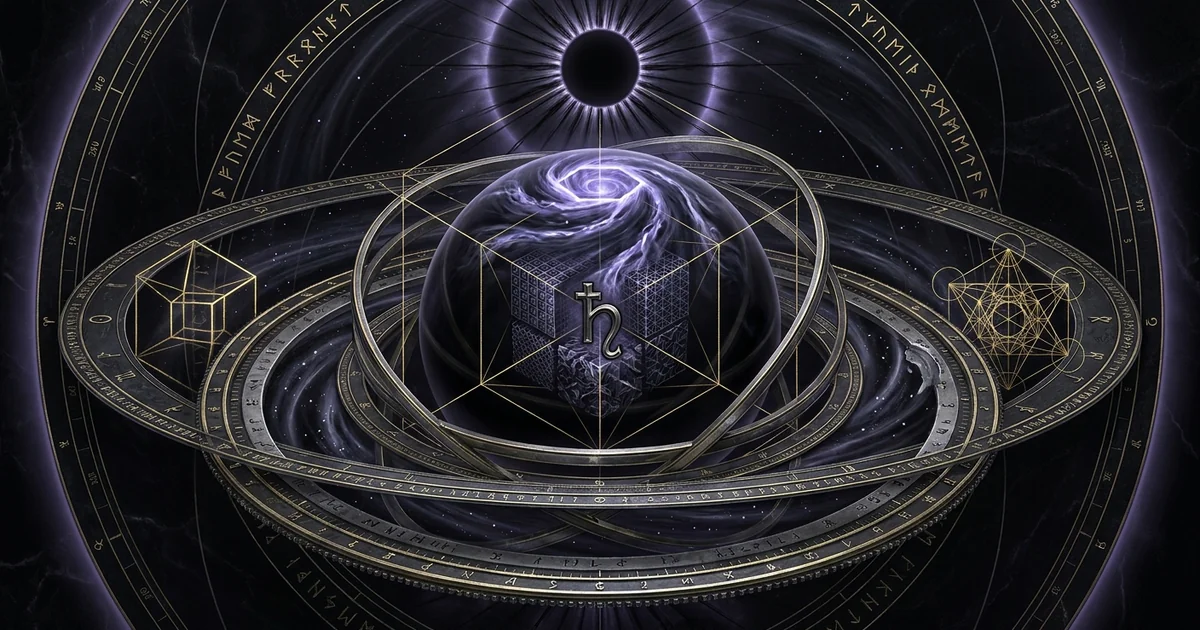
Saturn: Chronos, Sacred Boundary and Karmic Matrix
Archetypal Thesis & Systemic Paradigm: The Architecture of Spatiotemporal Limitation
Chronos and the Demarcation of Entropy
Within the architecture of esoteric cosmology and depth psychology, Saturn occupies the ontological threshold where unmanifest, infinite potential collides with the irreversibility of linear time (Chronos) and thermodynamic degradation. To approach the saturn astrology archetype meaning from an analytical perspective is to abandon moralistic dualisms of benevolence and cruelty. Saturn is not a punitive demiurge, but the fundamental cosmological constant that makes distinct manifestation possible.
In pre-cosmic void space, energy exists in a state of absolute symmetry, undifferentiated and devoid of structural localization. Saturn introduces the primordial rupture of this symmetry through demarcation. By imposing the dimension of duration, the Saturnian principle establishes the baseline reality of entropy: every organized system operating within the spatiotemporal continuum must expend energy to maintain its structural coherence, inevitably confronting wear, exhaustion, and physical mortality.
Far from an arbitrary celestial antagonist, Saturn represents the psycho-cosmological coordinate where the psyche encounters somatic limits. In early cosmological schemata, Chronos was frequently conflated with Kronos, the sickle-bearing titan who castrates Uranus (the infinite, uncontained sky). Psychologically, this castration signifies the violent truncation of boundless, omnipotent fantasy. The ego cannot achieve genuine sovereignty while suspended in oceanic formlessness. It requires an unyielding counter-force—a dense, non-negotiable exteriority—against which it can test its structural capacity. The sickle of Chronos severs the infantile delusion of limitless time, inaugurating the existential terror and developmental necessity of the countdown. Through the inexorable ticking of the chronological apparatus, the planetary archetypes (detailed across the /astrology/planetary-archetypes-overview systemic framework) cease to be abstract archetypal matrices and become localized, biological imperatives.
The Principle of Crystallization: Form Emerging from the Void
The metaphysical mechanics of Saturn operate through crystallization. In alchemical and physical systems, crystallization is an exothermic process of phase change wherein molecular chaos yields to geometric invariance. Saturn is the cosmic cryogenics chamber: it lowers the temperature of volatile psychic energy until it solidifies into objective form. Without this astringent, contracting vector, creation would remain an amorphous soup of unactualized possibilities—the primordial chaos or the boundless realm of Kether prior to the emanational descent.
This principle of structural condensation is inextricably linked to the Sephirah Binah on the Hermetic Tree of Life, explored extensively in the analysis of the /qabalah/binah-understanding-cosmic-matrix. Binah, the “Great Mother” or cosmic womb, is simultaneously the architect of form and the harbinger of death. The luminous, uncontained energy radiating from Chokmah is received by Binah, who weaves around it the restrictive garments of matter, space, and time. To give form to a spirit is, by definition, to condemn it to eventual decay; form is the vessel of life, but it is simultaneously life’s prison and tomb.
The Saturnian crystallization process forces the volatile, expansive spirit into the leaden crucible of somatic limitation. The skeleton within the biological organism precisely mirrors this principle: an interior, calcified architecture that resists the downward pull of gravity, allowing the softer tissues to orient themselves in space. Without this ossified scaffolding, mammalian locomotion and intentional agency would collapse into inert protoplasm. Thus, the boundary condition is not the antithesis of life, but its formal prerequisite.
Cybernetic Feedback and Karmic Causality
Viewed through modern cybernetics and complex systems analysis, the Saturnian archetype operates as the primary governor of negative feedback within the macrocosmic and psychic ecology. In cybernetic systems, runaway positive feedback loops lead inexorably to exponential instability, systemic overheating, and catastrophic structural failure. Unchecked growth—whether manifesting as biological malignancy, economic hyperinflation, or psychic grandiosity—destroys the systemic matrix that hosts it.
“The encounter with the shadow is often experienced as a dark, cold, and forbidding impasse—the exact psychological equivalent of the alchemical nigredo governed by Saturn. Here, the unconscious confronts the conscious ego with its own leaden weight, its moral failures, and the terrifying structural limitations of its mortal container. Yet, it is precisely this calcification and mortification that arrests the inflationary flight of the spirit, anchoring the personality within the indispensable gravity of psychic reality.” — C.G. Jung, Mysterium Coniunctionis (Collected Works Vol. 14, §334)
Saturn acts as the negative feedback mechanism that restores dynamic equilibrium. It registers systemic deviation from homeostatic balance and introduces friction, drag, and material resistance to counter the error trajectory. What classical astrology anthropomorphized as “karmic punishment” is precisely this cybernetic correction. The universe does not pass moral judgment; rather, structural stress lines fracture when excessive pressure is applied to a flawed design.
Karmic causality is the strict, deterministic conservation of momentum within a moral and psychological coordinate space. When the human agent overreaches, denying somatic limits or ethical contracts, the Saturnian matrix generates an equal and opposite counter-pressure. This confrontation with the unbending law of consequence compels the ego to re-evaluate its structural integrity. The friction experienced as suffering is nothing other than the recalibration of the self against the unyielding parameters of objective reality.
Classical Provenance & Textual Lineage: From Mesopotamian Kayamanu to Renaissance Hermeticism
Ninurta and Kayamanu: The Steadfast Watcher of Babylonian Celestial Omina
The archetypal genealogy of Saturn reveals a continuous conceptual evolution, oscillating between agrarian stewardship, inexorable doom, and metaphysical contemplation. In the Mesopotamian cuneiform record, the planet was designated as Kayamanu (the “Steady” or “Enduring One”), directly linked to Ninurta, the deity of agriculture, irrigation, and border disputes. In the omen series Enuma Anu Enlil, the movement of Kayamanu was tracked with reverent trepidation. Its excessively slow sidereal transit—crawling through the stellar constellations far slower than any other visible luminary—suggested an ancient, unblinking cosmic surveyor observing the boundaries of fields, the seasonal rise of river systems, and the preservation of legal treaties.
Ninurta possessed a double valence: he was the warrior-god who defended the realm from mountain monstrosities by building massive stone walls, yet he was also the master of agrarian labor who cleaved the earth with the plow. Here, at the root of the lineage, the saturn astrology archetype meaning combines hard stone, defensive fortification, geometric land division, and agricultural harvesting. The boundary stone (kudurru) served as an earthly talisman of this divinity. To displace a boundary stone was to invite cosmic disorder; the steadfast watcher stood guard over the lines dividing property, human civilization, and the wild wastes of chaos.
The Hellenistic Malefic: Ptolemy’s Frigid Outlier and Valens’ Inexorable Fate
As Babylonian celestial omens were synthesized into Hellenistic horoscopic astrology through the crucible of Ptolemaic Egypt, Saturn (Kronos) underwent an austere systematization. In the foundational system of Claudius Ptolemy’s Tetrabiblos (Book I), celestial bodies were classified according to their primary elemental qualities of heat, cold, moisture, and dryness. Ptolemy systematically demonstrated why Saturn had earned the designation of Infortuna Major—the Greater Malefic:
“The planet Saturn’s natural characteristic is chiefly to cool and also moderately to dry, because, perhaps, he is at the greatest distance from the sun’s heat and the moist exhalations around the earth… He produces cold and dryness, conditions hostile to life, which requires warmth and moisture for its generation and preservation.” (Ptolemy, Tetrabiblos, I.5)
For Ptolemy, Saturn’s malice was not a moral disposition, but an elementary thermodynamic reality. Operating at the icy periphery of the known cosmos, the planet sucked warmth from the sublunary sphere, producing mortification, consumption, dropsy, and decay.
Concurrently, the practicing astrologer Vettius Valens, writing in his Anthologiarum Libri Novem, presented an unvarnished catalog of Saturnian reality. For Valens, Saturn governed prison, bonds, mourning, tears, orphanhood, the destruction of estates, hard manual labor in quarries, deep water, and inexorable fate (Heimarmene). Valens’ clients lived in a brutal Mediterranean antiquity where an unexpected cold snap, an indebted foreclosure, or an infectious calcification of the lungs meant immediate death. In the horoscopes collected by Valens, a dominant, afflicted Saturn was repeatedly observed at the loci of social ostracism, institutional servitude, and systemic deprivation. The planet was the personification of the inescapable net of causal destiny: cold, dry, heavy, and completely deaf to human supplication.
“Saturn is a planet of profound speculation, who easily steals into the minds of men, and there frames great conceits; he governs the melancholic humor, heavy and profound thoughts, deep designs, solitary retirements, and the digging up of foundations, burying-places, and secrets hidden long in the earth. He is the ruler of lead, of all black, heavy, and foul metals, of bones, of teeth, and of the boundary marks that enclose the estates of men; he is slow, unyielding, an enemy to generation, yet the custodian of ancestral wisdom and subterranean wealth.” — Heinrich Cornelius Agrippa, De Occulta Philosophia Libri Tres, Book II, Chapter 22 (1533)
Renaissance Neoplatonism: Ficino and Agrippa on the Contemplative Genius of Lead
The late fifteenth-century revival of Neoplatonism led by Marsilio Ficino within the Medici circle at Florence executed an extraordinary intellectual reclamation of the Greater Malefic. Ficino, himself a melancholic physician and priest, was acutely conscious of Saturn’s agonizing psychic weight. In De Vita Libri Tres (Three Books on Life), he recognized that the intellectual and creative caste was inherently prone to the Saturnian humor: black bile (melaina chole).
Rather than fleeing this disposition, Ficino, drawing upon the Pseudo-Aristotelian Problemata XXX.1, argued that the cold, dry, contracting essence of Saturn was the indispensable physiological and psychological prerequisite for genius (ingenium). The volatile animal spirits, which ordinarily dart erratically across sensory stimuli, are chilled and concentrated by the Saturnian humor. The mind, pulled back from the ephemeral flux of external appearances, is driven downward and inward into profound contemplation (contemplatio).
Heinrich Cornelius Agrippa codified this perspective in his De Occulta Philosophia Libri Tres, asserting that Saturn’s lead metal does not merely signify squalor and death, but encloses within its dense atomic matrix the hidden spark of transcendental intellect. Saturn drives the soul away from superficial sociality toward solitude, mathematics, geometry, esoteric architecture, and metaphysics. The Greater Malefic became, in the hands of the Renaissance Hermeticists, the supreme planetary gateway to wisdom: the mind must endure the calcination of all worldly vanity to construct the immortal temple of the philosophical intellect.
Structural Mechanics & Symbolic Geometry: The Mathematical and Astrological Matrix
The 29.5-Year Synodic Period and Orbital Geometry
Saturn requires approximately 29.46 terrestrial years to execute a complete sidereal circuit of the zodiac. This structural chronometry forms the macro-temporal metronome of human developmental psychology. The complete cycle of roughly twenty-nine and a half years delineates the structural baseline of physical maturation, social integration, and cellular decline, punctuated by an uncompromising geometric rhythm:
At approximately age seven, the transiting Saturn forms its opening waning square (90°) to its natal position, corresponding precisely to the physiological transition marked by the loss of deciduous teeth, the ossification of the skeletal base, and the developmental milestone where the child is first required to operate within formal educational and social institutions.
At approximately age fourteen, the transiting Saturn opposes (180°) its natal position. This phase marks the stormy threshold of puberty, biological reproduction, and the acute psychological crisis wherein the burgeoning ego crashes against parental authority and cultural boundaries.
At age twenty-one to twenty-two, the closing waxing square (270°) occurs, confronting the emerging adult with economic reality, civic responsibility, and the systemic withdrawal of institutional shelter.
The climax of this developmental geometry arrives between ages 28.5 and 30: the first Saturn Return, exhaustively mapped in the /astrology/saturn-return-structural-guide. The natal blueprint is re-engaged at the identical degree of celestial longitude. During this interval, all ephemeral, ungrounded psychic constructs—illicit vocational choices, borrowed identities, unsustainable romantic arrangements, and infantile grandiosity—shatter against the immovable substrate of temporal reality. The return does not generate arbitrary tragedy; it merely collapses everything that was built on sand.
This 29.5-year cycle repeats: the second Saturn return (ages 57–60) demands an reckoning with senescence, legacy, somatic diminishment, and structural contribution to the collective matrix; while the third return (ages 86–89) forces the terminal surrender of physical architecture back to the entropic dust.
Classical Dignities: Domicile in the Solstitial Gates and Exaltation in Libra
The spatial placement of Saturn within the classical scheme of planetary dignities confirms its status as the cosmic boundary stone. Saturn is assigned rulership over two consecutive zodiacal signs: Capricorn (nocturnal cardinal earth) and Aquarius (diurnal fixed air). In the Thema Mundi—the Hellenistic teaching horoscope of the cosmos—these signs directly oppose the domiciles of the Luminaries (the Moon in Cancer and the Sun in Leo).
Capricorn represents the ingress of the winter solstice in the Northern Hemisphere: the lowest, darkest, coldest juncture of the solar cycle, where light is compressed to a pinpoint of survival. Here, Saturn functions as the cardinal earth matrix: granite, bedrock, defensive fortresses, and hierarchical institutions engineered to outlast systemic famine. In Aquarius, Saturn acts as fixed air: cold, abstract, structural intelligence; the geometric laws of physics; civil contracts; and the ideological blueprints that govern civilizational engineering.
       [Sun: Leo] <=================> [Saturn: Aquarius]
   (Radiant Life / Diurnal)       (Structural Law / Fixed Air)

      [Moon: Cancer] <===============> [Saturn: Capricorn]
  (Somatic Nourishment / Nocturnal) (Material Skeletal Wall / Cardinal Earth)
The planet’s exaltation occurs at 21 degrees of Libra, the sign of the autumnal equinox, balance, and bilateral contract. In Libra, solar exuberance is formally balanced by the scales of justice and legal boundary. Saturn is exalted here because equity, jurisprudence, and structural equilibrium can only exist when raw subjective desire is subordinated to the objective, unyielding metric of the law. Saturn’s detriment falls in Cancer and Leo, where its cold dryness suffocates the biological warmth and sovereign radiance of the ego-identity. Its fall in Aries exposes its deep structural incompatibility with raw, impulsive, uncalculated aggression; Aries acts without calculation, whereas Saturn demands absolute measurement before the stone is laid.
The Alchemical Axis of Lead and the 32nd Path of Tav
In the Western Mystery Tradition, Saturn’s astrological identity is fully integrated into the operations of hermetic metallurgy and esoteric Qabalah. In the alchemical opus, Saturn rules the base metal lead (Plumbum), the starting material of the Great Work. Lead is heavy, toxic, dull, and structurally dense—yet it is simultaneously the womb of gold. The alchemical dictum visita interiora terrae rectificando invenies occultum lapidem (VITRIOL) directs the adept directly into the Saturnian subterranean darkness, detailed within /alchemy/metallurgy-lead-to-gold-transmutation. The transmutation does not annihilate lead; it extracts the inner celestial fire that has been crystallized within its dense, heavy core.
[ Malkuth: Physical Earth ]
            ▲
            │
      Path 32 (Tav)  <--- Saturnian Threshold: The Leaden Gate
            │
            ▼
[ Yesod: Astral Foundation ]
On the Qabalistic Tree of Life, Saturn operates along two distinct vectors. In the Supernal Triad, it corresponds to Binah (Understanding), the third Sephirah, the cosmic loom that formats the radiant force of Chokmah into archetypal space-time. But in the descent toward manifest reality, Saturn is assigned to the 32nd Path, the Path of the letter Tav (meaning “Mark” or “Cross”), linking Malkuth (the material world) to Yesod (the astral foundation). Tav is the final letter of the Hebrew alphabet, the ultimate consolidation of creation. As the 32nd Path, Saturn acts as the severe customs officer of the cosmos: no entity ascends from the purely material plane into the subtle astral realms without passing through the leaden gate of Tav. The physical body must bear the signature of limitation, payment, and boundary before spiritual illumination is permitted to cross the threshold.
Psychological Dynamics & Operational Praxis: The Senex Shadow and Chart Integration
The Senex-Puer Polarity: Rigidity versus Perpetual Adolescence
In post-Jungian archetypal psychology, particularly the structural frameworks developed by James Hillman and Marie-Louise von Franz, Saturn is understood through the archetype of the Senex (the Old Man). The Senex embodies authority, patience, discipline, architectural mastery, memory, and ancestral continuity. However, psychological health depends entirely upon the systemic tension between the Senex and its psychic twin: the Puer Aeternus (the Eternal Youth).
When these two poles dissociate within the psychic economy, pathology erupts:
Pathological / Splintered Senex
- Cognitive: Paranoia, extreme cynicism, dogmatic rigidity, obsessive rumination on failure, and intellectual fossilization.
- Somatic: Chronic calcification, arthritis, severe dental erosion, anhedonic depletion of neurotransmitters, and dermatological drying.
- Behavioral: Authoritarian tyranny, emotional miserliness, hoarding of material resources, paralyzing fear of vulnerability, and punitive control over others.
Integrated / Architectonic Senex
- Cognitive: Lucid systemic thinking, capacity for profound concentration, objective assessment of structural limitations, and strategic foresight.
- Somatic: Durable skeletal alignment, metabolic economy, sustained biological endurance under duress, and graceful senescence.
- Behavioral: Mature mentorship, ethical integrity, steadfast boundary enforcement, emotional self-containment, and patient execution of long-term projects.
If the Senex is cut off from the Puer’s visionary enthusiasm and playful vitality, it degenerates into a petrified tyrant who seeks to strangle every emergent impulse in the cradle. This is Saturn eating his children: the established order murdering innovation out of an existential terror of usurpation and death. Conversely, the Puer without the grounding weight of the Senex remains an impotent, floating dreamer—a narcissist allergic to commitment, trapped in an unending series of unmanifested potentials, doomed to fall like Icarus the moment reality asserts its gravitational pull.
Diagnosing Saturnian Pathology: Anhedonia, Defense Mechanisms, and Fear
In clinical horoscopic practice, an unintegrated or deeply conflicted Saturn across the natal chart planets does not manifest merely as bad luck; it presents as a distinct psychological defense structure. The core affective wound of Saturn is an absolute conviction of fundamental deficiency. The subject feels an intrinsic, structural lack—a conviction that they are uniquely defective, unlovable, and unequipped to survive the demands of existence.
To defend against the terror of this perceived void, the ego erects massive psychological fortifications. These defenses typically bifurcate into two major vectors:
- Obsessional Hyper-Competence: The individual attempts to preemptively defend against failure and rejection by working themselves into somatic exhaustion. They construct an unassailable armor of credentials, wealth, administrative control, and rigid perfectionism. Yet, because the underlying wound of deficiency remains unaddressed, no quantity of accomplishment ever provides emotional safety. The interior landscape remains anhedonic, sterile, and haunted by the specter of impending ruin.
- Paralyzing Avoidance (The Leaden Inertia): Terrified of having their insufficiency exposed, the individual adopts a stance of total non-engagement. They rationalize their retreat through cynical intellectualization: why attempt the creative endeavor when the market is corrupt, time is brief, and failure is inevitable? Here, Saturn operates as the paralyzing lead that freezes the will, trapping the psyche in a depressive, melancholic tomb of its own construction.
Operational Chart Praxis: Delineating Saturn by House, Aspect, and Sect
To accurately delineate Saturn in a natal nativity, the practitioner must deploy an uncompromising, multi-layered technical analysis:
First, determine the chart’s Sect (Hellenistic hairesis). Saturn is the diurnal malefic. In a diurnal nativity (Sun above the horizon), Saturn’s hostile, refrigerating qualities are fundamentally moderated by the natural warmth of the day: its coldness becomes deliberate planning, its dryness becomes structural discipline, and its severity transforms into steady executive mastery.
Conversely, in a nocturnal nativity (Sun below the horizon), Saturn operates out of sect. The ambient coldness of the night exacerbates Saturn’s frigidity: its isolation turns bitter, its fears become acute paranoia, and the native experiences structural roadblocks as insurmountable, crushing impasses.
Second, analyze the House Placement. The house containing Saturn indicates the exact arena of incarnation where the native will encounter their foundational deficit, systematic delay, and unremitting labor. There are no shortcuts in the house of Saturn:
- In the 1st House, it imprints somatic self-consciousness, bodily stiffness, and an early impression that life is a grueling ordeal, demanding the patient construction of personal autonomy.
- In the 4th House, it points to cold, conditional, or heavily burdened familial foundations, generational ancestral debts, and domestic isolation, requiring the individual to build their own internal security architecture.
- In the 7th House, it enforces harsh delays and cold lessons in partnership, breaking illusions of romantic codependency and demanding rigorous, legalistic equality and mature contracts.
- In the 10th House, it promises profound civic elevation and structural authority, but only through agonizingly slow ascent, carrying the classical warning that any moral compromise will result in an equally catastrophic public fall from the heights.
Third, map the Hard Aspects (conjunction, square, opposition). Dynamic contacts between Saturn and personal planets act as structural choke points. Saturn-Sun demands that the ego forge its identity in the absence of paternal validation; Saturn-Moon crystallizes the emotional body, frequently generating early maternal deprivation, requiring the native to develop an autonomous capacity to self-mother; Saturn-Mars forces the volatile drive of ambition to be harnessed to long-term discipline, penalizing erratic aggression with swift physical or social containment.
Philosophical Synthesis & Macrocosmic Correspondence: Lead, Bones, and the Hermetic Threshold
The Metal of Gravity: Leaden Density and Alchemical Sublimation
The metallurgical assignment of lead to Saturn within Hermetic philosophy is not an arbitrary poetic metaphor, but a profound intuitive perception of material physics. Lead (Plumbum) possesses an exceptionally high atomic density and an extraordinarily stable isotopic nucleus. It sits at the absolute terminal end of radioactive decay chains: unstable, radiant, highly volatile heavy elements—such as uranium and thorium—cascade through cycles of radioactive decay, shedding alpha and beta particles over billions of years, until their violent instability finally ceases. The element at which this nuclear exhaustion rests, achieving final, permanent stability, is lead.
Lead is the ultimate cosmic graveyard of atomic agitation. In this physical property, the Hermetic principle of correspondence (“As above, so below”) demonstrates complete coherence: lead absorbs radiation, blocks X-rays, halts sound waves, and resists chemical corrosion.
[ Radioactive Volatility / Uranium-Thorium ]
                  │
     (Entropic Cascade / Time)
                  │
                  ▼
   [ Stable Terminal Density / Lead ]
                  │
  (Alchemical Transmutation / Opus)
                  │
                  ▼
  [ Sovereign Illumination / Gold ]
The alchemical process does not bypass this leaden baseline; it insists upon it. The nigredo, the blackening stage governed by Saturn, requires the total mortification and rot of all superficial psychic structures. The volatile prima materia must be cast into the heavy, leaden vessel of containment. Only when the psyche is completely sealed within the inescapable, dense reality of its own limitations can the internal pressure build sufficiently to catalyze genuine transmutation. Lead provides the absolute structural vessel without which the spiritual mercury would evaporate harmlessly into the ether.
- Planetary Metal: Lead (Plumbum). Characteristics: maximal nuclear stability, extreme density, terminal decay product of radioactive chains, acoustic and radiation shielding.
- Somatic Systems: The skeletal matrix (calcium-phosphate scaffolding), teeth (dentin and enamel), cellular walls, dermatological epidermal barrier (stratum corneum), the spleen, and chronic degenerative inflammatory pathways.
- Hermetic Axiom Resonance: The Principle of Polarity (“Everything has poles; its opposite is its identical” - lead and gold as ends of the same metallurgical continuum) and the Principle of Rhythm (“The measure of the swing to the right is the measure of the swing to the left” - the inevitable contraction following every expansion).
Somatic Resonance: Skeletal Scaffolding, Teeth, and Dermatological Enclosures
The biological manifestation of the Saturnian archetype operates wherever the human organism requires calcification, boundary demarcation, and structural defense against environmental entropy. The skeletal scaffolding is the ultimate biological expression of Saturn: an interior architecture composed of dense mineral salts that resists the physical acceleration of gravity. Without the bones, the organism possesses no leverage, no locomotion, and no defense.
Teeth—the most durable, non-regenerative structures in the mammalian body—are ruled directly by Saturn. They perform the primordial Saturnian act: crushing, grinding, breaking down the exterior material world so that it can be assimilated into the interior biological system. When teeth fail, the boundary between the organism and starvation collapses.
Similarly, Saturn rules the skin—specifically the stratum corneum, the outermost layer of dead, keratinized cells that encases the living biological interior. The skin is the living boundary stone, the somatic interface that divides the “I” from the “Not-I.” It retains internal fluids, maintains homeostatic temperature, and repels external pathogens. When this boundary membrane is compromised, the organism suffers systemic shock, infection, and death. In every layer of human physiology, Saturn is the calcified wall that preserves the fragile, warm fire of cellular life against the chilling, chaotic void of the external world.
The Hermetic Horizon: Saturn as the Ring-Pass-Not of Manifestation
In classical and esoteric geocentric cosmology, the sphere of Saturn was the seventh and outermost planetary sphere. Beyond Saturn lay only the Firmamentum (the sphere of the fixed stars) and the Primum Mobile. Saturn was therefore designated the Ring-Pass-Not—the absolute cosmic boundary condition of the manifest solar system.
To the ancients, passing beyond Saturn meant exiting the realm of individual soul-formation and dissolving back into the undifferentiated cosmic ocean. In contemporary psychological astrology, this symbolic boundary remains intact despite the discovery of the trans-Saturnian outer planets (Uranus, Neptune, Pluto).
Saturn acts as the psychic filter:
[ Transpersonal Forces: Uranus / Neptune / Pluto ]
                     │
                     ▼
       =============================
       [ SATURN: THE RING-PASS-NOT ]  <--- Structural Filter / Ego Wall
       =============================
                     │
                     ▼
    [ Personal Realm: Sun / Moon / Mars... ]
The outer planets represent transpersonal, evolutionary, collective forces of rupture, dissolution, and metamorphosis. The human ego, constituted of personal memories, somatic bounds, and social identity, cannot withstand direct, unmediated exposure to these trans-Saturnian voltages without shattering into psychosis or fragmentation.
Saturn is the ego’s protective, filtering wall. It regulates the exact dosage of transpersonal energy that is allowed to penetrate the conscious vessel. When an individual attempts a spiritual bypass—seeking mystical transcendence (Neptune), radical liberation (Uranus), or absolute power (Pluto) without having first built a robust, ethical, stable Saturnian container—the result is catastrophic psychological collapse.
One cannot dissolve an ego (Neptune) that one has not yet successfully constructed (Saturn). One cannot break cosmic laws (Uranus) that one has not thoroughly understood and honored (Saturn). Saturn stands eternally at the edge of the visible system, demanding that every soul demonstrate its mastery of form, accountability, and ethical structure before it is permitted to gaze into the abyss of the infinite.
Frequently Asked Questions: Advanced Syntheses on the Greater Malefic
Deconstructing the ‘Malefic’ Label in Contemporary Astrological Practice
The classical categorization of Saturn as the Infortuna Major (the Greater Malefic) requires deep re-contextualization rather than superficial rejection. Ancient astrology operated in an environment of extreme precarity, where crop failures, dental abscesses, military sieges, and sudden systemic ruin were daily realities. In that context, a planetary force that chilled, dried, delayed, and bound was correctly experienced as acutely dangerous to fragile mortal lives.
However, translating this concept into contemporary depth astrology demands an understanding of systemic dynamics. Saturn is “malefic” only to the infantile desires of the subjective ego. The pleasure-seeking ego desires immediate gratification, boundless expansion, and freedom from consequence. Saturn represents the objective world of physical physics, chronological time, societal boundaries, and biological decay.
When an individual attempts to defy reality, Saturn feels like an assault: plans stall, relationships demand painful accountability, and somatic illness enforces rest. This friction is not malevolent; it is the corrective feedback of an integrated universe. A universe devoid of the Saturnian malefic would be an unanchored nightmare of explosive, cancer-like positive feedback loops where nothing could achieve permanence, integrity, or lasting form.
The True Operational Mechanics of the First and Second Saturn Returns
The Saturn return is the quintessential developmental rite of passage in the Western esoteric tradition. The first Saturn return (occurring between ages 28.5 and 30) marks the formal termination of psychological adolescence. Prior to this transit, an individual’s life is largely supported and shaped by ancestral conditioning, parental mandates, societal scripts, and speculative fantasies of who they might become.
The first return collapses these external scaffolding structures. It asks one foundational question: What have you actually built on your own ground? If a career, a marriage, or an identity was constructed to satisfy external expectations or neurotic avoidance, the structural fault lines rupture under Saturnian pressure. The transit forces the individual to shed borrowed identities, shoulder unmediated personal responsibility, and accept the reality that life is finite.
The second Saturn return (occurring between ages 57 and 60) operates on a completely different existential octave. Here, the individual is not asking how to enter the world, but how to prepare for the inevitable egress. The second return confronts the native with biological senescence, the hard limits of what can still be achieved in this incarnational cycle, and the critical question of generational legacy. The focus shifts from worldly ambition to the consolidation of wisdom. It demands that the individual transition from the stage of the ambitious worker to that of the true elder—the embodied Senex—who acts as a cultural anchor, holding the boundaries and preserving the foundational wisdom for the generation that follows.
Navigating Saturn-Sun and Saturn-Moon Hard Aspects Without Catastrophizing
Hard aspects (conjunction, square, opposition) from natal Saturn to the luminaries—the Sun and the Moon—are historically feared in traditional astrology, yet they represent some of the most potent engines for profound character integration if delineated properly.
-
Saturn-Sun Hard Aspects: The Sun represents the radiant core of conscious vitality, personal authority, and the drive toward self-realization. When Saturn binds the Sun through a hard aspect, the individual experiences an acute, early sense that their right to exist and shine is invalid or deeply conditional. The father figure is often experienced as absent, tyrannical, emotionally cold, or burdened by severe failures. The operational task of this aspect is to abandon the expectation of external validation. The native cannot borrow their confidence; they are forced, through rigorous trial and repetitive effort, to build an authentic internal authority from the ground up. Over time, these individuals frequently become the most stable, unshakeable leaders in their fields, possessing an authority forged in the crucible of their own self-reliance.
-
Saturn-Moon Hard Aspects: The Moon represents the somatic nervous system, instinctual security, childhood attachment, and emotional receptivity. Saturnian pressure on the Moon points toward early emotional deprivation, maternal coldness, or premature parentification, wherein the child was forced to become the responsible adult before their time. The adult native develops an armor around their vulnerability, fearing that emotional needs will lead to abandonment or humiliation. Navigating this dynamic requires recognizing that the defensive armor, which once preserved the child’s sanity in a cold environment, has become an internal prison. Healing does not occur through manic emotional outpourings, but through the deliberate, patient practice of self-parenting: providing the inner child with the reliable, structural safety, clear boundaries, and unconditional containing presence that was absent in the formative environment. In this manner, the leaden wall of defense is consciously transmuted into a sanctuary of emotional resilience. :::