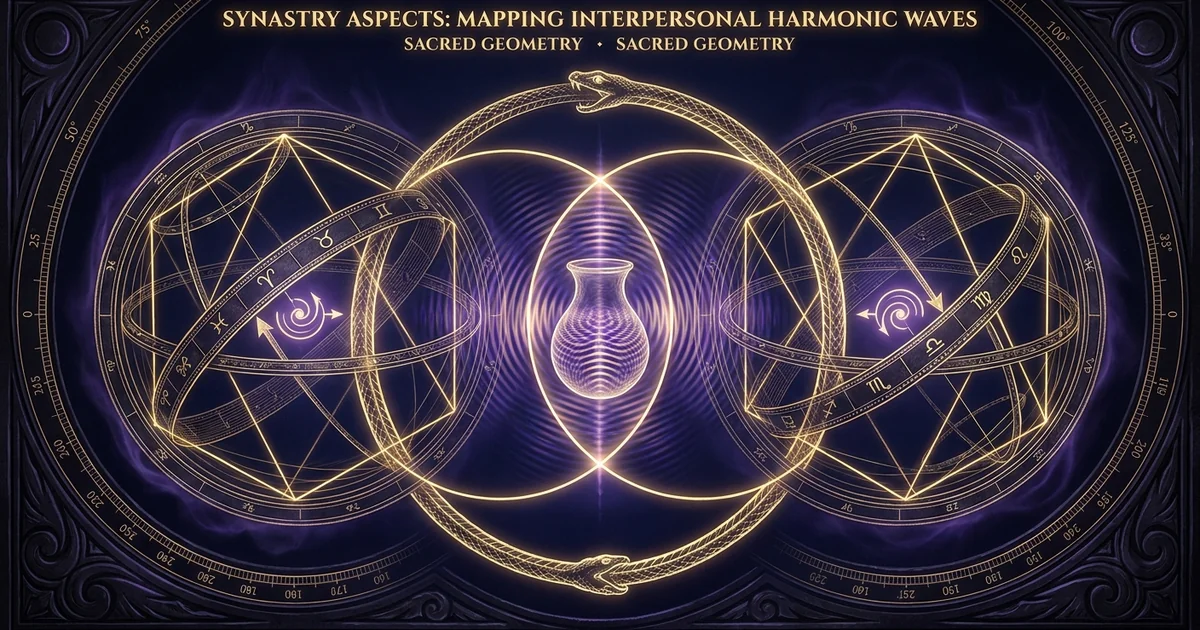
Synastry Aspects: Mapping Interpersonal Harmonic Waves
Archetypal Thesis & Systemic Paradigm: The Relational Field as an Interference Pattern
Planetary Geometries as Dynamic Archetypal Vectors
In contemporary psychological astrology and esoteric mechanics, the natal chart does not demarcate the boundary of an isolated subjective consciousness. Rather, it models an open, non-static psychic coordinate system whose internal vectors radiate through interpersonal space. The planetary placements along the 360-degree ecliptic sphere designate archetypal state-spaces—nodal concentrations of libido, functional somatic complexes, and instinctual imperatives configured at the native’s initial biological breath. When two sovereign natal matrices converge, their radiating fields intersect. The natal planets cease to operate purely as internal intrapsychic operators; instead, they function as resonant transmitters and receivers within an shared dyadic continuum. Evaluating a synastry aspects relationship astrology chart demands that the practitioner discard classical deterministic models of fatalistic compatibility in favor of an archetypal field theory, wherein celestial coordinates delineate the topography of mutual psychic induction.
Each planet serves as an archetypal vector possessing specific angular momentum and qualitative velocity. The inner luminaries and personal planets (Sun, Moon, Mercury, Venus, Mars) govern the operational baseline of the ego-consciousness, emotional homeostasis, communication protocols, and desire-dynamics. The social and transpersonal planets (Jupiter, Saturn, Uranus, Neptune, Pluto) govern collective developmental currents, structural boundary parameters, and evolutionary imperatives. When these vectors enter spatial alignment across two distinct natal horizons, they instantiate inter-chart aspects: measurable angular relationships that facilitate direct energetic transmission. The natal chart operates as a dynamic phase-space diagram; dyadic encounter triggers cross-planetary alignments that activate latent psychic complexes otherwise dormant in isolation.
The Interpersonal Field: Wave Superposition and Psychic Entanglement
The interpersonal field generated between two individuals is isomorphic to the physical phenomenon of wave superposition. When two coherent wave-trains traverse the same medium, their local amplitudes combine algebraically, producing regions of constructive and destructive interference. In relational mechanics, an aspect between Native A’s celestial vector and Native B’s celestial coordinate generates a psychic interference pattern. Constructive interference manifests when angular geometries share sympathetic harmonic divisors (such as the ternary and senary divisions of the circle), amplifying emotional safety, mutual recognition, and behavioral ease. Destructive or turbulent interference manifests through quadratic and binary divisions, precipitating friction, psychic compression, and structural resistance.
This wave dynamic fundamentally transposes internal psychological structures into externalized relational events. Unconscious material—most acutely the Jungian Anima, Animus, and Shadow—cannot remain unmanifest when struck by the planetary wave of another native. Through projective identification, an individual externalizes their disowned archetypal complexes onto the partner, who serves as a biological and psychological screen. Inter-chart aspects identify the precise energetic conduits through which this projection occurs. Far from being a static metric of whether two individuals will experience relational ease, synastry aspects chart the cybernetic feedback loops through which the unconscious mind constructs a relational crucible, compelling both participants toward individuation through dialectical friction.
Classical Provenance & Textual Lineage: From Ptolemaic Synaphe to Keplerian Harmonics
Hellenistic Synaphe and Ptolemaic Foundations of Mutual Witnessing
The technical genealogy of synastry originates within the Hellenistic astrological corpus, notably formalized under the operational concept of synaphe (συναφή)—meaning contiguity, adhesion, or bodily connection. Hellenistic astrologers evaluated planetary interaction through geometric witnessing (epimartyria), wherein planets cast rays (aktinobolia) across the zodiacal circle according to the Euclidean division of space. Claudius Ptolemy, writing in the second century CE, consolidated these principles into an analytical framework for dyadic union within the Tetrabiblos. Ptolemy’s treatment of relational concordance abandoned fatalistic singular points, requiring an examination of systemic luminary interchange, planetary triplicity affinities, and the condition of the angles.
“For the most part, marriage is lasting when the Sun and Moon are in harmonious aspect in both nativities, that is, when they are in trine or sextile with each other; and especially when the Moon of the husband is in such aspect with the Sun of the wife… The alienation and complete breaking of ties, however, occurs upon aspectual configurations of the Luminaries in disjunct or contrary signs, that is, when they are in quartile or opposition to one another, producing irreconcilable discord.”
Ptolemy identified the energetic foundation of relational stability in the sympathetic alignment of the primary luminaries. The solar principle, embodying the diurnal, active pneuma, and the lunar principle, embodying the nocturnal, bodily moisture and emotional flux, required structural rapport across the two nativity schemes. If the luminary of one chart occupied the triplicity or harmonious aspect of the luminary of the second, an organic cohesion was established. Conversely, Ptolemy observed that planets configured across averse (asyndeton) or conflicting signs generated structural hostility, as their radiating rays could not achieve geometric concord. This early mechanistic model treated aspectual rays as energetic forces traversing celestial space, directly impacting the humors and psychological temperaments of the interacting subjects.
Keplerian Harmonic Ratios: Translating Aspect Geometry into Archetypal Resonance
The conceptual evolution from Ptolemaic ray-casting to modern wave mechanics was catalyzed by Johannes Kepler in his 1619 treatise, Harmonices Mundi. Kepler stripped astrological theory of its Aristotelian elemental baggage and medieval accretions, reconstructing it entirely upon the foundation of Euclidean geometry and Pythagorean musical intervals. For Kepler, the astrological aspects derived their efficacy neither from zodiacal signs nor from arbitrary traditions, but from the regular polygons inscribable within the circle of the heavens. When the circle (representing the totality of the manifest macrocosm) is divided by whole integers, it generates harmonic fractions corresponding directly to the fundamental consonances and dissonances of the diatonic musical scale.
Kepler established that aspects derive their psychological potency directly from the geometric fraction of the 360° circle, correlating geometric division to auditory harmonics:
- Conjunction (1/1 = 360° / 0°): Unity, root vibration, fundamental tone. Psychological synthesis, non-differentiation, and subjective fusion.
- Opposition (1/2 = 180°): The diapason (octave). Polarization, confrontation of the Other, objective consciousness through bilateral tension.
- Trine (1/3 = 120°): The diapente (perfect fifth). Structural stability, equilibrium, passive elemental consonance.
- Square (1/4 = 90°): The diatessaron (perfect fourth). Kinetic dynamism, structural friction, crisis demanding conscious integration.
- Sextile (1/6 = 60°): The hexachord interval. Receptive resonance, active intellectual opportunity, complementary synthesis.
By grounding aspect theory in harmonic circle division, Kepler reframed inter-chart aspects not as static indicators of moral beneficence or maleficence, but as quantifiable ratios of resonance. A harmonic resonance and musical intervals framework demonstrates that two planets configured in an inter-chart square (a 1:4 division) generate a psychological diatessaron: an acoustically tense, dynamic oscillation that requires harmonic resolution. In contrast, the inter-chart trine (a 1:3 division) produces the serene consonance of the perfect fifth, allowing psychic energy to flow without resistance, though occasionally without the evolutionary impulse to generate new structural forms. Kepler’s harmonic architecture remains the mathematical bedrock beneath contemporary dyadic aspect evaluation.
Structural Mechanics & Symbolic Geometry: Harmonic Division and Planetary Overlays
Angular Harmonics: Hard versus Soft Aspect Energetics
Within the structural mechanics of synastry, aspects are classified into distinct functional typologies based upon their energetic dynamics. Harmonic analysis groups aspects into hard (dynamic/quadratic) and soft (harmonic/consonant) polarities. This polarization governs the operational velocity at which two psyches negotiate boundary conditions and shared libido. Hard aspects—predicated upon circle divisions by two, four, and eight (180° opposition, 90° square, and 45°/135° semi-square and sesquiquadrate)—introduce unavoidable psychic compression. They function as active evolutionary engines. When two planetary vectors meet in a cross-chart square, their inherent archetypal needs cannot operate simultaneously without generating structural stress, forcing the egos to adapt, negotiate, or succumb to neurotic defensive posturing.
Conversely, soft aspects—grounded in circle divisions by three and six (120° trine and 60° sextile)—exhibit an energetic impedance of near-zero. Planetary expressions between the partners flow without defensive friction, fostering instantaneous rapport, mutual validation, and organic empathy. However, an unexamined reliance on soft aspects introduces the pathology of relational entropy: without the kinetic resistance generated by hard aspects, the partnership can stagnate into an unexamined complacency, lacking the dynamic tension required for individuation.
Hard Dynamic Aspects (90° Square / 180° Opposition)
- Psychic Tension: High-amplitude friction, structural conflict, neurosis of boundary confrontation.
- Behavioral Manifestation: Compulsive mutual activation, defensive resistance, volatile attraction/repulsion dynamics.
- Evolutionary Potential: Catalytic propulsion toward psychic differentiation; forces unintegrated material into consciousness.
- Pathology of Stagnation: Relational burnout, chronic polarization, projective warfare, and ego exhaustion if unintegrated.
Soft Harmonic Aspects (120° Trine / 60° Sextile)
- Psychic Tension: Minimal-impedance flow, elemental sympathy, intrinsic neuro-somatic relaxation.
- Behavioral Manifestation: Effortless rapport, instinctual consensus, mutual comfort, passive affirmation of existing habits.
- Evolutionary Potential: Serves as a restorative sanctuary; stabilizes the relational vessel during developmental crises.
- Pathology of Stagnation: Psychic inertia, mutual enabling of unconscious complexes, lack of developmental impetus.
Topological Interpenetration: House Overlays and Sector Activation
While cross-chart aspects delineate the qualitative manner in which planetary energies interact, planetary overlays govern the topological location where those energies manifest within the lived experience of each individual. A planetary overlay occurs when Native A’s planetary coordinates are transposed onto the twelve-house topographical sphere of Native B. Houses represent the mundane arenas of consciousness—phenomenological sectors ranging from the somatosensory foundation of the 1st House to the ancestral, transpersonal depths of the 8th and 12th Houses.
When Native A’s Sun falls into Native B’s 8th House, Native A’s fundamental core consciousness directly illuminates Native B’s unconscious repressions, shared economic anxieties, and alchemical death-rebirth mechanisms. The overlay establishes the environmental theater in which the aspect operates. If Native A’s 8th-house Sun simultaneously squares Native B’s natal Mars in their 5th House, the psychological activation ceases to be an abstract archetypal dialogue. It manifests empirically as structural friction between Native B’s instinctual creative or erotic desires and the penetrating, transformative demands imposed by Native A’s Presence in their psychological underground. Planetary overlays constitute the spatial grounding of synastry aspects; without mapping overlays, the aspect remains a disembodied frequency lacking a contextual bio-psychic container.
+-----------------------------------------------------------------------------------+
|               TOPOLOGICAL INTERPENETRATION PIPELINE                               |
|                                                                                   |
|  [ Native A Planet: Archetypal Vector ]                                           |
|                     |                                                             |
|                     v                                                             |
|  [ Aspect Harmonic: Cross-Chart Angular Resonance (Conjunction/Square/Trine) ]    |
|                     |                                                             |
|                     v                                                             |
|  [ Planetary Overlay: Partner's Mundane House Sector (Phenomenological Field) ]   |
|                     |                                                             |
|                     v                                                             |
|  [ Manifest Behavior: Complex Constellation & Somato-Psychic Feedback Loop ]     |
+-----------------------------------------------------------------------------------+
The Asymmetry of Cross-Aspects: Symmetrical Double Whammies versus Unilateral Conduction
A common analytical error in the evaluation of relationship compatibility is the assumption that planetary cross-aspects operate symmetrically. In empirical practice, synastry aspects display distinct directional polarities. A unilateral aspect occurs when Native A’s Saturn squares Native B’s Sun, but Native B’s Saturn shares no Ptolemaic contact with Native A’s Sun or luminaries. In this configuration, the energetic conduction is asymmetrical: Native B experiences Native A as a restricting, structuring, or censoring authority figure, whereas Native A experiences Native B’s vitality through a fundamentally different filter—determined by whatever separate planetary cross-aspects Native A receives in return. The unilateral conduction often produces a power differential within the relational field, locating the locus of authority, emotional vulnerability, or volatile libido on one side of the dyad.
In contrast, symmetrical aspects—conventionally designated as “double whammies”—represent closed teleological circuits. A double whammy occurs when planetary archetypes are mutually reflected across the nativities: for instance, Native A’s Venus conjoining Native B’s Mars while Native B’s Venus forms a reciprocal trine or opposition to Native A’s Mars. Here, the energetic current achieves complete bilateral circulation. Neither native can claim psychological immunity from the archetypal field being constellated. Symmetrical aspect configurations generate high-potency subjective recognition, forging an intense relational glue. The natives become locked in an alchemical mirror where each action inevitably reverberates back through the complementary planetary circuit, vastly accelerating the individuation process of both participants.
Psychological Dynamics & Operational Praxis: Transference, Complex Constellation, and Archetypal Shadow Coupling
The Transference Matrix: Luminary-Saturnian Binding and Outer Planet Catalysts
From the perspective of depth psychology and Jungian archetypal theory, inter-chart aspects serve as the structural framework for dyadic transference and countertransference. The ego does not perceive the relational partner through pure sensory objectivity. Instead, the partner’s planetary vectors trigger preexisting internal autonomous complexes. Chief among these relational mechanisms is the Luminary-Saturnian matrix. When an individual’s Saturn forms a tight aspect (conjunction, square, or opposition) to their partner’s Sun or Moon, a classical archetypal bind is initiated. The Saturnian native instinctively activates parental superego projections, imposing structural boundaries, criticism, or sobering realism upon the Luminary partner’s core identity (Sun) or emotional vulnerability (Moon).
While the Luminary native often experiences this contact as an oppressive weight or an infant-parent dynamic, the Saturnian native often acts out of an unconscious terror of inadequacy or abandonment. The aspect binds the relationship into an enduring, karmically weighted container. Saturn provides the psychic density required for relational longevity, yet without conscious psychological work, it risks ossifying the connection into an emotional prison.
“The statistical material of our marriage experiment… showed that the conjunction of the Sun and Moon, the conjunction of the two Moons, and the conjunction of the Moon with the Ascendant yielded a remarkably high frequency… The astrological tradition asserts that these configurations are characteristic of married couples; their appearance in the statistics must therefore be regarded as a classic manifestation of archetypal synchronicity, where psychic readiness and external celestial coincidence reflect the same underlying reality.”
When outer planets (Uranus, Neptune, and Pluto) configure with personal planets in a synastry aspects relationship astrology chart, they function as impersonal, collective evolutionary catalysts. A cross-chart Pluto-Venus aspect inevitably drags the Venusian native into the underworld of their own desire architecture, exposing patterns of manipulation, obsessive dependency, and repressed somatic power. Uranus introduces radical individuation imperatives, preventing relational stagnation through periodic systemic shocks and unpredictable cycles of detachment. Neptune dissolves the defensive perimeters of the partner’s ego, inviting sublime mystical communion while running the severe risk of deceptive idealization, martyrdom, and absolute psychic boundary confusion. The transpersonal planet consistently demands that the personal planet elevate its operational frequency beyond mere domestic survival.
+-----------------------------------------------------------------------------------+
|               THE TRANSFERENCE MATRIX: ARCHETYPAL PROJECTION DYNAMICS             |
|                                                                                   |
|  [ Native A: Outer / Transpersonal Vector ]                                       |
|  (Pluto / Neptune / Uranus / Saturn)                                              |
|                     |                                                             |
|                     v  (Projective Induction via Hard / Tight Aspect)             |
|  [ Native B: Ego-Core Archetype ]                                                 |
|  (Sun / Moon / Venus / Mars)                                                      |
|                     |                                                             |
|                     v  (Internal Complex Constellation)                           |
|  [ Defense Mechanism Triggered: Shadow Eruption, Ego-Regression, or Idealization] |
+-----------------------------------------------------------------------------------+
The Alchemical Coniunctio: Sol/Luna and Mars/Venus Polarities
The core of traditional relationship astrology rests upon the great alchemical polarities: Sol/Luna (conscious vitality and unconscious emotionality) and Mars/Venus (desire-impulse and receptive attraction). In classical alchemy, the coniunctio represents the sacred marriage of polar opposites, a necessary precursor to the creation of the Philosophers’ Stone. When cross-chart aspects link these archetypal polarities, they induce an immediate, instinctual chemical valence between the natives.
+-------------------------------------------------------------------------+
|                  THE ALCHEMICAL DYADIC POLARITIES                       |
|                                                                         |
|      SOL (Solar Consciousness)       MARS (Erotic Engine/Will)          |
|                 ^                               ^                       |
|                 |  Cross-Chart Aspects          |  Cross-Chart Aspects  |
|                 v                               v                       |
|      LUNA (Somatic Vessel)           VENUS (Erotic Magnetic Core)       |
+-------------------------------------------------------------------------+
An inter-chart Sun-Moon conjunction forms the absolute apex of psychic consonance. The conscious self-expression of the Solar native operates in symphonic coherence with the instinctual, receptive needs of the Lunar native. This aspect provides an intuitive shorthand; emotional security is granted without the prerequisite of exhaustive verbal mediation. Conversely, Mars-Venus contacts establish the erotic matrix of the dyad. Mars supplies the directional vector, the initiating phallic potency, and the animal desire-nature; Venus supplies the magnetic containment, the aesthetic values, and the receptive capacity to synthesize the Martian drive into an integrated erotic art. When these planets meet via the conjunction, square, or trine, a biological and psychological polarity is sparked. However, a Mars-Venus square will manifest as high-friction passion that periodically deteriorates into boundary violations, whereas the trine sustains an organic, effortless sensuality that may nevertheless lack the sheer developmental heat required to force evolutionary breakthroughs.
Systemic Interpretive Protocol: An Eight-Stage Deconstructive Workflow
To evaluate cross-chart aspects accurately within an advanced clinical or archetypal consultation framework, the practitioner must not engage in atomized aspect reading. Instead, they must follow an unbending hierarchical protocol designed to deconstruct the relational matrix systematically:
- Orb Calibration and Tier Selection: Establish rigid orb thresholds. Restrict primary luminaries to an orb of 5° maximum; restrict all personal and outer planets to a maximum orb of 3°. Disregard wider aspects to eliminate statistical noise.
- Ascendant-Descendant Axis Infiltration: Calculate all planetary contacts intersecting the angles of both charts. The Descendant marks the relational horizon; any planet of Native A conjoining Native B’s Descendant becomes an immediate primary actor in the relationship’s externalization theater.
- Luminary Synthesis (Sun/Moon Dynamics): Map all mutual aspects between the Suns and Moons of both nativities. This defines the systemic vitality and psychological longevity baseline of the dyad.
- Nodal Axis / Karmic Axis Crossings: Analyze planetary conjunctions to the partner’s Mean or True Lunar Nodes. Planets conjoining the South Node designate established, instinctual, and frequently regressive psychic patterns; planets conjoining the North Node represent evolutionary disruption, demanding unpracticed behavioral adjustments.
- Inner-to-Inner Planetary Networks: Map the communicative and relational circuits: Mercury-Mercury (epistemological harmony or cognitive dissonance), Venus-Mars (erotic mechanics and aesthetic valuation), and Mars-Mars (assertive compatibility and conflict-resolution paradigms).
- Inner-to-Outer Planetary Binding (The Transference Field): Identify the Saturnian, Plutonian, and Neptunian hooks into the personal planets of the partner. Document the loci of authority, control, idealization, and psychological wounding.
- House Overlay Structural Geometries: Overlay the planets onto the partner’s houses. Identify topological clusterings (e.g., a high concentration of planets falling into the partner’s 4th, 8th, or 12th houses signifies a deeply submerged, psychological relationship, whereas clusterings in the 1st, 5th, or 10th houses demand public, outward structural expression).
- Double Whammy and Asymmetry Audit: Catalog all reciprocal planetary circuits versus unilateral aspects to evaluate the power equilibrium and bilateral individuation channels across the dyadic system.
Philosophical Synthesis & Macrocosmic Correspondence: Hermetic Feedback Loops and the Composite Organism
The Hermetic Mirror: ‘As Above, So Below’ in Dyadic Individuation
The foundational Hermetic axiom—Quod est superius est sicut quod est inferius (“That which is above is like that which is below”)—is traditionally applied to the relationship between the macrocosmic celestial sphere and the microcosmic human psyche. In relational mechanics, however, this correspondence expands into a horizontal Hermetic mirror: the internal psyche of Native A is reflected in the externalized planetary presence of Native B. Inter-chart aspects operate as cosmic feedback loops. The partner functions as a physical instrument through which an individual is compelled to confront their own unintegrated macrocosmic architecture.
If an individual possesses an unintegrated natal Saturn-Moon opposition, they will repeatedly attract partners whose personal planets conjoin or activate that exact planetary axis. The dyad functions as an alchemical crucible (athanor), a self-regulating cybernetic system wherein each native acts as an operational mirror. Relational conflict is rarely a response to the external partner alone; it is the psyche’s instinctual attempt to achieve wholeness by forcing the conscious ego to integrate the disowned complexes projected onto the other. The aspect patterns chart the energetic topography of this initiation, transforming the mundane partnership into a theater of archetypal individuation.
Beyond Synastry: The Genesis of the Midpoint Composite Entity
While synastry mapping delineates the dynamic vector-to-vector stimulus, energetic friction, and interpersonal resonance between two distinct entities, it remains fundamentally confined to dyadic subjectivity. It charts how Native A experiences Native B, and how Native B reacts to Native A. Yet, in the metaphysics of human union, the convergence of two sovereign consciousnesses gives birth to a third, autonomous psychic entity: the relationship itself. This emergent relational monad is mathematically and symbolically represented by the midpoint composite chart, an essential progression in the study of composite chart dynamics.
+-----------------------------------------------------------------------------------+
|               THE RELATIONAL GENERATION CONTINUUM                                 |
|                                                                                   |
|  [ Native A Natal Coordinates ] <===================> [ Native B Natal Coordinates ]
|               \                                             /                     |
|                \-----> [ SYNASTRY INTERACTION ] <----------/                      |
|                        (Subjective Vector Interference)                           |
|                                       |                                           |
|                                       v                                           |
|                     [ MIDPOINT COMPOSITE SYSTEM ]                                 |
|                     (The Emergent Relational Monad)                               |
+-----------------------------------------------------------------------------------+
The composite chart does not measure celestial positions at a given moment in terrestrial time. Instead, it calculates the mathematical midpoints between the two nativities’ respective planets and angles, synthesizing them into a singular, unified coordinate framework. If synastry aspects represent the acoustic interference pattern generated between two independent instruments, the composite chart represents the musical composition being played by the emergent dyad. Synastry aspects govern interpersonal psychology, behavioral transference, and daily friction; the composite chart governs the overarching teleological destiny, social purpose, and ultimate spiritual trajectory of the union. A complete deconstruction of relationship astrology requires a dynamic dialectic between both methodologies: utilizing synastry to map the interpersonal harmonic waves, and the composite chart to decode the autonomous vessel within which those waves are contained.
Frequently Asked Questions: Technical and Operational Clarifications in Synastry
How do orb thresholds influence the functional operation of inter-chart aspects?
In natal astrology, practitioners routinely apply wide orb thresholds (often 8° to 10° for major aspects involving luminaries) to account for the holistic, lifelong psychological presence of archetypal complexes. In synastry, however, maintaining such expansive orbs is a severe methodological failure that yields significant interpretive inaccuracies. Dyadic aspect analysis must measure active harmonic resonance, not diffuse celestial proximity.
The psychic impedance of an inter-chart aspect increases exponentially as the orb widens. For an inter-chart aspect to exert an undeniable, observable influence on the neuro-psychic dynamics of a relationship, the orb must be calibrated tightly:
- Primary Luminaries (Sun, Moon): 3° to 5° maximum.
- Personal Planets (Mercury, Venus, Mars): 3° to 4° maximum.
- Social and Transpersonal Planets (Jupiter, Saturn, Uranus, Neptune, Pluto): 1° to 2.5° maximum.
When an aspect falls within a 1° orb (an exact or partile aspect), it operates as a primary psychic highway. The complex is constellated continuously, dominating the relational dynamic. Aspects possessing orbs beyond 4° function primarily as ambient background noise, requiring direct transiting or progressed planetary triggers to yield perceptible phenomenological consequences in the partnership.
What is the theoretical boundary distinguishing synastry aspects from composite chart aspects?
The boundary separating synastry aspects from composite chart aspects is the ontological distinction between relational dynamics and relational identity. Synastry is dualistic, phenomenological, and subject-object oriented. It analyzes the energetic vectors passing between two autonomous egos: “Your Mars activates my Moon, inducing emotional vulnerability and erotic arousal; my Saturn constrains your Venus, generating insecurity and defensive emotional posturing.” Synastry maps the mechanics of the bridge connecting two distinct banks of a river.
The composite chart, conversely, is non-dual, holistic, and systemic. By synthesizing the two nativities into a single third chart via planetary midpoints, it maps the river itself. Aspects within the composite chart describe the inherent psychological structure, purpose, and behavioral patterns of the relationship as an independent organism. A composite Sun-Saturn square does not mean that one partner is acting as a Saturnian authority over the other; it signifies that the relationship itself possesses an intrinsic burden of responsibility, societal limitation, or somber maturity that both participants must shoulder collectively. Synastry details the interpersonal experience; the composite chart details the overarching vessel.
Can a chart with predominantly hard synastry aspects sustain long-term psychological coherence?
The historical and colloquial assumption that relationships require an abundance of soft, harmonious aspects (trines and sextiles) to survive is thoroughly disproven by empirical psychological astrology. While a synastry saturated exclusively with hard aspects (squares, oppositions, and quincunxes) risks volatile relational burnout, chronic combativeness, and ego exhaustion, a synastry devoid of hard aspects uniformly suffers from psychic entropy. Partnerships lacking quadratic friction frequently dissolve not out of mutual hostility, but through an absence of evolutionary tension, resulting in pervasive boredom, lack of erotic charge, and relational stasis.
Long-term psychological coherence and relational endurance rely on a structural balance between dynamic friction and harmonic containment:
- Hard Aspects supply the kinetic propulsion, erotic chemistry, and psychological impetus necessary for mutual growth and complex integration. They function as the alchemical fire heating the crucible.
- Soft Aspects and Luminary Affinities supply the structural insulation, providing baseline emotional trust, nervous system down-regulation, and shared intuitive empathy.
Provided the participating natives possess the psychological maturity, self-reflective capacity, and ego strength to engage in shadow integration rather than unexamined projective identification, high-density hard aspect synastries consistently forge the most transformative, durable, and individuated partnerships known to psycho-astrological practice. Friction is not the antithesis of relational coherence; it is the raw fuel of alchemical transformation.