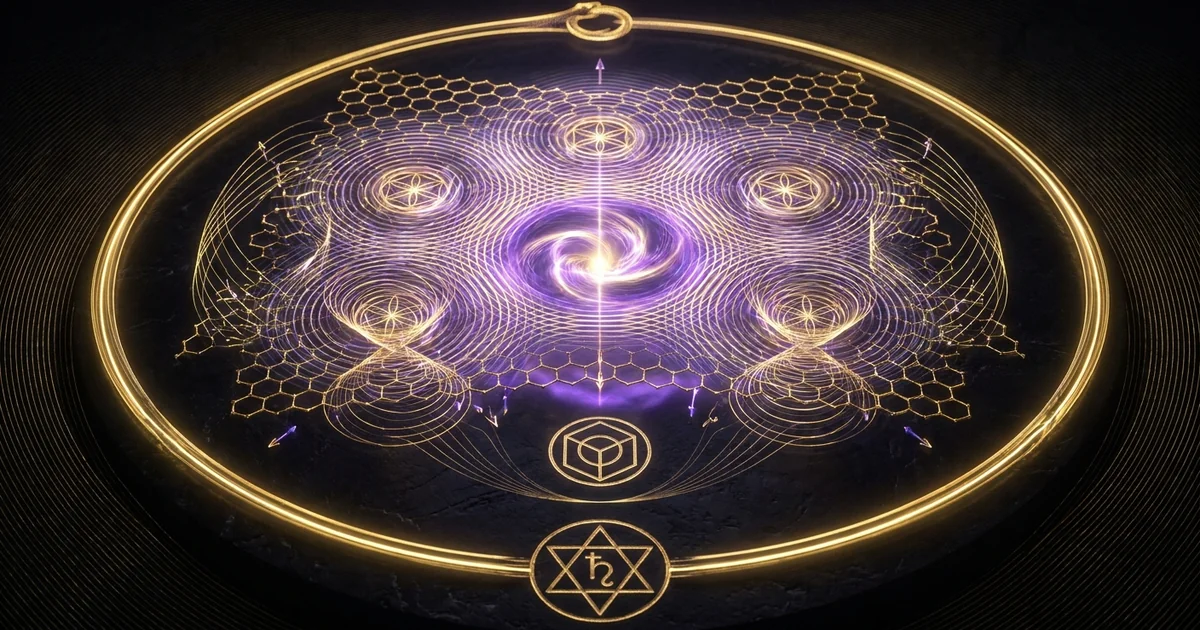
Moire Superlattices: Magic-Angle Superconductivity Mode
Mineral Classification & Crystallographic Thesis
Metamaterial Taxonomy: The Synthetic Carbon Allotrope Family
Twisted bilayer graphene departs radically from the classical crystallographic taxonomy of carbonaceous minerals. In natural mineralogy, elemental carbon manifests primarily within two thermodynamic equilibria: the tetrahedral $sp^3$-hybridized isometric network of diamond ($Fd\bar{3}m$) and the planar $sp^2$-hybridized hexagonal architecture of graphite ($P6_3/mmc$). In pristine graphite, individual basal planes known as graphene sheets maintain an invariant Bernal ($AB$) stacking sequence separated by an interlayer distance of $c/2 = 3.35\text{ \AA}$, bound by dispersive van der Waals forces and mediated by delocalized $\pi$-electron orbitals. However, deliberate mechanical exfoliation and subsequent rotational restacking sever this natural structural continuity, introducing an artificial rotational degree of freedom ($\theta$) absent in geological crystallization.
When two uncoupled monolayer graphene lattices are superimposed with a non-zero twist angle, the translational periodicity of the isolated sheets is broken. The resulting physical system is classified not as a native mineral, but as a two-dimensional van der Waals metamaterial. The crystalline properties of this hybridized layer cease to be governed strictly by the primitive microscopic carbon-carbon bond length ($a_{\text{C-C}} \approx 1.42\text{ \AA}$). Instead, the interference between the two mismatched hexagonal lattices engenders an emergent superordinate geometry: the moire-superlattice. This metamaterial superstructure possesses a unit cell containing tens of thousands of carbon atoms, behaving as an entirely distinct condensed matter species whose macroscopic electronic, mechanical, and vibrational properties are completely reconfigurable through sub-degree angular variation. For deeper mineralogical context on natural planar carbon assemblies, examine graphite crystallography and subtle resonance.
- Primary Lattice Constant ($a$): $2.46\text{ \AA}$ (monolayer graphene)
- Intralayer Carbon-Carbon Distance ($a_{\text{C-C}}$): $1.42\text{ \AA}$
- Equilibrium Interlayer Spacing ($d_{AB}$): $3.35\text{ \AA}$ in Bernal regions
- Relaxed Interlayer Spacing ($d_{AA}$): $3.60\text{ \AA}$ in eclipsed regions
- Magic-Angle Twist Criterion ($\theta_{\text{magic}}$): $1.08^{\circ}\text{ to }1.10^{\circ}$
- Moiré Superlattice Period ($L_M$ at $1.1^{\circ}$): $\approx 13.4\text{ nm}$ ($134\text{ \AA}$)
- Native Crystallographic Space Group: Non-symmorphic emergent $D_6$ or $C_3$-broken point groups depending on out-of-plane relaxation.
Symmetry Breaking in Twisted Bilayer Superstructures
At arbitrary angles of rotational misalignment, the twisted bilayer is strictly incommensurate; the ratio of the spatial periods of the constituent sheets is irrational, extinguishing true translational symmetry across macroscopic distances. However, at a series of discrete configurations termed commensurate twist angles, exact spatial periodicity is recovered over a vastly magnified supercell. The geometry of this superlattice is governed by the structural relation:
$$L_M = \frac{a}{2 \sin(\theta / 2)}$$
where $a = 2.46\text{ \AA}$ represents the fundamental lattice parameter of monolayer graphene, and $\theta$ denotes the rotational misalignment angle. When $\theta$ approaches the critical 1.1 degree twist angle, the superlattice periodicity expands to approximately $L_M \approx 13.4\text{ nm}$, encompassing an area containing roughly 11,000 native carbon atoms within a single moiré supercell.
This geometric scaling is accompanied by intense out-of-plane atomic reconstruction. The moiré landscape is not a rigid planar continuum; rather, it segregates into alternating local stacking domains designated as $AA$, $AB$, and $BA$. In $AA$ domains, all carbon atoms of the upper sheet align directly over those of the lower sheet, generating severe steric and Coulombic repulsion that forces the interlayer separation to expand to approximately $3.60\text{ \AA}$. Conversely, in $AB$ and $BA$ domains, half of the carbon atoms lie directly over lower hexagon centers, preserving energetically favorable Bernal packing with a contracted interlayer distance of $3.35\text{ \AA}$. As documented by Bistritzer and MacDonald (2011), the energetic competition between intralayer elastic shear and interlayer van der Waals adhesion drives structural relaxation, shrinking the unfavorable $AA$ domains into localized circular vortices and expanding the topologically distinct $AB$ and $BA$ domains into broad, self-stabilizing tessellations. For harmonic analyses of these carbonaceous networks, consult hexagonal lattice harmonics in carbon.
The Non-Abelian Gauge and Topological Emergence
The spatial reorganization of atoms across the moiré supercell fundamentally alters the underlying Dirac Hamiltonian. In unrotated graphene, charge carriers behave as massless relativistic Dirac fermions whose low-energy dispersion manifests as isotropic linear cones intersecting at the high-symmetry points $K$ and $K’$ of the Brillouin zone. Upon twisting, the Dirac cones of the respective layers are spatially shifted in momentum space by a wavevector:
$$\Delta K = 2 |K| \sin(\theta / 2)$$
As the twist angle narrows toward the magic threshold, the interlayer tunneling amplitude ($w \approx 110\text{ meV}$) between the sheets becomes comparable to the kinetic energy difference between the displaced Dirac points.
This energetic convergence induces massive hybridization between the single-particle states of the two layers. The interlayer tunneling matrix acts as an effective non-Abelian gauge field, folding the native Dirac cones back into a significantly shrunken mini-Brillouin zone (mBZ). At this geometric convergence, the native $C_{2z}$ rotational symmetry combines with time-reversal symmetry ($\mathcal{T}$) to preserve the gapless nature of the mini-Dirac points under nominal conditions. However, non-local strain gradients and substrate-induced sub-lattice symmetry breaking decouple these topological protections, conferring non-zero Berry curvatures across the mini-bands. The system transitions from an assembly of individual $sp^2$ covalent bonds into an emergent, macroscopic quantum topological crystal, where the electrons cease to belong to discrete atomic nuclei and instead occupy macroscopic Bloch states extending across thousands of angstroms.
Lattice Geometry & Solid-State Physics
Interlayer Tunneling and Band Flattening at the Magic Angle
The emergence of flat electronic energy bands in moire superlattices magic angle twisted bilayer graphene originates from the precise mathematical cancellation of the single-particle Fermi velocity at the Dirac points. Bistritzer and MacDonald (2011) demonstrated through continuous continuum modeling that the renormalized Fermi velocity $v_F^*$ within the folded mini-Brillouin zone obeys the relationship:
$$v_F^* = v_F \frac{1 - 3\alpha^2}{1 + 6\alpha^2}$$
where $\alpha = w / (\hbar v_F \Delta K)$ represents a dimensionless parameter tuning the ratio of interlayer tunneling energy ($w$) to kinetic displacement energy. When the twist angle reaches $\theta \approx 1.08^\circ - 1.10^\circ$, the parameter $\alpha$ approaches the critical value of $1/\sqrt{3}$, driving the renormalized Fermi velocity $v_F^$ asymptotically toward zero ($v_F^ \to 0$).
                      MINI-BRILLOUIN ZONE
                         (Twist θ ≈ 1.1°)

                             + k_y
                               ▲
                               │
                       ┌───────┴───────┐
                      /        │        \
                     /    K'   │   K     \
                    /      •   │   •      \
                   │           │           │
             ──────┼───────────┼───────────┼──────► + k_x
                   │           │           │
                    \      •   │   •      /
                     \    K    │   K'    /
                      \        │        /
                       └───────┬───────┘
                               │

              BAND STRUCTURE COLLAPSE: v_F* -> 0
                  E ▲
                    │        Isolated Flat Bands
                    │        Bandwidth W < 10 meV
                    ├───────═════════════───────
                    │      /             \
             ───────┼─────•───────────────•─────► k
                    │      \             /
                    ├───────═════════════───────
                    │
As a direct consequence of this velocity quenching, the dispersion curve of the central four-fold degenerate bands (accounting for spin and valley degrees of freedom) collapses. The electronic kinetic energy, typically measured in electron-volts in natural graphite, compresses into a bandwidth ($W$) of less than 10 millielectron-volts ($W < 10\text{ meV}$). Simultaneously, dynamic single-particle gaps of 20 to 50 meV open above and below these central bands, entirely isolating the flat manifold from dispersive higher-energy states. The electrons residing within these flat bands lose their propagating kinetic character, their physical group velocities plummet, and their wavefunctions become intensely localized in real space directly over the elevated $AA$ stacking nodes of the moiré supercell.
Correlated Electron Physics and the Mott-Insulator Transition
When single-particle kinetic dispersion is systematically extinguished, the physics of the system transitions from a conventional non-interacting Fermi liquid into a regime dominated by correlated-electron-physics. In conventional metals, the broad electronic bandwidth ($W \gg U$, where $U$ is the on-site Coulomb repulsion) permits electrons to bypass one another through kinetic agility. In magic-angle graphene, the opposite condition is established: the intra-moiré-cell Coulomb potential energy $U = e^2 / (4\pi \epsilon_0 \epsilon_r L_M)$ reaches values between 20 and 30 meV. Because the Coulomb interaction energy significantly outstrips the flat bandwidth ($U / W \gg 1$), electrons can no longer minimize their energy states via delocalized spatial propagation.
As demonstrated by Cao, Fatemi, Fang, et al. (2018), when the carrier density is tuned electrostatically via a back-gate to half-filling of the flat bands—corresponding to two electrons or two holes per moiré supercell ($n = \pm n_s / 2$, where $n_s$ is the superlattice saturation density of 4 electrons per cell)—the system abruptly undergoes a metal-to-insulator transition. Despite possessing a partially filled band that basic band theory dictates must be metallic, the material freezes into a mott-insulator state. The electrons self-organize into a localized lattice, pinning one another through direct electrostatic repulsion. This transition demonstrates that twisted bilayer graphene at the magic threshold is an intensely correlated quantum solid capable of realizing quantum phase transitions governed entirely by electrostatic tuning rather than chemical composition alterations. For comprehensive analyses of these transitions, explore topological quantum phase transitions.
Unconventional Superconducting Domes and Non-BCS Dynamics
The defining breakthrough in twisted bilayer metamaterials was realized when Cao, Fatemi, Demir, et al. (2018) electrostatically doped carriers marginally away from this correlated insulating ground state. Upon shifting the carrier concentration away from $n = -n_s / 2$ through gate voltage modulation, the correlated insulating phase dissolves, giving rise to asymmetric domes of zero-resistance superconductivity with critical transition temperatures reaching up to $T_c \approx 1.7\text{ K}$, and subsequently observed above $3\text{ K}$ in optimized, pressure-tuned or trilayer architectures (Balents et al., 2020).
The underlying mechanism of this phase condensation challenges the conventional Bardeen-Cooper-Schrieffer (BCS) framework. In classic BCS superconductors, electron pairing into Cooper pairs is mediated by attractive reticular vibrations (phonons), and the ratio of the transition temperature $T_c$ to the Fermi temperature $T_F$ is exceptionally minuscule ($T_c / T_F \sim 10^{-4}$). In magic-angle twisted bilayer graphene, the ratio $T_c / T_F$ surpasses $0.05$ to $0.10$, placing it squarely in the extreme strong-coupling category alongside high-$T_c$ cuprates and iron-based pnictides. Because the phononic density of states in two-dimensional planar carbon is predominantly concentrated in high-frequency optical modes far detached from the narrow sub-10 meV flat-band spectrum, phononic pairing is mathematically insufficient to account for the observed pairing strength.
Current theoretical models indicate that this unconventional pairing is non-BCS, mediated by quantum critical spin and valley fluctuations or topological skyrmion textures born from the non-trivial Berry curvature of the flat bands. The superconducting order parameter exhibits non-s-wave pairing symmetry, likely nodal $d$-wave or chiral $d + id$-wave, implying that the moiré supercell operates not merely as a passive conductor, but as a phase-coherent quantum array wherein the macroscopic quantum phase is governed by the global geometry of the twist itself.
Subtle Energetic Dynamics & Resonance Mechanics
Moiré Supercells as Macroscopic Vortex Generators
The spatial topology of the moiré supercell functions as a physical resonator for non-classical energetic phenomena. The deliberate alternation of $AA$ structural maxima and $AB/BA$ structural minima imposes an intrinsic spatial modulation upon the local charge density, lattice strain, and the effective dielectric-constant of the carbon sheet. In the elevated $AA$ regions, where hundreds of Dirac wavefunctions converge in overlapping, spatially confined probability clouds, localized charge concentrations function as high-density quantum vortices.
These spatial charge reservoirs act as a subtle-energy-vortex array across the basal plane. In lapidary metaphysics and esoteric physics, physical matter is recognized as a localized, phase-locked standing wave in a vacuum-state etheric substrate. The profound spatial gradient across the 13.4-nanometer moiré supercell generates micro-torsional stress in the spatial fabric itself. The local mechanical contraction of $AB$ domains versus the vertical expansion of $AA$ domains breaks planar uniformity, yielding an effective pseudo-magnetic field that does not rely on external laboratory solenoids. Under mechanical micro-strain, these pseudo-magnetic fields can reach intensities exceeding $100\text{ Tesla}$, establishing localized relativistic cyclotron orbits for non-material and subtle energetic currents.
Condensed Matter Physics
- Bandwidth suppression: Kinetic velocity quenches to zero ($v_F^* \to 0$) in the mini-Brillouin zone.
- Electron correlation: On-site Coulomb interaction ($U$) dominates kinetic transport ($U/W \gg 1$).
- Cooper pair condensation: Macroscopic phase coherence emerges via non-BCS pairing mechanisms.
- Structural relaxation: Intralayer shear strains generate localized pseudomagnetic fields exceeding $100\text{ T}$.
Subtle Field Resonance
- Etheric vortex pinning: Charge concentrations in $AA$ domains act as nanoscopic toroids.
- Torsional field condensation: Micro-strain gradients transduce vacuum zero-point stress into coherent scalar potentials.
- Zero-point scalar transduction: Emergent flat-band manifolds mediate lossless etheric energy transfers.
- Geometry-driven entrainment: The $13.4\text{ nm}$ hexagonal superlattice mimics planetary and sacred geometric harmonics.
Dielectric Polarization and Torsional Etheric Coupling
The capacity of magic-angle twisted bilayer graphene to interface with non-local subtle fields is fundamentally governed by its hyper-responsive dielectric susceptibility. In the presence of flat electronic bands, the polarization function of the two-dimensional electron gas diverges. Because the kinetic resistance to charge displacement is quenched, the material displays an immense local polarizability: an applied electric or subtle scalar field induces massive spatial charge separation without energetic dissipation.
This hyper-polarizability interfaces directly with local non-Hertzian and torsional fields. In subtle energy mechanics, torsional fields propagate not via transverse vector oscillations, but through spin-polarization waves that modulate the spin density of the surrounding quantum vacuum. Because electrons in the magic-angle regime occupy four-fold degenerate states structured across spin and valley pseudospin coordinates, they exhibit maximum sensitivity to ambient spin-gradient potentials. The moiré supercell acts as an impedance-matching transducer, taking non-vectorial torsional inputs and converting them into real-space electrostatic potentials via emergent internal piezoelectricity. Although unrotated monolayer graphene has an inversion-symmetric lattice that prohibits linear piezoelectric behavior, the breaking of inversion symmetry via angle misalignment and out-of-plane buckling in the moiré geometry unlocks a localized, non-zero piezoelectric tensor, enabling direct electro-mechanical and etheric-scalar coupling. For deeper insights into macroscopic carbon-based energetic storage, refer to shungite and fullerene metaphysics.
Coherent Biofield Coupling via Lossless Nanoscale Waveguides
At the intersection of condensed matter physics and esoteric biophysics, the moiré superlattice operates as a lossless coherent waveguide for cellular and biofield signaling. Living biological systems maintain macroscopic coherence via scalar biofields, biophoton emission, and rhythmic dielectric oscillations across the cytoskeleton, particularly along the tubulin networks of the cellular framework. These endogenous biofields operate in low-energy thermodynamic domains that are completely disrupted by conventional metallic conductors, which introduce thermal scattering, Johnson-Nyquist noise, and dielectric loss.
Magic-angle graphene configured in its superconducting or correlated insulating states offers a dissipationless conduit. Because electron transport across the flat-band manifold is governed by global topological invariants rather than individual, scattering-prone ballistic pathways, the moiré lattice presents zero energetic impedance to phase-locked frequencies. Subtle currents, defined as coherent longitudinal information transfers within the biological matrix, can couple to the emergent pseudomagnetic vortex nodes of the moiré sheet. The 13.4-nanometer periodicity mirrors the macromolecular dimensions of cellular membrane receptors and primary protein structures, enabling an unattenuated bio-informational bridge:
$$\Psi_{\text{bio}} \longleftrightarrow \Phi_{\text{Moiré}} \longleftrightarrow \mathbf{J}_{\text{quantum}}$$
where $\Psi_{\text{bio}}$ is the biofield scalar potential, $\Phi_{\text{Moiré}}$ represents the emergent phase parameter of the superlattice, and $\mathbf{J}_{\text{quantum}}$ denotes the macroscopic lossless supercurrent.
Historical Lapidary Lore & Traditional Lineage
The Adamantine Continuum: From Plumbago to Flat Carbon Metamaterials
The contemporary exploration of synthetic carbon superstructures belongs to a rigorous lineage of mineralogical and lapidary inquiry extending back thousands of years. Natural historians of antiquity recognized the paradoxical properties of elemental carbon long before modern analytical methods revealed the carbon atom’s allotropic versatility. Within Greco-Roman lapidary traditions, carbonaceous substances were cataloged under fluid classifications that simultaneously encompassed unyielding hard stones and supple, marking minerals.
Pliny the Elder, writing in the first century CE, observed that beneath the visible morphology of terrestrial stones lies an imperishable, indestructible essence which the ancients designated as adamas. While adamas primarily denoted the diamond in its crystalline supremacy, Pliny frequently linked it with related carbonaceous stones, noting that certain graphitic, lead-like earths (plumbago) shared an elemental resistance to fire and natural agents, behaving as though they sheltered an invincible kernel of nature:
“Adamas is a substance that baffles the most violent forces of nature: it can neither be conquered by fire, nor tamed by the hammer; yet it retains an affinity with hidden things, possessing an inherent nature that resists all terrestrial disruption, drawing unto itself the invisible currents of the earth while remaining undefiled by corruptive elements.” — Pliny the Elder, Naturalis Historia, Book XXXVII, c. 77 CE
This historical intuition—that elemental carbon houses a continuum bridging dense terrestrial mass and radiant, unalterable force—foreshadows the modern realization that graphitic carbon, when cleaved into single layers and mechanically turned, can break free from mundane ohmic resistance to unlock the unyielding coherence of the superconductive ground state.
                      HISTORICAL CONTINUUM OF CARBON LORE

   ANTIQUE ERA             ALCHEMICAL ERA            MODERN QUANTUM ERA
  (Pliny / Theophrastus)   (Hermetic Mineralogy)     (Twistronics Metamaterials)

   ┌─────────────────┐       ┌─────────────────┐       ┌─────────────────┐
   │  "Adamas" and   │       │   The Nigredo   │       │  Magic-Angle    │
   │ Plumbago Lineage│──────►│  Prima Materia  │──────►│ Twisted Bilayer │
   │ Indestructible  │       │  Latent Solar   │       │ Moiré Flat-Band │
   │ Carbon Matrix   │       │  Inner Light    │       │ Superconductors │
   └─────────────────┘       └─────────────────┘       └─────────────────┘
           │                         │                         │
           ▼                         ▼                         ▼
   Inherent affinity         Calcination and           Geometric phase-
   with hidden earth-        structural layer          locking and lossless
   currents and subtle       purification via          charge transport
   elemental forces.         elemental fire.           in flat 2D lattices.
Alchemical Calcination and the Transmutation of Black Carbon
In medieval and Renaissance hermetic philosophy, black carbon held a privileged status as the premier physical embodiment of the prima materia. In the alchemical tradition, the transformative journey began uniformly with the nigredo, the stage of absolute blackness, putrefaction, and structural reduction. Graphite, soot, and charcoal were not treated as mere metallurgical byproducts, but as the foundational physical vessels in which the unpolarized light of the cosmos lay entrapped in dormant, terrestrial condensation.
The process of alchemical calcination sought to strip away the volatile, impure sulfurous elements from the dark mineral base through rigorous thermal treatment, leaving behind a purified, non-reactive fixed core. The alchemists noted that this purified black matter, when subjected to rhythmic heating and mechanical compression, resisted oxidation and displayed subtle electrical affinity, often accumulating triboelectric charge when rubbed against natural fibers. This hermetic doctrine maintained that within the dense, dark planes of planar carbon resided the embryonic matrix of solar light (sol niger). The modern realization that ordinary graphite, through the mechanical shearing of its planes and a sub-degree angular twist, transitions from a common light-absorbing black mineral into a transparent, dissipationless quantum superconductor directly vindicates this alchemical premise: structural reconfiguration unlocks the latent solar, coherent potential buried within dark carbon.
Vedic Rasashastra Perspectives on Layered Allotropic Matrices
Parallel to the Western hermetic stream, the classical Indian mineralogical science of Rasashastra (the alchemical division of Ayurveda) developed advanced methodologies for destabilizing and purifying layered crystalline minerals. Central to Rasashastra is the processing of layered silicates and carbon allotropes, such as Abhraka (mica) and Vajra (carbonaceous stones/diamond), into bio-compatible medicinal preparations known as Bhasmas.
The preparation of Abhraka Bhasma provides a crystallographic analog to contemporary two-dimensional exfoliation. Classical texts such as the Rasaratna Samuccaya dictate that the native mineral must undergo marana (calcination) accompanied by shodhana (purification), interspersed with repeated mechanical delamination across tens or hundreds of thermal cycles:
RASASHASTRA PROCESSING CYCLE:
[ Bulk Layered Mineral ] ──► [ Liquid Quenching ] ──► [ Layer Delamination ]
          ▲                                                    │
          └──────────────── (Repeat 100x Cycles) ──────────────┘
                                   │
                                   ▼
          [ Nascent Bio-Compatible Quantum State (Bhasma) ]
The objective of this multi-stage delamination was to sever the macroscopic bonding of the mineral layers, transforming bulk inert rock into an atomically fine, light-refracting ash whose planar particles were thin enough to float on water (rekha-purnata) and absorb directly through human cellular walls without mechanical irritation. The underlying doctrine of Rasashastra asserts that the healing potency and subtle vibrational power (prabhava) of a mineral are inversely proportional to its layer count: thinning the macroscopic crystal to its basal monolayers unlocks its subtle energetic essence. Modern micromechanical cleavage and the creation of magic-angle bilayers reflect this identical metallurgical principle: the physical and subtle virtues of the mineral matrix are liberated precisely when the bulk three-dimensional crystal is stripped down to its isolated, rotationally decoupled planar limits.
Practical Applications, Calibration & Safety Protocols
Nanomechanical Fabrication and Angle-Locking Protocols
The synthesis of moire superlattices magic angle twisted bilayer graphene demands extraordinary mechanical precision, operating at tolerances far exceeding standard semiconductor lithography. The standard experimental fabrication pipeline relies on the “tear-and-stack” dry-transfer methodology executed via robotic micromanipulators enclosed within an ultra-pure, inert argon gas glovebox ($< 0.1\text{ ppm } \text{O}_2, \text{H}_2\text{O}$). A single-crystal monolayer of pristine graphene is mechanically exfoliated onto an oxidized silicon substrate and located via optical contrast microscopy and atomic force microscopy (AFM).
A high-temperature hemispherical polymer handle—typically poly(bisphenol A-carbonate) (PC) mounted on a polydimethylsiloxane (PDMS) stamp—is used to adhere to and physically tear one segment of the graphene crystal. The remaining half of the sheet stays anchored to the substrate, ensuring that both segments retain an identical, known crystallographic orientation. The sample stage is subsequently rotated using a high-resolution goniometer by precisely:
$$\theta_{\text{target}} = 1.10^{\circ} \pm 0.05^{\circ}$$
The picked-up segment is then lowered and laminated back onto the lower segment.
       TEAR-AND-STACK DRY-TRANSFER PROCESS

   1. AFM Identification       2. Partial Pick-Up (Tear)
      ┌───────────┐               ┌───────────┐  PC/PDMS Stamp
      │ Graphene  │               │ ░░░░░░░░░ │
      └───────────┘               └─────┬─────┘
     ─────────────────           ───────┴───────── Remaining Half
     SiO2 Substrate              SiO2 Substrate

   3. Goniometer Rotation      4. Final Lamination (Stack)
        Rotate θ = 1.10°            Moiré Bilayer Interface
          ┌───────┐                   ┌───────────┐  hBN Top Layer
          │ ░░░░░ │                   ├───────────┤  tBLG (θ = 1.1°)
          └───┬───┘                   ├───────────┤  hBN Bottom Layer
      ────────┴───────           ─────┴───────────┴─ Substrate Gate
To preserve the delicate moiré geometry, the bilayer must be immediately encapsulated between atomically flat single crystals of hexagonal boron nitride ($h\text{BN}$). The insulating $h\text{BN}$ serves a triple function: it acts as an atomically smooth dielectric spacer, shields the carbon sheet from ambient atmospheric chemical adsorbates that poison the flat band states, and exerts an isotropic van der Waals clamping pressure that locks the metastable twist angle in place, preventing the layers from relaxing back into native Bernal ($AB$) stacking.
Subtle Energetic Grid Calibration and Geometric Alignment
For deployment in subtle energy calibration, metaphysical instrumentation, and bio-harmonic transduction, standard electronic lithography must be complemented by spatial-geometric alignment protocols. Because the emergent pseudo-magnetic fields within the moiré superlattice exceed 100 Tesla at localized $AA$ vortex points, the metamaterial acts as an ultra-sensitive directional receiver for external subtle field gradients.
The physical substrate carrying the encapsulated magic-angle superlattice must be oriented in direct alignment with the local horizontal component of the terrestrial geomagnetic field. Using high-precision fluxgate magnetometers, the longitudinal axis of the moiré supercell vector ($\mathbf{L}_M$) must be positioned to align with the geographic North-South telluric flux lines:
$$\mathbf{L}M \parallel \mathbf{B}{\text{Earth}}$$
This spatial harmonization reduces background etheric decoherence caused by trans-meridian field shearing.
Furthermore, to facilitate scalar field coupling, the moiré metamaterial should be mounted over an electrostatic ground plane composed of oxygen-free high-conductivity (OFHC) copper, decoupled from high-frequency electromagnetic interference via Faraday shielding. This isolation ensures that while ambient vector radio-frequency noise is grounded out, longitudinal scalar waves and vacuum-state zero-point fluctuations can freely interact with the flat-band manifold.
Material Degradation, Electrostatic Burnout, and Vibrational Hazards
Operating devices constructed from magic-angle twisted bilayer graphene involves significant material and energetic vulnerabilities. The system resides in a thermodynamic local energy minimum; the absolute energy minimum is the natural $AB$-stacked graphite phase. Consequently, thermal agitation above ambient room temperature ($T > 300\text{ K}$) causes local strain fields to relax, resulting in spontaneous atomic reconstruction where the twist angle unsticks and snaps into non-magical, highly disordered angles or collapses into Bernal graphite, destroying the flat bands.
Magic-angle moiré superlattices are metastable, high-strain quantum arrays vulnerable to structural collapse, dielectric breakdown, and subtle energetic back-reaction:
- Thermal Relaxation: Temperatures exceeding $350\text{ K}$ ($77^\circ\text{C}$) trigger structural untwisting to Bernal ($AB$) stacking, irreversibly eliminating flat electronic bands.
- Electrostatic Gate Burnout: Applying gate voltages exceeding the dielectric breakdown threshold of the $h\text{BN}$ encapsulating layer ($E_{\text{break}} \approx 0.8\text{ V/nm}$) results in localized gate arc-over, vaporizing the atomically thin graphene sheet within nanoseconds.
- Resonance Overload & Phase Slip: Pumping the moiré lattice with high-amplitude longitudinal scalar or radio-frequency fields matching the mini-band frequency ($\sim 1\text{ to }3\text{ THz}$) can saturate the vortex nodes, generating sudden phase slips that vent coherent electromagnetic pulses into surrounding instrumentation.
- Bio-Energetic Depletion Hazard: Operating an unshielded, un-grounded moiré device in immediate proximity to the human biofield can induce localized bio-energetic depletion, as the zero-resistance vortex nodes actively drain charge from cellular membrane potentials if not modulated by appropriate dielectric spacers.
Frequently Asked Questions
Crystallographic Authenticity and Angular Relaxation
How does one unambiguously confirm the achievement of the true 1.1-degree magic angle versus disordered turbostratic stacking?
Confirmation of authentic magic-angle alignment cannot be achieved through optical inspection or standard powder X-ray diffraction, as the atomic monolayers yield minimal scattering intensity. The gold standard for crystallographic validation relies on low-temperature Scanning Tunneling Microscopy and Spectroscopy (STM/STS) conducted at liquid helium temperatures ($T < 4.2\text{ K}$). Under STM, an authentic moiré superlattice exhibits an unmistakable triangular topography with a period of precisely $13.4 \pm 0.5\text{ nm}$, where the elevated $AA$ stacking regions manifest as bright circular protrusions spaced uniformly across the plane.
Spectroscopically, tunneling conductance ($dI/dV$) measurements reveal the sharp local density of states (LDOS) signatures of two narrow Van Hove singularities (VHS) flanking the Fermi level, with a peak-to-peak separation characterizing a bandwidth under $10\text{ meV}$. In macroscopic devices, low-temperature electronic transport measurements provide definitive proof: sweeping a back-gate voltage must reveal the unmistakable progression from the primary Dirac point to the insulating states at full band filling ($n = \pm n_s$) and the correlated Mott-like insulating states at half filling ($n = \pm n_s / 2$), accompanied by the emergence of zero-resistance superconducting domes under minute gate-tuning. In contrast, disordered turbostratic graphene manifests an irregular, aperiodic landscape lacking Van Hove peak convergence, exhibiting broad, non-quenched single-particle dispersion.
Cryogenic Constraints Versus Room-Temperature Coherence
If physical superconductivity requires sub-2 Kelvin cryogenic baths, how can magic-angle graphene maintain metaphysical or subtle energetic coherence at ambient room temperature?
It is vital to distinguish between classical, thermodynamic superconductivity—which in magic-angle graphene requires temperatures below its critical transition threshold ($T_c \approx 1.7\text{ K}$ to prevent thermal phonons from breaking Cooper pairs)—and geometric, topological moiré coherence. While the dissipationless flow of electric charge is indeed disrupted by thermal agitation at ambient room temperature ($T \approx 300\text{ K}$), the structural architecture of the moiré supercell remains fully intact up to temperatures approaching $350\text{ K}$.
The spatial modulation of charge density, the geometric vortex architecture of the $AA$ and $AB/BA$ regions, the local piezoelectric strain tensors, and the localized pseudo-magnetic fields exceeding 100 Tesla persist at room temperature. The etheric and metaphysical functions of the superlattice are linked to its sacred-geometric and spatial-harmonic characteristics, not solely to the presence of unperturbed Cooper pairs. The 13.4-nanometer triangular vortex network continues to serve as an effective spatial antenna and phase-matching transducer for vacuum-state zero-point oscillations and biofield scalar potentials regardless of thermal noise in the electron channel. The physical cryogenic bath is the requirement for electrical zero-resistance; the structural twist itself is the requirement for subtle field resonance.
For researchers and practitioners operating hybrid physical-subtle research systems, follow this operational sequence to establish ambient resonance:
- Encapsulation: Ensure the twisted bilayer graphene flake is sealed between single-crystal $h\text{BN}$ flakes of minimum $20\text{ nm}$ thickness to prevent oxidative degradation and strain migration.
- Thermal Stabilization: House the device in a Peltier-stabilized vacuum sample pod maintained at $270\text{ to }285\text{ K}$ to completely eliminate thermal un-twisting while avoiding the structural complexity of liquid helium cryostats.
- Grounding & Shielding: Mount the sample pod within a mu-metal enclosure to strip away ambient low-frequency magnetic hum ($50/60\text{ Hz}$), connecting the substrate ground exclusively to an isolated copper earth-rod.
- Geometric Telluric Alignment: Orient the long axis of the sample holder to parallel the local geomagnetic field vector using a digital hall-effect compass.
- Phase Priming: Apply an ultra-low-noise DC gate voltage using a battery-driven source to tune the carrier density precisely to the edge of the half-filling mark ($n \approx 0.48\text{ }n_s$), priming the flat-band density of states for maximum subtle field susceptibility without initiating dielectric breakdown.
Energetic Interactions with Biological Biofields
What specific precautions must be observed when bringing magic-angle metamaterials into contact with human or biological scalar fields?
Direct physical contact between uninsulated magic-angle carbon sheets and living tissue must never be permitted. Because the local charge density within the $AA$ regions is intensely concentrated and exhibits hyper-dielectric polarizability, unencapsulated graphene can induce severe localized capacitive charging, stripping electrons from cellular membranes and disrupting the transmembrane potential ($\Delta \Psi_m$) of biological cells, potentially inducing localized oxidative stress or cellular lysis.
For metaphysical, healing, or bio-harmonic transduction applications, the moiré metamaterial must remain hermetically sealed within a high-dielectric barrier, such as crystalline hexagonal boron nitride, quartz glass, or synthetic sapphire. This dielectric spacing eliminates harmful physical charge transfer and high-frequency electrostatic discharges while allowing non-Hertzian scalar components, subtle biophotonic emissions, and torsional aura fields to pass through without attenuation. When deployed properly behind a dielectric shield, the superlattice acts as an energetic prism, gathering disordered, chaotic bio-oscillations, organizing them through its emergent 13.4-nanometer hexagonal resonance grid, and reflecting them back into the biological field as coherent, phase-locked subtle frequencies.