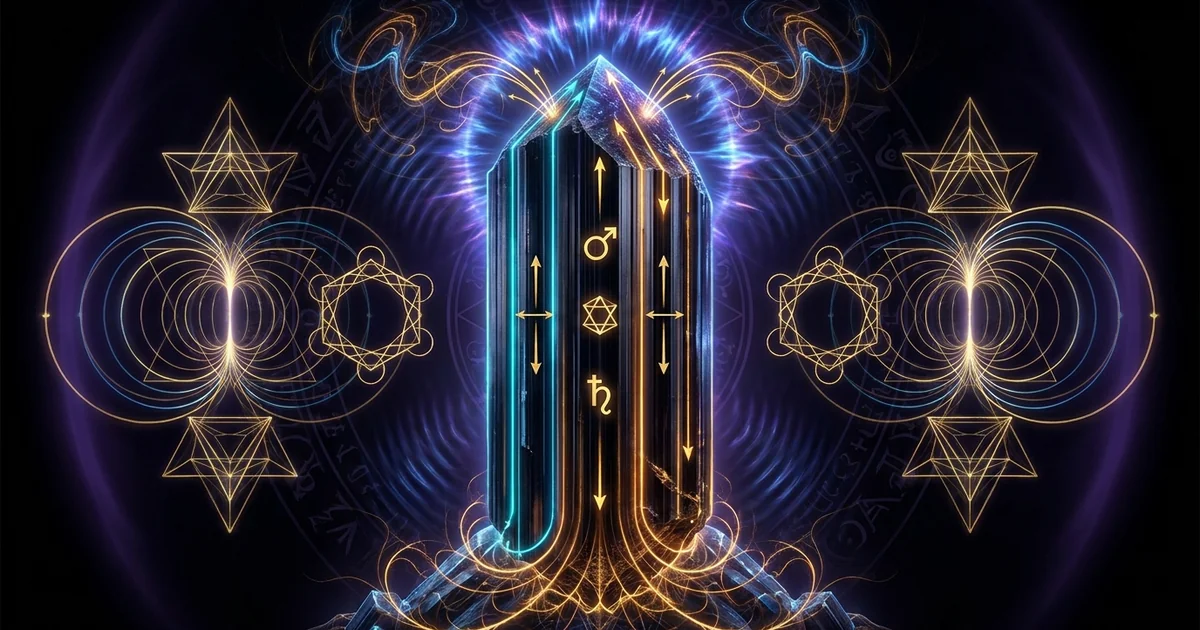
Black Tourmaline (Schorl) Properties: Geology & Crystalline
Mineral Classification & Crystallographic Thesis: The Borosilicate Framework
Stoichiometry and the General Tourmaline Formula XY₃Z₆(T₆O₁₈)(BO₃)₃V₃W
The tourmaline supergroup comprises some of the most structurally complex cyclosilicates known to solid-state mineralogy, operating as an open geochemical reservoir for lithophile and transition elements. Within this framework, schorl stands as the iron-dominant endmember, defined formally by the idealized structural stoichiometry $\text{NaFe}^{2+}_3\text{Al}_6(\text{BO}_3)_3\text{Si}6\text{O}{18}(\text{OH})_4$. Structural classification established by Hawthorne and Henry (1999) formalizes the tourmaline crystal architecture around the generalized site-occupancy formula:
$$XY_3Z_6(T_6\text{O}_{18})(\text{BO}_3)_3V_3W$$
In this overarching stoichiometric topology:
- the $X$-site is an expanded, nine-coordinated polyhedron typically occupied by large alkali or alkaline earth cations ($\text{Na}^+$, $\text{Ca}^{2+}$), or left partially vacant ($\Box$);
- the $Y$-site comprises a trio of edge-sharing, distorted octahedra accommodating transition metals, predominantly high-spin divalent iron ($\text{Fe}^{2+}$) in the case of schorl;
- the $Z$-site consists of six smaller, structurally rigid octahedra occupied primarily by trivalent aluminum ($\text{Al}^{3+}$), though susceptible to minor trivalent iron ($\text{Fe}^{3+}$) or magnesium ($\text{Mg}^{2+}$) substitution;
- the tetrahedrally coordinated $T$-site is occupied almost exclusively by silicon ($\text{Si}^{4+}$), which organizes into the unbranched, six-membered cyclosilicate ring $[\text{Si}6\text{O}{18}]^{12-}$;
- the boron sites house three structurally isolated, coplanar $[\text{BO}_3]^{3-}$ groups situated parallel to the crystallographic basis; and
- the anionic $V$ and $W$ positions coordinate the central polyhedral clusters, with $V$ dominated by hydroxyl groups ($\text{OH}^-$) and $W$ hosting either hydroxyl anions or fluorine ($\text{F}^-$).
The structural preservation of the schorl lattice across disparate pegmatitic and metamorphic environments is a consequence of this high polyhedral coordination. As a complex borosilicate, schorl accommodates significant localized strain through its inter-site polyhedral flexibility, distributing electrostatic tension across adjacent octahedra without destabilizing its core framework. The endmember identity of black tourmaline (schorl) crystal properties geology resonance is governed directly by the electronic structure of the $\text{Fe}^{2+}$ cations at the $Y$-octahedral sites. The presence of divalent iron establishes localized crystal field splittings that absorb the entirety of the visible light spectrum through metal-metal intervalence charge transfer ($\text{Fe}^{2+} \rightarrow \text{Fe}^{3+}$ or $\text{Fe}^{2+} \rightarrow \text{Ti}^{4+}$), imparting the characteristic opaque, jet-black macroscopic appearance. Concurrently, the uncompensated spin configurations within the $3d^6$ orbitals of high-spin $\text{Fe}^{2+}$ confer pronounced magnetic susceptibility to the mineral, establishing an intrinsic solid-state electromagnetic resonance signature that distinguishes it from its elbaite or dravite analogues.
The Non-Centrosymmetric Space Group R3m and Polar Axial Symmetry
The fundamental crystallographic and energetic characteristics of schorl derive from its non-centrosymmetric space group, designated in the International Tables for Crystallography as $R3m$ (No. 160). As initially demonstrated in the pioneering structural refinements by Donnay and Buerger (1950) and subsequently elaborated by Barton (1969), the rhombohedral lattice of schorl lacks a center of inversion symmetry ($\bar{1}$). This crystallographic absence generates an absolute polar axis parallel to the crystallographic $c$-axis, oriented along the $[0001]$ vector in hexagonal coordinates. The absence of an inversion center within the space group $R3m$ ensures that the crystal structure possesses true structural vectoring: the structural configuration viewed from the positive termination pole (conventionally designated the antilogous pole) is neither physically nor electrostatically equivalent to that viewed from the negative termination pole (the analogous pole).
   [0001] Polar Vector (c-axis)
        ▲  Antilogous Pole (+)
        │
   [ BO3 ] --- Trigonal Planar Groups
        │
   [Si6O18] -- Hexagonal Cyclosilicate Ring
        │
   [Y3Z6] ---- Octahedral Fe2+/Al3+ Cluster
        │
        ▼  Analogous Pole (-)
The crystallographic significance of this polar axial symmetry is profound. The three-fold rotation axis ($3$) parallel to $[0001]$ is intersected by three vertical mirror planes ($m$) oriented at $120^\circ$ intervals, bisecting the non-equivalent tetrahedral ring linkages. Because the six-membered cyclosilicate rings $[\text{Si}6\text{O}{18}]^{12-}$ and their associated planar $[\text{BO}_3]^{3-}$ units are stacked strictly along this polar axis without inversion compensation, the unit cell maintains a persistent, net macroscopic dipole moment along $[0001]$. The orientation of the silicon-dioxide-tetrahedra within the rings points invariably in a uniform crystallographic direction—specifically toward the analogous pole—preventing reciprocal dipole cancellation. This macroscopic orientation establishes the baseline energetic infrastructure for piezoelectric lattice dynamics, distinguishing schorl from centrosymmetric silicates and establishing the physical basis for its directional electrical transduction.
- Crystal System: Trigonal (Hexagonal Bravais lattice)
- Space Group: $R3m$ (Space Group No. 160)
- Unit Cell Parameters: $a = 15.992(3)\text{ \AA}$, $c = 7.185(2)\text{ \AA}$
- Cell Volume: $V \approx 1590.2\text{ \AA}^3$
- Unit Formula Multiplier ($Z$): 3
- Calculated Density ($\rho_{\text{calc}}$): $3.18\text{–}3.26\text{ g/cm}^3$ (varying with $\text{Fe}/\text{Al}$ substitution)
- Tenacity & Cleavage: Brittle; cleavage absent, showing irregular to sub-conchoidal fracture
- Mohs Hardness: 7.0–7.5
References: Hawthorne, F. C., & Henry, D. J. (1999). ‘Classification of the minerals of the tourmaline group.’ European Journal of Mineralogy, 11(2), 201–216; Dietrich, R. V. (1985). The Tourmaline Group. Van Nostrand Reinhold.
Schorl Endmember Chemistry: Solid-Solution Dynamics with Dravite and Elbaite
In natural geochemical environments, stoichiometric endmember $\text{NaFe}^{2+}_3\text{Al}_6(\text{BO}_3)_3\text{Si}6\text{O}{18}(\text{OH})_4$ is rarely isolated in pure thermodynamic isolation; instead, it anchors a series of continuous and discontinuous solid-solution series. The primary solid-solution series occurs between schorl and dravite ($\text{NaMg}_3\text{Al}_6(\text{BO}_3)_3\text{Si}6\text{O}{18}(\text{OH})_4$), where divalent transition metal iron undergoes homovalent, isomorphous substitution with divalent alkaline earth magnesium across the $Y$-octahedral positions:
$$\text{Fe}^{2+} \rightleftharpoons \text{Mg}^{2+}$$
Because the effective ionic radius of octahedral $\text{Fe}^{2+}$ ($0.78\text{ \AA}$) is marginally larger than that of octahedral $\text{Mg}^{2+}$ ($0.72\text{ \AA}$), the unit cell volume expands linearly with increasing iron mole fraction, following Vegard’s rule. This expands both the $a$ and $c$ lattice parameters, modifying the inter-atomic distances within the $Y\text{-O}$ polyhedra and fine-tuning the intrinsic fundamental frequency of the lattice.
Simultaneously, coupled heterovalent substitutions link schorl with the lithium-aluminum elbaite series ($\text{Na}(\text{Li}{1.5}\text{Al}{1.5})\text{Al}_6(\text{BO}_3)_3\text{Si}6\text{O}{18}(\text{OH})_4$). This transition occurs via a complex coupled exchange vector:
$$2\text{Fe}^{2+} \rightleftharpoons \text{Li}^+ + \text{Al}^{3+}$$
This substitution directly redistributes charge within the $Y$-cluster, inducing localized symmetry distortions within the structural coordination spheres. Additionally, aluminum can substitute for iron in the $Y$-site through a deprotonation vector:
$$\text{Fe}^{2+} + \text{OH}^- \rightleftharpoons \text{Al}^{3+} + \text{O}^{2-}$$
This process yields “oxy-schorl” endmembers characterized by oxygen-dominated $W$-sites.
These substitution dynamics hold substantial energetic and physical consequences. As the $\text{Fe}^{2+}$ content increases toward pure schorl, the structural density rises, the dielectric dissipation factor increases, and the mineral displays its maximum absorption coefficients for electromagnetic radiation across high-frequency bands. The precise position of a specimen along the schorl-dravite-elbaite ternary diagram dictates its thermodynamic stability, structural elasticity, and subtle field coupling capacity.
Lattice Geometry & Solid-State Physics: Acentric Rings and Polar Properties
Six-Membered Cyclosilicate Rings [Si₆O₁₈]¹²⁻ and Planar [BO₃]³⁻ Groups
The structural backbone of the schorl lattice consists of a rigid topological arrangement: isolated, unbranched single rings of six corner-sharing silicon-dioxide-tetrahedra ($[\text{Si}6\text{O}{18}]^{12-}$), intertwined with planar trigonal borate groups ($[\text{BO}_3]^{3-}$). In this architecture, each $\text{SiO}_4$ tetrahedron shares two of its apical oxygen atoms with neighboring tetrahedra to form the closed cyclosilicate loop. These hexameric rings do not adopt a planar geometry; instead, they undergo a distinct crown-like distortion governed by the trigonal symmetry and hexagonal rings inherent to space group $R3m$. The basal faces of all six tetrahedra in a single ring orient systematically in the negative $c$-axis direction, pointing their apexes toward the positive termination.
Intercalated between these cyclosilicate rings are the planar $[\text{BO}_3]^{3-}$ groups, coordinated by three oxygen atoms forming an equilateral triangle. The planes of these borate units lie precisely parallel to the (0001) basal plane. This absolute planarity and parallel alignment is crystallographically critical: because the boron atoms sit directly within the planes of their coordinating oxygen atoms without axial deviation, the borate groups contribute no net spontaneous dipole moment parallel to the $c$-axis.
Instead, the planar $[\text{BO}_3]^{3-}$ groups act as structural shear anchors. They physically cross-link the massive $Y$-site and $Z$-site octahedral frameworks to the flexible $[\text{Si}6\text{O}{18}]^{12-}$ rings, creating an exceptionally stable covalent grid. This configuration concentrates macroscopic polarization along the primary structural channels parallel to the $[0001]$ axis.
Piezoelectric Tensors and Pyroelectric Polarization Vectors
Because schorl crystallizes in the acentric point group $3m$, its crystallographic symmetry permits the operation of nonzero third-rank tensors governing piezoelectricity, as well as first-rank vectors governing pyroelectricity. The direct piezoelectric effect in schorl describes the generation of electrical polarization ($P_i$) as a direct linear function of applied mechanical stress ($\sigma_{jk}$):
$$P_i = d_{ijk}\sigma_{jk}$$
where $d_{ijk}$ represents the piezoelectric modulus tensor.
Constrained by the $3m$ symmetry operations, the non-vanishing piezoelectric tensor coefficients reduce to:
- the longitudinal modulus $d_{33}$, oriented precisely parallel to the polar $c$-axis $[0001]$;
- the transverse moduli $d_{31} = d_{32}$; and
- the shear moduli $d_{15} = d_{24}$ and $d_{22} = -d_{21} = -d_{16}$.
In high-purity natural schorl, the longitudinal piezoelectric coefficient measures within the range of:
$$d_{33} \approx 1.8\text{–}2.0\text{ pC/N}$$
This value is comparable to the fundamental transduction metrics observed in clear quartz oscillation properties, although schorl exhibits substantially higher anisotropic mechanical damping due to its iron content.
Concurrently, schorl functions as a primary pyroelectric material. Pyroelectricity occurs when a temperature variation ($\Delta T$) uniformly expands or contracts the crystal lattice, displacing the centers of positive charge (dominated by the octahedral $\text{Fe}^{2+}$ and $\text{Al}^{3+}$ clusters) relative to the centers of negative charge (dominated by the oxygen framework). This thermal shift alters the magnitude of the spontaneous internal polarization vector ($P_s$), producing an external potential difference across the crystal terminations:
$$\Delta P_i = p_i \Delta T$$
In space group $R3m$, the pyroelectric vector is strictly constrained to the polar axis:
$$\mathbf{p} = (0, 0, p_3)$$
where $p_3$ is the longitudinal pyroelectric coefficient (typically $-4.0\text{ to } -6.5\text{ }\mu\text{C}/(\text{m}^2\cdot\text{K})$ at 298 K).
Because ambient environmental temperatures oscillate continuously, schorl operates in a perpetual, dynamic state of solid-state charge pumping. It systematically generates transient micro-volt potentials at its termination faces without requiring external power supplies or artificial electrical stimuli.
Dielectric Permittivity, Refractive Indices, and Charge Separation Under Stress
The dielectric behavior of schorl displays structural anisotropy directly related to its complex borosilicate topology. The static relative dielectric constant ($\epsilon_r$) is split into components parallel and perpendicular to the crystallographic $c$-axis:
$$\epsilon_{\parallel} \approx 8.5\text{–}9.2 \quad\text{and}\quad \epsilon_{\perp} \approx 6.8\text{–}7.5$$
This configuration confirms that dielectric displacement is favored along the polar cyclosilicate channels. When the lattice experiences uniaxial mechanical compression along $[0001]$, the non-centrosymmetric displacement of the $\text{Fe}^{2+}$ and $\text{Al}^{3+}$ cations within their distorted oxygen octahedra induces substantial charge separation. Positive ionic charges accumulate at the antilogous pole (the pedion or pyramidal termination displaying the ${0001}$ or ${10\bar{1}1}$ forms), while negative polarization concentrates at the analogous pole.
Optically, this asymmetric electronic distribution manifests as pronounced negative uniaxial birefringence. The principal refractive indices for schorl are:
$$n_o \approx 1.660\text{–}1.672 \quad\text{and}\quad n_e \approx 1.632\text{–}1.642$$
with a birefringence:
$$\Delta n = n_o - n_e \approx 0.028\text{–}0.030$$
The mineral exhibits distinct pleochroism, absorbing photons traversing parallel to the extraordinary ray ($n_e$) far less intensely than those traversing parallel to the ordinary ray ($n_o$). At high frequencies, the interaction between electromagnetic waves and the localized iron-bearing charge fields transforms the crystal into a polarization filter for optical energy. Simultaneously, it acts as an anisotropic attenuator for lower-frequency radiation, absorbing vibrational and electrical stress along its crystallographic axis.
Subtle Energetic Dynamics & Resonance Mechanics: EMF Sinks and Biofield Grounding
Far-Infrared (FIR) Emission Profiles and Spontaneous Micro-Current Generation
The thermodynamic interplay between schorl’s pyroelectric polarization vectors and low-energy environmental heat creates measurable solid-state phenomena. Foremost among these is spontaneous micro-current generation. Because environmental temperatures vary continuously across ambient gradients, the schorl crystal continually attempts to equilibrate its internal dipole moment with external atmospheric surface charges. This polarization dynamic generates an operational surface micro-current across the crystal boundaries:
$$I_{\text{surf}} \approx 0.06\text{ mA}$$
This continuous current is sustained by ambient thermal motion, preventing the internal dipole from achieving a completely static, neutralized equilibrium.
Concurrently, the complex vibrational modes of the unbranched $[\text{Si}6\text{O}{18}]^{12-}$ cyclosilicate rings and the interstitial $[\text{BO}_3]^{3-}$ units act as solid-state emitters of far-infrared radiation. Driven by ambient phonon activation, the lattice absorbs ambient broadband thermal energy and re-emits it across a coherent, narrow-band wavelength spectrum:
$$\lambda_{\text{FIR}} = 4.0\text{–}14.0\text{ }\mu\text{m}$$
This emission profile peaks precisely between $8.0$ and $10.0\text{ }\mu\text{m}$.
This narrow window corresponds with the fundamental vibrational, rotational, and librational resonance frequencies of liquid water clusters ($(\text{H}_2\text{O})_n$) found within cellular cytoplasm and interstitial biological fluids. When exposed to this targeted far-infrared flux, the hydrogen bonds of macro-molecular water complexes undergo resonant absorption, breaking large clathrate water structures into smaller, higher-mobility clusters. This increases the permittivity, diffusion capacity, and membrane-transport efficiency of localized biological systems.
Coupling Mechanisms Between Pyroelectric Dipoles and Human Morphogenetic Fields
From the perspective of subtle field theory and biophysical energetics, schorl operates as an inductive transformer that stabilizes localized subtle-energy-vortices. The human biofield—characterized by low-amplitude, low-frequency electromagnetic fields, coherent photon emissions, and underlying etheric morphogenetic templates—interacts with mineral lattices through resonance coupling. The stable, macroscopic dipole maintained along the $[0001]$ polar axis of schorl creates a localized spatial gradient that polarizes and organizes subtle environmental vectors.
Physical Dielectric Absorption
- Real-time conversion of thermal/mechanical strain into electric potentials via $d_{33}$ and $p_3$ tensors.
- Anisotropic dielectric loss ($\epsilon’'$) dissipating RF energy as thermal phonon motion within the matrix.
- High-spin $\text{Fe}^{2+}$ octahedral clusters attenuation of near-field stray electric and magnetic components.
- Emission of $4\text{–}14\ \mu\text{m}$ far-infrared radiation, matching biological water cluster resonance.
Esoteric Etheric Grounding
- Deflection and grounding of incoherent metaphysical stress via the polar $[0001]$ axis.
- Anchoring the human toroid to planetary bio-currents via root/sub-pedal energetic pathways.
- Dissipation of subtle pathogenic qi, transmuting dense or chaotic ambient astral residue.
- Harmonization of distorted morphogenetic fields, stabilizing the primary vertical power channel.
When schorl’s antilogous and analogous poles are oriented relative to the human biofield, the persistent micro-current vectors interact with the micro-current systems of the cutaneous nervous framework and acupuncture meridians. This process functions analogously to smoky quartz radiation grounding, but exhibits a higher electrostatic drainage capacity due to its elevated iron content and lower internal bulk resistivity ($10^8\text{–}10^{10}\text{ }\Omega\cdot\text{m}$ for schorl, compared to $>10^{14}\text{ }\Omega\cdot\text{m}$ for high-purity silicas). Schorl acts as an energetic conduit, capturing static charge accumulations, erratic bio-energetic frequencies, and auric fragmentation, and channeling them down its polar axis into earth-coupled systems.
Attenuation of Coherent Electromagnetic Interference (EMI) via Low-Frequency Field Damping
Schorl’s capacity to mitigate anthropogenic electromagnetic fields (EMF) and electromagnetic interference (EMI) is rooted in condensed matter dielectric spectroscopy. When an alternating, incoherent electromagnetic wave encounters the crystalline lattice of schorl, the incident radiation interacts directly with:
- the permanent dipolar moments of the acentric unit cells, and
- the localized $3d$ electron configurations of the abundant $\text{Fe}^{2+}$ and trace $\text{Fe}^{3+}$ cations.
The complex dielectric permittivity is expressed as:
$$\epsilon^* = \epsilon’ - j\epsilon’'$$
where $\epsilon’$ represents the energy-storage capacity (real permittivity) and $\epsilon’'$ represents the dielectric loss factor (imaginary permittivity).
Schorl exhibits an elevated dielectric loss factor across the low-frequency ($10\text{ Hz to }100\text{ kHz}$) and high-frequency microwave ($800\text{ MHz to }5\text{ GHz}$) regimes. This loss factor is driven by Maxwell-Wagner interfacial polarization occurring at internal grain boundaries, growth zones, and solid-solution micro-inclusions. As the oscillating electric component of the external EMF attempts to displace the ion clusters within the cyclosilicate channels, the non-centrosymmetric framework resists rapid periodic realignments. This resistance absorbs incoming field energy and dissipates it through harmless phononic vibrations within the deep crystal lattice.
Through this solid-state mechanism, schorl functions as a low-impedance sink for coherent electromagnetic interference, dampening stray ambient fields and stabilizing the dielectric environment around sensitive biological receptors.
Historical Lapidary Lore & Traditional Lineage: From ‘Schorl’ to the Ashentrekker
Etymological Origins: The Medieval Tin Mining Village of Zschorlau
The formal scientific designation schorl traces its origin to medieval Germanic metallurgical and mining nomenclature. Prior to the birth of modern analytical mineralogy, sixteenth-century Saxon miners in the Erzgebirge (Ore Mountains) of central Europe encountered black, prismatic, non-tin-bearing silicate minerals embedded within granitic pegmatites and cassiterite-rich greisens. These crystalline phases hindered smelting extraction and lacked economic utility. The miners designated these dark, vitreous gangue minerals as Schorl, a term derived from the Saxon mining village of Zschorlau (near Schneeberg, Saxony), where massive black tourmaline was abundant in alluvial deposits and underlying granitic intrusions.
The term was formalized in lapidary literature by the German physician and metallurgist Johannes Mathesius in his 1562 treatise Sarepta, which codified early mineralogical classifications. Mathesius noted that Schörl occurred alongside cassiterite, describing it as an intractable, refractory mineral that resisted early furnace technologies. For nearly two centuries, the term remained a general descriptor for dark, prismatic silicate impurities—often applied indiscriminately to hornblende, pyroxene, and schorl.
It was not until the crystallographic classifications of Jean-Baptiste Romé de L’Isle and René-Just Haüy in the late eighteenth century that schorl was isolated from other dark silicates, confirmed as an iron-rich cyclosilicate, and definitively categorized as the primary species of the emerging tourmaline group.
The Dutch ‘Ashentrekker’ Phenomenon and Eighteenth-Century Electrostatic Experiments
The scientific and metaphysical trajectory of schorl shifted dramatically around 1707, when Dutch merchant vessels belonging to the Dutch East India Company (Vereenigde Oostindische Compagnie) brought parcels of gem gravels from the alluvial deposits of Ceylon (modern Sri Lanka) to Amsterdam. Among these lots were elongated, striated prismatic crystals capable of an anomalous physical reaction: when placed within or near the embers of peat or wood fires, the warmed crystals attracted and then repelled light wood ash, sawdust, and tobacco pipe debris.
“The stone of Ceylon, which possesses the rare quality of drawing to itself the ashes from the embers of burning pipes, is among the most singular curiosities of the lapidaries. When subjected to moderate fire, its faces awaken an occult virtue, wherein one extremity draweth the particulate matter while the adverse extremity casteth it violently away.” — Paraphrased from Johann Georg Schmidt, Curieuse Speculationes bey Schlaflosen Nächten (1707), early documentation of the Ashentrekker (Ash-puller) phenomenon in European scientific discourse.
The Dutch lapidaries named the mineral the Ashentrekker (ash-puller). This mechanical behavior caught the attention of the European Enlightenment scientific community. In 1756, the German physicist Franz Ulrich Theodor Aepinus published the first systematic experimental inquiry into the phenomenon, De Qualitatibus Electris Turmalini, demonstrating that:
- the thermal stimulation of tourmaline did not generate magnetic fields, but rather manifested pure electrostatic polarization;
- the two opposing termination poles developed opposite electrical signs simultaneously; and
- the magnitude of the electrostatic charge was directly proportional to the temperature differential applied across the lattice.
These experiments laid the empirical foundation for modern pyroelectricity, transforming what had once been regarded as a folkloric curiosity into a foundational model of solid-state crystallography.
Protective Talismanic Lineages across Classical, Ayurvedic, and Shamanic Traditions
Long before European mineralogists isolated the Ashentrekker phenomenon, ancient and indigenous traditions recognized the protective and directional dynamics of schorl. In Book XXXVII of his Naturalis Historia (77 CE), Pliny the Elder recorded descriptions of a stone termed lyncurium, traditionally interpreted by mineralogical historians as encompassing both amber and tourmaline varieties. Pliny noted that this mineral possessed an inherent attraction for dry leaves, straw, and metallic flecks when activated by heat or mechanical friction, classifying it as a material of protective preservation capable of repelling malevolent spiritual influences and environmental miasmas.
In the Indian Ayurvedic lapidary tradition, schorl and related dark tourmalines were integrated into the science of Ratna Pariksha (gemstone evaluation) and Rasa Shastra (iatrochemistry). Ayurvedic practitioners associated schorl with the grounding earth element (Prithvi) and the stabilizing base of the energetic spinal column (Muladhara chakra). The mineral was regarded as an energetic ballast: its deep black hue and dense, striated habit were believed to anchor excess mental wind (Vata) and draw overheated biological energy downward into the planetary field, clearing mental distress and warding off intrusive astral vectors.
   Traditional Lineage & Subtle Field Archetypes
   ┌───────────────────────┬────────────────────────┬────────────────────────┐
   │ Classical Era         │ Medieval / Saxon Era   │ Ayurvedic Tradition    │
   ├───────────────────────┼────────────────────────┼────────────────────────┤
   │ Pliny's "Lyncurium"   │ Zschorlau Tin Gangue   │ Muladhara Ballast      │
   │ Dynamic attraction    │ Refractory silicate    │ Downward energetic     │
   │ of light particulate; │ waste, transitioning   │ drainage; neutralizes  │
   │ psychic preservation  │ to 1707 "Ashentrekker" │ excess Vata imbalances │
   └───────────────────────┴────────────────────────┴────────────────────────┘
Shamanic traditions across the American continents and Indigenous Australian Dreamtime cosmologies similarly utilized schorl as an absolute stone of psychic protection. Worn as amulets or held during ceremonial transitions, schorl was deployed as an energetic cloak, making the bearer imperceptible to parasitic or predatory subtle entities. Traditional practitioners recognized that the mineral does not passively absorb dissonant energy until saturated; rather, it transmutes and deflects energetic incursions through its continuous directional flow, grounding subtle disruption into the earth.
Practical Applications, Calibration & Safety Protocols: Handling, Gridding, and Maintenance
Vector-Oriented Grid Placement: Utilizing the [0001] Polar Axis in Spatial Boundary Work
To fully utilize schorl’s natural properties in environmental protection and esoteric architecture, practitioners must align its physical crystal axes correctly. Because the space group $R3m$ lacks an inversion center, the polar $c$-axis $[0001]$ acts as a directional, anisotropic conduit. Prisms of natural schorl exhibit parallel vertical striations running along the length of the $c$-axis, providing a visual guide to its internal polar vector.
                  STRUCTURAL ORIENTATION PROTOCOLS

      Spatial Perimeter Grid               Sub-Pedal Biofield Anchor

         (Outward Facing)                       (Downward Facing)
  ───────────────────────────────       ─────────────────────────────────
         ▲ Antilogous Pole (+)                  ▲ Antilogous Pole (+)
         │ (Toward Perimeter)                   │ (Toward Base of Spine)
         │                                      │
       [SCHORL]                               [SCHORL]
         │                                      │
         ▼ Analogous Pole (-)                   ▼ Analogous Pole (-)
         (Toward Earth / Floor)                 (Toward Earth Center)
For boundary installations, individual tourmaline prisms should be positioned with their striations oriented vertically or directed outward toward the structural perimeter:
- When used as a room anchor, place four crystals at the structural corners of the space. Orient their analogous poles (the blunt or attachment ends) downward toward the floor, while their antilogous pyramidal terminations direct upward or outward. This configuration creates an anisotropic boundary barrier that channels stray environmental static and coherent EMF noise toward the ground;
- In sub-pedal grounding work, place a natural schorl prism between the feet during seated meditation, with the antilogous pole oriented toward the base of the spine and the analogous pole facing away. This aligns the crystal’s pyroelectric micro-current with the body’s vertical central current, encouraging the safe drainage of mental, emotional, and energetic tension.
Cleansing and Discharge Mechanics: Nullifying Accumulated Static and Toxic Residues
Because schorl acts as an active transducer rather than a static sink, it continuously accumulates surface electrostatic potentials, ambient ionic particulates, and localized etheric debris. If left unserviced, this surface accumulation can create an electrostatic barrier that impedes its ongoing transducing capacity.
To safely and completely discharge a saturated schorl crystal without compromising its structural lattice:
- Direct Earth Coupling: Bury the crystal in damp, mineral-dense soil for a period of 12 to 24 hours. The ionic moisture in the earth establishes an electrical ground, draining surface charges and resetting internal strain.
- Cold Water Immersion: Expose the crystal to running, demineralized, cold water for 5 to 10 minutes. Avoid hot water to prevent thermal shock.
- Galvanic Copper Contact: Place the striated prism onto a pure copper grounding plate connected via a insulated wire to an external copper earth grounding rod. This provides a direct, low-resistance path that discharges high-density static build-ups within minutes.
Mechanical ultrasonic cleansing must be strictly avoided. The high-frequency sonic cavitation of ultrasonic baths can trigger internal resonances within schorl’s fragile cyclosilicate rings, causing cleavage-free fracture propagation and irreversible structural disintegration.
Structural Fragility: Cleavage, Parting, and Thermal Shock Mitigations
Despite a relatively high Mohs hardness of 7.0 to 7.5, schorl possesses low structural tenacity: it is exceptionally brittle. The mineral lacks true crystallographic cleavage, breaking instead along uneven, irregular, or sub-conchoidal fracture surfaces. It also frequently displays basal parting parallel to ${0001}$, driven by internal tectonic shearing and fluid inclusion planes established during initial pegmatitic crystallization.
BRITTLE MATRIX VULNERABILITY ARCHITECTURE
            │ │ │ │ │ │ │ │ │ │  [0001] Vertical Striations
            │ │ │ │ │ │ │ │ │ │  (High Surface Tension)
           ┌───────────────────┐
           │                   │

Thermal ───► │   Schorl Matrix   │ ◄─── Ultrasonic Cavitation
Shock        │   (Low Tenacity)  │      (Lattice Disruption)
│                   │
└───────────────────┘
▲                 ▲
│ Parting Planes  │ Basal Fractures
Because of this brittleness, schorl is vulnerable to thermal shock. Rapid temperature changes induce steep pyroelectric and thermoelastic gradients along the $[0001]$ axis. If the rate of thermal expansion exceeds the lattice’s shear capacity, the crystal will fracture along its internal parting planes.
Practitioners must protect schorl from:
- boiling water sterilizations,
- sudden temperature swings,
- direct sunlight exposure on hot surfaces, and
- mechanical impacts against hard surfaces.
When handling rough or unpolished schorl specimens, take care to protect the striated prism faces, as mechanical shocks can dislodge sharp, microscopic mineral splinters along basal parting planes.
Toxicity Profile, Chemical Leaching, and Mineralogical Integrity
Risk of Heavy Metal Leaching in Aqueous Elixirs and Acid Environments
A prevalent and dangerous practice in contemporary holistic gem-therapy is the preparation of direct-immersion crystalline elixirs. In these preparations, raw mineral specimens are soaked in water intended for internal consumption.
Applying this direct method to schorl presents real chemical toxicity risks. Although the idealized formula $\text{NaFe}^{2+}_3\text{Al}_6(\text{BO}_3)_3\text{Si}6\text{O}{18}(\text{OH})_4$ appears relatively benign, schorl forms within lithium-cesium-tantalum (LCT) or niobium-yttrium-fluorine (NYF) granitic pegmatites and hydrothermal veins.
PEGMATITIC HOST MATRIX
                             │
     ┌───────────────────────┴───────────────────────┐
     ▼                                               ▼
[Schorl Core Lattice]                     [Interstitial Solid Solution]
NaFe²⁺₃Al₆(BO₃)₃Si₆O₁₈(OH)₄               - Manganese (Mn²⁺/Mn³⁺)
                                          - Fluorine (F⁻) in W-site
                                          - Transition elements (Ti, Cr, V)
                                          - Hydrothermal lead & arsenic traces
Within these complex geological environments, the $Y$, $Z$, and interstitial sites of schorl routinely host toxic trace substitutions:
- Manganese ($\text{Mn}^{2+}/\text{Mn}^{3+}$) frequently substitutes for iron;
- The $W$-site regularly contains elevated levels of fluorine ($\text{F}^-$);
- Trace quantities of titanium ($\text{Ti}$), chromium ($\text{Cr}$), vanadium ($\text{V}$), lead ($\text{Pb}$), and arsenic ($\text{As}$) can be trapped within microscopic fluid and mineral inclusions within the crystal; and
- Exposure to acidic water (such as rainwater or reverse-osmosis water exposed to atmospheric $\text{CO}_2$) accelerates transition-metal and iron leaching, yielding chemical contaminants and iron oxides.
Consequently, direct-immersion schorl elixirs must never be consumed. Practitioners seeking to capture schorl’s subtle energetic properties in liquid media must use the indirect method, sealing the dry mineral within a clean glass container before placing it in water.
- Zero Ingestion Tolerance: Never ingest water that has been in direct contact with natural, rough, or polished schorl. Transition metal leaching, fluorine ionization, and potential radioactive or heavy metal pegmatitic inclusions present toxicological hazards.
- Indirect Infusion Mandate: If creating gem essences, isolate the specimen within a secondary borosilicate glass vial. The glass container permits the transmission of far-infrared and subtle energetic vibrations while preventing chemical leaching into the water.
- Energetic Over-Saturation Warning: Protracted exposure to high-mass schorl arrays near the upper subtle anatomy (the ajna and sahasrara chakras) can induce field hyper-density. Symptoms include localized energetic stagnation, heaviness, dull cranial pressure, or feelings of spatial disorientation. If these symptoms occur, immediately remove the stones and re-establish equilibrium using clear quartz or gentle earthing techniques.
Distinguishing Genuine Schorl from Black Obsidian, Jet, and Synthetic Spinels
Because of schorl’s popularity in holistic and lapidary markets, it is frequently confused with or substituted by other black minerals and synthetic simulants. Rigorous physical diagnostic testing allows practitioners to distinguish genuine schorl from common alternatives:
                      DIAGNOSTIC MATRIX COMPARISON

  Mineral Phase      Symmetry / Structure   Hardness   Fracture / Cross-Section
  ─────────────────────────────────────────────────────────────────────────────
  Genuine Schorl     Trigonal ($R3m$)       7.0–7.5    Striated 3-sided prism;
                     Acentric Borosilicate             Sub-conchoidal/brittle

  Black Obsidian     Amorphous Glass        5.0–5.5    Conchoidal fracture;
                     Extrusive Silicate                Lacks striations or cleavage

  Jet                Organic (Lignite)      2.5–4.0    Extremely low density;
                     Fossilized Wood                   Warm feel, sectile, burns

  Synthetic Spinel   Isometric ($Fd\bar{3}m$)   8.0    Octahedral/massive habit;
                     Isotropic Oxide                   Lacks directional striations
- Black Obsidian: An amorphous volcanic glass. Obsidian exhibits a Mohs hardness of only 5.0 to 5.5 (easily scratched by a common steel blade or quartz point, which will not scratch schorl). It breaks with a sharp, vitreous conchoidal-fracture, completely lacks the vertical prismatic striations of schorl, and is optically isotropic under crossed polarizers.
- Jet: A compacted, fossilized organic coal/lignite. Jet is immediately identifiable by its exceptionally low specific gravity ($1.3\text{–}1.4\text{ g/cm}^3$ compared to schorl’s $3.18\text{–}3.26\text{ g/cm}^3$). It feels warm to the touch, has a low Mohs hardness of 2.5 to 4.0, and yields an acrid, burning odor if tested with a hot needle.
- Synthetic Spinel / Glass: Synthetic black spinels or cast glass imitations possess a uniform, isotropic matrix that lacks schorl’s characteristic rounded, spherical-triangle (trigonal) cross-section and directional striations. Genuine schorl almost always exhibits natural imperfections, fine longitudinal grooving parallel to $[0001]$, and internal basal micro-fissures.
Subtle Energetic Counter-Indications: Over-Saturation and Hyper-Density Symptoms
While schorl serves as an effective energetic shield, its high iron content and unyielding directional vectoring require thoughtful application. From an energetic perspective, schorl anchors subtle bodies rapidly down toward base-frequency states. When overused or deployed inappropriately, this strong grounding influence can manifest distinct symptoms of biofield over-saturation:
             SYMPTOMATIC PROGRESSION OF OVER-SATURATION

  [Subtle Biofield]
         │
         ▼ (Excess Downward Vectoring)
  [Localized Field Densification]
         │
         ▼ (Phase Compression)
  [Somatic Stagnation: Cranial pressure, lethargy, emotional inertia]
         │
         ▼ (Corrective Intervention)
  [Intervention: Removal of schorl + integration of Clear Quartz / Earthing]
- Cranial and Mental Heaviness: Placing large, uncalibrated schorl specimens on or directly near the upper chakras (throat, third eye, crown) during deep meditative or oneiric states can suppress higher subtle frequencies. Users often report headaches, heavy cranial pressure, or difficulty reaching elevated states of consciousness.
- Pranic Lethargy and Inertia: Continuous, uninterrupted contact with high-mass schorl arrays can over-anchor the energetic system, dampening vitality and leading to lethargy, apathy, and emotional flattening.
- Field Brittleness: Surrounding oneself with continuous, overlapping schorl grids can make the biofield rigid, reducing its natural flexibility and responsiveness to shifting environmental conditions.
If symptoms of energetic over-saturation arise, immediately remove the schorl specimens. The biofield can be rebalanced through brief periods of physical walking barefoot on natural ground, direct sunlight exposure, or pairing the work with high-frequency balancing minerals such as fluorite or clear quartz.
Frequently Asked Questions: Analytical Mineralogy and Subtle Field Dynamics
How Does Schorl Differ Crystallographically from Black Obsidian and Black Kyanite?
The operational distinctions between schorl, black obsidian, and black kyanite stem directly from their crystal lattices and solid-state physics:
SCHORL                    BLACK OBSIDIAN            BLACK KYANITE
   Trigonal ($R3m$)          Amorphous Glass           Triclinic ($P\bar{1}$)
  [0001] Polar Vector       No Long-Range Order       Centrosymmetric
  ▲                         (Isotropic Network)       Inversion Center
  │

┌─────┐                      ┌─────────────┐           ┌─────────────┐
│ d33 │ Piezoelectric        │ Non-Polar   │           │ Anisotropic │
│ p3  │ Pyroelectric         │ Dielectric  │           │ Hardness    │
└─────┘                      └─────────────┘           └─────────────┘
Schorl crystallizes in the trigonal system within the acentric space group $R3m$. It possesses an unbroken polar vector parallel to $[0001]$ that provides spontaneous pyroelectricity, directional piezoelectric coefficients, and anisotropic dielectric loss factors.
Black obsidian is not a crystal; it is an amorphous, extrusive volcanic glass. Because its silica framework lacks long-range atomic order, obsidian has no space group, no crystallographic axes, and no permanent dipole moment. It does not exhibit piezoelectricity or pyroelectricity. Energetically, obsidian acts as a non-directional vacuum sink that absorbs chaotic energy through rapid dissipative dampening, rather than filtering and transmuting it down an oriented crystallographic conduit.
Black kyanite is an aluminum silicate ($\text{Al}_2\text{SiO}5$) that crystallizes in the triclinic system with centrosymmetric space group $P\bar{1}$. Because it possesses an inversion center, black kyanite cannot generate spontaneous pyroelectric or piezoelectric polarization ($d{ijk} = 0$). Instead, it features pronounced structural anisotropy, exhibiting extreme directional hardness (Mohs 4.5 along its blade length; Mohs 7.0 across its width). In subtle energy work, black kyanite acts as a rapid, directional alignment tool that clears energetic blockages across meridian pathways without establishing the persistent, polarizing micro-current sink characteristic of schorl.
Can Pyroelectric Activity Dissipate Over Time Through Constant Grounding?
A common misconception in metaphysical circles is that schorl can permanently lose its electrical or grounding properties over time through extensive use. From a condensed matter physics perspective, this is impossible.
Piezoelectricity, pyroelectricity, and dielectric permittivity are not transient charges stored like chemical energy in a battery; they are intrinsic, structural properties of the mineral’s crystalline space group. As long as schorl retains its internal atomic lattice—meaning the non-centrosymmetric arrangement of its $[\text{Si}6\text{O}{18}]^{12-}$ cyclosilicate rings, planar $[\text{BO}3]^{3-}$ groups, and acentric polyhedra remains intact—the $d{33}$ and $p_3$ tensor coefficients remain active. The mineral will continue to generate electrical potentials whenever it encounters ambient mechanical, vibrational, or thermal fluctuations.
However, the external manifestation of these properties can become attenuated:
- In environments with high dust or humidity, schorl accumulates airborne ionic particulates, static charges, and surface films.
- This accumulation builds up an external screening layer that neutralizes the crystal’s surface fields, diminishing its operational efficiency.
- Performing physical washing and grounding procedures clears this surface layer, restoring the crystal’s natural interface with ambient fields. The underlying lattice properties themselves remain completely intact.
What Is the Optimal Geometry for EMF Neutralization in Living Environments?
Designing an effective environmental shield with schorl requires using its crystallographic polar axis to establish an anchored, anisotropic boundary:
OPTIMAL ENVIRONMENTAL PERIMETER
Corner Prism A                                       Corner Prism B
┌──────────────┐                                   ┌──────────────┐
│   SCHORL     │ ── c-axis [0001] Vector Field ──► │    SCHORL    │
└──────────────┘                                   └──────────────┘
│                                                  ▲
│                                                  │
c-axis Vector                                       c-axis Vector
│                                                  │
▼                                                  │
┌──────────────┐                                   ┌──────────────┐
│   SCHORL     │ ◄── c-axis [0001] Vector Field ── │    SCHORL    │
└──────────────┘                                   └──────────────┘
Corner Prism D                                       Corner Prism C
- Perimeter Corner Grid: Position natural, rough, striated schorl prisms at the four base corners of the room. Natural prisms perform better than polished spheres, as their unpolished faces preserve the crystallographic orientation of the unit cell channels.
- Axial Orientation: Stand each prism vertically on its blunt, analogous base, pointing its antilogous termination upward. This orientation directs the crystal’s spontaneous polar field to align with the vertical plane, establishing an electrostatic and subtle energetic boundary along the room’s perimeter.
- Proximity to Point Sources: For concentrated EMF emitters (such as high-power Wi-Fi routers, smart meters, and circuit breaker panels), position a substantial schorl specimen (weighing at least 300 to 500 grams) within 30 to 50 centimeters of the device. Align the crystal’s longitudinal striations parallel to the primary propagation path of the radiation. This arrangement allows the mineral’s elevated dielectric loss factor ($\epsilon’'$) to capture near-field components, transforming incoherent environmental electromagnetic interference into balanced far-infrared thermal emissions.