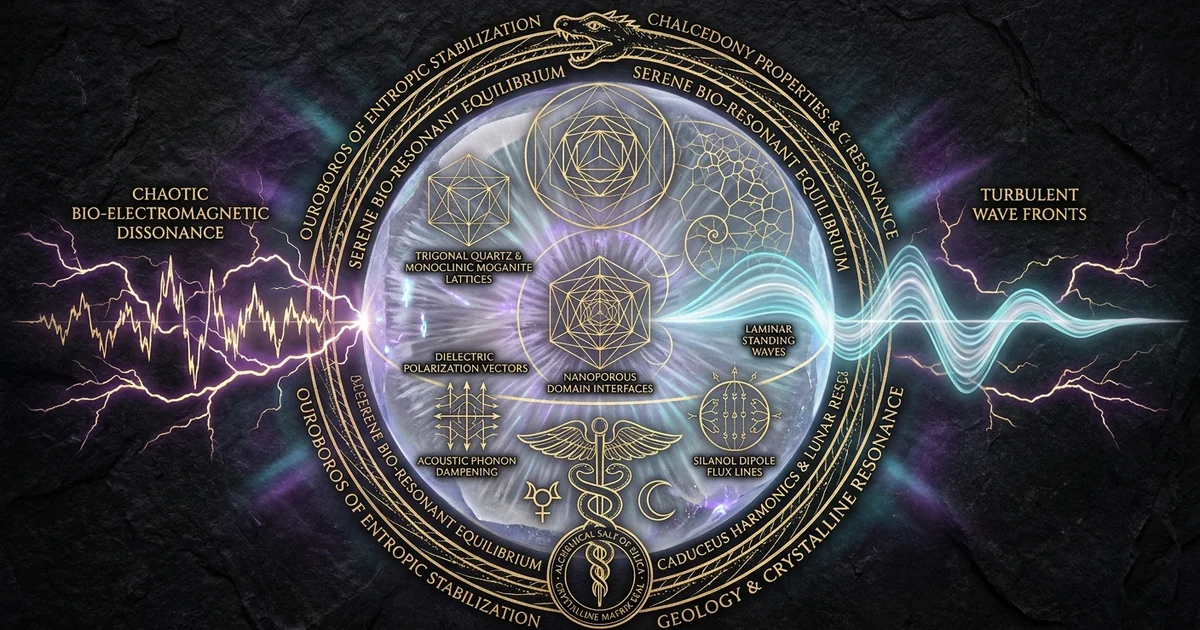
Chalcedony Properties: Geology & Crystalline Resonance
Mineral Classification & Crystallographic Thesis
┌───────────────────────────┐
                          │    Colloidal Silicic      │
                          │      Acid Precursor       │
                          │        [Si(OH)₄]          │
                          └─────────────┬─────────────┘
                                        │
                                        ▼  Low-T Polymerization
                          ┌───────────────────────────┐
                          │   Hydrated Silica Gel /   │
                          │       Opaline Phase       │
                          └─────────────┬─────────────┘
                                        │
                         Diagenesis &   ▼   Dehydration
             ┌──────────────────────────────────────────────────┐
             │       Chalcedonic Nanocrystalline Aggregate      │
             │                                                  │
             │  ┌──────────────────────┐  ┌──────────────────┐  │
             │  │   Trigonal α-Quartz  │  │Monoclinic Moganite│ │
             │  │      (P3₁21/P3₂21)   │  │      (I2/a)      │  │
             │  │   Length-Fast Fibers │  │   Intergrowths   │  │
             │  └──────────┬───────────┘  └────────┬─────────┘  │
             │             │                       │            │
             │             └───────────┬───────────┘            │
             │                         │                        │
             │                         ▼                        │
             │             [ Periodic Brazil Twins ]            │
             │                         │                        │
             │                         ▼                        │
             │             [ Interfacial Silanols ]             │
             │                     (Si-OH)                      │
             └──────────────────────────────────────────────────┘
Polysynthetic Intergrowth of α-Quartz and Moganite
Chalcedony cannot be classified as a simple mono-mineralic silicate. Solid-state crystallography reveals that this microcrystalline material is an intimate, polysynthetically twinned intergrowth composed of trigonal $\alpha$-quartz and the monoclinic silica polymorph moganite. While historical mineralogy classified chalcedony merely as a fibrous iteration of standard quartz, modern high-resolution transmission electron microscopy (HRTEM) and powder X-ray diffraction (XRD) demonstrate that chalcedony routinely accommodates between 5% and 20% moganite by volume, with select desert and lacustrine specimens exhibiting concentrations exceeding 75%.
The structural relationship between these two silica polymorphs relies on their shared foundation of corner-sharing [$\text{SiO}_4$] silicon-dioxide-tetrahedra. In $\alpha$-quartz, which crystallizes in the enantiomorphic trigonal space groups $P3_121$ or $P3_21$, the tetrahedra form continuous helical chains parallel to the $c$-axis $[0001]$. In moganite, designated under the monoclinic space group $I2/a$ (a non-standard setting of $C2/c$), the lattice undergoes periodic twinning on the unit-cell scale according to the Brazil twin law on the fundamental rhombohedral planes ${10\bar{1}1}$. As characterized by Miehe and Graetsch (1992), moganite represents an alternating sequence of right- and left-handed quartz unit-cell slabs connected along the ${10\bar{1}1}$ composition plane. When these phases intergrow within chalcedony, they assemble into fibrous crystallites categorized as either “length-fast” chalcedonite (where the crystallographic $c$-axis lies perpendicular to the fiber elongation direction) or “length-slow” quartzine (where the $c$-axis parallels the fiber axis).
The presence of moganite directly alters the solid-state behavior of the aggregate. Unlike isolated monocrystalline quartz, the intimate commingling of monoclinic and trigonal symmetry elements disrupts long-range translation vectors. This complex intergrowth eliminates continuous directional pathways for acoustic phonons, transforming the material into an integrated micro-composite characterized by localized strain gradients and distinct domain-boundary physics.
Monoclinic Moganite (I2/a)                Trigonal α-Quartz (P3₁21)
┌────────────────────────────────┐       ┌────────────────────────────────┐
│ Unit-cell Brazil twinning along│       │ Continuous helical chains      │
│ rhombohedral planes {10-11}    │  ◄─┬─►│ oriented parallel to c-axis    │
│ Alters spatial group symmetry  │    │  │ Unperturbed trigonal lattice   │
└────────────────────────────────┘    │  └────────────────────────────────┘
                                      │
                                      ▼
                        [ Structural Coexistence ]
                        Phase Boundaries Generate
                        Interfacial Capacitance
Stoichiometry, Structural Water, and Hydroxyl Defect Centers
The fundamental chemical formula of chalcedony is represented as $\text{SiO}_2 \cdot n\text{H}_2\text{O}$, with structural water values ranging typically from 0.5 to 2.0 weight percent, occasionally reaching 3.0 wt% in porous varieties. This analytical departure from stoichiometric quartz is governed by hydroxyl defect centers distributed throughout the complex silicate / oxide matrix. Structural water in chalcedony occupies two distinct physical and chemical regimes: molecular water ($\text{H}_2\text{O}$) trapped inside isolated, nanoscale interstitial micropores, and chemically bonded silanol groups ($\text{Si–OH}$) situated along internal grain and twin boundaries.
Fourier-transform infrared (FTIR) spectroscopy demonstrates that silanol defects arise through the hydrolytic weakening and rupture of bridging oxygen bonds:
$$\equiv\text{Si–O–Si}\equiv ;+; \text{H}_2\text{O} ;\rightleftharpoons; 2,(\equiv\text{Si–OH})$$
This reaction substitutes a single bridging oxygen with two hydroxyl groups, creating non-bridging oxygen parameters within the silica network. Because these $\text{Si–OH}$ complexes break the structural continuity of the silicon-oxygen framework, they yield localized lattice expansions, lowering the microhardness and density relative to macroscopic quartz. Monocrystalline quartz exhibits an absolute specific gravity of 2.651, whereas the structural hydrous defects and microporosity of chalcedony depress its bulk density to 2.58–2.64. The thermodynamic stabilization of these hydroxylated interfaces influences fracture propagation, shifting chalcedony’s mechanical behavior from pure conchoidal breakage toward tough, splintery, sub-conchoidal partings along fibrous intergranular networks.
Petrogenesis Across Silicates and Metamorphic Minerals
Chalcedony forms across low-temperature geochemical environments, sharply distinct from the high-temperature magmatic and pegmatitic crystallization regimes that yield rock crystal or smokey quartz. The petrogenetic trajectory typically initiates within volcanic cavities, such as cooling basaltic and andesitic amygdules, or within sedimentary sequences subjected to low-grade diagenesis and metasomatism. As meteoric or mild hydrothermal waters permeate silicates and metamorphic minerals, they leach silica from unstable volcanic glass, volcanic ash, or opaline microfossils, generating low-temperature aqueous solutions supersaturated with silicic acid ($\text{H}_4\text{SiO}_4$).
Upon reaching critical nucleation thresholds, typically below 200°C and often at ambient temperatures under 50°C, the silica polymerizes into a dense colloidal gel. Subsequent ripening promotes the phase transition of non-crystalline hydrated silica (opal-A and opal-CT) into fibrous crystalline silica. During this diagenetic maturation, rapid rhythmic precipitation in confined host cavities imposes oscillatory chemical conditions. These dynamic states dictate the relative concentrations of moganite and $\alpha$-quartz, as documented by Heaney and Post (1992). The final petrogenetic artifact is a microcrystalline aggregate whose complex morphology, nanostructured grain boundaries, and high interfacial surface areas govern its electromagnetic response and subtle acoustic resonance signatures.
- Chemical Formula: $\text{SiO}_2$ with 0.5–2.0 wt% structural $\text{H}_2\text{O}$ ($\text{Si–OH}$ and pore-bound $\text{H}_2\text{O}$)
- Crystallographic Systems: Polysynthetic intergrowth of Trigonal ($P3_121$ / $P3_21$) $\alpha$-quartz and Monoclinic ($I2/a$) moganite (typically 5–20% volume ratio)
- Unit Cell Dimensions ($\alpha$-quartz component): $a = 4.913\text{ \AA}$, $c = 5.405\text{ \AA}$; $Z = 3$
- Unit Cell Dimensions (moganite component): $a = 8.758\text{ \AA}$, $b = 4.876\text{ \AA}$, $c = 10.715\text{ \AA}$, $\beta = 90.08^\circ$; $Z = 12$
- Mohs Hardness: 6.5 – 7.0 (depressed by silanol boundary density)
- Specific Gravity: 2.58 – 2.64 $\text{g/cm}^3$ (sub-stoichiometric due to microporosity)
- Refractive Index: $n_\omega = 1.530\text{–}1.539$, $n_\epsilon = 1.532\text{–}1.543$; Birefringence $\Delta = 0.004\text{–}0.009$ (aggregate response)
- Optical Orientation: Positive uniaxial (fibers predominantly length-fast chalcedonite, occasionally length-slow quartzine)
Lattice Geometry & Solid-State Physics
Nanocrystalline Quartz-Moganite Interface
   α-Quartz Domain               Moganite Domain
  (Trigonal P3₁21)               (Monoclinic I2/a)

┌────────────────────┐         ┌────────────────────┐
│ [SiO₄]  [SiO₄]     │         │ [SiO₄]  [SiO₄]     │
│   \     /          │         │    \   /           │
│    [SiO₄]          │         │     [SiO₄]         │
│                    │         │                    │
└─────────┬──────────┘         └─────────┬──────────┘
│                              │
▼                              ▼
[ Brazil Twin ]                [ Brazil Twin ]
Plane Interface                Plane Interface
│                              │
└──────────────┬───────────────┘
│
▼
┌───────────────────────────┐
│  Interfacial Capacitance  │
│  & Bound Silanol (Si-OH)  │
│     Dielectric Layer      │
└───────────────────────────┘
Nanocrystalline Fiber Bundles and Periodic Brazil Twinning
The functional behavior of chalcedony depends fundamentally on the spatial organization of its nanocrystalline fiber bundles and the systematic presence of sub-microscopic Brazil twinning. In macroscopic $\alpha$-quartz, mechanical or chemical twinning occurs across observable, macroscopic domains. In chalcedony, Brazil twinning recurs periodically at unit-cell scales, with twin lamellae frequently spanning widths of only a few nanometers. These twin planes lie along the rhombohedral faces ${10\bar{1}1}$ and represent mirror boundaries that alternate right- and left-handed quartz configurations.
This pervasive twinning dramatically alters macroscopic physical dynamics. In monocrystalline quartz, non-centrosymmetric trigonal symmetry ($P3_121$) produces a robust anisotropic piezoelectric tensor, characterized by an electric polarization along the polar $a$-axes when subjected to mechanical stress (piezoelectric coefficient $d_{11} \approx -2.3,\text{pC/N}$). However, in chalcedony’s nanocrystalline matrix, the random radial orientation of the fiber bundles, combined with the dense alternation of enantiomorphic domains across nanoscale Brazil twin boundaries, produces near-complete cancellation of macroscopic piezoelectric polarization:
$$\sum d_{ijk}^{(\text{aggregate})} \approx 0$$
Rather than exhibiting unified, directional voltage responses to macroscopic mechanical strain, chalcedony confines its electromechanical coupling to nanometer-scale domain interfaces. The localized stress fields generated at these Brazil twin intersections store and redistribute mechanical energy, converting transient stress waves into localized elastoelectric polarization fields that bleed into adjacent hydrated grain boundaries.
Macrocrystalline Quartz: Direct Piezoelectric Conversion
[ Mechanical Strain σ ] ───► [ Lattice Displacement ] ───► [ Directional Charge Separation (d₁₁ = -2.3 pC/N) ]

Microcrystalline Chalcedony: Nanoscale Domain Entrapment
[ Mechanical Strain σ ] ───► [ Disordered Fiber Bundles ] ───► [ Periodic Brazil Twin Boundaries ]
                                                                             │
                                                                             ▼
                                                           [ Localized Domain Cancellations ]
                                                           [ & Interfacial Polarization (d_eff ≈ 0) ]
Dielectric Properties and Inter-Granular Capacitance
Because bulk piezoelectricity is suppressed by symmetry cancellation, the dielectric constant ($\kappa$ or $\varepsilon_r$) and interfacial capacitance of chalcedony emerge as its defining electro-physical traits. Chalcedony functions structurally as an anisotropic, heterostructure composite: the crystalline silica fibers operate as insulating dielectric pathways, while the hydrated grain boundaries, loaded with silanol defects and adsorbed water molecules, function as conductive and polarizable nanolayers.
This configuration creates a classic Maxwell-Wagner-Sillars (MWS) interfacial polarization mechanism, as analyzed in the context of dielectric resonance within crystalline lattices. When exposed to alternating electric fields, mobile charge carriers (primarily $\text{H}^+$ protons detached from silanol bonds and hydronium ions $\text{H}_3\text{O}^+$ trapped in micropores) migrate across the nanograins. They arrest at the phase boundaries separating $\alpha$-quartz from moganite lamellae.
Consequently, the boundaries act as nanoscale capacitive plates, accumulating charge and yielding an effective dielectric permittivity far higher at low frequencies ($<100,\text{kHz}$) than that observed in dry, anhydrous monocrystalline quartz. As the frequency transitions into radiofrequency and sub-gigahertz domains, the dielectric permittivity drops abruptly through dielectric relaxation, absorbing and dissipating electromagnetic energy via microscopic ionic displacement rather than propagating it coherently.
Optical Birefringence, Refractive Index, and Dispersion Metrics
The complex internal architecture of chalcedony directly governs its optical constants, distinguishing it sharply from monocrystalline varieties detailed in studies of quartz piezoelectric dynamics. The refractive index of chalcedony ranges from $n_\omega = 1.530$ to $n_\epsilon = 1.543$, which sits lower than the indices of pristine monocrystalline quartz ($n_\omega = 1.544$, $n_\epsilon = 1.553$). This reduction is directly proportional to the aggregate’s density deficit, reflecting the density of structural silanol defects and the volumetric fraction of nanoscale water-filled voids.
The measured optical birefringence of chalcedony ($\Delta = 0.004\text{–}0.009$) is likewise subdued relative to quartz ($\Delta = 0.009$). The aggregate optical behavior represents the composite sum of thousands of individual, sub-micron fibers traversed by the incident wavefront. Because individual fibers are oriented with their optical indicatrices pointing radially or tangentially within spherulitic bundles, the observed birefringence represents form-birefringence superimposed over structural crystalline birefringence.
Light propagating through the length-fast fibrous network encounters periodic shifts in optical path length driven by alternating quartz and moganite lamellae, resulting in mild Rayleigh scattering at shorter wavelengths. This scattering accounts for the subtle, opalescent blue sheen (often termed “chalcedonic adularescence”) observed in translucent, unpigmented specimens under incident illumination.
Chalcedony (Microcrystalline Matrix)
- Phase Composition: Polysynthetic mixture; $\alpha$-quartz + 5–20% monoclinic moganite ($I2/a$).
- Hydration State: Hydrated; 0.5–2.0 wt% $\text{H}_2\text{O}$ bound as silanol ($\text{Si–OH}$) and fluid inclusions.
- Piezoelectric Coefficient ($d_{11}$): Suppressed to near zero macroscopically through periodic Brazil twinning.
- Dielectric Architecture: High interfacial Maxwell-Wagner polarization; significant low-frequency dissipation.
- Optical Mechanics: Form and structural birefringence ($\Delta = 0.004\text{–}0.009$); aggregate scattering.
- Acoustic Phonon Profile: Strong boundary phonon scattering; severe high-frequency damping.
Macro-Quartz (Monocrystalline)
- Phase Composition: Monomineralic trigonal $\alpha$-quartz; absolute space-group symmetry $P3_121$ or $P3_21$.
- Hydration State: Anhydrous stoichiometry; defects limited to isolated point substitutions ($\text{Al}^{3+}$, $\text{Fe}^{3+}$).
- Piezoelectric Coefficient ($d_{11}$): Strong macroscopic tensor ($\sim -2.3,\text{pC/N}$); directional voltage production.
- Dielectric Architecture: Low uniform permittivity ($\varepsilon_\parallel = 4.6$, $\varepsilon_\perp = 4.5$); minimal interfacial loss.
- Optical Mechanics: High spatial coherence; unperturbed optical indicatrix ($\Delta = 0.009$).
- Acoustic Phonon Profile: Extended phonon mean free path; high $Q$-factor acoustic resonance.
Subtle Energetic Dynamics & Resonance Mechanics
                 Macro-Quartz (Monocrystalline)
               Narrow, Sharp Resonant Peak (High-Q)
         Resonance
             ▲                   │
             │                  ││
             │                  ││
             │                 │  │
             │                │    │
             │               │      │
             └──────────────┴────────┴──────────────►
                               Frequency

                 Chalcedony (Microcrystalline Matrix)
             Broadband Low-Pass Attenuation Profile
         Resonance
             ▲
             │          Low-Pass Passband
             │        ┌────────────────────┐
             │       │                      \
             │      │                        \   Steep High-Frequency
             │     │                          \  Phonon Attenuation
             └────┴────────────────────────────┴─────►
                               Frequency
Micro-Domain Boundary Polarization and Electromagnetic Attenuation
The operational mechanics of chalcedony within subtle field interactions derive from its suppressed macroscopic polarization and enhanced boundary-layer dynamics. In systems organized around trigonal lattice harmonics, uninterrupted macro-crystalline lattices focus and amplify high-frequency oscillatory inputs, establishing sharp resonance profiles characterized by elevated quality factors ($Q$-factors). Chalcedony functions through an inverted energetic mechanism: it acts as a non-resonant or broadband-damping substrate.
The hyper-dense array of domain boundaries dividing the quartz and moganite phases presents a maze of mechanical and electrical impedance mismatches. When external high-frequency electromagnetic noise or chaotic ambient field perturbations strike this microcrystalline barrier, the energy cannot propagate as coherent electromagnetic waves. Instead, the alternating phases and random crystallographic orientations force the incoming vector into localized displacement currents across millions of discrete grain interfaces.
This process causes dielectric dispersion. By dissipating rapid field fluctuations into boundary-layer ionic vibrations, chalcedony prevents the development of sharp, destabilizing electrical or energetic spikes, attenuating chaotic frequencies across the microcrystalline field.
Acoustic Phonon Scattering and Vibrational Damping
From the standpoint of condensed matter physics and vibrational resonance, chalcedony exhibits severe acoustic phonon scattering. In a flawless quartz single crystal, acoustic phonons—quantized vibrational lattice waves—travel across substantial distances before encountering defects, yielding exceptional acoustic propagation speeds and sustained mechanical oscillation. In chalcedony, however, the phonon mean free path ($\ell_{\text{ph}}$) is limited by the physical dimensions of the individual crystallites, which often measure only 10 to 500 nanometers across:
$$\ell_{\text{ph}} \approx d_{\text{grain}}$$
Whenever a high-frequency lattice vibration strikes a boundary between an $\alpha$-quartz fiber and an adjacent moganite lamella, the velocity shift caused by the difference in crystal symmetry and acoustic impedance triggers diffuse scattering.
       Acoustic Phonon Propagation Through Silicate Lattices

Macro-Quartz: Linear Phonon Mean Free Path
[ Phonon Injection ] ──────────────────────────────────────────► Long Free Path (Undamped)

Chalcedony: Phonon Boundary Scattering
                      Moganite Lamella
                             │
[ Phonon Injection ] ───► [ Si-OH Interface ] ───► [ Directional Dispersion ]
                             │
                      α-Quartz Domain
                             ▼
              [ Lattice Wave Kinetic Degradation ]
This dynamic is heightened by the hydrated silanol layers located at these boundary zones. The hydrogen-bonded networks of structural water molecules introduce strong anelastic relaxation properties. Thermal, kinetic, and high-frequency vibrational energies are absorbed by these boundary silanols, which undergo localized rotational and translational deformations.
Through this interfacial phonon dissipation, chalcedony acts as a mechanical and vibrational shock absorber. It degrades high-frequency acoustic and kinetic noise into coherent, long-wavelength thermal equilibrium, neutralizing ambient micro-strains that would otherwise agitate adjoining energetic structures.
Biofield Entrainment via Low-Pass Coherence Filtering
The biological and biofield consequences of this solid-state architecture are pronounced. Living systems do not interface with subtle material fields merely through passive reception; rather, biological matrices behave as complex liquid-crystalline lattices consisting of water domains, collagen fibril arrays, and lipid bilayers. These biological lattices remain susceptible to desynchronization caused by high-frequency environmental electromagnetic radiation (EMR) and volatile emotional-biophysical stress vectors, which introduce high-entropy phase jitter into the organism’s electromagnetic field.
Chalcedony stabilizes these configurations by functioning as an intrinsic biological low-pass filter. The primary dielectric relaxation frequency of its interstitial water and silanol network falls within the sub-gigahertz to megahertz bands. Consequently, while macro-crystalline quartz transfers and amplifies high-frequency environmental oscillations, chalcedony absorbs, scatters, and attenuates volatile high-frequency components.
Simultaneously, it passes low-frequency, homeostatically stabilizing rhythms (such as endogenous Schumann harmonics and physiological heart rate variability frequencies). By converting disparate mechanical and bioelectric stresses into a continuous, diffuse scalar field via micro-piezoelectric relaxation, chalcedony presents an ambient energy field that entrains the human autonomic and cellular systems toward energetic equilibrium.
Historical Lapidary Lore & Traditional Lineage
┌───────────────────────────┐
                          │   Ancient Anatolian Port  │
                          │   of Chalkedon (Bithynia) │
                          │     Origins of the Name   │
                          └─────────────┬─────────────┘
                                        │
                         Glyptic Arts & │ Intaglio Seals
                         Carving Craft  ▼ (Cleavage-Free SiO₂)
             ┌──────────────────────────────────────────────────┐
             │         Classical & Medieval Lineage             │
             │                                                  │
             │  ┌──────────────────────┐  ┌──────────────────┐  │
             │  │ Pliny the Elder (77) │  │  Theophrastus'   │  │
             │  │ Naturalis Historia   │  │   De Lapidibus   │  │
             │  │ Book 37: Carchedonia │  │ Cooling/Amuletic │  │
             │  └──────────┬───────────┘  └────────┬─────────┘  │
             │             │                       │            │
             │             └───────────┬───────────┘            │
             │                         │                        │
             │                         ▼                        │
             │          [ Medieval Marbode Lapidaries ]         │
             │           Prophylactic for Phantasms,            │
             │             Fevers, and Vocal Clarity            │
             │                         │                        │
             │                         ▼                        │
             │             [ Islamic Aqiq Traditions ]          │
             │             Throat-Chakra Articulation,          │
             │           Protection against Stridor/Fear        │
             └──────────────────────────────────────────────────┘
Antiquity of Chalcedon: Anatolian Glyptic Arts and Greco-Roman Seals
The historical designation of chalcedony traces its etymological lineage to the ancient Megarian port city of Chalkedon (or Calchedon) in Bithynia, situated on the Bosporus directly across from Byzantium. Classical civilizations did not possess the X-ray crystallographic frameworks required to identify moganite intergrowths, yet lapidary artisans intuitively understood chalcedony’s physical advantages over macro-crystalline quartz. Lacking structural cleavage planes and fortified against shattering by its interwoven fibrous crystallites, chalcedony stood as the premier canvas for classical glyptic arts, including intaglio seals, cameos, and signet rings.
From the Minoan civilization through the height of the Roman Empire, chalcedony signets were employed to stamp authoritative wax and clay impressions. This mechanical utility carried deep metaphysical value. Because the microcrystalline aggregate resisted adhesion to damp wax and yielded clean, sharp impressions, classical lapidaries linked the mineral to Mercury (Hermes)—the planetary intelligence governing commercial integrity, linguistic precision, and accurate transmission of messages.
Furthermore, the stone’s milky, waxy translucence, combined with its cool surface temperature derived from low thermal conductivity, linked it astrologically to the Moon. It was regarded as a material capable of capturing dynamic lunar tides and anchoring them within physical matter.
Talismanic Lithology: Pliny, Theophrastus, and Medieval Marbode Lapidaries
Classical mineralogical literature codified chalcedony as a prophylactic agent against mental disturbances, environmental toxicity, and physical disease. In De Lapidibus, the Greek philosopher Theophrastus classified chalcedonic varieties (often conflated with carnelian, onyx, and jasper under general regional headings) as stones of cooling temperaments, uniquely suited for mitigating internal inflammation and clearing ocular distress when applied directly to the skin.
Centuries later, Pliny the Elder analyzed the material in Book XXXVII of Naturalis Historia. Pliny addressed these specimens under descriptions of chalcedonius and carchedonia, distinguishing stones procured from Carthage and the copper mines of Bithynia. Pliny documented their deployment as talismans against melancholy, asserting that when engraved with designated astrological symbols, they conferred victory in legal debates and dispelled nocturnally induced fears.
       Historical Lapidary Trajectory of Microcrystalline Silica

[ Theophrastus: De Lapidibus ] ───► Cooling, Anti-Inflammatory, Ocular Calming
                │
                ▼
[ Pliny: Naturalis Historia ]  ───► Dispels Melancholia & Night Terrors; Enhances Oratory
                │
                ▼
[ Marbode: Liber Lapidum ]     ───► Expels Spectral Illusions; Overcomes Febrile Chills
                │
                ▼
[ Near-Eastern Aqiq Texts ]    ───► Vocal Resonance, Equilibrium, Protection from Strife
By the 11th century CE, Bishop Marbode of Rennes codified these traditions within the Liber Lapidum (The Book of Stones). Marbode asserted that chalcedony possessed the innate power to dispel nocturnal hallucinations, drive off demonic entities (“phantasms”), and neutralize fevers.
Crucially, medieval lapidary manuscripts consistently stated that chalcedony should be pierced and suspended around the neck on hairs plucked from an ass’s mane to maximize its calming efficacy. This persistent historical emphasis on calming, fever-reduction, and dispelling mental confusion aligns closely with the modern solid-state model of the mineral as a biological low-pass filter, dissipating high-frequency psychic and biofield noise into calm energetic coherence.
Near-Eastern and Islamic Traditions of Aqiq and Throat-Center Balancing
Throughout the Near and Middle East, microcrystalline chalcedonies—encompassing uniform blue-gray varieties, carnelian (aqiq), and sard—occupy an exalted tier within sacred lapidary traditions. Islamic lapidary texts, drawing from earlier Persian and Babylonian mineral treatises, detail aqiq as a stone that guards against unexpected misfortune, calms inner turbulence, and attracts divine favor. The Prophet Muhammad is recorded in traditional Hadith compilations as having worn a silver signet ring set with an Abyssinian aqiq upon his right hand, establishing an enduring talismanic lineage across Islamic geography.
Within these esoteric lapidary schools, chalcedony was specifically positioned as an energetic anchor for the throat, voice, and expressive breath. Its vibrational qualities were understood to resolve vocal strain, clear stutters, and instill diplomatic eloquence in orators and emissaries.
When translated into energetic models of subtle anatomy, chalcedony corresponds directly with the fifth primary center: the Vishuddha or throat chakra. The throat center governs the transmutational threshold between mental ideation and material realization through sound.
Because the microcrystalline lattice dampens chaotic energetic oscillations, it stabilizes the vocal tract and thyroid energetics, enabling individuals to express emotional truths free from turbulent static. The historical use of chalcedony to soothe the throat and calm chaotic speech demonstrates an intuitive understanding of the stone’s acoustic and electromagnetic properties.
“Of an entirely different nature is the stone called Chalcedonius, which is brought from the vicinity of the copper mines near Chalcedon… It is held that this stone, when worn, brings success in legal petitions and preserves the body against the intrusions of phantasms and dark humors of the mind. The ancients fashioned from it their most precious seals, for it retains no wax and yields its imprint with absolute purity… Furthermore, it carries an inherent coolness that assuages the fiery heat of fevers and quenches inner strife.” — Pliny the Elder, Naturalis Historia, Book XXXVII, Chapters 25 & 38 (c. 77 CE)
Practical Applications, Calibration & Safety Protocols
                            Trigonal Grid Node
                           (Primary Field Driver)
                        ┌───────────────────────────┐
                        │    e.g., Amethyst Prism   │
                        │    High Piezoelectric /   │
                        │   Directional Output (d₁₁)│
                        └─────────────┬─────────────┘
                                      │
                                      ▼  High-Amplitude Dynamic Wavefront
                        ┌───────────────────────────┐
                        │  Chalcedony Nodule Buffer │
                        │  (Dielectric Scalar Ring) │
                        │                           │
                        │   • MWS Interfacial Loss  │
                        │   • Phonon Dispersion     │
                        │   • Low-Pass Stabilization│
                        └─────────────┬─────────────┘
                                      │
                                      ▼  Buffered, Coherent Scalar Gradient
                        ┌───────────────────────────┐
                        │     Human Biofield or     │
                        │   Biological Receptor     │
                        │  (Cellular Homeostasis)   │
                        └───────────────────────────┘
Geometric Orientation in Resonant Grids and Scalar Transduction
To deploy chalcedony within resonant crystalline grids, its distinct microcrystalline properties must be accommodated. Monocrystalline minerals—such as quartz prisms, kyanite blades, or tourmaline rods—possess explicit crystallographic vectors, requiring axial alignment along directional poles to guide energy currents.
Because chalcedony consists of spherulitic or interwoven fiber bundles lacking a singular crystallographic vector, it cannot be employed as a linear directional driver. Instead, it must be positioned at structural boundary nodes, dynamic phase intersections, or perimeter buffers within the sacred architectural layout.
       Crystalline Matrix Grid: Impedance-Matching Topology

[ High-Frequency Emitter ] ──► ( Tourmaline / Pointed Quartz )
                                              │
                                              ▼ High Dynamic Gradient
                                  [ Chalcedony Buffer Node ]
                                  ( Intergranular Low-Pass Phase )
                                              │
                                              ▼ Steady Scalar Stream
[ Biofield Target Zone ]   ◄── ( Coherent Stable Baseline )
When integrating chalcedony into complex grids constructed with materials from the silicate / oxide matrix structures, the mineral serves as an energetic impedance matcher. Placing a nodule or sphere of chalcedony between two high-amplitude, polarized monocrystalline elements (such as an elestial quartz wand and a black tourmaline prism) prevents chaotic field clashes. The chalcedony absorbs high-velocity, conflicting piezoelectric outputs, scatters phase irregularities across its internal Brazil twin planes, and broadcasts a coherent, stabilized scalar field that settles the grid’s surrounding environment.
Acoustic and Ultrasonic Cleansing Protocols for Hydrous Nanopores
Due to its unique microstructural configuration, chalcedony requires specialized purification protocols. Standard lapidary and cleansing regimens that employ ultrasonic water baths or high-heat methods risk degrading the stone’s integrity. Ultrasonic cleaners operate by generating high-intensity cavitation bubbles within a liquid medium, which implode violently at frequencies typically between 20 kHz and 40 kHz.
While macroscopic quartz crystals tolerate these acoustic pressures, chalcedony’s nanoporous matrix absorbs these micro-shockwaves directly into its water-filled pores. This cavitation can trigger micro-fracturing along fibrous grain boundaries, breaking the structural silanol bridges ($\text{Si–OH}$) and permanently destabilizing its subtle vibrational mechanics.
              Acoustic Cleansing Pathway Comparison

Ultrasonic Water Immersion (Hazardous):
[ 40 kHz Cavitation ] ──► [ Liquid Enters Nanopores ] ──► [ Intergranular Cavitation Shock ]
                                                                      │
                                                                      ▼
                                                      [ Structural Silanol Fracture ]

Dry Resonant Tuning (Optimal):
[ 432 / 528 Hz Acoustic Tone ] ──► [ Air Cavity Coupling ] ──► [ Coherent Lattice Relaxation ]
                                                                      │
                                                                      ▼
                                                      [ Restored Interfacial Symmetry ]
Purification and vibrational calibration are best achieved through dry acoustic attunement or desiccated atmospheric settling. Practitioners should subject chalcedony to calibrated acoustic frequencies using therapeutic tuning forks tuned to natural harmonic ratios (e.g., 432 Hz or 528 Hz) struck at an offset distance of 10 to 15 centimeters.
The air-driven acoustic waves sweep through the aggregate, clearing vibrational static across the fiber interfaces without imparting the hydraulic stress that causes internal rupture. Alternatively, chalcedony may be cleansed using anhydrous dry packs, burying the specimen in dry sodium chloride or zeolitic beds separated by a protective linen barrier to clear adsorbed electrostatic charges without stripping structural silanol bonds.
Chemical Leaching Hazards, Porosity Contraindications, and Direct Elixir Warnings
The primary physical danger regarding chalcedony involves its structural nanoporosity and capillary capacity. The presence of internal micro-channels renders chalcedony susceptible to chemical leaching, hazardous ion absorption, and dye contamination. Many commercial chalcedonies (particularly vivid pink, green, and neon blue varieties) are subjected to chemical dyeing processes that use heavy metal salts, such as:
$$\text{Cr}^{3+},\quad \text{Ni}^{2+},\quad \text{Cu}^{2+},\quad \text{and}\quad \text{Fe}(\text{CN})_6^{3-}$$
These ions are fixed using acidic solutions that permanently lodge within the internal grain boundaries.
Nanoporous Leaching Mechanism in Chalcedony
  Direct Liquid Contact (Aqueous Matrix)
═════════════════════════════════════════════════════
     │                           │
     ▼ Capillary Uptake          ▼ Dissolution
┌──────────────────────────────────────────────┐
│ Nanopore Capillary Network                   │
│                                              │
│  [ Residual Dyes ]      [ Polishing Oxides ] │
│   • Cr³⁺ / Ni²⁺          • Cerium / Chrome   │
│                                              │
│  [ Leaching into Ingestible Solution ]       │
└──────────────────────────────────────────────┘
     │
     ▼ Contamination
═════════════════════════════════════════════════════
      Toxic Direct Elixir (Severe Hazard)</code></pre>
Furthermore, lapidary finishing compounds—including toxic cerium oxide, chromium oxide, and petroleum-based polishing agents—penetrate deep into the mineral’s capillary networks. If placed into direct contact with water intended for human consumption, these toxic compounds slowly leach into the liquid.
Consequently, direct gem elixirs must never be prepared using natural or dyed chalcedony. Any therapeutic or vibrational essence must be crafted exclusively via the indirect method, wherein the chalcedony is sealed inside an inert, clean glass vessel that is then submerged within the water-filled container. This protects the liquid from chemical contamination while allowing the stone’s electromagnetic and scalar resonance to imprint the solvent safely.
Chalcedony possesses an interconnected network of nanopores and fluid channels (diameters ranging from 5 to 100 nm). Because of this capillary action:
- Never prepare direct water infusions or elixirs: Chemical leaching of industrial dyes, polishing slurries (containing cerium, lead, or chromium oxides), and natural metallic inclusions will contaminate the water. Always mandate the indirect method using a hermetically sealed glass barrier.
- Prohibit chemical cleaners, acids, and soaps: Exposure to hydrochloric acid, hydrofluoric solutions, or household detergents strips structural silanol groups, leaving etched, destabilized boundary zones.
- Avoid thermal shock: Rapid temperature transitions exceed the thermal expansion tolerance of the moganite-quartz interfaces, triggering immediate internal cracking and fracturing the aggregate.
Frequently Asked Questions
                         Micro-Raman Spectrum
                  α-Quartz Mode vs. Moganite Mode
        Intensity
            ▲
            │                   Quartz Peak
            │                   (464 cm⁻¹)
            │                       │
            │                      │ │
            │                      │ │      Moganite Peak
            │                      │ │       (501 cm⁻¹)
            │                      │ │           │
            │                     │   │         │ │
            │                    │     │       │   │
            └───────────────────┴───────┴─────┴─────┴───────►
             400        440        480        520       Raman Shift
                                                        (cm⁻¹)
Crystallographic Verification of Moganite via Micro-Raman Spectroscopy
The definitive laboratory protocol for authenticating chalcedony and quantifying its moganite ratio relies on confocal micro-Raman spectroscopy. Because $\alpha$-quartz and moganite share identical chemical composition ($\text{SiO}_2$) and similar tetrahedral coordinations, standard optical petrography often fails to isolate subtle intergrowths.
Micro-Raman spectroscopy bypasses this limitation by interrogating the vibrational dynamics of the crystal lattice. Pristine $\alpha$-quartz exhibits a defining, high-intensity Raman-active vibrational mode ($A_1$) situated precisely at $464,\text{cm}^{-1}$, corresponding to the internal symmetric stretching-bending vibrations of the bridging $\text{Si–O–Si}$ bonds:
$$\nu_s(\text{Si–O–Si}) \approx 464,\text{cm}^{-1}$$
In contrast, the monoclinic structure of moganite alters this dynamic. Due to unit-cell Brazil twinning along the ${10\bar{1}1}$ planes, moganite displays an unmistakable, signature Raman band at $501,\text{cm}^{-1}$. By collecting a spectral acquisition between $350,\text{cm}^{-1}$ and $600,\text{cm}^{-1}$, mineralogists calculate the intensity ratio between the $501,\text{cm}^{-1}$ moganite peak and the $464,\text{cm}^{-1}$ quartz peak.
Using empirical calibration curves developed by Götze and Heaney, this ratio directly quantifies the volume percentage of moganite present. If a specimen exhibits zero Raman intensity at $501,\text{cm}^{-1}$, it is composed of pure microcrystalline quartz rather than authentic chalcedony, confirming the absence of the moganite intergrowths that govern the material’s unique dielectric and subtle field properties.
Confocal Micro-Raman Analytical Workflow
[ Specimen Preparation: Polished Anhydrous Surface ]
                         │
                         ▼
[ Laser Excitation: 532 nm or 785 nm Diode Integration ]
                         │
                         ▼
[ Spectral Acquisition Band: 350 cm⁻¹ to 600 cm⁻¹ ]
                         │
                         ▼
[ Resolve Quartz Primary Band: 464 cm⁻¹ (A₁ Mode) ]
                         │
                         ▼
[ Resolve Moganite Diagnostic Band: 501 cm⁻¹ (A₁ Mode) ]
                         │
                         ▼
[ Compute Integrated Intensity Ratio (I₅₀₁ / I₄₆₄) ]
                         │
                         ▼
[ Output: Absolute Moganite Volumetric Percentage (±1.5%) ]
Energetic Differentiation Between Banded Agate and Uniform Chalcedony
While agate is chemically classified as a variety of chalcedony, their internal structural organizations differ significantly, yielding distinct solid-state physics and subtle resonance profiles. Uniform chalcedony precipitates through relatively continuous, steady-state fluid flows, resulting in a consistent distribution of fibrous crystallites and an isotropic concentration of moganite and silanol defects throughout the matrix. This continuous micro-architecture produces uniform low-pass attenuation, making plain chalcedony an exceptional stabilizer for turbulent biofields.
       Comparative Morphology & Dielectric Manifestation

Uniform Chalcedony: Steady-State Low-Pass Filtration
┌────────────────────────────────────────────────────────┐
│ Steady-State Fluid Flow ──► Isotropic Moganite (5-15%)  │
│ Result: Homogeneous Attenuation & Broad Scalar Base    │
└────────────────────────────────────────────────────────┘

Banded Agate: Dynamic Oscillatory Dielectric Zoning
┌────────────────────────────────────────────────────────┐
│ Pulsating Geochemical Precipitation Waves              │
│ [High Moganite / Water] ──► [Low Moganite / Anhydrous] │
│ Result: Periodic Permittivity Waves & Field Modulation  │
└────────────────────────────────────────────────────────┘
Banded agate, conversely, forms through rhythmic, oscillatory chemical self-organization within enclosed voids. As the silica gel polymerizes, precipitation pulses create concentric or planar bands that vary in fiber orientation, microporosity, moganite content (which fluctuates from 1% up to 25% between adjacent bands), and foreign oxide pigmentation.
Consequently, banded agate behaves as a periodic multilayer dielectric mirror. Each micro-layer exhibits an alternating dielectric permittivity and acoustic impedance profile. Rather than delivering uniform damping, banded agate structures incoming energy into rhythmic, harmonic ripples. Agate processes and restructures energetic information into sequential patterns, whereas uniform chalcedony acts to quiet, damp, and clear the field entirely.
Thermal Sensitivity and Structural Dehydration Parameters
Thermal stress alters both the structural stability and subtle vibrational qualities of chalcedony. When heated, the physical degradation of the aggregate progresses through three distinct, measurable dehydration phases:
- Phase I ($20^\circ\text{C}$ to $100^\circ\text{C}$): chalcedony desorbs non-structural surface moisture and weakly bound capillary water from its interconnected micropores. This phase shift causes no fundamental structural damage and is fully reversible by exposing the specimen to ambient atmospheric humidity.
- Phase II ($100^\circ\text{C}$ to $300^\circ\text{C}$): capillary water held deep within closed nanopores builds high internal vapor pressures. If the thermal ramp rate exceeds $1^\circ\text{C}$ to $2^\circ\text{C}$ per minute, this internal steam pressure cannot diffuse through the dense crystallite boundaries, resulting in explosive micro-cavitation and clouding.
- Phase III ($300^\circ\text{C}$ to $600^\circ\text{C}$ and higher): the mineral undergoes irreversible dehydroxylation. The chemically bonded silanol groups ($\text{Si–OH}$) situated along internal grain and twin boundaries are forced to condense:
$$2,(\equiv\text{Si–OH}) ;\xrightarrow{\Delta}; \equiv\text{Si–O–Si}\equiv ;+; \text{H}_2\text{O}\uparrow$$
                   Thermal Dehydration Regime
        Temperature
             ▲
             │
     600°C ──┼─────────────────────────────────────────────
             │ Phase III: Irreversible Dehydroxylation
             │ • Si-OH Silanol Condensation
             │ • Grain Separation & Micro-fracturing
     300°C ──┼─────────────────────────────────────────────
             │ Phase II: Capillary Water Superheating
             │ • Internal Steam Vapor Pressure
             │ • High Risk of Micro-Cavitation & Clouding
     100°C ──┼─────────────────────────────────────────────
             │ Phase I: Surface Moisture Desorption
             │ • Fully Reversible Hydration Loss
       0°C ──┴─────────────────────────────────────────────►
This condensation reaction releases water that shatters the internal interfaces, tearing apart the nanocrystalline quartz-moganite boundary network. The loss of silanol defects fundamentally transforms the mineral: the interfacial Maxwell-Wagner polarization collapses, the acoustic phonon-scattering capacity drops, and the mineral’s subtle low-pass biofield filtering capacity is permanently extinguished. Chalcedony must never be subjected to temperatures exceeding 100°C, and cleansing regimens involving open flames, ovens, or direct solar heating must be strictly avoided.
To re-establish boundary-layer equilibrium in chalcedony specimens subjected to environmental electromagnetic over-saturation:
- Desiccated Ambient Settling: Place the specimen in a climate-controlled, shielded container (e.g., a Mu-metal or heavy aluminum enclosure) kept at $20^\circ\text{C} \pm 2^\circ\text{C}$ with a steady relative humidity of 45–50% for 48 hours. This allows internal pore pressure and hydronium ion distributions to reach homeostatic rest without inducing dehydration stress.
- Micro-Acoustic Entrainment: Expose the settled specimen to an unamplified, pure sinusoidal acoustic tone (432.0 Hz) using a calibrated aluminum-alloy tuning fork. Position the fork base 5 centimeters from the mineral’s primary access node for 180 seconds.
- Impedance Verification: The specimen’s boundary capacitance will re-align with its baseline dielectric profile, restoring its functional capacity as a subtle energetic low-pass filter.