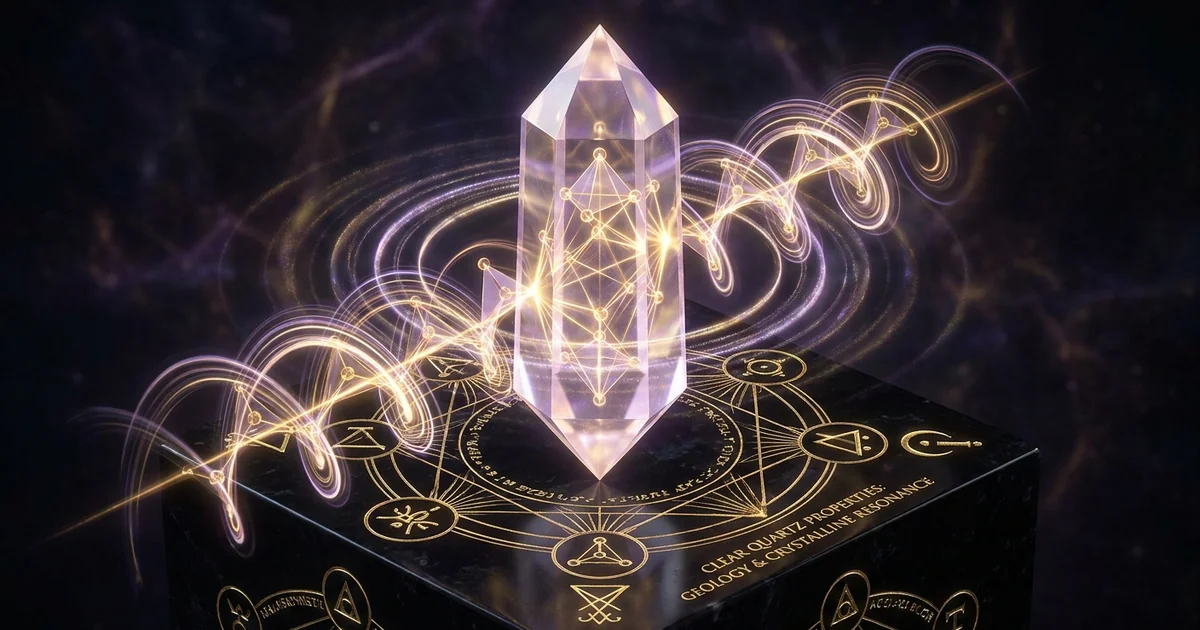
Clear Quartz Properties: Geology & Crystalline Resonance
Mineral Classification & Crystallographic Thesis: The Tectosilicate Architecture of SiO₂
Chemical Stoichiometry and Framework Silicates (Tectosilicates)
Low-temperature alpha-quartz ($\alpha\text{-SiO}_2$) occupies an archetype status within condensed matter physics and systematic mineralogy. Classified chemically as an inorganic oxide and structurally within the silicate mineralogy guide as a framework tectosilicate, its bulk architecture consists entirely of corner-sharing silicon-oxygen tetrahedra ($\text{SiO}_4$). Within this three-dimensional framework, every oxygen atom ($O^{2-}$) is shared between two adjacent silicon ions ($\text{Si}^{4+}$), fulfilling stoichiometric charge neutrality ($\text{SiO}_2$) without requiring the interstitial balancing cations—such as $\text{Na}^+$, $\text{Ca}^{2+}$, or $\text{Fe}^{2+}$—that populate more structurally permissive silicates like feldspars or pyroxenes. The absolute purity of stoichiometric clear quartz, often exceeding 99.9% silicon dioxide by weight, leaves its lattice uniquely unencumbered by foreign interstitial mass, isolating its intrinsic mechanical, optical, and electromagnetic resonant properties.
The geometric foundation of this framework rests upon the partially covalent, partially ionic Si–O bond, which possesses an average bond length of approximately 1.61 Å and an inter-tetrahedral Si–O–Si bridging angle oscillating between 143° and 144° at standard ambient temperature and pressure. Unlike planar sheet silicates or isolated orthosilicate groups, the continuous tetrahedral network distributes mechanical strain symmetrically across all crystallographic directions, providing quartz with its characteristic Mohs hardness of 7.0 and high bulk modulus ($K \approx 37\text{ GPa}$). Because the bridging bond angle lacks absolute rigidity, the macroscopic framework can deform elastically via tetrahedral tilting rather than bond rupture, laying the mechanical foundation for its electromechanical sensitivity and high dielectric stability.
The macro-morphology of pristine rock crystal reflects this internal atomic coordination. Crystals typically manifest as hexagonal prisms terminated by an apparent hexagonal pyramid; however, this habit does not stem from true hexagonal symmetry, but rather from the precise intersection of two distinct sets of rhombohedral faces—the positive rhombohedron ${10\bar{1}1}$ ($r$) and the negative rhombohedron ${01\bar{1}1}$ ($z$). The developmental dominance of the $r$-faces over the $z$-faces, accompanied by narrow trigonal trapezohedral ${51\bar{6}1}$ ($x$) faces, reveals the lower underlying trigonal symmetry of the phase. This geometric hierarchy provides an empirical bridge between classical Platonic solids and crystallography and modern X-ray diffraction analyses, validating historical lapidary descriptions of quartz’s geometric perfection while anchoring them within rigorous solid-state crystallographic mechanics.
- Chemical Formula: $\text{SiO}_2$ (Silicon Dioxide)
- Crystal System: Trigonal
- Crystal Class (Point Group): 32 (Trigonal Trapezohedral, enantiomorphic)
- Space Group: $P3_121$ (right-handed, No. 152) or $P3_221$ (left-handed, No. 154)
- Unit Cell Parameters: $a = 4.9133\text{ \AA}$, $c = 5.4053\text{ \AA}$, axial ratio $c/a = 1.1001$, volume $V = 113.00\text{ \AA}^3$ ($Z = 3$ formula units per unit cell)
- Density: $2.648\text{ g/cm}^3$ (measured), $2.651\text{ g/cm}^3$ (calculated at 298 K)
- Mohs Hardness: 7.0 (Vickers Hardness: $1100\text{–}1200\text{ kg/mm}^2$)
- Cleavage: None observed; distinct conchoidal fracture along non-crystallographic relief planes
- Source: Heaney, P. J., Prewitt, C. T., & Gibbs, G. V. (Eds.). (1994). Silica: Physical Behavior, Geochemistry and Materials Applications. Reviews in Mineralogy, Vol. 29.
Enantiomorphic Chirality: Left-Handed vs. Right-Handed Trigonal Polymorphs
Alpha-quartz crystallizes within the non-centrosymmetric trigonal trapezohedral crystal class 32, lacking an inversion center, a mirror plane, and a principal six-fold axis of rotation. The elimination of central symmetry bifurcates the species into two enantiomorphic space groups: $P3_121$ (right-handed quartz) and $P3_221$ (left-handed quartz). This structural enantiomorphism arises from the helical stacking sequence of the corner-sharing $\text{SiO}_4$ tetrahedra along the crystallographic $c$-axis (the [0001] optical direction). The silicon atoms form continuous screw axes that spiral clockwise or counterclockwise through the unit cell, translating one-third of the cell dimension per 120° rotation.
Right-Handed Helix (P3₁21)          Left-Handed Helix (P3₂21)
         [z = 1]                             [z = 1]
           /                                   \
     [z = 2/3]                               [z = 2/3]
         \                                   /
     [z = 1/3]                               [z = 1/3]
           \                                   /
         [z = 0]                             [z = 0]
 (Clockwise Descent along c)        (Counterclockwise Descent along c)
The physical manifestation of this structural chirality is observed through optical rotatory dispersion and morphological surface morphology. In right-handed quartz ($P3_121$), the $x$ trapezohedral face develops on the upper-right corner of the prism face adjacent to a positive rhombohedron, driving a right-handed (dextrorotatory) rotation of plane-polarized light passing along the $c$-axis. Conversely, in left-handed quartz ($P3_221$), the corresponding trigonal modifier appears at the upper-left boundary, inducing a counterclockwise (laevorotatory) rotation of the optical wave-vector. This chiral morphology reflects genuine micro-structural asymmetry rather than superficial surface twinning.
From an advanced physical and vibrational stance, this helical configuration establishes an intrinsic mechanical and electromagnetic gyrotropy. As subtle energy currents, electromagnetic fields, and acoustic phonon cascades traverse the quartz medium along the trigonal axis, they encounter an anisotropic potential energy landscape. The structural helix converts purely longitudinal compression waves into localized rotatory shear vectors, introducing a spatial phase offset to passing wavefronts. The clear quartz crystal properties geology resonance cannot be comprehensively modeled without isolating whether the underlying lattice exhibits a right- or left-handed chiral configuration, as this determines the directional orientation of its piezoelectric polarization tensors.
Phase Boundaries: The Alpha-Beta Inversion and Thermal Metastability
The ambient alpha polymorph of quartz remains thermodynamically stable only up to 573°C (846 K) under standard atmospheric pressures. At this critical isotherm, quartz undergoes a classic displacive, non-reconstructive phase transformation into beta-quartz ($\beta\text{-SiO}_2$). Unlike reconstructive transformations—such as the conversion of quartz to tridymite at 870°C or cristobalite at 1470°C, which require the severing and reformation of primary covalent Si–O bonds—the alpha-beta inversion proceeds via a cooperative, instantaneous rotation of the rigid $\text{SiO}_4$ tetrahedra. The inter-tetrahedral bridging angle widens from approximately 144° to roughly 153°, expanding the crystal volume by approximately 0.8% and transforming the trigonal space group $P3_121$/$P3_221$ into the hexagonal space group $P6_222$/$P6_422$.
     Alpha-Quartz (α-SiO₂)               Beta-Quartz (β-SiO₂)
     T < 573°C (Ambient P)              T > 573°C (Ambient P)
  ---------------------------        ---------------------------
  Space Group: P3₁21 / P3₂21         Space Group: P6₂22 / P6₄22
  Trigonal Symmetry                  Hexagonal Symmetry
  Non-centrosymmetric (Diad axes)    Higher symmetry class (622)
  Active Piezoelectric d₁₁           Vanishing d₁₁ Tensor Component
  Elastic, high-Q resonance          Acoustic damping / Phase loss
This structural shift dramatically alters the crystal’s physical and esoteric behaviors. Hexagonal $\beta$-quartz exhibits higher point-group symmetry (class 622), which causes its longitudinal piezoelectric coefficients along the former diad axes to vanish. Upon crossing the 573°C threshold, the low-temperature piezoelectric response collapses, accompanied by a sharp minimum in the elastic constants ($c_{11}$, $c_{33}$) and an acute spike in internal acoustic dissipation (the inverse of the mechanical Q-factor). The crystal temporarily loses its sharp, stabilizing frequency response and its ability to sustain a stable, anisotropic piezoelectric field.
When cooling back across the 573°C inversion boundary, the lattice spontaneously returns to the trigonal alpha phase, but it rarely re-establishes its original single-domain structural cohesion. Instead, cooling through the inversion plane frequently triggers Dauphiné twinning, an electrical twinning defect where adjacent domains in the crystal matrix are related by a 180° rotation about the $c$-axis. Although optically invisible under polarized light because both domains share the same optical chirality, Dauphiné twinning places opposed positive and negative electrical axes in direct juxtaposition, neutralizing macroscopic electromechanical charge generation. Consequently, heating natural clear quartz beyond 573°C permanently impairs its structural tuning, converting an electro-acoustically optimized medium into an internally conflicted, self-canceling mosaic.
Lattice Geometry & Solid-State Physics: Piezoelectric Tensors and Dielectric Properties
The Direct and Converse Piezoelectric Effect along the Polar Diad Axes
The foundational physics of clear quartz hinges upon its piezoelectricity, a phenomenon formally uncovered by Jacques and Pierre Curie in 1880 and theoretically codified by Walter Guyton Cady in his definitive 1946 monograph, Piezoelectricity. Because alpha-quartz crystallizes in point group 32, it possesses a polar threefold axis parallel to $c$ and three two-fold polar axes ($a_1, a_2, a_3$) oriented perpendicular to $c$ at 120° intervals. It lacks an inversion center ($\bar{1}$). When mechanical stress is applied along any of these polar two-fold diad axes, the spatial symmetry of the silicon ($\text{Si}^{4+}$) and oxygen ($\text{O}^{2-}$) atomic coordinates is perturbed, generating a net spatial separation between the barycenters of the positive and negative electric charges.
The direct piezoelectric effect describes the induced electric displacement $P_i$ as a linear function of applied mechanical stress $T_{jk}$, expressed through third-rank tensor notation:
$$P_i = d_{ijk} T_{jk}$$
Due to the symmetry constraints of point group 32, the piezoelectric strain tensor matrix reduces from 27 theoretical components down to two independent coefficients: $d_{11}$ and $d_{14}$. The direct longitudinal piezoelectric modulus along the $a$-axis is quantified as:
$$d_{11} \approx -2.31 \times 10^{-12}\text{ C/N}$$
while the shear piezoelectric modulus is established at:
$$d_{14} \approx +0.727 \times 10^{-12}\text{ C/N}$$
When an external force exerts compressive stress along the $a$-axis, the spatial shifting of the corner-sharing tetrahedra generates an electrical dipole moment directly across the opposing boundary faces of that prism vector.
The converse piezoelectric effect operates under the identical tensor matrix: the introduction of an external electrostatic potential difference across the crystal faces induces mechanical strain ($S_{ij}$) within the tectosilicate framework:
$$S_{jk} = d_{ijk} E_i$$
Subjecting an alpha-quartz plate to an alternating radiofrequency electric field forces the lattice to contract and expand at that exact input frequency. When this external excitation matches the intrinsic acoustic wave velocity of the quartz matrix—determined by its elastic stiffness tensor coefficients ($c_{11} = 86.74\text{ GPa}$, $c_{33} = 107.2\text{ GPa}$, $c_{44} = 57.94\text{ GPa}$, as documented by Bechmann in 1958)—the crystal enters stable electromechanical resonance. For further exploration of these mechanics, review piezoelectric lattice mechanics.
Dielectric Permittivity, Loss Tangent, and High Mechanical Q-Factor
Clear quartz functions as an exceptional dielectric medium, exhibiting minimal electrical conductivity and a remarkably low loss tangent ($\tan \delta$). Its relative dielectric permittivity tensor ($\varepsilon_r$) is anisotropic, governed by two independent diagonal components oriented parallel and perpendicular to the principal crystallographic $c$-axis:
$$\varepsilon_{11} / \varepsilon_0 = 4.520 \quad (\text{perpendicular to } c)$$ $$\varepsilon_{33} / \varepsilon_0 = 4.638 \quad (\text{parallel to } c)$$
These modest permittivity values indicate that quartz does not store vast quantities of electrostatic energy via internal ionic migration (as seen in ferroelectrics like barium titanate). Instead, it polarizes through the high-frequency displacement of valence electron clouds and minor bond-angle adjustments. Consequently, clear quartz exhibits a low dielectric loss tangent ($\tan \delta < 10^{-5}$ at room temperature across high-frequency regimes), signaling that electromagnetic field energy passing through the crystal passes with minimal conversion to thermal dissipation.
Closely coupled with this dielectric stability is the mechanical quality factor ($Q_m$), an empirical index that quantifies acoustic energy conservation relative to internal dissipation per vibrational cycle:
$$Q_m = 2\pi \frac{E_{\text{stored}}}{E_{\text{dissipated per cycle}}}$$
Natural optical-grade clear quartz regularly demonstrates mechanical $Q$-factors exceeding $10^5$, while ultra-pure synthetic crystals grown under strict hydrothermal regimens routinely exceed $Q_m > 3 \times 10^6$. The structural basis for this high $Q$-factor is the low density of interstitial mobile impurities and dislocation loops within the tectosilicate lattice. In inferior crystals, point defects—such as trace interstitial aluminum ($\text{Al}^{3+}$) counterbalanced by unbonded protons ($\text{H}^+$) or alkali ions ($\text{Li}^+$, $\text{Na}^+$)—cause anelastic relaxation, where defect ions hop between neighboring tetrahedral cavities under stress, dissipating acoustic energy as heat. In pristine clear quartz, this anelastic damping is virtually absent, enabling structural standing waves to oscillate with extreme coherence.
Optical Birefringence, Uniaxial Polarity, and Circular Gyrotropy
Electromagnetically, clear quartz belongs to the optically positive uniaxial crystal class. When unpolarized electromagnetic radiation enters the crystal at an angle to the optic ($c$) axis, the periodic electronic potential splits the wave-vector into two orthogonally polarized components that propagate at distinct phase velocities. The ordinary ray ($\text{o-ray}$) experiences a constant isotropic refractive index:
$$n_o = 1.54425 \quad (\text{at } \lambda = 589.3\text{ nm})$$
while the extraordinary ray ($\text{e-ray}$) encounters an index dependent upon propagation angle, reaching its maximum value:
$$n_e = 1.55338 \quad (\text{at } \lambda = 589.3\text{ nm})$$
The resulting optical birefringence ($\Delta n = n_e - n_o = +0.00913$) introduces a spatial phase delay between orthogonal polarization vectors, converting linear polarization into elliptical or circular states depending on path length through the crystal.
Incoming Unpolarized Light
          │
          ▼
┌─────────────────────────┐
│ Clear Quartz Matrix     │
│ (Optically Uniaxial +)  │
│                         │
│  no = 1.54425 (Fast)    │──> Ordinary Wave (Linear Polarization)
│  ne = 1.55338 (Slow)    │──> Extraordinary Wave (Orthogonal Polarization)
│                         │
│ Δn = +0.00913           │
└─────────────────────────┘
          │
          ▼
Rotated, Phase-Coherent Optical Wavefronts
Along the precise direction of the crystallographic $c$-axis, linear birefringence vanishes, uncovering the crystal’s intrinsic optical activity (circular gyrotropy). Driven by the helical arrangements of the $\text{SiO}_4$ tetrahedra described in the $P3_121$/$P3_221$ space groups, the crystal exhibits unequal refractive indices for right-handed ($n_R$) and left-handed ($n_L$) circularly polarized light. This difference produces optical rotatory power:
$$\rho = \frac{\pi}{\lambda}(n_L - n_R)$$
At sodium-D line wavelengths ($\lambda = 589.3\text{ nm}$), natural clear quartz exhibits a rotatory power of approximately $21.7^\circ\text{ per millimeter}$ of crystal thickness. Plane-polarized light directed down the optic axis emerges with its polarization vector continuously rotated around the propagation axis. Thus, clear quartz acts as a natural phase-retardation plate and optical rotator, transforming chaotic optical input into structured, chiral electromagnetic output.
Subtle Energetic Dynamics & Resonance Mechanics: Field Transduction and Coherence
Dielectric Polarization as an Interface for Biological Water Matrices
Beyond its formal condensed matter physics parameters, the dielectric boundary of clear quartz interfaces directly with the interfacial water structures of biological systems. Biological tissue is largely organized around liquid-crystalline water domains, often termed Exclusion Zone (EZ) water or coherent domains (CDs), which assemble at hydrophilic interfaces. These biological water layers assume a dense, quasi-crystalline hexagonal arrangement characterized by an excess of localized negative charge and an altered dielectric permittivity ($\varepsilon_r \approx 30\text{–}40$) compared to bulk water ($\varepsilon_r \approx 80$).
The anisotropic dielectric polarization of clear quartz matches the spatial requirements needed to stabilize these interfacial exclusion zones. When the cleaved or polished prism faces of an alpha-quartz crystal contact aqueous biological environments, the surface dangling silicon-oxygen bonds hydrate, forming silanol ($\text{Si–OH}$) functional groups. The spatial distribution of these silanol sites reflects the underlying trigonal lattice ($a = 4.913\text{ \AA}$), which mirrors the second-order tetrahedral coordination distance of the dynamic water network.
Quartz Silanol Boundary [Si-O-H]
    │       │       │       │
    ▼       ▼       ▼       ▼
 [ H-O-H ] [ H-O-H ] [ H-O-H ]   <-- Interfacial Hydration Layer
    │       │       │       │
    ▼       ▼       ▼       ▼
 [Coherent Biological Water Layer (EZ)] (Dipole-Aligned Water Matrix)
Consequently, the crystal’s surface acts as an organizing template, mitigating local entropic thermal dispersion and expanding the boundary thickness of structured biological water. This process facilitates coherent proton and hydronium-ion migration across biological membranes, offering a mechanistic crystallographic foundation for the historical use of quartz in biofield harmonization protocols. More on this biophysical alignment can be explored through biofield dielectric resonance.
Acoustic Phonon Coupling and Electromagnetic Coherence Transduction
Within the lattice of clear quartz, thermal and mechanical inputs do not remain isolated; they propagate as quantized collective vibrations, or acoustic phonons. These vibrational modes are governed by the acoustic wave velocities along specific crystallographic vectors:
$$v_{\text{longitudinal}} = \sqrt{\frac{c_{33}}{\rho}} \approx 6.3 \times 10^3\text{ m/s}$$
Because alpha-quartz is strongly piezoelectric, these acoustic phonons necessarily couple to localized electromagnetic fields, generating hybrid quasiparticles termed phonon-polaritons. A mechanical vibration running through the tectosilicate skeleton immediately produces an associated electromagnetic wave of matching frequency and spatial phase, linking phononic acoustics and photonic radiation.
This polaritonic coupling allows clear quartz to interface with biological systems through ultra-weak photon emissions (UPE) and biophotonic emissions. Living metabolic processes consistently emit coherent photons within the near-ultraviolet to infrared spectrum ($200\text{–}800\text{ nm}$), which mirror cellular regulation and metabolic status. When these subtle biophotonic emissions encounter an optical-grade quartz lattice, they do not suffer immediate absorption or random Rayleigh scattering, as would occur within an amorphous silicate matrix like glass. Instead, the non-centrosymmetric lattice channels the light through its birefringent, gyrotropic pathways, coupling biological photons into structured polaritonic states. Through this electro-acoustic transduction, the quartz medium serves as an impedance-matching transformer, converting erratic bio-electromagnetic emissions into organized acoustic-wave oscillations.
Classical Solid-State Electromechanics
- Driving Force: External macroscopic voltage or mechanical stress tensors ($T_{jk} > 10^2\text{ N/m}^2$).
- Wave Propagation: Bulk acoustic waves (BAW), surface acoustic waves (SAW) through non-centrosymmetric displacement.
- Damping and Dissipation: Governed strictly by structural dislocations, alkali ion migration, and anelastic lattice relaxation.
- Interface Target: Piezoceramic transducers, RF frequency oscillators, and industrial crystal timing units.
Subtle Biofield Resonance Mechanics
- Driving Force: Biophotonic emissions, micro-voltage potentials ($< 100\text{ mV}$), and subtle coherent auric fields.
- Wave Propagation: Phonon-polariton cascades, circular gyrotropic phase manipulation down the optical $c$-axis.
- Damping and Dissipation: Governed by morphic phase congruence, environmental electromagnetic noise, and silanol boundary hydration.
- Interface Target: Liquid-crystalline biological water, cell-membrane dipole arrays, and morphogenetic regulatory fields.
The High-Q Crystal as an Anisotropic Morphic Attractor
Because of its exceptionally high mechanical quality factor ($Q_m > 10^5$), clear quartz resists internal energy dissipation, allowing natural standing waves to persist across prolonged temporal windows. In the lexicon of complex systems and subtle resonance mechanics, a system exhibiting high $Q$, minimal internal damping, and precise non-centrosymmetric geometry functions as an attractor within ambient phase space. Environmental electromagnetic fields—frequently characterized by phase incoherence, industrial noise, and irregular frequency scatter—encounter the quartz medium as a passive, non-linear phase-locking resonator.
Incoherent Ambient Environmental Noise
 (Disordered, polychromatic frequencies)
                 │
                 ▼
 ┌───────────────────────────────┐
 │ Alpha-Quartz Crystal Matrix   │
 │                               │
 │ • High Mechanical Q (> 10⁵)   │
 │ • Piezoelectric Polarization  │
 │ • Optic Axis Gyrotropy        │
 └───────────────────────────────┘
                 │
                 ▼
 Coherent Standing-Wave Regime
 (Phase-locked, stabilized morphic field)
The geometric prism of clear quartz establishes a stable standing-wave boundary condition. Transverse acoustic and electromagnetic waves reflect between opposing boundary faces, while non-harmonic frequencies undergo destructive interference and rapidly decay. Frequencies that match the crystal’s physical dimensions and fundamental acoustic modes ($f_0 = v / 2L$) establish sustained standing waves that entrain weak surrounding fields. Consequently, the clear quartz crystal properties geology resonance framework operates as an anisotropic morphic stabilizer: it entrains disorganized, entropy-rich biological or spatial fields, drawing them into its stable, highly ordered vibrational modes.
Historical Lapidary Lore & Traditional Lineage: From Petrochemical Myth to Epistemic Tool
Greco-Roman Lithica: Pliny the Elder and the Permanent Ice Hypothesis
In classical Western antiquity, rock crystal was understood not as a mineral formed through high-temperature magmatic or hydrothermal petrogenesis, but as hyper-compressed, permanently solidified water. The term itself originates from the Greek krystallos, signifying clear ice or frozen frost. This hypothesis gained its most influential natural philosophical codification in the 1st century CE through Gaius Plinius Secundus (Pliny the Elder) in his encyclopedic Naturalis Historia. Pliny posited that rock crystal was precipitated exclusively in severe alpine conditions, where deep winter freezes and subterranean pressure permanently petrified pure moisture into a stone incapable of melting.
Pliny the Elder, Naturalis Historia, Book XXXVII, Chapter 9 (c. 77 CE):
“Crystallum fit gelu vehementiore tantum conglaciato, ob id in alpibus maxime repertum… Neque alibi quam sub nivibus nasci certum est, glaciemque esse liquet; unde et Graeci nomen indidere.”
(Crystal is produced only by the intense congelation of extreme frost; for this reason it is found chiefly in the Alpine heights… It is certain that it originates nowhere except beneath perpetual snows, and that it is unarguably solid ice; hence the Greeks assigned its name.)
Marbode of Rennes, De Lapidibus, Chapter 41 (c. 1090 CE):
“Hunc tamen ardorem solem deprendere dicunt, / Si radios ejus contra speculariter obstet; / Excitat igniculum, subjectam concitat escam: / Sic lapis hic gelidus producit lumine flammas.”
(Yet this crystal is said to capture the heat of the sun, if held transparently against its direct beams; it stirs a tiny fire, kindling tinder placed beneath: thus does this icy stone paradoxically draw forth flames from light.)
Although this permanent ice hypothesis appears petrochemical-ly inaccurate today, it preserved keen phenomenological observations. Clear quartz possesses a moderately high thermal conductivity along its $c$-axis ($\kappa \approx 11\text{ W/(m}\cdot\text{K)}$ at 300 K) relative to common amorphous silicates like volcanic glass or manufactured soda-lime glass ($\kappa \approx 1.0\text{–}1.4\text{ W/(m}\cdot\text{K)}$). When handled, rock crystal rapidly draws caloric energy away from human epidermis, producing a distinct, persistent physiological coldness that resembles real ice. Classical naturalists correctly observed this thermodynamic signature, translating an unmediated sensory experience into an early materialist ontology that dominated Western mineral classification for over fifteen centuries.
Ayurvedic Rasa-Shastra: Sphatika as a Pitta-Pacifying Cool Matrix
Within the parallel alchemical lineage of classical India, documented in the Ayurvedic treatises of Rasa-Shastra (such as the Rasaratna Samuccaya), pure monocrystalline quartz is known as Sphatika or Spatikam. Ayurvedic pharmacopoeia and iatrochemistry categorizes minerals into functional energetic vectors based on elemental dominance (panchamahabhutas) and their systemic influence on bodily humors (doshas). Sphatika was classified as a potent refrigerant mineral possessive of distinct Sheeta Virya (cooling energetic potency) and Madhura Vipaka (soothing post-digestive metabolic yield), establishing it as a primary counter-measure to pathological states dominated by excess Pitta (thermal, metabolic, inflammatory, and bilious hyperactivity).
To utilize Sphatika within therapeutic and lapidary-alchemical frameworks, ancient metallurgists subjected the stone to Shodhana (purification) and Marana (incineration/calcination) processes. The crystal was repeatedly heated and quenched into specialized herbal decoctions—such as the juice of Agalochum, cow’s milk, or the triphala extract—until the rigid tectosilicate framework fractured along internal thermal stress points. Through this process, the insoluble silicate mass was reduced to an assimilable nanostructured powder termed Sphatika Bhasma. Beyond its medical administration for hemostatic and anti-febrile treatments, unbroken gem-quality Sphatika served as an external lithic tool: worn against the skin or placed upon vital centers (marmas), it was believed to absorb visceral heat and stabilize erratic electrical rhythms within the bio-energetic body.
Ayurvedic Rasa-Shastra Preparation Flow
  [ Raw Optical Sphatika (Quartz) ]
                 │
                 ▼
  [ Shodhana: Thermal Quenching in Herbal Decocts ]
                 │
                 ▼
  [ Marana: Controlled Calcination Iterations ]
                 │
                 ▼
  [ Sphatika Bhasma: Bio-Assimilable Silicate Matrix ]
  (Pitta-Pacifying, Hemostatic, & Anti-Febrile Action)
Medieval Western Lapidaries: Marbode of Rennes and Optical Ignition
In medieval Europe, the intersection between lapidary magic, Christian liturgical theology, and practical optics coalesced around the De Lapidibus (The Book of Precious Stones) of Marbode of Rennes (c. 1035–1123 CE), the Bishop of Rennes. In this 11th-century poetic lapidary, Marbode synthesized classical Roman lore from Pliny and Solinus with Christian sacramental allegory, identifying clear quartz as a material emblem of divine purity, unblemished light, and celestial grace. However, his work stands out because it shifted quartz’s identity from a purely decorative or metaphysical talisman into an active epistemic and optical instrument.
Marbode documented the crystal’s capacity to serve as an ignition lens, a device capable of gathering diffused solar rays into a sharp focal point of light to ignite dry wood and cauterize infected surgical wounds. This marked a vital transition in Western natural philosophy: an object previously thought to consist of indestructible frozen ice was observed to produce elemental fire through the focused refraction of light. This lapidary insight directly foreshadowed the geometric optics of Robert Grosseteste and Roger Bacon in the 13th century, wherein quartz lenses helped uncover the mathematical laws of refraction and the physical properties of the electromagnetic spectrum, bridging esoteric mineral lore with modern experimental physics.
Practical Applications, Calibration & Safety Protocols: Handling and Energetic Remediation
Acoustic and Thermal Reset Procedures for Crystalline Charge Depletion
During extended utilization within high-impedance biofield systems or intense electromagnetic fields, the clear quartz lattice accumulates trapped charge carriers. Free electrons and hole pairs generated by exposure to low-level ambient gamma radiation, ultraviolet stimulation, or converse piezoelectric stress become trapped at localized lattice vacancies—such as oxygen vacancy defects or substitution sites where $\text{Si}^{4+}$ is replaced by $\text{Al}^{3+}$. These trapped charges create localized metastable dipole distributions that warp the periodic potential of the tectosilicate matrix, introducing anelastic damping that suppresses its high mechanical $Q$-factor. To re-establish optimal acoustic resonance, this trapped surface and interstitial charge distribution must be systematically cleared.
Charge Neutralization Sequence:
  [ Entropic Charge Accumulation / Trapped Holes ]
                 │
                 ▼
  [ Running Aqueous Desolvation (Silanol Dissipation) ]
                 │
                 ▼
  [ Coherent Acoustic Sweep (100 Hz - 10 kHz PZT Drive) ]
                 │
                 ▼
  [ Low-Temperature Thermal Cycling (< 200°C) ]
                 │
                 ▼
  [ Fully Restored Piezoelectric Q-Factor ]
The preferred remediation procedure relies on a multi-stage acoustic and thermal reset protocol:
- Aqueous Desolvation: First, immerse the crystal in continuously flowing, chemically neutral water for an extended duration. Water’s high static dielectric constant ($\varepsilon_r \approx 80$) screens and neutralizes surface electrostatic charges accumulated at the silanol boundary faces.
- Acoustic Coherence Sweep: Next, subject the quartz to a coherent acoustic sweep using a tuned piezoceramic driver scanning between $100\text{ Hz}$ and $10\text{ kHz}$. This mechanically drives the lattice without introducing destructive thermal stress, liberating trapped charge carriers from their potential wells via acoustic phonon stimulation.
- Controlled Thermal Cycling: For laboratory-grade remediation, the crystal can undergo controlled thermal annealing. The temperature should be raised slowly ($< 2^\circ\text{C/minute}$) to approximately $150^\circ\text{–}200^\circ\text{C}$, held for four hours, and then gradually returned to ambient temperature. This level of heat provides sufficient thermal activation energy to clear metastably trapped electrons without risking the destructive 573°C alpha-beta inversion point, leaving the quartz’s original piezoelectric coefficients uncompromised.
Geometric Gridding: Vectorial Alignment with Terrestrial Magnetic Axes
To maximize the collective energetic stability of quartz arrays, individual specimens must be positioned in strict coordination with their internal crystallographic axes and the local geomagnetic vector. Because alpha-quartz is an anisotropic medium, passing energy waves do not propagate uniformly in all directions; the principal optical $c$-axis ([0001]) serves as the path of zero linear birefringence and the primary axis of circular gyrotropy, while the three $a$-axes ([1120]) determine the polarity of its transverse piezoelectric responses.
Geomagnetic North Vector (B-field)
                       ▲
                       │
                       │
                [Quartz c-axis]
                (Optical Axis)
                       │
         ┌─────────────┴─────────────┐
         │                           │
  [a₁-axis] (0°)             [a₂-axis] (120°)
         │                           │
         └─────────────┬─────────────┘
                       │
                [a₃-axis] (240°)
When designing geometric arrays:
- The structural $c$-axis of the primary quartz resonator should be oriented parallel to the horizontal component of the terrestrial geomagnetic field (the local North-South axis). This alignment balances the crystal’s gyrotropic wave-vector against the Earth’s dipolar magnetic field ($\mathbf{B}$), reducing transverse acoustic scatter and maximizing the coherence of the surrounding field.
- Secondary satellite crystals should be arranged radially around this central focus at angular offsets of 60° or 120°, mirroring the trigonal-hexagonal habit of the alpha-quartz point group. This spatial organization creates a balanced constructive interference pattern among the outer piezoelectric $a$-axes, establishing a unified resonant field capable of stabilizing local environments against chaotic electromagnetic interference.
Mechanical Cleavage Vulnerabilities and Elixir Matrix Safety
Although alpha-quartz possesses a hard, robust surface (Mohs 7), it exhibits distinct mechanical vulnerabilities driven by its non-cleaving tectosilicate structure. In the absence of primary cleavage planes, mechanical stress concentrates until it produces irregular conchoidal fractures. These curved, glass-like fracture surfaces yield razor-sharp edges that release microscopic crystalline silica shards when mechanically shocked. Practitioners must avoid striking quartz points against hard surfaces or subjecting them to sudden temperature shifts ($\Delta T > 50^\circ\text{C/minute}$), which can cause catastrophic fracture due to internal thermal expansion gradients.
- Micro-Silica Inhalation Risk: Never sand, saw, grind, or mechanically alter clear quartz without water-feed dust suppression and certified N95/P100 particulate respiratory protection. Inhaling dry crystalline silica dust ($\alpha\text{-SiO}_2$) induces chronic pulmonary fibrosis (silicosis) and is classified as a Category 1 human carcinogen by IARC.
- Direct Elixir Preparation Hazards: Never introduce uncertified raw natural quartz crystals directly into drinking water designed for oral consumption. Natural quartz specimens regularly harbor internal micro-fractures, negative crystal cavities, and secondary inclusions that contain toxic heavy metals or toxic minerals, such as:
- Stibnite ($\text{Sb}_2\text{S}_3$ - Antimony toxicity)
- Realgar / Orpiment ($\text{As}_4\text{S}_4$ / $\text{As}_2\text{S}_3$ - Arsenic poisoning)
- Galena ($\text{PbS}$ - Lead systemic toxicity)
- Cinnabar ($\text{HgS}$ - Mercury poisoning)
- Indirect Contact Protocol: Safe preparations should exclusively use the indirect glass-barrier method, positioning the clean crystal within a sealed, chemically inert borosilicate glass vessel that sits inside purified water, allowing subtle electromagnetic and dielectric fields to pass through while preventing physical chemical contamination.
Frequently Asked Questions: Technical Crystallography and Resonance Mechanics
How Does Alpha-Quartz Differ Structurally from Fused Quartz and Amorphous Silica?
Although alpha-quartz, fused quartz, and amorphous silica share the same fundamental chemical stoichiometry ($\text{SiO}_2$), their physical, dielectric, and metaphysical properties differ dramatically due to their differing long-range structural orders. Alpha-quartz is a fully crystalline material possessing three-dimensional translational periodicity. Every $\text{SiO}_4$ tetrahedron occupies a rigorously defined crystallographic coordinate within the trigonal space group $P3_121$ or $P3_221$. This long-range translational symmetry is the precise structural condition that produces an absence of central symmetry, which in turn gives rise to its piezoelectric strain tensors, anisotropic birefringence, optical gyrotropy, and high mechanical $Q$-factor ($> 10^5$).
      Alpha-Quartz (Crystalline)               Fused Quartz (Amorphous)
      • Long-range periodic order              • Short-range order only
      • Trigonal Space Group P3₁21/P3₂21       • Random continuous network
      • Non-centrosymmetric                    • Macroscopically isotropic
      • Piezoelectric (d₁₁ ≈ -2.31 pC/N)      • Non-piezoelectric (d₁₁ = 0)
      • Birefringent & optically active        • Non-birefringent, optically inert
In contrast, fused quartz (fused silica) is a non-crystalline glass formed by melting natural crystalline quartz at temperatures exceeding 1710°C, followed by rapid quenching to prevent lattice nucleation. While the short-range coordination of fused quartz remains tetrahedral—preserving individual $\text{Si–O}$ bonds of $\sim 1.61\text{ \AA}$—the inter-tetrahedral bridging angle ($\text{Si–O–Si}$) varies randomly between 120° and 180°. This lack of long-range translational order makes the material macroscopically isotropic and centrosymmetric.
Consequently, fused quartz cannot exhibit piezoelectricity ($d_{11} = 0$), natural optical activity, or birefringence. Vibrational wave propagation is quickly scattered by the disordered vitreous network, causing high acoustic dissipation and dropping its mechanical $Q$-factor below that of pristine alpha-quartz. While fused quartz remains valuable as an isotropic thermal insulator, it lacks the non-centrosymmetric lattice dynamics required to function as an active piezoelectric resonator or subtle biofield transducer.
What Causes Dauphiné and Brazil Twinning, and How Does It Impair Resonant Performance?
Twinning represents an internal crystallographic defect wherein two or more distinct domains of the same mineral phase intergrow while sharing specific lattice vectors. In alpha-quartz, the two primary twinning variants that impair technical and metaphysical resonance are Dauphiné twinning and Brazil twinning:
          Dauphiné Twinning                       Brazil Twinning
   (Electrical / Symmetry Twin)             (Optical / Enantiomorphic Twin)
   ────────────────────────────             ───────────────────────────────
   • Intergrowth of identical chirality     • Intergrowth of opposite chirality
     (Right-Right or Left-Left)               (Right-Handed + Left-Handed)
   • Domains related by 180° rotation       • Domains related by mirror plane
     around the c-axis [0001]                 parallel to {1120}
   • Piezoelectric axes invert sign         • Optical rotation cancels locally
     (+a domain meets -a domain)              (d-rotation meets l-rotation)
   • Severe piezoelectric degradation       • Severe optical and phase losses
- Dauphiné Twinning (Electrical Twinning): Dauphiné twinning is an intergrowth of domains that share the same enantiomorphic chirality (both right-handed or both left-handed), but are related structurally by a 180° rotation about the crystallographic $c$-axis. This rotation inverts the polarity of the electrical two-fold $a$-axes across domain boundaries. When mechanical stress is applied to a Dauphiné-twinned crystal, one domain produces a positive surface charge while its twinned neighbor generates a negative charge, causing the opposing charges to cancel internally. This internal cancellation drastically reduces the net macroscopic piezoelectric strain tensor ($d_{11}$), rendering the stone ineffective for electromechanical frequency control. Dauphiné twinning regularly forms via mechanical stress or by cooling through the 573°C alpha-beta inversion point.
- Brazil Twinning (Optical Twinning): Brazil twinning represents an enantiomorphic intergrowth where right-handed ($P3_121$) and left-handed ($P3_221$) crystalline domains interlock along the ${11\bar{2}0}$ boundary plane. Because the crystal contains both chiralities, the optical rotatory power of the right-handed sections cancels out the rotation of the left-handed sections, eliminating net optical activity down the $c$-axis. Furthermore, the boundaries between the opposing chiral structures introduce high mechanical shear strain, increasing internal friction, driving anelastic dissipation, and degrading the mechanical quality factor ($Q_m$). Crystals showing significant Brazil twinning cannot sustain coherent standing waves and fail quality standards in both radio-frequency applications and precision subtle-energy designs.
Can a Natural Quartz Crystal Retain Modulated Information Without Power?
From a condensed matter physics perspective, natural alpha-quartz possesses physical mechanisms that can store modulated energetic states without an external power source. This phenomenon does not operate via magical inscription, but through solid-state defect structures, radiation-induced color centers, and long-lived metastable electron-hole trapping within the tectosilicate framework.
Dielectric Inscription & Trapping Sequence:
  [ External Coherent EM or Optical Field ]
                     │
                     ▼
  [ Displacement of Delocalized Charge Carriers ]
                     │
                     ▼
  [ Metallocenter Deep Potential Wells: (Al-h⁺, Ti³⁺, Ge⁴⁺, E'-Centers) ]
                     │
                     ▼
  [ Non-Volatile Polarized Defect Lattice Domain ]
  (Stable energy retention until optical or thermal reset)
Within natural, un-annealed quartz, the lattice contains a distribution of point defects, including:
- Interstitial vacancies ($E’$ centers, where an electron is trapped at an oxygen vacancy)
- Trace isomorphous substitutions (such as aluminum replacing a silicon atom, $\text{Al}_{\text{Si}}'$).
Because $\text{Al}^{3+}$ has a lower positive charge than the $\text{Si}^{4+}$ ion it replaces, the site maintains an effective negative charge that is balanced by a nearby interstitial mobile monovalent cation (such as $\text{H}^+$, $\text{Li}^+$, or $\text{Na}^+$).
When alpha-quartz is subjected to structured electromagnetic fields, coherent optical inputs, or localized thermal gradients, these valence electrons and mobile interstitial balancing ions shift out of their resting positions. They fall into deep potential energy wells formed by these aluminum and oxygen defect centers, creating long-lived metastable spatial charge patterns:
$$[\text{AlO}_4]^0 + e^- \longleftrightarrow [\text{AlO}_4]^-$$
These trapped charge distributions modify the local crystal field, creating subtle alterations in the crystal’s dielectric permittivity tensor and optical absorption spectrum that can persist indefinitely under normal ambient conditions. Only high-temperature thermal annealing ($> 250^\circ\text{C}$) or deep ultraviolet bleaching supplies the activation energy needed to free these trapped electrons and clear the stored pattern. This physical mechanism underpins both scientific applications (such as optical memory and thermoluminescence dating in geology) and traditional lapidary concepts of imprint retention, demonstrating how clear quartz can store subtle electromagnetic and environmental modulations within its solid-state architecture.
To rigorously assess the crystallographic integrity, resonant stability, and functional chirality of an alpha-quartz specimen before integrating it into biofield systems or technical assemblies, implement this multi-step diagnostic sequence:
-
Optical Chirality and Twinning Inspection: Place the parallel-polished, cut specimen between two crossed linear polarizing filters illuminated by a diffuse monochromatic sodium light source ($\lambda = 589.3\text{ nm}$). Align the line of sight along the structural $c$-axis:
- A pristine single-domain crystal displays concentric, unblemished circular interference patterns (Airy’s spirals).
- Turning the analyzer filter clockwise causes the center of the ring pattern to expand in a right-handed crystal ($P3_121$) or contract in a left-handed crystal ($P3_221$).
- Irregular triangular feathering or jagged optical interruptions reveal structural Brazil twinning, signaling that the specimen should be rejected for high-coherence applications.
-
Acoustic Q-Factor and Piezoelectric Verification: Couple the opposing polished $m$-faces (perpendicular to an $a$-axis) of the specimen to a frequency-synthesized acoustic sweep generator using a high-viscosity cross-linked phenyl-methyl silicone couplant. Scan frequencies between $500\text{ kHz}$ and $10\text{ MHz}$ while monitoring impedance with a vector network analyzer (VNA):
- Record the series resonance frequency ($f_s$) and parallel anti-resonance frequency ($f_p$).
- Calculate the electromechanical coupling factor: $$k_{11} \approx \sqrt{\frac{\pi}{2} \frac{f_p - f_s}{f_p}}$$
- Derive the unloaded mechanical quality factor: $$Q_m = \frac{f_s}{\Delta f_{-3\text{dB}}}$$
- Natural specimens failing to achieve $Q_m > 5 \times 10^4$ possess excessive interstitial cation dislocations or internal micro-fractures, making them unsuitable for stable morphic field stabilization.
-
Spectroscopic Defect Assessment: Run ultraviolet-visible-near infrared (UV-Vis-NIR) absorption spectroscopy across the $190\text{–}1100\text{ nm}$ spectral bandwidth:
- Pristine, uncompromised alpha-quartz must demonstrate zero measurable absorption bands across the visible spectrum ($380\text{–}750\text{ nm}$), with optical transmission exceeding $99.2%$ through a $10\text{ mm}$ path length.
- Prominent absorption peaks appearing at $215\text{ nm}$ indicate non-bridging oxygen vacancy defects ($E’$ centers), while broad absorption rising through the near-infrared reveals excessive unbonded structural hydroxyl groups ($\text{Si–OH}$). Minimizing these defects ensures maximum dielectric stability and coherent field transduction.