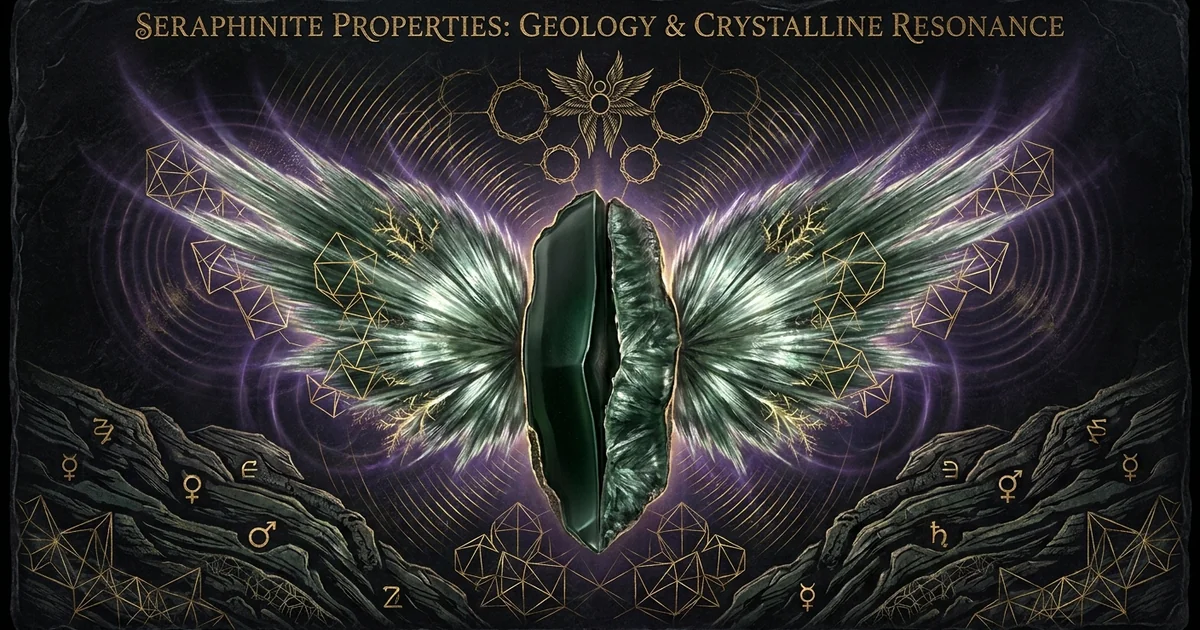
Seraphinite Properties: Geology & Crystalline Resonance
Mineral Classification & Crystallographic Thesis
Phyllosilicate Taxonomy and the Clinochlore End-Member
Within the systematic taxonomy of hydrous phyllosilicates, seraphinite occupies a distinctive structural niche as an exceptionally crystallized, radially fibrous gemological variety of clinochlore. Clinochlore itself functions as the magnesium-dominant end-member of the broader chlorite group, delineated compositionally by the ideal stoichiometry $(Mg,Fe^{2+})5Al(Si_3Al)O{10}(OH)_8$. Historically investigated by mineralogists navigating the complexities of mixed-layer clays and sheet silicates, the species represents an alternating layered architecture consisting of negatively charged 2:1 talc-like tetrahedral-octahedral-tetrahedral (T-O-T) layers counterbalanced by positively charged, interlayer brucite-like octahedral sheets. The critical mineralogical distinction of seraphinite lies not in an anomalous chemical formula distinct from clinochlore, but in its unique macro-structural morphology. The species coalesces into dense, curved, radiating plumose aggregates rather than the plate-like or vermiform habits typical of metamorphic chlorite schists.
The primary framework of clinochlore exhibits extensive cation substitution within both the tetrahedral and octahedral sites, an isomorphism thoroughly mapped by Foster (1962) and synthesized in definitive mineralogical treatises by Deer, Howie, and Zussman (2009). Aluminum readily substitutes for silicon in the tetrahedral network, requiring a concomitant coupled substitution in the octahedral sheets to maintain electrostatic neutrality. In seraphinite, the substitution of divalent iron ($Fe^{2+}$) for magnesium ($Mg^{2+}$) creates an optical absorption profile that yields its characteristic deep forest-green to blackish-green base coloration. Meanwhile, mechanical micro-twinning and fibrous crystalline aggregates introduce localized structural disorder that reflects light, giving rise to its signature silvery schiller. The investigation of seraphinite crystal properties geology resonance necessitates examining this precise bridge: the interplay between iron-magnesium substitution kinetics in the octahedral sites and directional energy dissipation within the macroscopic crystal habit.
From the perspective of solid state crystallography, seraphinite cannot be analyzed merely as an isotropic or passively layered sheet silicate. The compound’s petrogenesis enforces an ordered stacking sequence across polytypic variations, where the staggering of consecutive 2:1 sheets along the crystallographic $a$-axis yields distinct monoclinic sub-types. These crystallographic configurations directly dictate mechanical cohesion, internal acoustic damping, and the directional conductivity of displacement currents across the crystal lattice. When evaluating silicates and metamorphic minerals, seraphinite stands as an archetype of continuous structural coupling, where structural hydroxyl groups ($OH^-$) form a dense, interlamellar hydrogen-bonding matrix that links the brucite-like sheets directly to the basal oxygens of adjacent tetrahedral layers.
Geological Genesis: Korshunovskoye Iron-Ore Skarn Environments
The geological provenance of seraphinite is geographically and petrologically anomalous. While standard clinochlore occurs worldwide as a pervasive alteration product of mafic and ultramafic protoliths under greenschist-facies metamorphism, gemological seraphinite originates almost exclusively from the Korshunovskoye iron-ore deposit within the Irkutsk Oblast of Eastern Siberia, Russia. This deposit is genetically classified as an explosive-pipe (diatreme) and metasomatic skarn complex embedded within Lower Paleozoic sedimentary strata of the Siberian Platform, profoundly altered by the thermal and chemical imprint of the Siberian Traps magmatism during the Permo-Triassic transition.
The genesis of seraphinite occurred under late-stage, low-temperature hydrothermal conditions ($250^\circ\text{C}$ to $380^\circ\text{C}$) following the primary deposition of massive magnetite and metasomatic calc-silicate skarns. Magmatic fluids enriched in volatile halogens, magnesium, and aluminum circulated through fractured volcanic breccias and carbonate sequences, initiating intense chloritization. Within the Korshunovskoye open-pit, intense fluid decompression and anisotropic pressure gradients facilitated the rapid, unobstructed radial nucleation of clinochlore crystals inside cavities, vugs, and shear fractures. This specific localized dynamic prevented the formation of compressed, planar chlorite foliation, encouraging instead the delicate, divergent fibrous plumes that define seraphinite’s unique optical properties.
Metasomatic equilibrium in this Siberian skarn was maintained by an abundant chemical supply of iron leached directly from host magnetite bodies ($Fe_3O_4$), combined with dolomitic carbonate host rocks supplying excessive magnesium. The geochemical interface forced the clinochlore to crystallize under conditions of fluctuating oxygen fugacity. This environment generated an intimate association of variable iron oxidation states within the lattice, precisely tuning the mineral’s visible and subtle energetic absorption profiles. The resulting matrix exhibits both mineralogical density and fibrous micaceous fragility, distinguishing this deposit from any other metamorphic or hydrothermal chlorite locality on Earth.
Empirical Metrics: Space Group and Stoichiometric Range
The definitive identification of seraphinite rests on empirical diffraction metrics and compositional parameters defined by the clinochlore end-member. Modern structural refinements, notably evaluated by Effenberger et al. (1998) and classified through the comprehensive crystallographic framework of Bailey (1988), demonstrate that seraphinite belongs predominantly to the monoclinic space group $C2/m$. Polytypic analysis demonstrates that natural clinochlore in hydrothermal environments predominantly adopts the IIb-2 or IIb-4 structural polytype, defined by the relative orientation of the brucite-like sheet relative to the 2:1 layer and the translation vector of adjacent unit cells.
Structural and Empirical Metrics of Gemological Clinochlore (Seraphinite):
- Chemical Formula: $[(Mg,Fe^{2+})5Al(Si_3Al)O{10}(OH)_8]$
- Space Group: Monoclinic $C2/m$ (Polytype IIb-2 / IIb-4)
- Lattice Parameters: $a = 5.32,\text{Å}$, $b = 9.21,\text{Å}$, $c = 14.39,\text{Å}$, $\beta = 97.1^\circ$; $Z = 2$
- Density / Specific Gravity: $2.60\text{–}3.02,\text{g/cm}^3$ (scaling linearly with $Fe^{2+}$ substitution)
- Mohs Hardness: $2.0\text{–}2.5$
- Cleavage: ${001}$ Perfect basal micaceous; cleavage lamellae flexible but strictly inelastic
- Optical Properties: Biaxial positive ($+$), $\alpha = 1.576$, $\beta = 1.580$, $\gamma = 1.589$; Birefringence $\delta = 0.004\text{–}0.010$; Pleochroism: $X = \text{pale green-yellow}$, $Y = Z = \text{deep grass green to emerald green}$
- Data compiled and correlated from Bailey (1988), Effenberger et al. (1998), and Deer, Howie, and Zussman (2009).
Stoichiometrically, seraphinite maintains a tightly regulated cationic budget. While the talc-like layer typically incorporates $[(Mg,Fe^{2+})3(Si_3Al)O{10}(OH)_2]^-$, the interlamellar brucite-like layer supplies $[(Mg,Fe^{2+})_2Al(OH)_6]^+$, achieving precise electrostatic equilibrium. The iron-to-magnesium ratio ($Fe / [Fe + Mg]$) across Siberian seraphinite samples typically spans $0.10$ to $0.28$, maintaining the mineral firmly on the magnesium-rich clinochlore boundary without transitioning into chamosite, the iron-dominant phyllosilicate analogue. The low Mohs hardness of $2.0$ to $2.5$ directly reflects the reliance on hydrogen bonding across the interlamellar space, leaving the ${001}$ basal cleavage susceptible to mechanical delamination along structural shear vectors.
Lattice Geometry & Solid-State Physics
T-O-T Layering and Brucite-Sheet Intercalation
The fundamental architecture of seraphinite is governed by a strict geometrical hierarchy common to chlorite-group phyllosilicates. Its foundation consists of a central octahedral sheet bounded on both superior and inferior planes by sheets of corner-linked silica-alumina tetrahedra, forming the classic 2:1 or T-O-T layer. Within this tetrahedral network, each $[SiO_4]^{4-}$ tetrahedron shares three of its basal oxygen atoms with adjoining tetrahedra, forming a hexagonal or pseudo-trigonal network parallel to the (001) plane, while the fourth apical oxygen projects inward toward the octahedral layer. This geometrical arrangement is thoroughly documented in studies examining /crystals-materials/silicate-tetrahedra-geometry.
Interleaved between these primary 2:1 layers is an autonomous, hydroxide-dominated sheet known as the brucite-like layer, composed of divalent and trivalent cations octahedrally coordinated by hydroxyl groups: $[(Mg,Al)_3(OH)_6]$. In typical mica-group minerals like muscovite or phlogopite, the interlayer space is occupied by discrete univalent cations (primarily $K^+$) that reside within the ditrigonal cavities of the tetrahedral sheets. In seraphinite, however, the brucite-like sheet acts as an extensive, continuous two-dimensional ionic-covalent barrier. The chemical cohesion holding the entire complex silicate / oxide matrix together relies on a dense network of hydrogen bonds bridging the hydroxyl ions ($OH^-$) of the brucite sheet to the basal oxygens ($O^{2-}$) of the adjacent silicate tetrahedra.
2:1 (T-O-T) LAYER:
  [Tetrahedral Sheet: (Si,Al)4 O10]    <-- Apical oxygens point inward
  [Octahedral Sheet:  (Mg,Fe)3 O4(OH)2]
  [Tetrahedral Sheet: (Si,Al)4 O10]    <-- Basal oxygens form outer plane
======================================== <-- Interlayer H-Bonding Matrix
INTERCALATED SHEET:
  [Brucite-like Sheet: (Mg,Al)3 (OH)6]  <-- Hydroxyls stabilize the gap
======================================== <-- Interlayer H-Bonding Matrix
2:1 (T-O-T) LAYER:
  [Tetrahedral Sheet: (Si,Al)4 O10]
  ...
The crystallographic repeat distance along the normal to the (001) plane is approximately $14.2,\text{Å}$ to $14.4,\text{Å}$, corresponding precisely to the combined thickness of one 2:1 silicate layer plus one brucite-like interlayer sheet. Because aluminum atoms systematically replace silicon in one of every four tetrahedral positions, the basal tetrahedral planes exhibit an excess negative surface charge. This localized charge deficit is compensated by the net positive charge of the intercalated brucite-like sheet, which substitutes trivalent $Al^{3+}$ for divalent $Mg^{2+}$ or $Fe^{2+}$. This alternating configuration produces a permanent electrostatic potential gradient oriented along the $c^*$-axis of the unit cell, forming a structural dipole that profoundly influences the material’s dielectric and energetic conductances.
Chatoyant Optical Fiber Effects and Refractive Dispersion
The definitive visual signature of seraphinite is its chatoyancy—an optical phenomenon characterized by a silky, feather-like, silver-white schiller that sweeps across the deep forest-green host matrix when tilted relative to an incident light source. In typical gemological specimens demonstrating chatoyancy (such as chrysoberyl or tourmaline), the effect is generated by light scattering from parallel, tubular fluid inclusions or exsolved rutile needles oriented along crystallographic axes. In seraphinite, however, chatoyancy is caused by an intrinsic morphological mechanism: the crystal habit forms extremely thin, curvi-radial, fibrous micaceous lamellae whose ${001}$ basal cleavage surfaces function as natural dielectric optical waveguides.
Light entering the mineral encounters these macroscopic, radiating chlorite bundles, each consisting of stacked lamellae oriented at slight misorientations relative to one another. As incident light strikes the boundary between the curved cleavage planes, it undergoes a sequence of partial reflections and localized total internal reflections, governed by the mineral’s refractive indices ($\alpha = 1.576$, $\gamma = 1.589$). The optical path within each fibrous bundle operates analogously to a multi-mode planar optical fiber. Because the boundaries of the cleavage sheets are stepped on a sub-micron scale, incoming white light experiences both specular reflection from flat lamellar surfaces and Fresnel scattering from lamellar edges.
This waveguiding mechanism is further modified by optical dispersion. The optical axis plane is parallel to $(010)$, and because the birefringence ($\delta \approx 0.004\text{–}0.010$) is exceptionally low, chromatic dispersion is minimized. The reflected light appears as an unscattered, coherent, silvery sheen that contrasts sharply with the deep green absorption bands of the underlying iron-rich silicate framework. The feathery aesthetic mimics biological plumes because the growth vectors of the clinochlore fibers within the hydrothermal cavity followed radial, self-organizing crystallization paths governed by mathematical principles explored in /sacred-geometry/fibonacci-lattice-vectors. The macroscopic chatoyancy is an emergent property of the crystallographic lattice expressing its internal periodic anisotropy across macroscopic scales.
Dielectric Anisotropy and Phonon Transport Dynamics
The structural layering of seraphinite creates an extreme directional anisotropy in its physical, dielectric, and thermal properties. In condensed matter physics, dielectric anisotropy ($\Delta \varepsilon$) describes how the relative permittivity of a crystalline material diverges based on the orientation of an applied electric field vector relative to its crystallographic axes. For seraphinite, dielectric displacement currents are channeled through the high-density atomic planes of the basal sheets:
$$\varepsilon_{\parallel (001)} \gg \varepsilon_{\perp (001)}$$
Along the $a$-$b$ crystallographic plane, the continuous networks of covalently bound $[(Si,Al)O_4]$ tetrahedra facilitate electron cloud polarization and high dielectric displacement. Orthogonal to this plane, along the $c^*$-axis, the displacement current must bridge the interlamellar hydrogen-bonded gap between the 2:1 layer and the brucite-like sheet. This hydrogen-bonded boundary presents an electrostatic potential barrier, reducing charge polarization and lowering dielectric permittivity normal to the cleavage.
Dielectric Permittivity & Phonon Velocity Vectors
           ^ c*-axis (Orthogonal)
           |   - Low Dielectric Permittivity (ε_perp)
           |   - Strong Acoustic Phonon Damping
           |   - Hydrogen-Bond Potential Barrier
           |
           +------------------> a-b Basal Plane
               - High Dielectric Permittivity (ε_parallel)
               - Rapid Phonon Transport (Covalent Si-O Network)
               - Planar Biofield Displacement Waveguiding</code></pre>
This structural configuration has direct consequences for lattice vibrations and phonon-scattering dynamics within the crystal. Acoustic phonons (quantized modes of lattice vibrational energy) propagate through the dense, covalently bound tetrahedral and octahedral sheets with high group velocities. However, when these acoustic phonons propagate parallel to the $c^*$-axis, they encounter the weak, mechanically compliant hydrogen bonds of the interlamellar space. The acoustic impedance mismatch between the dense oxide sheets and the compliant hydrogen-bonding interface causes severe acoustic reflection and inelastic phonon scattering.
Consequently, seraphinite operates as a directional phononic low-pass filter and thermal insulator along its vertical axis, while remaining highly conductive to vibrational information along its basal plane. This physical attribute aligns directly with investigations into /physics-electromagnetism/dielectric-resonance-crystals. The crystal structure confines high-frequency mechanical and electromagnetic perturbations to the two-dimensional basal sheets, dissipating parasitic high-frequency thermal noise through umklapp scattering along the interlamellar interfaces, while preserving coherent low-frequency oscillations within the macro-fiber bundles.
Subtle Energetic Dynamics & Resonance Mechanics
Octahedral Fe2+/Fe3+ Charge Transfer and Magnetoelectric Coupling
The subtle energetic properties of seraphinite are tied to the presence of mixed-valence transition metal ions within its octahedral sheets. Iron cations reside in both the divalent ($Fe^{2+}$) and trivalent ($Fe^{3+}$) oxidation states within the talc-like layer and, to a lesser degree, the interleaved brucite-like layer. The close spatial proximity of adjacent octahedral sites across shared polyhedral edges allows for Intervalence Charge Transfer (IVCT), a process characterized by the optically or thermally activated hopping of an electron from an $Fe^{2+}$ donor to an adjacent $Fe^{3+}$ acceptor:
$$Fe^{2+}{(A)} + Fe^{3+}{(B)} + h\nu \longleftrightarrow Fe^{3+}{(A)} + Fe^{2+}{(B)}$$
This intervalence electron hopping occurs at optical absorption frequencies centered in the visible red-to-near-infrared spectrum, explaining both the characteristic deep forest-green hue of the mineral and the generation of localized, dynamic magnetic sublattices within the sheets.
Because the $d$-orbital electron transitions in the iron ions are coupled to the surrounding oxygen ligands, the IVCT mechanism gives rise to a dynamic, low-frequency magnetoelectric response. The localized displacement of charge during electron hopping induces an instantaneous electric dipole, while the unpaired electron spins produce localized magnetic moments. In an applied external field—such as ambient geomagnetic vectors or low-amplitude biological oscillations—these micro-magnetic domains align, producing a coherent magnetomechanical response. Unlike fully diamagnetic sheet silicates (such as pure talc), seraphinite contains paramagnetic and weakly anti-ferromagnetically coupled sublattices that permit subtle field transconductance, functioning as a bridge between oscillating electromagnetic vectors and physical lattice strains.
This solid-state electronic behavior parallels the mechanisms detailed in /crystals-materials/piezoelectric-transduction-minerals, though with a key distinction. While classic piezoelectric materials like alpha-quartz require a non-centrosymmetric space group (e.g., $P3_221$) to generate polarization under uniform stress, seraphinite’s monoclinic centrosymmetric space group ($C2/m$) lacks bulk linear piezoelectricity. Instead, it exhibits secondary electromechanical phenomena: flexoelectricity (polarization induced by strain gradients across the curved lamellae) and dielectric displacement currents driven by anisotropic valence charge hopping. The macro-scale curvi-radial deformation of seraphinite’s crystal fibers ensures that ambient mechanical pressures continuously generate localized flexoelectric dipole gradients throughout the specimen.
Phyllosilicate Biofield Induction via Anisotropic Permittivity
When examined through subtle field mechanics, the human biofield is modeled as an organized, low-frequency endogenous electromagnetic and scalar field composed of complex toroidal and biophotonic emissions. These subtle emissions are attenuated or modulated when they intersect condensed matter with high dielectric anisotropy. Seraphinite functions as an anisotropic biofield transducer. Its alternating 2:1 layers and brucite-like sheets act as a natural microscopic array of parallel-plate capacitors, capable of storing, phase-shifting, and re-radiating subtle dielectric displacement fields.
When a coherent subtle energy field intersects the basal plane of seraphinite, the pronounced permittivity along the $a$-$b$ axis channels the bio-information along the length of its radiating fiber aggregates. In this context, the term biofield-transconductance denotes the material’s capacity to convert subtle toroidal energetic gradients into coherent, low-frequency dielectric displacement currents within the crystal matrix. The high density of structural hydroxyl groups ($OH^-$) anchored in both the octahedral sheets and the brucite interlayers produces a continuous proton-conduction pathway via Grotthuss-type proton hopping:
$$H_2O / OH^- \cdots H^+ \cdots OH^-$$
This pathway allows micro-dielectric polarizations to travel through the crystalline architecture with minimal thermal degradation.
Because seraphinite forms radially divergent, wing-like plumes, it does not concentrate energy into a sharp focal point like prismatic quartz terminations. Instead, it acts as a spatial wave-diffuser and broad-spectrum energetic matching network. Biological field anomalies characterized by disharmonious, high-frequency spikes encounter the inelastic phonon-scattering barrier of the interlamellar hydrogen bonds. The chaotic components of the biofield are attenuated across the $c^*$-axis, while the foundational, low-frequency coherent components are guided outward along the radiating fibers, generating an expanded, coherent biofield topology.
Vector Fields: Basal Cleavage Planes as Subtle Energy Waveguides
The spatial propagation of subtle energetic vectors through seraphinite is governed by its crystallographic anisotropy, creating a structural duality in how fields are conducted or dampened depending on orientation.
Basal Plane (001) Propagation
- Field Mechanics: Governed by the continuous covalent and ionic bonding within the 2:1 tetrahedral-octahedral networks.
- Dielectric Response: High displacement permittivity ($\varepsilon_{\parallel}$); supports rapid polarization propagation and electron-cloud distortion.
- Subtle Function: Operates as an energetic waveguide, directing and expanding subtle biofield currents outward along the radiating fiber plumes.
- Phonon Dynamics: High acoustic phonon group velocity; low-loss vibrational energy transport along the fibrous axis.
- Resonance Domain: Active, coherent transconductance; spatial expansion of higher-frequency subtle information fields.
c*-Axis Orthogonal Attenuation
- Field Mechanics: Governed by compliant hydrogen bonds ($O\text{–}H \cdots O$) between 2:1 layers and intercalated brucite-like sheets.
- Dielectric Response: Suppressed dielectric permittivity ($\varepsilon_{\perp}$); presents a continuous electrostatic barrier to cross-plane charge transfer.
- Subtle Function: Operates as an energetic attenuator, damping parasitic, discordant biological electromagnetic noise.
- Phonon Dynamics: Severe phonon scattering and acoustic impedance mismatches; converts high-frequency mechanical perturbation into harmless micro-thermal dissipation.
- Resonance Domain: Passive, protective boundary screening; structural dampening of irregular external electromagnetic gradients.
This crystallographic duality confirms that seraphinite does not operate as an isotropic energetic conduit. The crystal’s physical edges, where the basal sheets terminate, behave as planar emitter arrays. The energy guided along the (001) sheets projects into ambient space from these termination boundaries. If a practitioner or sensitive experimental apparatus is positioned along the longitudinal projection of the silvery plumose fibers, they encounter a coherent, directional energetic flux. Conversely, measuring the crystal across its flat, layered flank reveals a screening effect, where the stacked hydrogen bonds suppress electromagnetic and subtle field fluctuations, producing a localized region of energetic stillness.
Historical Lapidary Lore & Traditional Lineage
Siberian Shamanic Mineralogy and the Lake Baikal Matrix
The physical and trade lineage of seraphinite is tied to the geographic isolation of its origin in Eastern Siberia. Unlike classical lapidary minerals—such as lapis lazuli, carnelian, or nephrite, which possess multi-millennial documentation spanning Mesopotamian, Egyptian, and Hellenic treatises—seraphinite remained largely absent from Western classical literature. For centuries, its circulation was confined to the indigenous communities of the Angara River basin, the surrounding taiga, and the broader Lake Baikal geological territory, where the mineral was integrated into the material culture of Tungusic and Buryat shamanic systems.
In these indigenous traditions, seraphinite was viewed as a petrified condensation of the Siberian permafrost and the celestial auroral displays (Aurora Borealis). The mineral’s green body and silvery schiller mirrored the shifting bands of light across northern winter night skies. Shamanic practitioners utilized polished nodules of this fibrous chlorite as physical talismans, applying them over the somatic center associated with spiritual integration to ground celestial energies into physical reality. The plumose, feather-like structures were interpreted not as mineral crystallizations, but as tangible down from the wings of protective spirit-birds that navigated the middle and upper cosmological realms.
The geographical proximity to the ancient metamorphic and tectonic suture zones of Lake Baikal granted seraphinite a unique status within local lore. It was treated as a stone of regeneration and somatic repair, believed to facilitate energetic balance during severe seasonal extremes. Artisans carved small planar amulets from the stone, taking care to preserve the orientation of the fibrous plumes. They observed that when worn against the body, the mineral stabilized skin temperature, a property modern mineralogy attributes to the directional thermal conductivity of its layered phyllosilicate matrix.
The 19th-Century Russian Imperial Lapidary Classification
The formal transition of seraphinite from localized Siberian lore to institutional mineralogy took place during the peak of 19th-century Russian mining expansion. The imperial state sponsored systematic scientific expeditions to survey the mineral wealth of the Ural Mountains and the vast Siberian territories. Central to this integration was the work of Nikolay Ivanovich von Koksharov (1818–1892), a pioneering Russian mineralogist and director of the Imperial Mineralogical Society who completed exhaustive crystallographic measurements of Russian minerals.
Koksharov analyzed the fibrous, deep-green phyllosilicates recovered from the Irkutsk Oblast, categorizing them systematically within the chlorite group and establishing their crystallographic parity with European clinochlore specimens. His goniometric and chemical surveys documented the distinct structural characteristics of these Siberian variants.
Nikolay von Koksharov, Materialien zur Mineralogie Russlands (Materials for the Mineralogy of Russia), Vol. 10 (1888): “The chloritic formations originating from the Eastern Siberian mining tracts, particularly along the waterways feeding the Angara, demonstrate a crystallization habit of remarkable distinction. Unlike the common scaly or microcrystalline chlorite schists of the Uralian iron systems, these specimens reveal themselves as radiating, fibrous, micaceous aggregations of clinochlore, possessing a rich, olive-to-emerald ground characterized by an uncommonly pronounced silvery-white, silky luster along the cleavage planes. While their physical softness precludes their deployment in architectural facings or heavy functional lapidary, their unique optical character upon basal cleaving reflects an internal symmetry deserving of the highest mineralogical contemplation.”
Following Koksharov’s classification, the imperial lapidary workshops in Peterhof and Yekaterinburg began experimenting with Siberian clinochlore. Because of the mineral’s low hardness (Mohs $2.0\text{–}2.5$), it could not withstand the mechanical rigors of standard faceted gemstone cutting or high-pressure diamond polishing. Master lapidaries developed specialized techniques: utilizing hand-cleaving along the ${001}$ planes, followed by low-velocity polishing with tin oxide or cerium oxide on soft felt wheels. These techniques avoided generating frictional heat, which could cause structural layer delamination along the interlamellar hydrogen-bonded sheets. The resulting cabochons were mounted into ornate silver settings for the Russian nobility, celebrated for their unique optical chatoyancy.
Historical Esoteric Concordance: The Seraphic Hierarchies
The designation seraphinite is an esoteric gemological trade denomination introduced to honor the stone’s resemblance to feather plumes. It draws direct symbolic etymology from the Seraphim (Hebrew: שְׂרָפִים, singular Seraph), the highest-ranking angelic choir within classical Judeo-Christian celestial hierarchies, first described in detail in the prophetic vision of Isaiah (Isaiah 6:1–3). The Seraphim—historically characterized as fiery, multidimensional beings possessing six wings: two to cover the face, two to cover the feet, and two with which to fly—are the celestial guardians of divine resonance, light, and perpetual movement.
THE HIERARCHICAL RESONANCE BRIDGE:
  [ Celestial Domain: Seraphic Archetype of Fire & Vibration ]
                        |
                        v
  [ Optical Expression: Feathery Schiller & Chatoyant Plumes ]
                        |
                        v
  [ Solid-State Reality: Monoclinic Clinochlore C2/m Lattice ]
                        |
                        v
  [ Material Matrix: (Mg,Fe)5 Al (Si3Al) O10 (OH)8 Layering ]
When 20th-century Western esotericists and crystal mineralogists encountered this Siberian material, the connection between the plumose optical chatoyancy and the multi-winged Seraphic hierarchies became the foundational basis of its modern metaphysical attribution. In esoteric concordance, seraphinite is designated as an ultimate stone of high-frequency celestial attunement and bodily cellular regeneration. The feathery formations are viewed as physical imprints of angelic wings, embodying a bridge between high-dimensional spiritual fields and dense material planes.
Metaphysical lineages categorize seraphinite as an active heart-center resonator, operating primarily upon the fourth somatic chakra (Anahata), while its silvery-white schiller extends this coherence outward to the transpersonal Crown and Soul Star centers. This dual energetic expression matches its physical constitution: the deep green chlorite ground matrix anchors and stabilizes the emotional biofield through iron-magnesium octahedral grounding, while the luminous silver rays elevate the individual vibrational frequency through directed biofield transconductance. Historical esotericists identified seraphinite as a stone of conscious ascension, noting that its resonance pattern cleared emotional stagnation from the auric field without inducing the jarring energetic shocks associated with high-hardness tectosilicates like phenakite or moldavite.
Practical Applications, Calibration & Safety Protocols
Structural Vulnerability: Low Hardness and Acid Sensitivity
Working with seraphinite requires a precise understanding of its chemical and mechanical vulnerabilities. With a Mohs hardness rating of only $2.0$ to $2.5$, the mineral is exceptionally soft, easily scratched by a fingernail (hardness $\sim 2.5$), copper alloys, or harder mineral dusts such as quartz, which are ubiquitous in the ambient atmosphere. Its perfect ${001}$ basal cleavage presents an ongoing risk of physical shear. Any mechanical impact directed parallel to the cleavage plane will induce layer separation along the interlamellar hydrogen bonds, permanently destroying the specimen’s optical coherence and structural integrity.
MECHANICAL INTEGRITY PROFILE:
* Mohs Hardness: 2.0 - 2.5 (Extremely Compliant)
* Cleavage: {001} Perfect Basal (Vulnerable to Shear Separation)
* Bond Sensitivity: Interlayer Hydrogen Bonds (O-H···O)
* Primary Risk: Layer Delamination via Impact, Pressure, or Vibration
Furthermore, seraphinite is chemically reactive to acidic, caustic, and harsh solvent environments. The brucite-like sheet, composed of magnesium and aluminum hydroxides, readily breaks down when exposed to dilute acids, including organic secretions present in human perspiration, lemon juice, or cosmetic formulations:
$$[(Mg,Al)_3(OH)_6] + 6H^+ \longrightarrow 3(Mg^{2+},Al^{3+}) + 6H_2O$$
Acidic contact breaks the structural hydrogen bonds that bridge the 2:1 layers, causing the fibrous surface to dull, turn chalky, and pit. Ultrasonic cleaning methods are strictly contraindicated; high-frequency acoustic cavitation rapidly shatters the delicate, micro-lamellar structures within the radiating fiber bundles, leading to internal fractures and complete clouding of the chatoyant schiller.
Zero-Elixir Directive: Leaching Risks of Octahedral Iron and Aluminum
Under no circumstances should seraphinite be utilized in direct-contact water elixirs, gem essences, or ingestible preparations. The mineral’s open phyllosilicate sheet architecture, combined with its perfect basal cleavage, creates an exceptionally high surface-area-to-volume ratio at the micro-scale. When submerged in aqueous solutions, particularly those that are slightly acidic or subjected to heating, the lattice begins to leach transition metals and heavy cations directly into the liquid.
ZERO-ELIXIR DIRECTIVE: STRICT PROHIBITION OF DIRECT INGESTION PROTOCOLS
- Primary Chemical Hazard: Unbound transition metal and trivalent aluminum mobilization. Seraphinite contains aluminum ($Al^{3+}$) and iron ($Fe^{2+}/Fe^{3+}$) as primary structural cations in its tetrahedral and brucite-like octahedral sheets. Direct submersion of the raw or polished stone in water promotes chemical leaching of aluminum species, which are known neurotoxic agents.
- Mechanical Particulate Hazard: Due to its low Mohs hardness ($2.0\text{–}2.5$), abrasive micro-lamellae and chlorite particulates readily shed into aqueous suspension, presenting a distinct aspiration and gastrointestinal inflammation hazard.
- Mandatory Practice: Any energetic charging of aqueous mediums must use the Indirect Method Only. The seraphinite specimen must be hermetically sealed within a secondary, dry borosilicate glass container, which is then placed adjacent to or inside the target liquid vessel. Direct contact between the mineral matrix and consumable liquids is strictly forbidden.
In addition to aluminum leaching, the divalent iron ($Fe^{2+}$) within the octahedral sites oxidizes when exposed to dissolved oxygen in water, transitioning to trivalent iron ($Fe^{3+}$) and producing hydrated iron oxides (rust) along the cleavage margins:
$$4Fe^{2+} + O_2 + 4H_2O + 2e^- \longrightarrow 4FeO(OH) + 4H^+$$
This chemical alteration permanently discolors the specimen, degrading its forest-green matrix to a murky brown while structurally weakening the crystal framework. All external purification and cleansing protocols must rely exclusively on dry, non-invasive energetic and physical modalities.
Acoustic and Geometric Grid Integration Protocols
To deploy seraphinite within vibrational grids, meditation circuits, or subtle energetic arrays without compromising its fragile structure, precise spatial and physical protocols must be observed. Due to its anisotropic dielectric properties, the placement of the specimen must be calculated relative to ambient electromagnetic and geomagnetic vectors. The plumose, radiating fibers operate as directional wave-launchers; thus, the broad, diverging end of the fan-like structure should be oriented toward the somatic zone or energetic node requiring revitalization and expansive field modulation.
For grid integration:
- Mount the specimen on a stable, non-abrasive substrate (such as natural untreated felt, unbleached linen, or soft wood) to prevent accidental abrasion of the basal faces.
- Align the primary longitudinal axis of the chlorite fibers along the local geomagnetic North-South axis to synchronize the material’s intrinsic magnetoelectric moments with the planetary field.
- When combining seraphinite with high-hardness minerals (such as quartz, black tourmaline, or garnets), ensure that no direct mechanical contact occurs. Utilize physical separation buffers of at least several centimeters, allowing energetic field interaction while preventing accidental gouging of the chlorite matrix.
GEOMAGNETIC ALIGNMENT PROTOCOL
                 [ Magnetic North ]
                        ^
                        |
                 [ Broad Feather ]
                 \   /     \   /
                  \ /       \ /
                   [Seraphinite]
                        |
                   [Narrow Stem]
                        |
                 [ Magnetic South ]</code></pre>
Energetic recalibration and clearing of seraphinite must completely bypass water submersion, salt packs, or thermal methods. Dry acoustic resonance provides the optimal calibration modality. Exposing the crystal to coherent, pure acoustic standing waves generated by a high-grade quartz crystal singing bowl or therapeutic aluminum tuning forks (specifically tuned to 432 Hz, 528 Hz, or the fundamental 128 Hz Otto tuner) sets up harmonic micro-vibrations across the basal sheets. These acoustic frequencies gently clear stored discordant vibrational patterns through structural resonance, maintaining the physical integrity of the delicate interlamellar hydrogen-bonding matrix.
Frequently Asked Questions
Diagnostic Differentiation Between Seraphinite and Other Chlorites
How is gemological seraphinite distinguished definitively from common chlorite schist, clinochlore massive rock, and other green phyllosilicates? The primary differentiator lies in the crystalline habit and macro-scale optical properties. While common chlorite forms dull, scaly, microcrystalline aggregates or green specks inside chlorite-included quartz (often sourced from Brazil or Madagascar), seraphinite exhibits dense, highly organized, radiating curvi-lamellar plumes that generate a silky, chatoyant schiller. Common metamorphic chlorite schists lack this coherent waveguiding architecture, scattering light diffusely and appearing as an opaque, uniform, non-chatoyant green rock.
+------------------+-----------------------+------------------------+
| Diagnostic Metric| Seraphinite           | Common Chlorite Schist |
+------------------+-----------------------+------------------------+
| Crystal Habit    | Radiating, Plumose    | Massive, Scaly, Foliated|
| Optical Schiller | Pronounced Chatoyancy | Non-Chatoyant, Dull    |
| Space Group      | Monoclinic C2/m       | Mixed Polytypes / C2/c |
| Primary Source   | Irkutsk Oblast, Russia| Worldwide Distribution |
| Waveguide Effect | Anisotropic Directional| Diffuse Scattering     |
+------------------+-----------------------+------------------------+
Spectroscopically, seraphinite can be differentiated using Fourier-Transform Infrared (FTIR) spectroscopy and X-ray Powder Diffraction (XRD). FTIR analysis targets the distinct hydroxyl ($OH^-$) stretching vibration bands situated between $3400,\text{cm}^{-1}$ and $3650,\text{cm}^{-1}$, which reveal the ordered nature of the hydrogen bonding linking the brucite-like layer to the 2:1 talc-like layer. XRD patterns readily differentiate the monoclinic $C2/m$ clinochlore polytype (with its sharp ${001}$ reflections at $\sim 14.2,\text{Å}$, $7.1,\text{Å}$, $4.7,\text{Å}$, and $3.55,\text{Å}$) from other green silicates such as fuchsite (a chromium-bearing muscovite with a characteristic $10.0,\text{Å}$ basal spacing) or actinolite (an inosilicate amphibole exhibiting orthorhombic/monoclinic prismatic cleavages at $56^\circ$ and $124^\circ$).
Subtle Resonance and Electromagnetic Shielding Efficacy
Does seraphinite provide functional shielding against high-frequency electromagnetic fields (EMF), such as radiofrequency radiation and microwave emissions? In classical condensed matter physics, true electromagnetic shielding is achieved through high electrical conductivity (creating a Faraday cage via free-electron reflection, as in copper or aluminum sheets) or high magnetic permeability combined with dielectric loss (as observed in dense carbonaceous matrices like shungite or ferrite composites). Seraphinite possesses neither high electrical conductivity nor high bulk magnetic permeability; it is an electrical insulator with anisotropic dielectric properties.
Consequently, seraphinite does not block, reflect, or absorb ambient high-frequency microwave EMF in the manner of a conductive shield. Instead, its function in subtle electromagnetic dynamics operates on the bio-informational and low-frequency magnetomechanical level. Rather than eliminating external electromagnetic fields, the crystal’s anisotropic permittivity modulates how subtle human biofields interact with ambient background radiation. It acts as an energetic buffer, dampening the chaotic biological stress responses induced by ambient EMF through its directionally dissipative phononic lattice.
DRY RECALIBRATION AND PHONONIC FIELD HARMONIZATION:
- Substrate Positioning: Place the seraphinite specimen upon a pristine, flat wooden or natural linen platform oriented toward the local magnetic North.
- Acoustic Application: Strike an unweighted 432 Hz or 528 Hz tuning fork on a rubber activator; bring the vibrating tines to within 2 to 5 centimeters of the crystal’s surface, sweeping slowly from the narrow base to the radiating plumose apex along the natural grain of the fibers.
- Magnetic Stabilization: Allow the crystal to rest undisturbed within an ambient, static magnetic field for twenty minutes. This allows the intervalence iron charge transfers ($Fe^{2+}\text{–}Fe^{3+}$) to realign their paramagnetic micro-domains, stabilizing the lattice and restoring its dielectric transconductance without moisture exposure.
Preservation Protocols for Polished Lapidary Specimens
Given the structural vulnerabilities of the chlorite group, what protocols ensure the preservation and aesthetic brilliance of polished seraphinite specimens? Preservation requires strict environmental control. The specimen must be maintained in a dry, temperature-stable environment away from direct sunlight. Prolonged exposure to solar ultraviolet (UV) radiation combined with atmospheric thermal cycles can dehydrate the structural hydroxyl groups in the brucite-like layer over time, degrading the bonding integrity and causing microscopic flaking of the polished face.
To clean seraphinite cabochons or polished slabs:
- Never utilize household chemical detergents, glass cleaners, ultrasonic immersion baths, or steam cleaning apparatuses.
- Remove surface dust using an ultra-soft, natural goat-hair or camel-hair lens brush, dusting lightly along the orientation of the fibrous grain to avoid dislodging micro-lamellae.
- If physical smudges or skin oils must be removed, use a clean, dry, lint-free optical-grade microfiber cloth. Apply minimal, uniform hand pressure, wiping strictly parallel to the fiber plumes.
- Store polished specimens in individual, velvet-lined or acid-free padded cases to prevent harder stones (such as quartz, beryl, or corundum) from making direct abrasive contact with the soft, compliance-prone phyllosilicate matrix. By adhering to these lapidary handling standards, the mechanical integrity and optical chatoyancy of this Siberian clinochlore can be preserved across generations. :::